
What considerations for assessing difficult environments are already given in the EU regulatory framework?
Although the Regulation (EU) No 139/2014 does not contain specific considerations on the assessment of difficult environments at or near an aerodrome as the response to such areas, the existing EU regulatory framework contains aspects that could be used to assess difficult environments and plan the response to such areas in a transparent way:
- definition of the area’s size (e.g. AMC1 ADR.OPS.B.005(b), AMC2 ADR.OPS.B.005(b), GM1 ADR.OPS.B.010(a)(1));
- availability of support within the area;
- resource management (e.g. GM3 ADR.OPS.B.010(a)(2), AMC3 ADR.OPS.B.010(a)(2); and
- verification.
For more information, please refer to the following acceptable means of compliance (AMC) and guidance material (GM):
- GM1 ADR.OPS.B.010(a)(1).
- AMC3 ADR.OPS.B.010(a)(2), which states that ‘If the aerodrome is located near a water/swampy area, or other difficult environment, or a significant portion of the approach/departure operations takes over these areas, the aerodrome operator should coordinate the availability of suitable rescue equipment’.
- GM3 ADR.OPS.B.010(a)(2), which states that ‘Special fire fighting equipment may not be provided for water areas; this does not prevent the provision of such equipment if it would be of practical use, such as when the areas concerned include reefs or islands. The objective should be to plan and deploy the necessary life-saving flotation equipment, as expeditiously as possible, in a number commensurate with the largest aeroplane normally using the aerodrome’.
- AMC1 ADR.OPS.B.005(b), which states that ‘The aerodrome operator should ensure that an assessment of the approach and departure areas within 1000 m of the runway threshold is carried out to determine the options available for intervention’.
- AMC2 ADR.OPS.B.005(b), which states that ‘A grid map of the aerodrome and its immediate surroundings, approximately at a distance of 8km from the centre of the aerodrome’.
What area should be considered when assessing difficult environments?
The assessment of potential difficult environments at or near an aerodrome should consider the immediate surroundings of an aerodrome and the established standard flight procedures.
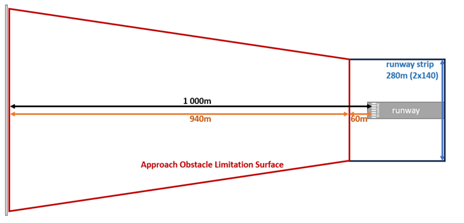
In accordance with point (b) of ADR.OPS.B.005, the assessment of the area at an aerodrome should consider the width of the runway strip and then follow the actual approach obstacle limitation surface up to a distance of 1 000 m beyond the runway’s threshold (or, if there is no threshold, the runway end).
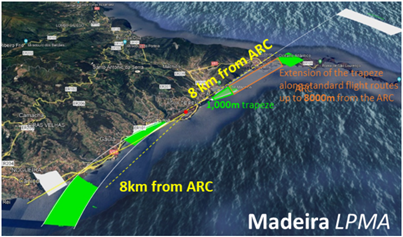
In accordance with point (e) of AMC2 ADR.OPS.B.005(b), the assessment near an aerodrome should consider significant portions underneath the standard approach and departure routes within a 8-km radius from the aerodrome reference point.
To determine the size of the area, please refer to the following:
- Table 1 of CS ADR-DSN.A.005 for the aerodrome reference code;
- CS ADR-DSN.A.002 for the runway;
- CS ADR-DSN.A.002 and CS ADR-DSN.B.160 for the runway strip; and
- CS ADR-DSN.A.002 and CS ADR-DSN.H.405 for the obstacle limitation surfaces.
Should the term near’ be understood as a distance of 1 000 meters, as identified in AMC1 ADR.OPS.B.005(b)?
The term ‘near’ used in AMC3 ADR.OPS.B.010(a)(2) should be understood as including at least the 1 000 m referred to in AMC1 ADR.OPS.B.005(b), up to the 8 km referred to in AMC2 ADR.OPS.B.005(b), considering the published approach and departure procedures and the preferential flight routes.
How should the aerodrome operator deduct these areas?
AMC1 ADR.OPS.B.005 aims that the aerodrome operator should ensure that assessment of the approach and departure areas is carried out which includes also cases when the aerodrome is located near a water/swampy area, or other difficult environment, or a significant portion of the approach/departure operations takes over these areas.
Within the 1 000 m, these areas should be defined considering the ‘obstacle limitation surfaces’ calculated according to the figures of ‘Divergence (each side)’ in CS ADR-DSN.J.480, Table J-1. ‘Dimensions and slopes of obstacle limitation surfaces — Approach runways’, adopting a trapezoidal shape with a 15-% angle for an instrument runway or a 10-% angle for a non‑instrument runway.
For a portion of approach or departure operations up to 8 km, these areas should be defined considering the protection envelopes of a published approach or departure procedure.
What width should be considered to define these areas?
AMC1 ADR.OPS.B.005 aims that the aerodrome operator should ensure that assessment of the approach and departure areas is carried out which includes also cases when the aerodrome is located near a water/swampy area, or other difficult environment, or a significant portion of the approach/departure operations takes over these areas.
These areas should be defined considering, whenever possible and depending on the type of approach or departure procedure, the width of the runway strip and the published procedures envelope.
What should be understood as the largest aeroplane normally using the aerodrome?
Based on AMC2 ADR.OPS.B010(a)(2), the aerodrome operator should consider for providing the minimum of the RFF service, that it needs sufficient equipment taking into account the longest aircraft (or group of aircraft) and their fuselage width based on which the level of protection of the aerodrome has been defined.
What should be understood as expeditiously as possible, should a response time be defined?
It is acknowledged that a response time should not be set to respond to an emergency in swampy or water areas, as it largely depends on varying local situations and environments. However, guidelines should be provided on the need for rescue entities to ensure timely response, taking into account:
- the local situation;
- specific conditions regarding survivability (e.g. survival in cold water is approximately 10 minutes maximum); and
the importance of providing adequate deployment of appropriate equipment in coordination among these entities.
In case off water/swampy areas, what should be considered to ensure an effective or adequate response to an emergency at the distances mentioned in AMC1 ADR.OPS.B.005(b) and AMC2 ADR.OPS.B.005(b)?
With regard to the 1000-m area from the runway thresholds, the aerodrome operator is required to assess and ensure the intervention capability of dedicated aerodrome services. If needed, according to the local environment, and through the establishment of appropriate cooperation protocols taking due account of national or local legislation, the institutional set-up and entities mission statement, the intervention capability could be ensured by relevant support entities.
With regard to the 8-km grid map and its relevant areas concerning published flight procedures, the aerodrome operator, taking due account of the the national or local situation in terms of the institutional set-up of responsibility for managing and responding to an emergency, should conduct, with the support of relevant national or local entities, an assessment of the area to map entities available in case of an emergency, to identify intervention capability.
Such capability, with the aim to clarify how intervention would be implemented and the available means (i.e. responsibilities considering national or local legislation; type and quantity of equipment and personnel available; dispatch/activation time; other alternatives when response capacity is exhausted or in case there is no immediate response), should be documented and included in the National or Local Emergency Plans (GM1 ADR.OPS.B.005(a)), as well as in the Aerodrome Emergency Plan.
Such assessment should consider the safety management system requirement to coordinate the aerodrome emergency response plan. In that respect, coordination of the aerodrome emergency response plan with the emergency response plans of those organisations it must interface with during the provision of aerodrome services and with the relevant external organisations who have the responsibility to respond to an emergency occurring at an aerodrome or in its surroundings (ADR.OR.D.005) should be ensured.
The assessment of intervention capability should be periodically reviewed, tested, and discussed with all organisations that bear some responsibility in case of an emergency.
What response to difficult environments is expected by the aerodrome operator in those areas that are considered as difficult environments?
Within the 1 000 m area, the aerodrome operator should normally provide intervention capacities and respond to an incident (however, those responsibilities may be limited by local or national legislation defining other responsibilities). Therefore, the aerodrome operator should determine the options available for intervention based on the capacity of its dedicated means or the established intervention protocols with third-party entities in charge. Additionally, activation and engagement procedures in accordance with needs and capacities considering the actual environment should be established.
For other difficult environments within the 8-km radius from the aerodrome reference point, the responsibility to respond remains with the local authorities or entities in charge within the local legal framework of the district where the incident occurred. Although there is no response expected by the aerodrome operator, the aerodrome operator should actively participate in the coordination of resources. This should include:
- the mapping of further entities’ location and intervention capacities considering the safety management system requirements; and
- the counselling other responsible entities located in the area in the establishment of protocols
to allow for the effective organisation of resources for a rapid intervention.
What resources could be considered when establishing intervention protocols?
Resources that could be considered to respond to incidents in difficult environments do not need to be limited to aerodrome-owned or RFFS resources. They could rather include any type of aerodrome service that can offer or ensure acceptable level of safety within the defined areas. Other such resources include third-party arrangements with external partners or organisations that can support or facilitate any response, whenever necessary, through knowledge, personnel, or equipment.
How could the presence of difficult environments and the response capabilities to difficult environments be verified?
The presence of difficult environments should be reassessed upon infrastructural changes at or near the aerodrome. The intervention capabilities should be verified during training sessions, familiarisation with difficult environments, or exercises. Any third-party arrangements should be reviewed and updated periodically to ensure high-level of safety.