
The European drone rules make it possible to fly drones across Europe using a common regulatory framework. Whether you fly recreationally or professionally, understanding your responsibilities as a drone operator and remote pilot is essential to staying safe, compliant and ready to fly.
This page explains the key concepts around:
- Drone operator registration
- Remote identification
- Operational authorisations (including Geographical zones and airspace restrictions)
- Remote pilot competency certificates
- Certificate validity, renewal and revalidation
- Difference between Drone pilots’ competence and drone operator’s registration
- The roles of EASA and National Aviation Authorities (NAAs) – with links to national authority portals
- Cross-border operations within EASA Member States
- Drone insurance
The rules described here are based on the European drone regulations under Commission Implementing Regulation (EU) 2019/947.
Before you fly: three things you need to understand
Under the European drone framework, there are three separate but connected elements:
| Area | What it means |
|---|---|
| Operator Registration | Identifies the person or organisation responsible for the drone operation |
| Remote Pilot Competency | Confirms the pilot has the required knowledge and training |
| Operational Authorisation | Permission required for certain higher-risk operations |
Depending on the type of operation you conduct, you may need one, two or all three of these requirements.
Drone operator registration
What is a drone operator?
The drone operator is the person or organisation responsible for the drone operation.
This could be:
- An individual recreational flyer
- A freelance drone pilot
- A company conducting drone operations
- A public authority or organisation
The operator is responsible for ensuring operations are conducted safely and in accordance with the rules.
Check Operating a drone | EASA and Guide - drone operators | EASA for more information.
When must you register?
In most cases, drone operators must register when operating drones that:
- Have a camera or sensor capable of capturing personal data, or
- Weigh 250 g or more, or
- Can transfer more than 80 joules of kinetic energy upon impact (e.g. a drone weighing 1 kg flying at approximately 45 km/h - a very normal speed for this drone type)
Once registered, you receive a unique Operator Registration Number that must be displayed on your drones and used in remote identification systems where required.
Operator registrations usually need to be renewed. This depends on the National Aviation Authority (NAA).
Remote identification in drones
Remote ID is a system that allows a drone to electronically broadcast information about itself during flight. It is essentially the same information you can obtained if you check the operator’s number. Like a “digital licence plate” for drones.
Under the European drone regulations, Remote ID helps authorities and other airspace users identify drones operating nearby and supports safer integration of drones into the airspace.
Typical information transmitted through Remote ID may include:
- the drone operator registration number,
- the drone’s unique serial number,
- the drone’s current position and altitude,
- the remote pilot’s location,
- and the drone’s flight path or speed.
In Europe, Remote ID is mainly associated with drones carrying a class identification label such as: C1, C2, C3, C5, and C6. It will be a compulsory requirement in the new update of the drone rules for many operations in the Open and Specific categories.
For operators, it is important to ensure:
- the Remote ID function is active when required,
- the operator registration number is correctly uploaded,
- and the drone firmware remains up to date.
One registration across Europe
You only register once in the EU Member State where:
- You reside (individuals), or
- Your business is established (organisations)
Your registration is then recognised throughout EASA Member States.
Open, Specific and Certified categories
Drone operations in Europe are divided into three operational categories: Open, Specific and Certified. They based on risk and this relates to Operator Registration, Authorisations and Pilot Competency. You can read more information in: Operating a drone | EASA
Operational authorisations
These are required for all UAS operations in the ‘specific’ category, unless covered by a STS or the drone operator has a LUC with appropriate privileges.
An authorisation defines the conditions the operator must observe when conduct all flights in the operation.
The applicant needs to apply to the National Aviation Authority (NAA) in the state where he/she is registered as an operator.
More information on authorisations can be found here.
Geographical zones
Geo zones are highly relevant in drone operational authorisations because they define where drone operations may be restricted, prohibited, or subject to specific conditions in order to protect safety, security, privacy, the environment, and other airspace users.
For more information: Geo-Zones – know where to fly your drone | EASA
Remote pilot competency and certificates
Remote pilots must hold the appropriate competency level for the type of operation being conducted.
Which qualification do you need?
It consist of the training or certificate you need to legally fly each type of drone in the Open category (A1, A2, A3).
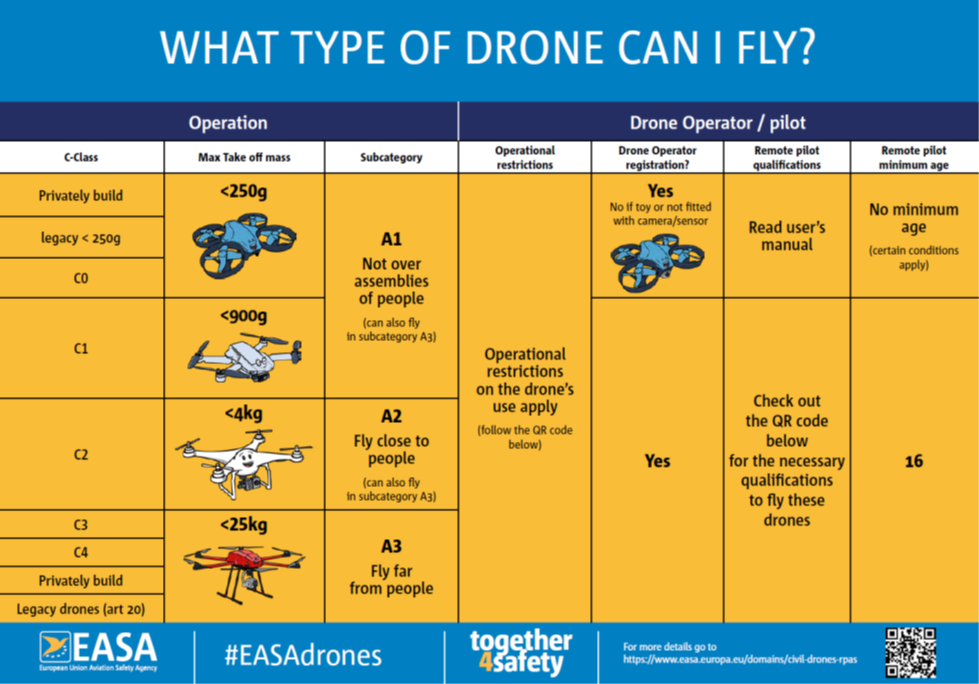
Below you can find a clear explanation by drone type and subcategory:
A1 Subcategory — small drones
|
Required for:
Requirements:
|
|
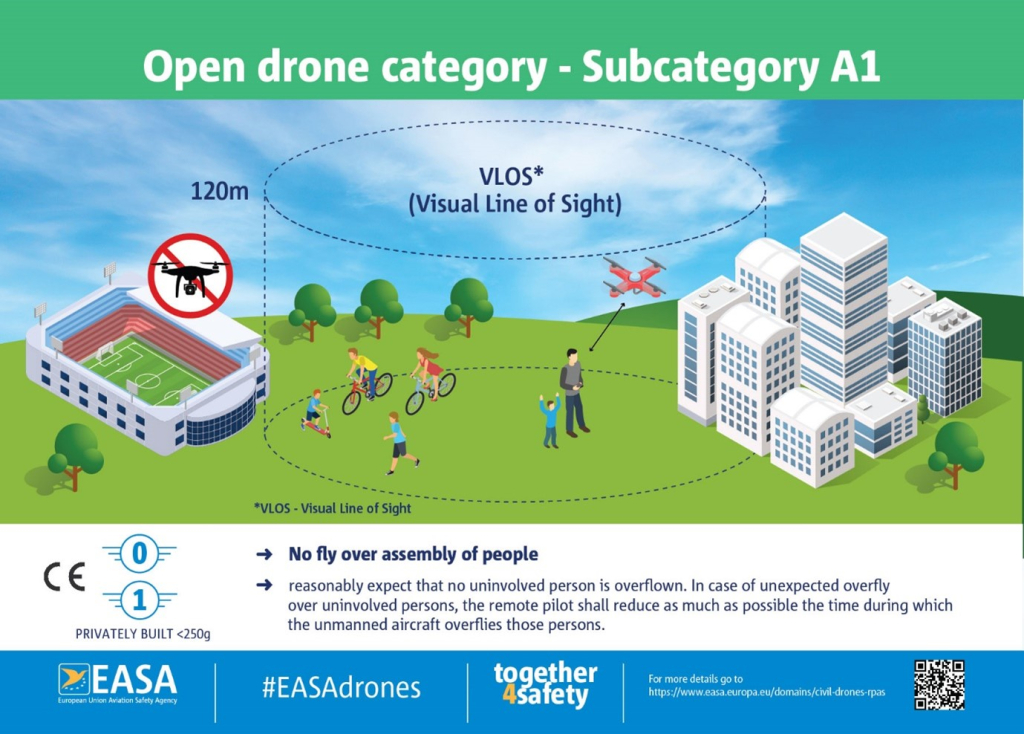
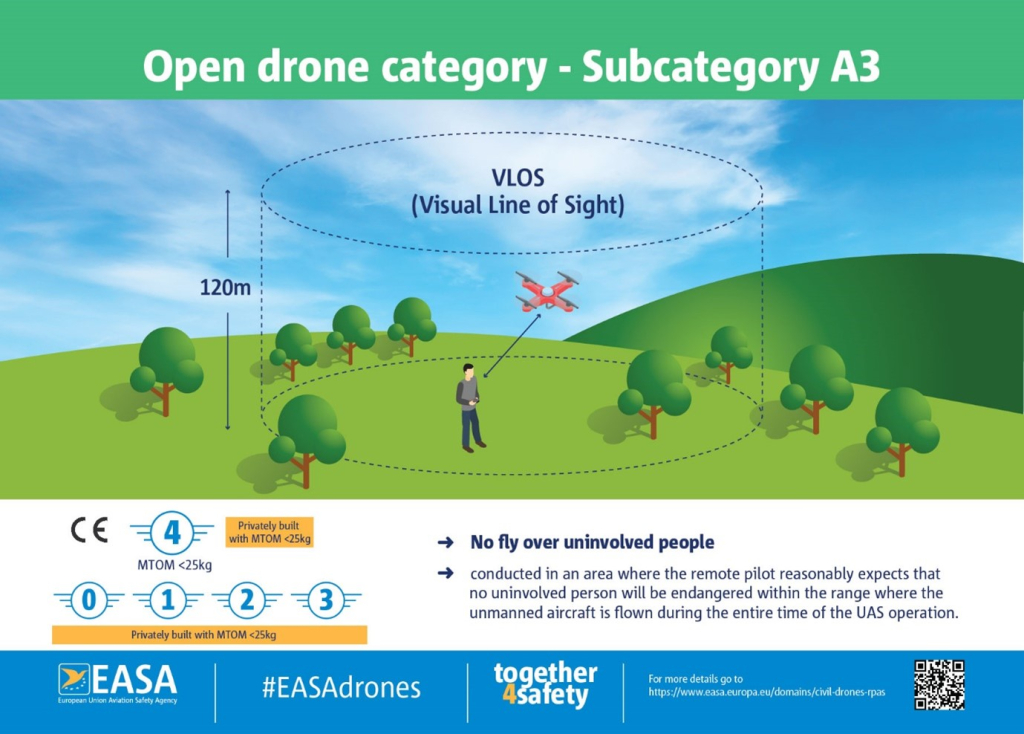
A1/A3 remote pilot certificate
|
Required for:
Requirements:
|
|
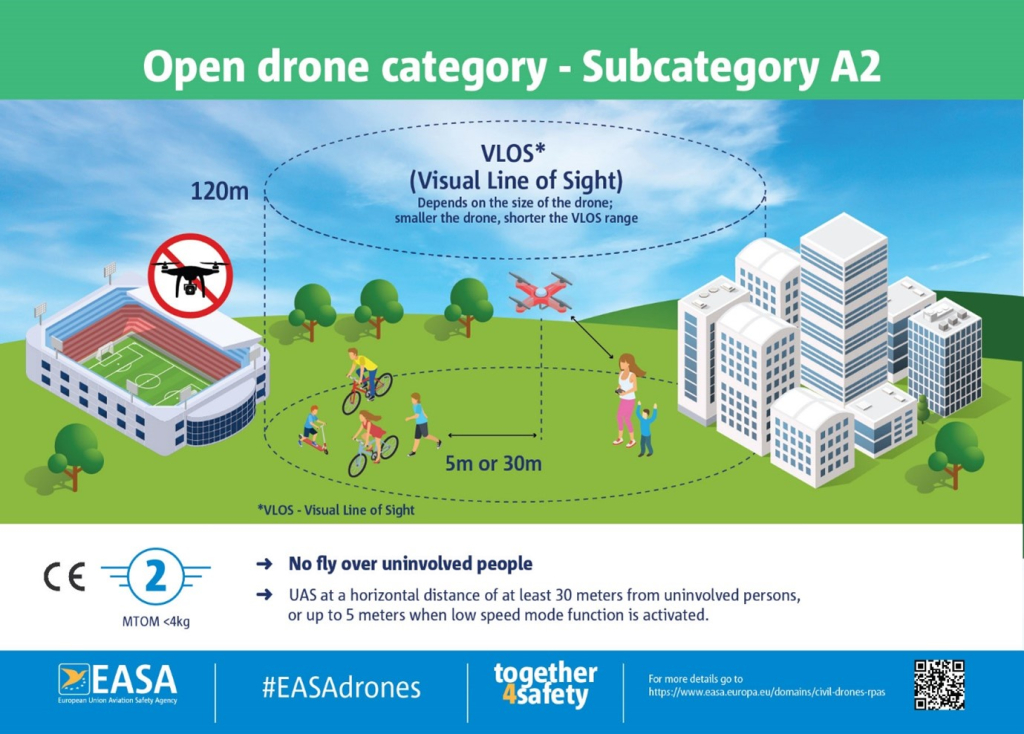
A2 remote pilot certificate
|
Required for:
Requirements:
|
|
STS remote pilot competency
Required for:
- Operations conducted under Standard Scenarios (STS)
- Certain Specific Category operations
Additional practical and theoretical training may apply.
Remote pilot certificate validity
Remote Pilot Certificates issued under the European drone rules are valid for 5 years.
This applies to:
- A1/A3 Remote Pilot Certificates
- A2 Remote Pilot Certificates
- STS Remote Pilot Competency Certificates
With many certificates issued when the rules entered into force in 2020 and 2021, a significant number of drone pilots will soon need to renew or revalidate their competency certificates.
Why staying current is important?
Keeping your drone competency certificates valid and remaining current is important because it ensures that you are legally authorised to fly and compliant with applicable regulations.
Expired certificates may affect your operational authorisation and could potentially invalidate insurance coverage.
It is not just for the certificate, remaining current also helps ensure that your knowledge of drone regulations, safety procedures, and airspace requirements stays up to date, contributing to safer operations and reducing operational risks.
In addition, competent authorities may request proof of valid competency during inspections or following an incident.
Renewal or Revalidation?
Remote Pilot Certificate revalidation and renewal are two different things.
-
Revalidation
Before expiry of your certificate, you can revalidate it with a refresher course or exam. Obviously, the effort is minimal.
For the certificate, a revalidation keeps the same ID you had before with a new validity date.
-
Renewal
However, after expiry of your certificate, you must renew it from scratch and the effort increases. This means that a new exam is required. If your certificate expires, there is not possibility for a refresher’s opportunity.
A renewal requires a new ID and a new certificate.
Exams needed for certificate renewal
In case of renewal, one exam per category is needed if you want to renew.
For example, if you only hold an A1/A3 certificate, you need to complete one exam. If you hold both A1/A3 and A2 certificates, two exams are required. For STS or Specific Category operations, the relevant exam(s) applicable to the operation must be completed.
Competent Authority (CA)
Your Competent Authority (CA) is the authority that issued your highest certificate level, i.e. A1/A3 or A2 or STS (for the Specific Category).
You revalidate with the same CA that issued your certificate by applying to the CA. However, if you renew it, you may choose any EASA CA you wish.
The revalidation or renewal process may be provided either directly by your CA or by a Recognised Entity (RE) by that CA. You can find them here:
Flying in your country — National Aviation Authorities | EASA
Changing Competent Authority (CA) for your certificate
If you wish to transfer your certificate to a different Competent Authority (CA), this is allowed when upgrading to a higher certificate level or when renewing a certificate after expiry, or upon request through an administrative transfer.
In some cases, notification to the previous CA may also be required.
Expiry date rule in your remote pilot certificate
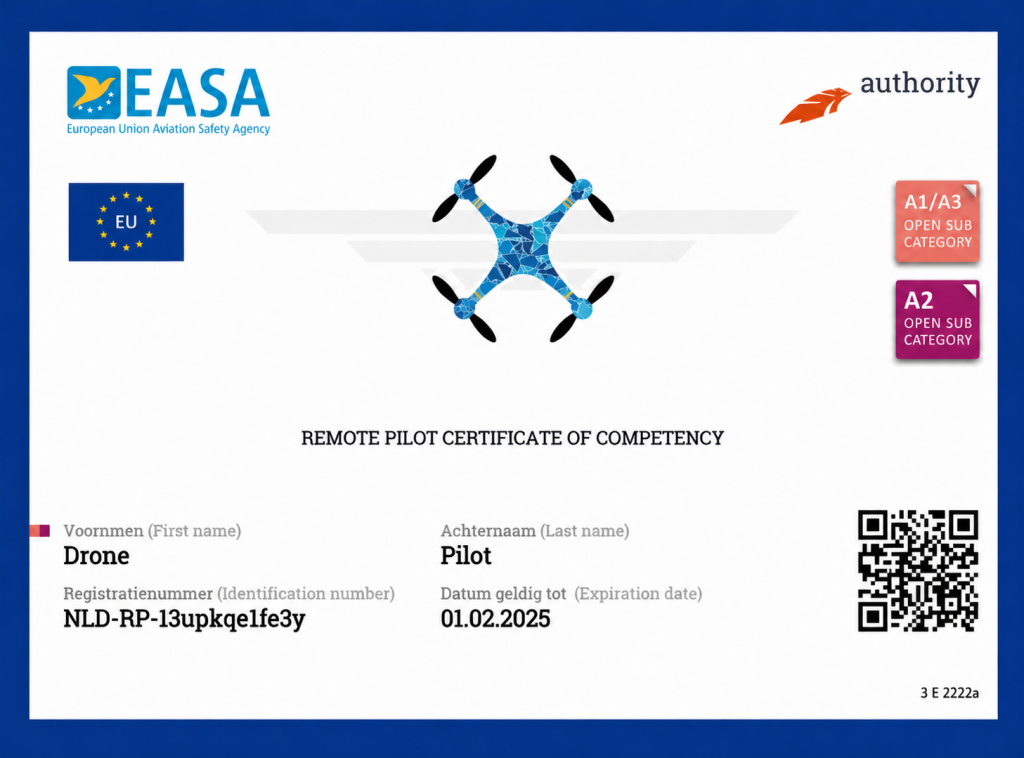
Only one expiry date appears in your certificate and it applies to all categories you hold. If you obtain a higher category later on, all categories align to that new expiry date.
For example, in this certificate shown below the expiry date of the 01/02/2025 applies to the A2 category. If you added STS to your certificate, which already includes A1/A3 + A2, it will have the new expiry of the STS qualification you just obtained.
Drone pilots’ competence versus drone operator’s registration
In the EU drone regulatory framework, the Drone Operator Registration and the Pilot Drone Certificate are two completely different things:
The drone operator registration is linked to the person or organisation operating the drone. While the pilot certificate applies to the individual pilot’s qualification flying it.
If the operator’s registration is out of date:
- the operator registration has expired or was not renewed
- the drone operation becomes non-compliant
- even if the pilot has a valid competency certificate, drone flights may still be illegal
Think of it like who is legally responsible for the drone? Whereas Pilot Drone Certificate is like: is this person qualified to fly? Or in simpler terms, the operator registration is similar to a vehicle registration, while the pilot certificate is comparable to a driving licence.
The roles of EASA and National Aviation Authorities (NAAs)
EASA and the National Aviation Authorities (NAAs) work together to ensure the safe and harmonised operation of drones across Europe.
-
EASA
EASA develops the common European drone regulatory framework, including rules for drone operations, pilot competency, product standards, and safety requirements applicable across EASA Member States. The Agency also provides guidance material, safety promotion, technical expertise, and digital tools to support drone operators, manufacturers, and authorities.
-
NAAs
National Aviation Authorities (NAAs) are responsible for implementing and enforcing these rules at national level. This includes drone operator registration, issuing remote pilot competency certificates and operational authorisations, overseeing compliance, determining and managing geographical zones, and conducting inspections or enforcement activities.
Which one to contact
While EASA ensures a common European approach and you can contact the agency in this context, NAAs remain the main point of contact for drone operators and remote pilots within each country.
Cross-border operations within EASA Member States
Under the European drone framework, operators only need to register once in their country of residence or where the business is established. That registration is recognised across all EASA Member States.
Likewise, remote pilot competency certificates issued by one EASA Member State are valid throughout the EASA system. You don’t have to do them again in another EASA State.
When flying outside EASA Member States, you must comply with the national drone regulations of the country they are visiting.
Equally, the opposite also applies; drone operators visiting EASA Member States from non-EASA countries must follow the European drone regulatory framework and the applicable national requirements of the Member State.
For more information: Travelling with drones | EASA
Drone insurance
Under the European drone rules, insurance is mandatory for drones weighing more than 20 kg, while many EASA Member States also require third-party liability insurance for lighter drones under national regulations (always check the specific requirements in the country where you fly
For more information: What should you consider when getting drone insurance? | EASA
Stay compliant, stay safe
Since the introduction of the EU drone rules at the end of 2020, more than 1.7 million A1/A3 and nearly 300,000 A2 drone certificates have been issued.
For many of us, flying isn’t just a hobby. It’s how we create, how we work and how we see the world from a new perspective. Every safe drone flight depends on preparation… responsibility… and staying current, staying compliant and staying safe.