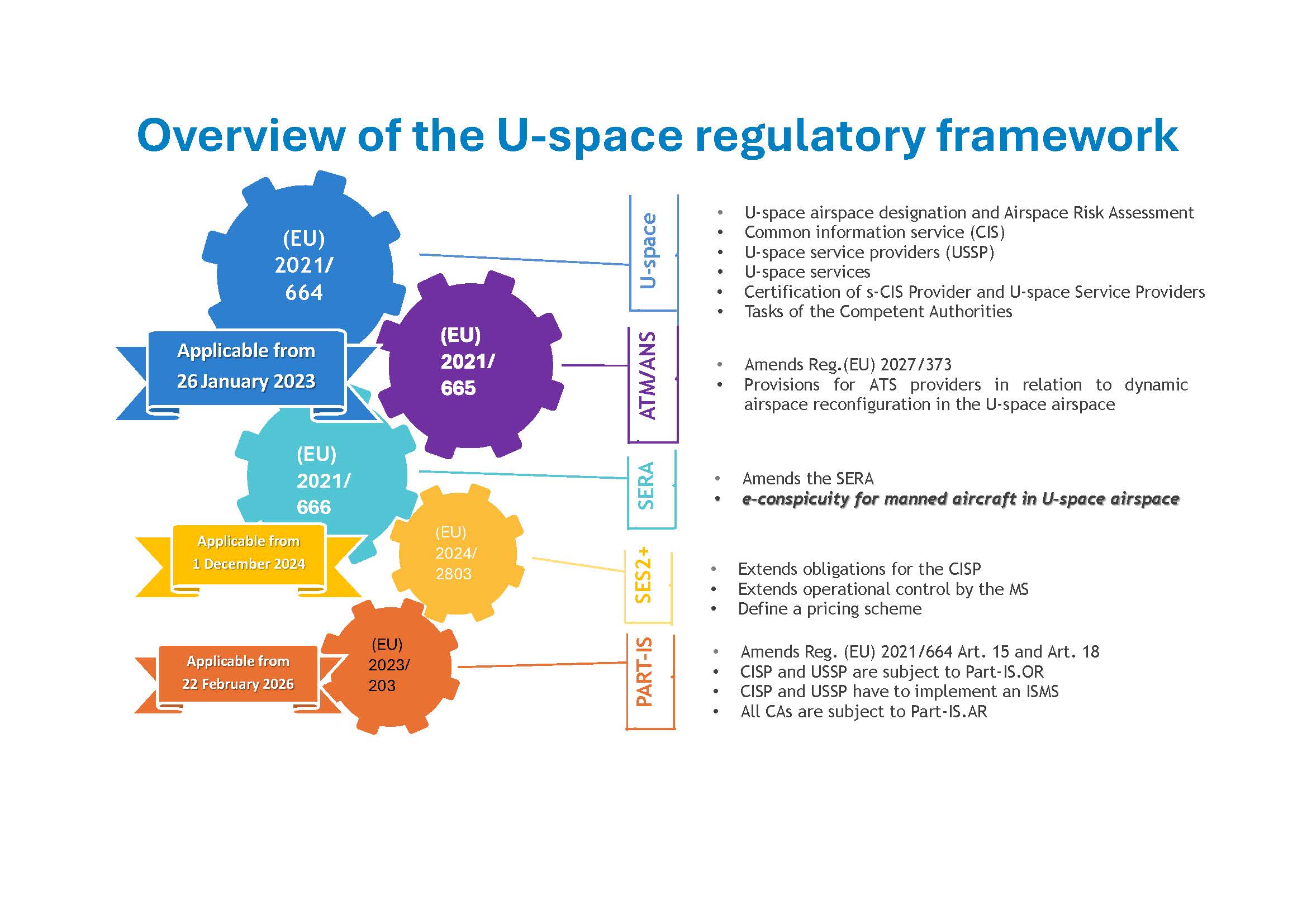
In January 2021, the U-space regulations entered into force, establishing a regulatory framework for the unmanned traffic management in Europe. The U-space regulatory framework is composed of three regulations which come together with a set of AMC/GM. The objectives of U-space are to enable a fair and efficient sharing and use of the airspace, allowing a safe separation between manned and unmanned aircraft. Below is an overview of the U-space regulatory framework:
U-space services
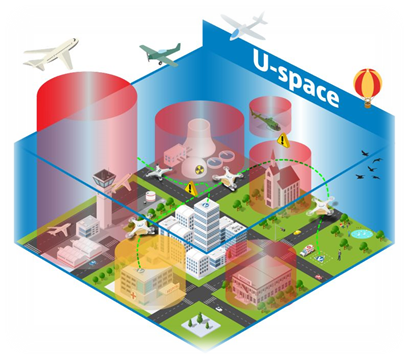
A U-space airspace is a geo-zone designated by the EASA Member States on the basis of an airspace risk assessment. When flying in a U-space airspace, UAS operators need to use the services provided by USSPs (U-space service provider). The following set of mandatory services are provided to UAS operators:
- UAS flight authorisation: every flight in U-space airspace must be authorised in order to be conducted safely, and not conflicting with other manned and unmanned aircraft;
- Geo-awareness provides UAS operators with the information about the latest airspace constraints and geo-zones;
- Network identification: provides users with live flight data of each unmanned aircraft flying in the U-space airspace;
- Traffic information: provides information on the position of manned aircraft flying in the U-space airspace
Based on the competent authorities’ assessment, these optional services may become mandatory.
U-space actors
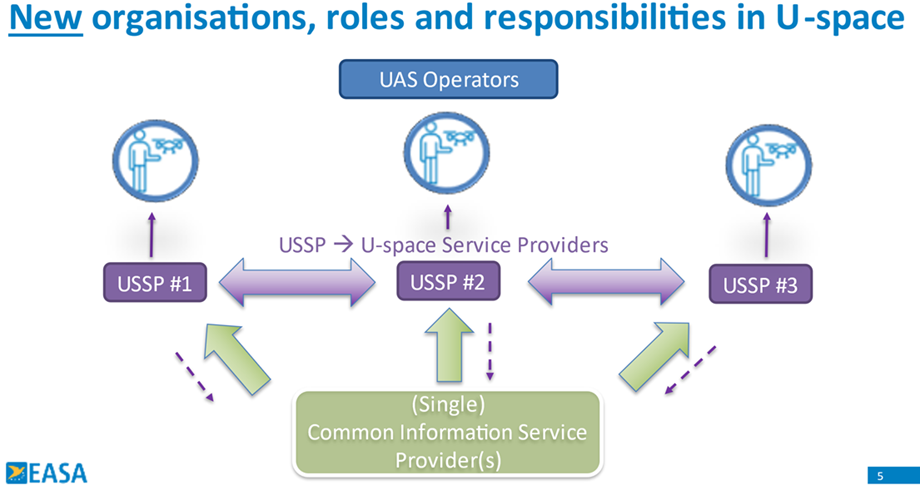
Several actors work together to ensure safe operations in a U-space, the main responsibilities are shared among:
- Member States: EASA Member State may designate U-space airspaces. To do so, they have to perform an airspace risk assessment in order to identify possible safety issues and hazards associated with the airspace;
- EASA and national competent authorities: EASA and national competent authorities have the responsibility to certify the USSP and single CISPs;
- U-space service providers (USSP): a certified service provider providing U-space services to UAS operators;
- Common Information Service Provider (CISP): a certified service provider disseminating static and dynamic data to enable the provision of U-space services. The data may come from a single source, referred as single CISP, or from different sources, referred as non-single CISP.
- UAS operators: are responsible for the safety of the operation, and must use U-space services when flying in a U-space airspace;
- Manned aviation: may fly in U-space airspace, provided they are electronically conspicuous to ensure safe separation with other aircrafts in uncontrolled airspace or provided they are segregated through the dynamic airspace configuration in controlled airspace.
Informative material
More detailed information on the U-space regulatory framework may be found consulting the U-space regulations and their AMC and GMs.
In addition, EASA hosted a comprehensive workshop on U-space and its recording is available on this page.
- Video recording - U-space workshop 2023 Day 1
- Video recording - U-space workshop 2023 Day 2
- Presentation - U-space workshop 2023
UAS operations in U-space airspace
When operating in U-space airspace, UAS operators are required to subscribe to and use the U-space mandatory services. These services are needed to mitigate the risk of a collision both with manned aircrafts and other drones.
The requirements for UAS operators established in Regulation (EU) 2019/947 and (EU) 2019/945 are still applicable even when operations are conducted in a U-space airspace. Flying in a U-space airspace mitigates the air risk as all the involved actors are following common structures and rules, and operators may take credit for this when performing their operational risk assessment using the SORA methodology.
U-space provisions do not apply to:
- model aircrafts clubs and associations which have received an authorisation in accordance with Article 16 of Regulation (EU) 2019/947;
- privately built drones with an MTOM lower than 250g or with a C0 class identification label.
CERTIFICATION
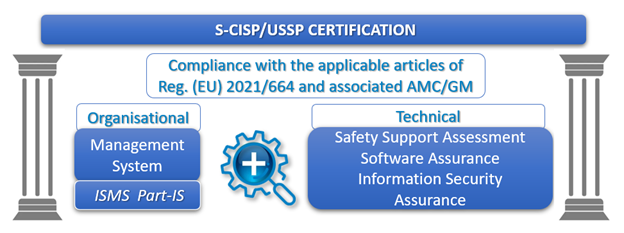
In order to become a USSP or a single CISP, the organisation needs to obtain a certificate in accordance with Regulation (EU) 2021/664. The competent authorities responsible for issuing the certificates may be:
- Member States (local competent authority) of the principal place of business,
- Member States or EASA (opt-in) when the place of business is in more than one EASA Member State,
- EASA for third country USSP/single CISP.
The application for a certification is usually preceded by a pre-application meeting focused on the exchange of information between EASA and the applicant. This meeting is a good opportunity for the applicant to provide information on its intended operations and for EASA to provide an overview of the certification process and its expectation to the applicant.
The certification process is two-fold: the assessment of the organisational capability of the applicant and the assessment of the provision of U-space services.