
Scope and purpose
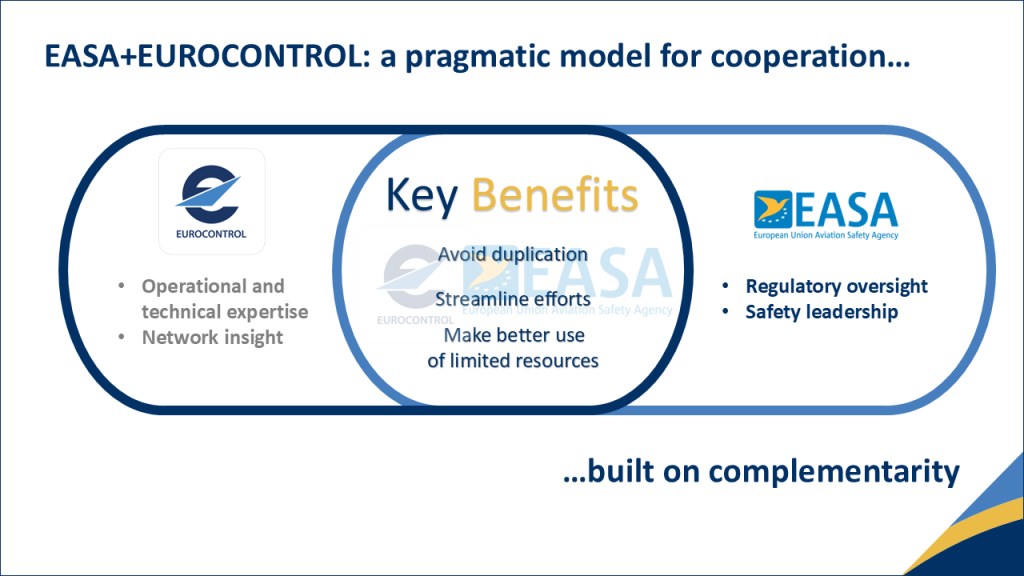
The European Union Aviation Safety Agency (EASA) and EUROCONTROL have built a longstanding and productive partnership, grounded in their Memorandum of Cooperation (MoC) and the Joint Working Programme. These frameworks provide a structured foundation for collaboration, enabling the two organisations to combine their expertise, coordinate activities, and advance shared goals in aviation safety, security, and sustainability.
A major part of this collaboration is implemented through nine specific Annexes, which define the technical areas of engagement, and five Pilot Projects, designed to address emerging operational and regulatory needs.
The Memorandum of Cooperation (MoC)
Intended cooperation includes, but is not limited to:
- The coordination and mutual exchange of knowledge and expertise in areas of common interest, including the possibility of staff exchanges between both parties.
- Consultation on matters of mutual interest and the establishment of a regular, structured dialogue to share information, knowledge, and experience in the fields of aviation safety, security, and sustainability, as well as related regulatory, scientific, and innovation developments — helping to coordinate activities and avoid duplication of efforts.
- The facilitation and planning of EUROCONTROL and EASA expert participation in tests, evaluations, technology assessments, technical reviews, and workshops, including the shared use of research and testing facilities and equipment.
- Participation in meetings and relevant working groups.
-
The Annexes to the MoC
The technical cooperation activities under the MoC Annexes are carried out through the mutual sharing of know how and resources. This includes participation in rule development and maintenance activities aligned with the EASA European Plan for Aviation Safety (EPAS), in full compliance with EASA oversight and training activities, as well as the EUROCONTROL Regulatory and Advisory Framework.
Both organisations have jointly agreed upon and signed nine Annexes, each covering specific domains of cooperation:
- Annex 1: Co-development and co-steering of a Joint Working Programme (JWP);
- Annex 2: Establishment and operation of a Technical and Coordination Office (TeCo);
- Annex 3: Data Sharing and Analysis (DSA) between the Sides;
- Annex 4: Training cooperation;
- Annex 5: Cooperation in Aviation Cybersecurity;
- Annex 6: Cooperation under Innovation and Research in Aviation activities;
- Annex 7: Cooperation between the Sides on the CNS Programme Manager (CNS PM) related activities;
- Annex 8: Sustainability
- Annex 9: Civil- Military cooperation
-
The Pilot Projects
Evolving operational and regulatory needs require a more structured and results‑oriented approach to cooperation. To this end, EASA and EUROCONTROL have launched Pilot Projects that bring together targeted activities aimed at enhancing coordination, supporting the Single European Sky (SES) implementation, and improving the alignment between operational and regulatory efforts. This represents a pragmatic and outcome‑focused step forward in strengthening EUROCONTROL–EASA cooperation.
-
Pilot Project 1: ATM/ANS Equipment rule-making and standards
Enhance the EU regulatory framework in the area of ATM/ANS equipment conformity assessment aiming to:
- facilitate harmonization and level playing field.
- provide the necessary clarity in Detailed Specifications (DS) and related Acceptable Means of Compliance (AMC) and Guidance Material (GM) and technical standards as regards the requirements ATM/ANS equipment should fulfil.
- achieve standardised and consistent certification and oversight approaches. support development of new technologies and introduction of new operational concepts.
-
Pilot Project 2: Cybersecurity Intelligence and stakeholder engagement
- Collaborate in the area of cyber threat intelligence to cover all aviation domains: collection, analysis and dissemination to European aviation stakeholders, building on the existing setups.
- Find synergies by managing a joint contract for collection of cyber threat intelligence (to replace the current two parallel contracts).
- Streamline stakeholders’ engagement by removing duplications and ensuring an efficient feedback mechanism, while maintaining a trusted environment.
-
Pilot Project 3: U-Space Safety and Performance
The aim is to deliver a set of examples of safety and performance requirements for the associated U-space airspace design and the U-space services, derived from an airspace risk assessment performed on a typical U-space airspace candidate, within a controlled airspace. This will support Member States by providing a concrete example of the expected safety and performance requirements necessary for the establishment of U-space.
-
Pilot Project 4: Monitoring the implementation of PBN and the EU PBN Regulation
The objective is enhancing ongoing support for the effective implementation of PBN and the EC PBN IR (1048/2018) in the ECAC area. This involves maintaining and improving the consistency, robustness, and monitoring efforts of the PBN Map tool. This activity combines regulatory oversight with practical tools and operational guidance, enabling consistent and efficient oversight across States, European institutions, and Pan-European organizations. This approach facilitates modernization, improves efficiency, and strengthens the strategic objectives of the Single European Sky.
-
Pilot Project 5: Enhanced International and ICAO Cooperation
The aim is to enhance European influence and capacity-building in global aviation through coordinated ICAO contributions, workshops, and training. Foster cooperation with other regions and promote the European aviation system for its uptake by third countries. Promote alignment with SES performance objectives and support the integration of non-EU States into the SES framework.
|
|
Joint Activities planned for 2026 |

-
U-space Safety in Uncontrolled Airspace
Improving the electronic “visibility” of drones operating in non-controlled airspace, ensuring that they can be detected by other drones, manned aircraft, and U-space systems.
Supports safe BVLOS operations and U-space implementation by enabling basic situational awareness where no ATC separation exists
-
Developing a coordinated European approach on radio-frequency use for UAS, with particular focus on the spectrum required by U-space Service Providers (USSPs) and for UAS command-and-control links.
Ensures reliable, harmonised communications to support large-scale drone operations across Europe
-
A joint EASA–EUROCONTROL Action Plan defining roles, responsibilities, and mitigation measures to strengthen Europe’s response to GNSS interference (jamming/spoofing).
The plan is intended to become the EU Action Plan, supporting both operational stakeholders and regulatory coordination at EU and ICAO levels.
-
A shared Data4Safety workspace where EASA and EUROCONTROL consolidate GNSS interference data, harmonise detection algorithms, and generate co-branded maps, alerts, and reports.
Provides a single, trusted European source of situational awareness on GNSS interference.
-
UAS GNSS & e-Conspicuity Flight Campaign
A coordinated EUROCONTROL–EASA–EUSPA campaign running throughout 2025–26 to collect real-world data on GNSS/PNT performance and drone conspicuity across multiple Member States.
Delivers evidence-based inputs for U-space implementation, Drone Strategy 2.0, technical specifications, and future regulation.
Use Cases (May 2026)
-
ATCO Training Material Support
A new cooperation activity aimed at simplifying and modernising ATCO training tools, and reducing manual processing and verification effort.
Supports the harmonised implementation of new operational and regulatory requirements by improving the efficiency, consistency, and traceability of ATCO training across Europe, while reducing administrative burden for ANSPs and authorities.