
Background

CORSIA was agreed by ICAO’s Member States back in 2016 with an aim to stabilise net carbon emissions from international flights at 2020 levels. In order to achieve this, aeroplane operators are required to purchase offset credits in order to compensate for CO2 emissions exceeding an agreed baseline. CORSIA operates on a route-based approach and applies to international flights, i.e. flights between two ICAO States. A route is covered by CORSIA offsetting requirements if both the State of departure and the State of destination are participating in the Scheme and is applicable to all aeroplane operators on the route (i.e. regardless of the administering State).
CORSIA scope and timeline
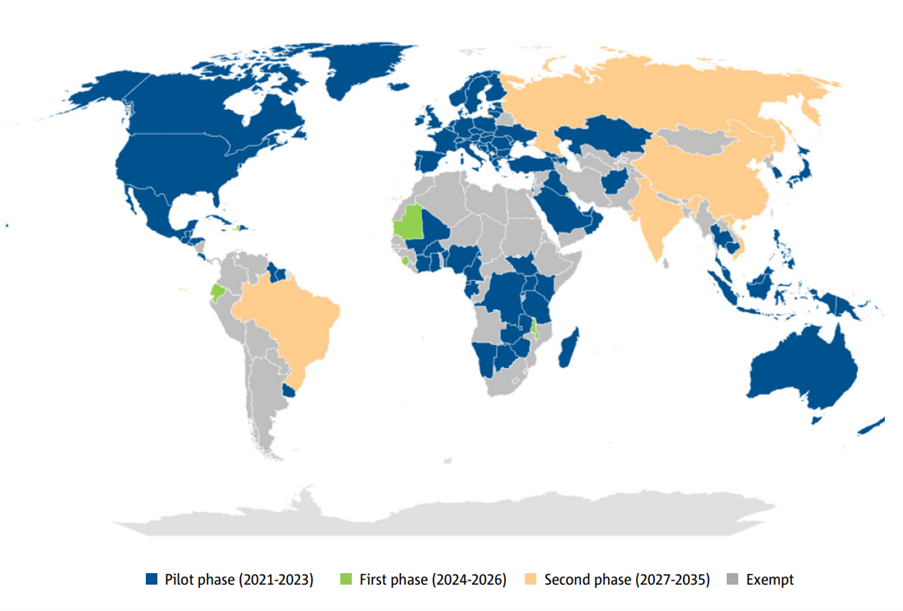
CORSIA includes three implementation phases. During the pilot (2021-2023) and first (2024-2026) phases, offsetting requirements will only be applicable to flights between States which have volunteered to participate in CORSIA offsetting. The second phase (2027-2035) applies to all ICAO Contracting States, with certain exemptions. There has been a gradual increase of States volunteering to join CORSIA offsetting, rising from 88 States in 2021 to 130 in 2026.
All aeroplane operators with international flights producing annual CO2 emissions greater than 10 000 tonnes from aeroplanes with a maximum take-off mass greater than 5 700 kg, are required to monitor, verify and report their CO2 emissions on an annual basis from 2019. The CO2 emissions reported for year 2019 represent the baseline for carbon neutral growth for CORSIA’s pilot phase (2021-2023), while for the first and second phases in 2024- 2035, the baseline is 85% of the CO2 emissions reported for year 2019. The aviation sector is required to offset any international CO2 emissions covered by CORSIA’s offsetting requirements above these baseline levels.
The offsetting requirements for each operator are calculated by multiplying the operator’s CO2 emissions covered by CORSIA offsetting requirements with a Sector Growth Factor (SGF). For years 2021-2032, the SGF represents the percentage growth of the aviation sector’s international CO2 emissions covered by CORSIA’s offsetting requirements in a given year compared to the sector’s baseline emissions. For the period of 2033- 2035, the SGF is calculated by using 85% of the sector’s growth against the baseline and 15% of individual aeroplane operator’s growth against the baseline.
Due to the change by the ICAO Assembly in 2022 to use 2019 emissions as CORSIA’s baseline emissions for years 2021-2023, and the fact that international aviation emissions covered by routes between two States that have volunteered to join CORSIA offsetting have not reached 2019 levels by 2023, there was no offsetting requirements to airlines from CORSIA during its pilot phase. In 2024, thanks to the change of baseline to 85% of 2019 emissions as well as aviation sector’s recovery from the Covid-19 pandemic, the aeroplane operators will be required to offset 15.4% of their CO2 emissions covered by the offsetting requirements. Globally, this represents approximately 55.6 million tonnes of CO2.
ICAO member states’ participation in CORSIA’s different phases.
CORSIA in practice and CORSIA’s emissions units
International flights within the scope of CORSIA are attributed to an aeroplane operator, and each operator is attributed to an administrating State to which it must submit an Emissions Monitoring Plan. Since 1 January 2019, an aeroplane operator is required to report its annual CO2 emissions to the State to which it has been attributed, irrespective of whether it has offsetting obligations.
At the end of each 3-year compliance period (2021-2023, 2024-2026, etc.), an aeroplane operator must meet its offsetting requirements by purchasing and cancelling certified CORSIA eligible emissions units. Each emissions unit represents a tonne of CO2 avoided or reduced. In order to safeguard the environmental integrity of offset credits used under CORSIA, the emission units must comply with the Emission Unit Criteria approved by the ICAO Council. The price of a CORSIA eligible emissions unit has varied greatly depending on the type of the project: Based on limited price information and data available for the purpose of the ICAO analyses supporting the 2025 CORSIA Periodic Review, the average price of emissions units was estimated to range from $10 to $40 per tCO2 during the First Phase of CORSIA.
For the period 2024-2026, it is estimated(Estimation by EASA AERO-MS model) that the cost of purchasing CORSIA offset credits could be limited at 0.07-0.15% of the total annual operating costs for airlines. Aeroplane operators can also reduce their offsetting requirements by using CORSIA Eligible Fuels (CEF) that meet the CORSIA sustainability criteria, which includes at least 10% less CO2e emissions on a life-cycle basis compared to a reference fossil fuel value of 89.1 gCO2e/MJ.
ICAO has established a Technical Advisory Body (TAB) to undertake the assessment of Emissions Unit Programmes against the approved Emissions Units Criteria, and to make annual recommendations on their use within CORSIA. To date, based on the TAB’s recommendations, the ICAO Council has approved 11 emissions unit programmes to supply CORSIA Eligible Emissions Units for CORSIA’s pilot phase in 2021-2023, eight programmes to supply Units for the first phase in 2024-2026, and four programmes to supply units for the second phase starting in 2027.
In order to address concerns on double counting, rules for international carbon markets under Article 6 of the Paris Agreement were adopted at the UNFCCC COP26 meeting in 2021. These rules require a host country to authorize carbon credits for ‘international mitigation purposes’, such as CORSIA, and to ensure that these emission reductions are not used to achieve its National Determined Contribution (NDC) under the UNFCCC process. These rules are designed to guarantee that corresponding adjustments take place prior to these emission reductions being used to demonstrate compliance with CORSIA. First announcements of authorizations of carbon credits for CORSIA compliance purposes have been observed in early 2024.
[1] Estimation by EASA AERO-MS model.