
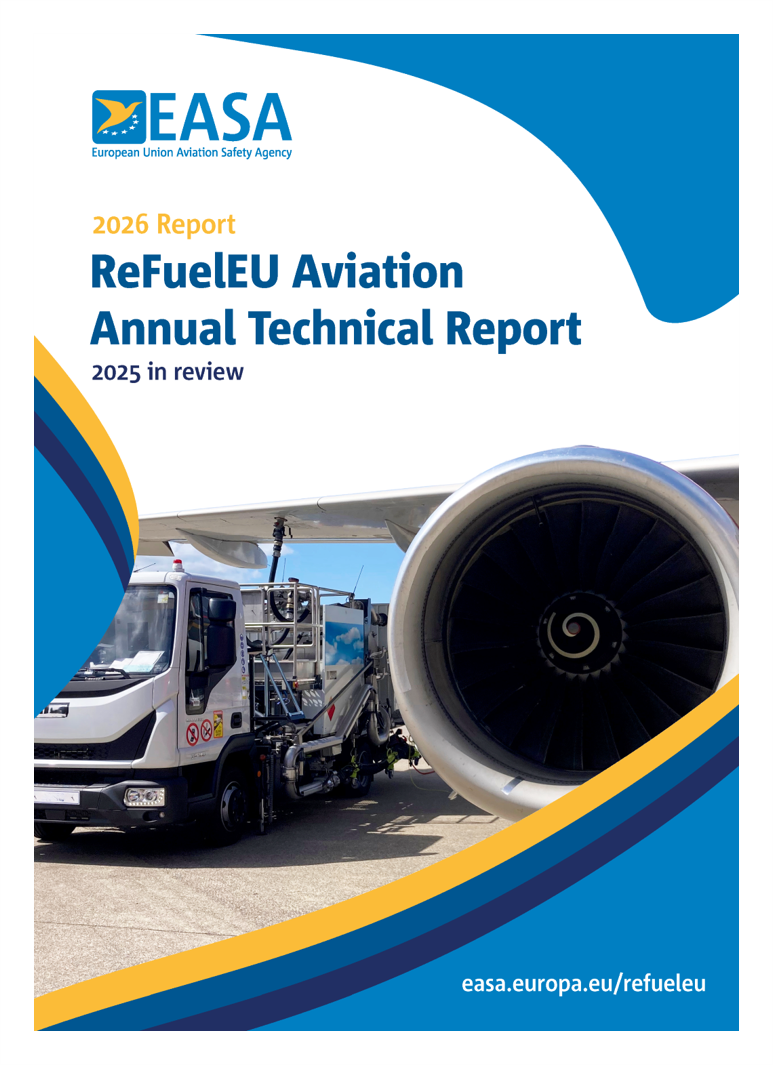
COLOGNE, September 17, 2026 — The European Union Aviation Safety Agency (EASA) today published the 2026 ReFuelEU Aviation Annual Technical Report, showing that the supply of Sustainable Aviation Fuels (SAF) in the European Union (EU) exceeded the first mandatory ReFuelEU Aviation target in 2025.
Aviation fuel suppliers reported supplying 39.3 million tonnes of aviation fuel at Union airports in 2025, of which 1.1 million tonnes – or 2.8% – was SAF. This exceeded the mandatory minimum SAF share of 2% that became applicable in 2025.
“We are pleased to confirm that the SAF mandate under ReFuelEU Aviation was not only met but exceeded,” said Florian Guillermet, EASA Executive Director.
“Through our monitoring work, EASA is building a strong evidence base to track this progress, understand how the European SAF market is developing and identify where further action may be needed to support the next stages of the transition."
SAF supply grows, delivering emissions savings
The 2025 data shows a major increase in the availability of SAF across Europe. Supply rose from 193,000 tonnes in 2024 to 1.1 million tonnes in 2025 – nearly six times the previous year's volume, before the mandate entered into force. SAF was supplied at 121 Union airports across all 27 EU Member States, meaning that 79% of Union airports received SAF during the year, showing a significant increase compared to 2024 when 33 Union airports received SAF.
Calculations show that the use of SAF instead of conventional jet fuel helped to reduce greenhouse gas (GHG) emissions at Union airports by 3.77 million tonnes in 2025.
SAF market continues to develop
The report provides the most comprehensive picture to date of the developing SAF market in the European Union. Key findings include:
- EU SAF production capacity is projected to remain on track to meet the overall 6% SAF blending target by 2030.
- Despite the synthetic aviation fuel market remaining at an early stage of development, the first EU-based demonstration plant was established proving that the technology is being deployed. Around 50 projects are awaiting final investment decisions and several EU Member States are taking important steps to support its scale-up.
- 86% of the SAF supplied at EU airports was produced domestically within the EU.
- Most of the feedstocks originated from outside the EU, accounting for 85% of SAF supplied at Union airports. Used cooking oil remained the predominant feedstock for SAF, accounting for 80% of the total volume, yet more significant amounts of additional feedstocks entered the mix in 2025.
- The Netherlands, Spain, Germany, Italy and France accounted for 0.8 million tonnes or 74% of all SAF supplied in the EU. The Netherlands received the largest amount of SAF among the EU Member States, with 0.32 million tonnes or 29% of all SAF reported.
Alongside the report, EASA developed a dedicated dashboard that allows users to further explore the data behind the report.
Background
The ReFuelEU Aviation Regulation (Regulation (EU) 2023/2405) establishes that EASA is required to publish an annual technical report, based on data from the previous year. This report shall contain information on the status of compliance of the parties obligated under the Regulation as well as on the state and development of the SAF market in the European Union and its Member States.
About European Union Aviation Safety Agency - EASA
The European Union Aviation Safety Agency (EASA) is the centrepiece of the European Union's strategy for aviation safety. Our mission is to promote and achieve the highest common standards of safety and environmental protection in civil aviation. Based in Cologne, the Agency employs experts and administrators from all over Europe.
For more information, please contact:
Janet Northcote
Chief Communications Officer
European Union Aviation Safety Agency
Email: communications [at] easa.europa.eu