
 On the page, you will the following on the Environmental Footprint Aviation (EFA) for Drones topic:
- Building Trust and Preventing Greenwashing in Electric Aviation
- Preliminary Results
- Timeline and Next Steps
Building Trust and Preventing Greenwashing in Electric Aviation
The sustainability of drones and air mobility, including UAM, AAM, and IAS, depends on factors like energy source, emissions, noise pollution, infrastructure, safety, efficiency, public acceptance, technological advancements, and environmental impact assessment. Sustainable implementation, with a focus on clean energy, reduced emissions, and efficient infrastructure, can make these technologies more environmentally friendly, but careful planning and ongoing assessment are essential to ensure they align with sustainability goals and do not harm the environment or communities.
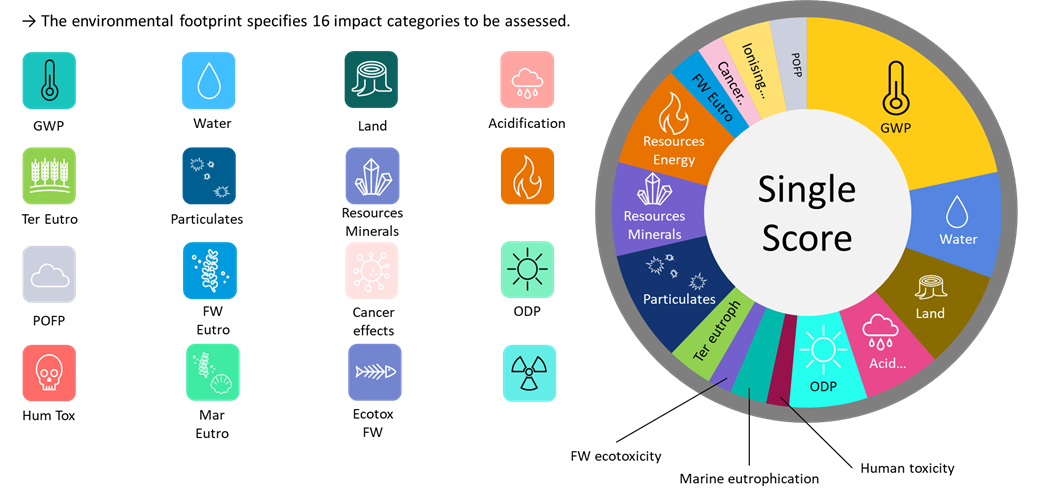
To ensure that all these factors are taken into account, a full life-cycle environmental assessment is needed. EASA is developing such a methodology, called Environmental Footprint Aviation (EFA) in a standardised manner which will ensure that there is no greenwashing.
EFA will follow the format of a Product Environmental Footprint (PEF) Category Rule (PEFCR). This methodology is the European Commission’s recommended methodology for assessing the environmental impacts of a product across its life cycle. This means it assesses the impacts of products while they are in use, the ‘upstream’ impacts associated with manufacturing and raw material extraction, and the ‘downstream’ impacts associated with their disposal at end-of-life.
The PEF method has been selected due to is comprehensive set of environmental indicators avoiding, issues of burden shifting and carbon tunnel vision, but also due to its adoption by the European Commission and being referenced within important European policy such as the sustainable batteries regulations.
Figure 1: Sixteen environmental impact categories studied under PEF
By establishing a standardised PEFCR for eVTOL and delivery drones (from here on “drone”), EASA aims to enable eVTOL and drone manufacturers and operators to quantify and communicate information regarding their aircraft’s environmental impact on a fair and consistent basis. This will enable investors and consumers to make informed decisions regarding the environmental impacts of their choices and avoid claims of greenwashing that can arise from different approaches to environmental assessments.
The first draft of the EFA category rules (PEFCR) is now in public consultation until 28 August 2024.
Preliminary Results
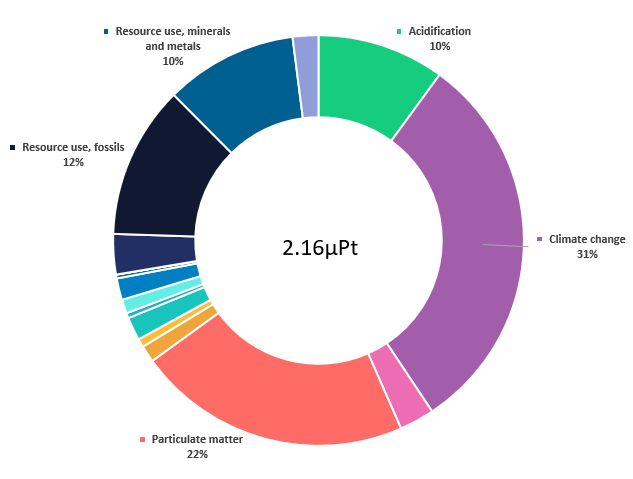
The Environmental Footprint methodology assigns a weight to each impact category, allowing for a weighted average of all environmental impacts. The final score is dimensionless and represents this weighted average. In the case of the drone benchmark data (PEF-RP), the following impact categories were most relevant, contributing over 80% to the single score:
- Climate change
- Particulate matter
- Resource use (minerals and metals)
- Resource use (fossils)
- Acidification
Figure 2: Results from the PEF-RP for delivery drones
The benchmark results from a separate draft PEFCR for aircraft being developed by EASA is shown for information purposes only.
Figure 3: Comparison in the relative size of the RP single score results for drones (A – Red outline) and aircrafts (B).
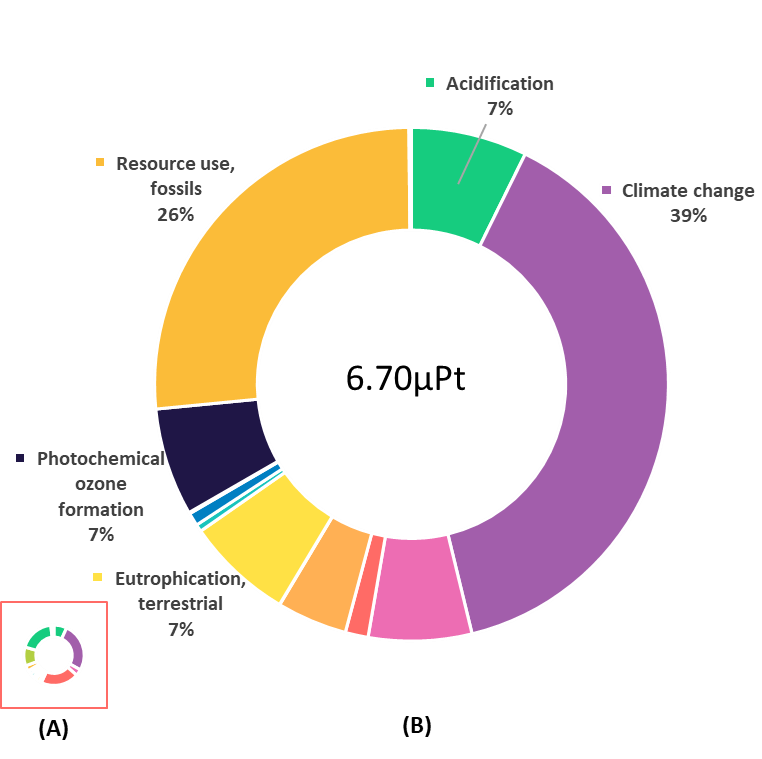
Figure 3 shows the product environmental footprint (PEF) single score for each category (aircrafts and drones) under study by EASA, scaled in size based on the relative value of the PEF score. The value in the centre denotes the overall score of the RP for the category, with the colour wheel on the outside denoting the contribution of each individual impact category under study within the EF method. The “most relevant impact categories” (as defined by PEF) for each system have been labelled.
It should be noted that the single score provided by PEF has a unit of “μpt” or micro point. This is a dimensionless unit and meant to demonstrate “relative environmental impact” of products within the same category. It is calculated by taking the normalised results for each impact category, applying a weight to each impact category and then summing all resulting values to form a single score for the product. The weight assigned to each impact category is defined by PEF within the methodology.
Timeline and Next Steps
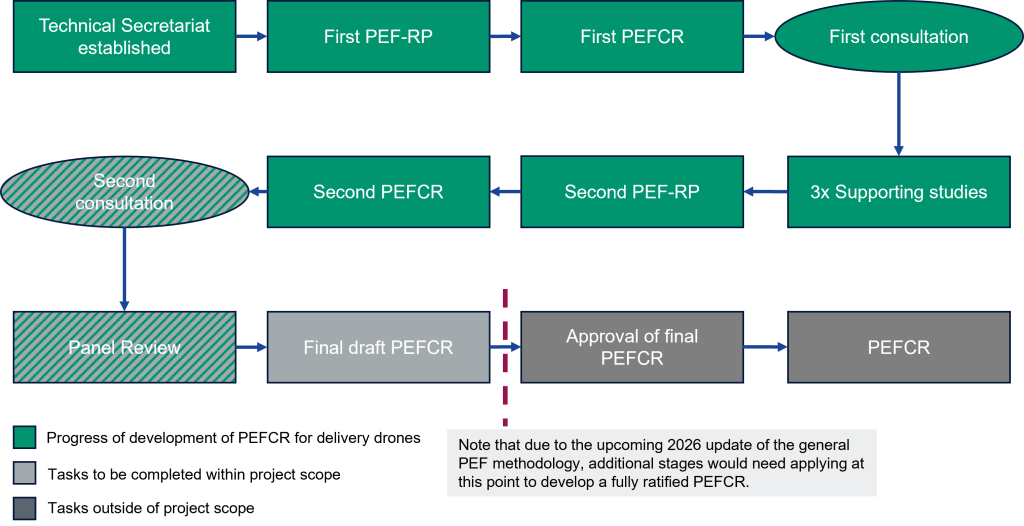
Since the previous public consultation in 2024, comments from the public consultation have been responded to, the PEFCR draft version 1 for Delivery Drones has been applied to three supporting studies on three different delivery drones, based on data provided by industry representatives. The learnings from the application of the PEFCR to these three studies, plus relevant queries raised and discussed from the first public consultation, have been used to update and improve the PEFCR, within PEFCR draft version 2 for Delivery Drones. A corresponding updated theoretical benchmark (PEF-RP version 2) has been created as part of this second draft PEFCR.
A second public consultation has now opened to enable public comment on the latest PEFCR draft version. This will close on 30th April 2026, after which consolidated comments will be reviewed by the PEFCR developers and EASA. Comment resolution will then take place and the critical review panel will undertake a review of the resulting PEFCR and its benchmark, the supporting studies, and summary information on the development of the PEFCR. The results of a successful panel review will culminate in a finalised draft PEFCR for Delivery Drones developed against the current (at time of writing in March 2026) PEF methodology.
Figure 4: PEF development pathway
With regards to the eVTOL PEFCR, the development of this should be paused until such a time where activity data can be collected and shared for the use stage and more granular data is available.