
The LOKI-PED research project is led by EASA and managed by an external consortium with Fraunhofer-Gesellschaft (FHG) as the project coordinator. The project is related to the risks of smoke and fire in the cabin, caused by Portable Electronic Devices (PEDs).
The research objectives and expected outcome
The amount of lithium metal and ion batteries transported by air is constantly growing. Lithium batteries, regardless of whether they are contained in equipment or not, are one of the main causes of incidents reported in the cabin. The main risks are fire and smoke, which can lead to catastrophic events.
Objectives of the research project:
- Fully characterise the hazards related to the carriage of lithium batteries and PEDs by passengers in the aircraft cabin.
- Determine the extent of the consequences of fire and smoke caused by an event on the safe conduct of the flight, using modelling and numerical simulation and involving operational safety experts.
- Assess the limits related to battery design and number of PEDs on board to maintain acceptable risk level(s) and determine the relationship between the risk and the increase/decrease of both battery energy and number through the experimental data available.
- Compare the scenarios assessed with the limits established by the applicable regulations to identify potential gaps and needs for change and justify the conclusions.
- Assess and evaluate current emergency procedures and identify potential improvements of the existing emergency procedures.
- Establish whether additional mitigating measures in relation to the hazard would need to be applied, determining whether the use of certain solutions may minimise or increase the risks and consequences and justifying whether manufacturing or testing standards should be developed by the appropriate entities.
- Identify gaps in the applicable regulatory provisions and the need to refine the guidance materials used by operators.
Required output and expected outcome:
- Provide experimental test evidence for the establishment of limits (power output and quantity) for the transport of PEDs and study the effects of an increase/decrease in the risks involved.
- Develop new and improve existing emergency procedures to cope with lithium batteries and PEDs transported in the cabin, thus rendering it a safer environment for both passengers and aircrew.
- Reduce the occurrences of safety events caused by lithium batteries and PEDs carried by passengers and aircrew by better understanding the causes, consequences, and patterns of lithium-battery thermal runaways in flight.
- Reduce the consequences of fire and smoke events by determining cabin and cockpit tolerances, identifying the consequences of failures in the aircraft systems, and identifying solutions both at aircraft and lithium-battery level.
- Support operators in assessing the risks associated with the transport of lithium batteries and PEDs in the cabin and identify the need for safety promotion for passengers.
- Fully characterise the hazards related to the carriage of lithium batteries and PEDs by passengers in the aircraft cabin.
Project Overview
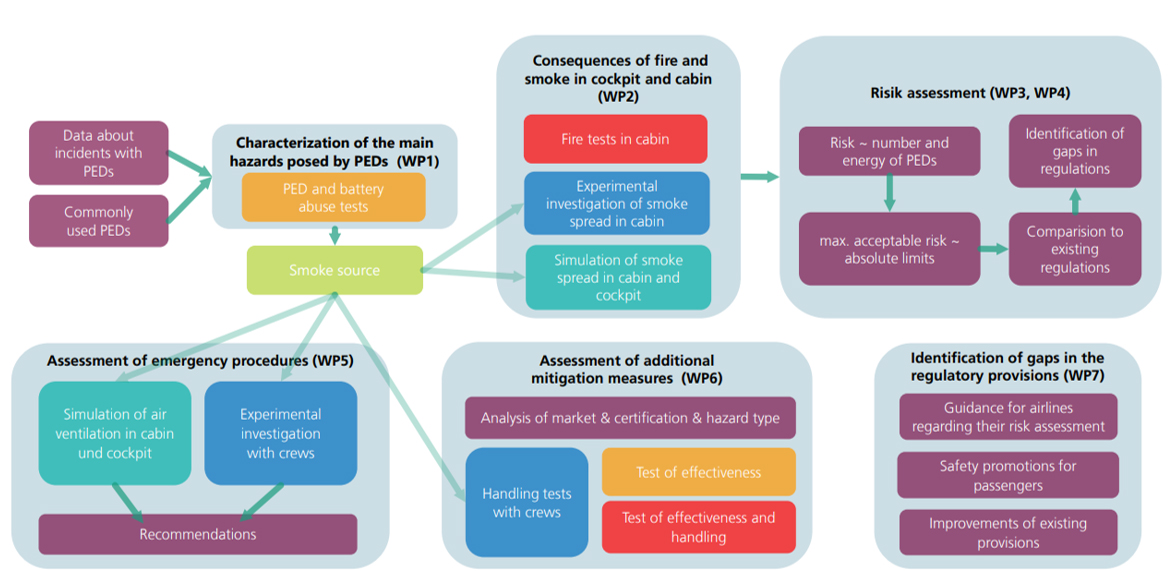
Work packages (WP)
2023
WP1: Characterization of the main hazards posed by lithium batteries and PEDs carried by passengers and aircrew in the cabin
2024
WP2: Evaluation of the consequences of fire and smoke
WP3: Assessment of the limits related to the number of batteries and the battery power / energy
WP4: Comparison of the risk scenarios with the limits established by the applicable regulations
2025
WP5: Assessment of the Cabin emergency procedures.
WP6: Assessment of additional mitigation measures
WP7: Identification of gaps in the regulatory provisions
Tests and Facilities
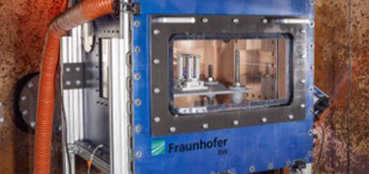
PED and battery abuse
Battery Test Center, Fraunhofer EMI
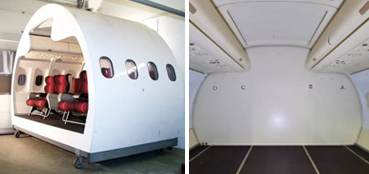
Cabin Fire
A320 Mockup, Fraunhofer EMI & IBP
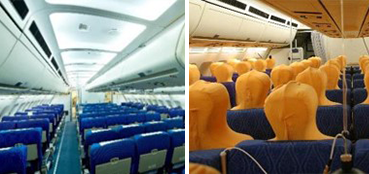
Smoke spread
Flight Test Facility, Fraunhofer IBP
LOKI-PED Project Workshops and Events
As part of the LOKI-PED project, a comprehensive programme of workshops and events was carried out with key stakeholders, including airline risk assessors, cabin crew members and trainers, and manufacturers of additional mitigation measures. These events were held both virtually and in person throughout the project.
In the early phase, participants were invited to share their operational challenges, requirements, and open questions. In the later phase, the workshops focused on presenting the outcomes of the LOKI-PED research, discussing implications for operational practice, and gathering final feedback.
The programme consisted of two main workshop series:
- Additional Mitigation Means Workshops (manufacturers)
- Safety Management & Emergency Procedures Workshops (airlines & cabin crews)
1. Additional Mitigation Means Workshop Series
Target group:
Manufacturers of fire containment devices, extinguishers, and other PED thermal-runaway mitigation solutions.
Purpose:
- Introduce the LOKI-PED project
- Collect product information and testing data
- Evaluate selected mitigation products
- Discuss potential certification pathways
- Share test results and gather feedback
Workshop Overview:
LOKI-PED Introduction:
- Workshop 1: February 6 & 24, 2024
Manufacturer Product Presentation Workshops:
- Workshop 2: June 11, 2024
- Workshop 3: June 18, 2024
- Workshop 4: June 25, 2024
LOKI-PED Test Results Presentation:
- Workshop 5: June 25, 2025
2. Safety Management & Emergency Procedures Workshop Series
Target group:
Airline cabin crews, safety trainers, emergency procedure specialists.
Purpose:
- Present the project and test strategy
- Understand current airline procedures for PED thermal-runaway events
- Evaluate operational mitigation means in realistic cabin scenarios
- Gather crew feedback
- Share results and recommendations
Workshop Overview
LOKI-PED Introduction:
- Workshop 1: April 9, 2025
Test Strategy Presentation:
- Workshop 2: July 9, 2024
Airline Emergency Procedures Presentations:
- Workshop 3: October 29, 2024
- Workshop 4: November 14, 2024
On-Site Handling Test Week:
- March 10–14, 2025
Results Presentation:
- Workshop 5: May 28, 2025
-
Presentation of LOKI-PED at international events
- World Safety and Operations Conference (WSOC) | Hanoi, Vietnam | 19-21/09/2023
- TRIP Summit | London, UK | 10/04/2024
- International Aircraft Materials & Systems Forum Meeting | Bremen, Germany | 17/04/2024
- FAA-EASA International Aviation Safety Conference | Cologne, Germany | 11–13/06/2024
- AIAA AVIATION Forum | Las Vegas, USA | 29/07-02/08/2024
- World Safety and Operations Conference (WSOC) | Marrakech, Morocco | 01-03/10/2024
- ICAO Dangerous Goods Panel | Montreal, Canada | 21-25/10/2024
- AIAA SciTech Forum | Orlando, USA | 06-10/01/2025
- EASA Cabin Safety Expert Group (CSEG) and Dangerous Goods Expert Group (DGEG) | Cologne, Germany | 15/01/2025
- ICAO Dangerous Goods Panel DGP-WG/25 | Delhi, India | 21-25/04/2025
- TRIP Summit | Singapore | 06-08/05/2025
- SAE-S9 Cabin Safety Working Group Meeting | Cologne, Germany | 09-11/09/2025
- International Aircraft Materials and Systems Forum | Long Beach, USA | 9-11/9/2025
- ICAO Cabin Safety Group | Montreal, Canada | 17/09/2025
- EASA National Authorities meeting | Cologne, Germany | 24/09/2025
- EASN conference | Madrid, Spain | 14-17/10/2025
- Airbus - EASA P11 Forum/Workshop (ATA 26 topics) | Cologne, Germany | 4-5/11/2025
- ICAO Dangerous Goods Panel DGP/30 | Montreal, Canada | 6-10/10/2025
- UL5800 - Standard for Safety for Battery Fire Containment Products Conference | 07-09/10/2025
- World Safety and Operations Conference (WSOC) 2025 | Xiamen, China | 14-15/10/2025
- EASA P11 Forum/Workshop (ATA 26) | Cologne, Germany | 04-05/11/2025
- EATS - European Airlines Training Summit | Cascais, Portugal | 04-05/11/2025
- EASA Air OPS TeB Meeting | Cologne, Germany | 18-19/11/2025 (provided online at a later date)
- EASA Cabin Safety Expert Group | Cologne, Germany | 25-26/11/2025
- Cabin Safety Seminar (Norwegian Authority and Operators) | | Bodø, Norway | 3-4/12/2025
- EASA Dangerous Goods Expert Group (DGELG) | Luxemburg | 14-15/01/2026
- Brandschutztag - 19th Conference on Lithium Batteries | Göttingen, Germany | 28/01/2026
Research Project details
 This project will be funded from the European Union's Horizon Europe
research and innovation programme.
At Fraunhofer Gesellschaft
Project manager: Simon Holz, simon.holz [at] emi.fraunhofer.de (simon[dot]holz[at]emi[dot]fraunhofer[dot]de)
Technical lead: Victor Norrefeld, victor.norrefeldt [at] ibp.fraunhofer.de (victor[dot]norrefeldt[at]ibp[dot]fraunhofer[dot]de)
Consortium members
Airbus
At EASA
Project manager: Simone Schwerdorf, simone.schwerdorf [at] easa.europa.eu
Technical lead: Lia Calleja Barcena, lia.calleja-barcena [at] easa.europa.eu
Technical expert: Enzo Canari, enzo.canari [at] easa.europa.eu