
Filters
AMC1 UAM.IDE.MVCA.190 Flight data recorder (FDR)
ED Decision 2025/010/R
FDR OPERATIONAL PERFORMANCE REQUIREMENTS
(a)The operational performance requirements for FDRs should be those laid down in EUROCAE Document 112B dated August 2023, or any later equivalent standard accepted by EASA.
(b)The FDR should, with reference to a timescale, record the parameters established in Table 3 and Table 4, as applicable, and any parameters that have been established during the type certification of the VCA.
Table 3
FDR — VCA
No | Parameter |
1 | Time |
2 | Altitude |
3 | Latitude |
4 | Longitude |
5 | Indicated airspeed or calibrated airspeed |
6 | Ground speed |
7 | Outside air temperature (OAT) |
8 | Heading (magnetic or true) |
9 | Track |
10 | Vertical speed |
11 | Pitch attitude |
12 | Roll attitude |
13 | Longitudinal acceleration (body axis) |
14 | Normal acceleration |
15 | Lateral acceleration |
16 | Roll rate or roll acceleration |
17 | Pitch rate or pitch acceleration |
18 | Yaw rate or yaw acceleration |
19 | Electric engines: |
19a | Rotation speed of each rotor or propeller (in rpm) |
19b | Health status of each electric engine controller |
19c | Temperature of each electric engine |
19d | Temperature of each electric engine controller |
19e | Measured electrical current for each electric engine |
19f | For liquid-cooled electric engines: pressure and temperature of the cooling liquid |
20 | Flight controls: |
20a | Pilot input positions on all axes and corresponding flight control |
20b | Outputs (e.g. target rpm for each electric engine, flight surface positions, etc.) |
21 | Status of each flight control computer |
22 | Wings angle (if applicable) |
23 | Nacelles angle (if applicable) |
24 | Propeller pits (for every variable pitch propeller) |
25 | Air–ground status such as weight on wheels or equivalent parameter |
26 | Alerts (including master warning and master caution status) |
27 | Manual voice transmission keying (if voice communications are used) |
28 | Each battery used for propulsion and/or flight controls: |
28a | Health status |
28b | State of charge (SOC) |
28c | Voltage |
28d | Temperature |
28e | Current flow |
28f | State of power (SOP) (if available) |
28g | Each battery used for propulsion and/or flight controls: calculated remaining flight time (if available) |
29 | Each electrical distribution unit (e.g. distribution units, converters) contributing to the propulsion and/or flight controls: health status |
30 | Status of the battery management system (if any) |
31 | Combustion engines: |
31a | Fuel parameters |
31b | Oil pressure and temperature |
31c | Parameters required to determine propulsive thrust or power delivered |
31d | Turbine rpm (if applicable) |
31e | FADEC health status (if applicable) |
31f | VCA inputs used by the FADEC (if applicable) |
31g | Any electrical current generation |
31h | Any other parameter subject to a limitation |
Table 4
FDR — VCA for which the data source for the parameter is either used by the VCA systems or is available for use by the pilot to operate the VCA
No | Parameter |
1 | Active AFCS mode |
2 | Radio altitude or terrain elevation |
3 | Current navigation source |
4 | Vertical and lateral deviation with respect to the current active navigation path |
5 | DME 1 & 2 distances |
6 | Drift angle |
7 | Wind speed |
8 | Wind direction |
9 | Landing gear position |
10 | Ice: ice detection |
11 | Ice: status of de-icing or anti-icing system |
12 | Electric engine: vibration level |
13 | Traffic advisory or alerts (if applicable) |
14 | Obstacle and terrain alerts (if applicable) |
UAM.IDE.MVCA.191 Flight recorder
Regulation (EU) 2024/1111
(a)A VCA with an MCTOM of 5 700 kg or less shall be equipped with a flight recorder.
(b)The flight recorder shall record by means of flight data and/or images information that is sufficient to determine the flight path and aircraft speed, as well as:
(1)audio from the flight crew compartment in multi-crew and VEMS operations; or
(2)radio communications with air traffic service (ATS) units, where applicable.
(c)The flight recorder shall be capable of retaining the flight data and/or images, as well as audio, recorded during at least the preceding 5 hours.
(d)The flight recorder shall automatically start to record prior to the VCA being capable of moving under its own power and shall stop automatically following lift and thrust units powering off at the end of the flight.
(e)If the flight recorder records images or audio of the flight crew compartment, a function to modify image and audio recordings shall be at the disposal of the PIC, so that the recordings made prior to the operation of that function cannot be retrieved using normal replay or copying techniques.
(f)As an alternative to points (b) and (c), some flight data, images or audio may be transmitted and recorded remotely if approved as part of the aircraft type certification.
AMC1 UAM.IDE.MVCA.191 Flight recorder
ED Decision 2025/010/R
FLIGHT RECORDER OPERATIONAL PERFORMANCE REQUIREMENTS
(a)The flight recorder should record the parameters established in point (b) or point (c) and any other parameters that have been established during the type certification of the VCA.
(b)If the flight recorder records flight data, it should record at least the following parameters:
(1)relative time count;
(2)pitch attitude or pitch rate;
(3)roll attitude or roll rate;
(4)heading (magnetic or true) or yaw rate;
(5)latitude;
(6)longitude;
(7)positioning system: estimated error (if available);
(8)pressure altitude or altitude from a positioning system;
(9)time;
(10)ground speed;
(11)positioning system: track (if available);
(12)normal acceleration;
(13)longitudinal acceleration;
(14)lateral acceleration;
(15)remaining usable amount of fuel/energy; and
(16)amount of fuel/energy necessary to complete the remaining part of the flight, unless the alternative procedure described in AMC1 UAM.OP.VCA.191 is used.
(c)If the flight recorder records images, it should capture views of the main instrument displays at the pilot station(s). The recorded image quality should allow reading the following indications during most of the flight, as applicable:
(1)magnetic or true heading;
(2)time (if presented on the front instrument panel);
(3)pressure altitude;
(4)indicated airspeed;
(5)vertical speed;
(6)slip;
(7)OAT;
(8)attitude (if displayed);
(9)stabilised heading (if displayed);
(10)lift and thrust unit status;
(11)remaining usable amount of fuel/energy; and
(12)amount of fuel/energy necessary to complete the remaining part of the flight, unless the alternative procedure described in AMC1 UAM.OP.VCA.191 is used.
(d)If the flight recorder records a combination of images and flight data, each flight parameter listed in point (b) should be recorded as flight data or by means of images.
(e)The parameters to be recorded as flight data should meet the performance specifications (range, sampling intervals, accuracy limits and resolution in read-out) as defined in the relevant tables of EUROCAE Document 112B ‘Minimum Operational Performance Specification for Crash Protected Airborne Recorder Systems’ or any later equivalent standard accepted by EASA, or EUROCAE Document ED-155 ‘Minimum Operational Performance Specification for Lightweight Flight Recording Systems’, dated July 2009, or any later equivalent standard accepted by EASA.
(f)The operational performance requirements for flight recorders should be those laid down in:
(1)EUROCAE Document ED-155 or any later equivalent standard accepted by EASA for lightweight flight recorders; or
(2)in EUROCAE Document 112B or any later equivalent standard accepted by EASA for crash-protected flight recorders.
GM1 UAM.IDE.MVCA.191 Flight recorder
ED Decision 2025/010/R
Useful guidance material about flight recorders may be found in:
—GM1 CAT.IDE.H.191 as regards additional useful information on lightweight flight recorders;
—GM2 CAT.IDE.H.191 as regards the installation of cameras;
—GM3 CAT.IDE.A.191 as regards recording accuracy of attitude rate parameters;
—GM1 CAT.IDE.A.191(e) as regards the function to modify image and audio recordings.
UAM.IDE.MVCA.200 Flight data and cockpit voice combination recorder
Regulation (EU) 2024/1111
Compliance with the CVR and FDR requirements may be achieved by the carriage of one combination recorder.
GM1 IAM.IDE.MVCA.200 Flight data and cockpit voice combination recorder
ED Decision 2025/010/R
GENERAL
The flight data and cockpit voice combination recorder is a flight recorder which records:
(a)all voice communications and the aural environment as required by point UAM.IDE.MVCA.185 regarding CVRs; and
(b)all the parameters required by point UAM.IDE.MVCA.190 regarding FDRs, with the associated specifications detailed in point UAM.IDE.MVCA.190.
UAM.IDE.MVCA.205 Seats, seat safety belts, restraint systems, and child restraint devices (CRDs)
Regulation (EU) 2024/1111
(a)The VCA shall be equipped with:
(1)a seat or berth for each person on board that is aged 24 months or older;
(2)a seat belt with an upper-torso restraint system for use on each passenger seat and restraining belts on each berth;
(3)a child restraint device (CRD) for each person on board that is younger than 24 months; and
(4)a four-point upper-torso restraint system that includes a seat belt with two shoulder straps, on each pilot seat.
(b)A seat belt with upper-torso restraint system shall:
(1)have a single-point release; and
(2)on the pilot seat, incorporate a device that will automatically restrain the occupant’s torso in the event of rapid deceleration.
AMC1 UAM.IDE.MVCA.205 Seats, seat safety belts, restraint systems and child restraint devices (CRDs)
ED Decision 2025/010/R
CHILD RESTRAINT DEVICES (CRDs)
CRDs should comply with AMC1 CAT.IDE.H.205.
GM1 UAM.IDE.MVCA.205 Seats, seat safety belts, restraint systems and child restraint devices (CRDs)
ED Decision 2025/010/R
UPPER TORSO RESTRAINT SYSTEM
The upper torso restraint system and the seat belt may be used independently.
GM2 UAM.IDE.MVCA.205 Seats, seat safety belts, restraint systems and child restraint devices (CRDs)
ED Decision 2025/010/R
FOUR-POINT UPPER TORSO RESTRAINT SYSTEM
A four-point upper torso restraint system may also be used on passenger seats.
UAM.IDE.MVCA.210 “FASTEN SEAT BELT” and “NO SMOKING” signs
Regulation (EU) 2024/1111
The VCA shall be equipped with a means of indicating to all persons on board when seat belts shall be fastened, and that smoking is not allowed at any time.
AMC1 UAM.IDE.MVCA.210 ‘FASTEN SEAT BELT’ and ‘NO SMOKING’ signs
ED Decision 2025/010/R
PERMANENT SIGNS
If seat belts need to be fastened throughout the flight, a permanent sign is acceptable. Passengers should be instructed accordingly.
UAM.IDE.MVCA.220 First-aid kits
Regulation (EU) 2024/1111
(a)The VCA shall be equipped with at least one first-aid kit.
(b)First-aid kits shall be:
(1)readily accessible for use;
(2)kept up to date.
AMC1 UAM.IDE.MVCA.220 First-aid kits
ED Decision 2025/010/R
CONTENT OF FIRST-AID KITS
(a)First-aid kits should be equipped with appropriate and sufficient medication and tools.
(b)The minimum content of a first-aid kit should comply with points (b)(1), (2) and (3) of AMC1 CAT.IDE.H.220. For local area operations with VCA and for VEMS, the minimum content may comply with such industry standards as approved by the competent authority.
GM1 UAM.IDE.MVCA.220 First-aid kits
ED Decision 2025/010/R
CONTENT OF FIRST-AID KITS
Standard DIN 13164 is found acceptable by EASA for local area flight operations with helicopters. Standard DIN 13164 may be deemed acceptable by the competent authority for local area operations with VCA or for VEMS.
UAM.IDE.MVCA.240 Supplemental oxygen – non-pressurised aircraft
Regulation (EU) 2024/1111
Non-pressurised VCA operated at pressure altitudes above 10 000 ft shall be equipped with supplemental oxygen equipment capable of storing and dispensing oxygen in accordance with the following table:
Table: Minimum requirements regarding supplemental oxygen in non-pressurised aircraft
Supply for: | Flight duration and cabin pressure altitude |
person(s) piloting the aircraft | For the entire flying time at pressure altitudes above 13 000 ft and for any period that exceeds 30 minutes at pressure altitudes above 10 000 ft but not exceeding 13 000 ft. |
100 % of passengers (1) | For the entire flying time at pressure altitudes above 13 000 ft. |
10 % of passengers (1) | For the entire flying time beyond 30 minutes at pressure altitudes above 10 000 ft but not exceeding 13 000 ft. |
(1)Passenger percentages in this table refer to passengers carried on board, including persons younger than 24 months of age.
AMC1 UAM.IDE.MVCA.240 Supplemental oxygen — non-pressurised VCA
ED Decision 2025/010/R
DETERMINATION OF AMOUNT OF OXYGEN
The amount of supplemental oxygen for sustenance for a particular operation should be determined on the basis of flight altitudes and flight duration, consistent with the operating procedures, including emergency procedures, established for each operation and the routes to be flown as specified in the operations manual.
UAM.IDE.MVCA.250 Handheld fire extinguishers
Regulation (EU) 2024/1111
(a)The VCA shall be equipped with at least one handheld fire extinguisher in the flight crew compartment, which shall be readily accessible for use.
(b)At least one handheld fire extinguisher shall be located in the passenger compartment if the handheld fire extinguisher located in the flight crew compartment cannot be easily accessed by the passengers.
(c)The type and quantity of the fire-extinguishing agent of the handheld fire extinguishers shall be suitable for the type of fire likely to occur in the compartment where the handheld fire extinguisher is intended to be used and to minimise the hazard of toxic gas concentration in compartments occupied by persons.
AMC1 UAM.IDE.MVCA.250 Handheld fire extinguishers
ED Decision 2025/010/R
QUANTITY, LOCATION, AVAILABILITY AND TYPES
(a)The quantity and location of handheld fire extinguishers should be such as to provide adequate availability for use in each compartment accessible in flight, account being taken of the need to minimise the hazard of toxic gas concentrations.
(b)Handheld fire extinguishers should be checked to make sure that:
(1)they are in place and secured;
(2)they are charged and pressurised; and
(3)their expiry date has not elapsed.
(c)Unless a handheld fire extinguisher is clearly visible, its location should be indicated by a placard or sign. Appropriate symbols may also be used to complement placards or signs.
(d)Handheld fire extinguishers should be suitable for the types of fire likely to occur in the compartment where they are intended to be used.
(e)Dry chemical fire extinguishers should not be used in the flight crew compartment or in any passenger cabin which is not separated by a partition from the flight crew compartment, because of the adverse effect on vision during discharge and, if conductive, interference with electrical contacts by the chemical residues.
(f)Passengers should be instructed on how to use the handheld fire extinguisher when necessary.
UAM.IDE.MVCA.260 Marking of break-in points
Regulation (EU) 2024/1111
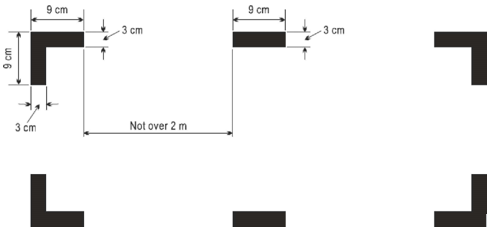
If areas on the VCA’s fuselage that are suitable for break-in by rescue crews in an emergency are marked, such areas shall be marked as shown in the figure below.
AMC1 UAM.IDE.MVCA.260 Marking of break-in points
ED Decision 2025/010/R
MARKINGS — COLOUR AND CORNERS
(a)The colour of the markings should be red or yellow and, if necessary, should be outlined in white to contrast with the background.
(b)If the corner markings are more than 2 m apart, intermediate lines 9 cm × 3 cm should be inserted so that there is no more than 2 m between the adjacent markings.
UAM.IDE.MVCA.275 Emergency lighting and marking
Regulation (EU) 2024/1111
The VCA shall be equipped with:
(a)an emergency lighting system independent of the VCA normal electric power supply to facilitate the evacuation of passengers from the aircraft; and
(b)emergency-exit marking and locating signs visible in daylight, in the dark and in a smoke filled cabin.
AMC1 UAM.IDE.MVCA.275 Emergency lighting and marking
ED Decision 2025/010/R
GENERAL
Compliance with point UAM.IDE.MVCA.275(a) of VCA operating in VFR by day may be achieved by:
(a)a floor proximity emergency escape path marking system, such as photoluminescent strips on the floor or lights on the seats, providing visual guidance along the cabin floor to the emergency exit(s) in darkness or in a smoke-filled cabin; or
(b)for a VCA with a maximum operational passenger seating configuration (MOPSC) of 6 or less, illumination of the instruments or illumination of the emergency-exit marking and locating signs if such illumination provides visual guidance to the emergency exit(s) in darkness and in a smoke-filled cabin and is independent of the VCA normal electric power supply.
UAM.IDE.MVCA.280 Emergency locator transmitters (ELTs)
Regulation (EU) 2024/1111
The VCA shall be equipped (fitted) with at least one approved automatic ELT or, alternatively, with such other approved automatic aircraft tracking device in combination with a locator beacon that shall enable rescue services to be alerted, to reach the accident site and to accurately locate survivors.
AMC1 UAM.IDE.MVCA.280 Emergency locator transmitters (ELTs)
ED Decision 2025/010/R
AUTOMATIC ELT OR AUTOMATIC TRACKING DEVICE
(a)An automatic ELT fitted on the VCA should comply with ETSO-C126b or ETSO-C126c, as applicable according to the date of issue of the individual CofA. First Generation Beacon (FGB) ELTs should be able to transmit an encoded position of the VCA from an internal GNSS receiver.
(b)The airborne system used in order to comply with point UAM.IDE.MVCA.280, when not based on an automatic ELT, should:
(1)be combined with an ELT(S) or a PLB;
(2)comply with the applicable ETSO;
(3)comply with the Certification Specifications for Airborne Communications, Navigation and Surveillance (CS-ACNS) issued by EASA, or equivalent,
and
the transmission service provider should be certified in accordance with Regulation (EU) 2017/373 (the ‘ATM/ANS Regulation’).
(c)The ground part of the VCA tracking system should automatically identify an abnormal lack of position reporting and alert the operator. It should also be capable of automatically transmitting tracking data and alerting signals to search and rescue services.
AMC2 UAM.IDE.MVCA.280 Emergency locator transmitters (ELTs)
ED Decision 2025/010/R
TYPES OF ELT AND GENERAL TECHNICAL SPECIFICATIONS
(a)Point (a) of AMC2 CAT.IDE.H.280 lists the applicable types of ELTs. An ‘automatic ELT’ means an ELT(AF), ELT(AP) or ELT(AD).
(b)To minimise the possibility of damage in the event of crash impact, the automatic ELT should be rigidly fixed to the VCA structure, as far as this is practicable, with its antenna and connections arranged so as to maximise the probability of the signal being transmitted after a crash.
(c)Any ELT carried should operate in accordance with the relevant provisions of ICAO Annex 10 ‘Aeronautical Telecommunications’ Volume III and should be registered with the national agency responsible for initiating search and rescue or any other competent agency.
AMC3 UAM.IDE.MVCA.280 Emergency locator transmitters (ELTs)
ED Decision 2025/010/R
PLB TECHNICAL SPECIFICATIONS
(a)A PLB should have a search and rescue satellite-aided tracking (COSPAS-SARSAT) type approval number. However, devices with a COSPAS-SARSAT number belonging to series 700 are excluded as this series of numbers identifies the special-use beacons not meeting all the technical requirements and all the tests specified by COSPAS-SARSAT.
(b)A First Generation PLB should have a built-in GNSS receiver.
(cAny PLB carried should be registered with the national agency responsible for initiating search and rescue or any other competent agency.
AMC4 UAM.IDE.MVCA.280 Emergency locator transmitters (ELTs)
ED Decision 2025/010/R
BRIEFING ON THE USE OF PLB
When a PLB is carried by a passenger, the PIC should brief that passenger, prior to the flight, on the PLB characteristics and use.
AMC5 UAM.IDE.MVCA.280 Emergency locator transmitters (ELTs)
ED Decision 2025/010/R
ELT AND PLB BATTERIES
(a)All batteries used in ELTs or PLBs should be replaced (or recharged, if the battery is rechargeable) when the equipment has been in use for more than 1 cumulative hour or in the following cases:
(1)Batteries specifically designed for use in ELTs and having an airworthiness release certificate (EASA Form 1 or equivalent) should be replaced or recharged before the end of their useful life in accordance with the maintenance instructions applicable to the ELT.
(2)Standard batteries manufactured in accordance with an industry standard and not having an airworthiness release certificate (EASA Form 1 or equivalent), when used in ELTs, should be replaced or recharged when 50 % of their useful life, as established by the battery manufacturer, has expired.
(3)All batteries used in PLBs should be replaced or recharged when 50 % of their useful life, as established by the battery manufacturer, has expired.
(4)The battery useful life criteria in points (1), (2) and (3) do not apply to batteries (such as water-activated batteries) that are essentially unaffected during probable storage intervals.
(b)The new expiry date for a replaced or recharged battery should be legibly marked on the outside of the equipment.
GM1 UAM.IDE.MVCA.280 Emergency locator transmitters (ELTs)
ED Decision 2025/010/R
AUTOMATIC ELT OR AUTOMATIC TRACKING DEVICE
(a)ETSO-C126b is applicable for VCA first issued with an individual CofA on or before 1 July 2030. ETSO-C126c is applicable for VCA first issued with an individual CofA after 1 July 2030.
(b)A First Generation Beacon (FGB) ELT is an ELT that has been approved in accordance with ETSO-C126b or ETSO-C126c with capability ‘First generation’. A Second Generation Beacon (FGB) ELT is an ELT that has been approved in accordance with ETSO-C126c with capability ‘Second generation’.
(c)A ‘tracking system compliant with the applicable ETSO’ means that it either complies with a particular ETSO or is part of the certified type design definition of the VCA.
UAM.IDE.MVCA.300 Flights over water
Regulation (EU) 2024/1111
(a)A VCA that carries passengers shall be certified:
(1)for ditching, when operated over water in a hostile sea at a distance from land corresponding to more than 10 minutes flying time at normal cruising speed;
(2)for ditching or emergency flotation, when operated over water in a non-hostile sea at a distance from land corresponding to more than 10 minutes flying time at normal cruising speed;
(3)for limited overwater operations, if not meeting the criteria referred to in point (a)(1) or (a)(2), and when one or more of the following conditions apply:
(i)the total flying time over water is longer than 3 minutes;
(ii)the landing or take-off is performed over water.
(b)A VCA that does not carry passengers shall be certified:
(1)for ditching or emergency flotation, when operated over water at a distance from land corresponding to more than 10 minutes flying time at normal cruising speed;
(2)for limited overwater operations, if not meeting the criteria referred to in point (b)(1) and when one or more of the following conditions apply:
(i)the total flying time over water is longer than 3 minutes;
(ii)the landing or take-off is performed over water.
(c)A VCA that operates on water shall be certified for operations on water in addition to meeting the criteria referred to in point (a) or (b).
(d)A VCA that operates on floating surfaces shall be certified for operations on floating surfaces in addition to meeting the criteria referred to in point (a) or (b).
(e)The VCA shall carry a survival ELT (ELT(S)) that is buoyant and can be automatically activated for flights over water, except for limited overwater operations.
AMC1 UAM.IDE.MVCA.300;310;311 Flights over water / Life rafts / Survival equipment
ED Decision 2025/010/R
SURVIVAL ELT (ELT(S))
(a)An ELT(S) is an ELT that can be removed from a VCA. The ELT(S) should be so stowed as to facilitate its ready use in an emergency. The ELT(S) should be activated manually by a survivor or automatically. The automatic activation of an ELT(S) should result from water immersion.
(b)The ELT(S) should be carried:
(1)on a crew member; or
(2)on a passenger or in a life raft; or
(3)adjacent to an emergency exit used for the evacuation of the VCA in an emergency.
(c)An automatic portable ELT (ELT(AP)) may be used to replace one required ELT(S) provided that it meets the ELT(S) requirements. A water-activated ELT(S) is not an ELT(AP).
GM1 UAM.IDE.MVCA.300 Flights over water
ED Decision 2025/010/R
LIMITED OVERWATER OPERATIONS
For limited overwater operations, the term ‘water’ refers to all types of waterbodies, including hostile seas, non-hostile seas, lakes, rivers, etc.
GM2 UAM.IDE.MVCA.300 Flights over water
ED Decision 2025/010/R
TOTAL FLYING TIME
The total flying time is meant to be the cumulative time of all periods during which the VCA is operated over water.
GM3 UAM.IDE.MVCA.300 Flights over water
ED Decision 2025/010/R
LANDING OR TAKE-OFF IS PERFORMED OVER WATER
The condition ‘landing or take-off is performed over water’ may include one of the following:
(a)taking off from or landing at a vertiport, diversion location or VEMS operating site where the take-off or approach path is over water;
(b)landing on or taking off from a fixed or floating platform in the water or a vessel suitable for that purpose.
UAM.IDE.MVCA.305 Life jackets and other equipment
Regulation (EU) 2024/1111
(a)Except as specified in point (c) for flights over water as defined in point UAM.IDE.MVCA.300, the VCA shall be equipped as a minimum with a life jacket for each person on board, stowed in a position that is readily accessible from the seat or berth of the person for whose use it is provided, with the restrain system fastened. If it is not possible to have the life jackets readily accessible with the restrain system fastened, each person shall wear a life jacket on or, if that person is younger than 24 months, an equivalent flotation device.
(b)Each life jacket or equivalent individual flotation device shall be equipped with a means of electric illumination for the purpose of facilitating the location of persons in the water.
(c)For flights over water in a hostile sea at a distance from land corresponding to more than 10 minutes flying time at normal cruising speed, for the purpose of support to activities related to non-renewable and renewable-energy sources and support to vessels:
(1)each person on board shall wear a life jacket during the entire operation unless integrated survival suits that meet the combined requirement of the survival suit and life jacket are worn;
(2)each person on board shall wear a survival suit as appropriate with regard to the water temperature and estimated rescue time; the level of insulation provided shall be sufficient for the prevailing conditions and not excessive;
(3)each person on board shall carry an emergency breathing system (EBS) and shall be instructed in its use.
AMC1 UAM.IDE.MVCA.305 Life jackets and other equipment
ED Decision 2025/010/R
ELECTRIC ILLUMINATION
The means of electric illumination should include a survivor locator light as defined in the applicable ETSO issued by EASA or equivalent.
GM1 UAM.IDE.MVCA.305 Life jackets and other equipment
ED Decision 2025/010/R
SEAT CUSHIONS
Seat cushions are not considered flotation devices.
GM2 UAM.IDE.MVCA.305 Life jackets and other equipment
ED Decision 2025/010/R
SUPPORT ACTIVITIES
Flights referred to in point UAM.IDE.MVCA.305(c) include operations for the purpose of:
—support of offshore oil, gas and mineral exploration, production, storage and transport;
—support to offshore wind turbines and other renewable-energy sources; or
—support to ships, including sea pilot transfer.
UAM.IDE.MVCA.310 Life rafts
Regulation (EU) 2024/1111
(a)The VCA shall be equipped with one or more life rafts for flights over water in a hostile sea area at a distance from land corresponding to more than 10 minutes flying time at normal cruising speed or shall carry at least one life raft stowed so as to facilitate its ready use in an emergency for flights over water in a non-hostile sea at a distance from land corresponding to more than 10 minutes flying time at normal cruising speed. The life rafts shall have sufficient capacity, separately or together, to accommodate all persons carried on board the VCA.
(b)All required life rafts shall allow for their ready use in an emergency.
(c)Each required life raft shall contain at least one ELT(S).
(d)Each required life raft shall be usable in the sea conditions in which the VCA’s ditching, flotation, and trim characteristics have been evaluated for the purpose of certification.
(e)Each required life raft shall contain life-saving equipment, including means of sustaining life, as appropriate to the flight to be undertaken.
AMC1 UAM.IDE.MVCA.310 Life rafts
ED Decision 2025/010/R
LIFE RAFTS AND EQUIPMENT FOR MAKING DISTRESS SIGNALS
(a)Each required life raft should conform to the following specifications:
(1)should be of an approved design and stowed so as to facilitate its readily use in an emergency;
(2)should be radar conspicuous to standard airborne radar equipment.
(b)In addition to the specifications under point (a):
(1)when carrying more than one life raft on board, at least 50 % should be deployable by the crew while seated at their normal station, where necessary by remote control; and
(2)life rafts that are not deployable by remote control or by the crew should be of such weight as to permit their handling by one person. 40 kg should be considered a maximum weight.
(c)Each required life raft should contain at least the following:
(1)one approved survivor locator light;
(2)one approved visual signalling device;
(3)one canopy (for use as a sail, sunshade or rain catcher) or other means to protect occupants from the elements;
(4)one radar reflector;
(5)one 20-m retaining line designed to hold the life raft near the VCA but to release it if the VCA becomes totally submerged;
(6)one sea anchor;
(7)one survival kit, appropriately equipped for the route to be flown, which should contain at least the following:
(i)one life raft repair kit;
(ii)one bailing bucket;
(iii)one signalling mirror;
(iv)one police whistle;
(v)one buoyant raft knife;
(vi)one supplementary means of inflation;
(vii)sea sickness tablets;
(viii)one first-aid kit;
(ix)one portable means of illumination;
(x)500 ml of pure water and one sea water desalting kit; and
(xi)one comprehensive illustrated survival booklet in an appropriate language.
UAM.IDE.MVCA.311 Survival equipment
Regulation (EU) 2024/1111
(a)A VCA operated over areas where search and rescue would be particularly difficult shall be equipped with:
(1)signalling equipment to make distress signals;
(2)at least one ELT(S); and
(3)additional survival equipment for the route to be flown taking into account the number of persons on board.
AMC1 UAM.IDE.MVCA.311 Survival equipment
ED Decision 2025/010/R
ADDITIONAL SURVIVAL EQUIPMENT
(a)The following additional survival equipment should be carried when required:
(1)500 ml of water for each 4, or fraction of 4, persons on board;
(2)one knife;
(3)first-aid equipment; and
(4)one set of air/ground codes.
(b)If any item of equipment contained in the above list is already carried on board the VCA in accordance with another requirement, there is no need for the list to be duplicated.
GM1 UAM.IDE.MVCA.311 Survival equipment
ED Decision 2025/010/R
SIGNALLING EQUIPMENT
The signalling equipment for making distress signals is described in ICAO Annex 2 ‘Rules of the Air’.
GM2 UAM.IDE.MVCA.311 Survival equipment
ED Decision 2025/010/R
AREAS WHERE SEARCH AND RESCUE WOULD BE PARTICULARLY DIFFICULT
The phrase ‘areas in which search and rescue would be particularly difficult’ means:
(a)areas so designated by the authority responsible for managing search and rescue; or
(b)areas that are largely uninhabited and where:
(1)the authority referred to in point (a) has not published any information to confirm whether search and rescue would or would not be particularly difficult; and
(2)the authority referred to in point (a) does not, as a matter of policy, designate areas as being particularly difficult for search and rescue.
UAM.IDE.MVCA.315 Equipment for on-water operations
Regulation (EU) 2024/1111
(a)A VCA certified for operating on water shall be equipped with:
(1)a sea anchor and other equipment necessary to facilitate mooring, anchoring or manoeuvring the VCA on water, appropriate to its size, weight and handling characteristics; and
(2)equipment for making the sound signals prescribed in the International Regulations for Preventing Collisions at Sea, where applicable.
GM1 UAM.IDE.MVCA.315 Equipment for on-water operations
ED Decision 2025/010/R
INTERNATIONAL REGULATIONS FOR PREVENTING COLLISIONS AT SEA
The International Regulations for Preventing Collisions at Sea are those that were published by the International Maritime Organization (IMO) in 1972.
UAM.IDE.MVCA.325 Headsets
Regulation (EU) 2024/1111
The VCA shall be equipped with a headset with boom microphone or equivalent and a transmit button on the flight controls for each pilot of the VCA at their assigned station.
AMC1 UAM.IDE.MVCA.325 Headsets
ED Decision 2025/010/R
GENERAL
(a)A headset consists of a communication device that includes two earphones to receive and a microphone to transmit audio signals to the VCA communication system. To comply with the minimum performance requirements, both the earphones and the microphone should match the communication system’s characteristics and the cockpit environment. The headset should be adequately adjustable in order to fit the pilot’s head. Headset boom microphones should be of the noise-cancelling type.
(b)If the intention is to utilise noise-cancelling earphones, the operator should ensure that the earphones do not attenuate any aural warnings or sounds necessary for alerting the flight crew on matters related to the safe operation of the VCA.
GM1 UAM.IDE.MVCA.325 Headsets
ED Decision 2025/010/R
GENERAL
The term ‘headset’ includes any aviation helmet incorporating headphones and microphone worn by a flight crew member.
UAM.IDE.MVCA.330 Radio communication equipment
Regulation (EU) 2024/1111
(a)The VCA shall be equipped with at least one radio communication system connected to the aircraft’s primary power supply and as many more radio communication systems as necessary for the type of operation to be conducted and the class(es) of airspace in which the operation shall take place.
(b)The radio communication equipment shall allow flight crews under normal operating conditions to:
(1)communicate with appropriate ground stations from any point on the route, including diversions;
(2)communicate with appropriate ATC stations from any point in controlled airspace within which flights are intended to be operated; and
(3)receive meteorological information.
(c)The radio communication equipment shall allow for communication on the 121,5 MHz aeronautical emergency frequency.
UAM.IDE.MVCA.345 Navigation equipment
Regulation (EU) 2024/1111
(a)The VCA shall be equipped with navigation equipment for flights in accordance with VFR by day and in accordance with the applicable airspace requirements.
(b)The VCA shall be equipped with sufficient navigation equipment to ensure that, in the event of failure of one item of equipment at any phase of the flight, the remaining equipment shall allow for safe navigation in accordance with the flight plan.
GM1 UAM.IDE.MVCA.345 Navigation equipment
ED Decision 2025/010/R
APPLICABLE AIRSPACE REQUIREMENTS
The applicable airspace requirements are those contained in Commission Implementing Regulation (EU) 2023/1770 of 12 September 2023 laying down provisions on aircraft equipment required for the use of the Single European Sky airspace and operating rules related to the use of the Single European Sky airspace and repealing Regulation (EC) No 29/2009 and Implementing Regulations (EU) No 1206/2011, (EU) No 1207/2011 and (EU) No 1079/2012120.
UAM.IDE.MVCA.350 Transponders
Regulation (EU) 2024/1111
When required by the class of airspace being flown, the VCA operated under VFR by day shall be equipped with a secondary surveillance radar (SSR) transponder with all the required capabilities.
GM1 UAM.IDE.MVCA.350 Transponders
ED Decision 2025/010/R
SSR TRANSPONDER
The requirements for the carriage and operation of SSR transponders according to the class of airspace being flown, relevant for VFR operations by day, are those contained in Regulation (EU) No 923/2012.
UAM.IDE.MVCA.355 Management of aeronautical databases
Regulation (EU) 2024/1111
(a)The IAM operator shall:
(1)ensure that the aeronautical databases to be used on certified aircraft system applications meet the data quality requirements that are adequate for the intended use of the data;
(2)ensure the timely distribution and update of current and unaltered aeronautical databases to all aircraft that require them;
(3)report to the database provider instances of erroneous, inconsistent or missing data that might be reasonably expected to constitute a hazard to flight, notwithstanding any other occurrence-reporting requirements as defined in Regulation (EU) No 376/2014. In such cases, the IAM operator shall inform all personnel concerned, and shall ensure that the affected data is not used.
AMC1 UAM.IDE.MVCA.355 Management of aeronautical databases
ED Decision 2025/010/R
AERONAUTICAL DATABASES
When a VCA operator uses an aeronautical database that supports an airborne navigation application as a primary means of navigation used to meet the airspace usage requirements, the database provider should be a Type 2 DAT provider certified in accordance with Regulation (EU) 2017/373 or equivalent.
AMC2 UAM.IDE.MVCA.355 Management of aeronautical databases
ED Decision 2025/010/R
TIMELY DISTRIBUTION OF AERONAUTICAL DATABASES
The operator should distribute current and unaltered aeronautical databases to all VCA that require them in accordance with the validity period of the databases or, if no validity period is defined, in accordance with a procedure established in the operations manual.
GM1 UAM.IDE.MVCA.355 Management of aeronautical databases
ED Decision 2025/010/R
AERONAUTICAL DATABASE APPLICATIONS
(a)Applications using aeronautical databases for which Type 2 DAT providers should be certified in accordance with Regulation (EU) 2017/373 may be found in GM1 DAT.OR.100 of the AMC & GM to Part-DAT of that Regulation.
(b)The certification of a Type 2 DAT provider in accordance with Regulation (EU) 2017/373 ensures data integrity and compatibility with the certified VCA application/equipment.