
Filters
CAT.IDE.A.220 First-aid kit
Regulation (EU) No 965/2012
(a)Aeroplanes shall be equipped with first-aid kits, in accordance with Table 1.
Table 1
Number of first-aid kits required
Number of passenger seats installed | Number of first-aid kits required |
0-100 | 1 |
101-200 | 2 |
201-300 | 3 |
301-400 | 4 |
401-500 | 5 |
501 or more | 6 |
(b)First-aid kits shall be:
(1)readily accessible for use; and
(2)kept up to date.
AMC1 CAT.IDE.A.220 First-aid kit
ED Decision 2021/005/R
CONTENT OF FIRST-AID KITS
(a)First-aid kits should be equipped with appropriate and sufficient medications and instrumentation. However, these kits should be supplemented by the operator according to the characteristics of the operation (scope of operation, flight duration, number and demographics of passengers, number of decks, etc.).
(b)The following should be included in the first-aid kit:
(1)Equipment
(i)bandages (assorted sizes, including a triangular bandage);
(ii)burns dressings (unspecified);
(iii)wound dressings (large and small);
(iv)adhesive dressings (assorted sizes);
(v)adhesive tape;
(vi)adhesive wound closures;
(vii)safety pins;
(viii)safety scissors;
(ix)antiseptic wound cleaner;
(x)disposable resuscitation aid;
(xi)disposable gloves;
(xii)tweezers: splinter;
(xiii)thermometers (non-mercury); and
(xiv)surgical masks.
(2)Medications
(i)simple analgesic (including paediatric form);
(ii)antiemetic — non-injectable (including paediatric form);
(iii)nasal decongestant;
(iv)gastrointestinal antacid, in the case of aeroplanes carrying more than 9 passengers;
(v)anti-diarrhoeal medication, in the case of aeroplanes carrying more than 9 passengers; and
(vi)antihistamine (including paediatric form).
(3)Other content. The operator should make the instructions readily available. If an electronic format is available, then all instructions should be kept on the same device. If a paper format is used, then the instructions should be kept in the same kit with the applicable equipment and medication. The instructions should include, as a minimum, the following:
(i)a list of contents in at least two languages (English and one other). This should include information on the effects and side effects of medications carried;
(ii)first-aid handbook, current edition;
(iii)Basic life support instructions cards (summarising and depicting the current algorithm for basic life support); and
(iv)medical incident report form.
(4)Additional equipment. The following additional equipment should be carried on board each aircraft equipped with a first-aid kit, though not necessarily in the first-aid kit. When operating multi-deck aircraft, operators should assess if the additional equipment is needed on each deck. The additional equipment should include, as a minimum:
(i)automated external defibrillator (AED) on all aircraft required to carry at least one cabin crew;
(ii)bag-valve masks (masks in three sizes: one for adults, one for children, and one for infants);
(iii)suitable airway management device (e.g. supraglottic airway devices, oropharyngeal or nasopharyngeal airways);
(iv)eye irrigator;
(v)biohazard disposal bags; and
(vi)basic delivery kit (including sterile umbilical cord scissors and a pair of cord clamps) on all aircraft required to carry at least one cabin crew.
AMC2 CAT.IDE.A.220 First-aid kit
ED Decision 2014/015/R
MAINTENANCE OF FIRST-AID KITS
To be kept up to date, first-aid kits should be:
(a)inspected periodically to confirm, to the extent possible, that contents are maintained in the condition necessary for their intended use;
(b)replenished at regular intervals, in accordance with instructions contained on their labels, or as circumstances warrant; and
(c)replenished after use in-flight at the first opportunity where replacement items are available.
GM1 CAT.IDE.A.220 First-aid kit
ED Decision 2021/005/R
LOCATION
The location of the first-aid kit in the cabin is normally indicated using internationally recognisable signs.
GM2 CAT.IDE.A.220 First-aid kit
ED Decision 2021/005/R
STORAGE
As a best practice and wherever practicable, the emergency medical equipment listed under AMC1 CAT.IDE.A.220 should be kept close together.
GM3 CAT.IDE.A.220 First-aid kit
ED Decision 2021/005/R
CONTENT OF FIRST-AID KITS
The operator may supplement first-aid kits according to the characteristics of the operation based on a risk assessment. The assessment does not require an approval by the competent authority.
GM4 CAT.IDE.A.220 First-aid kit
ED Decision 2021/005/R
LITHIUM BATTERIES
Risks related to the presence of lithium batteries should be assessed. All equipment powered by lithium batteries carried on an aeroplane should comply with the provisions of AMC1 CAT.GEN.MPA.140(f) including applicable technical standards such as (E)TSO-C142.
CAT.IDE.A.225 Emergency medical kit
Regulation (EU) No 965/2012
(a)Aeroplanes with an MOPSC of more than 30 shall be equipped with an emergency medical kit when any point on the planned route is more than 60 minutes flying time at normal cruising speed from an aerodrome at which qualified medical assistance could be expected to be available.
(b)The commander shall ensure that drugs are only administered by appropriately qualified persons.
(c)The emergency medical kit referred to in (a) shall be:
(1)dust and moisture proof;
(2)carried in a way that prevents unauthorised access; and
(3)kept up to date.
AMC1 CAT.IDE.A.225 Emergency medical kit
ED Decision 2021/005/R
CONTENT OF EMERGENCY MEDICAL KITS
(a)Emergency medical kits should be equipped with appropriate and sufficient medications and instrumentation. However, these kits should be supplemented by the operator according to the characteristics of the operation (scope of operation, flight duration, number and demographics of passengers, number of decks, etc.).
(b)The following should be included in the emergency medical kit:
(1)Equipment
(i)sphygmomanometer — electronic recommended;
(ii)stethoscope;
(iii)syringes and needles;
(iv)intravenous cannulae (a sufficient supply of intravenous cannulae should be available, subject to the amount of intravenous fluids carried on board);
(v)tourniquet;
(vi)disposable gloves;
(vii)needle disposal box;
(viii)one or more urinary catheter(s), appropriate for either sex, and anaesthetic gel;
(ix)aspirator;
(x)blood glucose testing equipment;
(xi)scalpel;
(xii)pulse oximeter; and
(xiii)pneumothorax set.
(2)Instructions: the instructions should contain a list of contents (medications in trade names and generic names) in at least two languages (English and one other). This should include information on the effects and side effects of medications carried. There should also be basic instructions for use of the medications in the kit and guidance for conversion of units for the blood glucose test. The operator should make the instructions readily available. If an electronic format is available, then all instructions should be kept on the same device. If a paper format is used, then the instructions should be kept in the same kit with the applicable equipment and medication.
(3)Medications
(i)coronary vasodilator e.g. glyceriltrinitrate-oral;
(ii)antispasmodic;
(iii)epinephrine/adrenaline 1:1 000;
(iv)adrenocorticoid;
(v)major analgesic;
(vi)diuretic — injectable;
(vii)antihistamine — oral and injectable (including paediatric form);
(viii)sedative/anticonvulsant — oral plus injectable and/or rectal sedative;
(ix)medication for hypoglycaemia (e.g. hypertonic glucose);
(x)antiemetic — injectable;
(xi)antibiotic — injectable form — Ceftriaxone or Cefotaxime;
(xii)bronchial dilator — inhaled (disposable collapsible spacer);
(xiii)IV fluids in appropriate quantity e.g. sodium chloride 0.9 % (minimum 250 ml); and
(xiv)acetylsalicylic acid — oral — for coronary use.
AMC2 CAT.IDE.A.225 Emergency medical kit
ED Decision 2017/008/R
CARRIAGE UNDER SECURE CONDITIONS
The emergency medical kit should be kept either in the flight crew compartment or in another secure location in the cabin that prevents unauthorised access to it.
AMC3 CAT.IDE.A.225 Emergency medical kit
ED Decision 2021/005/R
ACCESS TO THE EMERGENCY MEDICAL KIT
(a)When the actual situation on board so requires, the commander should limit access to the emergency medical kit.
(b)Drugs should be administered by medical doctors, qualified nurses, paramedics or emergency medical technicians.
(c)Medical students, student paramedics, student emergency medical technicians or nurses aides should only administer drugs if no person mentioned in (b) is on board the flight and appropriate advice has been received.
(d)Whenever allowed under the operator’s national legislation, drugs may be administered by suitably trained persons, other than medical doctors.
(e)Oral drugs should not be denied in medical emergency situations where no medically qualified persons are on board the flight.
AMC4 CAT.IDE.A.225 Emergency medical kit
ED Decision 2014/015/R
MAINTENANCE OF EMERGENCY MEDICAL KIT
To be kept up to date, the emergency medical kit should be:
(a)inspected periodically to confirm, to the extent possible, that the contents are maintained in the condition necessary for their intended use;
(b)replenished at regular intervals, in accordance with instructions contained on their labels, or as circumstances warrant; and
(c)replenished after use-in-flight at the first opportunity where replacement items are available.
GM1 CAT.IDE.A.225 Emergency medical kit
ED Decision 2017/008/R
SECURE LOCATION
‘Secure location’ refers to a location in the cabin that is not intended for the use by passengers and preferably to which passengers do not have access.
GM2 CAT.IDE.A.225 Emergency medical kit
ED Decision 2021/005/R
CONTENT OF EMERGENCY MEDICAL KITS
The operator may supplement emergency medical kits according to the characteristics of the operation based on a risk assessment. The assessment does not require an approval by the competent authority.
GM3 CAT.IDE.A.225 Emergency medical kit
ED Decision 2021/005/R
LITHIUM BATTERIES
Risks related to the presence of lithium batteries should be assessed. All equipment powered by lithium batteries carried on an aeroplane should comply with the provisions of AMC1 CAT.GEN.MPA.140(f) including applicable technical standards such as (E)TSO-C142.
CAT.IDE.A.230 First-aid oxygen
Regulation (EU) 2019/1387
(a)Pressurised aeroplanes operated at pressure altitudes above 25 000 ft, in the case of operations for which a cabin crew member is required, shall be equipped with a supply of undiluted oxygen for passengers who, for physiological reasons, might require oxygen following a cabin depressurisation.
(b)The oxygen supply referred to in (a) shall be sufficient for the remainder of the flight after cabin depressurisation when the cabin altitude exceeds 8 000 ft but does not exceed 15 000 ft, for at least 2 % of the passengers carried, but in no case for less than one person.
(c)There shall be a sufficient number of dispensing units, but in no case less than two, with a means for cabin crew to use the supply.
(d)The first-aid oxygen equipment shall be capable of generating a mass flow to each person.
GM1 CAT.IDE.A.230 First-aid oxygen
ED Decision 2021/005/R
GENERAL
(a)First-aid oxygen is intended for those passengers who still need to breath oxygen when the amount of supplemental oxygen required under CAT.IDE.A.235 or CAT.IDE.A.240 has been exhausted.
(b)When calculating the amount of first-aid oxygen, the operator should take into account the fact that, following a cabin depressurisation, supplemental oxygen as calculated in accordance with Table 1 of CAT.IDE.A.235 and Table 1 of CAT.IDE.A.240 should be sufficient to cope with potential effects of hypoxia for:
(1)all passengers when the cabin altitude is above 15 000 ft;
(2)at least 30 % of the passengers, for any period when, in the event of loss of pressurisation and taking into account the circumstances of the flight, the pressure altitude in the passenger compartment will be between 14 000 ft and 15 000 ft; and
(3)at least 10 % of the passengers for any period in excess of 30 minutes when the pressure altitude in the passenger compartment will be between 10 000 ft and 14 000 ft.
(c)For the above reasons, the amount of first-aid oxygen should be calculated for the part of the flight after cabin depressurisation during which the cabin altitude is between 8 000 ft and 15 000 ft, when supplemental oxygen may no longer be available.
(d)Moreover, following cabin depressurisation, an emergency descent should be carried out to the lowest altitude compatible with the safety of the flight. In addition, in these circumstances, the aeroplane should land at the first available aerodrome at the earliest opportunity.
(e)The conditions above may reduce the period of time during which the first-aid oxygen may be required and consequently may limit the amount of first-aid oxygen to be carried on board.
AMC1 CAT.IDE.A.230(d) First-aid oxygen
ED Decision 2021/005/R
GENERAL
(a)The mass flow of oxygen should be in accordance with CS-25.1443 or equivalent.
(b)The oxygen supply may be calculated by assuming an average flow rate of at least 3 litres standard temperature pressure dry (STPD)/minute/person, or equivalent, as demonstrated during the certification of the dispensing unit.
CAT.IDE.A.235 Supplemental oxygen – pressurised aeroplanes
Regulation (EU) No 965/2012
(a)Pressurised aeroplanes operated at pressure altitudes above 10 000 ft shall be equipped with supplemental oxygen equipment that is capable of storing and dispensing the oxygen supplies in accordance with Table 1.
(b)Pressurised aeroplanes operated at pressure altitudes above 25 000 ft shall be equipped with:
(1)quick donning types of masks for flight crew members;
(2)sufficient spare outlets and masks or portable oxygen units with masks distributed evenly throughout the passenger compartment, to ensure immediate availability of oxygen for use by each required cabin crew member;
(3)an oxygen dispensing unit connected to oxygen supply terminals immediately available to each cabin crew member, additional crew member and occupants of passenger seats, wherever seated; and
(4)a device to provide a warning indication to the flight crew of any loss of pressurisation.
(c)In the case of pressurised aeroplanes first issued with an individual CofA after 8 November 1998 and operated at pressure altitudes above 25 000 ft, or operated at pressure altitudes at, or below 25 000 ft under conditions that would not allow them to descend safely to 13 000 ft within four minutes, the individual oxygen dispensing units referred to in (b)(3) shall be automatically deployable.
(d)The total number of dispensing units and outlets referred to in (b)(3) and (c) shall exceed the number of seats by at least 10 %. The extra units shall be evenly distributed throughout the passenger compartment.
(e)Notwithstanding (a), the oxygen supply requirements for cabin crew member(s), additional crew member(s) and passenger(s), in the case of aeroplanes not certified to fly at altitudes above 25 000 ft, may be reduced to the entire flying time between 10 000 ft and 13 000 ft cabin pressure altitudes for all required cabin crew members and for at least 10 % of the passengers if, at all points along the route to be flown, the aeroplane is able to descend safely within four minutes to a cabin pressure altitude of 13 000 ft.
(f)The required minimum supply in Table 1, row 1 item (b)(1) and row 2, shall cover the quantity of oxygen necessary for a constant rate of descent from the aeroplane’s maximum certified operating altitude to 10 000 ft in 10 minutes and followed by 20 minutes at 10 000 ft.
(g)The required minimum supply in Table 1, row 1 item 1(b)(2), shall cover the quantity of oxygen necessary for a constant rate of descent from the aeroplane’s maximum certified operating altitude to 10 000 ft in 10 minutes followed by 110 minutes at 10 000 ft.
(h)The required minimum supply in Table 1, row 3, shall cover the quantity of oxygen necessary for a constant rate of descent from the aeroplane’s maximum certified operating altitude to 15 000 ft in 10 minutes.
Table 1
Oxygen minimum requirements for pressurised aeroplanes
Supply for | Duration and cabin pressure altitude |
1. Occupants of flight crew compartment seats on flight crew compartment duty | (a)The entire flying time when the cabin pressure altitude exceeds 13 000 ft. (b)The remainder of the flying time when the cabin pressure altitude exceeds 10 000 ft but does not exceed 13 000 ft, after the initial 30 minutes at these altitudes, but in no case less than: (1)30 minutes’ supply for aeroplanes certified to fly at altitudes not exceeding 25 000 ft; and (2)2 hours’ supply for aeroplanes certified to fly at altitudes of more than 25 000 ft. |
2. Required cabin crew members | (a)The entire flying time when the cabin pressure altitude exceeds 13 000 ft, but not less than 30 minutes’ supply. (b)The remainder of the flying time when the cabin pressure altitude exceeds 10 000 ft but does not exceed 13 000 ft, after the initial 30 minutes at these altitudes. |
3. 100 % of passengers(1) | The entire flying time when the cabin pressure altitude exceeds 15 000 ft, but in no case less than 10 minutes’ supply. |
4. 30 % of passengers(1) | The entire flying time when the cabin pressure altitude exceeds 14 000 ft but does not exceed 15 000 ft. |
5. 10 % of passengers(1) | The remainder of the flying time when the cabin pressure altitude exceeds 10 000 ft but does not exceed 14 000 ft, after the initial 30 minutes at these altitudes. |
(1) Passenger numbers in Table 1 refer to passengers actually carried on board, including persons younger than 24 months. | |
AMC1 CAT.IDE.A.235 Supplemental oxygen – pressurised aeroplanes
ED Decision 2014/015/R
DETERMINATION OF OXYGEN
(a)In the determination of the amount of supplemental oxygen required for the routes to be flown, it is assumed that the aeroplane will descend in accordance with the emergency procedures specified in the operations manual, without exceeding its operating limitations, to a flight altitude that will allow the flight to be completed safely (i.e. flight altitudes ensuring adequate terrain clearance, navigational accuracy, hazardous weather avoidance, etc.).
(b)The amount of supplemental oxygen should be determined on the basis of cabin pressure altitude, flight duration and on the assumption that a cabin pressurisation failure will occur at the pressure altitude or point of flight that is most critical from the standpoint of oxygen need.
(c)Following a cabin pressurisation failure, the cabin pressure altitude should be considered to be the same as the aeroplane pressure altitude unless it can be demonstrated to the competent authority that no probable failure of the cabin or pressurisation system will result in a cabin pressure altitude equal to the aeroplane pressure altitude. Under these circumstances, the demonstrated maximum cabin pressure altitude may be used as a basis for determination of oxygen supply.
AMC2 CAT.IDE.A.235 Supplemental oxygen – pressurised aeroplanes
ED Decision 2014/015/R
OXYGEN REQUIREMENTS FOR FLIGHT CREW COMPARTMENT SEAT OCCUPANTS AND CABIN CREW IN ADDITION TO THE REQUIRED MINIMUM NUMBER OF CABIN CREW
(a)For the purpose of supplemental oxygen supply, flight crew compartment seat occupants who are:
(1)supplied with oxygen from the flight crew source of oxygen should be considered as flight crew members; and
(2)not supplied with oxygen by the flight crew source of oxygen should be considered as passengers.
(b)Cabin crew members in addition to the minimum number of cabin crew and additional crew members should be considered as passengers for the purpose of supplemental oxygen supply.
GM1 CAT.IDE.A.235(b)(1) Supplemental oxygen – pressurised aeroplanes
ED Decision 2014/015/R
QUICK DONNING MASKS
A quick donning mask is a type of mask that:
(a)can be placed on the face from its ready position, properly secured, sealed and supplying oxygen upon demand, with one hand and within 5 seconds and will thereafter remain in position, both hands being free;
(b)can be donned without disturbing eye glasses and without delaying the flight crew member from proceeding with assigned emergency duties;
(c)once donned, does not prevent immediate communication between the flight crew members and other crew members over the aircraft intercommunication system; and
(d)does not inhibit radio communications.
AMC1 CAT.IDE.A.235(c) Supplemental oxygen – pressurised aeroplanes
ED Decision 2017/004/R
AEROPLANES WITHOUT AUTOMATIC DEPLOYABLE OXYGEN-DISPENSING UNITS
(a)For operations approved in accordance with Subpart L (SET-IMC) of Annex V (Part-SPA) to Regulation (EU) No 965/2012 with aeroplanes first issued with an individual certificate of airworthiness (CofA) after 8 November 1998, operated at pressure altitudes at or below 25 000 ft, and not fitted with automatic deployable oxygen-dispensing units, the flight crew should manage the descent in case of a loss of power in order to ensure that the cabin pressure altitude is not higher that 13 000 ft for more than 4 min.
(b)The operator should specify in the operations manual (OM) the aircraft capability in terms of cabin pressure leak rate in case of engine power loss, as well as the relevant procedures.
GM1 CAT.IDE.A.235(c) Supplemental oxygen – pressurised aeroplanes
ED Decision 2017/004/R
AEROPLANES WITHOUT AUTOMATIC DEPLOYABLE OXYGEN-DISPENSING UNITS
For operations approved in accordance with Subpart L (SET-IMC) of Annex V (Part-SPA) to Regulation (EU) No 965/2012, should a loss of engine power occur, it is required that sufficient supplemental oxygen for all occupants is available to allow descent from the maximum certified cruising altitude, performed at the best-range gliding speed and in the best gliding configuration, assuming the maximum cabin pressure leak rate, during the entire flying time when the cabin pressure altitude exceeds 13 000 ft.
In the case of pressurised aeroplanes first issued with an individual certificate of airworthiness (CofA) after 8 November 1998, with a maximum certified cruising altitude above 25 000 ft, and not fitted with automatically deployable oxygen-dispensing units, the amount of supplemental oxygen should be based on a cruising altitude of 25 000 ft as CAT.IDE.A.235(c) limits the operations of such aeroplanes to the aforementioned altitude.
For such single-engined turbine aeroplanes, with the energy source of the pressurisation system being lost (this is at least the case of pressurisation systems relying on bleed air inflow), the cabin pressure altitude increases at a rate dependent upon the pressurisation system design and the cabin pressure leak rate.
Therefore, following an engine failure during such operations, the cabin pressure altitude will remain below 13 000 ft for a certain duration, which should allow the flight crew to descend at the best gliding speed during this period.
The intent of the CAT.IDE.A.235(c) requirement is to ensure that this does not result in any unsafe conditions for the passengers, as the cabin pressure altitude might increase above 13 000 ft, as well as not jeopardise the safety of operations approved in accordance with Subpart L (SET-IMC) of Annex V (Part-SPA) to Regulation (EU) No 956/2012 by maximising the chances of reaching an appropriate landing site.
AMC1 CAT.IDE.A.235(e) Supplemental oxygen – pressurised aeroplanes
ED Decision 2014/015/R
AEROPLANES NOT CERTIFIED TO FLY ABOVE 25 000 ft
(a)With respect to CAT.IDE.A.235(e), the maximum altitude up to which an aeroplane can operate without a passenger oxygen system being installed and capable of providing oxygen to each cabin occupant, should be established using an emergency descent profile that takes into account the following conditions:
(1)17 seconds’ time delay for pilot’s recognition and reaction, including mask donning, for trouble shooting and configuring the aeroplane for the emergency descent (emergency descent data/charts established by the aeroplane manufacturer and published in the aircraft flight manual (AFM), and/or the AFM should be used to ensure uniform application of the option); and
(2)maximum operational speed (VMO) or the airspeed approved in the AFM for emergency descent, (emergency descent data/charts established by the aeroplane manufacturer and published in the AFM, and/or AFM should be used to ensure uniform application of the option), whichever is the less;
(b)On routes where oxygen is necessary to be carried for 10 % of the passengers for the flight time between 10 000 ft and 13 000 ft, the oxygen should be provided either by:
(1)a plug-in or drop-out oxygen system with sufficient outlets and dispensing units uniformly distributed throughout the cabin so as to provide oxygen to each passenger at his/her own discretion when seated on his/her assigned seat; or
(2)portable bottles, when a cabin crew member is required on board such flight.
CAT.IDE.A.240 Supplemental oxygen – non-pressurised aeroplanes
Regulation (EU) No 965/2012
Non-pressurised aeroplanes operated at pressure altitudes above 10 000 ft shall be equipped with supplemental oxygen equipment capable of storing and dispensing the oxygen supplies in accordance with Table 1.
Table 1
Oxygen minimum requirements for non-pressurised aeroplanes
Supply for | Duration and cabin pressure altitude |
1. Occupants of flight crew compartment seats on flight crew compartment duty and crew members assisting flight crew in their duties | The entire flying time at pressure altitudes above 10 000 ft. |
2. Required cabin crew members | The entire flying time at pressure altitudes above 13 000 ft and for any period exceeding 30 minutes at pressure altitudes above 10 000 ft but not exceeding 13 000 ft. |
3. Additional crew members and 100 % of passengers(1) | The entire flying time at pressure altitudes above 13 000 ft. |
4. 10 % of passengers(1) | The entire flying time after 30 minutes at pressure altitudes above 10 000 ft but not exceeding 13 000 ft. |
(1) Passenger numbers in Table 1 refer to passengers actually carried on board, including persons younger than 24 months. | |
AMC1 CAT.IDE.A.240 Supplemental oxygen – non-pressurised aeroplanes
ED Decision 2014/015/R
AMOUNT OF SUPPLEMENTAL OXYGEN
The amount of supplemental oxygen for sustenance for a particular operation should be determined on the basis of flight altitudes and flight duration, consistent with the operating procedures, including emergency procedures, established for each operation and the routes to be flown, as specified in the operations manual.
CAT.IDE.A.245 Crew protective breathing equipment
Regulation (EU) 2019/1384
(a)All pressurised aeroplanes and those unpressurised aeroplanes with an MCTOM of more than 5 700 kg or having an MOPSC of more than 19 seats shall be equipped with protective breathing equipment (PBE) to protect the eyes, nose and mouth and to provide for a period of at least 15 minutes:
(1)oxygen for each flight crew member on duty in the flight crew compartment;
(2)breathing gas for each required cabin crew member, adjacent to his/her assigned station; and
(3)breathing gas from a portable PBE for one member of the flight crew, adjacent to his/her assigned station, in the case of aeroplanes operated with a flight crew of more than one and no cabin crew member.
(b)A PBE intended for flight crew use shall be installed in the flight crew compartment and be accessible for immediate use by each required flight crew member at his/her assigned station.
(c)A PBE intended for cabin crew use shall be installed adjacent to each required cabin crew member station.
(d)Aeroplanes shall be equipped with an additional portable PBE installed adjacent to the hand fire extinguisher referred to in points CAT.IDE.A.250 (b) and (c), or adjacent to the entrance of the cargo compartment, in case the hand fire extinguisher is installed in a cargo compartment.
(e)A PBE while in use shall not prevent the use of the means of communication referred to in CAT.IDE.A.170, CAT.IDE.A.175, CAT.IDE.A.270 and CAT.IDE.A.330.
AMC1 CAT.IDE.A.245 Crew protective breathing equipment
ED Decision 2014/015/R
PROTECTIVE BREATHING EQUIPMENT (PBE)
The supply for PBE for the flight crew members may be provided by the supplemental oxygen required in CAT.IDE.A.235 or CAT.IDE.A.240.
CAT.IDE.A.250 Hand fire extinguishers
Regulation (EU) No 965/2012
(a)Aeroplanes shall be equipped with at least one hand fire extinguisher in the flight crew compartment.
(b)At least one hand fire extinguisher shall be located in, or readily accessible for use in, each galley not located on the main passenger compartment.
(c)At least one hand fire extinguisher shall be available for use in each class A or class B cargo or baggage compartment and in each class E cargo compartment that is accessible to crew members in flight.
(d)The type and quantity of extinguishing agent for the required fire extinguishers shall be suitable for the type of fire likely to occur in the compartment where the extinguisher is intended to be used and to minimise the hazard of toxic gas concentration in compartments occupied by persons.
(e)Aeroplanes shall be equipped with at least a number of hand fire extinguishers in accordance with Table 1, conveniently located to provide adequate availability for use in each passenger compartment.
Table 1
Number of hand fire extinguishers
MOPSC | Number of extinguishers |
7-30 | 1 |
31-60 | 2 |
61-200 | 3 |
201-300 | 4 |
301-400 | 5 |
401-500 | 6 |
501-600 | 7 |
601 or more | 8 |
AMC1 CAT.IDE.A.250 Hand fire extinguishers
ED Decision 2014/015/R
NUMBER, LOCATION AND TYPE
(a)The number and location of hand fire extinguishers should be such as to provide adequate availability for use, account being taken of the number and size of the passenger compartments, the need to minimise the hazard of toxic gas concentrations and the location of lavatories, galleys, etc. These considerations may result in a number of fire extinguishers greater than the minimum required.
(b)There should be at least one hand fire extinguisher installed in the flight crew compartment and this should be suitable for fighting both flammable fluid and electrical equipment fires. Additional hand fire extinguishers may be required for the protection of other compartments accessible to the crew in flight. Dry chemical fire extinguishers should not be used in the flight crew compartment, or in any compartment not separated by a partition from the flight crew compartment, because of the adverse effect on vision during discharge and, if conductive, interference with electrical contacts by the chemical residues.
(c)Where only one hand fire extinguisher is required in the passenger compartments, it should be located near the cabin crew member’s station, where provided.
(d)Where two or more hand fire extinguishers are required in the passenger compartments and their location is not otherwise dictated by consideration of CAT.IDE.A.250(b), an extinguisher should be located near each end of the cabin with the remainder distributed throughout the cabin as evenly as is practicable.
(e)Unless an extinguisher is clearly visible, its location should be indicated by a placard or sign. Appropriate symbols may also be used to supplement such a placard or sign.
CAT.IDE.A.255 Crash axe and crowbar
Regulation (EU) No 965/2012
(a)Aeroplanes with an MCTOM of more than 5 700 kg or with an MOPSC of more than nine shall be equipped with at least one crash axe or crowbar located in the flight crew compartment.
(b)In the case of aeroplanes with an MOPSC of more than 200, an additional crash axe or crowbar shall be installed in or near the rearmost galley area.
(c)Crash axes and crowbars located in the passenger compartment shall not be visible to passengers.
AMC1 CAT.IDE.A.255 Crash axe and crowbar
ED Decision 2014/015/R
STORAGE OF CRASH AXES AND CROWBARS
Crash axes and crowbars located in the passenger compartment should be stored in a position not visible to passengers.
CAT.IDE.A.260 Marking of break-in points
Regulation (EU) No 379/2014
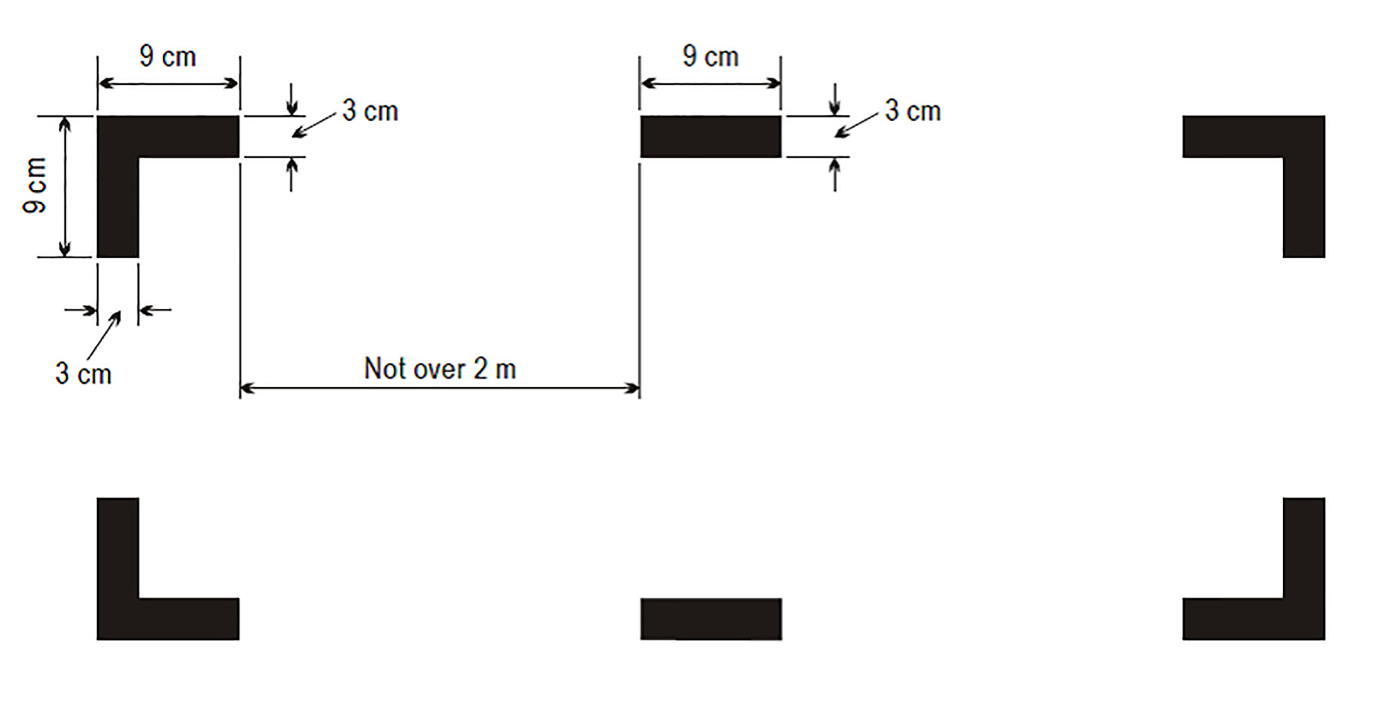
If areas of the aeroplane’s fuselage suitable for break-in by rescue crews in an emergency are marked, such areas shall be marked as shown in Figure 1.
Figure 1
AMC1 CAT.IDE.A.260 Marking of break-in points
ED Decision 2014/015/R
MARKINGS — COLOUR AND CORNERS
(a)The colour of the markings should be red or yellow and, if necessary, should be outlined in white to contrast with the background.
(b)If the corner markings are more than 2 m apart, intermediate lines 9 cm x 3 cm should be inserted so that there is no more than 2 m between adjacent markings.
CAT.IDE.A.265 Means for emergency evacuation
Regulation (EU) No 965/2012
(a)Aeroplanes with passenger emergency exit sill heights of more than 1,83 m (6 ft) above the ground shall be equipped at each of those exits with a means to enable passengers and crew to reach the ground safely in an emergency.
(b)Notwithstanding (a), such means are not required at overwing exits if the designated place on the aeroplane structure at which the escape route terminates is less than 1,83 m (6 ft) from the ground with the aeroplane on the ground, the landing gear extended, and the flaps in the take-off or landing position, whichever flap position is higher from the ground.
(c)Aeroplanes required to have a separate emergency exit for the flight crew for which the lowest point of the emergency exit is more than 1,83 m (6 ft) above the ground shall have a means to assist all flight crew members in descending to reach the ground safely in an emergency.
(d)The heights referred to in (a) and (c) shall be measured:
(1)with the landing gear extended; and
(2)after the collapse of, or failure to extend of, one or more legs of the landing gear, in the case of aeroplanes with a type certificate issued after 31 March 2000.
CAT.IDE.A.270 Megaphones
Regulation (EU) No 965/2012
Aeroplanes with an MOPSC of more than 60 and carrying at least one passenger shall be equipped with the following quantities of portable battery-powered megaphones readily accessible for use by crew members during an emergency evacuation:
(a)For each passenger deck:
Table 1
Number of megaphones
Passenger seating configuration | Number of megaphones |
61 to 99 | 1 |
100 or more | 2 |
(b)For aeroplanes with more than one passenger deck, in all cases when the total passenger seating configuration is more than 60, at least one megaphone.
AMC1 CAT.IDE.A.270 Megaphones
ED Decision 2014/015/R
LOCATION OF MEGAPHONES
(a)Where one megaphone is required, it should be readily accessible at the assigned seat of a cabin crew member or crew members other than flight crew.
(b)Where two or more megaphones are required, they should be suitably distributed in the passenger compartment(s) and readily accessible to crew members assigned to direct emergency evacuations.
(c)This does not necessarily require megaphones to be positioned such that they can be physically reached by a crew member when strapped in a cabin crew member’s seat.
CAT.IDE.A.275 Emergency lighting and marking
Regulation (EU) 2019/1384
(a)Aeroplanes with an MOPSC of more than nine shall be equipped with an emergency lighting system having an independent power supply to facilitate the evacuation of the aeroplane.
(b)In the case of aeroplanes with an MOPSC of more than 19, the emergency lighting system, referred to in (a) shall include:
(1)sources of general cabin illumination;
(2)internal lighting in floor level emergency exit areas;
(3)illuminated emergency exit marking and locating signs;
(4)in the case of aeroplanes for which the application for the type certificate or equivalent was filed before 1 May 1972, when operated by night, exterior emergency lighting at all overwing exits and at exits where descent assist means are required;
(5)in the case of aeroplanes for which the application for the type certificate or equivalent was filed after 30 April 1972, when operated by night, exterior emergency lighting at all passenger emergency exits; and
(6)in the case of aeroplanes for which the type certificate was first issued on or after 31 December 1957, floor proximity emergency escape path marking system(s) in the passenger compartments.
(c)For aeroplanes with an MOPSC of 19 or less and type certified on the basis of the Agency's certification specification, the emergency lighting system referred to in point (a) shall include the equipment referred to in points (1), (2) and (3) of point (b).
(d)For aeroplanes with an MOPSC of 19 or less that are not certified on the basis of the Agency's certification specification, the emergency lighting system referred to in point (a) shall include the equipment referred to in point (b)(1).
(e)Aeroplanes with an MOPSC of nine or less, operated at night, shall be equipped with a source of general cabin illumination to facilitate the evacuation of the aeroplane.
CAT.IDE.A.280 Emergency locator transmitter (ELT)
Regulation (EU) 2015/2338
(a)Aeroplanes with an MOPSC of more than 19 shall be equipped with at least:
(1)two ELTs, one of which shall be automatic, or one ELT and one aircraft localisation means meeting the requirement of CAT.GEN.MPA.210, in the case of aeroplanes first issued with an individual CofA after 1 July 2008; or
(2)one automatic ELT or two ELTs of any type or one aircraft localisation means meeting the requirement of CAT.GEN.MPA.210, in the case of aeroplanes first issued with an individual CofA on or before 1 July 2008.
(b)Aeroplanes with an MOPSC of 19 or less shall be equipped with at least:
(1)one automatic ELT or one aircraft localisation means meeting the requirement of CAT.GEN.MPA.210, in the case of aeroplanes first issued with an individual CofA after 1 July 2008; or
(2)one ELT of any type or one aircraft localisation means meeting the requirement of CAT.GEN. MPA.210, in the case of aeroplanes first issued with an individual CofA on or before 1 July 2008.
(c)An ELT of any type shall be capable of transmitting simultaneously on 121,5 MHz and 406 MHz.
AMC1 CAT.IDE.A.280 Emergency locator transmitter (ELT)
ED Decision 2014/015/R
BATTERIES
(a)All batteries used in ELTs should be replaced (or recharged if the battery is rechargeable) when the equipment has been in use for more than 1 cumulative hour or in the following cases:
(1)Batteries specifically designed for use in ELTs and having an airworthiness release certificate (EASA Form 1 or equivalent) should be replaced (or recharged if the battery is rechargeable) before the end of their useful life in accordance with the maintenance instructions applicable to the ELT.
(2)Standard batteries manufactured in accordance with an industry standard and not having an airworthiness release certificate (EASA Form 1 or equivalent), when used in ELTs should be replaced (or recharged if the battery is rechargeable) when 50 % of their useful life (or for rechargeable, 50 % of their useful life of charge), as established by the battery manufacturer, has expired.
(3)The battery useful life (or useful life of charge) criteria in (1) and (2) do not apply to batteries (such as water-activated batteries) that are essentially unaffected during probable storage intervals.
(b)The new expiry date for a replaced (or recharged) battery should be legibly marked on the outside of the equipment.
AMC2 CAT.IDE.A.280 Emergency locator transmitter (ELT)
ED Decision 2021/008/R
TYPES OF ELTs AND GENERAL TECHNICAL SPECIFICATIONS
(a)The ELT required by this provision should be one of the following:
(1)Automatic fixed (ELT(AF)). An automatically activated ELT that is permanently attached to an aircraft and is designed to aid search and rescue (SAR) teams in locating the crash site.
(2)Automatic portable (ELT(AP)). An automatically activated ELT, that is rigidly attached to an aircraft before a crash, but is readily removable from the aircraft after a crash. It functions as an ELT during the crash sequence. If the ELT(AP) does not employ an integral antenna, the aircraft-mounted antenna may be disconnected and an auxiliary antenna (stored on the ELT case) attached to the ELT. The ELT can be tethered to a survivor or a life-raft. This type of ELT is intended to aid SAR teams in locating the crash site or survivor(s).
(3) Automatic deployable (ELT(AD)). An ELT that is rigidly attached to the aircraft before the crash and that is automatically deployed and activated by an impact, and, in some cases, also by water sensors. This type of ELT should float in water and is intended to aid SAR teams in locating the crash site. The ELT(AD) may be either a stand-alone beacon or an inseparable part of a deployable recorder.
(4)Distress tracking ELT (ELT(DT)). An ELT that is designed to be activated upon automatic detection of conditions indicative of a distress situation. This type of ELT is intended to provide information prior to the crash, to aid SAR teams in locating the crash site and/or any survivor(s).
(5) Survival ELT (ELT(S)). An ELT that is removable from an aircraft, stowed so as to facilitate its ready use in an emergency, and manually activated by a survivor. An ELT(S) may be activated manually or automatically (e.g. by water activation). It should be designed either to be tethered to a life-raft or a survivor. A water-activated ELT(S) is not an ELT(AP).
(b)To minimise the possibility of damage in the event of a crash impact, the ELT(AF), ELT(AP), ELT(AD), or ELT(DT) should be rigidly fixed to the aircraft structure, as far aft as practicable, with its antenna and connections arranged so as to maximise the probability of the signal being transmitted after a crash.
(c)Unless an automatic ELT is installed, the ELT(DT) should have capability C (crash survivability) and capability H1 (121.5-MHz homing signal) as specified in EUROCAE ED-62B ‘Minimum Operational Performance Standard for Aircraft Emergency Locator Transmitters’, dated December 2018, or in any later equivalent standard that is produced by EUROCAE.
(d)Any ELT carried should operate in accordance with the relevant provisions of ICAO Annex 10, Volume III communications systems and should be registered with the national agency responsible for initiating search and rescue or other nominated agency.
GM1 CAT.IDE.A.280 Emergency locator transmitter (ELT)
ED Decision 2021/008/R
TERMINOLOGY
(a) An ‘automatic ELT’ means an ELT(AF), ELT(AP), or ELT(AD). Other types of ELTs are not considered ‘automatic ELTs’.
(b) A ‘water sensor’ means a sensor that detects water immersion, including at low depth.
GM2 CAT.IDE.A.280 Emergency locator transmitter (ELT)
ED Decision 2021/008/R
ADDITIONAL GUIDANCE
(a)It is advisable to install automatic ELTs that transmit encoded position data and that meet the operational performance requirements of EUROCAE Document ED-62B, or RTCA DO-204B, or any later equivalent standard.
(b)Guidance material for the inspection of an ELT can be found in FAA Advisory Circular (AC) 91-44A ‘Installation and Inspection Procedures for Emergency Locator Transmitters and Receivers’, Change 1, dated February 2018.
CAT.IDE.A.285 Flight over water
Regulation (EU) 2019/1384
(a)The following aeroplanes shall be equipped with a life-jacket for each person on board or equivalent flotation device for each person on board younger than 24 months, stowed in a position that is readily accessible from the seat or berth of the person for whose use it is provided:
(1)landplanes operated over water at a distance of more than 50 NM from the shore or taking off or landing at an aerodrome where the take-off or approach path is so disposed over water that there would be a likelihood of a ditching; and
(2)seaplanes operated over water.
(b)Each life-jacket or equivalent individual flotation device shall be equipped with a means of electric illumination for the purpose of facilitating the location of persons.
(c)Seaplanes operated over water shall be equipped with the following:
(1)a sea anchor and other equipment necessary to facilitate mooring, anchoring or manoeuvring the seaplane on water, appropriate to its size, mass and handling characteristics;
(2)equipment for making the sound signals as prescribed in the International Regulations for Preventing Collisions at Sea, where applicable.
(d)Aeroplanes operated over water at a distance away from land suitable for making an emergency landing, greater than that corresponding to:
(1)120 minutes at cruising speed or 400 NM, whichever is the lesser, in the case of aeroplanes capable of continuing the flight to an aerodrome with the critical engine(s) becoming inoperative at any point along the route or planned diversions; or
(2)for all other aeroplanes, 30 minutes at cruising speed or 100 NM, whichever is the lesser,
shall be equipped with the equipment specified in (e).
(e)Aeroplanes complying with (d) shall carry the following equipment:
(1)life-rafts in sufficient numbers to carry all persons on board, stowed so as to facilitate their ready use in an emergency, and being of sufficient size to accommodate all the survivors in the event of a loss of one raft of the largest rated capacity;
(2)a survivor locator light in each life-raft;
(3)life-saving equipment to provide the means for sustaining life, as appropriate for the flight to be undertaken; and
(4)at least two survival ELTs (ELT(S)).
(f)By 1 January 2019 at the latest, aeroplanes with an MCTOM of more than 27 000 kg and with an MOPSC of more than 19 and all aeroplanes with an MCTOM of more than 45 500 kg shall be fitted with a securely attached underwater locating device that operates at a frequency of 8,8 kHz ± 1 kHz, unless:
(1)the aeroplane is operated over routes on which it is at no point at a distance of more than 180 NM from the shore; or
(2)the aeroplane is equipped with robust and automatic means to accurately determine, following an accident where the aeroplane is severely damaged, the location of the point of end of flight.
AMC1 CAT.IDE.A.285 Flight over water
ED Decision 2014/015/R
LIFE RAFTS AND EQUIPMENT FOR MAKING DISTRESS SIGNALS
(a)The following should be readily available with each life-raft:
(1)means for maintaining buoyancy;
(2)a sea anchor:
(3)life-lines and means of attaching one life-raft to another;
(4)paddles for life-rafts with a capacity of six or less;
(5)means of protecting the occupants from the elements;
(6)a water-resistant torch;
(7)signalling equipment to make the pyrotechnic distress signals described in ICAO Annex 2, ‘Rules of the Air’;
(8)100 g of glucose tablets for each four, or fraction of four, persons that the life-raft is designed to carry;
(9)at least 2 litres of drinkable water provided in durable containers or means of making sea water drinkable or a combination of both; and
(10)first-aid equipment.
(b)As far as practicable, items listed in (a) should be contained in a pack.
AMC1 CAT.IDE.A.285(e)(4) & CAT.IDE.A.305(a)(2) Flight over water & Survival equipment
ED Decision 2014/015/R
SURVIVAL ELT
An ELT(AP) may be used to replace one required ELT(S) provided that it meets the ELT(S) requirements. A water-activated ELT(S) is not an ELT(AP).
AMC1 CAT.IDE.A.285(a) Flight over water
ED Decision 2014/015/R
ACCESSIBILITY OF LIFE-JACKETS
The life-jacket should be accessible from the seat or berth of the person for whose use it is provided, with a safety belt or restraint system fastened.
AMC2 CAT.IDE.A.285(a) Flight over water
ED Decision 2014/015/R
ELECTRIC ILLUMINATION OF LIFE-JACKETS
The means of electric illumination should be a survivor locator light as defined in the applicable ETSO issued by the Agency or equivalent.
GM1 CAT.IDE.A.285(a) Flight over water
ED Decision 2014/015/R
SEAT CUSHIONS
Seat cushions are not considered to be flotation devices.
AMC1 CAT.IDE.A.285(f) Flight over water
ED Decision 2015/030/R
LOW-FREQUENCY UNDERWATER LOCATING DEVICE
(a)The underwater locating device should be compliant with ETSO-C200 or equivalent.
(b)The underwater locating device should not be installed in wings or empennage.
AMC2 CAT.IDE.A.285(f) Flight over water
ED Decision 2021/008/R
ROBUST AND AUTOMATIC MEANS TO LOCATE THE POINT OF END OF FLIGHT AFTER AN ACCIDENT
The ‘robust and automatic means to accurately determine, following an accident where the aeroplane is severely damaged, the location of the point of end of flight’ should comply with point CAT.GEN.MPA.210.
GM1 CAT.IDE.A.285(f)(2) Flight over water
ED Decision 2017/023/R
ROBUST AND AUTOMATIC MEANS TO LOCATE THE POINT OF END OF FLIGHT AFTER AN ACCIDENT
CAT.IDE.A.285(f)(2) refers to means such as required by CAT.GEN.MPA.210 ‘Location of an aircraft in distress’. The adjective ‘robust’ in CAT.IDE.A.285(f)(2) indicates that this means is designed to provide the location of the point of end of flight in non-survivable accident scenarios as well as in survivable accident scenarios.
CAT.IDE.A.305 Survival equipment
Regulation (EU) No 965/2012
(a)Aeroplanes operated over areas in which search and rescue would be especially difficult shall be equipped with:
(1)signalling equipment to make the distress signals;
(2)at least one ELT(S); and
(3)additional survival equipment for the route to be flown taking account of the number of persons on board.
(b)The additional survival equipment specified in (a)(3) does not need to be carried when the aeroplane:
(1)remains within a distance from an area where search and rescue is not especially difficult corresponding to:
(i)120 minutes at one-engine-inoperative (OEI) cruising speed for aeroplanes capable of continuing the flight to an aerodrome with the critical engine(s) becoming inoperative at any point along the route or planned diversion routes; or
(ii)30 minutes at cruising speed for all other aeroplanes;
(2)remains within a distance no greater than that corresponding to 90 minutes at cruising speed from an area suitable for making an emergency landing, for aeroplanes certified in accordance with the applicable airworthiness standard.
AMC1 CAT.IDE.A.305 Survival equipment
ED Decision 2014/015/R
ADDITIONAL SURVIVAL EQUIPMENT
(a)The following additional survival equipment should be carried when required:
(1)2 litres of drinkable water for each 50, or fraction of 50, persons on board provided in durable containers;
(2)one knife;
(3)first-aid equipment; and
(4)one set of air/ground codes.
(b)In addition, when polar conditions are expected, the following should be carried:
(1)a means for melting snow;
(2)one snow shovel and one ice saw;
(3)sleeping bags for use by 1/3 of all persons on board and space blankets for the remainder or space blankets for all passengers on board; and
(4)one arctic/polar suit for each crew member.
(c)If any item of equipment contained in the above list is already carried on board the aeroplane in accordance with another requirement, there is no need for this to be duplicated.
AMC1 CAT.IDE.A.285(e)(4) & CAT.IDE.A.305(a)(2) Flight over water & Survival equipment
ED Decision 2014/015/R
SURVIVAL ELT
An ELT(AP) may be used to replace one required ELT(S) provided that it meets the ELT(S) requirements. A water-activated ELT(S) is not an ELT(AP).
AMC1 CAT.IDE.A.305(b)(2) Survival equipment
ED Decision 2014/015/R
APPLICABLE AIRWORTHINESS STANDARD
The applicable airworthiness standard should be CS-25 or equivalent.
GM1 CAT.IDE.A.305 Survival equipment
ED Decision 2014/015/R
SIGNALLING EQUIPMENT
The signalling equipment for making distress signals is described in ICAO Annex 2, Rules of the Air.
GM2 CAT.IDE.A.305 Survival equipment
ED Decision 2014/015/R
AREAS IN WHICH SEARCH AND RESCUE WOULD BE ESPECIALLY DIFFICULT
The expression ‘areas in which search and rescue would be especially difficult’ should be interpreted, in this context, as meaning:
(a)areas so designated by the authority responsible for managing search and rescue; or
(b)areas that are largely uninhabited and where:
(1)the authority referred to in (a) has not published any information to confirm whether search and rescue would be or would not be especially difficult; and
(2)the authority referred to in (a) does not, as a matter of policy, designate areas as being especially difficult for search and rescue.
CAT.IDE.A.325 Headset
Regulation (EU) No 965/2012
(a)Aeroplanes shall be equipped with a headset with a boom or throat microphone or equivalent for each flight crew member at their assigned station in the flight crew compartment.
(b)Aeroplanes operated under IFR or at night shall be equipped with a transmit button on the manual pitch and roll control for each required flight crew member.
AMC1 CAT.IDE.A.325 Headset
ED Decision 2014/015/R
GENERAL
(a)A headset consists of a communication device that includes two earphones to receive and a microphone to transmit audio signals to the aeroplane’s communication system. To comply with the minimum performance requirements, the earphones and microphone should match the communication system’s characteristics and the flight crew compartment environment. The headset should be sufficiently adjustable to fit the pilot’s head. Headset boom microphones should be of the noise cancelling type.
(b)If the intention is to utilise noise cancelling earphones, the operator should ensure that the earphones do not attenuate any aural warnings or sounds necessary for alerting the flight crew on matters related to the safe operation of the aeroplane.
GM1 CAT.IDE.A.325 Headset
ED Decision 2014/015/R
GENERAL
The term ‘headset’ includes any aviation helmet incorporating headphones and microphone worn by a flight crew member.
CAT.IDE.A.330 Radio communication equipment
Regulation (EU) No 965/2012
(a)Aeroplanes shall be equipped with the radio communication equipment required by the applicable airspace requirements.
(b)The radio communication equipment shall provide for communication on the aeronautical emergency frequency 121,5 MHz.
CAT.IDE.A.335 Audio selector panel
Regulation (EU) No 965/2012
Aeroplanes operated under IFR shall be equipped with an audio selector panel operable from each required flight crew member station.
CAT.IDE.A.340 Radio equipment for operations under VFR over routes navigated by reference to visual landmarks
Regulation (EU) No 965/2012
Aeroplanes operated under VFR over routes navigated by reference to visual landmarks shall be equipped with radio communication equipment necessary under normal radio propagation conditions to fulfil the following:
(a)communicate with appropriate ground stations;
(b)communicate with appropriate ATC stations from any point in controlled airspace within which flights are intended; and
(c)receive meteorological information.
CAT.IDE.A.345 Communication, navigation and surveillance equipment for operations under IFR or under VFR over routes not navigated by reference to visual landmarks
Regulation (EU) 2019/1387
(a)Aeroplanes operated under IFR or under VFR over routes that cannot be navigated by reference to visual landmarks shall be equipped with radio communication, navigation and surveillance equipment in accordance with the applicable airspace requirements.
(b)Radio communication equipment shall include at least two independent radio communication systems necessary under normal operating conditions to communicate with an appropriate ground station from any point on the route, including diversions.
(c)Notwithstanding point (b), aeroplanes operated for short haul operations in the North Atlantic high-level (NAT HLA) airspace and not crossing the North Atlantic shall be equipped with at least one long range communication system, in case alternative communication procedures are published for the airspace concerned.
(d)Aeroplanes shall have sufficient navigation equipment to ensure that, in the event of the failure of one item of equipment at any stage of the flight, the remaining equipment shall allow safe navigation in accordance with the flight plan.
(e)Aeroplanes operated on flights in which it is intended to land in IMC shall be equipped with suitable equipment capable of providing guidance to a point from which a visual landing can be performed for each aerodrome at which it is intended to land in IMC and for any designated alternate aerodrome.
(f)For PBN operations the aircraft shall meet the airworthiness certification requirements for the appropriate navigation specification.
AMC1 CAT.IDE.A.345 Communication and navigation equipment for operations under IFR or under VFR over routes not navigated by reference to visual landmarks
ED Decision 2014/015/R
TWO INDEPENDENT MEANS OF COMMUNICATION
Whenever two independent means of communication are required, each system should have an independent antenna installation, except where rigidly supported non-wire antennae or other antenna installations of equivalent reliability are used.
AMC2 CAT.IDE.A.345 Communication and navigation equipment for operations under IFR or under VFR over routes not navigated by reference to visual landmarks
ED Decision 2014/015/R
ACCEPTABLE NUMBER AND TYPE OF COMMUNICATION AND NAVIGATION EQUIPMENT
(a)An acceptable number and type of communication and navigation equipment is:
(1)one VHF omnidirectional radio range (VOR) receiving system, one automatic direction finder (ADF) system, one distance measuring equipment (DME), except that an ADF system need not be installed provided that the use of ADF is not required in any phase of the planned flight;
(2)one instrument landing system (ILS) or microwave landing system (MLS) where ILS or MLS is required for approach navigation purposes;
(3)one marker beacon receiving system where a marker beacon is required for approach navigation purposes;
(4)area navigation equipment when area navigation is required for the route being flown (e.g. equipment required by Part-SPA);
(5)an additional DME system on any route, or part thereof, where navigation is based only on DME signals;
(6)an additional VOR receiving system on any route, or part thereof, where navigation is based only on VOR signals; and
(7)an additional ADF system on any route, or part thereof, where navigation is based only on non-directional beacon (NDB) signals.
(b)Aeroplanes may be operated without the navigation equipment specified in (6) and (7) provided they are equipped with alternative equipment. The reliability and the accuracy of alternative equipment should allow safe navigation for the intended route.
(c)The operator conducting extended range operations with two-engined aeroplanes (ETOPS) should ensure that the aeroplanes have a communication means capable of communicating with an appropriate ground station at normal and planned contingency altitudes. For ETOPS routes where voice communication facilities are available, voice communications should be provided. For all ETOPS operations beyond 180 minutes, reliable communication technology, either voice-based or data link, should be installed. Where voice communication facilities are not available and where voice communication is not possible or is of poor quality, communications using alternative systems should be ensured.
(d)To perform IFR operations without an ADF system installed, the operator should consider the following guidelines on equipment carriage, operational procedures and training criteria.
(1)ADF equipment may only be removed from or not installed in an aeroplane intended to be used for IFR operations when it is not essential for navigation, and provided that alternative equipment giving equivalent or enhanced navigation capability is carried. This may be accomplished by the carriage of an additional VOR receiver or a GNSS receiver approved for IFR operations.
(2)For IFR operations without ADF, the operator should ensure that:
(i)route segments that rely solely on ADF for navigation are not flown;
(ii)ADF/NDB procedures are not flown;
(iii)the minimum equipment list (MEL) has been amended to take account of the non-carriage of ADF;
(iv)the operations manual does not refer to any procedures based on NDB signals for the aeroplanes concerned; and
(v)flight planning and dispatch procedures are consistent with the above mentioned criteria.
(3)The removal of ADF should be taken into account by the operator in the initial and recurrent training of flight crew.
(e)VHF communication equipment, ILS localiser and VOR receivers installed on aeroplanes to be operated in IFR should comply with the following FM immunity performance standards:
(1)ICAO Annex 10, Volume I - Radio Navigation Aids, and Volume III, Part II - Voice Communications Systems; and
(2)acceptable equipment standards contained in EUROCAE Minimum Operational Performance Specifications, documents ED-22B for VOR receivers, ED-23B for VHF communication receivers and ED-46B for LOC receivers and the corresponding Radio Technical Commission for Aeronautics (RTCA) documents DO-186, DO-195 and DO-196.
AMC3 CAT.IDE.A.345 Communication and navigation equipment for operations under IFR or under VFR over routes not navigated by reference to visual landmarks
ED Decision 2014/015/R
FAILURE OF A SINGLE UNIT
Required communication and navigation equipment should be installed such that the failure of any single unit required for either communication or navigation purposes, or both, will not result in the failure of another unit required for communications or navigation purposes.
AMC4 CAT.IDE.A.345 Communication and navigation equipment for operations under IFR or under VFR over routes not navigated by reference to visual landmarks
ED Decision 2014/015/R
LONG RANGE COMMUNICATION SYSTEMS
(a)The long range communication system should be either a high frequency/HF-system or another two-way communication system if allowed by the relevant airspace procedures.
(b)When using one communication system only, the competent authority may restrict the minimum navigation performance specifications (MNPS) approval to the use of the specific routes.
GM1 CAT.IDE.A.345 Communication and navigation equipment for operations under IFR or under VFR over routes not navigated by reference to visual landmarks
ED Decision 2014/015/R
APPLICABLE AIRSPACE REQUIREMENTS
For aeroplanes being operated under European air traffic control, the applicable airspace requirements include the Single European Sky legislation.
GM2 CAT.IDE.A.345 Communication and navigation equipment for operations under IFR or under VFR over routes not navigated by reference to visual landmarks
ED Decision 2016/015/R
AIRCRAFT ELIGIBILITY FOR PBN SPECIFICATION NOT REQUIRING SPECIFIC APPROVAL
(a)The performance of the aircraft is usually stated in the AFM.
(b)Where such a reference cannot be found in the AFM, other information provided by the aircraft manufacturer as TC holder, the STC holder or the design organisation having a privilege to approve minor changes may be considered.
(c)The following documents are considered acceptable sources of information:
(1)AFM, supplements thereto, and documents directly referenced in the AFM;
(2)FCOM or similar document;
(3)Service Bulletin or Service Letter issued by the TC holder or STC holder;
(4)approved design data or data issued in support of a design change approval;
(5)any other formal document issued by the TC or STC holders stating compliance with PBN specifications, AMC, Advisory Circulars (AC) or similar documents issued by the State of Design; and
(6)written evidence obtained from the State of Design.
(d)Equipment qualification data, in itself, is not sufficient to assess the PBN capabilities of the aircraft, since the latter depend on installation and integration.
(e)As some PBN equipment and installations may have been certified prior to the publication of the PBN Manual and the adoption of its terminology for the navigation specifications, it is not always possible to find a clear statement of aircraft PBN capability in the AFM. However, aircraft eligibility for certain PBN specifications can rely on the aircraft performance certified for PBN procedures and routes prior to the publication of the PBN Manual.
(f)Below, various references are listed which may be found in the AFM or other acceptable documents (see listing above) in order to consider the aircraft’s eligibility for a specific PBN specification if the specific term is not used.
(g)RNAV 5
(1)If a statement of compliance with any of the following specifications or standards is found in the acceptable documentation as listed above, the aircraft is eligible for RNAV 5 operations.
(i)B-RNAV;
(ii)RNAV 1;
(iii)RNP APCH;
(iv)RNP 4;
(v)A-RNP;
(vi)AMC 20-4;
(vii)JAA TEMPORARY GUIDANCE MATERIAL, LEAFLET NO. 2 (TGL 2);
(viii)JAA AMJ 20X2;
(ix)FAA AC 20-130A for en route operations;
(x)FAA AC 20-138 for en route operations; and
(xi)FAA AC 90-96.
(h)RNAV 1/RNAV 2
(1)If a statement of compliance with any of the following specifications or standards is found in the acceptable documentation as listed above, the aircraft is eligible for RNAV 1/RNAV 2 operations.
(i)RNAV 1;
(ii)PRNAV;
(iii)US RNAV type A;
(iv)FAA AC 20-138 for the appropriate navigation specification;
(v)FAA AC 90-100A;
(vi)JAA TEMPORARY GUIDANCE MATERIAL, LEAFLET NO. 10 Rev1 (TGL 10); and
(vii)FAA AC 90-100.
(2)However, if position determination is exclusively computed based on VOR-DME, the aircraft is not eligible for RNAV 1/RNAV 2 operations.
(i)RNP 1/RNP 2 continental
(1)If a statement of compliance with any of the following specifications or standards is found in the acceptable documentation as listed above, the aircraft is eligible for RNP 1/RNP 2 continental operations.
(i)A-RNP;
(ii)FAA AC 20-138 for the appropriate navigation specification; and
(iii)FAA AC 90-105.
(2)Alternatively, if a statement of compliance with any of the following specifications or standards is found in the acceptable documentation as listed above and position determination is primarily based on GNSS, the aircraft is eligible for RNP 1/RNP 2 continental operations. However, in these cases, loss of GNSS implies loss of RNP 1/RNP 2 capability.
(i)JAA TEMPORARY GUIDANCE MATERIAL, LEAFLET NO. 10 (TGL 10) (any revision); and
(ii)FAA AC 90-100.
(j)RNP APCH — LNAV minima
(1)If a statement of compliance with any of the following specifications or standards is found in the acceptable documentation as listed above, the aircraft is eligible for RNP APCH — LNAV operations.
(i)A-RNP;
(ii)AMC 20-27;
(iii)AMC 20-28;
(iv)FAA AC 20-138 for the appropriate navigation specification; and
(v)FAA AC 90-105 for the appropriate navigation specification.
(2)Alternatively, if a statement of compliance with RNP 0.3 GNSS approaches in accordance with any of the following specifications or standards is found in the acceptable documentation as listed above, the aircraft is eligible for RNP APCH — LNAV operations. Any limitation such as ‘within the US National Airspace’ may be ignored since RNP APCH procedures are assumed to meet the same ICAO criteria around the world.
(i)JAA TEMPORARY GUIDANCE MATERIAL, LEAFLET NO. 3 (TGL 3);
(ii)AMC 20-4;
(iii)FAA AC 20-130A; and
(iv)FAA AC 20-138.
(k)RNP APCH — LNAV/VNAV minima
(1)If a statement of compliance with any of the following specifications or standards is found in the acceptable documentation as listed above, the aircraft is eligible for RNP APCH — LNAV/VNAV operations.
(i)A-RNP;
(ii)AMC 20-27 with Baro VNAV;
(iii)AMC 20-28;
(iv)FAA AC 20-138; and
(v)FAA AC 90-105 for the appropriate navigation specification.
(2)Alternatively, if a statement of compliance with FAA AC 20-129 is found in the acceptable documentation as listed above, and the aircraft complies with the requirements and limitations of EASA SIB 2014-0483, the aircraft is eligible for RNP APCH — LNAV/VNAV operations. Any limitation such as ‘within the US National Airspace’ may be ignored since RNP APCH procedures are assumed to meet the same ICAO criteria around the world.
(l)RNP APCH — LPV minima
(1)If a statement of compliance with any of the following specifications or standards is found in the acceptable documentation as listed above, the aircraft is eligible for RNP APCH — LPV operations.
(i)AMC 20-28;
(ii)FAA AC 20-138 for the appropriate navigation specification; and
(iii)FAA AC 90-107.
(2)For aircraft that have a TAWS Class A installed and do not provide Mode-5 protection on an LPV approach, the DH is limited to 250 ft.
(m)RNAV 10
(1)If a statement of compliance with any of the following specifications or standards is found in the acceptable documentation as listed above, the aircraft is eligible for RNAV 10 operations.
(i)RNP 10;
(ii)FAA AC 20-138 for the appropriate navigation specification;
(iii)AMC 20-12;
(iv)FAA Order 8400.12 (or later revision); and
(v)FAA AC 90-105.
(n)RNP 4
(1)If a statement of compliance with any of the following specifications or standards is found in the acceptable documentation as listed above, the aircraft is eligible for RNP 4 operations.
(i)FAA AC 20-138B or later, for the appropriate navigation specification;
(ii)FAA Order 8400.33; and
(iii)FAA AC 90-105 for the appropriate navigation specification.
(o)RNP 2 oceanic
(1)If a statement of compliance with FAA AC 90-105 for the appropriate navigation specification is found in the acceptable documentation as listed above, the aircraft is eligible for RNP 2 oceanic operations.
(2)If the aircraft has been assessed eligible for RNP 4, the aircraft is eligible for RNP 2 oceanic.
(p)Special features
(1)RF in terminal operations (used in RNP 1 and in the initial segment of the RNP APCH)
(i)If a statement of demonstrated capability to perform an RF leg, certified in accordance with any of the following specifications or standards, is found in the acceptable documentation as listed above, the aircraft is eligible for RF in terminal operations:
(A)AMC 20-26; and
(B)FAA AC 20-138B or later.
(ii)If there is a reference to RF and a reference to compliance with AC 90-105, then the aircraft is eligible for such operations.
(q)Other considerations
(1)In all cases, the limitations in the AFM need to be checked; in particular, the use of AP or FD which can be required to reduce the FTE primarily for RNP APCH, RNAV 1, and RNP 1.
(2)Any limitation such as ‘within the US National Airspace’ may be ignored since RNP APCH procedures are assumed to meet the same ICAO criteria around the world.
GM3 CAT.IDE.A.345 Communication and navigation equipment for operations under IFR or under VFR over routes not navigated by reference to visual landmarks
ED Decision 2016/015/R
GENERAL
(a)The PBN specifications for which the aircraft complies with the relevant airworthiness criteria are set out in the AFM, together with any limitations to be observed.
(b)Because functional and performance requirements are defined for each navigation specification, an aircraft approved for an RNP specification is not automatically approved for all RNAV specifications. Similarly, an aircraft approved for an RNP or RNAV specification having a stringent accuracy requirement (e.g. RNP 0.3 specification) is not automatically approved for a navigation specification having a less stringent accuracy requirement (e.g. RNP 4).
RNP 4
(c)For RNP 4, at least two LRNSs, capable of navigating to RNP 4, and listed in the AFM, may be operational at the entry point of the RNP 4 airspace. If an item of equipment required for RNP 4 operations is unserviceable, then the flight crew may consider an alternate route or diversion for repairs. For multi-sensor systems, the AFM may permit entry if one GNSS sensor is lost after departure, provided one GNSS and one inertial sensor remain available.
GM1 CAT.IDE.A.345(c) Communication and navigation equipment for operations under IFR or under VFR over routes not navigated by reference to visual landmarks
ED Decision 2014/015/R
SHORT HAUL OPERATIONS
The term ’short haul operations’ refers to operations not crossing the North Atlantic.
AMC1 CAT.IDE.A.345(a) Communication, navigation and surveillance equipment for operations under IFR or under VFR over routes not navigated by reference to visual landmarks
ED Decision 2021/005/R
PERFORMANCE-BASED COMMUNICATION AND SURVEILLANCE (PBCS) OPERATIONS
For operations in airspaces where required communication performance (RCP) and required surveillance performance (RSP) for PBCS have been prescribed, the operator should:
(a)ensure that the communication equipment and surveillance equipment meet the prescribed RCP and RSP specifications respectively, as shown by an AFM statement or equivalent;
(b)ensure that operational constraints are reflected in the MEL;
(c)establish and include in the OM:
(1)normal, abnormal and contingency procedures;
(2)the flight crew qualification and proficiency constraints; and
(3)a training programme for relevant personnel consistent with the intended operations;
(d)ensure continued airworthiness of the communication equipment and surveillance equipment in accordance with the appropriate RCP and RSP specifications respectively;
(e)ensure that the contracted communication service provider (CSP) for the airspace being flown complies with the required RCP and RSP specifications as well as with monitoring, recording and notification requirements; and
(f)participate to monitoring programmes established in the airspace being flown in order to:
(1)submit the relevant reports of observed communication and surveillance performance respectively; and
(2)establish a process for immediate corrective action in case non-compliance with the appropriate RCP or RSP specifications is detected.
GM1 CAT.IDE.A.345(a) Communication, navigation and surveillance equipment for operations under IFR or under VFR over routes not navigated by reference to visual landmarks
ED Decision 2021/005/R
PBCS OPERATIONS — GENERAL
Detailed guidance material on PBCS operations may be found in the following documents:
(a)ICAO Doc 9869 ‘Performance-based Communication and Surveillance (PBCS) Manual’
(b)ICAO Doc 10037 ‘Global Operational Data Link (GOLD) Manual’
PBCS OPERATIONS — AIRCRAFT ELIGIBILITY
(a)The aircraft eligibility for compliance with the required RCP/RSP specifications should be demonstrated by the aircraft manufacturer or equipment supplier and be specific to each individual aircraft or the combination of the aircraft type and the equipment. The demonstrated compliance with specific RCP/RSP specifications may be documented in one of the following documents:
(1)the type certificate (TC);
(2)the supplemental type certificate (STC);
(3)the aeroplane flight manual (AFM) or AFM Supplement;
(4)a compliance statement from the manufacturer or the holder of the design approval of the data link installation, approved by the State of Design; or
(b)In addition to the indication of compliance with specific RCP/RSP specifications, the operator should comply with any associated operating limitations, information and procedures specified by the aircraft manufacturer or equipment supplier in the AFM or other appropriate documents.
PBCS OPERATIONS — MEL ENTRIES
(a)The operator should amend the MEL, in accordance with the items identified by the aircraft manufacturer or equipment supplier in the master minimum equipment list (MMEL) or MMEL supplement, in relation to PBCS capability, to address the impact of losing an associated system/sub-system on data link operational capability.
(b)As an example, equipment required in current FANS 1/A-capable aircraft, potentially affecting RCP and RSP capabilities, may be the following:
(1)VHF, SATCOM, or HFDL1 radios, as applicable;
(2)ACARS management unit (MU)/communications management unit (CMU);
(3)flight management computer (FMC) integration; and
(4)printer, if procedures require its use.
PBCS OPERATIONS — OPERATING PROCEDURES
The operator should establish operating procedures for the flight crew and other relevant personnel, such as but not limited to, flight dispatchers and maintenance personnel. These procedures should cover the usage of PBCS-relevant systems and include as a minimum:
(a)pre-flight planning requirements including MEL consideration and flight plan filing;
(b)actions to be taken in the data link operation, to include specific RCP/RSP required cases;
(c)actions to be taken for the loss of data link capability while in and prior to entering the airspace requiring specific RCP/RSP specifications. Examples may be found in ICAO Doc 10037;
(d)problem reporting procedures to the local/regional PBCS monitoring body or central reporting body as applicable; and
(e)compliance with specific regional requirements and procedures, if applicable.
PBCS OPERATIONS — QUALIFICATION AND TRAINING
(a)The operator should ensure that flight crew and other relevant personnel such as flight dispatchers and maintenance personnel are proficient with PBCS operations. A separate training programme is not required if data link communication is integrated in the current training programme. However, the operator should ensure that the existing training programme incorporates a basic PBCS concept and requirements for flight crew and other personnel that have direct impact on overall data link performance required for the provisions of air traffic services such as reduced separation.
(b)The elements covered during the training should be as a minimum:
(1)Flight crew
(i)Data link communication system theory relevant to operational use;
(ii)AFM limitations;
(iii)Normal pilot response to data link communication messages;
(iv)Message elements in the message set used in each environment;
(v)RCP/RSP specifications and their performance requirements;
(vi)Implementation of performance-based reduced separation with associated RCP/RSP specifications or other possible performance requirements associated with their routes;
(vii)Other ATM operations involving data link communication services;
(viii)Normal, non-normal and contingency procedures; and
(ix)Data link communication failure/problem and reporting.
Note (1)If flight crew has already been trained on data link operations, additional training only on PBCS is required, addressing a basic concept and requirements that have direct impact on overall data link performance required for provisions of air traffic services (e.g. reduced separation).
Note (2)Training may be provided through training material and other means that simulate the functionality.
(2)Dispatchers/flight operations officers
(i)Proper use of data link and PBCS flight plan designators;
(ii)Air traffic service provider’s separation criteria and procedures relevant to RCP/RSP specifications;
(iii)MEL remarks or exceptions based on data link communication;
(iv)Procedures for transitioning to voice communication and other contingency procedures related to the operation in the event of abnormal behaviour of the data link communication;
(v)Coordination with the ATS unit related to, or following a special data link communication exceptional event (e.g. log-on or connection failures); and
(vi)Contingency procedures to transition to a different separation standard when data link communication fails.
(3)Engineering and maintenance personnel
(i)Data link communication equipment including its installation, maintenance and modification;
(ii)MEL relief and procedures for return to service authorisations; and
(iii)Correction of reported non-performance of data link system.
PBCS OPERATIONS — CONTINUED AIRWORTHINESS
(a)The operator should ensure that aircraft systems are properly maintained to continue to meet the applicable RCP/RSP specifications.
(b)The operator should ensure that the following elements are documented and managed appropriately:
(1)configuration and equipment list detailing the pertinent hardware and software components for the aircraft/fleet(s) applicable to the specific RCP/RSP operation;
(2)configuration control for subnetwork, communication media and routing policies; and
(3)description of systems including display and alerting functions (including message sets).
PBCS OPERATIONS — CSP COMPLIANCE
(a)The operator should ensure that their contracted CSPs notify the ATS units of any failure condition that may have an impact on PBCS operations. Notification should be made to all relevant ATS units regardless of whether the CSP has a contract with them.
(b)The operator may demonstrate the compliance of their contracted CSP through service level agreements (SLAs)/contractual arrangements for data link services or through a joint agreement among PBCS stakeholders such as a Memorandum of Understanding (MOU) or a PBCS Charter.
PBCS OPERATIONS — PBCS CHARTER
A PBCS charter has been developed by PBCS stakeholders and is available as an alternative to SLAs in order to validate the agreement between the operator and the CSP for compliance with RCP/RSP required for PBCS operations. The charter is hosted on the website www.FANS-CRA.com where operators and CSPs can subscribe.
PBCS OPERATIONS — PARTICIPATION IN MONITORING PROGRAMMES
(a)The operator should establish a process to participate in local or regional PBCS monitoring programmes and provide the following information, including any subsequent changes, to monitoring bodies:
(1)operator name;
(2)operator contact details; and
(3)other coordination information as applicable, including appropriate information means for the CSP/SSP service fail notification.
(b)The process should also address the actions to be taken with respect to problem reporting and resolution of deficiencies, such as:
(1)reporting problems identified by the flight crew or other personnel to the PBCS monitoring bodies associated with the route of the flight on which the problem occurred;
(2)disclosing operational data in a timely manner to the appropriate PBCS monitoring bodies when requested for the purposes of investigating a reported problem; and
(3)investigating and resolving the cause of the deficiencies reported by the PBCS monitoring bodies
CAT.IDE.A.350 Transponder
Regulation (EU) No 965/2012
Aeroplanes shall be equipped with a pressure altitude reporting secondary surveillance radar (SSR) transponder and any other SSR transponder capability required for the route being flown.
AMC1 CAT.IDE.A.350 Transponder
ED Decision 2014/015/R
SSR TRANSPONDER
(a)The secondary surveillance radar (SSR) transponders of aeroplanes being operated under European air traffic control should comply with any applicable Single European Sky legislation.
(b)If the Single European Sky legislation is not applicable, the SSR transponders should operate in accordance with the relevant provisions of Volume IV of ICAO Annex 10.
CAT.IDE.A.355 Management of aeronautical databases
Regulation (EU) 2016/1199
(a)Aeronautical databases used on certified aircraft system applications shall meet data quality requirements that are adequate for the intended use of the data.
(b)The operator shall ensure the timely distribution and insertion of current and unaltered aeronautical databases to all aircraft that require them.
(c)Notwithstanding any other occurrence reporting requirements as defined in Regulation (EU) No 376/2014, the operator shall report to the database provider instances of erroneous, inconsistent or missing data that might be reasonably expected to constitute a hazard to flight.
In such cases, the operator shall inform flight crew and other personnel concerned, and shall ensure that the affected data is not used.
AMC1 CAT.IDE.A.355 Management of aeronautical databases
ED Decision 2017/003/R
AERONAUTICAL DATABASES
When the operator of an aircraft uses an aeronautical database that supports an airborne navigation application as a primary means of navigation used to meet the airspace usage requirements, the database provider should be a Type 2 DAT provider certified in accordance with Regulation (EU) 2017/373 or equivalent.
GM1 CAT.IDE.A.355 Management of aeronautical databases
ED Decision 2017/003/R
AERONAUTICAL DATABASE APPLICATION
(a)Applications using aeronautical databases for which Type 2 DAT providers should be certified in accordance with Regulation (EU) 2017/373 may be found in GM1 DAT.OR.100.
(b)The certification of a Type 2 DAT provider in accordance with Regulation (EU) 2017/373 ensures data integrity and compatibility with the certified aircraft application/equipment.
GM2 CAT.IDE.A.355 Management of aeronautical databases
ED Decision 2017/003/R
TIMELY DISTRIBUTION
The operator should distribute current and unaltered aeronautical databases to all aircraft requiring them in accordance with the validity period of the databases or in accordance with a procedure established in the operations manual if no validity period is defined.
GM3 CAT.IDE.A.355 Management of aeronautical databases
ED Decision 2017/003/R
STANDARDS FOR AERONAUTICAL DATABASES AND DAT PROVIDERS
(a)A ‘Type 2 DAT provider’ is an organisation as defined in Article 2(5)(b) of Regulation (EU) 2017/373.
(b)Equivalent to a certified ‘Type 2 DAT provider’ is defined in any Aviation Safety Agreement between the European Union and a third country, including any Technical Implementation Procedures, or any Working Arrangements between EASA and the competent authority of a third country.
SECTION 2 – Helicopters
CAT.IDE.H.100 Instruments and equipment – general
Regulation (EU) 2019/1384
(a)Instruments and equipment required by this Subpart shall be approved in accordance with the applicable airworthiness requirements, except for the following items:
(1)independent portable lights;
(2)an accurate time piece;
(3)chart holder;
(4)first-aid kit;
(5)megaphones;
(6)survival and signalling equipment;
(7)sea anchors and equipment for mooring;
(8)child restraint devices.
(b)Instruments and equipment not required under this Annex (Part-CAT) as well as any other equipment which is not required under this Regulation, but carried on a flight, shall comply with the following requirements:
(1) the information provided by those instruments, equipment or accessories shall not be used by the flight crew members to comply with Annex II to Regulation (EU) 2018/1139 or points CAT.IDE.H.330, CAT.IDE.H.335, CAT.IDE.H.340 and CAT.IDE.H.345 of this Annex;
(2)the instruments and equipment shall not affect the airworthiness of the helicopter, even in the case of failures or malfunction.
(c)If equipment is to be used by one flight crew member at his/her station during flight, it shall be readily operable from that station. When a single item of equipment is required to be operated by more than one flight crew member it shall be installed so that the equipment is readily operable from any station at which the equipment is required to be operated.
(d)Those instruments that are used by any flight crew member shall be so arranged as to permit the flight crew member to see the indications readily from his/her station, with the minimum practicable deviation from the position and line of vision that he/she normally assumes when looking forward along the flight path.
(e)All required emergency equipment shall be easily accessible for immediate use.
GM1 CAT.IDE.H.100(a) Instruments and equipment – general
ED Decision 2014/015/R
REQUIRED INSTRUMENTS AND EQUIPMENT THAT DO NOT NEED TO BE APPROVED IN ACCORDANCE WITH COMMISSION REGULATION (EU) NO 748/2012
The functionality of non-installed instruments and equipment required by this Subpart and that do not need an equipment approval, as listed in CAT.IDE.H.100(a), should be checked against recognised industry standards appropriate to the intended purpose. The operator is responsible for ensuring the maintenance of these instruments and equipment.
GM1 CAT.IDE.H.100(b) Instruments and equipment – general
ED Decision 2014/015/R
NOT REQUIRED INSTRUMENTS AND EQUIPMENT THAT DO NOT NEED TO BE APPROVED IN ACCORDANCE WITH COMMISSION REGULATION (EU) NO 748/2012, BUT ARE CARRIED ON A FLIGHT
(a)The provision of this paragraph does not exempt any installed instrument or item of equipment from complying with Commission Regulation (EU) No 748/2012. In this case, the installation should be approved as required in Commission Regulation (EU) No 748/2012 and should comply with the applicable Certification Specifications as required under that Regulation.
(b)The failure of additional non-installed instruments or equipment not required by this Part or the Certification Specifications as required under Commission Regulation (EU) No 748/2012 or any applicable airspace requirements should not adversely affect the airworthiness and/or the safe operation of the aircraft. Examples may be the following:
(1)portable electronic flight bag (EFB);
(2)portable electronic devices carried by flight crew or cabin crew; and
(3)non-installed passenger entertainment equipment.
GM1 CAT.IDE.H.100(d) Instruments and equipment — general
ED Decision 2014/015/R
POSITIONING OF INSTRUMENTS
This requirement implies that whenever a single instrument is required to be installed in a helicopter operated in a multi-crew environment, the instrument needs to be visible from each flight crew station.
CAT.IDE.H.105 Minimum equipment for flight
Regulation (EU) 2019/1384
A flight shall not be commenced when any of the helicopter’s instruments, items of equipment or functions required for the intended flight are inoperative or missing, unless:
(a)the helicopter is operated in accordance with the operator’s MEL; or
(b)the operator is approved by the competent authority to operate the helicopter within the constraints of the MMEL in accordance with point ORO.MLR.105(j) of Annex III.
AMC1 CAT.IDE.H.105 Minimum equipment for flight
ED Decision 2021/005/R
MANAGEMENT OF THE STATUS OF CERTAIN INSTRUMENTS, EQUIPMENT OR FUNCTIONS
The operator should control and retain the status of the instruments, equipment or functions required for the intended operation, that are not controlled for the purpose of continuing airworthiness management.
GM1 CAT.IDE.H.105 Minimum equipment for flight
ED Decision 2021/005/R
MANAGEMENT OF THE STATUS OF CERTAIN INSTRUMENTS, EQUIPMENT OR FUNCTIONS
(a)The operator should define responsibilities and procedures to retain and control the status of instruments, equipment or functions required for the intended operation, that are not controlled for the purpose of continuing airworthiness management.
(b)Examples of such instruments, equipment or functions may be, but are not limited to, equipment related to navigation approvals as FM immunity or certain software versions.
CAT.IDE.H.115 Operating lights
Regulation (EU) No 965/2012
(a)Helicopters operated under VFR by day shall be equipped with an anti-collision light system.
(b)Helicopters operated at night or under IFR shall, in addition to (a), be equipped with:
(1)lighting supplied from the helicopter’s electrical system to provide adequate illumination for all instruments and equipment essential to the safe operation of the helicopter;
(2)lighting supplied from the helicopter’s electrical system to provide illumination in all passenger compartments;
(3)an independent portable light for each required crew member readily accessible to crew members when seated at their designated stations;
(4)navigation/position lights;
(5)two landing lights of which at least one is adjustable in flight so as to illuminate the ground in front of and below the helicopter and the ground on either side of the helicopter; and
(6)lights to conform with the International Regulations for Preventing Collisions at Sea if the helicopter is amphibious.
CAT.IDE.H.125 Operations under VFR by day – flight and navigational instruments and associated equipment
Regulation (EU) 2019/1384
(a)Helicopters operated under VFR by day shall be equipped with the following equipment, available at the pilot’s station:
(1)A means of measuring and displaying:
(i)Magnetic heading;
(ii)Time in hours, minutes, and seconds;
(iii)Barometric altitude;
(iv)Indicated airspeed;
(v)Vertical speed;
(vi)Slip; and
(vii)Outside air temperature.
(2)A means of indicating when the supply of power to the required flight instruments is not adequate.
(b)Whenever two pilots are required for the operation, an additional separate means of displaying the following shall be available for the second pilot:
(1)Barometric altitude;
(2)Indicated airspeed;
(3)Vertical speed; and
(4)Slip.
(c)Helicopters with an MCTOM of more than 3 175 kg or any helicopter operating over water when out of sight of land or when the visibility is less than 1 500 m, shall be equipped with a means of measuring and displaying:
(1)Attitude; and
(2)Heading.
(d)A means for preventing malfunction of the airspeed indicating systems due to condensation or icing shall be available for helicopters with an MCTOM of more than 3 175 kg or an MOPSC of more than nine.
AMC1 CAT.IDE.H.125 & CAT.IDE.H.130 Operations under VFR by day & Operations under IFR or at night – flight and navigational instruments and associated equipment
ED Decision 2014/015/R
INTEGRATED INSTRUMENTS
(a)Individual equipment requirements may be met by combinations of instruments or by integrated flight systems or by a combination of parameters on electronic displays, provided that the information so available to each required pilot is not less than the required in the applicable operational requirements, and the equivalent safety of the installation has been shown during type certification approval of the helicopter for the intended type of operation.
(b)The means of measuring and indicating slip, helicopter attitude and stabilised helicopter heading may be met by combinations of instruments or by integrated flight director systems, provided that the safeguards against total failure, inherent in the three separate instruments, are retained.
AMC1 CAT.IDE.H.125(a)(1)(i) & CAT.IDE.H.130(a)(1) Operations under VFR by day & Operations under IFR or at night — flight and navigational instruments and associated equipment
ED Decision 2014/015/R
MEANS OF MEASURING AND DISPLAYING MAGNETIC HEADING
The means of measuring and displaying magnetic direction should be a magnetic compass or equivalent.
AMC1 CAT.IDE.H.125(a)(1)(ii) & CAT.IDE.H.130(a)(2) Operations under VFR by day & Operations under IFR or at night – flight and navigational instruments and associated equipment
ED Decision 2014/015/R
MEANS OF MEASURING AND DISPLAYING THE TIME
An acceptable means of compliance is a clock displaying hours, minutes and seconds, with a sweep-second pointer or digital presentation.
AMC1 CAT.IDE.H.125(a)(1)(iii) & CAT.IDE.H.130(b) Operations under VFR by day & Operations under IFR or at night – flight and navigational instruments and associated equipment
ED Decision 2014/015/R
CALIBRATION OF THE MEANS OF MEASURING AND DISPLAYING PRESSURE ALTITUDE
The instrument measuring and displaying pressure altitude should be of a sensitive type calibrated in feet (ft), with a sub-scale setting, calibrated in hectopascals/millibars, adjustable for any barometric pressure likely to be set during flight.
AMC1 CAT.IDE.H.125(a)(1)(iv) & CAT.IDE.H.130(a)(3) Operations under VFR by day & Operations under IFR or at night – flight and navigational instruments and associated equipment
ED Decision 2014/015/R
CALIBRATION OF THE INSTRUMENT INDICATING AIRSPEED
The instrument indicating airspeed should be calibrated in knots (kt).
AMC1 CAT.IDE.H.125(a)(1)(vii) & CAT.IDE.H.130(a)(8) Operations under VFR by day & Operations under IFR or at night – flight and navigational instruments and associated equipment
ED Decision 2014/015/R
OUTSIDE AIR TEMPERATURE
(a)The means of displaying outside air temperature should be calibrated in degrees Celsius.
(b)The means of displaying outside air temperature may be an air temperature indicator that provides indications that are convertible to outside air temperature.
AMC1 CAT.IDE.H.125(b) & CAT.IDE.H.130(h) Operations under VFR by day & Operations under IFR or at night – flight and navigational instruments and associated equipment
ED Decision 2015/007/R
MULTI-PILOT OPERATIONS — DUPLICATE INSTRUMENTS
Duplicate instruments should include separate displays for each pilot and separate selectors or other associated equipment where appropriate.
GM1 CAT.IDE.H.125(b) Operations under VFR by day — flight and navigational instruments and associated equipment
ED Decision 2022/012/R
MULTI-PILOT OPERATIONS
(a)Two pilots are required for the operation if required by the one of the following:
(1)the AFM;
(2)point ORO.FC.200.
MULTI-PILOT OPERATIONS ON A VOLUNTARY BASIS — HELICOPTERS OPERATED UNDER VFR BY DAY
(b)If the AFM permits single-pilot operations, and the operator decides that the crew composition is more than one pilot, then point CAT.IDE.H.125(b) does not apply. However, additional means to display instruments referred to in CAT.IDE.H.125(b) may be required by point CAT.IDE.H.100(d).
AMC1 CAT.IDE.H.125(c)(2) & CAT.IDE.H.130(a)(7) Operations under VFR by day & Operations under IFR or at night – flight and navigational instruments and associated equipment
ED Decision 2014/015/R
STABILISED HEADING
Stabilised heading should be achieved for VFR flights by a gyroscopic heading indicator, whereas for IFR flights, this should be achieved through a magnetic gyroscopic heading indicator.
AMC1 CAT.IDE.H.125(d) & CAT.IDE.H.130(d) Operations under VFR by day & Operations under IFR or at night operations – flight and navigational instruments and associated equipment
ED Decision 2014/015/R
MEANS OF PREVENTING MALFUNCTION DUE TO CONDENSATION OR ICING
The means of preventing malfunction due to either condensation or icing of the airspeed indicating system should be a heated pitot tube or equivalent.