
Filters
SPO.IDE.H.197 Life-jackets – complex motor-powered helicopters
Regulation (EU) No 379/2014
(a)Helicopters shall be equipped with a life-jacket for each person on board, that shall be worn or stowed in a position that is readily accessible from the seat or station of the person for whose use it is provided, when:
(1)operated on a flight over water at a distance from land corresponding to more than 10 minutes flying time at normal cruising speed, where in the case of the critical engine failure, the helicopter is able to sustain level flight;
(2)operated on a flight over water beyond auto-rotational distance from the land, where in the case of the critical engine failure, the helicopter is not able to sustain level flight; or
(3)taking off or landing at an aerodrome or operating site where the take-off or approach path is so disposed over water that in the event of a mishap there would be the likelihood of a ditching.
(b)Each life-jacket shall be equipped with a means of electric illumination for the purpose of facilitating the location of persons.
AMC1 SPO.IDE.H.197 Life-jackets – complex motor-powered helicopters
ED Decision 2014/018/R
ACCESSIBILITY OF LIFE-JACKETS
The life-jacket, if not worn, should be accessible from the seat or station of the person for whose use it is provided, with a safety belt or a restraint system fastened.
MEANS OF ILLUMINATION FOR LIFE-JACKETS
The means of electric illumination should be a survivor locator light as defined in the applicable ETSO issued by the Agency or equivalent.
GM1 SPO.IDE.H.197 Life-jackets – complex motor-powered helicopters
ED Decision 2014/018/R
SEAT CUSHIONS
Seat cushions are not considered to be flotation devices.
SPO.IDE.H.198 Survival suits – complex motor-powered helicopters
Regulation (EU) 2016/1199
Each person on board shall wear a survival suit when so determined by the pilot-in-command based on a risk assessment taking into account the following conditions:
(a)flights over water beyond autorotational distance or safe forced-landing distance from land, where, in the case of a critical engine failure, the helicopter is not able to sustain level flight; and
(b)the weather report or forecasts available to the pilot-in-command indicate that the sea temperature will be less than plus 10 °C during the flight.
GM1 SPO.IDE.H.198 Survival suits – complex motor-powered helicopters
ED Decision 2014/018/R
ESTIMATING SURVIVAL TIME
(a)Introduction
(1)A person accidentally immersed in cold seas (typically offshore Northern Europe) will have a better chance of survival if he/she is wearing an effective survival suit in addition to a life-jacket. By wearing the survival suit, he/she can slow down the rate which his/her body temperature falls and, consequently, protect himself/herself from the greater risk of drowning brought about by incapacitation due to hypothermia.
(2)The complete survival suit system – suit, life-jacket and clothes worn under the suit – should be able to keep the wearer alive long enough for the rescue services to find and recover him/her. In practice the limit is about 3 hours. If a group of persons in the water cannot be rescued within this time they are likely to have become so scattered and separated that location will be extremely difficult, especially in the rough water typical of Northern European sea areas. If it is expected that in water protection could be required for periods greater than 3 hours, improvements should, rather, be sought in the search and rescue procedures than in the immersion suit protection.
(b)Survival times
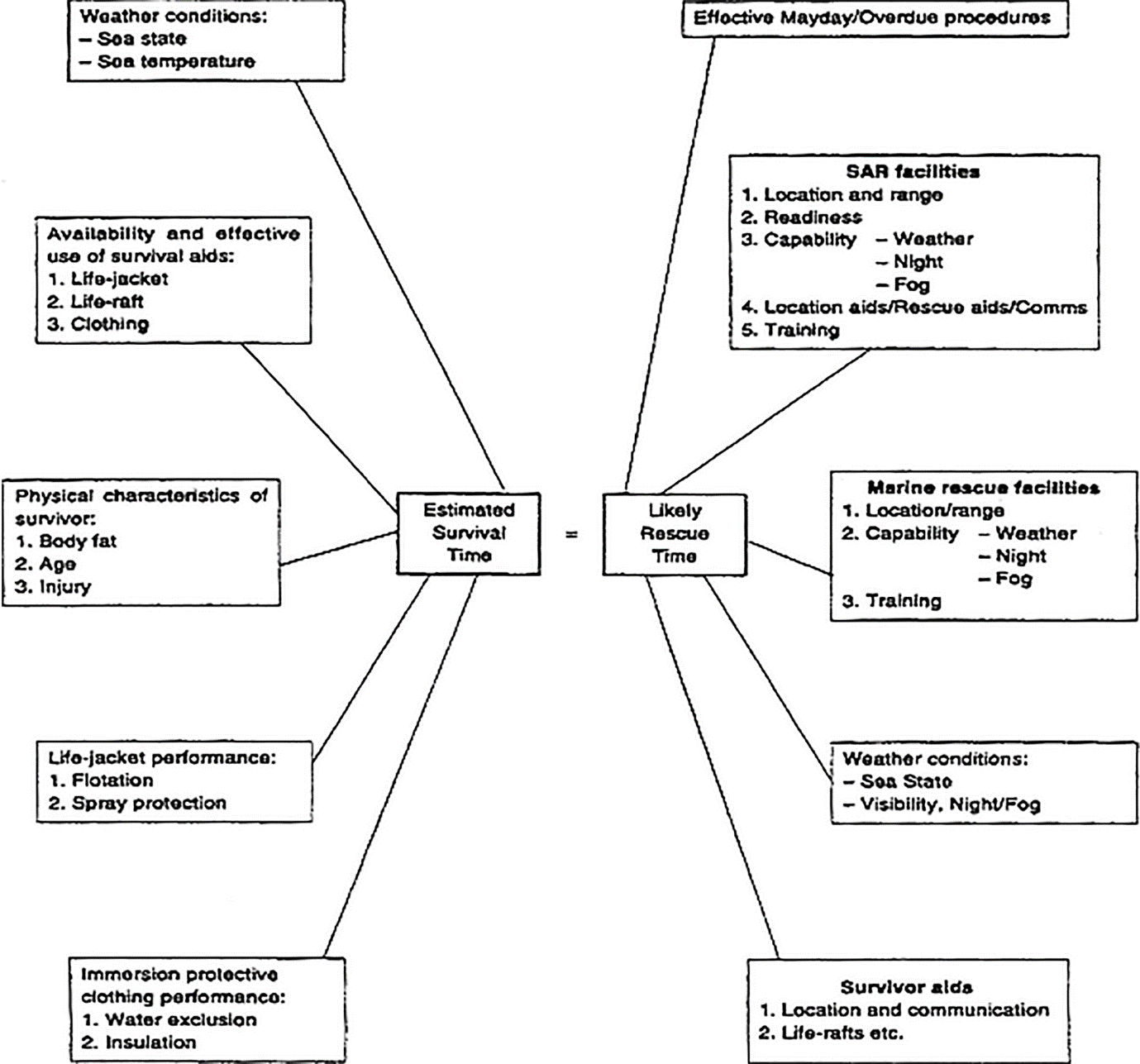
(1)The aim should be to ensure that a person in the water can survive long enough to be rescued, i.e. the survival time should be greater than the likely rescue time. The factors affecting both times are shown in Figure 1. The figure emphasises that survival time is influenced by many factors, physical and human. Some of the factors are relevant to survival in cold water and some are relevant in water at any temperature.
Figure 1: The survival equation
(2)Broad estimates of likely survival times for the thin individual offshore are given in Table 1 below. As survival time is significantly affected by the prevailing weather conditions at the time of immersion, the Beaufort wind scale has been used as an indicator of these surface conditions.
Table 1: Timescale within which the most vulnerable individuals are likely to succumb to the prevailing conditions.
Clothing assembly | Beaufort wind force | Times within which the most vulnerable individuals are likely to drown | |
(water temp 5°C) | (water temp 13°C) | ||
Working clothes (no immersion suit) | 0 – 2 | Within ¾ hour | Within 1 ¼ hours |
3 – 4 | Within ½ hour | Within ½ hour | |
5 and above | Significantly less than ½ hour | Significantly less than ½ hour | |
Immersion suit worn over working clothes (with leakage inside suit) | 0 – 2 | May well exceed 3 hours | May well exceed 3 hours |
3 – 4 | Within 2 ¾ hours | May well exceed 3 hours | |
5 and above | Significantly less than 2 ¾ hours. May well exceed 1 hour | May well exceed 3 hours | |
(3)Consideration should also be given to escaping from the helicopter itself should it submerge or invert in the water. In this case escape time is limited to the length of time the occupants can hold their breath. The breath holding time can be greatly reduced by the effect of cold shock. Cold shock is caused by the sudden drop in skin temperature on immersion, and is characterised by a gasp reflex and uncontrolled breathing. The urge to breath rapidly becomes overwhelming and, if still submerged, the individual will inhale water resulting in drowning. Delaying the onset of cold shock by wearing an immersion suit will extend the available escape time from a submerged helicopter.
(4)The effects of water leakage and hydrostatic compression on the insulation quality of clothing are well recognised. In a nominally dry system the insulation is provided by still air trapped within the clothing fibres and between the layers of suit and clothes. It has been observed that many systems lose some of their insulating capacity either because the clothes under the 'waterproof' survival suit get wet to some extent or because of hydrostatic compression of the whole assembly. As a result of water leakage and compression, survival times will be shortened. The wearing of warm clothing under the suit is recommended.
(5)Whatever type of survival suit and other clothing is provided, it should not be forgotten that significant heat loss can occur from the head.
SPO.IDE.H.199 Life-rafts, survival ELTs and survival equipment on extended overwater flights – complex motor-powered helicopters
Regulation (EU) No 379/2014
Helicopters operated:
(a)on a flight over water at a distance from land corresponding to more than 10 minutes flying time at normal cruising speed where in the case of the critical engine failure, the helicopter is able to sustain level flight; or
(b)on a flight over water at a distance corresponding to more than 3 minutes flying time at normal cruising speed, where in the case of the critical engine failure, the helicopter is not able to sustain level flight, and if so determined by the pilot-in-command by means of a risk assessment, shall be equipped with:
(1)at least one life-raft with a rated capacity of not less than the maximum number of persons on board, stowed so as to facilitate their ready use in emergency;
(2)at least one survival ELT (ELT(S)) for each required life-raft; and
(3)life-saving equipment, including means of sustaining life, as appropriate to the flight to be undertaken.
AMC1 SPO.IDE.H.199 Life-rafts, survival ELTs and survival equipment on extended overwater flights – complex motor-powered helicopters
ED Decision 2014/018/R
LIFE–RAFTS AND EQUIPMENT FOR MAKING DISTRESS SIGNALS
(a)Each required life-raft should conform to the following specifications:
(1)be of an approved design and stowed so as to facilitate their ready use in an emergency;
(2)be radar conspicuous to standard airborne radar equipment;
(3)when carrying more than one life-raft on board, at least 50 % of the rafts should be able to be deployed by the crew while seated at their normal station, where necessary by remote control; and
(4)life-rafts that are not deployable by remote control or by the crew should be of such weight as to permit handling by one person. 40 kg should be considered a maximum weight.
(b)Each required life-raft should contain at least the following:
(1)one approved survivor locator light;
(2)one approved visual signalling device;
(3)one canopy (for use as a sail, sunshade or rain catcher) or other mean to protect occupants from the elements;
(4)one radar reflector;
(5)one 20 m retaining line designed to hold the life-raft near the helicopter but to release it if the helicopter becomes totally submerged;
(6)one sea anchor; and
(7)one survival kit, appropriately equipped for the route to be flown, which should contain at least the following:
(i)one life-raft repair kit;
(ii)one bailing bucket;
(iii)one signalling mirror;
(iv)one police whistle;
(v)one buoyant raft knife;
(vi)one supplementary means of inflation;
(vii)sea sickness tablets;
(viii)one first-aid kit;
(ix)one portable means of illumination;
(x)500 ml of pure water and one sea water desalting kit; and
(xi)one comprehensive illustrated survival booklet in an appropriate language.
SPO.IDE.H.200 Survival equipment
Regulation (EU) No 379/2014
Helicopters operated over areas in which search and rescue would be especially difficult shall be equipped with:
(a)signalling equipment to make distress signals;
(b)at least one survival ELT (ELT(S)); and
(c)additional survival equipment for the route to be flown taking account of the number of persons on board.
AMC1 SPO.IDE.H.200 Survival equipment
ED Decision 2014/018/R
ADDITIONAL SURVIVAL EQUIPMENT
(a)The following additional survival equipment should be carried when required:
(1)500 ml of water for each four, or fraction of four, persons on board;
(2)one knife;
(3)first-aid equipment; and
(4)one set of air/ground codes.
(b)In addition, when polar conditions are expected, the following should be carried:
(1)a means of melting snow;
(2)one snow shovel and one ice saw;
(3)sleeping bags for use by 1/3 of all persons on board and space blankets for the remainder or space blankets for all persons on board; and
(4)one arctic/polar suit for each crew member.
(c)If any item of equipment contained in the above list is already carried on board the aircraft in accordance with another requirement, there is no need for this to be duplicated.
AMC1 SPO.IDE.H.200(b) Survival equipment
ED Decision 2014/018/R
SURVIVAL ELT
An ELT(AP) may be used to replace one required ELT(S) provided that it meets the ELT(S) requirements. A water-activated ELT(S) is not an ELT(AP).
GM1 SPO.IDE.H.200 Survival equipment
ED Decision 2014/018/R
SIGNALLING EQUIPMENT
The signalling equipment for making distress signals is described in ICAO Annex 2, Rules of the Air.
GM2 SPO.IDE.H.200 Survival equipment
ED Decision 2014/018/R
AREAS IN WHICH SEARCH AND RESCUE WOULD BE ESPECIALLY DIFFICULT
The expression ‘areas in which search and rescue would be especially difficult’ should be interpreted, in this context, as meaning:
(a)areas so designated by the authority responsible for managing search and rescue; or
(b)areas that are largely uninhabited and where:
(1)the authority referred to in (a) has not published any information to confirm whether search and rescue would be or would not be especially difficult; and
(2)the authority referred to in (a) does not, as a matter of policy, designate areas as being especially difficult for search and rescue.
SPO.IDE.H.202 Helicopters certified for operating on water – miscellaneous equipment
Regulation (EU) No 379/2014
Helicopters certified for operating on water shall be equipped with:
(a)a sea anchor and other equipment necessary to facilitate mooring, anchoring or manoeuvring the helicopter on water, appropriate to its size, weight and handling characteristics; and
(b)equipment for making the sound signals prescribed in the International Regulations for Preventing Collisions at Sea, where applicable.
GM1 SPO.IDE.H.202 Helicopters certificated for operating on water – miscellaneous equipment
ED Decision 2014/018/R
INTERNATIONAL REGULATIONS FOR PREVENTING COLLISIONS AT SEA
International Regulations for Preventing Collisions at Sea are those that were published by the International Maritime Organisation (IMO) in 1972.
SPO.IDE.H.203 All helicopters on flights over water – ditching
Regulation (EU) 2015/140
Complex motor-powered helicopters operated on a flight over water in a hostile environment at a distance from land corresponding to more than 10 minutes' flying time at normal cruising speed and other-than complex motor-powered helicopters flying over water in a hostile environment beyond a distance of 50 NM from land shall be:
(a)designed for landing on water in accordance with the relevant airworthiness code;
(b)certified for ditching in accordance with the relevant airworthiness code; or
(c)fitted with emergency flotation equipment.
AMC1 SPO.IDE.H.203 All helicopters on flights over water – ditching
ED Decision 2016/022/R
EMERGENCY FLOTATION EQUIPMENT
The considerations of AMC1 SPA.HOFO.165(d) should apply in respect of emergency flotation equipment.
SPO.IDE.H.205 Individual protective equipment
Regulation (EU) No 379/2014
Each person on board shall wear individual protective equipment that is adequate for the type of operation being undertaken.
GM1 SPO.IDE.H.205 Individual protective equipment
ED Decision 2014/018/R
TYPES OF INDIVIDUAL PROTECTIVE EQUIPMENT
Personal protective equipment should include, but is not limited to: flying suits, gloves, helmets, protective shoes, etc.
SPO.IDE.H.210 Headset
Regulation (EU) No 379/2014
Whenever a radio communication and/or radio navigation system is required, helicopters shall be equipped with a headset with boom microphone or equivalent and a transmit button on the flight controls for each required pilot, crew member and/or task specialist at his/her assigned station.
AMC1 SPO.IDE.H.210 Headset
ED Decision 2014/018/R
GENERAL
(a)A headset consists of a communication device that includes two earphones to receive and a microphone to transmit audio signals to the helicopter’s communication system. To comply with the minimum performance requirements, the earphones and microphone should match the communication system’s characteristics and the flight crew compartment environment. The headset should be adequately adjustable in order to fit the flight crew’s head. Headset boom microphones should be of the noise cancelling type.
(b)If the intention is to utilise noise cancelling earphones, the operator should ensure that the earphones do not attenuate any aural warnings or sounds necessary for alerting the flight crew on matters related to the safe operation of the helicopter.
GM1 SPO.IDE.H.210 Headset
ED Decision 2014/018/R
GENERAL
The term ‘headset’ includes any aviation helmet incorporating headphones and microphone worn by a flight crew member.
SPO.IDE.H.215 Radio communication equipment
Regulation (EU) No 379/2014
(a)Helicopters operated under IFR or at night, or when required by the applicable airspace requirements, shall be equipped with radio communication equipment that, under normal radio propagating conditions, shall be capable of:
(1)conducting two-way communication for aerodrome control purposes;
(2)receiving meteorological information;
(3)conducting two-way communication at any time during flight with those aeronautical stations and on those frequencies prescribed by the appropriate authority; and
(4)providing for communication on the aeronautical emergency frequency 121,5 MHz.
(b)When more than one communications equipment unit is required, each shall be independent of the other or others to the extent that a failure in any one will not result in failure of any other.
(c)When a radio communication system is required, and in addition to the flight crew interphone system required in SPO.IDE.H.135, helicopters shall be equipped with a transmit button on the flight controls for each required pilot and crew member at his/her assigned station.
GM1 SPO.IDE.H.215 Radio communication equipment
ED Decision 2014/018/R
APPLICABLE AIRSPACE REQUIREMENTS
For helicopters being operated under European air traffic control, the applicable airspace requirements include the Single European Sky legislation.
SPO.IDE.H.220 Navigation equipment
Regulation (EU) 2019/1384
(a)Helicopters shall be equipped with navigation equipment that will enable them to proceed in accordance with:
(1)the ATS flight plan, if applicable; and
(2)the applicable airspace requirements.
(b)Helicopters shall have sufficient navigation equipment to ensure that, in the event of the failure of one item of equipment at any stage of the flight, the remaining equipment shall allow safe navigation in accordance with (a), or an appropriate contingency action to be completed safely.
(c)Helicopters operated on flights in which it is intended to land in IMC shall be equipped with navigation equipment capable of providing guidance to a point from which a visual landing can be performed. This equipment shall be capable of providing such guidance for each aerodrome at which it is intended to land in IMC and for any designated alternate aerodromes.
(d)For PBN operations the aircraft shall meet the airworthiness certification requirements for the appropriate navigation specification.
(e)Helicopters shall be equipped with surveillance equipment in accordance with the applicable airspace requirements.
AMC1 SPO.IDE.H.220 Navigation equipment
ED Decision 2014/018/R
NAVIGATION WITH VISUAL REFERENCE TO LANDMARKS — OTHER-THAN COMPLEX HELICOPTERS
Where other-than complex helicopters, with the surface in sight, can proceed according to the ATS flight plan by navigation with visual reference to landmarks, no additional equipment is needed to comply with SPO.IDE.H.220(a)(1).
GM1 SPO.IDE.H.220 Navigation equipment
ED Decision 2016/021/R
AIRCRAFT ELIGIBILITY FOR PBN SPECIFICATION NOT REQUIRING SPECIFIC APPROVAL
(a)The performance of the aircraft is usually stated in the AFM.
(b)Where such a reference cannot be found in the AFM, other information provided by the aircraft manufacturer as TC holder, the STC holder or the design organisation having a privilege to approve minor changes may be considered.
(c)The following documents are considered acceptable sources of information:
(1)AFM, supplements thereto, and documents directly referenced in the AFM;
(2)FCOM or similar document;
(3)Service Bulletin or Service Letter issued by the TC holder or STC holder;
(4)approved design data or data issued in support of a design change approval;
(5)any other formal document issued by the TC or STC holders stating compliance with PBN specifications, AMC, Advisory Circulars (AC) or similar documents issued by the State of Design; and
(6)written evidence obtained from the State of Design.
(d)Equipment qualification data, in itself, is not sufficient to assess the PBN capabilities of the aircraft, since the latter depend on installation and integration.
(e)As some PBN equipment and installations may have been certified prior to the publication of the PBN Manual and the adoption of its terminology for the navigation specifications, it is not always possible to find a clear statement of aircraft PBN capability in the AFM. However, aircraft eligibility for certain PBN specifications can rely on the aircraft performance certified for PBN procedures and routes prior to the publication of the PBN Manual.
(f)Below, various references are listed which may be found in the AFM or other acceptable documents (see listing above) in order to consider the aircraft’s eligibility for a specific PBN specification if the specific term is not used.
(g)RNAV 5
(1)If a statement of compliance with any of the following specifications or standards is found in the acceptable documentation as listed above, the aircraft is eligible for RNAV 5 operations.
(i)B-RNAV;
(ii)RNAV 1;
(iii)RNP APCH;
(iv)RNP 4;
(v)A-RNP;
(vi)AMC 20-4;
(vii)JAA TEMPORARY GUIDANCE MATERIAL, LEAFLET NO. 2 (TGL 2)
(viii)JAA AMJ 20X2;
(ix)FAA AC 20-130A for en route operations;
(x)FAA AC 20-138 for en route operations; and
(xi)FAA AC 90-96.
(h)RNAV 1/RNAV 2
(1)If a statement of compliance with any of the following specifications or standards is found in the acceptable documentation as listed above, the aircraft is eligible for RNAV 1/RNAV 2 operations.
(i)RNAV 1;
(ii)PRNAV;
(iii)US RNAV type A;
(iv)FAA AC 20-138 for the appropriate navigation specification;
(v)FAA AC 90-100A;
(vi)JAA TEMPORARY GUIDANCE MATERIAL, LEAFLET NO. 10 Rev1 (TGL 10);
(vii)FAA AC 90-100.
(2)However, if position determination is exclusively computed based on VOR-DME, the aircraft is not eligible for RNAV 1/RNAV 2 operations.
(i)RNP 1/RNP 2 continental
(1)If a statement of compliance with any of the following specifications or standards is found in the acceptable documentation as listed above, the aircraft is eligible for RNP 1/RNP 2 continental operations.
(i)A-RNP;
(ii)FAA AC 20-138 for the appropriate navigation specification; and
(iii)FAA AC 90-105.
(2)Alternatively, if a statement of compliance with any of the following specifications or standards is found in the acceptable documentation as listed above and position determination is primarily based on GNSS, the aircraft is eligible for RNP 1/RNP 2 continental operations. However, in these cases, loss of GNSS implies loss of RNP 1/RNP 2 capability.
(i)JAA TEMPORARY GUIDANCE MATERIAL, LEAFLET NO. 10 (TGL 10) (any revision); and
(ii)FAA AC 90-100.
(j)RNP APCH — LNAV minima
(1)If a statement of compliance with any of the following specifications or standards is found in the acceptable documentation as listed above, the aircraft is eligible for RNP APCH LNAV operations.
(i)A-RNP;
(ii)AMC 20-27;
(iii)AMC 20-28;
(iv)FAA AC 20-138 for the appropriate navigation specification; and
(v)FAA AC 90-105 for the appropriate navigation specification.
(2)Alternatively, if a statement of compliance with RNP 0.3 GNSS approaches in accordance with any of the following specifications or standards is found in the acceptable documentation as listed above, the aircraft is eligible for RNP APCH — LNAV operations. Any limitation such as ‘within the US National Airspace’ may be ignored since RNP APCH procedures are assumed to meet the same ICAO criteria around the world.
(i)JAA TEMPORARY GUIDANCE MATERIAL, LEAFLET NO. 3 (TGL 3);
(ii)AMC 20-4;
(iii)FAA AC 20-130A; and
(iv)FAA AC 20-138.
(k)RNP APCH — LNAV/VNAV minima
(1)If a statement of compliance with any of the following specifications or standards is found in the acceptable documentation as listed above, the aircraft is eligible for RNP APCH — LNAV/VNAV operations.
(i)A-RNP;
(ii)AMC 20-27 with Baro VNAV;
(iii)AMC 20-28;
(iv)FAA AC 20-138; and
(v)FAA AC 90-105 for the appropriate navigation specification.
(2)Alternatively, if a statement of compliance with FAA AC 20-129 is found in the acceptable documentation as listed above, and the aircraft complies with the requirements and limitations of EASA SIB 2014-04108, the aircraft is eligible for RNP APCH — LNAV/VNAV operations. Any limitation such as ‘within the US National Airspace’ may be ignored since RNP APCH procedures are assumed to meet the same ICAO criteria around the world.
(l)RNP APCH — LPV minima
(1)If a statement of compliance with any of the following specifications or standards is found in the acceptable documentation as listed above, the aircraft is eligible for RNP APCH — LPV operations.
(i)AMC 20-28;
(ii)FAA AC 20-138 for the appropriate navigation specification; and
(iii)FAA AC 90-107.
(2)For aircraft that have a TAWS Class A installed and do not provide Mode-5 protection on an LPV approach, the DH is limited to 250 ft.
(m)RNAV 10
(1)If a statement of compliance with any of the following specifications or standards is found in the acceptable documentation as listed above, the aircraft is eligible for RNAV 10 operations.
(i)RNP 10;
(ii)FAA AC 20-138 for the appropriate navigation specification;
(iii)AMC 20-12;
(iv)FAA Order 8400.12 (or later revision); and
(v)FAA AC 90-105.
(n)RNP 4
(1)If a statement of compliance with any of the following specifications or standards is found in the acceptable documentation as listed above, the aircraft is eligible for RNP 4 operations.
(i)FAA AC 20-138B or later, for the appropriate navigation specification;
(ii)FAA Order 8400.33; and
(iii)FAA AC 90-105 for the appropriate navigation specification.
(o)RNP 2 oceanic
(1)If a statement of compliance with FAA AC 90-105 for the appropriate navigation specification is found in the acceptable documentation as listed above, the aircraft is eligible for RNP 2 oceanic operations.
(2)If the aircraft has been assessed eligible for RNP 4, the aircraft is eligible for RNP 2 oceanic.
(p)Special features
(1)RF in terminal operations (used in RNP 1 and in the initial segment of the RNP APCH)
(i)If a statement of demonstrated capability to perform an RF leg, certified in accordance with any of the following specifications or standards, is found in the acceptable documentation as listed above, the aircraft is eligible for RF in terminal operations:
(A)AMC 20-26;
(B)FAA AC 20-138B or later.
(ii)If there is a reference to RF and a reference to compliance with AC 90-105, then the aircraft is eligible for such operations.
(q)Other considerations
(1)In all cases, the limitations in the AFM need to be checked, in particular the use of AP or FD which can be required to reduce the FTE primarily for RNP APCH, RNAV 1, and RNP 1.
(2)Any limitation such as ‘within the US National Airspace’ may be ignored since RNP APCH procedures are assumed to meet the same ICAO criteria around the world.
GM2 SPO.IDE.H.220 Navigation equipment
ED Decision 2016/021/R
GENERAL
(a)The PBN specifications for which the aircraft complies with the relevant airworthiness criteria are set out in the AFM, together with any limitations to be observed.
(b)Because functional and performance requirements are defined for each navigation specification, an aircraft approved for an RNP specification is not automatically approved for all RNAV specifications. Similarly, an aircraft approved for an RNP or RNAV specification having a stringent accuracy requirement (e.g. RNP 0.3 specification) is not automatically approved for a navigation specification having a less stringent accuracy requirement (e.g. RNP 4).
RNP 4
(c)For RNP 4, at least two LRNSs, capable of navigating to RNP 4, and listed in the AFM, may be operational at the entry point of the RNP 4 airspace. If an item of equipment required for RNP 4 operations is unserviceable, then the flight crew may consider an alternate route or diversion for repairs. For multi-sensor systems, the AFM may permit entry if one GNSS sensor is lost after departure, provided one GNSS and one inertial sensor remain available.
SPO.IDE.H.225 Transponder
Regulation (EU) No 379/2014
Where required by the airspace being flown, helicopters shall be equipped with a secondary surveillance radar (SSR) transponder with all the required capabilities.
AMC1 SPO.IDE.H.225 Transponder
ED Decision 2014/018/R
GENERAL
(a)The SSR transponders of helicopters being operated under European air traffic control should comply with any applicable Single European Sky legislation.
(b)If the Single European Sky legislation is not applicable, the SSR transponders should operate in accordance with the relevant provisions of Volume IV of ICAO Annex 10.
SPO.IDE.H.230 Management of aeronautical databases
Regulation (EU) 2016/1199
(a)Aeronautical databases used on certified aircraft system applications shall meet data quality requirements that are adequate for the intended use of the data.
(b)The operator shall ensure the timely distribution and insertion of current and unaltered aeronautical databases to all aircraft that require them.
(c)Notwithstanding any other occurrence reporting requirements as defined in Regulation (EU) No 376/2014, the operator shall report to the database provider instances of erroneous, inconsistent or missing data that might be reasonably expected to constitute a hazard to flight.
In such cases, the operator shall inform flight crew and other personnel concerned, and shall ensure that the affected data is not used.
AMC1 SPO.IDE.H.230 Management of aeronautical databases
ED Decision 2014/018/R
AERONAUTICAL DATABASES
When the operator of an aircraft uses an aeronautical database that supports an airborne navigation application as a primary means of navigation used to meet the airspace usage requirements, the database provider should be a Type 2 DAT provider certified in accordance with Regulation (EU) 2017/373 or equivalent.
GM1 SPO.IDE.H.230 Management of aeronautical databases
ED Decision 2017/003/R
AERONAUTICAL DATABASE APPLICATIONS
(a)Applications using aeronautical databases for which Type 2 DAT providers should be certified in accordance with Regulation (EU) 2017/373 may be found in GM1 DAT.OR.100.
(b)The certification of a Type 2 DAT provider in accordance with Regulation (EU) 2017/373 ensures data integrity and compatibility with the certified aircraft application/equipment.
GM2 SPO.IDE.H.230 Management of aeronautical databases
ED Decision 2017/003/R
TIMELY DISTRIBUTION
The operator should distribute current and unaltered aeronautical databases to all aircraft requiring them in accordance with the validity period of the databases or in accordance with a procedure established in the operations manual if no validity period is defined.
GM3 SPO.IDE.H.230 Management of aeronautical databases
ED Decision 2017/003/R
STANDARDS FOR AERONAUTICAL DATABASES AND DAT PROVIDERS
(a)A ‘Type 2 DAT provider’ is an organisation as defined in Article 2(5)(b) of Regulation (EU) 2017/373.
(b)Equivalent to a certified ‘Type 2 DAT provider’ is defined in any Aviation Safety Agreement between the European Union and a third country, including any Technical Implementation Procedures, or any Working Arrangements between EASA and the competent authority of a third country.
SUBPART E: SPECIFIC REQUIREMENTS
SECTION 1 – Helicopter external sling load operations (HESLO)
SPO.SPEC.HESLO.100 Standard operating procedures
Regulation (EU) 2019/1384
The standard operating procedures for HESLO shall specify:
(a)the equipment to be carried, including its operating limitations and appropriate entries in the MEL, as applicable;
(b)crew composition and experience requirements of crew members and task specialists;
(c)the relevant theoretical and practical training for crew members to perform their tasks, the relevant training for task specialists to perform their tasks, and the qualification and nomination of persons providing such training to crew members and task specialists;
(d)responsibilities and duties of crew members and task specialists;
(e)helicopter performance criteria necessary to be met to conduct HESLO operations;
(f)normal, abnormal and emergency procedures.
AMC1 SPO.SPEC.HESLO.100 Standard operating procedures
ED Decision 2017/012/R
STANDARD OPERATING PROCEDURES
(a)Before conducting any HESLO, the operator should develop its SOPs taking into account the elements below.
(b)Nature and complexity of the activity
(1)Nature of the activity and exposure:
Helicopter flights for the purpose of transporting external loads by different means, e.g. under slung, external pods or racks. These operations are usually performed at a low height.
(2)Complexity of the activity:
The complexity of the activity varies with the size and the shape of the load, the length of the rope and characteristics of the pick-up and drop-off zones, the time per load cycle, etc.
Table 1: HESLO types
HESLO 1: | short line, 20 metres (m) or less |
HESLO 2: | long line, more than 20 m |
HESLO 3: | specialised sling load, such as: Logging, insulators and pullers, traverse mounting, spinning of fibre cable, ice and snow removal from power lines, sawing, geophysical surveys, cable laying onto the ground or into ditches, avalanche control, landslide control |
HESLO 4: | Advanced sling load such as: Tower erecting, wire stringing, disassembly of masts and towers |
(3)Operational environment and geographical area:
HESLO may be performed over any geographical area. Special attention should be given to:
(i)hostile and congested;
(ii)mountains;
(iii)sea;
(iv)jungle;
(v)desert; and
(vi)polar;
(vii)lakes and river canyons; and
(viii)environmentally sensitive areas (e.g. national parks, noise sensitive areas).
(c)Equipment
(1)The helicopter may be equipped with:
(i)additional mirror(s) and/or video camera(s);
(ii)a bubble window;
(iii)supplementary hook(s) or multi-hook device(s); and
(iv)load data recorder (lifts, weights, torques, power, forces, shocks and electrical activities)
(2)When conducting single-pilot vertical reference operations with no assistance of a task specialist or other crew member, additional engine monitoring in the pilot line of vision or an audio warning system is recommended.
(3)All additional equipment used, e.g. ropes, cables, mechanical hooks, swivel hooks, nets, buckets, chainsaws, baskets, containers, should be manufactured according to applicable rules or recognised standards. The operator should be responsible for maintaining the serviceability of this equipment.
(4)Adequate radio communication equipment (e.g. VHF, UHF, FM) should be installed and serviceable in the helicopter for co-ordination with the task specialists involved in the operation.
(5)Task specialists involved in the operation should be equipped with hand-held communication equipment, protective helmets with integrated earphones and microphones, and the relevant personal protective equipment.
(d)Crew members
(1)Crew composition:
(i)The minimum flight crew as stated in the approved AFM. For operational or training purposes, an additional crew member may assist the pilot-in-command (PIC) in a single-pilot operation. In such a case:
(A)procedures are in place for a crew member to monitor the flight, especially during the departure, approach and HESLO cycle, to ensure that a safe flight path is maintained; and
(B)when a task specialist is tasked with assisting the pilot, the procedures according to which this assistance is taking place should be clearly defined.
(ii)For safety and/or operational purposes, task specialists should be instructed by the operator to fulfil specified tasks.
(2)Pilot training for HESLO
Before acting as unsupervised PIC, the pilot should demonstrate to the operator that he/she has the required skills and knowledge.
(i)Theoretical knowledge for HESLO 1:
(A)content of the operations manual (OM) including the relevant SOPs;
(B)AFM (limitations, performance, mass and balance, abnormal and emergency procedures, etc.);
(C)procedures (e.g. short line, long line, construction, wire stringing or cable laying flying techniques), as required for the operation;
(D)load and site preparation including load rigging techniques and external load procedures;
(E)special equipment used in the operation;
(F)training in human factor principles; and
(G)hazards and dangers.
(ii)Theoretical knowledge for other HESLO levels should include the elements listed in point (i) above where additional knowledge to that of HESLO 1 is needed for the adequate HESLO level.
(iii)Practical training defined in the operator’s training programme:
(A)Flight instruction provided by a HESLO instructor; and
(B)Flight under the supervision of a HESLO instructor. The supervision should take place during HESLO missions, from inside the helicopter and on-site.
For the purpose of this AMC, a HESLO mission is defined as a flight or series of flights from point A to point B on a particular day and for commercial specialised operations, for a particular client.
(3)Pilot experience
(i)Prior to commencing training:
(A)10 hours flight experience on the helicopter type;
(B)For HESLO 2: At least 100 HESLO cycles;
(C)For HESLO 3: At least 500 HESLO cycles; and
(D)For HESLO 4: At least 1 000 flight hours on helicopters and 2 000 HESLO cycles, including experience as unsupervised PIC in HESLO 2 or HESLO 3.
(ii)Before acting as PIC under the supervision of a HESLO instructor:
(A)For HESLO 1: At least 5 hours and 50 HESLO cycles flight instruction;
(B)For HESLO 2: In addition to HESLO 1 training, at least 2 hours and 20 HESLO cycles flight instruction with a long line of more than 20 metres.
(C)For HESLO 3 and 4: A number of HESLO cycles flight instruction, as relevant to the activity to be performed and the required skills.
(iii)Before acting as unsupervised PIC:
(A)For HELSO 1, 300 hours helicopter flight experience as PIC; and
(B)For HESLO 1: At least 8 hours, 80 HESLO cycles and 5 HESLO missions;
(C)For HESLO 2: At least 5 hours, 50 HESLO cycles and 5 HESLO missions with long line of more than 20 metres;
(D)For HESLO 3 and 4: A number of HESLO missions under the supervision of a HESLO instructor, as relevant to the activity to be performed and the required skills;
(E)For HESLO 3 and 4, 15 hours on the helicopter type, performing HESLO 1 and 2 operations;
(F)At least 20 hours gained in an operational environment similar to the environment of intended operation (desert, sea, jungle, mountains, etc.).
(4)Pilot proficiency: Before acting as unsupervised PIC, pilot proficiency has been assessed as sufficient for the intended operations and environment under the relevant HESLO type, by a HESLO instructor nominated by the operator.
(5)Pilot recurrent training and checking at least every two years:
(i)review of the load rigging techniques;
(ii)external load procedures;
(iii)review of the applicable flying techniques; and
(iv)review of human factor principles.
(v)A pilot who has performed 20 hours of relevant HESLO within the past 12 months may not need any further flight training other than in accordance with Part-ORO and Part-FCL.
(e)Task specialists
Before acting as task specialist, he/she should demonstrate to the operator that he/she has been trained appropriately and has the required skill and knowledge.
(1)Initial training
(i)The initial training of task specialists should include at least:
(A)behaviour in a rotor turning environment and training in ground safety and emergency procedures;
(B)procedures including load rigging, usage and conservation (replacement) of LLD;
(C)helicopter marshalling signals;
(D)radio communication;
(E)selection and preparation of pick-up and drop-off sites, dangers on working places (downwash, loose goods, third people);
(F)handling and safety of the third party;
(G)relevant training for the helicopter type;
(H)duties and responsibilities as described in the appropriate manual;
(I)perception and classification of flight obstacles (none, critical, danger), measures for safety;
(J)human factor principles; and
(K)for task specialists seated in the cockpit and whose tasks are to assist the pilot, the relevant CRM training elements as specified in ORO.FC.115.
(ii)The individual safety equipment appropriate to the operational environment and complexity of the activity should be described in the appropriate manual.
(2)Recurrent training
(i)The annual recurrent training should include the items listed in the initial training as described in (e)(1) above.
(ii)The operator should establish a formal qualification list for each task specialist.
(iii)The operator should establish a system of record keeping that allows adequate storage and reliable traceability of:
(A)the initial and recurrent training;
(B)Qualifications (qualification list).
(3)Briefing of task specialists
Briefings on the organisation and coordination between the flight crew and task specialists involved in the operation should take place prior to each operation. These briefings should include at least the following:
(i)location and size of pick-up and drop-off site, operating altitude;
(ii)location of refuelling site and procedures to be applied;
(iii)load sequence, danger areas, performance and limitations, emergency procedures; and
(iv)for a task specialist who has not received the relevant elements of CRM training as specified in ORO.FC.115, the operator’s crew coordination concept including relevant elements of CRM.
(4)Responsibility of task specialists operating on the ground:
(i)Task specialists operating on the ground are responsible for the safe organisation of the ground operation, including:
(A)adequate selection and preparation of the pick-up and drop-off points and load rigging;
(B)appropriate communication and assistance to the flight crew and other task specialists; and
(C)access restriction on the pick-up and drop-off site.
(ii)If more than one task specialist is required for a task, one should be nominated as leading the activities. He/she should act as the main link between the flight crew and other task specialist(s) involved in the operation and is responsible for:
(A)task specialist coordination and activities on the ground; and
(B)the safety of the working area (loading and fuelling).
(f)HESLO instructor
The HESLO instructor should be assigned by the operator on the basis of the following:
(1)the HESLO instructor for pilots should:
(i)be suitably qualified as determined by the operator and have a minimum experience of 500 hours HESLO;
(ii)have at least 10 hours HESLO experience as unsupervised PIC in the appropriate HESLO level on which instruction, supervision and proficiency assessments are to be provided; and
(iii)have attended the ‘teaching and learning’ part of the flight instructor or type rating instructor training, or have prior experience as an aerial work instructor subject to national rules.
(2)the HESLO instructor for task specialists should be suitably qualified as determined by the operator and have at least 2 years of experience in HESLO operations.
(g)Performance
(1)Power margins for HESLO operations:
(i)HESLO 1 and 2
The mass of the helicopter should not exceed the maximum mass specified in accordance with SPO.POL.146(c)(1) at the pick-up or drop-off site, whichever is higher, as stated in the appropriate manual.
(ii)HESLO 3 and 4
The mass of the helicopter should not exceed the maximum mass specified in accordance with SPO.POL.146(c)(1) at the pick-up or drop-off site, whichever is higher, as stated in the appropriate manual, and in the case of construction (montage) operations, reduced by 10% of the mass of the sling load capacity.
(h)Normal procedures
(1)Operating procedures:
HESLO should be performed in accordance with the appropriate manual and appropriate operating procedures. These procedures should include, for each type of operation:
(i)crew individual safety equipment (e.g. helmet, fire-retardant suits);
(ii)crew responsibilities;
(iii)crew coordination and communication;
(iv)selection and size of pick-up and drop-off sites;
(v)selection of flight routes;
(vi)fuel management in the air and on the ground;
(vii)task management; and
(viii)third party risk management.
(2)Ground procedures:
The operator should specify appropriate procedures, including:
(i)use of ground equipment;
(ii)load rigging;
(iii)size and weight assessment of loads;
(iv)attachment of suitably prepared loads to the helicopter;
(v)two-way radio communication procedures;
(vi)selection of suitable pick-up and drop-off sites;
(vii)safety instructions for task specialists operating on the ground;
(viii)helicopter performances information;
(ix)fuel management on the ground;
(x)responsibility, organisation and task management of other personnel on the ground involved in the operation;
(xi)third party risk management; and
(xii)environmental protection.
(i)Emergency procedures
(1)Operating procedures for the flight crew:
In addition to the emergency procedures published in the AFM or OM, the operator should ensure that the flight crew:
(i)is familiar with the appropriate emergency procedures;
(ii)has appropriate knowledge of the emergency procedures for personnel on the ground involved in the operation; and
(iii)reports emergencies as specified in the AFM or OM.
(2)Ground procedures:
The operator should ensure that the task specialist on the ground involved in the operation:
(i)is familiar with the appropriate emergency procedures;
(ii)has appropriate knowledge of the flight crew emergency procedures;
(iii)reports emergencies as specified in the AFM or OM; and
(iv)prevents, as far as possible, environmental pollution.
(j)Ground equipment
The operator should specify the use of ground equipment, such as fuel trucks, cables, strops, etc. in the AFM or OM, including at least:
(1)minimum size of the operating site;
(2)surface condition;
(3)positioning of ground equipment on the operating site;
(4)fuel handling;
(5)environment protection plan; and
(6)location and use of fire suppression equipment.
GM1 SPO.SPEC.HESLO.100 Standard operating procedures
ED Decision 2017/012/R
PILOT INITIAL TRAINING
The table below summarises minimum training standards.
Table 1: Training minimum standards
HESLO 1 | —CPL(H) or ATPL(H) —PPL(H) only for non-commercial operations —Minimum 10 hours PIC on type —Type rating completed —HESLO ground instruction completed —Task specialist syllabus reviewed —HESLO 1 flight instruction completed: Minimum 5 hours/50 HESLO cycles —HESLO 1 flights under supervision completed —Minimum experience 8 hours/80 HESLO cycles/5 HESLO missions —Minimum 300 hours PIC(H) —HESLO 1 proficiency |
HESLO 2 | —CPL(H) or ATPL(H) —PPL(H) only for non-commercial operations —HESLO level 1 completed —Type rating completed —Minimum 10 hours PIC on type —HESLO 2 ground instruction completed —Task specialist syllabus reviewed —Minimum 100 HESLO cycles —HESLO 2 flight instruction completed: Minimum 2 hours/20 HESLO cycles with long line —HESLO 2 flights under supervision completed —Minimum experience 5 hours/50 HESLO 2 cycles/5 HESLO 2 missions —HESLO 2 proficiency |
HESLO 3 | —CPL(H) or ATPL(H) —PPL(H) only for non-commercial operations —HESLO level 1 completed to 20m —Min. 500 HESLO cycles —Type rating completed —Minimum 10 hours PIC on type —HESLO 3 ground instruction completed —Task specialist syllabus reviewed —Practical Task specialist training for logging —HESLO 3 flight instruction completed —HESLO 3 flights under supervision completed —HESLO 3 proficiency |
HESLO 4 | —CPL(H) or ATPL(H) —PPL(H) only for non-commercial operations —Minimum 1 000 hours (H) —HESLO level 2 or 3 completed —Minimum 2 000 HESLO cycles —Type rating completed —Minimum 10 hours PIC on type —HESLO 4 ground instruction completed —Practical load preparation training —HESLO 4 flight instruction completed —HESLO 4 flights under supervision completed —HESLO 4 proficiency |
HESLO ground instruction, HESLO flight training, HESLO flights under supervision and HESLO proficiency assessments may be combined with the operator’s conversion course.
SPO.SPEC.HESLO.105 Specific HESLO equipment
Regulation (EU) No 379/2014
The helicopter shall be equipped with at least:
(a)one cargo safety mirror or alternative means to see the hook(s)/load; and
(b)one load meter, unless there is another method of determining the weight of the load.
SPO.SPEC.HESLO.110 Transportation of dangerous goods
Regulation (EU) No 379/2014
The operator transporting dangerous goods to or from unmanned sites or remote locations shall apply to the competent authority for an exemption from the provisions of the Technical Instructions if they intend not to comply with the requirements of those Instructions.
SECTION 2 – Human external cargo operations (HEC)
SPO.SPEC.HEC.100 Standard operating procedures
Regulation (EU) 2019/1384
The standard operating procedures for HEC shall specify:
(a)the equipment to be carried, including its operating limitations and appropriate entries in the MEL, as applicable;
(b)crew composition and experience requirements of crew members and task specialists;
(c)the relevant theoretical and practical training for crew members to perform their tasks, the relevant training for task specialists to perform their tasks, and the qualification and nomination of persons providing such training to crew members and task specialists;
(d)responsibilities and duties of crew members and task specialists;
(e)helicopter performance criteria necessary to be met to conduct HEC operations;
(f)normal, abnormal and emergency procedures.
AMC1 SPO.SPEC.HEC.100 Standard operating procedures
ED Decision 2017/012/R
STANDARD OPERATING PROCEDURES
(a)Before conducting any HEC operations, the operator should develop its SOPs taking into account the elements below.
(b)Nature and complexity of the activity
(1)Nature of the activity and exposure:
HEC operations are usually performed at a low height.
(2)Complexity of the activity:
(i)The complexity of the activity varies with the length of the rope and characteristics of the pick-up and drop-off zones, etc.
Table 1: HEC levels
HEC 1: | Sling or cable length is less or equal to 25 m |
HEC 2: | Sling or cable length is greater than 25 m |
(3)Operational environment and geographical area:
HEC may be performed over any geographical area. Special attention should be given to:
(i)hostile congested and non-congested environment;
(ii)mountains;
(iii)sea;
(iv)jungle;
(v)desert;
(vi)artic;
(vii)lakes and river canyons; and
(viii)environmentally sensitive areas (e.g. national parks, noise sensitive areas).
(c)Equipment
(1)The helicopter may be equipped with:
(i)additional mirror(s) and/or video camera(s);
(ii)a bubble window;
(iii)supplementary hook(s) or multi-hook device(s); and
(iv)load data recorder (lifts, weights, torques, power, forces, shocks and electrical activities).
(2)When conducting single-pilot vertical reference operations with no assistance of a task specialist or other crew member, additional engine monitoring in the pilot line of vision or an audio warning system is recommended.
(3)Adequate radio communication equipment (e.g. VHF, UHF, FM) should be installed in the helicopter for co-ordination with the task specialist involved in the operation.
(4)Task specialists involved in the operation should be equipped with hand-held communication equipment, protective helmets with integrated earphones and microphones as well as personal protective equipment.
(d)Crew members
(1)Crew composition:
(i)The minimum flight crew is stated in the approved AFM. For operational or training purposes, an additional qualified crew member may assist the PIC in a single-pilot operation. In such a case:
(A)procedures are in place for a member of the flight crew to monitor the flight, especially during the departure, approach and HEC operations, to ensure that a safe flight path is maintained; and
(B)when a task specialist is tasked with assisting the pilot, the procedures according to which this assistance is taking place should be clearly defined.
(ii)For safety and/or operational purposes, a task specialist may be required by the operator to fulfil the task (e.g. to establish vertical reference or to operate the release safety device for the belly rope).
(2)Pilot initial training:
Before acting as PIC, the pilot should demonstrate to the operator that he/she has the required skills and knowledge, as follows:
(i)Theoretical knowledge:
(A)load rigging techniques;
(B)external load procedures;
(C)site organisation and safety measures;
(D)short line, long line, construction, wire stringing or cable laying flying techniques, as required for the operation.
(ii)Pilot experience prior to commencing the training:
(A)10 hours flight experience on the helicopter type;
(B)type rating completed;
(C)HESLO type 1 or 2 completed;
(D)relevant experience in the field of operation;
(E)training in human factor principles; and
(F)ground instruction completed (marshaller syllabus).
(iii)Pilot experience prior to commencind unsupervised HEC flights:
(A)HEC flight instruction completed.
(B)1 000 hours helicopter flight experience as PIC.
(C)for mountain operations, 500 hours of flight experience as PIC in mountain operations.
(D)for HEC 2, HESLO type 2 completed.
(3)Pilot proficiency prior to commencing unsupervised HEC flights:
Pilot proficiency has been assessed as sufficient for the intended operations and environment under the relevant HEC level, by a HEC instructor nominated by the operator.
(4)Pilot recurrent training and checking at least every two years:
(i)review of the sling technique;
(ii)external load procedures;
(iii)training in human factor principles; and
(iv)review of the applicable flying techniques, which should take place during a training flight if the pilot has not performed HEC or HHO operations within the past 24 months.
(5)Conditions of HEC instruction:
(i)Maximum sling length according to the level applicable:
(A)1 task specialist (with radio) at pickup point;
(B)1 task specialist (with radio) at drop off point/on the line;
(C)helicopter fitted with cargo mirror/bubble window;
(D)flight instruction DC/: Cycles DC/minimum 10 cycles which of 5 Human Cargo Sling; and
(E)flight instruction solo with onsite supervision/Cycles solo/minimum 10 cycles.
(ii)HEC instructor:
The HEC instructor should be assigned by the operator on the basis of the following:
(A)the HEC instructor for pilots should:
—have a minimum experience of 100 cycles in HEC operations at HEC levels equal to or greater than that on which instruction, supervision and proficiency assessment are to be provided; and
—have attended the ‘teaching and learning’ part of the flight instructor or type rating instructor training, or have prior experience as an aerial work instructor subject to national rules;
(B)the HEC instructor for task specialists should be suitably qualified as determined by the operator and have at least 2 years of experience in HEC operations as a task specialist.
(e)Task specialists
Before acting as task specialists, they should demonstrate to the operator that they have been appropriately trained and have the required skills and knowledge including training on human factor principles.
(1)Task specialists should receive training relevant to their tasks including:
(i)fitting and removal of system; and
(ii)normal procedure.
For task specialists in charge of assisting the pilot, the relevant CRM training elements as specified in AMC1 ORO.FC.115.
(2)Briefings
Briefings on the organisation and coordination between flight crew and task specialist involved in the operation should take place prior to each operation. These briefings should include at least the following:
(i)location and size of pick-up and drop-off site, operating altitude;
(ii)location of refuelling site and procedures to be applied; and
(iii)load sequence, danger areas, performance and limitations, emergency procedures.
(iv)for task specialists who have not received the relevant elements of CRM training as specified in AMC1 ORO.FC.115, the operator’s crew coordination concept including relevant elements of crew resource management.
(3)Recurrent training
(i)The annual recurrent training should include the items listed in the initial training as described in (e)(1) above.
(ii)The operator should establish a formal qualification list for each task specialist.
(iii)The operator should establish a system of record keeping that allows adequate storage and reliable traceability of:
(A)the initial and recurrent training;
(B)qualifications (qualification list).
(f)Performance
HEC should be performed with the following power margins: the mass of the helicopter should not exceed the maximum mass specified in accordance with SPO.POL.146(c)(1).
(g)Normal procedures
(1)Operating procedures:
HEC should be performed in accordance with the AFM. Operating procedures should include, for each type of operation:
(i)crew individual safety equipment (e.g. helmet, fire retardant suits);
(ii)crew responsibilities;
(iii)crew coordination and communication;
(iv)selection and size of pick-up and drop-off sites;
(v)selection of flight routes;
(vi)fuel management in the air and on the ground;
(vii)task management; and
(viii)third party risk management.
(2)Ground procedures:
The operator should specify appropriate procedures, including:
(i)use of ground equipment;
(ii)load rigging;
(iii)size and weight assessment of loads;
(iv)attachment of suitably prepared loads to the helicopter;
(v)two-way radio communication procedures;
(vi)selection of suitable pick-up and drop-off sites;
(vii)safety instructions for ground task specialists or other persons required for the safe conduct of the operation;
(viii)helicopter performances information;
(ix)fuel management on the ground;
(x)responsibility and organisation of the personnel on the ground involved in the operation;
(xi)task management of personnel on the ground involved in the operation;
(xii)third party risk management; and
(xiii)environmental protection.
(h)Emergency procedures
(1)Operating procedures:
In addition to the emergency procedures published in the AFM or OM, the operator should ensure that the flight crew:
(i)is familiar with the appropriate emergency procedures;
(ii)has appropriate knowledge of the emergency procedures for personnel on the ground involved in the operation; and
(iii)reports emergencies as specified in the AFM or OM.
(2)Ground procedures:
The operator should ensure that the task specialist on the ground involved in the operation:
(i)is familiar with the appropriate emergency procedures;
(ii)has appropriate knowledge of the emergency procedures for personnel on the ground involved in the operation;
(iii)reports emergencies as specified in the AFM or OM; and
(iv)prevents, as far as possible, environmental pollution.
SPO.SPEC.HEC.105 Specific HEC equipment
Regulation (EU) 2019/1384
(a)The helicopter shall be equipped with:
(1)hoist operations equipment or cargo hook;
(2)one cargo safety mirror or alternative means to see the hook; and
(3)one load meter, unless there is another method of determining the weight of the load.
(b)The installation of all hoist and cargo hook equipment other than a simple PCDS, and any subsequent modifications shall have an airworthiness approval appropriate to the intended function.
AMC1 SPO.SPEC.HEC.105(b) Specific HEC equipment
ED Decision 2014/018/R
AIRWORTHINESS APPROVAL FOR HEC EQUIPMENT
(a)Hoist or cargo hook installations that have been certificated according to any of the following standards should be considered to satisfy the airworthiness criteria for HEC operations:
(1)CS 27.865 or CS 29.865;
(2)JAR 27 Amendment 2 (27.865) or JAR 29 Amendment 2 (29.865) or later;
(3)FAR 27 Amendment 36 (27.865) or later — including compliance with CS 27.865(c)(6); or
(4)FAR 29 Amendment 43 (29.865) or later.
(b)Hoist or cargo hook installations that have been certified prior to the issuance of the airworthiness criteria for HEC as defined in (a) may be considered as eligible for HEC provided that following a risk assessment either:
(1)the service history of the hoist or cargo hook installation is found satisfactory to the competent authority; or
(2)for hoist or cargo hook installations with an unsatisfactory service history, additional substantiation to allow acceptance by the competent authority should be provided by the hoist or cargo hook installation certificate holder (type certificate (TC) or supplemental type certificate (STC)) on the basis of the following requirements:
(i)The hoist or cargo hook installation should withstand a force equal to a limit static load factor of 3.5, or some lower load factor, not less than 2.5, demonstrated to be the maximum load factor expected during hoist operations, multiplied by the maximum authorised external load.
(ii)The reliability of the primary and back up quick release systems at helicopter level should be established and failure mode and effect analysis at equipment level should be available. The assessment of the design of the primary and back up quick release systems should consider any failure that could be induced by a failure mode of any other electrical or mechanical rotorcraft system.
(iii)The appropriate manual should contain one-engine-inoperative (OEI) hover performance data or single engine failures procedures for the weights, altitudes, and temperatures throughout the flight envelope for which hoist or cargo hook operations are accepted.
(iv)Information concerning the inspection intervals and retirement life of the hoist or cargo hook cable should be provided in the instructions for continued airworthiness.
SECTION 3 – Parachute operations (PAR)
SPO.SPEC.PAR.100 Standard operating procedures
Regulation (EU) No 379/2014
The standard operating procedures for PAR shall specify:
(a)the equipment to be carried, including its operating limitations and appropriate entries in the MEL, as applicable;
(b)crew composition and experience requirements of crew members and task specialists;
(c)the relevant training for crew members and task specialists to perform their task and the qualification and nomination of persons providing such training to the crew members and task specialists;
(d)responsibilities and duties of crew members and task specialists;
(e)performance criteria necessary to be met to conduct parachute operations;
(f)normal, abnormal and emergency procedures.
SPO.SPEC.PAR.105 Carriage of crew members and task specialists
Regulation (EU) No 379/2014
The requirement for task specialist’s responsibilities as laid down in SPO.GEN.106(c) shall not be applicable for task specialists performing parachute jumping.
SPO.SPEC.PAR.110 Seats
Regulation (EU) No 379/2014
Notwithstanding SPO.IDE.A.160(a) and SPO.IDE.H.160(a)(1), the floor of the aircraft may be used as a seat, provided means are available for the task specialist to hold or strap on.
SPO.SPEC.PAR.115 Supplemental oxygen
Regulation (EU) No 379/2014
Notwithstanding SPO.OP.195(a), the requirement to use supplemental oxygen shall not be applicable for crew members other than the pilot-in-command and for task specialists carrying out duties essential to the specialised task, whenever the cabin altitude:
(a)exceeds 13 000 ft, for a period of not more than 6 minutes.
(b)exceeds 15 000 ft, for a period of not more 3 minutes.
SPO.SPEC.PAR.125 Releasing of dangerous goods
Regulation (EU) 2019/1384
Notwithstanding point SPO.GEN.155, parachutists may exit the aircraft for the purpose of parachute display over congested areas of cities, towns or settlements or over an open-air assembly of persons whilst carrying smoke trail devices, provided those are manufactured for that purpose.
SECTION 4 – Aerobatic flights (ABF)
SPO.SPEC.ABF.100 Standard operating procedures
Regulation (EU) No 379/2014
The standard operating procedures for ABF shall specify:
(a)the equipment to be carried, including its operating limitations and appropriate entries in the MEL, as applicable;
(b)crew composition and experience requirements of crew members and task specialists;
(c)the relevant training for crew members and task specialists to perform their task and the qualification and nomination of persons providing such training to the crew members and task specialists;
(d)responsibilities and duties of crew members and task specialists;
(e)performance criteria necessary to be met to conduct aerobatic flights;
(f)normal, abnormal and emergency procedures.
SPO.SPEC.ABF.105 Documents, manuals and information to be carried
Regulation (EU) No 379/2014
The following documents listed in SPO.GEN.140(a) need not be carried during aerobatic flights:
(a)details of the filed ATS flight plan, if applicable;
(b)current and suitable aeronautical charts for the route/area of the proposed flight and all routes along which it is reasonable to expect that the flight may be diverted;
(c)procedures and visual signals information for use by intercepting and intercepted aircraft; and
(d)information concerning search and rescue services for the area of the intended flight.
SPO.SPEC.ABF.115 Equipment
Regulation (EU) No 379/2014
The following equipment requirements need not be applicable to aerobatic flights:
(a)first-aids kit as laid down in SPO.IDE.A.165 and SPO.IDE.H.165;
(b)hand-fire extinguishers as laid down in SPO.IDE.A.180 and SPO.IDE.H.180; and
(c)emergency locator transmitters or personal locator beacons as laid down in SPO.IDE.A.190 and SPO.IDE.H.190.
SECTION 5 – Maintenance check flights (MCFs)
SPO.SPEC.MCF.100 Levels of maintenance check flight
Regulation (EU) 2019/1387
Before conducting a maintenance check flight, the operator shall determine the applicable level of the maintenance check flight as follows:
(a)“Level A” maintenance check flight for a flight where the use of abnormal or emergency procedures, as defined in the aircraft flight manual, is expected, or where a flight is required to prove the functioning of a backup system or other safety devices;
(b)a “Level B” maintenance check flight for any maintenance check flights other than a “Level A” maintenance check flight.
SPO.SPEC.MCF.105 Flight programme for a 'Level A' maintenance check flight
Regulation (EU) 2019/1384
Before conducting a Level A maintenance check flight with a complex motor-powered aircraft, the operator shall develop and document a flight programme.
GM1 SPO.SPEC.MCF.105 Flight programme
ED Decision 2019/019/R
DOCUMENTATION WHEN DEVELOPING A FLIGHT PROGRAMME
When developing a flight programme, the operator should consider the applicable documentation available from the type certificate holder or other valid documentation such as the Flight Safety Foundation Functional Check Flight Compendium.
SPO.SPEC.MCF.110 Maintenance check flight manual for a 'Level A' maintenance check flight
Regulation (EU) 2019/1384
The operator conducting a “Level A” maintenance check flight shall:
(a)describe those operations and associated procedures in the operations manual referred to in point ORO.MLR.100 of Annex III or in a dedicated maintenance check flight manual;
(b)update the manual when necessary;
(c)inform all affected personnel of the manual and of its changes that are relevant to their duties;
(d)provide the competent authority with the manual and its updates.
AMC1 SPO.SPEC.MCF.110 Maintenance check flight manual
ED Decision 2019/019/R
CONTENTS OF THE MAINTENANCE CHECK FLIGHT MANUAL
The items to be covered in the manual for a ‘Level A’ maintenance check flight (MCF) with complex motor-powered aircraft should be as follows:
(a)General considerations:
(1)conditions requiring a MCF (e.g. heavy maintenance);
(2)appropriate maintenance release before the MCF;
(3)flight authorisation by the operator;
(4)process to develop a flight programme and procedures;
(5)relevant procedures to document MCFs in the aircraft records; and
(6)policy for the determination of a ‘Level A’ or ‘Level B’ MCF.
(b)Aircraft status:
(1)requirements for the status of the aircraft prior to departure (e.g. MEL, CDL and multiple defects) for the purpose of conducting an MCF;
(2)fuel loading, if applicable;
(3)mass and balance, if applicable; and
(4)specific test and safety equipment.
(c)Crew selection and other persons on board:
(1)qualifications;
(2)experience and recency;
(3)training; and
(4)persons on board.
(d)Briefings:
(1)briefing participants;
(2)specific pre-flight briefing topics:
(i)aircraft status,
(ii)summary of maintenance,
(iii)flight programme, specific procedures and limitations,
(iv)crew members’ responsibilities and coordination, and
(v)documents on board;
(3)information to ATC; and
(4)post-flight briefing.
(e)Contents of the flight programme and procedures: the flight programme should be thoroughly developed by the operator using applicable current data. It should contain the checks to be performed in-flight and may include ‘read and do’ checklists where practicable. The following items should be included in the overall procedure:
(1)in-flight briefings;
(2)limits (not to be exceeded);
(3)specific entry conditions;
(4)task-sharing and call-outs;
(5)potential risks and contingency plans;
(6)information to additional crew; and
(7)adequate available airspace and coordination with ATC.
(f)External conditions:
(1)weather and light conditions;
(2)terrain;
(3)ATC, airspace; and
(4)airport (runway, equipment)/operating site.
(g)Documentation:
(1)specific documentation on board;
(2)in-flight recordings;
(3)results of the MCF and related data; and
(4)accurate recording of the required maintenance actions after the flight.
SPO.SPEC.MCF.115 Flight crew requirements for a 'Level A' maintenance check flight
Regulation (EU) 2019/1384
(a)The operator shall select adequate flight crew members considering the aircraft complexity and the level of the maintenance check flight. When selecting flight crew members for a “Level A” maintenance check flight with a complex motor-powered aircraft, the operator shall ensure all of the following:
(1)that the pilot-in-command has followed a training course in accordance with point SPO.SPEC.MCF.120; if the training has been conducted in a simulator, the pilot shall conduct at least one “Level A” maintenance check flight as a pilot monitoring or as an observer before flying as a pilot-in-command on a “Level A” maintenance check flight;
(2)that the pilot-in-command has completed on aircraft of the same aircraft category as the aircraft to be flown a minimum of 1 000 flight hours, of which at least 400 hours as a pilot-in-command in a complex motor-powered aircraft and at least 50 hours on the particular aircraft type.
Notwithstanding point (2) of the first paragraph, if the operator introduces a new aircraft type to its operation and has assessed the pilot's qualifications in accordance with an established assessment procedure, the operator may select a pilot having less than 50 hours experience on the particular aircraft type.
(b)Pilots holding a flight test rating in accordance with Regulation (EU) No 1178/2011 shall be given full credit for the training course stipulated in point (a)(1) of this point, provided that the pilots holding a flight test rating have obtained the required initial and recurrent crew resource management training in accordance with points ORO.FC.115 and ORO.FC.215 of Annex III.
(c)A pilot-in-command shall not perform a “Level A” maintenance check flight on a complex motor-powered aircraft unless the pilot-in-command has carried out a “Level A” maintenance check flight within the preceding 36 months.
(d)Recency as pilot-in-command on a “Level A” maintenance check flight is regained after performing a “Level A” maintenance check flight as an observer or a pilot monitoring, or after acting as the pilot-in-command in a “Level A” maintenance check flight in a simulator.
GM1 SPO.SPEC.MCF.115 and SPO.SPEC.MCF.120 Flight crew requirements for a “Level A” maintenance check flight & Flight crew training course for Level A maintenance check flights
ED Decision 2019/019/R
DEFINITION OF AIRCRAFT CATEGORY
In respect of the term ‘aircraft category’ used in the context of point (a) of SPO.SPEC.MCF.115 and point (c) of SPO.SPEC.MCF.120, it should be understood as ‘category of aircraft’ as defined in Commission Regulation (EU) No 1178/2011 (the Aircrew Regulation).
SPO.SPEC.MCF.120 Flight crew training course for Level A maintenance check flights
Regulation (EU) 2019/1384
(a)The training course required for a “Level A” maintenance check flight shall be conducted in accordance with a detailed syllabus.
(b)The flight instruction for the training course shall be conducted in either of the following ways:
(1)in a simulator which, for training purposes, adequately reflects the reaction of the aircraft and its systems to the checks being conducted;
(2)during a flight in an aircraft demonstrating maintenance check flight techniques.
(c)A training course followed on one aircraft category is considered valid for all aircraft types of that category.
(d)When considering the aircraft used for the training and the aircraft to be flown during the maintenance check flight, the operator shall specify whether differences or familiarisation training is required and describe the contents of such a training.
AMC1 SPO.SPEC.MCF.120 Flight crew training course
ED Decision 2019/019/R
COURSE CONSIDERATIONS
(a)The training course stipulated in point (a) of SPO.SPEC.MCF.120 should comprise ground training followed by a demonstration in a simulator or aircraft of the techniques for the checks in flight and failure conditions. In a demonstration performed in an aircraft, the trainer should not simulate a failure condition that could induce a safety risk.
(b)The ground training should cover the specified training syllabus (see AMC2 SPO.SPEC.MCF.120).
(c)The flight demonstration should include the techniques for the most significant checks covered in the ground training. As part of this demonstration, the pilots under training should be given the opportunity to conduct checks themselves under supervision.
(d)The ground training and flight demonstration should be provided by experienced flight crew with test or MCF experience. Flight demonstrations should be instructed by any of the following persons:
(1)a type rating instructor currently authorised by the operator to conduct MCFs; or
(2)a pilot assigned by an aircraft manufacturer and experienced in conducting pre-delivery check flights; or
(3)a pilot holding a flight test rating.
(e)Upon successful completion of the training, a record should be kept and a training certificate issued to the trainee.
AMC2 SPO.SPEC.MCF.120 Flight crew training course
ED Decision 2019/019/R
COURSE SYLLABUS
In the case of aeroplanes and helicopters, the training course syllabus should include the following subjects:
(a)Legal aspects: regulations concerning MCFs.
(b)Organisation of MCFs: crew composition, persons on board, definition of tasks and responsibilities, briefing requirements for all participants, decision-making, ATC, development of a flight programme.
(c)Environmental conditions: weather and light requirements for all flight phases.
(d)Flight preparation: aircraft status, weight and balance, flight profile, airfield limitations, list of checks.
(e)Equipment and instrumentation: on-board access to various parameters.
(f)Organisation on board: CRM, crew coordination and response to emergency situations.
(g)Ground checks and engine runs: review of checks and associated techniques.
(h)Taxi and rejected take-off: specifications and techniques.
(i)Techniques for checks of various systems:
(1)aeroplanes: flight controls, high-speed and low-speed checks, autopilot and autothrottle, depressurisation, hydraulic, electricity, air conditioning, APU, fuel, anti-icing, navigation, landing gear, engine parameters and relight, air data systems.
(2)helicopters: flight controls, engine power topping, track and balance, high-wind start, autopilot, performance measurement, hydraulic, electricity, air conditioning, APU, fuel, anti-icing, navigation, landing gear, engine checks and relight, autorotation, air data systems.
(j)Review of failure cases specific to these checks.
(k)Post-flight analysis.
SPO.SPEC.MCF.125 Crew composition and persons on board
Regulation (EU) 2019/1384
(a)The operator shall establish procedures to identify the need for additional task specialists.
(b)For a “Level A” maintenance check flight, the operator shall define in its manual the policy for other persons on board.
(c)For a “Level A” maintenance check flight, a task specialist or additional pilot is required in the flight crew compartment to assist the flight crew members, unless the aircraft configuration does not permit it or the operator can justify, considering the flight crew members workload based on the flight programme, that the flight crew members does not require additional assistance.
GM1 SPO.SPEC.MCF.125 Crew composition and persons on board
ED Decision 2019/019/R
TASK SPECIALIST’S ASSIGNED DUTIES, EQUIPMENT AND TRAINING
(a)The operator should ensure that the task specialist is trained and briefed as necessary to assist the flight crew, including performing functions such as but not limited to:
(1)assistance on ground for flight preparation;
(2)reading of a MCF checklist; and
(3)monitoring and recording of relevant aircraft or systems’ parameters.
(b)If a task specialist’s assigned duties are not directly related to the flight operation but to the MCF (e.g. reporting from the cabin on a certain vibration or noise), the required training and briefing should be adequate to this function.
(c)The task specialist should be trained as necessary in crew coordination procedures and emergency procedures and be appropriately equipped.
(d)Only personnel (crew and task specialists) essential for the completion of the flight should be on board.
SPO.SPEC.MCF.130 Simulated abnormal or emergency procedures in flight
Regulation (EU) 2019/1384
By way of derogation from point SPO.OP.185 a task specialist may be on board a “Level A” maintenance check flight if the task specialist is required to meet the intention of the flight and has been identified in the flight programme.
SPO.SPEC.MCF.135 Flight time limitations and rest requirements
Regulation (EU) 2019/1384
When assigning crew members to maintenance check flights, operators subject to Subpart FTL of Annex III (Part-ORO) shall apply the provisions of that Subpart.
SPO.SPEC.MCF.140 Systems and equipment
Regulation (EU) 2019/1384
When a maintenance check flight is intended to check the proper functioning of a system or equipment, that system or equipment shall be identified as potentially unreliable and appropriate mitigation measures shall be agreed prior to the flight in order to minimise risks to flight safety.
SPO.SPEC.MCF.145 Cockpit voice recorder, flight data recorder and data link recording requirements for AOC holders
Regulation (EU) 2019/1384
For a maintenance check flight of an aircraft otherwise used for CAT operations, the provisions for cockpit voice recorders (CVR), flight data recorders (FDR) and data link recorders (DLR) of Annex IV (Part-CAT) shall continue to apply.