
Filters
AMC1 NCO.OP.142(b)(5) Destination alternate aerodromes — instrument approach operations
ED Decision 2023/007/R
APPROPRIATE CONTINGENCY ACTION
An appropriate contingency action is an alternative offered in NCO.OP.142(b)(5) to completion of the planned flight to a safe landing, either at the planned destination or a destination alternate, using normal procedures and using navigation equipment meeting the requirements of NCO.IDE.A/H.100, installed for redundancy or as a backup.
The contingency action should be considered before flight and take into account the information identified by flight preparation according to NCO.OP.135. It may depend on the flight and availability of navigation solutions (satellites, ground navaids, etc.) and weather conditions (IMC, VMC) along the flight.
The contingency action addresses partial loss of navigation capability, such as:
—loss of the stand-alone GNSS equipment;
—local loss of GNSS signal-in-space (e.g. local jamming at destination);
—loss of GNSS signal-in-space.
It should take into account what options remain in case of loss of GNSS signal; for instance, (non-GNSS-based) radar vectoring by ATC, non-GNSS-based navigation systems or the possibility to reach VMC.
Examples of contingency actions include:
—seeking navigational assistance from ATS, using communication and surveillance systems that remain operational, to enable safe descent to VMC;
—the emergency use of navigation equipment not meeting the requirements of NCO.IDE.A/H.100 by making use of the provisions in NCO.GEN.105(e);
—descent over water or very flat terrain to levels with reduced (but reasonable) obstacle clearance; and
—unusually long periods of dead reckoning.
NCO.OP.143 Destination alternate aerodromes planning minima — aeroplanes
Regulation (EU) 2021/2237
An aerodrome shall not be specified as a destination alternate aerodrome unless the available current meteorological information indicates, for the period from 1 hour before until 1 hour after the estimated time of arrival, or from the actual time of departure to 1 hour after the estimated time of arrival, whichever is the shorter period:
(a)for an alternate aerodrome with an available instrument approach operation with DH less than 250 ft,
(1)a ceiling of at least 200 ft above the decision height (DH) or minimum descent height (MDH) associated with the instrument approach operation; and
(2)a visibility of at least 1 500m; or
(b)for an alternate aerodrome with an instrument approach operation with DH or MDH 250 ft or more,
(1)a ceiling of at least 400 ft above the DH or MDH associated with the instrument approach operation; and
(2)a visibility of at least 3 000m; or
(c)for an alternate aerodrome without an IAP,
(1)a ceiling of at least the higher of 2 000ft and the minimum safe IFR height; and
(2)a visibility of at least 5 000m.
GM1 NCO.OP.143 Destination alternate aerodromes planning minima — aeroplanes
ED Decision 2022/012/R
MINIMUM SAFE IFR HEIGHT
For the purpose of NCO.OP.143, the minimum safe IFR height is the height above the aerodrome of the lowest level compatible with SERA.5015(b) for en-route flight at a point from which visual flight to the aerodrome could reasonably be commenced.
NCO.OP.144 Destination alternate aerodromes planning minima — helicopters
Regulation (EU) 2021/2237
An aerodrome shall not be specified as a destination alternate aerodrome unless the available current meteorological information indicates, for the period from 1 hour before until 1 hour after the estimated time of arrival, or from the actual time of departure to 1 hour after the estimated time of arrival, whichever is the shorter period,
(a)for an alternate aerodrome with an IAP:
(1)a ceiling of at least 200 ft above the DH or MDH associated with the IAP; and
(2)a visibility of at least 1 500m by day or 3 000m by night; or
(b)for an alternate aerodrome without an IAP:
(1)a ceiling of at least the higher of 2 000ft and the minimum safe IFR height; and
(2)a visibility of at least 1 500m by day or 3 000m by night.
GM1 NCO.OP.144 Destination alternate aerodromes planning minima — helicopters
ED Decision 2022/012/R
MINIMUM SAFE IFR HEIGHT
For the purpose of NCO.OP.144, the minimum safe IFR height is the height above the aerodrome of the lowest level compatible with SERA.5015(b) for en-route flight at a point from which visual flight to the aerodrome could reasonably be commenced.
NCO.OP.145 Refuelling with passengers embarking, on board or disembarking
Regulation (EU) 2021/1296
(a)The aircraft shall not be refuelled with aviation gasoline (AVGAS) or wide-cut type fuel or a mixture of these types of fuel, when passengers are embarking, on board or disembarking.
(b)For all other types of fuel/energy, the aircraft shall not be refuelled when passengers are embarking, on board or disembarking, unless it is attended by the pilot-in-command or other qualified personnel ready to initiate and direct an evacuation of the aircraft by the most practical and expeditious means available.
AMC1 NCO.OP.145 Refuelling with passengers embarking, on board or disembarking
ED Decision 2014/016/R
OPERATIONAL PROCEDURES
If passengers are on board when refuelling with other than aviation gasoline (AVGAS), wide-cut type fuel or a mixture of these types of fuel, the following precautions should be taken:
(a)the pilot-in-command should remain at a location during fuelling operations with passengers on board which allows him to handle emergency procedures concerning fire protection and fire-fighting and initiate and direct an evacuation;
(b)personnel and passengers should be warned that refuelling will take place;
(c)passengers should be instructed to unfasten their seat belts and refrain from smoking; and
(d)if the presence of fuel vapour is detected inside the aircraft, or any other hazard arises during refuelling, fuelling should be stopped immediately.
NCO.OP.147 Refuelling with engine(s) and/or rotors turning – helicopters
Regulation (EU) 2021/1296
Refuelling with engine(s) and/or rotors turning shall only be conducted if all those conditions are met simultaneously:
(a)if it is not practical to shut down or restart the engine;
(b)in accordance with any specific procedures and limitations in the aircraft flight manual (AFM);
(c)with JET A or JET A-1 fuel types;
(d)with no passengers or task specialists on board, embarking or disembarking;
(e)if the operator of the aerodrome or operating site allows such operations;
(f)in the presence of the appropriate rescue and firefighting (RFF) facilities or equipment; and
(g)in accordance with a checklist that shall contain:
(1)normal and contingency procedures;
(2)the required equipment;
(3)any limitations; and
(4)responsibilities and duties of the pilot-in-command and, if applicable, crew members and task specialists.
AMC1 NCO.OP.147 Refuelling with the engine(s) running and/or rotors turning — helicopters
ED Decision 2022/005/R
CHECKLIST — HELICOPTERS
(a)Before commencing a refuelling with rotors turning, the pilot-in-command should conduct a risk assessment, assessing the complexity of the activity in order to determine the hazards and associated risks inherent in the operation, and establish mitigating measures.
(b)Refuelling with rotors turning should be performed in accordance with a checklist. Based on the risk assessment, the pilot-in-command should establish a checklist appropriate to the activity and aircraft used, taking into account this AMC.
(c)The checklist should cover relevant elements of GM1 NCO.SPEC.105.
(d)The checklist that is relevant to the duties of the pilot-in-command, crew members, and task specialists should be readily accessible.
(e)The checklist should be regularly reviewed and updated, as appropriate.
GM1 NCO.OP.147 Refuelling with the engine(s) running and/or rotors turning — helicopters
ED Decision 2022/005/R
PROCEDURES — HELICOPTERS
AMC1 SPO.OP.157 and GM1 SPO.OP.157 provide a generic framework for the development of standard operating procedures (SOPs) for refuelling with the rotors turning.
NCO.OP.150 Carriage of passengers
Regulation (EU) 2018/394
The pilot-in-command shall ensure that, prior to and during taxiing, take-off and landing, and whenever deemed necessary in the interest of safety, each passenger on board occupies a seat or berth and has his/her safety belt or restraint device properly secured.
NCO.OP.155 Smoking on board
Regulation (EU) 2025/133
The pilot-in-command shall not allow smoking on board:
(a)whenever considered necessary in the interest of safety; and
(b)during refuelling of the aircraft.
NCO.OP.160 Meteorological conditions
Regulation (EU) 2021/2237
(a)The pilot-in-command shall only commence or continue a VFR flight if the latest available meteorological information indicates that the meteorological conditions along the route and at the intended destination at the estimated time of use will be at or above the applicable VFR operating minima.
(b)The pilot-in-command shall only commence or continue an IFR flight towards the planned destination aerodrome if the latest available meteorological information indicates that, at the estimated time of arrival, the meteorological conditions at the destination or at least one destination alternate aerodrome are at or above the applicable aerodrome operating minima.
(c)If a flight contains VFR and IFR segments, the meteorological information referred to in (a) and (b) shall be applicable as far as relevant.
AMC1 NCO.OP.160 Meteorological conditions
ED Decision 2025/023/R
APPLICATION OF AERODROME FORECASTS (TAF & TREND)
Where a terminal area forecast (TAF) or meteorological aerodrome or aeronautical report (METAR) with landing forecast (TREND) is used as forecast, the following criteria should be used:
(a)From the start of a TAF validity period up to the time of applicability of the first subsequent 'FM...' or 'BECMG' or, if no 'FM' or ‘BECMG' is given, up to the end of the validity period of the TAF, the prevailing weather conditions forecast in the initial part of the TAF should be applied.
(b)From the time of observation of a METAR up to the time of applicability of the first subsequent 'FM...' or 'BECMG' or, if no 'FM' or ‘BECMG' is given, up to the end of the validity period of the TREND, the prevailing weather conditions forecast in the METAR should be applied.
(c)Following FM (alone) or BECMG AT, any specified change should be applied from the time of the change.
(d)Following BECMG (alone), BECMG FM, BECMG TL, BECMG FM TL:
(1)in the case of deterioration, any specified change should be applied from the start of the change; and
(2)in the case of improvement, any specified change should be applied from the end of the change.
(e)In a period indicated by TEMPO (alone), TEMPO FM, TEMPO TL, TEMPO FM TL, PROB30/40 (alone):
(1)deteriorations associated with persistent conditions in connection with e.g. haze, mist, fog, dust/sandstorm, continuous precipitation should be applied;
(2)deteriorations associated with transient/showery conditions in connection with short-lived weather phenomena, e.g. thunderstorms, showers may be ignored; and
(3)improvements should in all cases be disregarded.
(f)In a period indicated by PROB30/40 TEMPO:
(1)deteriorations may be disregarded; and
(2)improvements should be disregarded.
Note:Abbreviations used in the context of this AMC are as follows:
FM: from
BECMG:becoming
AT: at
TL: till
TEMPO: temporarily
PROB:probability
GM1 NCO.OP.160 Meteorological conditions
ED Decision 2025/023/R
CONTINUATION OF A FLIGHT
In the case of in-flight re-planning, continuation of a flight refers to the point from which a revised flight plan applies.
GM2 NCO.OP.160 Meteorological conditions
ED Decision 2025/023/R
EVALUATION OF METEOROLOGICAL CONDITIONS
It is recommended that the pilot-in-command carefully evaluates the available meteorological information relevant to the proposed flight, such as applicable surface observations, winds, temperatures aloft, terminal and area forecasts, air meteorological information reports (AIRMETs), significant meteorological information (SIGMET) and pilot reports. The ultimate decision whether, when, and where to make the flight rests with the pilot-in-command. The pilot-in-command also should continue to re-evaluate changing weather conditions.
NCO.OP.165 Ice and other contaminants – ground procedures
Regulation (EU) No 800/2013
The pilot-in-command shall only commence take-off if the aircraft is clear of any deposit that might adversely affect the performance or controllability of the aircraft, except as permitted in the AFM.
NCO.OP.170 Ice and other contaminants – flight procedures
Regulation (EU) No 800/2013
(a)The pilot-in-command shall only commence a flight or intentionally fly into expected or actual icing conditions if the aircraft is certified and equipped to cope with such conditions as referred to in 2.a.5 of Annex IV to Regulation (EC) No 216/2008.
(b)If icing exceeds the intensity of icing for which the aircraft is certified or if an aircraft not certified for flight in known icing conditions encounters icing, the pilot-in-command shall exit the icing conditions without delay, by a change of level and/or route, and if necessary by declaring an emergency to ATC.
GM1 NCO.OP.170(b) Ice and other contaminants – flight procedures
ED Decision 2014/016/R
KNOWN ICING CONDITIONS
Known icing conditions are conditions where actual ice is observed visually to be on the aircraft by the pilot or identified by on-board sensors.
NCO.OP.175 Take-off conditions
Regulation (EU) 2025/133
Before commencing take-off, the pilot-in-command shall be satisfied that:
(a)according to the information available, the meteorological conditions at the aerodrome or the operating site and the condition of the runway/FATO intended to be used will not prevent a safe take-off and departure; and
(b)the selected aerodrome operating minima are consistent with all of the following:
(1)the operative ground equipment;
(2)the operative aircraft systems;
(3)the aircraft performance;
(4)flight crew qualifications.
AMC1 NCO.OP.175 Take-off conditions
ED Decision 2025/023/R
METEOROLOGICAL CONDITIONS FOR TAKE-OFF — AEROPLANES
(a)When the reported visibility is below that required for take-off and RVR is not reported, a takeoff should only be commenced if the pilot-in-command can determine that the visibility along the take-off runway/area is equal to or better than the required minimum.
(b)When no reported visibility or RVR is available, a take-off should only be commenced if the pilotin-command can determine that the RVR/VIS along the take-off runway/area is equal to or better than the required minimum.
NCO.OP.180 Simulated situations in flight
Regulation (EU) 2018/1975
(a)The pilot-in-command shall, when carrying passengers or cargo, not simulate:
(1)situations that require the application of abnormal or emergency procedures; or
(2)flight in instrument meteorological conditions (IMC).
(b)Notwithstanding (a), when training flights are conducted by a training organisation referred to in Article 10a of Commission Regulation (EU) No 1178/2011, such situations may be simulated with student pilots on-board.
GM1.NCO.OP.180 Simulated situations in flight
ED Decision 2017/011/R
DESIGNATION OF PERSONS AS CREW MEMBERS
(a)The operator may designate any person as a crew member (including a task specialist) provided that:
(1)the role, according to the reasonable expectation of the operator, will enhance the safety of the flight or achieve an operational objective of the flight;
(2)the person, according to the reasonable expectation of the operator, is capable of fulfilling the role;
(3)the person has been briefed on the role as a crew member and informed that they are crew, not a passenger; and
(4)the person agrees to the role as a crew member.
(b)Crew members are not considered to be passengers.
(c)Crew members may be required, by specific provisions of this Regulation and other Implementing Rules, to hold licences, ratings or other personnel certificates to fulfil certain roles such as instructor, examiner or flight engineer in certain circumstances.
NCO.OP.185 In-flight fuel/energy management
Regulation (EU) 2021/1296
(a)The pilot-in-command shall monitor the amount of usable fuel/energy remaining on board to ensure that it is protected and not less than the fuel/energy that is required to proceed to an aerodrome or operating site where a safe landing can be made.
(b)The pilot-in-command of a controlled flight shall advise air traffic control (ATC) of a ‘minimum fuel/energy’ state by declaring ‘MINIMUM FUEL’ when the pilot-in-command has:
(1)committed to land at a specific aerodrome or operating site; and
(2)calculated that any change to the existing clearance to that aerodrome or operating site, or other air traffic delays, may result in landing with less than the planned final reserve fuel/energy.
(c)The pilot-in-command of a controlled flight shall declare a situation of ‘fuel/energy emergency’ by broadcasting ‘MAYDAY MAYDAY MAYDAY FUEL’ when the usable fuel/energy estimated to be available upon landing at the nearest aerodrome or operating site where a safe landing can be made is less than the planned final reserve fuel/energy.
GM1 NCO.OP.185(b)&(c) In-flight fuel/energy management
ED Decision 2022/005/R
‘MINIMUM FUEL’ DECLARATION
(a)The pilot-in-command may consider reporting the remaining fuel/energy endurance after a ‘MINIMUM FUEL’ or ‘MAYDAY MAYDAY MAYDAY FUEL’ declaration.
Note: For Part-NCO operators, the FRF/energy varies; therefore, the ATC may not be aware of the amount of the remaining fuel/energy endurance.
(b)The ‘MINIMUM FUEL’ declaration informs the ATC that all planned landing options have been reduced to a specific aerodrome or operating site of intended landing, and that for helicopters, no other landing site is available. It also informs the ATC that any change to the existing clearance may result in landing with less than the planned FRF/energy. This is not an emergency situation but an indication that an emergency situation is possible, should any additional delay occur.
The pilot should not expect any form of priority handling as a result of a ‘MINIMUM FUEL’ declaration. However, the ATC should advise the flight crew of any additional expected delays, as well as coordinate with other ATC units when transferring the control of the aircraft, to ensure that the other ATC units are aware of the flight’s fuel/energy state.
(c)The requirement for declaring ‘MINIMUM FUEL’ and ‘MAYDAY MAYDAY MAYDAY FUEL’ applies only to controlled flights; however, these declarations may also be made during uncontrolled flights if the pilot-in-command considers this advisable.
NCO.OP.190 Use of supplemental oxygen
Regulation (EU) 2016/1199
(a)The pilot-in-command shall ensure that all flight crew members engaged in performing duties essential to the safe operation of an aircraft in flight use supplemental oxygen continuously whenever he/she determines that at the altitude of the intended flight the lack of oxygen might result in impairment of the faculties of crew members, and shall ensure that supplemental oxygen is available to passengers when lack of oxygen might harmfully affect passengers.
(b)In any other case when the pilot-in-command cannot determine how the lack of oxygen might affect all occupants on board, he/she shall ensure that:
(1)all crew members engaged in performing duties essential to the safe operation of an aircraft in flight use supplemental oxygen for any period in excess of 30 minutes when the pressure altitude in the the passenger compartment will be between 10 000 ft and 13 000 ft; and
(2)all occupants use supplemental oxygen for any period that the pressure altitude in the the passenger compartment will be above 13 000 ft.
AMC1 NCO.OP.190(a) Use of supplemental oxygen
ED Decision 2016/018/R
DETERMINATION OF SUPPLEMENTAL OXYGEN NEED
When determining the need for supplemental oxygen carriage and use, the pilot-in-command should:
(a)in the preflight phase:
(1)be aware of hypoxia conditions and associated risks;
(2)consider the following objective conditions for the intended flight:
(i)altitude;
(ii)duration of the flight; and
(iii)any other relevant operational conditions.
(3)consider individual conditions of flight crew members and passengers in relation to:
(i)altitude of the place of residence;
(ii)smoking;
(iii)experience in flights at high altitudes;
(iv)actual medical conditions and medications;
(v)age
(vi)disabilities; and
(vii)any other relevant factor that may be detected, or reported by the person; and
(4)when relevant, ensure that all flight crew members and passengers are briefed on hypoxia conditions and symptoms, as well as on the usage of supplemental oxygen equipment.
(b)during flight:
(1)monitor for early symptoms of hypoxia conditions; and
(2)if detecting early symptoms of hypoxia conditions:
(i)consider to return to a safe altitude, and
(ii)ensure that supplemental oxygen is used, if available.
GM1 NCO.OP.190 Use of supplemental oxygen
ED Decision 2016/018/R
GENERAL
(a)The responsibility of the pilot-in-command for safety of all persons on board, as required by NCO.GEN.105(a)(1), includes the determination of need for supplemental oxygen use.
(b)The altitudes above which NCO.OP.190(b) requires oxygen to be available and used are applicable to those cases when the pilot-in-command cannot determine the need for supplemental oxygen. However, if the pilot-in-command is able to make this determination, he/she may elect in the interest of safety to require oxygen also for operations at or below such altitudes.
(c)The pilot-in-command should be aware that flying below altitudes mentioned in NCO.OP.190(b) does not provide absolute protection against hypoxia symptoms, should individual conditions and aptitudes be prevalent.
GM2 NCO.OP.190 Use of supplemental oxygen
ED Decision 2016/018/R
DETERMINATION OF OXYGEN NEED — BEFORE FLIGHT
Detailed information and guidance on hypoxia conditions and symptoms, content of the briefing on hypoxia and assessment of individual conditions may be found in the EASA leaflet ‘Hypoxia’.
DETERMINATION OF OXYGEN NEED — IN FLIGHT
Several methods for monitoring hypoxia early symptoms may be used and some methods may be aided by personal equipment, such as finger-mounted pulse oximeters. Detailed information and guidance on entering hypoxia conditions, on hypoxia symptoms early detection, and on use of personal equipment such as finger-mounted pulse oximeters or equivalent may be found in the EASA leaflet ‘Hypoxia’.
NCO.OP.195 Ground proximity detection
Regulation (EU) No 800/2013
When undue proximity to the ground is detected by the pilot-in-command or by a ground proximity warning system, the pilot-in-command shall take corrective action immediately in order to establish safe flight conditions.
NCO.OP.200 Airborne collision avoidance system (ACAS II)
Regulation (EU) No 800/2013
When ACAS II is used, operational procedures and training shall be in accordance with Regulation (EU) No 1332/2011.
NCO.OP.205 Approach and landing conditions — aeroplanes
Regulation (EU) 2021/2237
Before commencing an approach to land, the pilot-in-command shall be satisfied that:
(a)according to the information available, the meteorological conditions at the aerodrome or the operating site, and the condition of the runway intended to be used will not prevent a safe approach, landing, or missed approach; and
(b)the selected aerodrome operating minima are consistent with all of the following:
(1)the operative ground equipment;
(2)the operative aircraft systems;
(3)the aircraft performance, and
(4)flight crew qualifications.
AMC1 NCO.OP.205 Approach and landing conditions – aeroplanes
ED Decision 2021/005/R
LANDING DISTANCE ASSESSMENT
(a)The in-flight landing distance assessment should be based on the latest available weather report and, if available, runway condition report (RCR).
(b)The assessment should be initially carried out when weather report and RCR, if available, are obtained, usually around top of descent. If the planned duration of the flight does not allow to carry out the assessment in non-critical phases of flight, the assessment should be carried out before departure.
(c)When meteorological conditions may lead to a degradation of the runway surface condition, the assessment should include consideration of how much deterioration in runway surface friction characteristics may be tolerated, so that a quick decision can be made prior to landing.
(d)Whenever the RCR is in use and the runway braking action encountered during the landing roll is not as good as reported by the aerodrome operator in the RCR, the pilot-in-command should notify the air traffic services (ATS) by means of a special air-report (AIREP) as soon as practicable.
GM1 NCO.OP.205 Approach and landing conditions — aeroplanes
ED Decision 2021/005/R
RUNWAY CONDITION REPORT (RCR)
When the aerodrome reports the runway conditions by means of an RCR, the information contained therein includes a runway condition code (RWYCC). The determination of the RWYCC is based on the use of the runway condition assessment matrix (RCAM). The RCAM correlates the RWYCC with the contaminants present on the runway and the braking action.
A detailed description of the RCR format and content, the RWYCC and the RCAM may be found in Annex V (Part-ADR.OPS) to Regulation (EU) No 139/2014, in Regulation (EU) 2017/373 and in Regulation (EU) No 923/2012 (SERA). Further guidance may be found in the following documents:
(a)ICAO Doc 9981 ‘PANS Aerodromes’;
(b)ICAO Doc 4444 ‘PANS ATM’;
(c)ICAO Doc 10064 ‘Aeroplane Performance Manual’; and
(d)ICAO Circular 355 ‘Assessment, Measurement and Reporting of Runway Surface Conditions’.
NCO.OP.206 Approach and landing conditions — helicopters
Regulation (EU) 2021/2237
Before commencing an approach to land, the pilot-in-command shall be satisfied that:
(a)according to the information available, the meteorological conditions at the aerodrome or the operating site and the condition of the final approach and take-off area (FATO) intended to be used will not prevent a safe approach, landing or missed approach; and
(b)the selected aerodrome operating minima are consistent with all of the following:
(1)the operative ground equipment;
(2)the operative aircraft systems;
(3)the aircraft performance;
(4)flight crew qualifications.
AMC1 NCO.OP.206 Approach and landing conditions — helicopters
ED Decision 2021/005/R
FATO SUITABILITY
The in-flight determination of the FATO suitability should be based on the latest available meteorological report.
NCO.OP.207 Approach and landing conditions – gyroplanes
Regulation (EU) 2025/133
Before commencing an approach to land, the pilot-in-command shall be satisfied that, according to the information available, the weather at the aerodrome or the operating site and the condition of the runway intended to be used do not prevent a safe approach, landing or missed approach.
AMC1 NCO.OP.207 Approach and landing conditions — gyroplanes
ED Decision 2025/023/R
The in-flight determination of the landing distance suitability should be based on the latest available meteorological report.
NCO.OP.210 Commencement and continuation of approach — aeroplanes and helicopters
Regulation (EU) 2021/2237
(a)If the controlling RVR for the runway to be used for landing is less than 550 m (or any lower value established in accordance with an approval under SPA.LVO), then an instrument approach operation shall not be continued:
(1)past a point at which the aircraft is 1 000 ft above the aerodrome elevation; or
(2)into the final approach segment if the DH or MDH is higher than 1 000 ft.
(b)If the required visual reference is not established, a missed approach shall be executed at or before the DA/H or the MDA/H.
(c)If the required visual reference is not maintained after DA/H or MDA/H, a go-around shall be executed promptly.
AMC1 NCO.OP.210 Commencement and continuation of approach — aeroplanes and helicopters
ED Decision 2022/012/R
VISUAL REFERENCES
(a)For a straight-in approach, at DH or MDH, at least one of the visual references specified below should be distinctly visible and identifiable to the pilot:
(1)elements of the approach lighting system;
(2)the threshold;
(3)the threshold markings;
(4)the threshold lights;
(5)the threshold identification lights;
(6)the visual glide path indicator;
(7)the touchdown zone (TDZ) or TDZ markings;
(8)the TDZ lights;
(9)FATO/runway edge lights;
(10)for helicopter PinS approaches, the identification beacon light and visual ground reference;
(11)for helicopter PinS approaches, the identifiable elements of the environment defined on the instrument chart; or
(12)for helicopter PinS approaches with instructions to ‘proceed VFR’, sufficient visual cues to determine that the conditions for VFR are met.
(b)For a circling approach, the required visual reference is the runway environment.
AMC2 NCO.OP.210 Commencement and continuation of approach — aeroplanes and helicopters
ED Decision 2022/012/R
RVR MINIMA FOR CONTINUED APPROACH
(a)The controlling RVR should be the touchdown RVR.
(b)If the touchdown RVR is not reported, then the midpoint RVR should be the controlling RVR.
(c)If neither the touchdown RVR nor the midpoint RVR is reported, then NCO.OP.210(a) is not applicable.
GM1 NCO.OP.210 Commencement and continuation of approach — aeroplanes and helicopters
ED Decision 2023/007/R
APPLICATION OF RVR REPORTS
(a)There is no prohibition on the commencement of an approach based on reported RVR. The restriction in NCO.OP.210 applies only if the RVR is reported and applies to the continuation of the approach past a point where the aircraft is 1 000 ft above the aerodrome elevation or into the final approach segment (FAS) as applicable.
(b)If a deterioration in the RVR is reported once the aircraft is below 1 000 ft on the FAS, as applicable, then there is no requirement for the approach to be discontinued. In this situation, the normal visual reference requirements would apply at the DA/H.
(c)Where additional RVR information is provided (e.g. midpoint and stop end), this is advisory; such information may be useful to the pilot in order to determine whether there will be sufficient visual reference to control the aircraft during roll-out and taxi.
(d)If the RVR is less than the RVR calculated in accordance with AMC3 NCO.OP.110, a go-around is likely to be necessary since visual reference may not be established at the DH, or at the MDH at a point where a stable approach to landing in the TDZ remains possible. Similarly, in the absence of an RVR report, the reported visibility may indicate that a go-around is likely. The pilotincommand should consider available options, based on a thorough assessment of risk, such as diverting to an alternate, before commencing the approach.
NCO.OP.220 Airborne collision avoidance system (ACAS II)
Regulation (EU) 2016/1199
When ACAS II is used, pilot-in-command shall apply the appropriate operational procedures and be adequately trained.
SUBPART C: AIRCRAFT PERFORMANCE AND OPERATING LIMITATIONS
NCO.POL.100 Operating limitations – all aircraft
Regulation (EU) 2018/394
(a)During any phase of operation, the loading, the mass and, the centre of gravity (CG) position of the aircraft shall comply with any limitation specified in the AFM or equivalent document.
(b)Placards, listings, instrument markings, or combinations thereof, containing those operating limitations prescribed by the AFM for visual presentation, shall be displayed in the aircraft.
NCO.POL.105 Weighing
Regulation (EU) 2018/1975
(a)The operator shall ensure that the mass and, the CG of the aircraft have been established by actual weighing prior to the initial entry into service of the aircraft. The accumulated effects of modifications and repairs on the mass and balance shall be accounted for and properly documented. Such information shall be made available to the pilot-in-command. The aircraft shall be reweighed if the effect of modifications on the mass and balance is not accurately known.
(b)The weighing shall be accomplished by the manufacturer of the aircraft or by an approved maintenance organisation.
GM1 NCO.POL.105 Weighing
ED Decision 2018/003/R
GENERAL
(a)New aircraft that have been weighed at the factory may be placed into operation without reweighing if the mass records and, balance records have been adjusted for alterations or modifications to the aircraft. Aircraft transferred from one EU operator to another EU operator do not have to be weighed prior to use by the receiving operator, unless the mass and balance cannot be accurately established by calculation.
(b)The mass and centre of gravity (CG) position should be revised whenever the cumulative changes to the dry operating mass exceed ± 0.5 % of the maximum landing mass or, for aeroplanes, the cumulative change in CG position exceeds 0.5 % of the mean aerodynamic chord. This may be done by weighing the aircraft or by calculation. If the AFM requires to record changes to mass and CG position below these thresholds, or to record changes in any case, and make them known to the pilot-in-command, mass and CG position should be revised accordingly and made known to the pilot-in-command.
NCO.POL.110 Performance – general
Regulation (EU) No 800/2013
The pilot-in-command shall only operate the aircraft if the performance is adequate to comply with the applicable rules of the air and any other restrictions applicable to the flight, the airspace or the aerodromes or operating sites used, taking into account the charting accuracy of any charts and maps used.
SUBPART D: INSTRUMENTS, DATA AND EQUIPMENT
SECTION 1 – Aeroplanes
NCO.IDE.A.100 Instruments and equipment – general
Regulation (EU) 2019/1384
(a)Instruments and equipment required by this Subpart shall be approved in accordance with the applicable airworthiness requirements if they are:
(1)used by the flight crew to control the flight path;
(2)used to comply with NCO.IDE.A.190;
(3)used to comply with NCO.IDE.A.195; or
(4)installed in the aeroplane.
(b)The following items, when required under this Subpart, do not need an equipment approval:
(1)spare fuses;
(2)independent portable lights;
(3)an accurate time piece;
(4)first-aid kit;
(5)survival and signalling equipment;
(6)sea anchor and equipment for mooring;
(7)child restraint device;
(8)a simple PCDS used by a task specialist as a restraint device.
(c)Instruments and equipment not required under Annex VII (Part-NCO) as well as any other equipment that is not required under this Regulation, but is carried on a flight, shall comply with the following requirements:
(1)the information provided by those instruments or equipment shall not be used by the flight crew members to comply with Annex II to Regulation (EU) 2018/1139 or points NCO.IDE.A.190 and NCO.IDE.A.195 of Annex VII;
(2)the instruments and equipment shall not affect the airworthiness of the aeroplane, even in the case of failures or malfunction.
(d)Instruments and equipment shall be readily operable or accessible from the station where the flight crew member that needs to use it is seated.
(e)All required emergency equipment shall be easily accessible for immediate use.
GM1 NCO.IDE.A.100(a) Instruments and equipment – general
ED Decision 2014/016/R
APPLICABLE AIRWORTHINESS REQUIREMENTS
The applicable airworthiness requirements for approval of instruments and equipment required by this Part are the following:
(a)Regulation (EU) No 748/2012100 for aeroplanes registered in the EU; and
(b)Airworthiness requirements of the State of registry for aeroplanes registered outside the EU.
GM1 NCO.IDE.A.100(b) Instruments and equipment – general
ED Decision 2014/016/R
REQUIRED INSTRUMENTS AND EQUIPMENT THAT DO NOT NEED TO BE APPROVED IN ACCORDANCE WITH THE APPLICABLE AIRWORTHINESS REQUIREMENTS
The functionality of non-installed instruments and equipment required by this Subpart and that do not need an equipment approval, as listed in NCO.IDE.A.100(b), should be checked against recognised industry standards appropriate to the intended purpose. The operator is responsible for ensuring the maintenance of these instruments and equipment.
GM1 NCO.IDE.A.100(c) Instruments and equipment – general
ED Decision 2014/016/R
NOT REQUIRED INSTRUMENTS AND EQUIPMENT THAT DO NOT NEED TO BE APPROVED IN ACCORDANCE WITH THE APPLICABLE AIRWORTHINESS REQUIREMENTS, BUT ARE CARRIED ON A FLIGHT
(a)The provision of this paragraph does not exempt any installed instrument or item of equipment from complying with the applicable airworthiness requirements. In this case, the installation should be approved as required in the applicable airworthiness requirements and should comply with the applicable Certification Specifications.
(b)The failure of additional non-installed instruments or equipment not required by this Part or by the applicable airworthiness requirements or any applicable airspace requirements should not adversely affect the airworthiness and/or the safe operation of the aeroplane. Examples may be the following:
(1)portable electronic flight bag (EFB);
(2)portable electronic devices carried by crew members; and
(3)non-installed passenger entertainment equipment.
NCO.IDE.A.105 Minimum equipment for flight
Regulation (EU) No 800/2013
A flight shall not be commenced when any of the aeroplane instruments, items of equipment or functions required for the intended flight are inoperative or missing, unless:
(a)the aeroplane is operated in accordance with the MEL, if established; or
(b)the aeroplane is subject to a permit to fly issued in accordance with the applicable airworthiness requirements.
AMC1 NCO.IDE.A.105 Minimum equipment for flight
ED Decision 2021/005/R
MANAGEMENT OF THE STATUS OF CERTAIN INSTRUMENTS, EQUIPMENT OR FUNCTIONS
The operator should control and retain the status of the instruments, equipment or functions required for the intended operation, that are not controlled for the purpose of continuing airworthiness management.
GM1 NCO.IDE.A.105 Minimum equipment for flight
ED Decision 2021/005/R
MANAGEMENT OF THE STATUS OF CERTAIN INSTRUMENTS, EQUIPMENT OR FUNCTIONS
(a)The operator should define responsibilities and procedures to retain and control the status of instruments, equipment or functions required for the intended operation, that are not controlled for the purpose of continuing airworthiness management.
(b)Examples of such instruments, equipment or functions may be, but are not limited to, equipment related to navigation approvals as FM immunity or certain software versions.
NCO.IDE.A.110 Spare electrical fuses
Regulation (EU) No 800/2013
Aeroplanes shall be equipped with spare electrical fuses, of the ratings required for complete circuit protection, for replacement of those fuses that are allowed to be replaced in flight.
GM1 NCO.IDE.A.110 Spare electrical fuses
ED Decision 2014/016/R
FUSES
A spare electrical fuse means a replaceable fuse in the flight crew compartment, not an automatic circuit breaker or circuit breakers in the electric compartments.
NCO.IDE.A.115 Operating lights
Regulation (EU) No 800/2013
Aeroplanes operated at night shall be equipped with:
(a)an anti-collision light system;
(b)navigation/position lights;
(c)a landing light;
(d)lighting supplied from the aeroplane’s electrical system to provide adequate illumination for all instruments and equipment essential to the safe operation of the aeroplane;
(e)lighting supplied from the aeroplane’s electrical system to provide illumination in all passenger compartments;
(f)an independent portable light for each crew member station; and
(g)lights to conform with the International Regulations for Preventing Collisions at Sea if the aeroplane is operated as a seaplane.
NCO.IDE.A.120 Operations under VFR – flight and navigational instruments and associated equipment
Regulation (EU) 2019/1384
(a)Aeroplanes operated under VFR by day shall be equipped with a means of measuring and displaying the following:
(1)magnetic heading;
(2)time, in hours, minutes and seconds;
(3)barometric altitude;
(4)indicated airspeed; and
(5)Mach number, whenever speed limitations are expressed in terms of Mach number.
(b)Aeroplanes operated under visual meteorological conditions (VMC) at night, or in conditions where the aeroplane cannot be maintained in a desired flight path without reference to one or more additional instruments, shall be, in addition to (a), equipped with:
(1)a means of measuring and displaying the following:
(i)turn and slip;
(ii)attitude;
(iii)vertical speed; and
(iv)stabilised heading;
and
(2)a means of indicating when the supply of power to the gyroscopic instruments is not adequate.
(c)Aeroplanes operated in conditions where they cannot be maintained in a desired flight path without reference to one or more additional instruments, shall be, in addition to (a) and (b), equipped with a means of preventing malfunction of the airspeed indicating system required in (a)(4) due to condensation or icing.
AMC1 NCO.IDE.A.120&NCO.IDE.A.125 Operations under VFR & operations under IFR – flight and navigational instruments and associated equipment
ED Decision 2014/016/R
INTEGRATED INSTRUMENTS
(a)Individual equipment requirements may be met by combinations of instruments, by integrated flight systems or by a combination of parameters on electronic displays. The information so available to each required pilot should not be less than that required in the applicable operational requirements, and the equivalent safety of the installation should be approved during type certification of the aeroplane for the intended type of operation.
(b)The means of measuring and indicating turn and slip, aeroplane attitude and stabilised aeroplane heading may be met by combinations of instruments or by integrated flight director systems, provided that the safeguards against total failure, inherent in the three separate instruments, are retained.
AMC2 NCO.IDE.A.120 Operations under VFR – flight and navigational instruments and associated equipment
ED Decision 2014/016/R
LOCAL FLIGHTS
For flights that do not exceed 60 minutes duration, that take off and land at the same aerodrome, and that remain within 50 NM of that aerodrome, an equivalent means of complying with NCO.IDE.A.120(b)(1)(i), (b)(1)(ii) may be:
(a)a turn and slip indicator;
(b)a turn co-ordinator; or
(c)both an attitude indicator and a slip indicator.
GM1 NCO.IDE.A.120 Operations under VFR – flight and navigational instruments and associated equipment
ED Decision 2014/016/R
SLIP INDICATION
Aeroplanes should be equipped with a means of measuring and displaying slip.
NCO.IDE.A.125 Operations under IFR – flight and navigational instruments and associated equipment
Regulation (EU) 2019/1384
Aeroplanes operated under IFR shall be equipped with:
(a)a means of measuring and displaying the following:
(1)magnetic heading;
(2)time in hours, minutes and seconds;
(3)barometric altitude;
(4)indicated airspeed;
(5)vertical speed;
(6)turn and slip;
(7)attitude;
(8)stabilised heading;
(9)outside air temperature; and
(10)Mach number, whenever speed limitations are expressed in terms of Mach number;
(b)a means of indicating when the supply of power to the gyroscopic instruments is not adequate; and
(c)a means of preventing malfunction of the airspeed indicating system required in (a)(4) due to condensation or icing.
GM1 NCO.IDE.A.125 Operations under IFR – flight and navigational instruments and associated equipment
ED Decision 2014/016/R
ALTERNATE SOURCE OF STATIC PRESSURE
Aeroplanes should be equipped with an alternate source of static pressure.
AMC1 NCO.IDE.A.120(a)(1)&NCO.IDE.A.125(a)(1) Operations under VFR & operations under IFR – flight and navigational instruments and associated equipment
ED Decision 2014/016/R
MEANS OF MEASURING AND DISPLAYING MAGNETIC HEADING
The means of measuring and displaying magnetic direction should be a magnetic compass or equivalent.
AMC1 NCO.IDE.A.120(a)(2)&NCO.IDE.A.125(a)(2) Operations under VFR & operations under IFR – flight and navigational instruments and associated equipment
ED Decision 2014/016/R
MEANS OF MEASURING AND DISPLAYING THE TIME
A means of measuring and displaying the time in hours, minutes and seconds may be a wrist watch capable of the same functions.
AMC1 NCO.IDE.A.120(a)(3)&NCO.IDE.A.125(a)(3) Operations under VFR operations & operations under IFR – flight and navigational instruments and associated equipment
ED Decision 2019/019/R
CALIBRATION OF THE MEANS OF MEASURING AND DISPLAYING PRESSURE ALTITUDE
The instrument measuring and displaying barometric altitude should be of a sensitive type calibrated in feet (ft), with a sub-scale setting, calibrated in hectopascals/millibars, adjustable for any barometric pressure likely to be set during flight.
GM1 NCO.IDE.A.125(a)(3) Operations under IFR – flight and navigational instruments and associated equipment
ED Decision 2014/016/R
ALTIMETERS
Altimeters with counter drum-pointer or equivalent presentation are considered to be less susceptible to misinterpretation for aeroplanes operating above 10 000 ft.
AMC1 NCO.IDE.A.120(a)(4)&NCO.IDE.A.125(a)(4) Operations under VFR & operations under IFR – flight and navigational instruments and associated equipment
ED Decision 2015/004/R
CALIBRATION OF THE INSTRUMENT INDICATING AIRSPEED
(a)The instrument indicating airspeed should be calibrated in knots (kt).
(b)In the case of aeroplanes with a maximum certified take-off mass (MCTOM) below 2 000 kg, calibration in kilometres per hour (kph) or in miles per hour (mph) is acceptable when such units are used in the AFM.
AMC1 NCO.IDE.A.120(c)&NCO.IDE.A.125(c) Operations under IFR — flight and navigational instruments and associated equipment
ED Decision 2014/016/R
MEANS OF PREVENTING MALFUNCTION DUE TO CONDENSATION OR ICING
The means of preventing malfunction due to either condensation or icing of the airspeed indicating system should be a heated pitot tube or equivalent.
AMC1 NCO.IDE.A.125(a)(9) Operations under IFR – flight and navigational instruments and associated equipment
ED Decision 2014/016/R
MEANS OF DISPLAYING OUTSIDE AIR TEMPERATURE
(a)The means of displaying outside air temperature should be calibrated in degrees Celsius.
(b)In the case of aeroplanes with a maximum certified take-off mass (MCTOM) below 2 000 kg, calibration in degrees Fahrenheit is acceptable, when such unit is used in the AFM.
(c)The means of displaying outside air temperature may be an air temperature indicator that provides indications that are convertible to outside air temperature.
NCO.IDE.A.130 Terrain awareness warning system (TAWS)
Regulation (EU) No 800/2013
Turbine-powered aeroplanes certified for a maximum passenger seating configuration of more than nine shall be equipped with a TAWS that meets the requirements for:
(a)class A equipment, as specified in an acceptable standard, in the case of aeroplanes for which the individual certificate of airworthiness (CofA) was first issued after 1 January 2011; or
(b)class B equipment, as specified in an acceptable standard, in the case of aeroplanes for which the individual CofA was first issued on or before 1 January 2011.
AMC1 NCO.IDE.A.130 Terrain awareness warning system (TAWS)
ED Decision 2014/016/R
EXCESSIVE DOWNWARDS GLIDESLOPE DEVIATION WARNING FOR CLASS A TAWS
The requirement for a Class A TAWS to provide a warning to the flight crew for excessive downwards glideslope deviation should apply to all final approach glideslopes with angular vertical navigation (VNAV) guidance, whether provided by the instrument landing system (ILS), microwave landing system (MLS), satellite-based augmentation system approach procedure with vertical guidance (SBAS APV (localiser performance with vertical guidance approach LPV)), ground-based augmentation system (GBAS (GPS landing system, GLS)) or any other systems providing similar guidance. The same requirement should not apply to systems providing vertical guidance based on barometric VNAV.
GM1 NCO.IDE.A.130 Terrain awareness warning system (TAWS)
ED Decision 2014/016/R
ACCEPTABLE STANDARD FOR TAWS
An acceptable standard for Class A and Class B TAWS may be the applicable European Technical Standards Order (ETSO) issued by the Agency or equivalent.
NCO.IDE.A.135 Flight crew interphone system
Regulation (EU) No 800/2013
Aeroplanes operated by more than one flight crew member shall be equipped with a flight crew interphone system, including headsets and microphones for use by all flight crew members.
AMC1 NCO.IDE.A.135 Flight crew interphone system
ED Decision 2014/016/R
GENERAL
(a)The flight crew interphone system should not be of a handheld type.
(b)A headset consists of a communication device that includes two earphones to receive and a microphone to transmit audio signals to the aeroplane’s communication system. To comply with the minimum performance requirements, the earphones and microphone should match the communication system’s characteristics and the flight crew compartment environment. The headset should be adequately adjustable in order to fit the pilot’s head. Headset boom microphones should be of the noise cancelling type.
(c)If the intention is to utilise noise cancelling earphones, the pilot-in-command should ensure that the earphones do not attenuate any aural warnings or sounds necessary for alerting the flight crew on matters related to the safe operation of the aeroplane.
GM1 NCO.IDE.A.135 Flight crew interphone system
ED Decision 2014/016/R
HEADSET
The term ‘headset’ includes any aviation helmet incorporating headphones and microphone worn by a flight crew member.
NCO.IDE.A.140 Seats, seat safety belts, restraint systems and child restraint devices
Regulation (EU) 2019/1384
(a)Aeroplanes shall be equipped with:
(1)a seat or berth for each person on board who is aged 24 months or more;
(2)a seat belt on each seat and restraining belts for each berth;
(3)a child restraint device (CRD) for each person on board younger than 24 months; and
(4)a seat belt with upper torso restraint system on each flight crew seat, having a single point release for aeroplanes having a CofA first issued on or after 25 August 2016.
AMC1 NCO.IDE.A.140 Seats, seat safety belts, restraint systems and child restraint devices
ED Decision 2019/019/R
CHILD RESTRAINT DEVICES (CRDs)
(a)A CRD is considered to be acceptable if:
(1)it is a supplementary loop belt manufactured with the same techniques and the same materials as the approved safety belts; or
(2)it complies with (b).
(b)Provided the CRD can be installed properly on the respective aircraft seat, the following CRDs are considered acceptable:
(1)CRDs approved for use in aircraft according to the European Technical Standard Order ETSO-C100c on Aviation Child Safety Device (ACSD);
(2)CRDs approved by EASA through a Type Certificate or Supplemental Type Certificate;
(3)Child seats approved for use in motor vehicles on the basis of the technical standard specified in (i). The child seat must be also approved for use in aircraft on the basis of the technical standard specified in either point (ii) or point (iii):
(i)UN Standard ECE R44-04 (or 03), or ECE R129 bearing the respective ‘ECE R’ label; and
(ii)German ‘Qualification Procedure for Child Restraint Systems for Use in Aircraft’ (TÜV/958-01/2001) bearing the label ‘For Use in Aircraft’; or
(iii) Other technical standard acceptable to the competent authority. The child seat should hold a qualification sign that it can be used in aircraft.
(4)Child seats approved for use in motor vehicles and aircraft according to Canadian CMVSS 213/213.1 bearing the respective label;
(5)Child seats approved for use in motor vehicles and aircraft according to US FMVSS No 213 and bearing one or two labels displaying the following two sentences:
(i)‘THIS CHILD RESTRAINT SYSTEM CONFORMS TO ALL APPLICABLE FEDERAL MOTOR VEHICLE SAFETY STANDARDS’; and
(ii)in red letters ‘THIS RESTRAINT IS CERTIFIED FOR USE IN MOTOR VEHICLES AND AIRCRAFT’;
(6)Child seats approved for use in motor vehicles and aircraft according to Australia/New Zealand’s technical standard AS/NZS 1754:2013 bearing the green part on the label displaying ‘For Use in Aircraft’; and
(7)CRDs manufactured and tested according to other technical standards equivalent to those listed above. The devices should be marked with an associated qualification sign, which shows the name of the qualification organisation and a specific identification number, related to the associated qualification project. The qualifying organisation should be a competent and independent organisation that is acceptable to the competent authority.
(c)Location
(1)Forward-facing child seats may be installed on both forward-and rearward-facing passenger seats, but only when fitted in the same direction as the passenger seat on which they are positioned. Rearward-facing child seats should only be installed on forward-facing passenger seats. A child seat may not be installed within the radius of action of an airbag unless it is obvious that the airbag is de-activated or it can be demonstrated that there is no negative impact from the airbag.
(2)An infant/child in a CRD should be located in the vicinity of a floor level exit.
(3)An infant/child in a CRD should not hinder evacuation for any passenger.
(d)Installation
(1)CRDs tested and approved for use in aircraft should only be installed on a suitable passenger seat by the method shown in the manufacturer’s instructions provided with each CRD and with the type of connecting device they are approved for the installation in aircraft. CRDs designed to be installed only by means of rigid bar lower anchorages (ISOFIX or equivalent) should only be used on passenger seats equipped with such connecting devices and should not be secured by passenger seat lap belt.
(2)All safety and installation instructions should be followed carefully by the responsible adult accompanying the infant/child. Operators should prohibit the use of a CRD not installed on the passenger seat according to the manufacturer’s instructions or not approved for use in aircraft.
(3)If a forward-facing child seat with a rigid backrest is to be fastened by a seat lap belt, the restraint device should be fastened when the backrest of the passenger seat on which it rests is in a reclined position. Thereafter, the backrest is to be positioned upright. This procedure ensures better tightening of the child seat on the aircraft seat if the aircraft seat is reclinable.
(4)The buckle of the adult safety belt should be easily accessible for both opening and closing, and should be in line with the seat belt halves (not canted) after tightening.
(5)Forward-facing restraint devices with an integral harness must not be installed such that the adult safety belt is secured over the infant.
(e)Operation
(1)Each CRD should remain secured to a passenger seat during all phases of flight unless it is properly stowed when not in use.
(2)Where a child seat is adjustable in recline, it should be in an upright position for all occasions when passenger restraint devices are required.
AMC2 NCO.IDE.A.140 Seats, seat safety belts, restraint systems and child restraint devices
ED Decision 2016/018/R
UPPER TORSO RESTRAINT SYSTEM
(a)The following systems are deemed to be compliant with the requirement for an upper torso restraint system:
(1)A seat belt with a diagonal shoulder strap;
(2)A restraint system having a seat belt and two shoulder straps that may be used independently;
(3)A restraint system having a seat belt, two shoulder straps and additional straps that may be used independently.
(b)The use of the upper torso restraint independently from the use of the seat belt is intended as an option for the comfort of the occupant of the seat in those phases of flight where only the seat belt is required to be fastened. A restraint system including a seat belt and an upper torso restraint that both remain permanently fastened is also acceptable.
SEAT BELT
A seat belt with a diagonal shoulder strap (three anchorage points) is deemed to be compliant with the requirement for a seat belt (two anchorage points).
NCO.IDE.A.145 First-aid kit
Regulation (EU) No 800/2013
(a)Aeroplanes shall be equipped with a first-aid kit.
(b)The first-aid kit shall be:
(1)readily accessible for use; and
(2)kept up-to-date.
AMC1 NCO.IDE.A.145 First-aid kit
ED Decision 2021/005/R
CONTENT OF FIRST-AID KITS
(a)First-aid kits should be equipped with appropriate and sufficient medications and instrumentation. However, these kits should be supplemented by the operator according to the characteristics of the operation (scope of operation, flight duration, number and demographics of passengers, etc.).
(b)The following should be included in the FAKs:
(1)bandages (assorted sizes, including a triangular bandage),
(2)burns dressings (large and small),
(3)wound dressings (large and small),
(4)adhesive dressings (assorted sizes),
(5)antiseptic wound cleaner,
(6)safety scissors,
(7)disposable gloves,
(8)disposable resuscitation aid, and
(9)surgical masks.
AMC2 NCO.IDE.A.145 First-aid kit
ED Decision 2014/016/R
MAINTENANCE OF FIRST-AID KIT
To be kept up-to-date, the first-aid kit should be:
(a)inspected periodically to confirm, to the extent possible, that contents are maintained in the condition necessary for their intended use;
(b)replenished at regular intervals, in accordance with instructions contained on their labels, or as circumstances warrant; and
(c)replenished after use in-flight at the first opportunity where replacement items are available.
GM1 NCO.IDE.A.145 First-aid kit
ED Decision 2021/005/R
LOCATION
The location of the first-aid kit in the cabin is normally indicated using internationally recognisable signs.
GM2 NCO.IDE.A.145 First-aid kit
ED Decision 2021/005/R
CONTENT OF FIRST-AID KITS
The operator may supplement first-aid kits according to the characteristics of the operation based on a risk assessment. The assessment does not require an approval by the competent authority.
NCO.IDE.A.150 Supplemental oxygen – pressurised aeroplanes
Regulation (EU) No 800/2013
(a)Pressurised aeroplanes operated at flight altitudes for which the oxygen supply is required in accordance with (b) shall be equipped with oxygen storage and dispensing apparatus capable of storing and dispensing the required oxygen supplies.
(b)Pressurised aeroplanes operated above flight altitudes at which the pressure altitude in the passenger compartments is above 10 000 ft shall carry enough breathing oxygen to supply:
(1)all crew members and:
(i)100 % of the passengers for any period when the cabin pressure altitude exceeds 15 000 ft, but in no case less than 10 minutes’ supply;
(ii)at least 30 % of the passengers, for any period when, in the event of loss of pressurisation and taking into account the circumstances of the flight, the pressure altitude in the passenger compartment will be between 14 000 ft and 15 000 ft; and
(iii)at least 10 % of the passengers for any period in excess of 30 minutes when the pressure altitude in the passenger compartment will be between 10 000 ft and 14 000 ft;
and
(2)all the occupants of the passenger compartment for no less than 10 minutes, in the case of aeroplanes operated at pressure altitudes above 25 000 ft, or operated below that altitude but under conditions that will not allow them to descend safely to a pressure altitude of 13 000 ft within 4 minutes.
(c)Pressurised aeroplanes operated at flight altitudes above 25 000 ft shall, in addition, be equipped with a device to provide a warning indication to the flight crew of any loss of pressurisation.
AMC1 NCO.IDE.A.150 Supplemental oxygen – pressurised aeroplanes
ED Decision 2014/016/R
DETERMINATION OF OXYGEN
(a)In the determination of the amount of oxygen for the routes to be flown, it is assumed that the aeroplane will descend in accordance with the emergency procedures specified in the AFM, without exceeding its operating limitations, to a flight altitude that will allow the flight to be completed safely (i.e. flight altitudes ensuring adequate terrain clearance, navigational accuracy, hazardous weather avoidance, etc.).
(b)The amount of oxygen should be determined on the basis of cabin pressure altitude, flight duration, and on the assumption that a cabin pressurisation failure will occur at the pressure altitude or point of flight that is most critical from the standpoint of oxygen need.
(c)Following a cabin pressurisation failure, the cabin pressure altitude should be considered to be the same as the aeroplane pressure altitude, unless it can be demonstrated to the competent authority that no probable failure of the cabin or pressurisation system will result in a cabin pressure altitude equal to the aeroplane pressure altitude. Under these circumstances, the demonstrated maximum cabin pressure altitude may be used as a basis for determination of oxygen supply.
NCO.IDE.A.155 Supplemental oxygen – non-pressurised aeroplanes
Regulation (EU) 2016/1199
Non-pressurised aeroplanes operated when an oxygen supply is required in accordance with NCO.OP.190 shall be equipped with oxygen storage and dispensing apparatus capable of storing and dispensing the required oxygen supplies.
AMC1 NCO.IDE.A.155 Supplemental oxygen – non-pressurised aeroplanes
ED Decision 2014/016/R
DETERMINATION OF OXYGEN
(a)In the determination of the amount of oxygen for the routes to be flown, it is assumed that the aeroplane will operate at a flight altitude that will allow the flight to be completed safely (i.e. flight altitudes ensuring adequate terrain clearance, navigational accuracy, hazardous weather avoidance, etc.).
(b)The amount of oxygen should be determined on the basis of cabin pressure altitude and flight duration.
AMC2 NCO.IDE.A.155 Supplemental oxygen supply – non-pressurised aeroplanes
ED Decision 2016/018/R
OXYGEN SUPPLY
The need for oxygen supply, when required by NCO.OP.190, may be met either by means of installed equipment or portable equipment.
NCO.IDE.A.160 Hand fire extinguishers
Regulation (EU) 2018/1975
(a)Aeroplanes, except ELA1 aeroplanes, shall be equipped with at least one hand fire extinguisher:
(1)in the flight crew compartment; and
(2)in each passenger compartment that is separate from the flight crew compartment, except if the compartment is readily accessible to the flight crew.
(b)The type and quantity of extinguishing agent for the required fire extinguishers shall be suitable for the type of fire likely to occur in the compartment where the extinguisher is intended to be used and to minimise the hazard of toxic gas concentration in compartments occupied by persons.
NCO.IDE.A.165 Marking of break-in points
Regulation (EU) No 800/2013
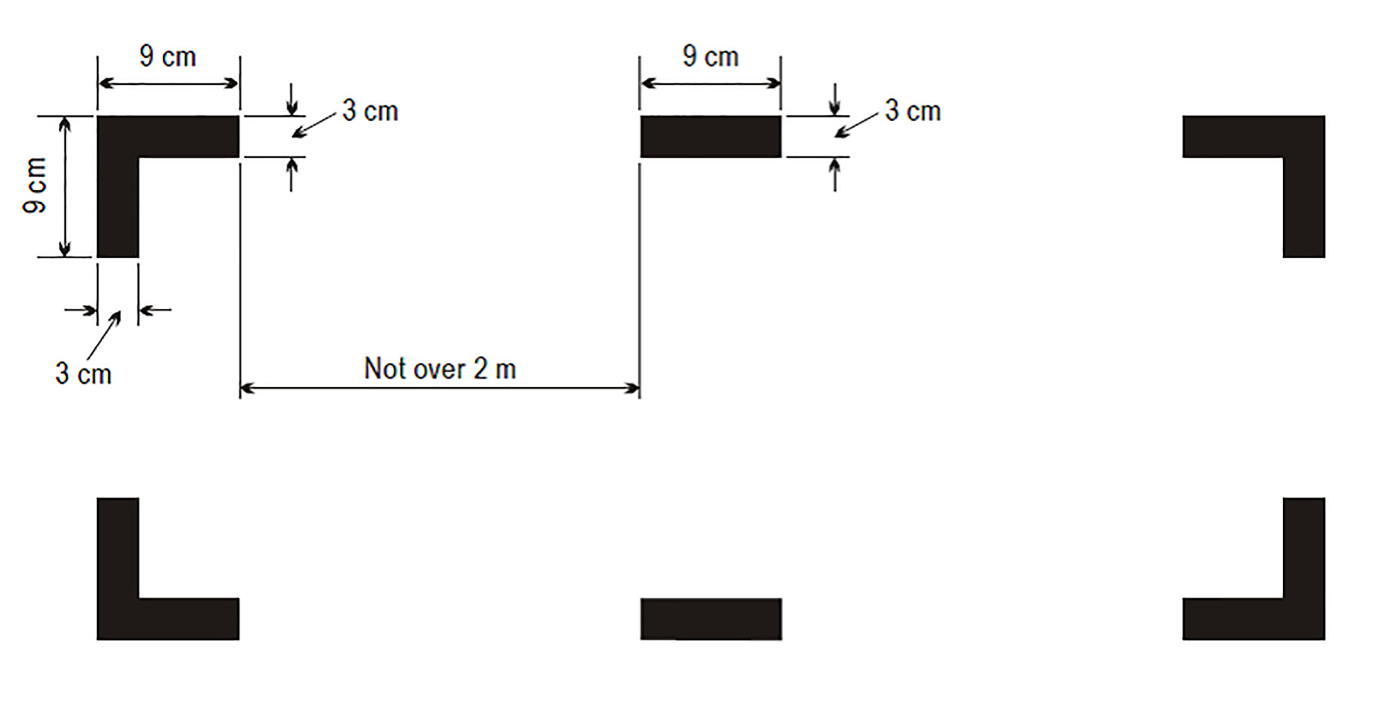
If areas of the aeroplane’s fuselage suitable for break-in by rescue crews in an emergency are marked, such areas shall be marked as shown in Figure 1.
Figure 1
Marking of break-in points
AMC1 NCO.IDE.A.165 Marking of break-in points
ED Decision 2014/016/R
MARKINGS — COLOUR AND CORNERS
(a)The colour of the markings should be red or yellow and, if necessary, should be outlined in white to contrast with the background.
(b)If the corner markings are more than 2 m apart, intermediate lines 9 cm x 3 cm should be inserted so that there is no more than 2 m between adjacent markings.
NCO.IDE.A.170 Emergency locator transmitter (ELT)
Regulation (EU) No 800/2013
(a)Aeroplanes shall be equipped with:
(1)an ELT of any type, when first issued with an individual CofA on or before 1 July 2008;
(2)an automatic ELT, when first issued with an individual CofA after 1 July 2008; or
(3)a survival ELT (ELT(S)) or a personal locator beacon (PLB), carried by a crew member or a passenger, when certified for a maximum passenger seating configuration of six or less.
(b)ELTs of any type and PLBs shall be capable of transmitting simultaneously on 121,5 MHz and 406 MHz.
AMC1 NCO.IDE.A.170 Emergency locator transmitter (ELT)
ED Decision 2014/016/R
BATTERIES
(a)All batteries used in ELTs or PLBs should be replaced (or recharged, if the battery is rechargeable) when the equipment has been in use for more than 1 cumulative hour or in the following cases:
(1)Batteries specifically designed for use in ELTs and having an airworthiness release certificate (EASA Form 1 or equivalent) should be replaced (or recharged, if the battery is rechargeable) before the end of their useful life in accordance with the maintenance instructions applicable to the ELT.
(2)Standard batteries manufactured in accordance with an industry standard and not having an airworthiness release certificate (EASA Form 1 or equivalent), when used in ELTs should be replaced (or recharged, if the battery is rechargeable) when 50 % of their useful life (or for rechargeable, 50 % of their useful life of charge), as established by the battery manufacturer, has expired.
(3)All batteries used in PLBs should be replaced (or recharged, if the battery is rechargeable) when 50 % of their useful life (or for rechargeable, 50 % of their useful life of charge), as established by the battery manufacturer, has expired.
(4)The battery useful life (or useful life of charge) criteria in (1),(2) and (3) do not apply to batteries (such as water-activated batteries) that are essentially unaffected during probable storage intervals.
(b)The new expiry date for a replaced (or recharged) battery should be legibly marked on the outside of the equipment.
AMC2 NCO.IDE.A.170 Emergency locator transmitter (ELT)
ED Decision 2021/008/R
TYPES OF ELTs AND GENERAL TECHNICAL SPECIFICATIONS
(a)The ELT required by this provision should be one of the following:
(1)Automatic fixed (ELT(AF)). An automatically activated ELT that is permanently attached to an aircraft and is designed to aid search and rescue (SAR) teams in locating the crash site.
(2)Automatic portable (ELT(AP)). An automatically activated ELT that is rigidly attached to an aircraft before a crash, but is readily removable from the aircraft after a crash. It functions as an ELT during the crash sequence. If the ELT does not employ an integral antenna, the aircraft-mounted antenna may be disconnected and an auxiliary antenna (stored on the ELT case) attached to the ELT. The ELT can be tethered to a survivor or a life-raft. This type of ELT is intended to aid SAR teams in locating the crash site or survivor(s).
(3)Automatic deployable (ELT(AD)). An ELT that is rigidly attached to the aircraft before the crash and that is automatically deployed and activated by an impact, and, in some cases, also by water sensors. This type of ELT should float in water and is intended to aid SAR teams in locating the crash site. The ELT(AD) may be either a stand-alone beacon or an inseparable part of a deployable recorder.
(4)Survival ELT (ELT(S)). An ELT that is removable from an aircraft, stowed so as to facilitate its ready use in an emergency and manually activated by a survivor. An ELT(S) may be activated manually or automatically (e.g. by water activation). It should be designed either to be tethered to a life-raft or a survivor. A water-activated ELT(S) is not an ELT(AP).
(b)To minimise the possibility of damage in the event of crash impact, the automatic ELT should be rigidly fixed to the aircraft structure, as far aft as is practicable, with its antenna and connections arranged so as to maximise the probability of the signal being transmitted after a crash.
(c)Any ELT carried should operate in accordance with the relevant provisions of ICAO Annex 10, Volume III, and should be registered with the national agency responsible for initiating search and rescue or other nominated agency.
AMC3 NCO.IDE.A.170 Emergency locator transmitter (ELT)
ED Decision 2014/016/R
PLB TECHNICAL SPECIFICATIONS
(a)A personal locator beacon (PLB) should have a built-in GNSS receiver with a cosmicheskaya sistyema poiska avariynich sudov — search and rescue satellite-aided tracking (COSPAS-SARSAT) type approval number. However, devices with a COSPAS-SARSAT number belonging to series 700 are excluded as this series of numbers identifies the special-use beacons not meeting all the technical requirements and all the tests specified by COSPAS-SARSAT.
(b)Any PLB carried should be registered with the national agency responsible for initiating search and rescue or other nominated agency.
AMC4 NCO.IDE.A.170 Emergency locator transmitter (ELT)
ED Decision 2014/016/R
BRIEFING ON PLB USE
When a PLB is carried by a passenger, he/she should be briefed on its characteristics and use by the pilot-in-command before the flight.
GM1 NCO.IDE.A.170 Emergency locator transmitter (ELT)
ED Decision 2021/008/R
TERMINOLOGY
GM1 CAT.IDE.A.280 contains explanations of terms used in point NCO.IDE.A.170 and in the related AMC.
NCO.IDE.A.175 Flight over water
Regulation (EU) No 800/2013
(a)The following aeroplanes shall be equipped with a life-jacket for each person on board, or equivalent individual floatation device for each person on board younger than 24 months, that shall be worn or stowed in a position that is readily accessible from the seat or berth of the person for whose use it is provided:
(1)single-engined landplanes when:
(i)flying over water beyond gliding distance from land; or
(ii)taking off or landing at an aerodrome or operating site where, in the opinion of the pilot-in-command, the take-off or approach path is so disposed over water that there would be a likelihood of a ditching;
(2)seaplanes operated over water; and
(3)aeroplanes operated at a distance away from land where an emergency landing is possible greater than that corresponding to 30 minutes at normal cruising speed or 50 NM, whichever is less.
(b)Seaplanes operated over water shall be equipped with:
(1)one anchor;
(2)one sea anchor (drogue), when necessary to assist in manoeuvring; and
(3)equipment for making the sound signals, as prescribed in the International Regulations for Preventing Collisions at Sea, where applicable.
(c)The pilot-in-command of an aeroplane operated at a distance away from land where an emergency landing is possible greater than that corresponding to 30 minutes at normal cruising speed or 50 NM, whichever is the lesser, shall determine the risks to survival of the occupants of the aeroplane in the event of a ditching, based on which he/she shall determine the carriage of:
(1)equipment for making the distress signals;
(2)life-rafts in sufficient numbers to carry all persons on board, stowed so as to facilitate their ready use in emergency; and
(3)life-saving equipment, to provide the means of sustaining life, as appropriate to the flight to be undertaken.
AMC1 NCO.IDE.A.175 Flight over water
ED Decision 2014/016/R
ACCESSIBILITY OF LIFE-JACKETS
The life-jacket, if not worn, should be accessible from the seat or berth of the person for whose use it is provided, with a safety belt or a restraint system fastened.
MEANS OF ILLUMINATION FOR LIFE-JACKETS
Each life-jacket or equivalent individual flotation device should be equipped with a means of electric illumination for the purpose of facilitating the location of persons.
RISK ASSESSMENT
(a)When conducting the risk assessment, the pilot-in-command should base his/her decision, as far as is practicable, on the Implementing Rules and AMCs applicable to the operation of the aeroplane.
(b)The pilot-in-command should, for determining the risk, take the following operating environment and conditions into account:
(1)sea state;
(2)sea and air temperatures;
(3)the distance from land suitable for making an emergency landing; and
(4)the availability of search and rescue facilities.
GM1 NCO.IDE.A.175 Flight over water
ED Decision 2014/016/R
SEAT CUSHIONS
Seat cushions are not considered to be flotation devices.
NCO.IDE.A.180 Survival equipment
Regulation (EU) No 800/2013
Aeroplanes operated over areas in which search and rescue would be especially difficult shall be equipped with such signalling devices and life-saving equipment, including means of sustaining life, as may be appropriate to the area overflown.
AMC1 NCO.IDE.A.180 Survival equipment
ED Decision 2014/016/R
GENERAL
(a)Aeroplanes operated across land areas in which search and rescue would be especially difficult should be equipped with the following:
(1)signalling equipment to make the distress signals;
(2)at least one ELT(S) or a PLB, carried by the pilot-in-command or a passenger; and
(3)additional survival equipment for the route to be flown, taking account of the number of persons on board.
(b)The additional survival equipment specified in (a)(3) does not need to be carried when the aeroplane remains within a distance from an area where search and rescue is not especially difficult, that corresponds to:
(1)120 minutes at one-engine-inoperative (OEI) cruising speed for aeroplanes capable of continuing the flight to an aerodrome with the critical engine(s) becoming inoperative at any point along the route or planned diversion routes; or
(2)30 minutes at cruising speed for all other aeroplanes.
AMC2 NCO.IDE.A.180 Survival equipment
ED Decision 2014/016/R
ADDITIONAL SURVIVAL EQUIPMENT
(a)The following additional survival equipment should be carried when required:
(1)500 ml of water for each four, or fraction of four, persons on board;
(2)one knife;
(3)first-aid equipment; and
(4)one set of air/ground codes.
(b)If any item of equipment contained in the above list is already carried on board the aeroplane in accordance with another requirement, there is no need for this to be duplicated.
GM1 NCO.IDE.A.180 Survival equipment
ED Decision 2014/016/R
SIGNALLING EQUIPMENT
The signalling equipment for making distress signals is described in ICAO Annex 2, Rules of the Air.
GM2 NCO.IDE.A.180 Survival equipment
ED Decision 2014/016/R
AREAS IN WHICH SEARCH AND RESCUE WOULD BE ESPECIALLY DIFFICULT
The expression ‘areas in which search and rescue would be especially difficult’ should be interpreted, in this context, as meaning:
(a)areas so designated by the competent authority responsible for managing search and rescue; or
(b)areas that are largely uninhabited and where:
(1)the authority referred to in (a) has not published any information to confirm whether search and rescue would be or would not be especially difficult; and
(2)the authority referred to in (a) does not, as a matter of policy, designate areas as being especially difficult for search and rescue.
NCO.IDE.A.190 Radio communication equipment
Regulation (EU) No 800/2013
(a)Where required by the airspace being flown aeroplanes shall be equipped with radio communication equipment capable of conducting two-way communication with those aeronautical stations and on those frequencies to meet airspace requirements.
(b)Radio communication equipment, if required by (a), shall provide for communication on the aeronautical emergency frequency 121,5 MHz.
(c)When more than one communication equipment unit is required, each shall be independent of the other or others to the extent that a failure in any one will not result in failure of any other.
GM1 NCO.IDE.A.190 Radio communication equipment
ED Decision 2014/016/R
APPLICABLE AIRSPACE REQUIREMENTS
For aeroplanes being operated under European air traffic control, the applicable airspace requirements include the Single European Sky legislation.
NCO.IDE.A.195 Navigation equipment
Regulation (EU) 2019/1384
(a)Aeroplanes operated over routes that cannot be navigated by reference to visual landmarks shall be equipped with any navigation equipment necessary to enable them to proceed in accordance with:
(1)the ATS flight plan; if applicable; and
(2)the applicable airspace requirements.
(b)Aeroplanes shall have sufficient navigation equipment to ensure that, in the event of the failure of one item of equipment at any stage of the flight, the remaining equipment shall allow safe navigation in accordance with (a), or an appropriate contingency action, to be completed safely.
(c)Aeroplanes operated on flights in which it is intended to land in IMC shall be equipped with suitable equipment capable of providing guidance to a point from which a visual landing can be performed. This equipment shall be capable of providing such guidance for each aerodrome at which it is intended to land in IMC and for any designated alternate aerodromes.
(d)For PBN operations the aircraft shall meet the airworthiness certification requirements for the appropriate navigation specification.
(e)Aeroplanes shall be equipped with surveillance equipment in accordance with the applicable airspace requirements.
AMC1 NCO.IDE.A.195 Navigation equipment
ED Decision 2014/016/R
NAVIGATION WITH VISUAL REFERENCE TO LANDMARKS
Where aeroplanes, with the surface in sight, can proceed according to the ATS flight plan by navigation with visual reference to landmarks, no additional equipment is needed to comply with NCO.IDE.A.195(a)(1).
GM1 NCO.IDE.A.195 Navigation equipment
ED Decision 2016/018/R
AIRCRAFT ELIGIBILITY FOR PBN SPECIFICATION NOT REQUIRING SPECIFIC APPROVAL
(a)The performance of the aircraft is usually stated in the AFM/POH.
(b)Where such a reference cannot be found in the AFM/POH, other information provided by the aircraft manufacturer as TC holder, the STC holder or the design organisation having a privilege to approve minor changes may be considered.
(c)The following documents are considered acceptable sources of information:
(1)AFM/POH, supplements thereto, and documents directly referenced in the AFM/POH;
(2)FCOM or similar document;
(3)Service Bulletin or Service Letter issued by the TC holder or STC holder;
(4)approved design data or data issued in support of a design change approval;
(5)any other formal document issued by the TC or STC holders stating compliance with PBN specifications, AMC, Advisory Circulars (AC) or similar documents issued by the State of Design; and
(6)written evidence obtained from the State of Design.
(d)Equipment qualification data, in itself, is not sufficient to assess the PBN capabilities of the aircraft, since the latter depend on installation and integration.
(e)As some PBN equipment and installations may have been certified prior to the publication of the PBN Manual and the adoption of its terminology for the navigation specifications, it is not always possible to find a clear statement of aircraft PBN capability in the AFM/POH. However, aircraft eligibility for certain PBN specifications can rely on the aircraft performance certified for PBN procedures and routes prior to the publication of the PBN Manual.
(f)Below, various references are listed which may be found in the AFM/POH or other acceptable documents (see listing above) in order to consider the aircraft’s eligibility for a specific PBN specification if the specific term is not used.
(g)RNAV 5
(1)If a statement of compliance with any of the following specifications or standards is found in the acceptable documentation as listed above, the aircraft is eligible for RNAV 5 operations.
(i)B-RNAV;
(ii)RNAV 1;
(iii)RNP APCH;
(iv)RNP 4;
(v)A-RNP;
(vi)AMC 20-4;
(vii)JAA TEMPORARY GUIDANCE MATERIAL, LEAFLET NO. 2 (TGL 2);
(viii)JAA AMJ 20X2;
(ix)FAA AC 20-130A for en route operations;
(x)FAA AC 20-138 for en route operations; and
(xi)FAA AC 90-96.
(h)RNAV 1/RNAV 2
(1)If a statement of compliance with any of the following specifications or standards is found in the acceptable documentation as listed above, the aircraft is eligible for RNAV 1/RNAV 2 operations.
(i)RNAV 1;
(ii)PRNAV;
(iii)US RNAV type A;
(iv)FAA AC 20-138 for the appropriate navigation specification;
(v)FAA AC 90-100A;
(vi)JAA TEMPORARY GUIDANCE MATERIAL, LEAFLET NO. 10 Rev1 (TGL 10); and
(vii)FAA AC 90-100.
(2)However, if position determination is exclusively computed based on VOR-DME, the aircraft is not eligible for RNAV 1/RNAV 2 operations.
(i)RNP 1/RNP 2 continental
(1)If a statement of compliance with any of the following specifications or standards is found in the acceptable documentation as listed above, the aircraft is eligible for RNP 1/RNP 2 continental operations.
(i)A-RNP;
(ii)FAA AC 20-138 for the appropriate navigation specification; and
(iii)FAA AC 90-105.
(2)Alternatively, if a statement of compliance with any of the following specifications or standards is found in the acceptable documentation as listed above and position determination is primarily based on GNSS, the aircraft is eligible for RNP 1/RNP 2 continental operations. However, in these cases, loss of GNSS implies loss of RNP 1/RNP 2 capability.
(i)JAA TEMPORARY GUIDANCE MATERIAL, LEAFLET NO. 10 (TGL 10) (any revision); and
(ii)FAA AC 90-100.
(j)RNP APCH — LNAV minima
(1)If a statement of compliance with any of the following specifications or standards is found in the acceptable documentation as listed above, the aircraft is eligible for RNP APCH — LNAV operations.
(i)A-RNP;
(ii)AMC 20-27;
(iii)AMC 20-28;
(iv)FAA AC 20-138 for the appropriate navigation specification; and
(v)FAA AC 90-105 for the appropriate navigation specification.
(2)Alternatively, if a statement of compliance with RNP 0.3 GNSS approaches in accordance with any of the following specifications or standards is found in the acceptable documentation as listed above, the aircraft is eligible for RNP APCH — LNAV operations. Any limitation such as ‘within the US National Airspace’ may be ignored since RNP APCH procedures are assumed to meet the same ICAO criteria around the world.
(i)JAA TEMPORARY GUIDANCE MATERIAL, LEAFLET NO. 3 (TGL 3);
(ii)AMC 20-4;
(iii)FAA AC 20-130A; and
(iv)FAA AC 20-138.
(k)RNP APCH — LNAV/VNAV minima
(1)If a statement of compliance with any of the following specifications or standards is found in the acceptable documentation as listed above, the aircraft is eligible for RNP APCH — LNAV/VNAV operations.
(i)A-RNP;
(ii)AMC 20-27 with Baro VNAV;
(iii)AMC 20-28;
(iv)FAA AC 20-138; and
(v)FAA AC 90-105 for the appropriate navigation specification.
(2)Alternatively, if a statement of compliance with FAA AC 20-129 is found in the acceptable documentation as listed above, and the aircraft complies with the requirements and limitations of EASA SIB 2014-04101, the aircraft is eligible for RNP APCH — LNAV/VNAV operations. Any limitation such as ‘within the US National Airspace’ may be ignored since RNP APCH procedures are assumed to meet the same ICAO criteria around the world.
(l)RNP APCH — LPV minima
(1)If a statement of compliance with any of the following specifications or standards is found in the acceptable documentation as listed above, the aircraft is eligible for RNP APCH — LPV operations.
(i)AMC 20-28;
(ii)FAA AC 20-138 for the appropriate navigation specification; and
(iii)FAA AC 90-107.
(2)For aircraft that have a TAWS Class A installed and do not provide Mode-5 protection on an LPV approach, the DH is limited to 250 ft.
(m)RNAV 10
(1)If a statement of compliance with any of the following specifications or standards is found in the acceptable documentation as listed above, the aircraft is eligible for RNAV 10 operations.
(i)RNP 10;
(ii)FAA AC 20-138 for the appropriate navigation specification;
(iii)AMC 20-12;
(iv)FAA Order 8400.12 (or later revision); and
(v)FAA AC 90-105.
(n)RNP 4
(1)If a statement of compliance with any of the following specifications or standards is found in the acceptable documentation as listed above, the aircraft is eligible for RNP 4 operations.
(i)FAA AC 20-138B or later, for the appropriate navigation specification;
(ii)FAA Order 8400.33; and
(iii)FAA AC 90-105 for the appropriate navigation specification.
(o)RNP 2 oceanic
(1)If a statement of compliance with FAA AC 90-105 for the appropriate navigation specification is found in the acceptable documentation as listed above, the aircraft is eligible for RNP 2 oceanic operations.
(2)If the aircraft has been assessed eligible for RNP 4, the aircraft is eligible for RNP 2 oceanic.
(p)Special features
(1)RF in terminal operations (used in RNP 1 and in the initial segment of the RNP APCH)
(i)If a statement of demonstrated capability to perform an RF leg, certified in accordance with any of the following specifications or standards, is found in the acceptable documentation as listed above, the aircraft is eligible for RF in terminal operations.
(A)AMC 20-26; and
(B)FAA AC 20-138B or later.
(ii)If there is a reference to RF and a reference to compliance with AC 90-105, then the aircraft is eligible for such operations.
(q)Other considerations
(1)In all cases, the limitations in the AFM/POH need to be checked, in particular the use of AP or FD which can be required to reduce the FTE primarily for RNP APCH, RNAV 1, and RNP 1.
(2)Any limitation such as ‘within the US National Airspace’ may be ignored since RNP APCH procedures are assumed to meet the same ICAO criteria around the world.
GM2 NCO.IDE.A.195 Navigation equipment
ED Decision 2016/018/R
GENERAL
(a)The PBN specifications for which the aircraft complies with the relevant airworthiness criteria are set out in the AFM/POH, together with any limitations to be observed.
(b)Because functional and performance requirements are defined for each navigation specification, an aircraft approved for an RNP specification is not automatically approved for all RNAV specifications. Similarly, an aircraft approved for an RNP or RNAV specification having a stringent accuracy requirement (e.g. RNP 0.3 specification) is not automatically approved for a navigation specification having a less stringent accuracy requirement (e.g. RNP 4).
RNP 4
(c)For RNP 4, at least two LRNSs, capable of navigating to RNP 4, and listed in the AFM/POH, may be operational at the entry point of the RNP 4 airspace. If an item of equipment required for RNP 4 operations is unserviceable, then the pilot-in-command may consider an alternate route or diversion for repairs. For multi-sensor systems, the AFM/POH may permit entry if one GNSS sensor is lost after departure, provided one GNSS and one inertial sensor remain available.
AMC1 NCO.IDE.A.195(a) Navigation equipment
ED Decision 2022/012/R
NAVIGATION EQUIPMENT — RNAV SUBSTITUTION
An RNAV system may be used to substitute for conventional navigation aids and radio equipment, without monitoring of the raw data from conventional navigation aids, under the following conditions:
SCOPE OF RNAV SUBSTITUTION
(a)RNAV substitution may be used in all the phases of flight except:
(1)to provide lateral guidance in the FAS of an IAP; and
(2)to substitute for DME, if a DME transceiver is either not installed on the aircraft or found to be unserviceable before flight.
SUITABILITY OF THE RNAV SYSTEM FOR RNAV SUBSTITUTION
(b)The RNAV system should meet:
(1)at least the requirements of (E)TSO-C129/-C196/-C145/-C146 (or later equivalent standards); and
(2)the requirements of NCO.OP.116(a) for RNAV 1, RNP 1 or RNP APCH as regards its installation in the aircraft.
OPERATING PROCEDURE
(c)The pilot-in-command is responsible for:
(1)ensuring that any procedure and waypoints used are retrieved from a navigation database which meets the requirements of NCO.IDE.A.205;
(2)verifying waypoint sequence, reasonableness of track angles, and distances of any overlay procedure used;
(3)applying pre-flight procedures associated with GNSS use (e.g. RAIM check if applicable); and
(4)complying with any limitation on RNAV substitution in the AFM.
PILOT COMPETENCE
(d)The pilot-in-command should be aware of the limitations of RNAV substitution.
AIRSPACE LIMITATIONS
(e)RNAV substitution should not be applied on any procedure where RNAV substitution has been indicated as ‘not authorised’ by an AIP entry or a notice to airmen (NOTAM).
CONTINGENCY PLANNING
(f)Nothing in this AMC relieves the pilot-in-command from compliance with NCO.IDE.A.195(b) which requires sufficient navigation equipment to ensure that, in the event of the failure of one item of equipment at any stage of the flight, the remaining equipment shall allow safe navigation according to the flight plan, or an appropriate contingency action, to be completed safely.
GM1 NCO.IDE.A.195(a) Navigation equipment
ED Decision 2022/012/R
NAVIGATION EQUIPMENT — SCOPE OF RNAV SUBSTITUTION
(a)Applications of RNAV substitution include use to:
(1)determine aircraft position relative to or distance from a VOR, marker, DME fix or a named fix defined by a VOR radial or NDB bearing;
(2)navigate to or from a VOR, or NDB, except as lateral guidance in the FAS of an IAP;
(3)hold over a VOR, NDB, or DME fix;
(4)fly an arc based upon DME;
(5)fly an overlay of a conventional departure, arrival, approach or route except as lateral guidance in the FAS of an IAP.
(b)RNAV substitution for ADF, marker and VOR may be used where airborne and/or ground-based equipment is not available.
(c)RNAV substitution for DME may be used where the ground-based DME transponder is unserviceable or the airborne DME transceiver is found to be unserviceable in flight. Caution must be exercised by the pilot-in-command when calculating and using GNSS distances to the active waypoint as reference points are often different.
GM2 NCO.IDE.A.195(a) Navigation equipment
ED Decision 2022/012/R
NAVIGATION EQUIPMENT — SUITABILITY OF THE RNAV SYSTEM FOR RNAV SUBSTITUTION
GNSS (E)TSOs are referenced in AMC1 NCO.IDE.A.195(a) since most of the aircraft conducting NCO are equipped with an RNAV stand-alone system which exclusively bases its positioning on GNSS.
GM3 NCO.IDE.A.195(a) Navigation equipment
ED Decision 2022/012/R
NAVIGATION EQUIPMENT — RNAV SUBSTITUTION — OPERATING PROCEDURE
Although RNAV substitution may not be used for lateral guidance in the FAS, this does not preclude the use of the RNAV system to fly the FAS, provided that raw data from the associated conventional navigation aids is monitored.
AMC1 NCO.IDE.A.195(b) Navigation equipment
ED Decision 2022/012/R
APPROPRIATE CONTINGENCY ACTION
An appropriate contingency action is an alternative offered in NCO.IDE.A.195(b) to completion of the planned flight to a safe landing, either at the planned destination or a destination alternate, using normal procedures and using navigation equipment meeting the requirements of NCO.IDE.A.100, installed for redundancy or as a backup.
The contingency action should be considered before flight and take into account the information identified by flight preparation according to NCO.OP.135. It may depend on the flight and availability of navigation solutions (satellites, ground navaids, etc.) and weather conditions (IMC, VMC) along the flight.
The contingency action addresses partial loss of navigation capability. An appropriate contingency action to meet the requirements of NCO.IDE.A.195(b) does not rely on the performance of any function of the item of equipment whose potential failure is being considered. For example, in considering the failure of a VOR/LOC/DME receiver, none of the functions of that receiver should be relied upon in the contingency action.
Examples of contingency actions include:
—seeking navigational assistance from ATS, using communication, navigation and surveillance systems that remain operational, to enable a safe instrument approach or a safe descent to VMC;
—unusually long periods of dead reckoning.
A contingency action is required such that the failure of one item of navigation equipment has a reasonable likelihood of a safe outcome to the flight, consistent with other risks to which the operation is exposed.
NCO.IDE.A.200 Transponder
Regulation (EU) No 800/2013
Where required by the airspace being flown, aeroplanes shall be equipped with a secondary surveillance radar (SSR) transponder with all the required capabilities.
AMC1 NCO.IDE.A.200 Transponder
ED Decision 2014/016/R
GENERAL
(a)The secondary surveillance radar (SSR) transponders of aeroplanes being operated under European air traffic control should comply with any applicable Single European Sky legislation.
(b)If the Single European Sky legislation is not applicable, the SSR transponders should operate in accordance with the relevant provisions of Volume IV of ICAO Annex 10.
NCO.IDE.A.205 Management of aeronautical databases
Regulation (EU) 2016/1199
(a)Aeronautical databases used on certified aircraft system applications shall meet data quality requirements that are adequate for the intended use of the data.
(b)The pilot-in-command shall ensure the timely distribution and insertion of current and unaltered aeronautical databases to the aircraft that require them.
(c)Notwithstanding any other occurrence reporting requirements as defined in Regulation (EU) No 376/2014, the pilot-in-command shall report to the database provider instances of erroneous, inconsistent or missing data that might be reasonably expected to constitute a hazard to flight.
In such cases, the pilot-in-command shall not use the affected data.
AMC1 NCO.IDE.A.205 Management of aeronautical databases
ED Decision 2017/003/R
AERONAUTICAL DATABASES
When the operator of an aircraft uses an aeronautical database that supports an airborne navigation application as a primary means of navigation used to meet the airspace usage requirements, the database provider should be a Type 2 DAT provider certified in accordance with Regulation (EU) 2017/373 or equivalent.
GM1 NCO.IDE.A.205 Management of aeronautical databases
ED Decision 2017/003/R
AERONAUTICAL DATABASE APPLICATIONS
The certification of a Type 2 DAT provider in accordance with Regulation (EU) 2017/373 ensures data integrity and compatibility with the certified aircraft application/equipment.
GM2 NCO.IDE.A.205 Management of aeronautical databases
ED Decision 2017/003/R
TIMELY DISTRIBUTION
The operator should distribute current and unaltered aeronautical databases to all aircraft requiring them in accordance with the validity period of the databases or in accordance with an established procedure if no validity period is defined.
GM3 NCO.IDE.A.205 Management of aeronautical databases
ED Decision 2017/003/R
STANDARDS FOR AERONAUTICAL DATABASES AND DAT PROVIDERS
(a)A ‘Type 2 DAT provider’ is an organisation as defined in Article 2(5)(b) of Regulation (EU) 2017/373.
(b)Equivalent to a certified ‘Type 2 DAT provider’ is defined in any Aviation Safety Agreement between the European Union and a third country, including any Technical Implementation Procedures, or any Working Arrangements between EASA and the competent authority of a third country.
SECTION 2 – Rotorcraft
NCO.IDE.H.100 Instruments and equipment – general
Regulation (EU) 2025/133
(a)Instruments and equipment required by this Subpart shall be approved in accordance with the applicable airworthiness requirements if they are:
(1)used by the flight crew to control the flight path;
(2)used to comply with NCO.IDE.H.190;
(3)used to comply with NCO.IDE.H.195; or
(4)installed in the rotorcraft.
(b)The following items, when required under this Subpart, do not need an equipment approval:
(1)independent portable lights;
(2)an accurate time piece;
(3)first-aid kit;
(4)survival and signalling equipment;
(5)sea anchor and equipment for mooring;
(6)child restraint device;
(7)a simple PCDS used by a task specialist as a restraint device.
(c)Instruments and equipment or accessories not required under Annex VII (Part-NCO), as well as any other equipment that is not required under this Regulation, but carried on a flight, shall comply with the following requirements:
(1)the information provided by those instruments, equipment or accessories shall not be used by the flight crew members to comply with Annex II to Regulation (EU) 2018/1139 or points NCO.IDE.H.190 and NCO.IDE.H.195 of Annex VII;
(2)the instruments and equipment shall not affect the airworthiness of the rotorcraft, even in the case of failures or malfunction.
(d)Instruments and equipment shall be readily operable or accessible from the station where the flight crew member that needs to use it is seated.
(e)All required emergency equipment shall be easily accessible for immediate use.
GM1 NCO.IDE.H.100(a) Instruments and equipment – general
ED Decision 2025/023/R
APPLICABLE AIRWORTHINESS REQUIREMENTS
The applicable airworthiness requirements for the approval of instruments and equipment required by this Part are the following:
(a)Regulation (EU) No 748/2012 for rotorcraft registered in the EU; and
(b)airworthiness requirements of the State of registry for rotorcraft registered outside the EU.
GM1 NCO.IDE.H.100(b) Instruments and equipment – general
ED Decision 2014/016/R
REQUIRED INSTRUMENTS AND EQUIPMENT THAT DO NOT NEED TO BE APPROVED IN ACCORDANCE WITH THE APPLICABLE AIRWORTHINESS REQUIREMENTS
The functionality of non-installed instruments and equipment required by this Subpart and that do not need an equipment approval, as listed in NCO.IDE.H.100(b), should be checked against recognised industry standards appropriate to the intended purpose. The operator is responsible for ensuring the maintenance of these instruments and equipment.
GM1 NCO.IDE.H.100(c) Instruments and equipment – general
ED Decision 2025/023/R
NOT REQUIRED INSTRUMENTS AND EQUIPMENT THAT DO NOT NEED TO BE APPROVED IN ACCORDANCE WITH THE APPLICABLE AIRWORTHINESS REQUIREMENTS, BUT ARE CARRIED ON A FLIGHT
(a)The provision of this paragraph does not exempt any installed instrument or item of equipment from complying with the applicable airworthiness requirements. In this case, the installation should be approved as required in the applicable airworthiness requirements and should comply with the applicable Certification Specifications.
(b)The failure of additional non-installed instruments or equipment not required by this Part or by the applicable airworthiness requirements or any applicable airspace requirements should not adversely affect the airworthiness and/or the safe operation of the rotorcraft. Examples may be the following:
(1)portable electronic flight bag (EFB);
(2)portable electronic devices carried by crew members; and
(3)non-installed passenger entertainment equipment.
NCO.IDE.H.105 Minimum equipment for flight
Regulation (EU) 2025/133
A flight shall not be commenced when any of the rotorcraft’s instruments, items of equipment or functions required for the intended flight are inoperative or missing, unless:
(a)the rotorcraft is operated in accordance with the MEL, if established; or
(b)the rotorcraft is subject to a permit to fly issued in accordance with the applicable airworthiness requirements.
AMC1 NCO.IDE.H.105 Minimum equipment for flight
ED Decision 2021/005/R
MANAGEMENT OF THE STATUS OF CERTAIN INSTRUMENTS, EQUIPMENT OR FUNCTIONS
The operator should control and retain the status of the instruments, equipment or functions required for the intended operation, that are not controlled for the purpose of continuing airworthiness management.
GM1 NCO.IDE.H.105 Minimum equipment for flight
ED Decision 2021/005/R
MANAGEMENT OF THE STATUS OF CERTAIN INSTRUMENTS, EQUIPMENT OR FUNCTIONS
(a)The operator should define responsibilities and procedures to retain and control the status of instruments, equipment or functions required for the intended operation, that are not controlled for the purpose of continuing airworthiness management.
(b)Examples of such instruments, equipment or functions may be, but are not limited to, equipment related to navigation approvals as FM immunity or certain software versions.
NCO.IDE.H.115 Operating lights
Regulation (EU) 2025/133
Rotorcraft operated at night shall be equipped with:
(a)an anti-collision light system;
(b)navigation/position lights;
(c)a landing light;
(d)lighting supplied from the rotorcraft’s electrical system to provide adequate illumination for all instruments and equipment essential to the safe operation of the rotorcraft;
(e)lighting supplied from the rotorcraft’s electrical system to provide illumination in all passenger compartments;
(f)an independent portable light for each crew member station; and
(g)lights to conform with the International Regulations for Preventing Collisions at Sea if the rotorcraft is amphibious.
AMC1 NCO.IDE.H.115 Operating lights
ED Decision 2025/023/R
LANDING LIGHT FOR HELICOPTERS
For helicopters, the landing light should be trainable, at least in the vertical plane, or optionally be an additional fixed light or lights positioned to give a wide spread of illumination.
NCO.IDE.H.120 Operations under VFR – flight and navigational instruments and associated equipment
Regulation (EU) 2025/133
(a)Rotorcraft operated under VFR by day shall be equipped with a means of measuring and displaying the following:
(1)magnetic heading;
(2)time in hours, minutes and seconds;
(3)barometric altitude;
(4)indicated airspeed; and
(5)slip.
(b)Rotorcraft operated under VMC at night, or when the visibility is less than 1 500 m, or in conditions where the rotorcraft cannot be maintained in a desired flight path without reference to one or more additional instruments, shall be, in addition to (a), equipped with:
(1)a means of measuring and displaying the following:
(i)attitude;
(ii)vertical speed; and
(iii)stabilised heading; and
(2)a means of indicating when the supply of power to the gyroscopic instruments is not adequate.
(c)Rotorcraft operated when the visibility is less than 1 500 m, or in conditions where the rotorcraft cannot be maintained in a desired flight path without reference to one or more additional instruments, shall be, in addition to (a) and (b), equipped with a means of preventing malfunction of the airspeed indicating system required in (a)(4) due to condensation or icing.
AMC1 NCO.IDE.H.120 & NCO.IDE.H.125 Operations under VFR & operations under IFR — flight and navigational instruments and associated equipment
ED Decision 2025/023/R
INTEGRATED INSTRUMENTS
(a)Individual equipment requirements may be met by combinations of instruments, by integrated flight systems or by a combination of parameters on electronic displays. The information so available to each required pilot should not be less than that required in the applicable operational requirements, and the equivalent safety of the installation should be approved during the type certification of the rotorcraft for the intended type of operation.
(b)The means of measuring and indicating turn and slip, rotorcraft attitude and stabilised rotorcraft heading may be met by combinations of instruments or by integrated flight director systems, provided that the safeguards against total failure, inherent in the three separate instruments, are retained.
AMC1 NCO.IDE.H.120(a)(1)&NCO.IDE.H.125(a)(1) Operations under VFR & operations under IFR – flight and navigational instruments and associated equipment
ED Decision 2014/016/R
MEANS OF MEASURING AND DISPLAYING MAGNETIC HEADING
The means of measuring and displaying magnetic direction should be a magnetic compass or equivalent.
AMC1 NCO.IDE.H.120(a)(2)&NCO.IDE.H.125(a)(2) Operations under VFR & operations under IFR – flight and navigational instruments and associated equipment
ED Decision 2014/016/R
MEANS OF MEASURING AND DISPLAYING THE TIME
A means of measuring and displaying the time in hours, minutes and seconds may be a wrist watch capable of the same functions.
AMC1 NCO.IDE.H.120(a)(3)&NCO.IDE.H.125(a)(3) Operations under VFR & operations under IFR – flight and navigational instruments and associated equipment
ED Decision 2014/016/R
CALIBRATION OF THE MEANS OF MEASURING AND DISPLAYING PRESSURE ALTITUDE
The instrument measuring and displaying pressure altitude should be of a sensitive type calibrated in feet (ft), with a sub-scale setting, calibrated in hectopascals/millibars, adjustable for any barometric pressure likely to be set during flight.
AMC1 NCO.IDE.H.120(a)(5) Operations under VFR – flight and navigational instruments and associated equipment
ED Decision 2014/016/R
SLIP
The means of measuring and displaying slip may be a slip string for operations under VFR.
NCO.IDE.H.125 Operations under IFR – flight and navigational instruments and associated equipment
Regulation (EU) 2019/1384
Helicopters operated under IFR shall be equipped with:
(a)a means of measuring and displaying the following:
(1)magnetic heading;
(2)time in hours, minutes and seconds;
(3)barometric altitude;
(4)indicated airspeed;
(5)vertical speed;
(6)slip;
(7)attitude;
(8)stabilised heading; and
(9)outside air temperature;
(b)a means of indicating when the supply of power to the gyroscopic instruments is not adequate;
(c)a means of preventing malfunction of the airspeed indicating system required by (a)(4) due to condensation or icing; and
(d)an additional means of measuring and displaying attitude as a standby instrument.
GM1 NCO.IDE.H.125(a)(3) Operations under IFR – flight and navigational instruments and associated equipment
ED Decision 2014/016/R
ALTIMETERS
Altimeters with counter drum-pointer or equivalent presentation are considered to be less susceptible to misinterpretation for helicopters operating above 10 000 ft.
AMC1 NCO.IDE.H.120(a)(4) & NCO.IDE.H.125(a)(4) Operations under VFR & operations under IFR – flight and navigational instruments and associated equipment
ED Decision 2025/023/R
CALIBRATION OF THE INSTRUMENT INDICATING AIRSPEED
(a)The instrument indicating airspeed should be calibrated in knots (kt).
(b)In the case of rotorcraft with an MCTOM below 2 000 kg, calibration in kilometres per hour (km/h) or in miles per hour (mph) is acceptable when such units are used in the AFM.
AMC1 NCO.IDE.H.120(b)(1)(iii)&NCO.IDE.H.125(a)(8) Operations under VFR & operations under IFR – flight and navigational instruments and associated equipment
ED Decision 2014/016/R
STABILISED HEADING
Stabilised direction should be achieved for VFR flights by a gyroscopic direction indicator, whereas for IFR flights, this should be achieved through a magnetic gyroscopic direction indicator.
AMC1 NCO.IDE.H.120(c)&NCO.IDE.H.125(c) Operations under VFR & Operations under IFR – flight and navigational instruments and associated equipment
ED Decision 2014/016/R
MEANS OF PREVENTING MALFUNCTION DUE TO CONDENSATION OR ICING
The means of preventing malfunction due to either condensation or icing of the airspeed indicating system should be a heated pitot tube or equivalent.
AMC1 NCO.IDE.H.125(a)(9) Operations under IFR – flight and navigational instruments and associated equipment
ED Decision 2014/016/R
MEANS OF DISPLAYING OUTSIDE AIR TEMPERATURE
(a)The means of displaying outside air temperature should be calibrated in degrees Celsius.
(b)In the case of helicopters with a maximum certified take-off mass (MCTOM) below 2 000 kg, calibration in degrees Fahrenheit is acceptable, when such unit is used in the AFM.
(c)The means of displaying outside air temperature may be an air temperature indicator that provides indications that are convertible to outside air temperature.
NCO.IDE.H.126 Additional equipment for single pilot operations under IFR
Regulation (EU) No 800/2013
Helicopters operated under IFR with a single pilot shall be equipped with an autopilot with at least altitude hold and heading mode.
NCO.IDE.H.135 Flight crew interphone system
Regulation (EU) 2025/133
Rotorcraft operated by more than one flight crew member shall be equipped with a flight crew interphone system, including headsets and microphones for use by all flight crew members.
AMC1 NCO.IDE.H.135 Flight crew interphone system
ED Decision 2025/023/R
GENERAL
(a)The flight crew interphone system should not be of a handheld type.
(b)A headset consists of a communication device which includes two earphones to receive and a microphone to transmit audio signals to the rotorcraft’s communication system. To comply with the minimum performance requirements, the earphones and microphone should match the communication system’s characteristics and the flight crew compartment environment. The headset should be adequately adjustable in order to fit the pilot’s head. Headset boom microphones should be of the noise-cancelling type.
(c)If the intention is to utilise noise-cancelling earphones, the pilot-in-command should ensure that the earphones do not attenuate any aural warnings or sounds necessary for alerting the flight crew on matters related to the safe operation of the rotorcraft.
GM1 NCO.IDE.H.135 Flight crew interphone system
ED Decision 2014/016/R
HEADSET
The term ‘headset’ includes any aviation helmet incorporating headphones and microphone worn by a flight crew member.
NCO.IDE.H.140 Seats, seat safety belts, restraint systems and child restraint devices
Regulation (EU) 2025/133
(a)Rotorcraft shall be equipped with:
(1)a seat or berth for each person on board that is aged 24 months or older, or a station for each crew member or task specialist on board;
(2)a seat belt on each passenger seat and restraining belts for each berth, and restraint devices for each station;
(3)for rotorcraft first issued with an individual CofA after 31 December 2012, a seat belt with an upper-torso restraint system for each passenger that is aged 24 months or older;
(4)a child restraint device for each person on board younger than 24 months; and
(5)a seat belt with upper torso restraint system incorporating a device that will automatically restrain the occupant’s torso in the event of rapid deceleration on each flight crew seat.
(b)A seat belt with upper torso restraint system shall have a single point release.
AMC1 NCO.IDE.H.140 Seats, seat safety belts, restraint systems and child restraint devices
ED Decision 2025/023/R
CHILD RESTRAINT DEVICES (CRDs)
(a)A CRD is considered to be acceptable if:
(1)it is a supplementary loop belt manufactured with the same techniques and the same materials of the approved safety belts; or
(2)it complies with (b).
(b)Provided the CRD can be installed properly on the respective rotorcraft seat, the following CRDs are considered acceptable:
(1)CRDs approved for use in aircraft according to the European Technical Standard Order ETSO-C100c on Aviation Child Safety Device (ACSD);
(2)CRDs approved by EASA through a Type Certificate or Supplemental Type Certificate;
(3)Child seats approved for use in motor vehicles on the basis of the technical standard specified in (i). The child seat must be also approved for use in aircraft on the basis of the technical standard specified in either point (ii) or point (iii):
(i) UN Standard ECE R44-04 (or 03), or ECE R129 bearing the respective ‘ECE R’ label; and
(ii) German ‘Qualification Procedure for Child Restraint Systems for Use in Aircraft’ (TÜV Doc.: TÜV/958-01/2001) bearing the label ‘For Use in Aircraft’; or
(iii) Other technical standard acceptable to the competent authority. The child seat should hold a qualification sign that it can be used in aircraft.
(4)Child seats approved for use in motor vehicles and aircraft according to Canadian CMVSS 213/213.1 bearing the respective label;
(5)Child seats approved for use in motor vehicles and aircraft according to US FMVSS No 213 and bearing one or two labels displaying the following two sentences:
(i)‘THIS CHILD RESTRAINT SYSTEM CONFORMS TO ALL APPLICABLE FEDERAL MOTOR VEHICLE SAFETY STANDARDS’; and
(ii)in red letters ‘THIS RESTRAINT IS CERTIFIED FOR USE IN MOTOR VEHICLES AND AIRCRAFT’;
(6)Child seats approved for use in motor vehicles and aircraft according to Australia/New Zealand’s technical standard AS/NZS 1754:2013 bearing the green part on the label displaying ‘For Use in Aircraft’; and
(7)CRDs manufactured and tested according to other technical standards equivalent to those listed above. The devices should be marked with an associated qualification sign, which shows the name of the qualification organisation and a specific identification number, related to the associated qualification project. The qualifying organisation should be a competent and independent organisation that is acceptable to the competent authority.
(c)Location
(1)Forward-facing child seats may be installed on both forward- and rearward-facing passenger seats, but only when fitted in the same direction as the passenger seat on which they are positioned. Rearward-facing child seats should only be installed on forward-facing passenger seats. A child seat may not be installed within the radius of action of an airbag unless it is obvious that the airbag is de-activated or it can be demonstrated that there is no negative impact from the airbag.
(2)An infant/child in a CRD should be located in the vicinity of a floor level exit.
(3)An infant/child in a CRD should not hinder evacuation for any passenger.
(d)Installation
(1)CRDs tested and approved for use in aircraft should only be installed on a suitable passenger seat by the method shown in the manufacturer’s instructions provided with each CRD and with the type of connecting device they are approved for the installation in aircraft. CRDs designed to be installed only by means of rigid bar lower anchorages (ISOFIX or equivalent) should only be used on passenger seats equipped with such connecting devices and should not be secured by passenger seat lap belt.
(2)All safety and installation instructions should be followed carefully by the responsible person accompanying the infant/child. Operators should prohibit the use of a CRD not installed on the passenger seat according to the manufacturer’s instructions or not approved for use in aircraft.
(3)If a forward-facing child seat with a rigid backrest is to be fastened by a seat lap belt, the restraint device should be fastened when the backrest of the passenger seat on which it rests is in a reclined position. Thereafter, the backrest is to be positioned upright. This procedure ensures better tightening of the child seat on the aircraft seat if the aircraft seat is reclinable.
(4)The buckle of the adult safety belt should be easily accessible for both opening and closing, and should be in line with the seat belt halves (not canted) after tightening.
(5)Forward-facing restraint devices with an integral harness must not be installed such that the adult safety belt is secured over the infant.
(e)Operation
(1)Each CRD should remain secured to a passenger seat during all phases of flight, unless it is properly stowed when not in use.
(2)Where a child seat is adjustable in recline, it should be in an upright position for all occasions when passenger restraint devices are required.
AMC2 NCO.IDE.H.140 Seats, seat safety belts, restraint systems and child restraint devices
ED Decision 2014/016/R
UPPER TORSO RESTRAINT SYSTEM
The following systems are deemed to be compliant with the requirement for an upper torso restraint system:
(a)a seat belt with a diagonal shoulder strap;
(b)a restraint system having a seat belt and two shoulder straps that may be used independently;
(c)a restraint system having a seat belt, two shoulder straps and additional straps that may be used independently.
SEAT BELT
A seat belt with diagonal shoulder strap (three anchorage points) is deemed to be compliant with the requirement for a seat belt (two anchorage points).
NCO.IDE.H.145 First-aid kit
Regulation (EU) 2025/133
(a)Rotorcraft shall be equipped with a first-aid kit.
(b)The first-aid kit shall be:
(1)readily accessible for use; and
(2)kept up-to-date.
AMC1 NCO.IDE.H.145 First-aid kit
ED Decision 2021/005/R
CONTENT OF FIRST-AID KITS
(a)First-aid kits should be equipped with appropriate and sufficient medications and instrumentation. However, these kits should be supplemented by the operator according to the characteristics of the operation (scope of operation, flight duration, number and demographics of passengers, etc.).
(b)The following should be included in the FAKs:
(1)bandages (assorted sizes, including a triangular bandage),
(2)burns dressings (large and small),
(3)wound dressings (large and small),
(4)adhesive dressings (assorted sizes),
(5)antiseptic wound cleaner,
(6)safety scissors,
(7)disposable gloves,
(8) disposable resuscitation aid, and
(9)surgical masks.
AMC2 NCO.IDE.H.145 First-aid kit
ED Decision 2014/016/R
MAINTENANCE OF FIRST-AID KIT
To be kept up-to-date, the first-aid kit should be:
(a)inspected periodically to confirm, to the extent possible, that contents are maintained in the condition necessary for their intended use;
(b)replenished at regular intervals, in accordance with instructions contained on their labels, or as circumstances warrant; and
(c)replenished after use in-flight at the first opportunity where replacement items are available.
GM1 NCO.IDE.H.145 First-aid kit
ED Decision 2025/023/R
LOCATION AND USE
The location of the first-aid kit is normally indicated by internationally recognisable signs.
The first-aid kit ‘should be easily accessible for use’ in rotorcraft operations should be understood as the first-aid kit being accessible either in flight or immediately after landing.
In some operations, it is not practicable to use the first-aid kit during flight. Therefore, the first-aid kit can be carried in the cargo compartment, where it will be easily accessible for use as soon as the aircraft has landed, when the following conditions are met:
(a)precautionary landing sites are available;
(b)the lack of cabin space is such that movement or use of the first-aid kit is impaired; and
(c)the installation of the first-aid kit in the cabin is not practicable.
GM2 NCO.IDE.H.145 First-aid kit
ED Decision 2021/005/R
CONTENT OF FIRST-AID KITS
The operator may supplement first-aid kits according to the characteristics of the operation based on a risk assessment. The assessment does not require an approval by the competent authority.
NCO.IDE.H.155 Supplemental oxygen – non-pressurised rotorcraft
Regulation (EU) 2025/133
Non-pressurised rotorcraft operated when an oxygen supply is required in accordance with NCO.OP.190 shall be equipped with oxygen storage and dispensing apparatus capable of storing and dispensing the required oxygen supplies.
AMC1 NCO.IDE.H.155 Supplemental oxygen – non-pressurised helicopters
ED Decision 2014/016/R
DETERMINATION OF OXYGEN
The amount of oxygen should be determined on the basis of cabin pressure altitude and flight duration, consistent with the operating procedures, including emergency procedures, established for each operation and the routes to be flown as specified in the AFM.
AMC2 NCO.IDE.H.155 Supplemental oxygen supply – non-pressurised helicopters
ED Decision 2016/018/R
OXYGEN SUPPLY
The need for oxygen supply, when required by NCO.OP.190, may be met either by means of installed equipment or portable equipment.
NCO.IDE.H.160 Hand fire extinguishers
Regulation (EU) 2025/133
(a)Rotorcraft, except ELA2 helicopters, shall be equipped with at least one hand fire extinguisher:
(1)in the flight crew compartment; and
(2)in each passenger compartment that is separate from the flight crew compartment, except if the compartment is readily accessible to the flight crew.
(b)The type and quantity of extinguishing agent for the required fire extinguishers shall be suitable for the type of fire likely to occur in the compartment where the extinguisher is intended to be used and to minimise the hazard of toxic gas concentration in compartments occupied by persons.