

Filters
AMC1 SPO.IDE.H.145 Flight data recorder
ED Decision 2016/012/R
OPERATIONAL PERFORMANCE REQUIREMENTS FOR HELICOPTERS HAVING AN MCTOM OF MORE THAN 3 175 KG AND FIRST ISSUED WITH AN INDIVIDUAL CofA ON OR AFTER 1 JANUARY 2016 AND BEFORE 1 JANUARY 2023
(a)The operational performance requirements for flight data recorders (FDRs) should be those laid down in EUROCAE Document ED-112 (Minimum Operational Performance Specification for Crash Protected Airborne Recorder Systems) dated March 2003, including amendments No°1 and No°2, or any later equivalent standard produced by EUROCAE.
(b)The FDR should record, with reference to a timescale, the list of parameters in Table 1 and Table 2, as applicable.
(c)The parameters recorded by the FDR should meet, as far as practicable, the performance specifications (designated ranges, sampling intervals, accuracy limits and minimum resolution in read-out) defined in EUROCAE ED-112, including amendments No°1 and No°2, or any later equivalent standard produced by EUROCAE.
(d)FDR systems for which some recorded parameters do not meet the performance specifications of EUROCAE Document ED-112 may be acceptable to the Agency.
Table 1: FDR parameters — All helicopters
No* | Parameter |
1 | Time or relative time count |
2 | Pressure altitude |
3 | Indicated airspeed |
4 | Heading |
5 | Normal acceleration |
6 | Pitch attitude |
7 | Roll attitude |
8 | Manual radio transmission keying CVR/FDR synchronisation reference |
9 9a 9b 9c 9d 9e | Power on each engine: Free power turbine speed (NF) Engine torque Engine gas generator speed (NG) Flight crew compartment power control position Other parameters to enable engine power to be determined |
10 10a 10b | Rotor: Main rotor speed Rotor brake (if installed) |
11 11a 11b 11c 11d 11e 11f | Primary flight controls — Pilot input and/or control output position (if applicable) Collective pitch Longitudinal cyclic pitch Lateral cyclic pitch Tail rotor pedal Controllable stabilator (if applicable) Hydraulic selection |
12 | Hydraulics low pressure (each system should be recorded.) |
13 | Outside air temperature |
18 | Yaw rate or yaw acceleration |
20 | Longitudinal acceleration (body axis) |
21 | Lateral acceleration |
25 | Marker beacon passage |
26 | Warnings — a discrete should be recorded for the master warning, gearbox low oil pressure and as failure. Other ‘red’ warnings should be recorded where the warning condition cannot be determined from other parameters or from the cockpit voice recorder. |
27 | Each navigation receiver frequency selection |
37 | Engine control modes |
* The number in the left hand column reflects the serial number depicted in EUROCAE ED-112.
Table 2: FDR parameters — Helicopters for which the data source for the parameter is either used by helicopter systems or is available on the instrument panel for use by the flight crew to operate the helicopter.
No* | Parameter |
14 | AFCS mode and engagement status |
15 | Stability augmentation system engagement (each system should be recorded) |
16 | Main gear box oil pressure |
17 17a 17b 17c | Gear box oil temperature Main gear box oil temperature Intermediate gear box oil temperature Tail rotor gear box oil temperature |
19 | Indicated sling load force (if signals readily available) |
22 | Radio altitude |
23 23a 23b 23c | Vertical deviation — the approach aid in use should be recorded. ILS glide path MLS elevation GNSS approach path |
24 24a 24b 24c | Horizontal deviation — the approach aid in use should be recorded. ILS localiser MLS azimuth GNSS approach path |
28 | DME 1 & 2 distances |
29 29a 29b 29c 29d 29e 29f | Navigation data Drift angle Wind speed Wind direction Latitude Longitude Ground speed |
30 | Landing gear or gear selector position |
31 | Engine exhaust gas temperature (T4) |
32 | Turbine inlet temperature (TIT/ITT) |
33 | Fuel contents |
34 | Altitude rate (vertical speed) — only necessary when available from cockpit instruments |
35 | Ice detection |
36 36a 36b 36c 36d 36e | Helicopter health and usage monitor system (HUMS) Engine data Chip detector Track timing Exceedance discretes Broadband average engine vibration |
38 38a 38b | Selected barometric setting — to be recorded for helicopters where the parameter is displayed electronically Pilot Co-pilot |
39 | Selected altitude (all pilot selectable modes of operation) — to be recorded for the helicopters where the parameter is displayed electronically |
40 | Selected speed (all pilot selectable modes of operation) — to be recorded for the helicopters where the parameter is displayed electronically |
41 | Not used (selected Mach) |
42 | Selected vertical speed (all pilot selectable modes of operation) — to be recorded for the helicopters where the parameter is displayed electronically |
43 | Selected heading (all pilot selectable modes of operation) — to be recorded for the helicopters where the parameter is displayed electronically |
44 | Selected flight path (all pilot selectable modes of operation) — to be recorded for the helicopters where the parameter is displayed electronically |
45 | Selected decision height (all pilot selectable modes of operation) — to be recorded for the helicopters where the parameter is displayed electronically |
46 | EFIS display format |
47 | Multi-function/engine/alerts display format |
48 | Event marker |
* The number in the left hand column reflects the serial number depicted in EUROCAE ED-112.
AMC2 SPO.IDE.H.145 Flight data recorder
ED Decision 2016/021/R
OPERATIONAL PERFORMANCE REQUIREMENTS FOR HELICOPTERS HAVING AN MCTOM OF MORE THAN 3 175 KG AND FIRST ISSUED WITH AN INDIVIDUAL CofA ON OR AFTER 1 JANUARY 2023
(a)The operational performance requirements for flight data recorders (FDRs) should be those laid down in EUROCAE Document 112A (Minimum Operational Performance Specification for Crash Protected Airborne Recorder Systems) dated September 2013, or any later equivalent standard produced by EUROCAE.
(b)The FDR should, with reference to a timescale, record:
(1)the list of parameters in Table 1 below;
(2)the additional parameters listed in Table 2 below, when the information data source for the parameter is used by helicopter systems or is available on the instrument panel for use by the flight crew to operate the helicopter; and
(3)any dedicated parameters related to novel or unique design or operational characteristics of the helicopter as determined by the Agency.
(c)The parameters to be recorded should meet the performance specifications (range, sampling intervals, accuracy limits and resolution in read-out) as defined in the relevant tables of EUROCAE Document 112A, or any later equivalent standard produced by EUROCAE.
Table 1: FDR — All helicopters
No* | Parameter |
1 | Time or relative time count |
2 | Pressure altitude |
3 | Indicated airspeed or calibrated airspeed |
4 | Heading |
5 | Normal acceleration |
6 | Pitch attitude |
7 | Roll attitude |
8 | Manual radio transmission keying CVR/FDR synchronisation reference |
9 9a 9b 9c 9d 9e | Power on each engine: Free power turbine speed (NF) Engine torque Engine gas generator speed (NG) Flight crew compartment power control position Other parameters to enable engine power to be determined |
10 10a 10b | Rotor: Main rotor speed Rotor brake (if installed) |
11 11a 11b 11c 11d 11e 11f | Primary flight controls — pilot input or control output position if it is possible to derive either the control input or the control movement (one from the other) for all modes of operation and flight regimes. Otherwise, pilot input and control output position Collective pitch Longitudinal cyclic pitch Lateral cyclic pitch Tail rotor pedal Controllable stabilator (if applicable) Hydraulic selection |
12 | Hydraulics low pressure (each system should be recorded) |
13 | Outside air temperature |
18 | Yaw rate or yaw acceleration |
20 | Longitudinal acceleration (body axis) |
21 | Lateral acceleration |
25 | Marker beacon passage |
26 | Warnings — including master warning, gearbox low oil pressure and stability augmentation system failure, and other ‘red’ warnings where the warning condition cannot be determined from other parameters or from the cockpit voice recorder. |
27 | Each navigation receiver frequency selection |
37 | Engine control modes |
* The number in the left-hand column reflects the serial numbers depicted in EUROCAE Document 112A.
Table 2: Helicopters for which the data source for the parameter is either used by the helicopter systems or is available on the instrument panel for use by the flight crew to operate the helicopter
No* | Parameter |
14 | AFCS mode and engagement status (showing which systems are engaged and which primary modes are controlling the flight path) |
15 | Stability augmentation system engagement (each system should be recorded) |
16 | Main gear box oil pressure |
17 17a 17b 17c | Gear box oil temperature: Main gear box oil temperature Intermediate gear box oil temperature Tail rotor gear box oil temperature |
19 | Indicated sling load force (if signals readily available) |
22 | Radio altitude |
23 23a 23b 23c | Vertical deviation — the approach aid in use should be recorded: ILS glide path MLS elevation GNSS approach path |
24 24a 24b 24c | Horizontal deviation — the approach aid in use should be recorded: ILS localiser MLS azimuth GNSS approach path |
28 | DME 1 & 2 distances |
29 29a 29b 29c 29d 29e 29f | Navigation data: Drift angle Wind speed Wind direction Latitude Longitude Ground speed |
30 | Landing gear or gear selector position |
31 | Engine exhaust gas temperature (T4) |
32 | Turbine inlet temperature (TIT)/interstage turbine temperature (ITT) |
33 | Fuel contents |
34 | Altitude rate (vertical speed) — only necessary when available from cockpit instruments |
35 | Ice detection |
36 36a 36b 36c 36d 36e | Helicopter health and usage monitor system (HUMS): Engine data Chip detector Track timing Exceedance discretes Broadband average engine vibration |
38 38a 38b | Selected barometric setting — to be recorded for helicopters where the parameter is displayed electronically: Pilot Co-pilot |
39 | Selected altitude (all pilot selectable modes of operation) — to be recorded for the helicopters where the parameter is displayed electronically. |
40 | Selected speed (all pilot selectable modes of operation) — to be recorded for the helicopters where the parameter is displayed electronically. |
41 | Selected Mach (all pilot selectable modes of operation) — to be recorded for the helicopters where the parameter is displayed electronically. |
42 | Selected vertical speed (all pilot selectable modes of operation) — to be recorded for the helicopters where the parameter is displayed electronically. |
43 | Selected heading (all pilot selectable modes of operation) — to be recorded for the helicopters where the parameter is displayed electronically. |
44 | Selected flight path (all pilot selectable modes of operation) — to be recorded for the helicopters where the parameter is displayed electronically. |
45 | Selected decision height (all pilot selectable modes of operation) — to be recorded for the helicopters where the parameter is displayed electronically. |
46 46a 46b | EFIS display format (showing the display system status): Pilot First officer |
47 | Multi-function/engine/alerts display format (showing the display system status) |
48 | Event marker |
49
| Status of ground proximity warning system (GPWS)/terrain awareness warning system (TAWS)/ground collision avoidance system (GCAS): Selection of terrain display mode including pop-up display status — for helicopters type certified before 1 January 2023, to be recorded only if this does not require extensive modification. Terrain alerts, both cautions and warnings, and advisories — for helicopters type certified before 1 January 2023, to be recorded only if this does not require extensive modification. On/off switch position — for helicopters type certified before 1 January 2023, to be recorded only if this does not require extensive modification. |
50 50a
| Traffic alert and collision avoidance system (TCAS)/airborne collision avoidance system (ACAS): Combined control — for helicopters type certified before 1 January 2023, to be recorded only if this does not require extensive modification. Vertical control — for helicopters type certified before 1 January 2023, to be recorded only if this does not require extensive modification. Up advisory — for helicopters type certified before 1 January 2023, to be recorded only if this does not require extensive modification. Down advisory — for helicopters type certified before 1 January 2023, to be recorded only if this does not require extensive modification. Sensitivity level — for helicopters type certified before 1 January 2023, to be recorded only if this does not require extensive modification. |
51 51a 51b 51c 51d | Primary flight controls — pilot input forces: Collective pitch — for helicopters type certified before 1 January 2023, to be recorded only if this does not require extensive modification. Longitudinal cyclic pitch — for helicopters type certified before 1 January 2023, to be recorded only if this does not require extensive modification. Lateral cyclic pitch — for helicopters type certified before 1 January 2023, to be recorded only if this does not require extensive modification. Tail rotor pedal – for helicopters type certified before 1 January 2023, to be recorded only if this does not require extensive modification. |
52 | Computed centre of gravity — for helicopters type certified before 1 January 2023, to be recorded only if this does not require extensive modification. |
53 | Helicopter computed weight — for helicopters type certified before 1 January 2023, to be recorded only if this does not require extensive modification. |
* The number in the left-hand column reflects the serial numbers depicted in EUROCAE Document 112A.
SPO.IDE.H.146 Lightweight flight recorder
Regulation (EU) 2021/1296
(a)Turbine-engined helicopters with an MCTOM of 2 250 kg or more shall be equipped with a flight recorder if all the following conditions are met:
(1)they are not within the scope of point SPO.IDE.H.145(a);
(2)they are used for commercial operations;
(3)they are first issued with an individual CofA on or after 5 September 2022.
(b)The flight recorder shall record, by means of flight data or images, information that is sufficient to determine the flight path and aircraft speed.
(c)The flight recorder shall be capable of retaining the flight data and the images recorded during at least the preceding 5 hours.
(d)The flight recorder shall automatically start to record prior to the helicopter being capable of moving under its own power and shall stop automatically after the helicopter is no longer capable of moving under its own power.
(e)If the flight recorder records images or audio of the flight crew compartment, then a function shall be provided which can be operated by the pilot-in-command and which modifies image and audio recordings made before the operation of that function, so that those recordings cannot be retrieved using normal replay or copying techniques.
AMC1 SPO.IDE.H.146 Lightweight flight recorder
ED Decision 2021/005/R
OPERATIONAL PERFORMANCE REQUIREMENTS
(a)If the flight recorder records flight data, it should record at least the following parameters:
(1)relative time count,
(2)pitch attitude or pitch rate,
(3)roll attitude or roll rate,
(4)heading (magnetic or true) or yaw rate,
(5)latitude,
(6)longitude,
(7)positioning system: estimated error (if available),
(8)pressure altitude or altitude from a positioning system,
(9)time,
(10)ground speed,
(11)positioning system: track (if available),
(12)normal acceleration,
(13)longitudinal acceleration, and
(14)lateral acceleration.
(b)If the flight recorder records images, it should capture views of the main instrument displays at the pilot station, or at both pilot stations when the helicopter is certified for operation with a minimum crew of two pilots. The recorded image quality should allow reading the following indications during most of the flight:
(1)magnetic or true heading,
(2)time (if presented on the front instrument panel),
(3)pressure altitude,
(4)indicated airspeed,
(5)vertical speed,
(6)slip,
(7)OAT,
(8)attitude (if displayed),
(9)stabilised heading (if displayed), and
(10)main rotor speed.
(c)If the flight recorder records a combination of images and flight data, each flight parameter listed in (a) should be recorded as flight data or by means of images.
(d)The flight parameters listed in (a), which are recorded as flight data, should meet the performance specifications (range, sampling intervals, accuracy limits and resolution in read-out) as defined in the relevant table of EUROCAE Document ED-112 ‘Minimum Operational Performance Specification for Crash Protected Airborne Recorder Systems’, dated March 2003, or EUROCAE Document ED-155 ‘Minimum Operational Performance Specification for Lightweight Flight Recording Systems’, dated July 2009, or any later equivalent standard accepted by EASA.
(e)The operational performance requirements for the flight recorder should be those laid down in:
(1)EUROCAE Document ED-155 or any later equivalent standard accepted by EASA for lightweight flight recorders; or
(2)EUROCAE Document ED-112 or any later equivalent standard accepted by EASA for crash-protected flight recorders.
GM1 SPO.IDE.H.146 Lightweight flight recorder
ED Decision 2021/005/R
ADDITIONAL USEFUL INFORMATION
Refer to GM1 SPO.IDE.A.146.
GM1 SPO.IDE.H.146(e) Lightweight flight recorder
ED Decision 2021/005/R
FUNCTION TO MODIFY IMAGE AND AUDIO RECORDINGS
Refer to GM1 SPO.IDE.A.146(e).
GM2 SPO.IDE.H.146 Lightweight flight recorder
ED Decision 2021/005/R
INSTALLATION OF CAMERAS
Refer to GM2 SPO.IDE.A.146.
GM3 SPO.IDE.H.146 Lightweight flight recorder
ED Decision 2021/005/R
RECORDING ACCURACY OF ATTITUDE RATE PARAMETERS
Refer to GM3 SPO.IDE.A.146.
SPO.IDE.H.150 Data link recording
Regulation (EU) 2015/2338
(a)Helicopters first issued with an individual CofA on or after 1 January 2016 that have the capability to operate data link communications and are required to be equipped with a CVR shall record on a recorder, where applicable:
(1)data link communication messages related to ATS communications to and from the helicopter, including messages applying to the following applications:
(i)data link initiation;
(ii)controller-pilot communication;
(iii)addressed surveillance;
(iv)flight information;
(v)as far as is practicable, given the architecture of the system, aircraft broadcast surveillance;
(vi)as far as is practicable, given the architecture of the system, aircraft operational control data; and
(vii)as far as is practicable, given the architecture of the system, graphics;
(2)information that enables correlation to any associated records related to data link communications and stored separately from the helicopter; and
(3)information on the time and priority of data link communications messages, taking into account the system’s architecture.
(b)The recorder shall use a digital method of recording and storing data and information and a method for readily retrieving that data. The recording method shall allow the data to match the data recorded on the ground.
(c)The recorder shall be capable of retaining data recorded for at least the same duration as set out for CVRs in SPO.IDE.H.140.
(d)If the recorder is not deployable, it shall have a device to assist in locating it under water. By 1 January 2020 at the latest, this device shall have a minimum underwater transmission time of 90 days. If the recorder is deployable, it shall have an automatic emergency locator transmitter.
(e)The requirements applicable to the start and stop logic of the recorder are the same as the requirements applicable to the start and stop logic of the CVR contained in SPO.IDE.H.140(d) and (e).
AMC1 SPO.IDE.H.150 Data link recording
ED Decision 2014/018/R
GENERAL
(a)As a means of compliance with SPO.IDE.H.150, the recorder on which the data link messages are recorded should be:
(1)the CVR;
(2)the FDR;
(3)a combination recorder when SPO.IDE.H.155 is applicable; or
(4)a dedicated flight recorder. In such case, the operational performance requirements for this recorder should be those laid down in EUROCAE Document ED-112 (Minimum Operational Performance Specification for Crash Protected Airborne Recorder Systems), dated March 2003, including amendments No°1 and No°2, or any later equivalent standard produced by EUROCAE.
(b)As a means of compliance with SPO.IDE.H.150(a)(2), the operator should enable correlation by providing information that allows an accident investigator to understand what data was provided to the aircraft and, when the provider identification is contained in the message, by which provider.
(c)The timing information associated with the data link communications messages required to be recorded by SPO.IDE.H.150(a)(3) should be capable of being determined from the airborne-based recordings. This timing information should include at least the following:
(1)the time each message was generated;
(2)the time any message was available to be displayed by the flight crew;
(3)the time each message was actually displayed or recalled from a queue; and
(4)the time of each status change.
(d)The message priority should be recorded when it is defined by the protocol of the data link communication message being recorded.
(e)The expression ‘taking into account the system’s architecture’, in SPO.IDE.H.150(a)(3), means that the recording of the specified information may be omitted if the existing source systems involved would require a major upgrade. The following should be considered:
(1)the extent of the modification required;
(2)the down-time period; and
(3)equipment software development.
(f)Data link communications messages that support the applications in Table 1 should be recorded.
(g)Further details on the recording requirements can be found in the recording requirement matrix in Appendix D.2 of EUROCAE Document ED-93 (Minimum Aviation System Performance Specification for CNS/ATM Recorder Systems), dated November 1998.
Table 1: Data link recording
Item No | Application Type | Application Description | Required Recording Content |
1 | Data link initiation | This includes any application used to log on to, or initiate, a data link service. In future air navigation system (FANS)-1/A and air traffic navigation (ATN), these are ATS facilities notification (AFN) and context management (CM), respectively. | C |
2 | Controller/pilot communication | This includes any application used to exchange requests, clearances, instructions and reports between the flight crew and controllers on the ground. In FANS-1/A and ATN, this includes the controller pilot data link communications (CPDLC) application. It also includes applications used for the exchange of oceanic clearances (OCL) and departure clearances (DCL), as well as data link delivery of taxi clearances. | C |
3 | Addressed surveillance | This includes any surveillance application in which the ground sets up contracts for delivery of surveillance data. In FANS-1/A and ATN, this includes the automatic dependent surveillance-contract (ADS-C) application. | C, F2 |
4 | Flight information | This includes any application used for delivery of flight information data to specific aeroplanes. This includes for example data link-automatic terminal information service (D-ATIS), data link-operational terminal information service (D-OTIS), digital weather information services (D-METAR or TWIP), data link-flight information service (D-FIS) and Notice to Airmen (electronic NOTAM) delivery. | C |
5 | Broadcast surveillance | This includes elementary and enhanced surveillance systems, as well as automatic dependent surveillance-broadcast (ADS-B) output data. | M*, F2 |
6 | AOC data | This includes any application transmitting or receiving data used for AOC purposes (in accordance with the ICAO definition of AOC). Such systems may also process AAC messages, but there is no requirement to record AAC messages | M* |
7 | Graphics | This includes any application receiving graphical data to be used for operational purposes (i.e. excluding applications that are receiving such things as updates to manuals). | M* F1 |
GM1 SPO.IDE.H.150 Data link recording
ED Decision 2019/019/R
GENERAL
(a)The letters and expressions in Table 1 of AMC1 SPO.IDE.H.150 have the following meaning:
(1)C: complete contents recorded.
(2)M: information that enables correlation with any associated records stored separately from the helicopter.
(3)*: applications that are to be recorded only as far as is practicable, given the architecture of the system.
(4)F1: graphics applications may be considered as AOC messages when they are part of a data link communications application service run on an individual basis by the operator itself in the framework of the operational control.
(5)F2: where parametric data sent by the helicopter, such as Mode S, is reported within the message, it should be recorded unless data from the same source is recorded on the FDR.
(b)The definitions of the applications type in Table 1 of AMC1 SPO.IDE.H.150 are described in Table 1 below.
Table 1: Definitions of the applications type
Item No | Application Type | Messages | Comments |
1 | CM | CM is an ATN service | |
2 | AFN | AFN is a FANS 1/A service | |
3 | CPDLC | All implemented up and downlink messages to be recorded | |
4 | ADS-C | ADS-C reports | All contract requests and reports recorded |
Position reports | Only used within FANS 1/A. Mainly used in oceanic and remote areas. | ||
5 | ADS-B | Surveillance data | Information that enables correlation with any associated records stored separately from the helicopter. |
6 | D-FIS | D-FIS is an ATN service. All implemented up and downlink messages to be recorded | |
7 | TWIP | TWIP messages | Terminal weather information for pilots |
8 | D ATIS | ATIS messages | Refer to EUROCAE ED-89A, dated December 2003: Data Link Application System Document (DLASD) for the ‘ATIS’ data link service |
9 | OCL | OCL messages | Refer to EUROCAE ED-106A, dated March 2004: Data Link Application System Document (DLASD) for ‘Oceanic Clearance’ (OCL) data link service |
10 | DCL | DCL messages | Refer to EUROCAE ED-85A, dated March 2003: Data Link Application System Document (DLASD) for ‘Departure Clearance’ data link service |
11 | Graphics | Weather maps & other graphics | Graphics exchanged in the framework of procedures within the operational control, as specified in Part-ORO. Information that enables correlation with any associated records stored separately from the helicopter. |
12 | AOC | Aeronautical operational control messages | Messages exchanged in the framework of procedures within the operational control, as specified in Part-ORO. Information that enables correlation with any associated records stored separately from the helicopter. Definition in EUROCAE ED-112, dated March 2003. |
13 | Surveillance | Downlinked Aircraft Parameters (DAP) | As defined in ICAO Annex 10 Volume IV (Surveillance systems and ACAS). |
AACaeronautical administrative communications
ADS-Bautomatic dependent surveillance — broadcast
ADS-C automatic dependent surveillance — contract
AFNaircraft flight notification
AOCaeronautical operational control
ATISautomatic terminal information service
ATSCair traffic service communication
CAPcontroller access parameters
CPDLCcontroller pilot data link communications
CMconfiguration/context management
D-ATISdigital ATIS
D-FISdata link flight information service
D-METARdata link meteorological airport report
DCLdeparture clearance
FANSFuture Air Navigation System
FLIPCYflight plan consistency
OCLoceanic clearance
SAPsystem access parameters
TWIPterminal weather information for pilots
GM1 SPO.IDE.H.150(a) Data link recording
ED Decision 2015/030/R
APPLICABILITY OF THE DATA LINK RECORDING REQUIREMENT
(a)If it is certain that the helicopter cannot use data link communication messages for ATS communications corresponding to any application designated by SPO.IDE.H.150(a)(1), then the data link recording requirement does not apply.
(b)Examples where the helicopter cannot use data link communication messages for ATS communications include but are not limited to the cases where:
(1)the helicopter data link communication capability is disabled permanently and in a way that it cannot be enabled again during the flight;
(2)data link communications are not used to support air traffic service (ATS) in the area of operation of the helicopter; and
(3)the helicopter data link communication equipment cannot communicate with the equipment used by ATS in the area of operation of the helicopter.
SPO.IDE.H.155 Flight data and cockpit voice combination recorder
Regulation (EU) No 379/2014
Compliance with CVR and FDR requirements may be achieved by one flight data and cockpit voice combination recorder.
GM1 SPO.IDE.H.155 Flight data and cockpit voice combination recorder
ED Decision 2014/018/R
COMBINATION RECORDERS
(a)A flight data and cockpit voice combination recorder is a flight recorder that records:
(1)all voice communications and the aural environment required by SPO.IDE.H.140; and
(2)all parameters and specifications required by SPO.IDE.H.145,
with the same specifications required by SPO.IDE.H.140 and SPO.IDE.H.145.
(b)In addition, a flight data and cockpit voice combination recorder may record data link communication messages and related information required by SPO.IDE.H.150.
SPO.IDE.H.160 Seats, seat safety belts and restraint systems
Regulation (EU) No 379/2014
(a)Helicopters shall be equipped with:
(1)a seat or station for each crew member or task specialist on board;
(2)a seat belt on each seat, and restraint devices for each station;
(3)for helicopters first issued with an individual CofA after 31 December 2012, a seat belt with an upper torso restraint system for each seat; and
(4)a seat belt with upper torso restraint system incorporating a device that will automatically restrain the occupant’s torso in the event of rapid deceleration on each flight crew seat.
(b)A seat belt with upper torso restraint system shall have a single point release.
AMC2 SPO.IDE.H.160 Seats, seat safety belts and restraint systems
ED Decision 2014/018/R
UPPER TORSO RESTRAINT SYSTEM
The following systems are deemed to be compliant with the requirement for an upper torso restraint system:
(a)For other-than complex helicopters, a seat belt with a diagonal shoulder strap;
(b)For all helicopters, a restraint system having a seat belt and two shoulder straps that may be used independently.
(c)For all helicopters, a restraint system having a seat belt, two shoulder straps and additional straps that may be used independently.
SEAT BELT
A seat belt with a diagonal shoulder strap (three anchorage points) is deemed to be compliant with the requirement for a seat belt (two anchorage points).
SPO.IDE.H.165 First-aid kit
Regulation (EU) No 379/2014
(a)Helicopters shall be equipped with a first-aid kit.
(b)The first-aid kit shall be:
(1)readily accessible for use; and
(2)kept up-to-date.
AMC1 SPO.IDE.H.165 First-aid kit
ED Decision 2021/005/R
CONTENT OF FIRST-AID KITS — OTHER-THAN COMPLEX MOTOR-POWERED HELICOPTERS
(a)First-aid kits should be equipped with appropriate and sufficient medications and instrumentation. However, these kits should be supplemented by the operator according to the characteristics of the operation (scope of operation, flight duration, number and demographics of persons on board, etc.).
(b)The following should be included in the FAKs:
(1)bandages (assorted sizes, including a triangular bandage),
(2)burns dressings (large and small),
(3)wound dressings (large and small),
(4)adhesive dressings (assorted sizes),
(5)antiseptic wound cleaner,
(6)safety scissors,
(7)disposable gloves,
(8) disposable resuscitation aid, and
(9)surgical masks.
AMC2 SPO.IDE.H.165 First-aid kit
ED Decision 2021/005/R
CONTENT OF FIRST-AID KITS — COMPLEX MOTOR-POWERED HELICOPTERS
(a)First-aid kits should be equipped with appropriate and sufficient medications and instrumentation. However, these kits should be supplemented by the operator according to the characteristics of the operation (scope of operation, flight duration, number and demographics of persons on board, etc.).
(b)The following should be included in the FAKs:
(1)Equipment
(i)bandages (assorted sizes, including a triangular bandage);
(ii) burns dressings (unspecified);
(iii) wound dressings (large and small);
(iv) adhesive dressings (assorted sizes);
(v) adhesive tape;
(vi) adhesive wound closures;
(vii) safety pins;
(viii) safety scissors;
(ix) antiseptic wound cleaner;
(x) disposable resuscitation aid;
(xi) disposable gloves;
(xii)tweezers: splinter;
(xiii)thermometers (non-mercury); and
(xiv)surgical masks.
(2)Medications
(i)simple analgesic;
(ii)antiemetic — non-injectable;
(iii) nasal decongestant;
(iv) gastrointestinal antacid, in the case of helicopters carrying more than nine persons;
(v) anti-diarrhoeal medication in the case of helicopters carrying more than nine persons; and
(vi) antihistamine.
(3)Other content. The operator should make available instructions either in a paper-based or an electronic format. If an electronic format is available, then all instructions should be kept on the same device. If a paper format is used, then the instructions should be kept in the same kit with the applicable equipment and medication. The instructions should include, as a minimum, the following:
(i)a list of contents in at least two languages (English and one other). This should include information on the effects and side effects of medications carried;
(ii)first-aid handbook, current edition;
(iii)Basic life support instructions cards (summarising and depicting the current algorithm for basic life support);
(iv)medical incident report form;
(v)biohazard disposal bags.; and
(vi)bag-valve masks for adults.
(4)Additional equipment. The operators should carry additional equipment based on an assessment that considers the specificities and the nature of their specialised operations:
(i)automated external defibrillator (AED);
(ii)suitable airway management device (e.g. supraglottic airway devices, oropharyngeal and nasopharyngeal airways); and
(iii)eye irrigator.
AMC3 SPO.IDE.H.165 First-aid kit
ED Decision 2014/018/R
MAINTENANCE OF FIRST-AID KIT
To be kept up to date, the first-aid kit should be:
(a)inspected periodically to confirm, to the extent possible, that contents are maintained in the condition necessary for their intended use;
(b)replenished at regular intervals, in accordance with instructions contained on their labels, or as circumstances warrant; and
(c)replenished after use in-flight at the first opportunity where replacement items are available.
GM1 SPO.IDE.H.165 First-aid kit
ED Decision 2021/005/R
LOCATION AND USE
The location of the first-aid kit is normally indicated using internationally recognisable signs.
The first-aid kit ‘should be readily accessible for use’ in helicopter operations should be understood as the first-aid kit being either accessible in flight or immediately after landing.
In some operations it is not practicable to use the first-aid kit during flight. Therefore, the first-aid kit can be carried in the cargo compartment, where it will be easily accessible for use as soon as the aircraft has landed, when the following conditions are met:
(a)precautionary landing sites are available;
(b)the lack of cabin space is such that movement or use of the first-aid kit is impaired; and
(c)the installation of the first-aid kit in the cabin is not practicable.
GM2 SPO.IDE.H.165 First-aid kit
ED Decision 2021/005/R
STORAGE
As a best practice and wherever practicable, the emergency medical equipment listed under AMC2 SPO.IDE.H.165 should be kept close together.
GM3 SPO.IDE.H.165 First-aid kit
ED Decision 2021/005/R
CONTENT OF FIRST-AID KITS
The operator may supplement first-aid kits according to the characteristics of the operation based on a risk assessment. The assessment does not require an approval by the competent authority.
GM4 SPO.IDE.H.165 First-aid kit
ED Decision 2021/005/R
LITHIUM BATTERIES
Risks related to the presence of lithium batteries should be assessed. All equipment powered by lithium batteries carried on an aeroplane should comply with the provisions of AMC1 CAT.GEN.MPA.140(f) including applicable technical standards such as (E)TSO-C142.
SPO.IDE.H.175 Supplemental oxygen – non-pressurised helicopters
Regulation (EU) No 379/2014
(a)Non-pressurised helicopters operated at flight altitudes when the oxygen supply is required in accordance with (b) shall be equipped with oxygen storage and dispensing apparatus capable of storing and dispensing the required oxygen supplies.
(b)Non-pressurised helicopters operated above flight altitudes at which the pressure altitude in the cabin compartments is above 10 000 ft shall carry enough breathing oxygen to supply:
(1)all crew members for any period in excess of 30 minutes when the pressure altitude in the cabin compartment will be between 10 000 ft and 13 000 ft; and
(2)all crew members and task specialists for any period that the pressure altitude in the cabin compartment will be above 13 000 ft.
(c)Notwithstanding (b), excursions of a specified duration between 13 000 ft and 16 000 ft may be undertaken without oxygen supplies, -in accordance with SPO.OP.195(b).
AMC1 SPO.IDE.H.175 Supplemental oxygen – non-pressurised helicopters
ED Decision 2014/018/R
DETERMINATION OF OXYGEN
The amount of oxygen should be determined on the basis of cabin pressure altitude and flight duration, consistent with the operating procedures, including emergency, procedures, established for each operation and the routes to be flown as specified in the AFM.
SPO.IDE.H.180 Hand fire extinguishers
Regulation (EU) No 379/2014
(a)Helicopters, except ELA2 helicopters, shall be equipped with at least one hand fire extinguisher:
(1)in the flight crew compartment; and
(2)in each cabin compartment that is separate from the flight crew compartment, except if the compartment is readily accessible to the flight crew.
(b)The type and quantity of extinguishing agent for the required fire extinguishers shall be suitable for the type of fire likely to occur in the compartment where the extinguisher is intended to be used and to minimise the hazard of toxic gas concentration in compartments occupied by persons.
AMC1 SPO.IDE.H.180 Hand fire extinguishers
ED Decision 2014/018/R
NUMBER, LOCATION AND TYPE
(a)The number and location of hand fire extinguishers should be such as to provide adequate availability for use, account being taken of the number and size of the cabin compartments, the need to minimise the hazard of toxic gas concentrations and the location of toilets, galleys, etc. These considerations may result in the number of fire extinguishers being greater than the minimum required.
(b)There should be at least one hand fire extinguisher installed in the flight crew compartment and this should be suitable for fighting both flammable fluid and electrical equipment fires. Additional hand fire extinguishers may be required for the protection of other compartments accessible to the flight crew or task specialist in flight. Dry chemical fire extinguishers should not be used in the flight crew compartment, or in any compartment not separated by a partition from the flight crew compartment, because of the adverse effect on vision during discharge and, if conductive, interference with electrical contacts by the chemical residues.
(c)Where only one hand fire extinguisher is required in the cabin compartments, it should be located near the task specialist’s station, where provided.
(d)Where two or more hand fire extinguishers are required in the cabin compartments and their location is not otherwise dictated by consideration of (a), an extinguisher should be located near each end of the cabin with the remainder distributed throughout the cabin as evenly as is practicable.
(e)Unless an extinguisher is clearly visible, its location should be indicated by a placard or sign. Appropriate symbols may also be used to supplement such a placard or sign.
SPO.IDE.H.185 Marking of break-in points
Regulation (EU) No 379/2014
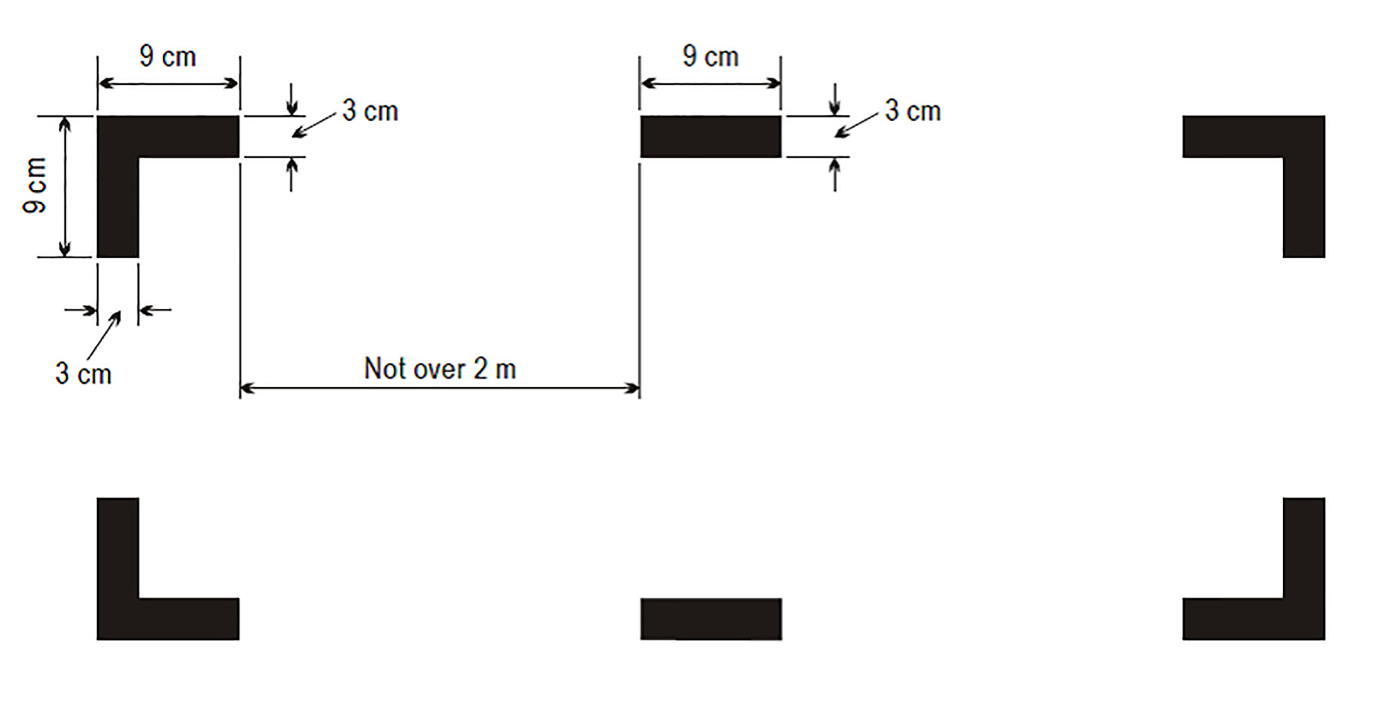
If areas of the helicopter’s fuselage suitable for break-in by rescue crews in an emergency are marked, such areas shall be marked as shown in Figure 1.
Figure 1
Marking of break-in points
AMC1 SPO.IDE.H.185 Marking of break-in points
ED Decision 2014/018/R
COLOUR AND CORNERS’ MARKING
(a)The colour of the markings should be red or yellow and, if necessary, should be outlined in white to contrast with the background.
(b)If the corner markings are more than 2 m apart, intermediate lines 9 cm x 3 cm should be inserted so that there is no more than 2 m between adjacent markings.
SPO.IDE.H.190 Emergency locator transmitter (ELT)
Regulation (EU) 2023/1020
(a)Helicopters certified for a maximum seating configuration above six shall be equipped with:
(1)an automatic ELT; and
(2)one survival ELT (ELT(S)) in a life-raft or life-jacket when the helicopter is operated at a distance from land corresponding to more than 3 minutes flying time at normal cruising speed.
(b)Helicopters certified for a maximum seating configuration of six or less shall be equipped with an ELT(S) or a personal locator beacon (PLB), carried by a crew member or a task specialist, or with an automatic ELT.
(c)ELTs of any type and PLBs shall be capable of transmitting simultaneously on 121,5 MHz and 406 MHz.
AMC1 SPO.IDE.H.190 Emergency locator transmitter (ELT)
ED Decision 2014/018/R
BATTERIES
(a)All batteries used in ELTs or PLBs should be replaced (or recharged if the battery is rechargeable) when the equipment has been in use for more than 1 cumulative hour or in the following cases:
(1)Batteries specifically designed for use in ELTs and having an airworthiness release certificate (EASA Form 1 or equivalent) should be replaced (or recharged, if the battery is rechargeable) before the end of their useful life in accordance with the maintenance instructions applicable to the ELT.
(2)Standard batteries manufactured in accordance with an industry standard and not having an airworthiness release certificate (EASA Form 1 or equivalent), when used in ELTs should be replaced (or recharged if the battery is rechargeable) when 50 % of their useful life (or for rechargeable, 50 % of their useful life of charge), as established by the battery manufacturer, has expired.
(3)All batteries used in PLBs should be replaced (or recharged, if the battery is rechargeable) when 50 % of their useful life (or for rechargeable 50 % of their useful life of charge), as established by the battery manufacturer, has expired.
(4)The battery useful life (or useful life of charge) criteria in (1),(2) and (3) do not apply to batteries (such as water-activated batteries) that are essentially unaffected during probable storage intervals.
(b)The new expiry date for a replaced (or recharged) battery should be legibly marked on the outside of the equipment.
AMC2 SPO.IDE.H.190 Emergency locator transmitter (ELT)
ED Decision 2021/008/R
TYPES OF ELTs AND GENERAL TECHNICAL SPECIFICATIONS
(a)The ELT required by this provision should be one of the following:
(1)Automatic fixed (ELT(AF)). An automatically activated ELT that is permanently attached to an aircraft and is designed to aid SAR teams in locating the crash site.
(2)Automatic portable (ELT(AP)). An automatically activated ELT that is rigidly attached to an aircraft before a crash, but is readily removable from the aircraft after a crash. It functions as an ELT during the crash sequence. If the ELT does not employ an integral antenna, the aircraft-mounted antenna may be disconnected and an auxiliary antenna (stored on the ELT case) attached to the ELT. The ELT can be tethered to a survivor or a life-raft. This type of ELT is intended to aid SAR teams in locating the crash site or survivor(s).
(3)Automatic deployable (ELT(AD)). An ELT that is rigidly attached to the aircraft before the crash and that is automatically deployed and activated by an impact, and, in some cases, also by water sensors. This type of ELT should float in water and is intended to aid SAR teams in locating the crash site. The ELT(AD) may be either a stand-alone beacon or an inseparable part of a deployable recorder.
(4)Survival ELT (ELT(S)). An ELT that is removable from an aircraft, stowed so as to facilitate its ready use in an emergency, and manually activated by a survivor. An ELT(S) may be activated manually or automatically (e.g. by water activation). It should be designed to be tethered to a life-raft or a survivor. A water-activated ELT(S) is not an ELT(AP).
(b)To minimise the possibility of damage in the event of crash impact, the automatic ELT should be rigidly fixed to the aircraft structure, as far aft as is practicable, with its antenna and connections arranged so as to maximise the probability of the signal being transmitted after a crash.
(c)Any ELT carried should operate in accordance with the relevant provisions of ICAO Annex 10, Volume III and should be registered with the national agency responsible for initiating search and rescue or other nominated agency.
AMC3 SPO.IDE.H.190 Emergency locator transmitter (ELT)
ED Decision 2014/018/R
PLB TECHNICAL SPECIFICATIONS
(a)A personal locator beacon (PLB) should have a built-in GNSS receiver with a cosmicheskaya sistyema poiska avariynich sudov — search and rescue satellite-aided tracking (COSPAS-SARSAT) type approval number. However, devices with a COSPAS-SARSAT with a number belonging to series 700 are excluded as this series of numbers identifies the special-use beacons not meeting all the technical requirements and all the tests specified by COSPAS-SARSAT.
(b)Any PLB carried should be registered with the national agency responsible for initiating search and rescue or other nominated agency.
AMC4 SPO.IDE.H.190 Emergency locator transmitter (ELT)
ED Decision 2014/018/R
BRIEFING ON PLB USE
When a PLB is carried by a task specialist, he/she should be briefed on its characteristics and use by the pilot-in-command before the flight.
GM1 SPO.IDE.H.190 Emergency locator transmitter (ELT)
ED Decision 2021/008/R
TERMINOLOGY
GM1 CAT.IDE.H.280 contains explanations of terms used in point SPO.IDE.H.190 and in the related AMC.
GM2 SPO.IDE.H.190 Emergency locator transmitter (ELT)
ED Decision 2014/018/R
MAXIMUM CERTIFIED SEATING CONFIGURATION
The maximum certified seating configuration does not include flight crew seats.
GM3 SPO.IDE.H.190 Emergency locator transmitter (ELT)
ED Decision 2021/008/R
ADDITIONAL GUIDANCE
The guidance provided in is applicable to point SPO.IDE.H.190.
SPO.IDE.H.195 Flight over water – other-than complex motor-powered helicopters
Regulation (EU) 2015/140
(a)Helicopters shall be equipped with a life-jacket for each person on board, that shall be worn or stowed in a position that is readily accessible from the seat or station of the person for whose use it is provided, when:
(1)flying over water beyond autorotational distance from the land where in case of the critical engine failure, the helicopter is not able to sustain level flight; or
(2)flying over water at a distance of land corresponding to more than 10 minutes flying at normal cruising speed, where in case of the critical engine failure, the helicopter is able to sustain level flight; or
(3)taking off or landing at an aerodrome/operating site where the take-off or approach path is over water.
(b)Each life-jacket shall be equipped with a means of electric illumination for the purpose of facilitating the location of persons.
(c)The pilot-in-command of a helicopter operated on a flight over water at a distance from land corresponding to more than 30 minutes flying time at normal cruising speed or 50 NM, whichever is less, shall determine the risks to survival of the occupants of the helicopter in the event of a ditching, based on which he/she shall determine the carriage of:
(1)equipment for making the distress signals;
(2)life-rafts in sufficient numbers to carry all persons on board, stowed so as to facilitate their ready use in emergency; and
(3)life-saving equipment to provide the means of sustaining life, as appropriate to the flight to be undertaken.
(d)The pilot-in-command shall determine the risks to survival of the occupants of the helicopter in the event of a ditching, when deciding if the life-jackets required in (a) shall be worn by all occupants.
AMC1 SPO.IDE.H.195 Flight over water – other-than complex motor-powered helicopters
ED Decision 2014/018/R
ACCESSIBILITY OF LIFE-JACKETS
The life-jacket, if not worn, should be accessible from the seat or station of the person for whose use it is provided, with a safety belt or a restraint system fastened.
MEANS OF ILLUMINATION FOR LIFE-JACKETS
The means of electric illumination should be a survivor locator light as defined in the applicable ETSO issued by the Agency or equivalent.
RISK ASSESSMENT
(a)When conducting the risk assessment, the pilot-in-command should base his/her decision, as far as is practicable, on the Implementing Rules and AMCs applicable to the operation of the helicopter.
(b)The pilot-in-command should, for determining the risk, take the following operating environment and conditions into account:
(1)sea state;
(2)sea and air temperatures;
(3)the distance from land suitable for making an emergency landing; and
(4)the availability of search and rescue facilities.
GM1 SPO.IDE.H.195 Flight over water – other-than complex motor-powered helicopters
ED Decision 2014/018/R
SEAT CUSHIONS
Seat cushions are not considered to be flotation devices.