
Filters
GM2 CAT.OP.MPA.170 Passenger briefing
ED Decision 2017/008/R
SAFETY BRIEFING MATERIAL
(a)Safety briefing material may include but is not limited to an audio-visual presentation, such as a safety video or a safety briefing card. Information in the safety briefing material should be relevant to the aircraft type and the installed equipment and should be consistent with the operator’s procedures. Information in the safety briefing material should be presented in a clear and unambiguous manner and in a form easily understandable to passengers.
(b)For those passengers occupying seats with direct access to emergency exits, the operator should consider providing a separate briefing card, which contains a summary of the exit briefing information.
(c)The safety briefing card should be designed, and the information should be provided, in a size easily visible to the passenger. The safety briefing card should be stowed in a location from where it is easily visible and reachable to the seated passenger and from where it cannot easily fall out. Information should be presented in a pictographic form and should be consistent with the placards used in the aircraft. Written information should be kept to the necessary minimum. The safety briefing card should only contain information relevant to safety.
(d)The operator conducting an operation with no cabin crew should consider including expanded information, such as location and use of fire extinguisher, oxygen system if different from the drop-down system, etc.
(e)The safety video should be structured in a pace that allows a continuous ability to follow the information presented. The operator may consider including sign language or subtitles to simultaneously complement the soundtrack.
(f)The operator should consider including the following information in its safety briefing material:
(1)hand baggage:
(i)correct versus forbidden stowage locations (e.g. exits, aisles, etc.);
(2)safety belts and other restraint systems:
(i)when and how to use safety belts and other restraint systems;
(ii)restraint of infants and children;
(iii)additional installed systems, e.g. airbag;
(3)drop-down oxygen system:
(i)location;
(ii)activation;
(iii)indication of active oxygen supply;
(iv)correct and timely donning of oxygen mask;
(v)assisting others;
(4)flotation devices:
(i)stowage locations (including if different in various cabin sections);
(ii)use for adult, child and infant;
(iii)features, e.g. straps, toggles, tubes, signalling light, whistle;
(iv)when and where to inflate a life jacket;
(v)flotation devices for infants;
(5)emergency exits:
(i)number and location;
(ii)method of operation, including alternative operation in case of ditching;
(iii)surrounding conditions prior to opening (e.g. fire, smoke, water level, etc.);
(iv)unusable exit;
(v)alternative egress routes in case of unusable exit(s);
(vi)leaving hand baggage behind;
(vii)method of egress through exit including with infants and children;
(viii)awareness of exit height;
(ix)awareness of propellers;
(6)escape routes: depiction of routes:
(i)to the exits (inside the aircraft);
(ii)movement on a double-deck aircraft;
(iii)via the wing to the ground;
(iv)on the ground away from the aircraft;
(7)assisting evacuation means:
(i)location of available equipment (e.g. life raft, installed slide/raft, etc.);
(ii)awareness of the evacuation equipment’s features;
(iii)operation of the available equipment (activation, detachment, etc.);
(iv)method of boarding the device including with infants and children;
(v)use of shoes;
(vi)method of evacuation through exits with no assisting evacuation means;
(8)brace position:
(i)appropriate method to the applicable facing direction;
(ii)alternative brace positions for e.g. expectant mothers, passengers with lap-held infants, tall or large individuals, children, etc.;
(9)portable electronic devices, including spare batteries:
(i)allowed versus forbidden devices;
(ii)use in various flight phases including during safety briefing;
(iii)stowage;
(iv)danger of fire in case the device is damaged;
(v)the need to call for immediate assistance in case a device is damaged, hot, produces smoke, is lost, or falls into the seat structure (including advice to refrain from manipulating the seat);
(vi)the need to monitor devices during charging;
(10)cabin secured aspects:
(i)required position of seatbacks, headrests, tray tables, footrests, window blinds, in-seat video screens and their control gadgets, etc.;
(ii)caution when opening overhead compartments;
(11)smoking regulations (e.g. phase of flight, electronic smoking devices, pipes, etc.) including smoking in the lavatory;
(12)floor proximity escape path marking:
(i)location;
(ii)purpose in case of darkness or smoke;
(13)actions in case of an emergency (e.g. remove sharp objects, fasten seat belt, open window blind, etc.);
(14)any other safety aspects.
CAT.OP.MPA.175 Flight preparation
Regulation (EU) 2021/1296
(a)An operational flight plan shall be completed for each intended flight based on considerations of aircraft performance, other operating limitations and relevant expected conditions on the route to be followed and at the aerodromes/operating sites concerned.
(b)The flight shall not be commenced unless the commander is satisfied that:
(1)all items stipulated in 2.a.3 of Annex IV to Regulation (EC) No 216/2008 concerning the airworthiness and registration of the aircraft, instrument and equipment, mass and centre of gravity (CG) location, baggage and cargo and aircraft operating limitations can be complied with;
(2)the aircraft is not operated contrary to the provisions of the configuration deviation list (CDL);
(3)the parts of the operations manual that are required for the conduct of the flight are available;
(4)the documents, additional information and forms required to be available by CAT.GEN.MPA.180 are on board;
(5)current maps, charts and associated documentation or equivalent data are available to cover the intended operation of the aircraft including any diversion that may reasonably be expected;
(6)space-based facilities, ground facilities and services that are required for the planned flight are available and adequate;
(7)the provisions specified in the operations manual in respect of fuel/energy, oil, oxygen, minimum safe altitudes, aerodrome operating minima and availability of alternate aerodromes, where required, can be complied with for the planned flight;
(7a)any navigational database required for performance-based navigation is suitable and current; and
(8)any additional operational limitation can be complied with.
(c)Notwithstanding (a), an operational flight plan is not required for operations under VFR of:
(1)other-than complex motor-powered aeroplane taking off and landing at the same aerodrome or operating site; or
(2)helicopters with an MCTOM of 3 175 kg or less, by day and over routes navigated by reference to visual landmarks in a local area as specified in the operations manual.
AMC1 CAT.OP.MPA.175 Flight preparation
ED Decision 2016/015/R
FLIGHT PREPARATION FOR PBN OPERATIONS
(a)The flight crew should ensure that RNAV 1, RNAV 2, RNP 1 RNP 2, and RNP APCH routes or procedures to be used for the intended flight, including for any alternate aerodromes, are selectable from the navigation database and are not prohibited by NOTAM.
(b)The flight crew should take account of any NOTAMs or operator briefing material that could adversely affect the aircraft system operation along its flight plan including any alternate aerodromes.
(c)When PBN relies on GNSS systems for which RAIM is required for integrity, its availability should be verified during the preflight planning. In the event of a predicted continuous loss of fault detection of more than five minutes, the flight planning should be revised to reflect the lack of full PBN capability for that period.
(d)For RNP 4 operations with only GNSS sensors, a fault detection and exclusion (FDE) check should be performed. The maximum allowable time for which FDE capability is projected to be unavailable on any one event is 25 minutes. If predictions indicate that the maximum allowable FDE outage will be exceeded, the operation should be rescheduled to a time when FDE is available.
(e)For RNAV 10 operations, the flight crew should take account of the RNAV 10 time limit declared for the inertial system, if applicable, considering also the effect of weather conditions that could affect flight duration in RNAV 10 airspace. Where an extension to the time limit is permitted, the flight crew will need to ensure that en route radio facilities are serviceable before departure, and to apply radio updates in accordance with any AFM limitation.
AMC2 CAT.OP.MPA.175 Flight preparation
ED Decision 2016/015/R
DATABASE SUITABILITY
(a)The flight crew should check that any navigational database required for PBN operations includes the routes and procedures required for the flight.
DATABASE CURRENCY
(b)The database validity (current AIRAC cycle) should be checked before the flight.
(c)Navigation databases should be current for the duration of the flight. If the AIRAC cycle is due to change during flight, the flight crew should follow procedures established by the operator to ensure the accuracy of navigation data, including the suitability of navigation facilities used to define the routes and procedures for the flight.
(d)An expired database may only be used if the following conditions are satisfied:
(1)the operator has confirmed that the parts of the database which are intended to be used during the flight and any contingencies that are reasonable to expect are not changed in the current version;
(2)any NOTAMs associated with the navigational data are taken into account;
(3)maps and charts corresponding to those parts of the flight are current and have not been amended since the last cycle;
(4)any MEL limitations are observed; and
(5)the database has expired by no more than 28 days.
AMC1 CAT.OP.MPA.175(a) Flight preparation
ED Decision 2022/005/R
OPERATIONAL FLIGHT PLAN — COMPLEX MOTOR-POWERED AIRCRAFT
(a)The operational flight plan used and the entries made during flight should contain the following items:
(1)aircraft registration;
(2)aircraft type and variant;
(3)date of flight;
(4)flight identification;
(5)names of flight crew members;
(6)duty assignment of flight crew members;
(7)place of departure;
(8)time of departure (actual off-block time, take-off time);
(9)place of arrival (planned and actual);
(10)time of arrival (actual landing and on-block time);
(11)type of operation (ETOPS, VFR, ferry flight, etc.);
(12)route and route segments with checkpoints/waypoints, distances, time and tracks;
(13)planned cruising speed and flying times between check-points/waypoints (estimated, revised, and actual times overhead);
(14)safe altitudes and minimum levels;
(15)planned altitudes and flight levels;
(16)fuel calculations (records of in-flight fuel checks);
(17)fuel on board when starting engines;
(18)alternate(s) for destination, including the information required in (a)(12) to (15), as well as destination 2 and destination 2 alternate aerodromes in case of a reduced contingency fuel (RCF) procedure;
(19)where applicable, a take-off alternate and fuel ERA aerodrome(s);
(20)initial ATS flight plan clearance and subsequent reclearance;
(21)in-flight replanning calculations; and
(22)meteorological information, as specified in point (a) of point MET.TR.215 of Part-MET.
(b)Items that are readily available in other documentation or from another acceptable source or are irrelevant to the type of operation may be omitted from the operational flight plan.
(c)The operational flight plan and its use should be described in the operations manual.
(d)All entries on the operational flight plan should be made concurrently and be permanent in nature.
OPERATIONAL FLIGHT PLAN — OTHER-THAN-COMPLEX MOTOR-POWERED AIRCRAFT OPERATIONS AND LOCAL OPERATIONS
(e)An operational flight plan may be established in a simplified form relevant to the type of operation for operations with other-than-complex motor-powered aircraft as well as local operations with any aircraft. Local operations should be defined in the OM.
OPERATIONAL FLIGHT PLAN — HELICOPTERS OPERATED WITH A SINGLE PILOT AND WITHOUT A STABILITY AUGMENTATION SYSTEM OR AN AUTOMATIC FLIGHT CONTROL SYSTEM (AFCS)
(f)No entries should be made in the operational flight plan during the flight.
OPERATIONAL FLIGHT PLAN PRODUCED BY A COMPUTERISED FLIGHT-PLANNING SYSTEM
(g)When the operator uses a computerised flight-planning system to produce an operational flight plan, the functionality of this system should be described in the OM.
(h)If the computerised flight-planning system is used in conjunction with a basic fuel scheme with variations or an individual fuel scheme, the operator should ensure that the quality and the proper functionality of the software are tested after each upgrade. The test should verify that the changes to the software do not affect the final output.
GM1 CAT.OP.MPA.175(b)(5) Flight preparation
ED Decision 2014/015/R
CONVERSION TABLES
The documentation should include any conversion tables necessary to support operations where metric heights, altitudes and flight levels are used.
CAT.OP.MPA.177 Submission of the ATS flight plan
Regulation (EU) 2021/1296
(a)If an air traffic services (ATS) flight plan is not submitted because it is not required by the rules of the air, adequate information shall be deposited in order to permit alerting services to be activated if required.
(b)When operating from a site where it is impossible to submit an ATS flight plan, the ATS flight plan shall be transmitted as soon as possible after take-off by the commander or the operator.
AMC1 CAT.OP.MPA.177 Submission of the ATS flight plan
ED Decision 2022/005/R
FLIGHTS WITHOUT AN ATS FLIGHT PLAN
(a)When unable to submit or close the ATS flight plan due to lack of ATS facilities or of any other means of communications to ATS, the operator should establish procedures, instructions, and a list of nominated persons to be responsible for alerting search and rescue (SAR) services.
(b)To ensure that each flight is located at all times, these instructions should:
(1)provide the nominated person with at least the information required to be included in a VFR flight plan, and the location, date, and estimated time for re-establishing communications;
(2)if an aircraft is overdue or missing, ensure that the appropriate ATS or SAR service is notified; and
(3)ensure that the information will be retained at a designated place until the completion of the flight.
CAT.OP.MPA.180 Fuel/energy scheme – aeroplanes
Regulation (EU) 2021/1296
(a)The operator shall establish, implement, and maintain a fuel/energy scheme that:
(1)is appropriate for the type(s) of operation performed;
(2)corresponds to the capability of the operator to support its implementation; and
(3)is either:
(i)a basic fuel/energy scheme, which shall form the basis for a basic fuel/energy scheme with variations and an individual fuel/energy scheme; the basic fuel/energy scheme derives from a large-scale analysis of safety and operational data from previous performance and experience of the industry, applying scientific principles; the basic fuel/energy scheme shall ensure, in this order, a safe, effective, and efficient operation of the aircraft; or
(ii)a basic fuel/energy scheme with variations, which is a basic fuel/energy scheme where the analysis referred to in point (i) is used to establish a variation to the basic fuel/energy scheme that ensures, in this order, a safe, effective, and efficient operation of the aircraft; or
(iii)an individual fuel/energy scheme, which derives from a comparative analysis of the operator’s safety and operational data, applying scientific principles; the analysis is used to establish a fuel/energy scheme with a higher or equivalent level of safety to that of the basic fuel/energy scheme that ensures, in this order, a safe, effective, and efficient operation of the aircraft.
(b)All fuel/energy schemes shall comprise:
(1)a fuel/energy planning and in-flight re-planning policy;
(2)an aerodrome selection policy; and
(3)an in-flight fuel/energy management policy.
(c)The fuel/energy scheme and any change to it shall require prior approval by the competent authority.
(d)When the operator intends to apply for an individual fuel/energy scheme, it shall:
(1)establish a baseline safety performance of its current fuel/energy scheme;
(2)demonstrate its capability to support the implementation of the proposed individual fuel/energy scheme, including the capability to exercise adequate operational control and to ensure exchange of the relevant safety information between the operational control personnel and the flight crew; and
(3)make a safety risk assessment that demonstrates how an equivalent level of safety to that of the current fuel/energy scheme is achieved.
AMC1 CAT.OP.MPA.180 Fuel/energy scheme — aeroplanes
ED Decision 2022/005/R
INDIVIDUAL FUEL SCHEME
(a)Prior to submitting an individual fuel scheme for approval, the operator should perform all the following actions to establish a baseline safety performance:
(1)measure the baseline safety performance of its operation with the current fuel scheme by:
(i)selecting safety performance indicators (SPIs) and targets that are agreed with the competent authority; and
(ii)collecting statistically relevant data for a period of at least 2 years of continuous operation (note: the number of flights should be sufficient to provide data to support the intended deviation);
(2)identify the hazards associated with the individual fuel scheme and carry out a safety risk assessment of these hazards; and
(3)based on this safety risk assessment, establish a mechanism for risk monitoring and risk control to ensure an equivalent level of safety to that of the current fuel scheme.
(b)In order to ensure the approval of the competent authority and its continuous oversight, the operator should establish an effective continuous reporting system to the competent authority on the safety performance and regulatory compliance of the individual fuel scheme.
(c)When determining the extent of the deviation from the current fuel scheme, the operator should take into account at least the following elements for the relevant area of operation:
(1)the available aerodrome technologies, capabilities, and infrastructure;
(2)the reliability of meteorological and aerodrome information;
(3)the reliability of the aeroplane systems, especially the time-limited ones; and
(4)the type of ATS provided and, where applicable, characteristics and procedures of the air traffic flow management and of the airspace management.
(d)An operator wishing to apply for the approval of an individual fuel scheme should be able to demonstrate that it exercises sufficient organisational control over internal processes and the use of resources. The operator should adapt its management system to ensure that:
(1)processes and procedures are established to support the individual fuel scheme;
(2)involved flight crew and personnel are trained and competent to perform their tasks; and
(3)the implementation and effectiveness of such processes, procedures, and training are monitored.
(e)The operator should have as a minimum the following operational capabilities that support the implementation of an individual fuel scheme:
(1)use a suitable computerised flight-planning system;
(2)ensure that the planning of flights is based upon current aircraft-specific data that is derived from a fuel consumption monitoring system and reliable meteorological data;
(3)have airborne fuel prediction systems;
(4)be able to operate in required navigation performance (RNP) 4 oceanic and remote continental airspace and in area navigation (RNAV) 1 continental en-route airspace, as applicable;
(5)be able to perform APCHs that require an LVO approval and RNP APCHs down to VNAV minima; and
(6)update the available landing options by establishing an operational control system with the following capabilities:
(i)flight monitoring or flight watch;
(ii)collection and continuous monitoring of reliable meteorological, aerodrome, and traffic information;
(iii)two independent airborne communications systems to achieve rapid and reliable exchange of relevant safety information between flight operations personnel and flight crew during the entire flight; and
(iv)monitoring of the status of aircraft systems that affect fuel consumption and of ground and aircraft systems that affect landing capabilities.
(f)After receiving the approval, the operator should:
(1)continually measure and monitor the outcome of each SPI; and
(2)in case of degradation of any SPI:
(i)assess the root cause of the degradation;
(ii)identify remedial actions to restore the baseline safety performance; and
(iii)when the associated safety performance target is not met, inform the authority as soon as practicable.
GM1 CAT.OP.MPA.180 Fuel/energy scheme — aeroplanes
ED Decision 2022/005/R
FUEL SCHEMES
An operator can choose between three different fuel schemes. For the development of each fuel scheme, the following AMC are applicable:
(a)Basic fuel scheme: all the AMC that apply to the basic fuel scheme.
(b)Basic fuel scheme with variations: when an operator decides to deviate fully or partly from the basic fuel schemes, the AMC for basic fuel schemes with variations apply to the specific deviation.
(c)Individual fuel scheme: when an operator wishes to apply an individual fuel scheme, the AMC for the individual fuel scheme apply; for the part of the scheme where the operator still follows the basic fuel scheme, the operator should apply the AMC referred to in (a) and (b).
GM2 CAT.OP.MPA.180 Fuel/energy scheme — aeroplanes
ED Decision 2022/005/R
INDIVIDUAL FUEL SCHEMES — BASELINE SAFETY PERFORMANCE INDICATORS (SPIs) AND EQUIVALENT LEVEL OF SAFETY
(a)Establishing the baseline safety performance of a current fuel scheme involves collecting historical statistical data for the selected SPIs over a defined period of time, e.g. a minimum of 2 years. The safety performance of the operator’s processes is then measured against this baseline safety performance before and after implementation of the individual fuel scheme.
(b)Agreed SPIs should be commensurate with the complexity of the operational context, the extent of the deviations of the individual fuel scheme from the current fuel scheme, and the availability of resources to address those SPIs.
(c)The following is a non-exhaustive list of SPIs that are used to measure the baseline safety performance:
(1)flights with 100 % consumption of the contingency fuel;
(2)flights with a percentage consumption of the contingency fuel (e.g. 85 %), as agreed by the operator and the competent authority;
(3)difference between planned and actual trip fuel;
(4)landings with less than the final reserve fuel (FRF) remaining;
(5)flights landing with less than minutes of fuel remaining (e.g. 45 minutes), as agreed by the operator and the competent authority;
(6)‘MINIMUM FUEL’ declarations;
(7)‘MAYDAY MAYDAY MAYDAY FUEL’ declarations;
(8)in-flight re-planning to the planned destination due to fuel shortage, including committing to land at the destination by cancelling the planned destination alternate;
(9)diversion to an en route alternate (ERA) aerodrome to protect the FRF;
(10)diversion to the destination alternate aerodrome; and
(11)any other indicator with the potential of demonstrating the suitability or unsuitability of the alternate aerodrome and fuel planning policy.
Note: Although the above-list includes quantitative SPIs, for certain non-data-based monitoring SPIs, alert and target levels may be qualitative in nature.
(d)Equivalent level of safety: SPIs and associated targets that are achieved after the introduction of an individual fuel scheme ‘should be equivalent to’ or ‘exceed’ the SPIs and associated targets that were used in the previously approved fuel scheme. To determine if such equivalence is achieved, the operator should carefully compare with one another the safety performance of operational activities before and after the application of the individual fuel scheme. For example, the operator should ensure that the average number of landings with less than the FRF does not increase after the introduction of the individual fuel scheme.
(e)The applicability of the individual fuel scheme may be limited to a specific aircraft fleet or type/variant of aircraft or area of operations. Different policies may be established as long as the procedures clearly specify the boundaries of each policy so that the flight crew is aware of the policy being applied: for example, the operator may wish to deviate from the basic 5 % contingency fuel policy only in certain areas of operations or only for a specific aircraft fleet or type/variant of aircraft. The safety performance of the fuel scheme may be measured according to the relevant area of operation or aircraft fleet or type/variant of aircraft so that any degradation of the safety performance can be isolated and mitigated separately. In that case, the approval for a deviation may be suspended for the affected area of operations and/or type/variant of aircraft until the required safety performance is achieved.
Note: ICAO Doc 9976 Flight Planning and Fuel Management (FPFM) Manual (1st Edition, 2015) and the EASA Fuel Manual provide further guidance.
GM3 CAT.OP.MPA.180 Fuel/energy scheme — aeroplanes
ED Decision 2022/005/R
INDIVIDUAL FUEL SCHEMES — OPERATOR CAPABILITIES — COMMUNICATIONS SYSTEMS
(a)In the context of point (e)(6) of AMC1 CAT.OP.MPA.180, the availability of two independent communications systems at dispatch is particularly relevant for flights over oceanic and remote areas (e.g. when flying over the ocean without VHF coverage, operators need either HF or satellite communications (SATCOM)).
(b)Consideration should also be given to the operational control system associated with the use of the aircraft communications addressing and reporting system (ACARS). Two communications systems (e.g. VHF and SATCOM) should be used to support the ACARS functionality to ensure the required degree of independence unless the operator has established contingency procedures for reverting to voice communication only.
(c)Additional means of communications may be required by other regulations that are not linked to fuel schemes.
Note: For further information, see ICAO Doc 9976 Flight Planning and Fuel Management (FPFM) Manual, Appendix 7 to Chapter 5 A performance-based approach job-aid for an approving authority (1st Edition, 2015).
CAT.OP.MPA.181 Fuel/energy scheme – fuel/energy planning and in-flight re-planning policy – aeroplanes
Regulation (EU) 2021/1296
(a)The operator shall:
(1)establish a fuel/energy planning and in-flight re-planning policy as part of the fuel/energy scheme;
(2)ensure that the aeroplane carries a sufficient amount of usable fuel/energy to safely complete the planned flight and to allow for deviations from the planned operation;
(3)develop procedures for the fuel/energy planning and in-flight re-planning policy that shall be contained in the operations manual.
(4)ensure that the fuel/energy planning of the flight is based on:
(i)current aircraft-specific data derived from a fuel/energy consumption monitoring system or, if not available;
(ii)data provided by the aeroplane manufacturer.
(b)The operator shall ensure that the planning of flights includes the operating conditions under which the flight is to be conducted; the operating conditions shall include at least:
(1)aircraft fuel/energy consumption data;
(2)anticipated masses;
(3)anticipated meteorological conditions;
(4)the effects of deferred maintenance items and/or of configuration deviations;
(5)the expected departure and arrival routing and runways; and
(6)anticipated delays.
(c)The operator shall ensure that the pre-flight calculation of the usable fuel/energy that is required for a flight includes:
(1)taxi fuel/energy that shall not be less than the amount expected to be used prior to takeoff;
(2)trip fuel/energy that shall be the amount of fuel/energy that is required to enable the aeroplane to fly from take-off, or from the point of in-flight re-planning, to landing at the destination aerodrome;
(3)contingency fuel/energy that shall be the amount of fuel/energy required to compensate for unforeseen factors;
(4)destination alternate fuel/energy:
(i)when a flight is operated with at least one destination alternate aerodrome, it shall be the amount of fuel/energy required to fly from the destination aerodrome to the destination alternate aerodrome; or
(ii)when a flight is operated with no destination alternate aerodrome, it shall be the amount of fuel/energy required to hold at the destination aerodrome, while enabling the aeroplane to perform a safe landing, and to allow for deviations from the planned operation; as a minimum, this amount shall be 15-minute fuel/energy at holding speed at 1 500ft (450 m) above the aerodrome elevation in standard conditions, calculated according to the estimated aeroplane mass on arrival at the destination aerodrome;
(5)final reserve fuel/energy that shall be the amount of fuel/energy that is calculated at holding speed at 1 500ft (450 m) above the aerodrome elevation in standard conditions according to the aeroplane estimated mass on arrival at the destination alternate aerodrome, or destination aerodrome when no destination alternate aerodrome is required, and shall not be less than:
(i)for aeroplanes with reciprocating engines, the fuel/energy to fly for 45 minutes; or
(ii)for turbine-engined aeroplanes, the fuel/energy to fly for 30 minutes;
(6)additional fuel/energy, if required by the type of operation; it shall be the amount of fuel/energy to enable the aeroplane to land at a fuel/energy en route alternate aerodrome (fuel/energy ERA aerodrome critical scenario) in the event of an aircraft failure that significantly increases the fuel/energy consumption at the most critical point along the route; this additional fuel/energy is required only if the minimum amount of fuel/energy that is calculated according to points (c)(2) to (c)(5) is not sufficient for such an event;
(7)extra fuel/energy to take into account anticipated delays or specific operational constraints; and
(8)discretionary fuel/energy, if required by the commander.
(d)The operator shall ensure that in-flight re-planning procedures for calculating the usable fuel/energy that is required when a flight proceeds along a route or to a destination aerodrome other than the ones originally planned include points (c)(2) to (c)(7).
AMC1 CAT.OP.MPA.181 Fuel/energy scheme — fuel/energy planning and in-flight re-planning policy — aeroplanes
ED Decision 2022/005/R
BASIC FUEL SCHEME — PRE-FLIGHT CALCULATION OF USABLE FUEL FOR PERFORMANCE CLASS A AEROPLANES
For the pre-flight calculation of the usable fuel in accordance with point CAT.OP.MPA.181, the operator should:
(a)for taxi fuel, take into account the local conditions at the departure aerodrome and the APU consumption;
(b)for trip fuel, include:
(1)fuel for take-off and climb from the aerodrome elevation to the initial cruising level/altitude, taking into account the expected departure routing;
(2)fuel from the top of climb to the top of descent, including any step climb/descent;
(3)fuel from the top of descent to the point where the approach procedure is initiated, taking into account the expected arrival routing; and
(4)fuel for making an approach and landing at the destination aerodrome;
(c)for contingency fuel, calculate for unforeseen factors either:
(1)5 % of the planned trip fuel or, in the event of in-flight re-planning, 5 % of the trip fuel for the remainder of the flight; or
(2)an amount to fly for 5 minutes at holding speed at 1 500 ft (450 m) above the destination aerodrome in standard conditions,
whichever is the higher;
(d)for destination alternate fuel, include:
(1)when the aircraft is operated with one destination alternate aerodrome:
(i)fuel for a missed approach from the applicable DA/H or MDA/H at the destination aerodrome to the missed-approach altitude, taking into account the complete missed-approach procedure;
(ii)fuel for climb from the missed-approach altitude to the cruising level/altitude, taking into account the expected departure routing;
(iii)fuel for cruising from the top of climb to the top of descent, taking into account the expected routing;
(iv)fuel for descent from the top of descent to the point where the approach is initiated, taking into account the expected arrival routing; and
(v)fuel for making an approach and landing at the destination alternate aerodrome; and
(2)when the aircraft is operated with two destination alternate aerodromes, the amount of fuel that is calculated in accordance with point (d)(1), based on the destination alternate aerodrome that requires the greater amount of fuel;
(e)for FRF, comply with point CAT.OP.MPA.181(c);
(f)for additional fuel, include an amount of fuel that allows the aeroplane to proceed, in the event of an engine failure or loss of pressurisation, from the most critical point along the route to a fuel en route alternate (fuel ERA) aerodrome in the relevant aircraft configuration, hold there for 15 minutes at 1 500 ft (450 m) above the aerodrome elevation in standard conditions, make an approach, and land;
(g)for extra fuel, include anticipated delays or specific operational constraints that can be predicted; and
(h)for discretionary fuel, include a quantity at the sole discretion of the commander.
AMC2 CAT.OP.MPA.181 Fuel/energy scheme — fuel/energy planning and in-flight re-planning policy — aeroplanes
ED Decision 2022/005/R
BASIC FUEL SCHEME — PRE-FLIGHT CALCULATION OF USABLE FUEL FOR PERFORMANCE CLASS B and C AEROPLANES
The pre-flight calculation of required usable fuel should include:
(a)taxi fuel, if significant;
(b)trip fuel;
(c)contingency fuel that is not less than 5 % of the planned trip fuel, or in the event of in-flight replanning, 5 % of the trip fuel for the remainder of the flight;
(d)alternate fuel to reach the destination alternate aerodrome via the destination if a destination alternate aerodrome is required;
(e)FRF to comply with point CAT.OP.MPA.181(c);
(f)extra fuel if there are anticipated delays or specific operational constraints; and
(g)discretionary fuel, if required by the commander.
The operating conditions may include rounded-up figures of fuel for all flights.
AMC3 CAT.OP.MPA.181 Fuel/energy scheme — fuel/energy planning and in-flight re-planning policy — aeroplanes
ED Decision 2022/005/R
BASIC FUEL SCHEME — PRE-FLIGHT CALCULATION OF USABLE FUEL FOR ELA2 AEROPLANES
For operations, take-off, and landing at the same aerodrome or operating site under VFR by day, operators should specify the minimum FRF in the OM. This FRF should not be less than the amount needed to fly for a period of 45 minutes. The operating conditions may be rounded up to a single figure of fuel for all flights. For the pre-flight calculation of the required usable fuel, a single roundedup figure for the particular flight is needed, which includes trip fuel, contingency fuel, extra fuel, discretionary fuel, and alternate fuel, to reach a destination alternate aerodrome if such an aerodrome is required.
AMC4 CAT.OP.MPA.181 Fuel/energy scheme — Fuel/energy planning and in-flight re-planning policy — aeroplanes
ED Decision 2022/005/R
BASIC FUEL SCHEME — PRE-FLIGHT CALCULATION OF USABLE FUEL
The additional fuel required by the type of operation in the event of an aircraft failure that significantly increases fuel consumption at the most critical point along the route should be calculated according to the engine failure or loss of pressurisation, whichever requires a greater amount of fuel.
AMC5 CAT.OP.MPA.181 Fuel/energy scheme — fuel/energy planning and in-flight re-planning policy — aeroplanes
ED Decision 2022/005/R
BASIC FUEL SCHEME WITH VARIATIONS — TAXI FUEL
To calculate taxi fuel for a basic fuel scheme with variations, the operator may use statistical taxi fuel.
AMC6 CAT.OP.MPA.181 Fuel/energy scheme — fuel/energy planning and in-flight re-planning policy — aeroplanes
ED Decision 2022/005/R
BASIC FUEL SCHEME WITH VARIATIONS — CONTINGENCY FUEL
(a)Contingency fuel variations are methods of reducing the basic amount of contingency fuel based on established mitigating measures.
(b)If the operator establishes and maintains a fuel consumption monitoring system for individual aeroplanes, and uses valid data for fuel calculation based on such a system, the operator may use any of the requirements in point (c) or (d) of this AMC to calculate the contingency fuel.
(c)The contingency fuel should be the fuel described in points (c)(1) or (c)(2) of this AMC, whichever is higher:
(1)an amount of fuel that should be either:
(i)not less than 3 % of the planned trip fuel, or in the event of in-flight re-planning, 3 % of the trip fuel for the remainder of the flight provided that a fuel en route alternate (fuel ERA) aerodrome is available; or
(ii)an amount of fuel sufficient for 20-minute flying time based upon the planned trip fuel consumption; or
(iii)an amount of fuel based on a statistical fuel method that ensures an appropriate statistical coverage of the deviation from the planned to the actual trip fuel; prior to implementing a statistical fuel method, a continuous 2-year operation is required during which statistical contingency fuel (SCF) data is recorded — note: to use SCF on a particular city pair/aeroplane combination, sufficient data is required to be statistically significant; the operator should use this method to monitor the fuel consumption on each city pair/aeroplane combination, and to carry out a statistical analysis to calculate the required contingency fuel for that city pair/aeroplane combination;
or
(2)an amount of fuel to fly for 5 minutes at holding speed at 1 500 ft (450 m) above the destination aerodrome in standard conditions.
(d)RCF procedure: if the operator’s fuel policy includes pre-flight planning to a destination 1 aerodrome (commercial destination with an RCF procedure using a decision point along the route) and a destination 2 aerodrome (optional refuelling destination), the amount in the preflight calculation of the required usable fuel should be greater than the sum in points (d)(1) or (d)(2):
(1)the sum of:
(i)taxi fuel;
(ii)trip fuel to the destination 1 aerodrome via the decision point;
(iii)contingency fuel equal to not less than 5 % of the fuel that is estimated to be consumed from the decision point to the destination 1 aerodrome;
(iv)the amount of fuel specified in AMC2 CAT.OP.MPA.182: destination 1 alternate fuel or no alternate fuel if the remaining flying time from the decision point to destination 1 aerodrome is less than 6 hours;
(v)FRF;
(vi)additional fuel;
(vii)extra fuel if there are anticipated delays or specific operational constraints; and
(viii)discretionary fuel, if required by the commander; or
(2)the sum of:
(i)taxi fuel;
(ii)trip fuel to the destination 2 aerodrome via the decision point;
(iii)contingency fuel equal to not less than the amount that is calculated in accordance with point (c) of this AMC, from the departure aerodrome to the destination 2 aerodrome;
(iv)alternate fuel if a destination 2 alternate aerodrome is required;
(v)FRF;
(vi)additional fuel;
(vii)extra fuel if there are anticipated delays or specific operational constraints; and
(viii)discretionary fuel, if required by the commander.
AMC7 CAT.OP.MPA.181 Fuel/energy scheme — fuel/energy planning and in-flight re-planning policy — aeroplanes
ED Decision 2022/005/R
BASIC FUEL SCHEME WITH VARIATIONS — LOCATION OF THE FUEL EN ROUTE ALTERNATE AERODROME TO REDUCE CONTINGENCY FUEL TO 3 %
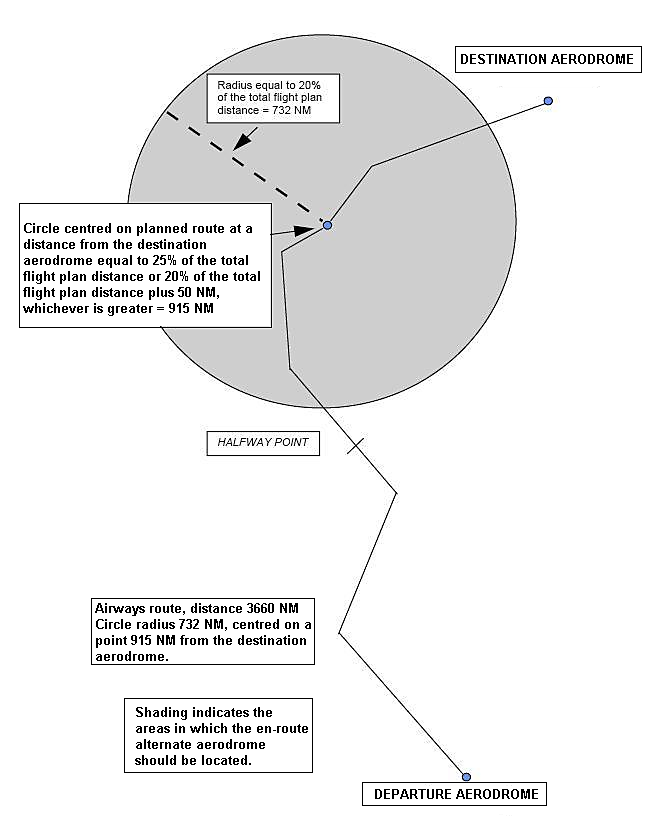
The fuel en route alternate (fuel ERA) aerodrome should be located within a circle with a radius equal to 20 % of the total flight plan distance; the centre of this circle lies on the planned route at a distance from the destination aerodrome equal to 25 % of the total flight plan distance, or at least 20 % of the total flight plan distance plus 50 NM, whichever is greater. All distances should be calculated in stillair conditions (see Figure 1). The fuel ERA aerodrome should be nominated in the operational flight plan.
Figure 1 — Location of the fuel ERA aerodrome to reduce contingency fuel to 3 %
AMC8 CAT.OP.MPA.181 Fuel/energy scheme — fuel/energy planning and in-flight re-planning policy — aeroplanes
ED Decision 2022/005/R
INDIVIDUAL FUEL SCHEME — FUEL CONSUMPTION MONITORING SYSTEM
A fuel consumption monitoring system should be data driven, and should include the following:
(a)a fuel performance monitoring system;
(b)a database that contains statistically significant data of at least 2 years;
(c)statistics and data normalisation; and
(d)data transparency and verification.
GM1 CAT.OP.MPA.181 Fuel/energy scheme — fuel/energy planning and in-flight re-planning policy — aeroplanes
ED Decision 2022/005/R
BASIC FUEL SCHEME
TAXI FUEL — LOCAL CONDITIONS
(a)Local conditions, as referred to in point (a) of AMC1 CAT.OP.MPA.181, include NOTAMs, meteorological conditions (e.g. winter operations), ATS procedures (e.g. LVP, collaborative decision-making (CDM)), and any anticipated delay(s).
PLANNING OF FLIGHTS
(b)A flight should be planned by using the most accurate information available. If aircraft-specific data that is derived from a fuel consumption monitoring system is available, this data is used in preference to data that is provided by the aircraft manufacturer. Data that is provided by the aircraft manufacturer should be used only in specific cases, e.g. when introducing a new aircraft type into service.
FUEL CONSUMPTION MONITORING SYSTEM
(c)Extensive guidance on a fuel consumption monitoring system is provided in ICAO Doc 9976 Flight Planning and Fuel Management (FPFM) Manual, Appendix 5 to Chapter 5 Example of a fuel consumption monitoring (FCM) programme (1st Edition, 2015). As a basic requirement, the fuel consumption monitoring system (commonly referred to as ‘hull-specific fuel bias’) is a process of comparing an aeroplane’s achieved in-flight performance to an aeroplane’s predicted performance. Variations between the achieved performance and the predicted performance result in a variation of the fuel consumption rate, which should be accounted for by the operator during flight planning and in-flight re-planning.
The fuel consumption monitoring system is used to determine an individual aeroplane’s performance in comparison with its predicted one. In no case, should data that is collected from one aeroplane be used as a basis for varying another aeroplane’s performance figures away from the predicted values.
The data that is collected and used to determine an aeroplane’s actual performance should be collected in a manner acceptable to the competent authority. The operator should demonstrate that the data collected during in-service operation of the aeroplane is accurate. Where possible, the data should be collected automatically; however, manual recording of data does not preclude an operator from participating in a fuel consumption monitoring system.
ANTICIPATED MASSES — LAST-MINUTE CHANGES
(d)Where appropriate, the operating procedures should include means to revise the fuel quantity and define limits to zero fuel weight (ZFW) changes, beyond which a new operational flight plan should be calculated.
TRIP FUEL — ARRIVAL ROUTING
(e)POINT MERGE PATTERN
When planning for a STAR to point merge, fuel for the direct STAR to the point merge should be included in the trip fuel. The fuel required to account for the probability that part of or the entire point merge route needs to be flown may be included in the contingency fuel unless there is an anticipated delay, in which case, the fuel required for the route should be included in the extra fuel.
(f)POINT TROMBONE PATTERN
When planning for a STAR or transition including a trombone pattern, fuel for the reasonably expected route should be included in the trip fuel. The fuel required to account for the probability that an extended part of or the entire trombone pattern route needs to be flown may be included in the contingency fuel unless there is an anticipated delay, in which case, the fuel required for the trombone pattern route should be included in the extra fuel.
UNFORESEEN FACTORS
(g)According to its definition, contingency fuel is the amount of fuel required to compensate for unforeseen factors.
Unforeseen factors are those that could have an influence on the fuel consumption to the destination aerodrome, such as deviations of an individual aeroplane from the expected fuel consumption data, deviations from forecast meteorological conditions, extended unexpected delays in flight, extended unexpected taxi times, and deviations from planned routings and/or cruising levels.
Unforeseen factors may differ based on the type of fuel scheme adopted by each operator; the higher the capability of the operator, the fewer unforeseen factors there may be.
For example, operators that have a fuel consumption monitoring system should calculate the trip fuel based on the individual fuel consumption. Extended unexpected delays or deviations from forecast meteorological conditions are mitigated by means of statistical data.
DESTINATION ALTERNATE AERODROME
(h)The departure aerodrome may be selected as the destination alternate aerodrome.
FINAL RESERVE FUEL
(i)The operator may determine conservative (rounded-up) FRF values for each type and variant of aeroplane that is used in operations. The intent of this recommendation is:
(1)to provide a reference value for comparing to pre-flight fuel planning computations, and for the purpose of a ‘gross error’ check; and
(2)to provide flight crews with easily referenced and recallable FRF figures to support inflight fuel monitoring and decision-making activities.
ANTICIPATED DELAYS
(j)In the context of fuel schemes, an anticipated delay is defined as one that can be predicted based on the information that is provided by the State of the aerodrome and/or ATS provider before the flight commences. For example, restrictions due to scheduled maintenance work on a runway are likely to cause a delay to the normal flow of inbound traffic. That delay may be promulgated either through NOTAMs or via the aeronautical information publication (AIP), including a specific time and/or date.
Another example is an ATS procedure that requires an operator to fly longer routes, e.g. due to curfew during night-time.
DISCRETIONARY FUEL
(k)Discretionary fuel is defined as ‘fuel at the sole discretion of the commander’ (PIC). The commander’s discretion over the amount of fuel to be carried is independent and cannot be encouraged or discouraged.
IN-FLIGHT RE-PLANNING
(l)In the context of fuel policy, in-flight re-planning means voluntarily changing the destination aerodrome, any alternate aerodrome, or the remainder of the route after the flight commences, even when the flight can be completed as originally planned. In-flight re-planning has a broader sense than being obliged to change the intended course of action due to safety issues (remaining fuel, failures, bad weather conditions, etc.). In-flight re-planning allows the operator to modify the filed flight plan after flight commencement for commercial or other reasons. However, the modified flight plan should fulfil all requirements of a new flight plan. The use of en route alternate (ERA) aerodromes to save fuel should comply with the in-flight re-planning requirements.
In-flight re-planning should not apply when the aircraft no longer continues via the flight plan route to the intended destination for reasons that could not be anticipated. In such cases, the in-flight fuel management policy dictates the commander’s course of action.
GM2 CAT.OP.MPA.181 Fuel/energy scheme — fuel/energy planning and in-flight re-planning policy — aeroplanes
ED Decision 2022/005/R
BASIC FUEL SCHEME WITH VARIATIONS — STATISTICAL CONTINGENCY FUEL METHOD
As an example of statistical contingency fuel, the following statistical values of the deviation from the planned to the actual trip fuel provide appropriate statistical coverage:
(a)99 % coverage plus 3 % of the trip fuel if the calculated flight time:
(1)is less than 2 hours; or
(2)is more than 2 hours and no fuel ERA aerodrome is available;
(b)99 % coverage if the calculated flight time is more than 2 hours and a fuel ERA aerodrome is available; and
(c)90 % coverage if:
(1)the calculated flight time is more than 2 hours;
(2)a fuel ERA aerodrome is available; and
(3)at the destination aerodrome, two separate runways are available and usable, one of which is suitable for type B instrument approach operations, and the meteorological conditions are in accordance with point CAT.OP.MPA.182(e).
GM3 CAT.OP.MPA.181 Fuel/energy scheme — fuel/energy planning and in-flight re-planning policy — aeroplanes
ED Decision 2022/005/R
INDIVIDUAL FUEL SCHEME — FUEL CONSUMPTION MONITORING SYSTEM
More information can be found in ICAO Doc 9976 Flight Planning and Fuel Management (FPFM) Manual, Appendix 5 to Chapter 5.
GM4 CAT.OP.MPA.181 Fuel/energy scheme — fuel/energy planning and in-flight re-planning policy — aeroplanes
ED Decision 2022/005/R
INDIVIDUAL FUEL SCHEME — ANTICIPATED METEOROLOGICAL CONDITIONS
When determining the extent of the deviation in the area of operation, the operator should monitor the reliability of the meteorological forecast reports. The competent authority should consider restricting or even not allowing a deviation when reliable meteorological information is not available. To this end, tools to predict and improve the reliability of the meteorological forecast reports may be explored to allow for the intended deviation.
CAT.OP.MPA.182 Fuel/energy scheme – aerodrome selection policy – aeroplanes
Regulation (EU) 2021/1296
(a)At the planning stage, the operator shall ensure that once the flight has commenced, there is reasonable certainty that an aerodrome where a safe landing can be made will be available at the estimated time of use of that aerodrome.
(b)At the planning stage, to allow for a safe landing in case of an abnormal or emergency situation after take-off, the operator shall select and specify in the operational flight plan a take-off alternate aerodrome if either:
(1)the meteorological conditions at the aerodrome of departure are below the operator’s established aerodrome landing minima for that operation; or
(2)it would be impossible to return to the aerodrome of departure for other reasons.
(c)The take-off alternate aerodrome shall be located within a distance from the departure aerodrome that minimises the risk of exposure to potential abnormal or emergency situations. In selecting the take-off alternate aerodrome, the operator shall consider at least the following:
(1)actual and forecast meteorological conditions;
(2)availability and quality of the aerodrome infrastructure;
(3)navigation and landing capabilities of the aircraft in abnormal or emergency conditions, taking into account the redundancy of critical systems; and
(4)approvals held (e.g. extended range operations with two-engined aeroplanes (ETOPS), low visibility operation (LVO), etc.).
(d)At the planning stage, for each instrument flight rules (IFR) flight, the operator shall select and specify in the operational and air traffic services (ATS) flight plans one or more aerodromes so that two safe-landing options are available during normal operation when:
(1)reaching the destination aerodrome; or
(2)reaching the point of no return, to any available fuel/energy ERA aerodrome during isolated aerodrome operations; a flight to an isolated aerodrome shall not be continued past the point of no return unless a current assessment of meteorological conditions, traffic, and other operational conditions indicates that a safe landing can be made at the destination aerodrome at the estimated time of use.
The operator shall obtain prior approval from the competent authority for the use of an isolated aerodrome as destination aerodrome.
(e)The operator shall provide appropriate safety margins to flight planning to take into account a possible deterioration of the available forecast meteorological conditions at the estimated time of landing.
(f)For each IFR flight, the operator shall ensure that sufficient means are available to navigate to and land at the destination aerodrome or at any destination alternate aerodrome in the event of loss of capability for the intended approach and landing operation.
AMC1 CAT.OP.MPA.182 Fuel/energy scheme — aerodrome selection policy — aeroplanes
ED Decision 2022/005/R
BASIC FUEL SCHEME — TAKE-OFF ALTERNATE AERODROME
The take-off alternate aerodrome should not be farther from the departure aerodrome than:
(a)for two-engined aeroplanes:
(1)1-hour flight time at an one-engine-inoperative (OEI) cruising speed according to the AFM in ISA and still-air conditions using the actual take-off mass; or
(2)the extended-range twin operations (ETOPS) diversion time that is approved in accordance with Subpart F of Annex V (Part-SPA) to Regulation (EU) No 965/2012, subject to any minimum equipment list (MEL) restriction, up to a maximum of 2-hour flight time at OEI cruising speed according to the AFM in ISA and still-air conditions using the actual take-off mass; and
(b)for three- or four-engined aeroplanes, 2-hour flight time at an all-engines-operating cruising speed according to the AFM in ISA and still-air conditions using the actual take-off mass;
(c)for operations approved in accordance with Annex V (Part-SPA), Subpart L SINGLE-ENGINED TURBINE AEROPLANE OPERATIONS AT NIGHT OR IN IMC (SET-IMC), 30 minutes flying time at normal cruising speed in still-air conditions, based on the actual take-off mass;
(d)in the case of multi-engined aeroplanes, if the AFM does not contain an OEI cruising speed, the speed to be used for calculation shall be that which is achieved with the remaining engine(s) set at maximum continuous power.
AMC2 CAT.OP.MPA.182 Fuel/energy scheme — aerodrome selection policy — aeroplanes
ED Decision 2023/007/R
BASIC FUEL SCHEME — DESTINATION ALTERNATE AERODROME
(a)For each IFR flight, the operator should select and specify in the operational and ATS flight plans at least one destination alternate aerodrome.
(b)For each IFR flight, the operator should select and specify in the operational and ATS flight plans two destination alternate aerodromes when for the selected destination aerodrome, the safety margins for meteorological conditions of AMC5 CAT.OP.MPA.182, and the planning minima of AMC6 CAT.OP.MPA.182 cannot be met, or when no meteorological information is available.
BASIC FUEL SCHEME WITH VARIATIONS — NO DESTINATION ALTERNATE AERODROME
(c)The operator may operate with no destination alternate aerodrome when the destination aerodrome is an isolated aerodrome or when the following two conditions are met:
(1)the duration of the planned flight from take-off to landing does not exceed 6 hours or, in the event of in-flight re-planning, in accordance with point CAT.OP.MPA.181(d), the remaining flying time to destination does not exceed 4 hours; and
(2)two separate runways are usable at the destination aerodrome and the appropriate weather reports and/or weather forecasts indicate that for the period from 1 hour before to 1 hour after the expected time of arrival, the ceiling is at least 2 000 ft (600 m) or the circling height + 500 ft (150 m), whichever is greater, and ground visibility is at least 5 km.
AMC3 CAT.OP.MPA.182 Fuel/energy scheme — aerodrome selection policy — aeroplanes
ED Decision 2022/005/R
BASIC FUEL SCHEME — AERODROME FORECAST METEOROLOGICAL CONDITIONS
Table 1 — Aerodrome forecasts (TAFs) and landing forecasts (TRENDs) to be used for pre-flight planning
APPLICATION OF AERODROME FORECASTS (TAF AND TREND) TO PRE-FLIGHT PLANNING | ||||||||
(a)APPLICATION OF INITIAL PART OF TAF (1)Application period: from the start of the TAF validity period to the time of applicability of the first subsequent ‘FM…*’ or ‘BECMG’, or if no ‘FM…’ or ‘BECMG’ is given, to the end of the validity period of the TAF. (2)Application of forecast: the forecast of the prevailing weather conditions in the initial part of the TAF should be fully applied, with the exception of mean wind and gusts that should be applied in accordance with the policy under column ‘BECMG AT and FM…’ in the table below. However, this may be temporarily superseded by a ‘TEMPO’ or ‘PROB**’, if applicable according to the table below. | ||||||||
(b)APPLICATION OF FORECAST FOLLOWING CHANGE INDICATION IN THE TAF AND TREND | ||||||||
TAF or TREND for AERODROME PLANNED AS: | FM… (alone) and BECMG AT: | BECMG (alone), BECMG FM, BECMG TL, BECMG FM… TL, in case of: | TEMPO (alone), TEMPO FM, TEMPO FM… TL, PROB 30/40 (alone) | PROB TEMPO | ||||
Deterioration and improvement | Deterioration | Improvement | Deterioration | Improvement | Deterioration and improvement | |||
Transient/shower conditions in connection with shortlived weather phenomena, e.g. thunderstorms, showers | Persistent conditions in connection with e.g. haze, mist, fog, dust storm/sandstorm, continuous precipitations | In any case | ||||||
DESTINATION at ESTIMATED TIME OF ARRIVAL (ETA) ± 1 HR TAKE-OFF ALTERNATE at ETA ± 1 HR DESTINATION ALTERNATE at ETA ± 1 HR FUEL ERA at ETA ± 1 HR | Applicable from the start of change Mean wind should be within required limits Gusts exceeding crosswind limits should be fully applied | Applicable from the start of change Mean wind should be within required limits Gusts exceeding crosswind limits should be fully applied | Applicable from the end of change Mean wind should be within required limits Gusts exceeding crosswind limits should be fully applied | Not applicable Mean wind and gusts exceeding required limits may be disregarded | Applicable | Should be disregarded | Deterioration may be disregarded. Improvement should be disregarded including mean wind and gusts. | |
Mean wind should be within required limits | ||||||||
Gusts exceeding crosswind limits should be fully applied | ||||||||
ETOPS ERA From earliest ETA to ETA + 1 HR | Applicable from the start of | Applicable from the start of change | Applicable from the end of change | Applicable if below applicable landing minima | Applicable if below applicable landing minima | |||
Mean wind should be within required limits | Mean wind should be within required limits | Mean wind should be within required limits | Mean wind should be within required limits | Mean wind should be within required limits | ||||
Gusts exceeding crosswind limits should be fully applied | Gusts exceeding crosswind limits should be fully applied | Gusts exceeding crosswind limits should be fully applied | Gusts exceeding crosswind limits should be fully applied | Gusts exceeding crosswind limits should be fully applied | ||||
*The space following ‘FM’ should always include a time group, e.g. FM1030. Note 1:‘required limits’ are those contained in the OM. Note 2:if promulgated aerodrome forecasts do not comply with the provisions of ICAO Annex 3, operators should ensure that guidance on the application of these reports is provided. Note 3:for the definitions of the meteorological terms used in this table, see ICAO Annex 3. | ||||||||
AMC4 CAT.OP.MPA.182 Fuel/energy scheme — aerodrome selection policy — aeroplanes
ED Decision 2022/005/R
BASIC FUEL SCHEME — REACHING THE DESTINATION AERODROME
In the context of the basic fuel scheme and basic fuel scheme with variations, ‘reaching the destination’ means the point at which the aircraft has reached the applicable DA/H or MDA/H at the destination aerodrome.
AMC5 CAT.OP.MPA.182 Fuel/energy scheme — aerodrome selection policy — aeroplanes
ED Decision 2022/005/R
BASIC FUEL SCHEME — SAFETY MARGINS FOR METEOROLOGICAL CONDITIONS
(a)The operator should only select an aerodrome as:
(1)take-off alternate aerodrome; or
(2)destination aerodrome
when the appropriate weather reports and/or forecasts indicate that during a period commencing 1 hour before and ending 1 hour after the estimated time of arrival at the aerodrome, the weather conditions will be at or above the applicable landing minima as follows:
(i)RVR or VIS specified in accordance with point CAT.OP.MPA.110; and
(ii)for a type A or a circling operation, ceiling at or above MDH.
(b)The operator should only select an aerodrome as:
(1)destination alternate aerodrome;
(2)fuel ERA aerodrome; or
(3)isolated destination aerodrome
when the appropriate weather reports and/or forecasts indicate that during a period commencing 1 hour before and ending 1 hour after the estimated time of arrival at the aerodrome, the weather conditions will be at or above the planning minima.
(c)For the take-off alternate aerodrome and isolated destination aerodrome, any limitations related to OEI operations should be taken into account.
AMC6 CAT.OP.MPA.182 Fuel/energy scheme — aerodrome selection policy — aeroplanes
ED Decision 2022/005/R
BASIC FUEL SCHEME— PLANNING MINIMA
The operator should select an aerodrome as:
(a)destination alternate aerodrome;
(b)fuel ERA aerodrome; or
(c)isolated destination aerodrome
only when the appropriate weather reports and/or forecasts indicate that the weather conditions will be at or above the planning minima of Table 2 below (any limitations related to OEI operations are also taken into account):
Table 2 — Basic fuel scheme — planning minima — aeroplanes
Destination alternate aerodrome, fuel ERA aerodrome, isolated destination aerodrome
Type of approach operation | Aerodrome ceiling (cloud base or vertical visibility) | RVR/VIS |
Type B instrument approach operations | DA/H + 200 ft | RVR/VIS + 800 m |
Type A instrument approach operations | DA/H or MDA/H + 400 ft | RVR/VIS + 1 500 m |
Circling approach operations | MDA/H + 400 ft | VIS + 1 500 m |
Crosswind planning minima: see Table 1 of AMC3 CAT.OP.MPA.182 | ||
Wind limitations should be applied taking into account the runway condition (dry, wet, contaminated). | ||
AMC7 CAT.OP.MPA.182 Fuel/energy scheme — aerodrome selection policy — aeroplanes
ED Decision 2022/005/R
BASIC FUEL SCHEMES WITH VARIATIONS — ISOLATED AERODROME — POINT OF NO RETURN
(a)Unless destination alternate fuel is carried, the operator should use a destination aerodrome as an isolated aerodrome if the alternate fuel plus the FRF that is required to reach the nearest adequate destination alternate aerodrome is more than:
(1)for aeroplanes with reciprocating engines, the amount of fuel required to fly either for 45 minutes plus 15 % of the flying time planned for cruising, including FRF or for 2 hours, whichever is less; or
(2)for turbine-engined aeroplanes, the amount of fuel required to fly for 2 hours with normal cruise consumption above the destination aerodrome, including the FRF.
(b)If the operator’s fuel planning policy includes an isolated aerodrome, a PNR should be determined by a computerised flight-planning system and specified in the operational flight plan. The required usable fuel for pre-flight calculation should be as indicated in points (b)(1) or (b)(2), whichever is greater:
(1)the sum of:
(i)taxi fuel;
(ii)trip fuel from the departure aerodrome to the isolated aerodrome via the PNR;
(iii)contingency fuel that is calculated in accordance with the operator’s current fuel scheme;
(iv)additional fuel, if required, but not less than:
(A)for aeroplanes with reciprocating engines, the fuel to fly either for 45 minutes plus 15 % of the flight time planned for cruising or for 2 hours, whichever is less; or
(B)for turbine-engined aeroplanes, the fuel to fly for 2 hours with normal cruise consumption above the destination aerodrome, including the FRF;
(v)extra fuel if there are anticipated delays or specific operational constraints; and
(vi)discretionary fuel, if required by the commander; or
(2)the sum of:
(i)taxi fuel;
(ii)trip fuel from the departure aerodrome to the fuel ERA PNR aerodrome via the PNR;
(iii)contingency fuel that is calculated in accordance with the operator’s current fuel scheme;
(iv)additional fuel, if required, but not less than:
(A)for aeroplanes with reciprocating engines, fuel to fly for 45 minutes; or
(B)for turbine-engined aeroplanes, fuel to fly for 30 minutes at holding speed at 1 500 ft (450 m) above the fuel ERA aerodrome elevation in standard conditions, which should not be less than the FRF;
(v)extra fuel if there are anticipated delays or specific operational constraints; and
(vi)discretionary fuel, if required by the commander.
AMC8 CAT.OP.MPA.182 Fuel/energy scheme — aerodrome selection policy — aeroplanes
ED Decision 2023/007/R
BASIC FUEL SCHEME WITH VARIATIONS — PLANNING MINIMA
(a)Variations to the basic fuel schemes in the selection of aerodromes in regard to the planning minima are methods to reduce the meteorological margins based on the established mitigating measures.
(b)As a minimum, the operator should:
(1)use a suitable computerised flight-planning system; and
(2)have established an operational control system that includes flight monitoring.
(c)In addition:
(1)the duration of the planned flight from take-off to landing does not exceed 6 hours or, in the event of in-flight re-planning, in accordance with point CAT.OP.MPA.181(d), the remaining flying time to destination does not exceed 4 hours; and
(2)the planned flight should have a minimum flight crew of two pilots.
(d)Additionally, the operator should select an aerodrome as:
(1)a destination alternate aerodrome, or
(2)a fuel ERA aerodrome,
only when the appropriate weather reports and/or forecasts indicate that the weather conditions will be at or above the planning minima of Table 3 below.
Table 3 — Basic fuel scheme with variations — planning minima — aeroplanes
Destination alternate aerodrome, fuel ERA aerodrome
Row | Type of approach operation | Aerodrome ceiling (cloud base or vertical visibility) | RVR/VIS |
1 | Type B instrument approach operations | DA/H + 200 ft | RVR/VIS + 550 m |
2 | 3D Type A instrument approach operations, based on a facility with a system minimum of 200 ft or less | DA/H+ 200 ft | RVR/VIS+ 800 m |
3 | Two or more usable type A instrument approach operations***, each based on a separate navigation aid | DA/H or MDA/H* + 200 ft | RVR/VIS** + 1 000 m |
4 | Other type A instrument approach operations | DA/H or MDA/H + 400 ft | RVR/VIS + 1 500 m |
5 | Circling approach operations | MDA/H + 400 ft | VIS + 1 500 m |
Crosswind planning minima: see Table 1 of AMC3 CAT.OP.MPA.182 | |||
Wind limitations should be applied taking into account the runway condition (dry, wet, contaminated). | |||
*The higher of the usable DA/H or MDA/H.
**The higher of the usable RVR or VIS.
***Compliance with point CAT.OP.MPA.182(f) should be ensured.
Note: The operator may select the most convenient planning minima row. For example, aerodrome with two type A approaches: one ILS CAT I (DA 350 ft/DH250 ft/550 m) another VOR/DME (MDA 650 ft/1 500 m). The operator may use Row 2 instead of Row 3.
AMC9 CAT.OP.MPA.182 Fuel/energy scheme — aerodrome selection policy — aeroplanes
ED Decision 2023/007/R
BASIC FUEL SCHEME WITH VARIATIONS — PLANNING MINIMA
(a)Variations to the basic fuel schemes in the selection of aerodromes in regard to the planning minima are methods to reduce the meteorological margins based on the established mitigating measures.
(b)As a minimum, the operator should:
(1)use a suitable computerised flight-planning system;
(2)hold an approval for low-visibility approach operations for that fleet; and
(3)have established an operational control system that includes flight monitoring.
(c)Additionally, the operator should select an aerodrome as:
(1)destination alternate aerodrome;
(2)fuel ERA aerodrome; or
(3)isolated destination aerodrome
only when the appropriate weather reports and/or forecasts indicate that the weather conditions will be at or above the planning minima of Table 4 below.
Table 4 — Basic fuel scheme with variations — planning minima
Destination alternate aerodrome, fuel ERA aerodrome, isolated destination aerodrome
Row | Type of approach | Aerodrome ceiling (cloud base or vertical VIS) | RVR/VIS |
1 | Two or more usable type B instrument approach operations to two separate runways*** | DA/H* + 100 ft | RVR** + 300 m |
2 | One usable type B instrument approach operation | DA/H + 150 ft | RVR + 450 m |
3 | 3D Type A instrument approach operations, based on a facility with a system minimum of 200 ft or less | DA/H + 200 ft | RVR/VIS + 800 m |
4 | Two or more usable type A instrument approach operations ***, each based on a separate navigation aid | DA/H or MDA/H* + 200 ft | RVR/VIS** + 1 000 m |
5 | One usable type A instrument approach operation | DA/H or MDA/H + 400 ft | RVR/VIS + 1 500 m |
6 | Circling approach operations | MDA/H + 400 ft | VIS + 1 500 m |
Crosswind planning minima: see Table 1 of AMC3 CAT.OP.MPA.182 | |||
Wind limitations should be applied taking into account the runway condition (dry, wet, contaminated). | |||
*The higher of the usable DA/H or MDA/H.
**The higher of the usable RVR or VIS.
***Compliance with point CAT.OP.MPA.182(f) should be ensured.
Note: The operator may select the most convenient planning minima row. For example, aerodrome with two type B approaches: one CAT3 (0 ft/75 m) another CAT1 (200 ft/550 m). The operator may use Row 2 and use CAT3 (0 + 150 ft/75 + 450 m) instead of Row 1 CAT1 (200 + 100 ft/550 + 300 m).
GM1 CAT.OP.MPA.182 Fuel/energy scheme — aerodrome selection policy — aeroplanes
ED Decision 2022/005/R
BASIC FUEL SCHEME
SAFE-LANDING OPTIONS
(a)Point CAT.OP.MPA.182 sets out the safety objectives of the selection of aerodromes policy. This GM expands on the intent of that provision.
ONE SAFE-LANDING OPTION
(b)Point CAT.OP.MPA.182(a) requires the fuel planning and in-flight re-planning policy to ensure that the aircraft can always proceed to at least one aerodrome where landing is possible, even in abnormal operational conditions. This may require additional fuel (point CAT.OP.MPA.181(c)(6)) to reach an en route alternate (ERA) aerodrome in case of engine or pressurisation failure.
ONE OR MORE AERODROMES
(c)Point CAT.OP.MPA.182(d) requires the operator to select one or more aerodromes at the planning stage; the operator may select only one aerodrome, i.e. the destination aerodrome, in compliance with point CAT.OP.MPA.181(c)(4)(ii).
TWO SAFE-LANDING OPTIONS
(d)Point CAT.OP.MPA.182(d) requires that when planning the flight, two safe-landing options are expected to remain available until the flight reaches its destination, where a decision will be made to commit to land or divert. This will typically be a runway at the destination aerodrome itself and a runway at a destination alternate aerodrome.
The requirement may also be satisfied by two landing runways at the destination aerodrome, provided that the risk of a single event (such as an aircraft accident) or meteorological deterioration at that single aerodrome will not eliminate both options.
(e)Point CAT.OP.MPA.182(d) may also be satisfied by two destination alternate aerodromes when the destination aerodrome is not a weather-permissible aerodrome or when there is insufficient weather information at the time of planning.
(f)In the case of an isolated aerodrome, only one safe-landing option exists beyond the point of no return (PNR), therefore, an exception is set out in point CAT.OP.MPA.182(d)(2), where the conditions to proceed beyond the PNR are laid down, and further explained in AMC7 CAT.OP.MPA.182 and in point (b) of AMC2 CAT.OP.MPA.185(a).
SAFETY MARGINS
(f)Point CAT.OP.MPA.182(e) requires operators to apply safety margins to the aerodrome operating minima to mitigate the risk that the destination alternate aerodromes, isolated aerodromes, or fuel ERA aerodromes fall below aerodrome operating minima due to minor unforeseen weather deteriorations.
GM2 CAT.OP.MPA.182 Fuel/energy scheme — aerodrome selection policy — aeroplanes
ED Decision 2022/005/R
BASIC FUEL SCHEME WITH VARIATIONS — NORMAL CRUISE CONSUMPTION
In the context of AMC7 CAT.OP.MPA.182 on isolated aerodromes, normal cruise consumption is the consumption of fuel for 2 hours above the isolated aerodrome. These two hours include 30-minute FRF, leaving enough fuel for an approximately 90-minute hold over the destination.
More information is provided in ICAO Doc 9976 Flight Planning and Fuel Management (FPFM) Manual (1st Edition, 2015).
GM3 CAT.OP.MPA.182 Fuel/energy scheme — aerodrome selection policy — aeroplanes
ED Decision 2022/005/R
BASIC FUEL SCHEME WITH VARIATIONS — FACILITIES WITH A SYSTEM MINIMUM OF 200 FT OR LESS
(a)Table 3 in AMC8 CAT.OP.MPA.182 and Table 4 in AMC9 CAT.OP.MPA.182 refer to type A instrument approach operations based on a facility with a system minimum of 200 ft or less. Such facilities include ILS/MLS, GBAS landing system (GLS) and GNSS/SBAS (LPV). The system minima for various facilities are contained in AMC3 CAT.OP.MPA.110, Table 3.
(b)In regard to system minima and type of instrument approach operation (type A or B), the following should be noted:
(1)System minimum is the lowest height to which a facility can be used without visual references. This value is not related to a particular runway or obstacle environment.
(2)The type of instrument approach operations is related to each individual runway with its obstacle environment.
(c)Amongst other things the lowest DH for an instrument approach operation is determined by the system minima for the facility and the obstacle clearance height (OCH). The resulting DH determines the type of approach operation (type A or B). If the DH is 250 ft or more, it will be a type A approach operation; if the DH is less than 250 ft, it will be a type B approach operation. So, while ILS approaches to most runways may be conducted as type B approach operations, difficult obstacle situations, driving up the DH to 250 ft or higher, will result in type A approach operations.
(d)For example, Row 2 of Table 3 in AMC8 CAT.OP.MPA.182 refers to a case where the obstacle situation and associated OCH result in a DH of 250 ft or more, even though the facility involved supports a DH of 200 ft or less.
(e)This GM refers only to DH (not MDH) since facilities with a system minimum of 200 ft or less are only operated with a DH (or DA), not an MDH.
GM4 CAT.OP.MPA.182 Fuel/energy scheme — aerodrome selection policy — aeroplanes
ED Decision 2022/005/R
FUEL SCHEMES — PLANNING MINIMA — INSTRUMENT APPROACH OPERATIONS
An instrument approach operation is considered usable for planning minima (e.g. Tables 2, 3 and 4 in AMC6 CAT.OP.MPA.182, AMC8 CAT.OP.MPA.182 and AMC9 CAT.OP.MPA.182 respectively) when the approach facilities are available, the aircraft is equipped to perform such an approach, the flight crew is accordingly trained, and the runway is available for landing.
GM1 CAT.OP.MPA.182(d)(1) Fuel/energy scheme — aerodrome selection policy — aeroplanes
ED Decision 2022/005/R
INDIVIDUAL FUEL SCHEME — REACHING THE DESTINATION AERODROME
In the context of individual fuel schemes, ‘reaching the destination’ means being as close as possible to the destination, but not necessarily overhead the destination, and no farther than IAF of the planned instrument approach procedure for the destination aerodrome.
AMC1 CAT.OP.MPA.182(f) Fuel/energy scheme — aerodrome selection policy — aeroplanes
ED Decision 2022/012/R
BASIC FUEL SCHEME — DESTINATION AERODROMES — PBN OPERATIONS
(a)To comply with point CAT.OP.MPA.182(f), when the operator intends to use PBN, the operator should select an aerodrome as destination alternate aerodrome only if an instrument approach procedure that does not rely on a GNSS is available either at that aerodrome or at the destination aerodrome.
BASIC FUEL SCHEME — DESTINATION AERODROMES — OPERATIONAL CREDITS
(b)To comply with point CAT.OP.MPA.182(f), when the operator intends to use ‘operational credits’ (e.g. EFVS, SA CAT I, etc.), the operator should select an aerodrome as destination alternate aerodrome only if an approach procedure that does not rely on the same ‘operational credit’ is available either at that aerodrome or at the destination aerodrome.
GM1 CAT.OP.MPA.182(f) Fuel/energy scheme — aerodrome selection policy — aeroplanes
ED Decision 2022/005/R
BASIC FUEL SCHEME — DESTINATION AERODROMES — PBN OPERATIONS
(a)Point (a) of AMC1 CAT.OP.MPA.182(f) applies only to destination alternate aerodromes in flights that require a destination alternate aerodrome. A take-off or an ERA aerodrome with instrument approach procedures that rely on a GNSS may be planned without restrictions. A destination aerodrome with all instrument approach procedures that rely solely on a GNSS may be used without a destination alternate aerodrome if the conditions for a flight without a destination alternate aerodrome are met.
(b)The term ‘sufficient means are available to navigate to and land at’ means that the procedure can be used in the planning stage and should comply with planning minima requirements.
CAT.OP.MPA.185 Fuel/energy scheme – in-flight fuel/energy management policy – aeroplanes
Regulation (EU) 2021/1296
(a)The operator shall establish procedures for in-flight fuel/energy management that ensure:
(1)continual validation of the assumptions made during the planning stage (pre-flight or inflight re-planning, or both);
(2)re-analysis and adjustment, if necessary;
(3)that the amount of usable fuel/energy remaining on board is protected and not less than the fuel/energy that is required to proceed to an aerodrome where a safe landing can be made; and
(4)relevant fuel/energy data for the purpose of points (1), (2), and (3) shall be recorded.
(b)The operator shall have procedures in place to require the commander to obtain delay information from a reliable source when unforeseen circumstances may result in landing at the destination aerodrome with less than the final reserve fuel/energy plus any:
(1)fuel/energy to proceed to an alternate aerodrome, if required; or
(2)fuel/energy required to proceed to an isolated aerodrome.
(c)The commander shall advise air traffic control (ATC) of a ‘minimum fuel/energy’ state by declaring ‘MINIMUM FUEL’ when the commander has:
(1)committed to land at a specific aerodrome; and
(2)calculated that any change to the existing clearance to that aerodrome may result in landing with less than the planned final reserve fuel/energy.
(d)The commander shall declare a situation of ‘fuel/energy emergency’ by broadcasting ‘MAYDAY MAYDAY MAYDAY FUEL’ when the usable fuel/energy that is calculated to be available upon landing at the nearest aerodrome where a safe landing can be made is less than the planned final reserve fuel/energy.
GM1 CAT.OP.MPA.185 Fuel/energy scheme — in-flight fuel/energy management policy — aeroplanes
ED Decision 2023/007/R
BASIC FUEL SCHEME
RELEVANT FUEL DATA TO BE RECORDED
(a)The operator may decide at which regular intervals the relevant fuel data should be recorded.
An example of such intervals could be every 30 minutes for short-range flights and every 60 minutes for longer flights.
(b)The operator should record at least the following relevant fuel-related data:
(1)off-block fuel;
(2)take-off fuel if this data can be recorded automatically;
(3)‘MINIMUM FUEL’ declarations;
(4)‘MAYDAY MAYDAY MAYDAY FUEL’ declarations;
(5)fuel after touchdown if this data can be recorded automatically; and
(6)on-block fuel.
When an aircraft communications addressing and reporting system (ACARS) is available, the pilot does not need to be the one recording this data.
RELIABLE SOURCE TO OBTAIN DELAY INFORMATION
(c)A reliable source to obtain delay information may be derived from data provided by an air navigation services provider (ANSP) and should have the following characteristics ranked in order of priority:
(1)integrity: provide timely warnings to users when the delay information should not be used;
(2)availability: the time during which the delay information is accessible to the crew;
(3)accuracy: the degree of conformity between the estimated delay and the true delay; the delay information should be communicated with its corresponding gap error, e.g. delay of 15 ± 2 minutes; the gap error should be added to the base value; and
(4)continuity: the capability of the service to provide the delay information without unscheduled interruptions during the intended operation.
‘MINIMUM FUEL’ DECLARATION
(d)The ‘MINIMUM FUEL’ declaration informs the ATC that all planned aerodrome options have been reduced to a specific aerodrome of intended landing. It also informs the ATC that any change to the existing clearance may result in landing with less than the planned FRF. This is not an emergency situation but an indication that an emergency situation is possible, should any additional delay occur.
(e)When committed to land at a specific aerodrome, the commander should take into account any operational factor that may cause a delay to landing, and thus determine whether the aircraft will land with less than the planned FRF, even after receiving clearance from ATC. A change that may cause a delay to landing could be other than the ATC, e.g. a change of weather conditions, etc. If any such factor is likely to result in landing with less than the planned FRF, the commander should declare ‘MINIMUM FUEL’ to ATC.
(f)The pilot should not expect any form of priority handling as a result of a ‘MINIMUM FUEL’ declaration. However, the ATC should advise the flight crew of any additional expected delays, as well as coordinate with other ATC units when transferring the control of the aeroplane, to ensure that the other ATC units are aware of the flight’s fuel state.
(g)Example 1: The aircraft is on the final approach to the destination aerodrome with a single runway, with just the destination alternate fuel plus FRF available. The aircraft ahead has a tyre burst upon landing and has stopped on the runway. The ATC orders the aircraft on final approach to execute a go-around as the destination aerodrome is closed due to a blocked runway. After completing the go-around, the flight crew decides to divert to the destination alternate aerodrome. After the ATC gives clearance for the destination alternate aerodrome and if the calculated fuel upon landing is close to the FRF, the flight crew should declare ‘MINIMUM FUEL’. The flight crew has now committed to land at the destination alternate aerodrome, and any change to the clearance may result in landing there with less than the planned FRF.
(h)Example 2: The aircraft is approaching the clearance limit point, which has a holding pattern operating at this point in time. The ATC gives the aircraft an expected arrival time that would result in a delay of 25 minutes, and the aircraft enters the holding zone. On receiving this information and prior to entering the holding pattern, the remaining fuel is 7-minute contingency fuel plus 25-minute destination alternate fuel plus 30-minute FRF. The weather conditions and aircraft serviceability are such that the flight crew can convert the destination alternate fuel into holding time over the destination aerodrome. When the remaining fuel no longer allows a diversion from the holding pattern, then the flight crew should declare ‘MINIMUM FUEL’. The flight crew has committed to land at the destination aerodrome, and any change to the clearance may result in landing with less than the planned FRF.
(i)Example 3: The aircraft reaches FL 350, which is the cruising flight level on its 5-hour flight. The weather forecast information that was obtained before departure was favourable and, therefore, the commander did not order any discretionary fuel. The destination alternate fuel is sufficient for 25-minute flight time and the destination alternate aerodrome is located beyond the destination aerodrome. For some reason (unexpected severe turbulence, cockpit window crack, etc.), the aircraft has to descend and continue the flight at FL 230, where fuel consumption is higher. In-flight fuel checks and fuel management now show that the destination aerodrome can still be reached but only if in-flight re-planning is done without the destination alternate aerodrome (the destination aerodrome has two runways and good weather, and it is less than 4-hour flight time away, thus meeting the conditions for not requiring an alternate aerodrome). By doing so, the aircraft will arrive at destination for a straight-in approach with exactly the FRF plus 15-minute flight time. During the next 3,5 hours, an ERA aerodrome is available, and the situation is under control. When approaching the destination, the aircraft has to commit to land at the destination aerodrome as there is no other destination alternate aerodrome within 15 minutes of reaching the destination aerodrome. The ATC now informs the pilots that there is a change of landing runway resulting in a 12-minute trip fuel increase. It is time to declare ‘MINIMUM FUEL’.
(j)Several scenarios illustrating circumstances that could lead to a ‘MINIMUM FUEL’ declaration are provided in ICAO Doc 9976 Flight Planning and Fuel Management (FPFM) Manual (1st Edition, 2015) and the EASA Fuel Manual.
ENSURING A SAFE LANDING — FINAL RESERVE FUEL PROTECTION
(k)The objective of the FRF protection is to ensure that a safe landing is made at any aerodrome when unforeseen circumstances may not allow to safely complete the flight, as originally planned.
The commander should always consider first planning a safe-landing option and estimating whether this landing can be performed with more than the FRF. When this estimation indicates that the FRF can no longer be protected, then a fuel emergency should be declared and any landing option explored (e.g. aerodromes not assessed by operators, military aerodromes, closed runways), including deviating from rules, operational procedures, and methods in the interest of safety (as per point CAT.GEN.MPA.105(b)). ICAO Doc 9976 and the EASA Fuel Manual provide further detailed guidance on the development of a comprehensive in-flight fuel management policy and related procedures.
Note: See Annex I (Definitions) to Regulation (EU) No 965/2012 for the definition of ‘safe landing’.
FURTHER GUIDANCE ON PROCEDURES FOR IN-FLIGHT FUEL MANAGEMENT
(l)ICAO Doc 9976 and the EASA Fuel Manual provide guidance on procedures for in-flight fuel management including reanalysis, adjustment, and/or re-planning considerations when a flight begins
AMC1 CAT.OP.MPA.185(a) Fuel/energy scheme — in-flight fuel/energy management policy — aeroplanes
ED Decision 2022/005/R
BASIC FUEL SCHEME — PROCEDURES FOR IN-FLIGHT FUEL MANAGEMENT
(a)In-flight fuel checks
(1)The operator should establish a procedure to ensure that in-flight fuel checks are carried out at regular intervals or at specified points indicated in the operational flight plan (one check at least every 60 minutes).
(2)The remaining usable fuel should be evaluated to:
(i)compare the actual consumption with the planned consumption;
(ii)check that the remaining usable fuel is sufficient to complete the flight, in accordance with point (b); and
(iii)determine the usable fuel that is expected to remain upon landing at the destination aerodrome.
(3)In relation to the recording of relevant data, the operator should:
(i)agree with the competent authority on what constitutes relevant data for the purpose of recoding;
(ii)use the relevant data as safety performance indicators (SPIs) of the current fuel scheme; and
(iii)ensure that the recorded data is stored for at least 2 years.
The operator should establish a procedure for the data to be de-identified to a level that ensures the implementation of a ‘just culture’.
(b)In-flight fuel management
(1)The flight should be conducted to ensure that the usable fuel expected to remain upon landing at the destination aerodrome is not less than:
(i)the required alternate fuel plus the FRF; or
(ii)the FRF if no alternate aerodrome is required.
(2)If an in-flight fuel check shows that the usable fuel expected to remain upon landing at the destination aerodrome is less than:
(i)the required alternate fuel plus the FRF, the commander should request delay information from the ATC, and take into account the prevailing traffic and operational conditions at the destination aerodrome, at the destination alternate aerodrome, and at any other adequate aerodrome, to decide whether to proceed to the destination aerodrome or to divert in order to perform a safe landing with not less than the FRF; or
(ii)the FRF, if no destination alternate aerodrome is required, the commander should take appropriate action and proceed to an aerodrome where a safe landing can be made with not less than the FRF.
(c)The use of fuel after flight commencement for objectives other than the ones originally intended during pre-flight planning should require reanalysis and, if applicable, adjustment of the planned operation.
AMC2 CAT.OP.MPA.185(a) Fuel/energy scheme — in-flight fuel/energy management policy — aeroplanes
ED Decision 2022/005/R
BASIC FUEL SCHEME WITH VARIATIONS — PROCEDURES FOR IN-FLIGHT FUEL MANAGEMENT
(a)In addition to AMC1 CAT.OP.MPA.185(a) and in the context of point (d) of AMC6 CAT.OP.MPA.181, if the RCF procedure is used on a flight to proceed to destination 1 aerodrome, the commander should ensure that the remaining usable fuel at the decision point is at least the total of the following:
(1)trip fuel from the decision point to destination 1 aerodrome;
(2)contingency fuel that is equal to 5 % of the trip fuel from the decision point to destination 1 aerodrome;
(3)destination 1 aerodrome alternate fuel if a destination 1 alternate aerodrome is required;
(4)additional fuel, if required; and
(5)FRF.
(b)In addition to AMC1 CAT.OP.MPA.185(a), on a flight to an isolated aerodrome, the commander should ensure that the remaining usable fuel at the actual PNR is at least the total of the following:
(1)trip fuel from the PNR to the destination isolated aerodrome;
(2)contingency fuel from the PNR to the destination isolated aerodrome; and
(3)the additional fuel required for isolated aerodromes, as described in AMC7 CAT.OP.MPA.182.
AMC3 CAT.OP.MPA.185(a) Fuel/energy scheme — in-flight fuel/energy management policy — aeroplanes
ED Decision 2022/005/R
INDIVIDUAL FUEL SCHEME — COMMITTING TO LAND AT A SPECIFIC AERODROME
The operator should provide relevant safety information to the commander before the commander decides to commit to land at a specific aerodrome.
CAT.OP.MPA.190 Fuel/energy scheme – helicopters
Regulation (EU) 2021/1296
(a)The operator shall establish, implement, and maintain a fuel/energy scheme that comprises:
(1)a fuel/energy planning and in-flight re-planning policy; and
(2)an in-flight fuel/energy management policy.
(b)The fuel/energy scheme shall:
(1)be appropriate for the type(s) of operation performed; and
(2)correspond to the capability of the operator to support its implementation.
(c)The fuel/energy scheme and any change to it shall require prior approval by the competent authority.
CAT.OP.MPA.191 Fuel/energy scheme – Fuel/energy planning and in-flight re-planning policy – helicopters
Regulation (EU) 2021/1296
(a)As part of the fuel/energy scheme, the operator shall establish a fuel/energy planning and inflight re-planning policy to ensure that the aircraft carries a sufficient amount of usable fuel/energy to safely complete the planned flight and to allow for deviations from the planned operation.
(b)The operator shall ensure that the fuel/energy planning of flights is based upon at least the following elements:
(1)procedures contained in the operations manual as well as:
(i)current aircraft-specific data derived from a fuel/energy consumption monitoring system; or
(ii)data provided by the aircraft manufacturer; and
(2)the operating conditions under which the flight is to be conducted including:
(i)aircraft fuel/energy consumption data;
(ii)anticipated masses;
(iii)anticipated meteorological conditions;
(iv)the effects of deferred maintenance items or of configuration deviations, or both; and
(v)procedures and restrictions introduced by air navigation service providers.
(c)The operator shall ensure that the pre-flight calculation of the usable fuel/energy that is required for a flight includes:
(1)taxi fuel/energy, which shall not be less than the amount expected to be used prior to take-off;
(2)trip fuel/energy;
(3)contingency fuel/energy;
(4)destination alternate fuel/energy if a destination alternate aerodrome is required;
(5)final reserve fuel/energy, which shall not be less than:
(i)if flying under visual flight rules (VFR) and navigating by day with reference to visual landmarks, 20-minute fuel/energy at best-range speed; or
(ii)if flying under VFR and navigating by means other than by reference to visual landmarks or at night, 30-minute fuel/energy at best-range speed; or
(iii)if flying under instrument flight rules (IFR), 30-minute fuel/energy at holding speed at 1 500 ft (450m) above the aerodrome elevation in standard conditions, calculated according to the helicopter estimated mass on arrival at the destination alternate aerodrome or at the destination aerodrome when no destination alternate aerodrome is required;
(6)extra fuel/energy, to take into account anticipated delays or specific operational constraints; and
(7)discretionary fuel/energy, if required by the commander.
(d)The operator shall ensure that if a flight has to proceed along a route or to a destination aerodrome other than the ones originally planned, in-flight re-planning procedures for calculating the required usable fuel/energy include:
(1)trip fuel/energy for the remainder of the flight;
(2)reserve fuel/energy consisting of:
(i)contingency fuel/energy;
(ii)alternate fuel/energy if a destination alternate aerodrome is required;
(iii)final reserve fuel/energy; and
(iv)additional fuel/energy, if required by the type of operation;
(3)extra fuel/energy, to take into account anticipated delays or specific operational constraints; and
(4)discretionary fuel/energy, if required by the commander.
(e)As an alternative to points (b) to (d), for helicopters with a maximum certified take-off mass (MCTOM) of 3 175 kg or less, flying by day and over routes navigated by reference to visual landmarks, or for local helicopter operations (LHO), the fuel/energy policy shall ensure that on completion of the flight, or series of flights, the final reserve fuel/energy is sufficient for:
(1)30-minute flying time at best-range speed; or
(2)20-minute flying time at best-range speed, if operating within an area providing continuous and suitable operating sites.
AMC1 CAT.OP.MPA.191(b)&(c) Fuel/energy scheme — fuel/energy planning and in-flight re-planning policy —helicopters
ED Decision 2022/005/R
PLANNING CRITERIA
(a)The pre-flight calculation of the required usable fuel to be carried on board should include the following:
(1)taxi fuel, which should take into account local conditions at the departure site and the APU consumption;
(2)trip fuel, which should include fuel:
(i)for take-off and climb from the departure site elevation to the initial cruising level/altitude, taking into account the expected departure routing;
(ii)from the top of climb to the top of descent, including any step climb/descent;
(iii)from the top of descent to the point where the approach procedure is initiated, taking into account the expected arrival procedure; and
(iv)for the approach and landing at the destination site;
(3)contingency fuel, which should be:
(i)for IFR flights, or for VFR flights in a hostile environment, 10 % of the planned trip fuel; or
(ii)for VFR flights in a non-hostile environment, 5 % of the planned trip fuel;
(4)alternate fuel, which should be:
(i)fuel for a missed approach from the applicable DA/H or MDA/H at the destination to the missed-approach altitude, taking into account the complete missed approach procedure;
(ii)fuel for climb from the missed approach altitude to the cruising level/altitude;
(iii)fuel for the cruise from the top of climb to the top of descent;
(iv)fuel for descent from the top of descent to the point where the approach is initiated, taking into account the expected arrival procedure;
(v)fuel for the approach and landing at the destination alternate that is selected in accordance with point CAT.OP.MPA.192; and
(vi)for helicopters operating to or from helidecks that are located in a hostile environment, 10 % of points (a)(4)(i) to (a)(4)(v);
(5)FRF;
(6)extra fuel if there are anticipated delays or specific operational constraints; and
(7)discretionary fuel, which should be at the sole discretion of the commander.
(b)Reduced contingency fuel (RCF) IFR procedure
If the operator’s fuel scheme includes pre-flight planning to a destination 1 aerodrome (commercial destination) with an RCF procedure using a decision point along the route and a destination 2 aerodrome (optional refuelling destination), the pre-flight calculation of the required usable fuel should be according to points (b)(1) or (b)(2), whichever is greater:
(1)the sum of:
(i)taxi fuel;
(ii)trip fuel to the destination 1 aerodrome via the decision point;
(iii)contingency fuel equal to not less than 10 % of the estimated fuel consumption from the decision point to the destination 1 aerodrome;
(iv)alternate fuel;
(v)FRF;
(vi)extra fuel if there are anticipated delays or specific operational constraints; and
(vii)discretionary fuel, which should be at the sole discretion of the commander; or
(2)the sum of:
(i)taxi fuel;
(ii)trip fuel to the destination 2 aerodrome via the decision point;
(iii)contingency fuel equal to not less than 10 % of the estimated fuel consumption from the decision point to the destination 2 aerodrome;
(iv)alternate fuel, if a destination 2 alternate aerodrome is required;
(v)FRF;
(vi)extra fuel if there are anticipated delays or specific operational constraints; and
(vii)discretionary fuel, which should be at the sole discretion of the commander.
(c)Isolated aerodrome IFR procedure
If the operator’s fuel policy includes planning to fly to an isolated aerodrome under IFR or under VFR over routes not navigated by reference to visual landmarks, for which a destination alternate does not exist, the pre-flight calculation of the required usable fuel should include:
(1)taxi fuel;
(2)trip fuel;
(3)contingency fuel calculated in accordance with point (a)(3);
(4)additional fuel to fly for 2 hours at holding speed, including FRF; and
(5)extra fuel if there are anticipated delays or specific operational constraints; and
(6)discretionary fuel, which should be at the sole discretion of the commander.
(d)Sufficient fuel should be carried at all times to ensure that following the failure of an engine that occurs at the most critical point along the route, the helicopter is able to:
(1)descend as necessary and proceed to an adequate aerodrome;
(2)hold for 15 minutes at 1 500 ft (450 m) above aerodrome elevation in standard conditions; and
(3)make an approach and land.