
Filters
AMC2 CAT.POL.MAB.100(b) Mass and balance, loading
ED Decision 2014/015/R
FLEET MASS AND CG POSITION — AEROPLANES
(a)For a group of aeroplanes of the same model and configuration, an average dry operating mass and CG position may be used as the fleet mass and CG position, provided that:
(1)the dry operating mass of an individual aeroplane does not differ by more than ±0.5 % of the maximum structural landing mass from the established dry operating fleet mass; or
(2)the CG position of an individual aeroplane does not differ by more than ±0.5 % of the mean aerodynamic chord from the established fleet CG.
(b)The operator should verify that, after an equipment or configuration change or after weighing, the aeroplane falls within the tolerances above.
(c)To add an aeroplane to a fleet operated with fleet values, the operator should verify by weighing or calculation that its actual values fall within the tolerances specified in (a)(1) and (2).
(d)To obtain fleet values, the operator should weigh, in the period between two fleet mass evaluations, a certain number of aeroplanes as specified in Table 1, where ‘n’ is the number of aeroplanes in the fleet using fleet values. Those aeroplanes in the fleet that have not been weighed for the longest time should be selected first.
Table 1
Minimum number of weighings to obtain fleet values
Number of aeroplanes in the fleet | Minimum number of weighings |
2 or 3 | n |
4 to 9 | (n + 3)/2 |
10 or more | (n + 51)/10 |
(e)The interval between two fleet mass evaluations should not exceed 48 months.
(f)The fleet values should be updated at least at the end of each fleet mass evaluation.
(g)Aeroplanes that have not been weighed since the last fleet mass evaluation may be kept in a fleet operated with fleet values, provided that the individual values are revised by calculation and stay within the tolerances above. If these individual values no longer fall within the tolerances, the operator should determine new fleet values or operate aeroplanes not falling within the limits with their individual values.
(h)If an individual aeroplane mass is within the dry operating fleet mass tolerance but its CG position exceeds the tolerance, the aeroplane may be operated under the applicable dry operating fleet mass but with an individual CG position.
(i)Aeroplanes for which no mean aerodynamic chord has been published, should be operated with their individual mass and CG position values. They may be operated under the dry operating fleet mass and CG position, provided that a risk assessment has been completed.
AMC1 CAT.POL.MAB.100(d) Mass and balance, loading
ED Decision 2014/015/R
DRY OPERATING MASS
The dry operating mass includes:
(a)crew and crew baggage;
(b)catering and removable passenger service equipment; and
(c)tank water and lavatory chemicals.
AMC2 CAT.POL.MAB.100(d) Mass and balance, loading
ED Decision 2014/015/R
MASS VALUES FOR CREW MEMBERS
(a)The operator should use the following mass values for crew to determine the dry operating mass:
(1)actual masses including any crew baggage; or
(2)standard masses, including hand baggage, of 85 kg for flight crew/technical crew members and 75 kg for cabin crew members.
(b)The operator should correct the dry operating mass to account for any additional baggage. The position of this additional baggage should be accounted for when establishing the centre of gravity of the aeroplane.
AMC1 CAT.POL.MAB.100(e) Mass and balance, loading
ED Decision 2021/005/R
MASS VALUES FOR PASSENGERS AND BAGGAGE
(a)When the number of passenger seats available is:
(1)less than 10 for aeroplanes; or
(2)less than 6 for helicopters,
passenger mass may be calculated on the basis of a statement by, or on behalf of, each passenger, adding to it a predetermined mass to account for hand baggage and clothing.
The predetermined mass for hand baggage and clothing should be established by the operator on the basis of studies relevant to his particular operation. In any case, it should not be less than:
(1)4 kg for clothing; and
(2)6 kg for hand baggage.
The passengers’ stated mass and the mass of passengers’ clothing and hand baggage should be checked prior to boarding and adjusted, if necessary. The operator should establish a procedure in the operations manual when to select actual or standard masses and the procedure to be followed when using verbal statements.
(b)When determining the actual mass by weighing, passengers’ personal belongings and hand baggage should be included. Such weighing should be conducted immediately prior to boarding the aircraft.
(c)When determining the mass of passengers by using standard mass values, the standard mass values in Tables 1 and 2 below should be used. The standard masses include hand baggage and the mass of any infant carried by an adult on one passenger seat. Infants occupying separate passenger seats should be considered as children for the purpose of this AMC. When the total number of passenger seats available on an aircraft is 20 or more, the standard masses for males and females in Table 1 should be used. As an alternative, in cases where the total number of passenger seats available is 30 or more, the ‘All Adult’ mass values in Table 1 may be used.
Table 1
Standard masses for passengers — aircraft with a total number of passenger seats of 20 or more
Passenger seats: | 20 and more | 30 and more | |
Male | Female | All adult | |
All flights except holiday charters | 88 kg | 70 kg | 84 kg |
Holiday charters(*) | 83 kg | 69 kg | 76 kg |
Children | 35 kg | 35 kg | 35 kg |
(*) Holiday charter means a charter flight that is part of a holiday travel package. On such flights the entire passenger capacity is hired by one or more charterer(s) for the carriage of passengers who are travelling, all or in part by air, on a round- or circle-trip basis for holiday purposes. The holiday charter mass values apply provided that not more than 5 % of passenger seats installed in the aircraft are used for the non-revenue carriage of certain categories of passengers. Categories of passengers such as company personnel, tour operators’ staff, representatives of the press, authority officials, etc. can be included within the 5% without negating the use of holiday charter mass values.
Table 2
Standard masses for passengers — aircraft with a total number of passenger seats of 19 or less
Passenger seats: | 1 - 5 | 6 - 9 | 10 - 19 |
Male | 104 kg | 96 kg | 92 kg |
Female | 86 kg | 78 kg | 74 kg |
Children | 35 kg | 35 kg | 35 kg |
(1)On aeroplane flights with 19 passenger seats or less and all helicopter flights where no hand baggage is carried in the cabin or where hand baggage is accounted for separately, 6 kg may be deducted from male and female masses in Table 2. Articles such as an overcoat, an umbrella, a small handbag or purse, reading material or a small camera are not considered as hand baggage.
(2)For helicopter operations in which a survival suit is provided to passengers, 3 kg should be added to the passenger mass value.
(d)Mass values for baggage
(1)Aeroplanes. When the total number of passenger seats available on the aeroplane is 20 or more, the standard mass values for checked baggage of Table 3 should be used.
(2)Helicopters. When the total number of passenger seats available on the helicopters is 20 or more, the standard mass value for checked baggage should be 13 kg.
(3)For aircraft with 19 passenger seats or less, the actual mass of checked baggage should be determined by weighing.
Table 3
Standard masses for baggage — aeroplanes with a total number of passenger seats of 20 or more
Type of flight | Baggage standard mass |
Domestic | 11 kg |
Within the European region | 13 kg |
Intercontinental | 15 kg |
All other | 13 kg |
(4)For the purpose of Table 3:
(i)domestic flight means a flight with origin and destination within the borders of one State;
(ii)flights within the European region mean flights, other than domestic flights, whose origin and destination are within the area specified in (d)(5); and
(iii)intercontinental flight means flights beyond the European region with origin and destination in different continents.
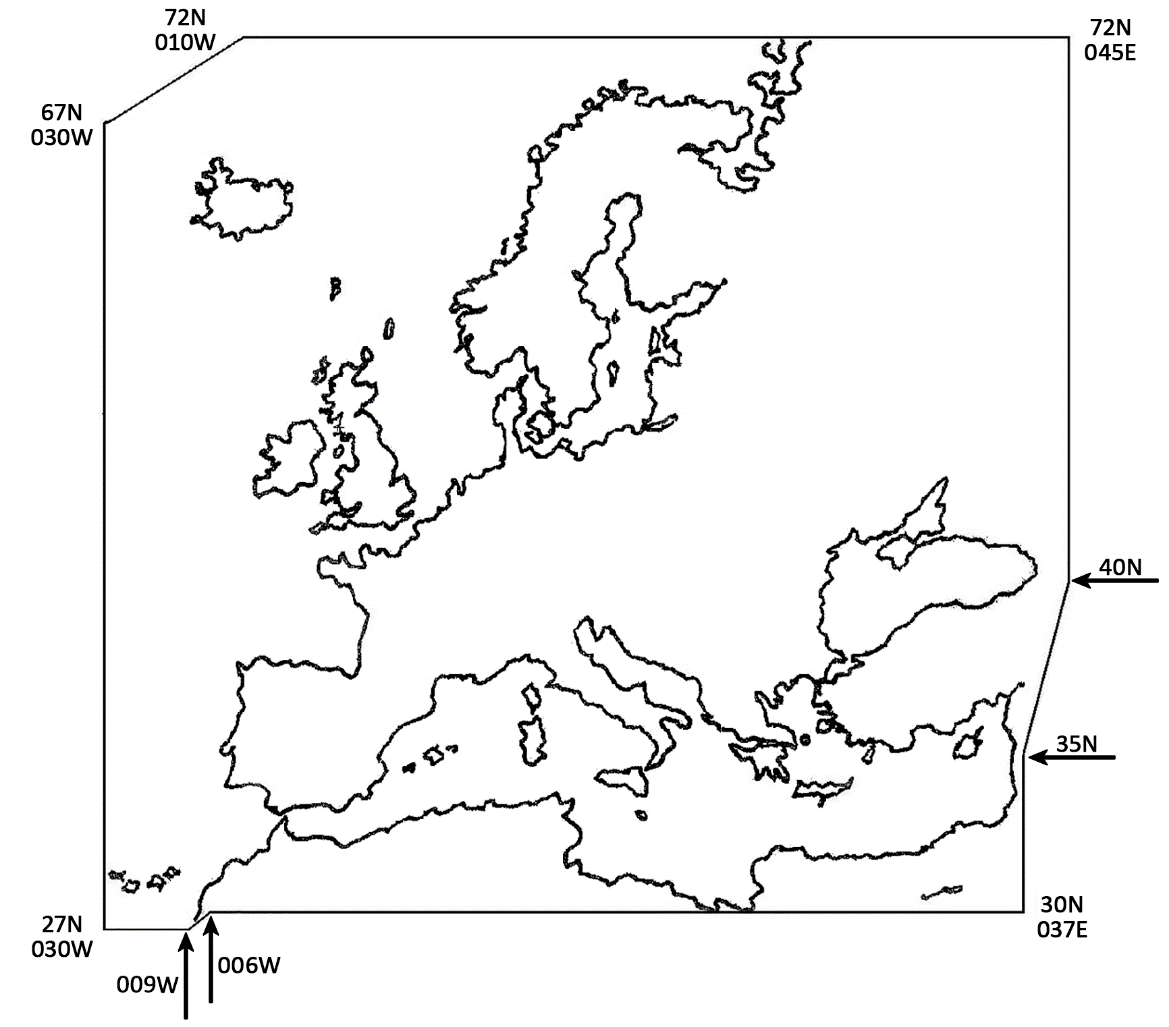
(5)Flights within the European region are flights conducted within the following area:
—N7200E04500
—N4000E04500
—N3500E03700
—N3000E03700
—N3000W00600
—N2700W00900
—N2700W03000
—N6700W03000
—N7200W01000
—N7200E04500
as depicted in Figure 1.
Figure 1
The European region
(e)Other standard masses may be used provided they are calculated on the basis of a detailed weighing survey plan and a reliable statistical analysis method is applied. The operator should advise the competent authority about the intent of the passenger weighing survey and explain the survey plan in general terms. The revised standard mass values should only be used in circumstances comparable with those under which the survey was conducted. Where the revised standard masses exceed those in Tables 1, 2 and 3 of, then such higher values should be used.
(f)On any flight identified as carrying a significant number of passengers whose masses, including hand baggage, are expected to significantly deviate from the standard passenger mass, the operator should determine the actual mass of such passengers by weighing or by adding an adequate mass increment.
(g)If standard mass values for checked baggage are used and a significant number of passengers checked baggage is expected to significantly deviate from the standard baggage mass, the operator should determine the actual mass of such baggage by weighing or by adding an adequate mass increment.
AMC2 CAT.POL.MAB.100(e) Mass and balance, loading
ED Decision 2014/015/R
PROCEDURE FOR ESTABLISHING REVISED STANDARD MASS VALUES FOR PASSENGERS AND BAGGAGE
(a)Passengers
(1)Weight sampling method. The average mass of passengers and their hand baggage should be determined by weighing, taking random samples. The selection of random samples should by nature and extent be representative of the passenger volume, considering the type of operation, the frequency of flights on various routes, in/outbound flights, applicable season and seat capacity of the aircraft.
(2)Sample size. The survey plan should cover the weighing of at least the greatest of:
(i)a number of passengers calculated from a pilot sample, using normal statistical procedures and based on a relative confidence range (accuracy) of 1 % for all adult and 2 % for separate male and female average masses; and
(ii)for aircraft:
(A)with a passenger seating capacity of 40 or more, a total of 2 000 passengers; or
(B)with a passenger seating capacity of less than 40, a total number of 50 multiplied by the passenger seating capacity.
(3)Passenger masses. Passenger masses should include the mass of the passengers' belongings that are carried when entering the aircraft. When taking random samples of passenger masses, infants should be weighted together with the accompanying adult.
(4)Weighing location. The location for the weighing of passengers should be selected as close as possible to the aircraft, at a point where a change in the passenger mass by disposing of or by acquiring more personal belongings is unlikely to occur before the passengers board the aircraft.
(5)Weighing machine. The weighing machine used for passenger weighing should have a capacity of at least 150 kg. The mass should be displayed at minimum graduations of 500 g. The weighing machine should have an accuracy of at least 0.5 % or 200 g, whichever is greater.
(6)Recording of mass values. For each flight included in the survey the mass of the passengers, the corresponding passenger category (i.e. male/female/children) and the flight number should be recorded.
(b)Checked baggage. The statistical procedure for determining revised standard baggage mass values based on average baggage masses of the minimum required sample size should comply with (a)(1) and (a)(2). For baggage, the relative confidence range (accuracy) should amount to 1 %. A minimum of 2 000 pieces of checked baggage should be weighed.
(c)Determination of revised standard mass values for passengers and checked baggage
(1)To ensure that, in preference to the use of actual masses determined by weighing, the use of revised standard mass values for passengers and checked baggage does not adversely affect operational safety, a statistical analysis should be carried out. Such an analysis should generate average mass values for passengers and baggage as well as other data.
(2)On aircraft with 20 or more passenger seats, these averages apply as revised standard male and female mass values.
(3)On aircraft with 19 passenger seats or less, the increments in Table 1 should be added to the average passenger mass to obtain the revised standard mass values.
Table 1
Increments for revised standard masses values
Number of passenger seats | Required mass increment |
1 – 5 incl. | 16 kg |
6 – 9 incl. | 8 kg |
10 – 19 incl. | 4 kg |
Alternatively, all adult revised standard (average) mass values may be applied on aircraft with 30 or more passenger seats. Revised standard (average) checked baggage mass values are applicable to aircraft with 20 or more passenger seats.
(4)The revised standard masses should be reviewed at intervals not exceeding 5 years.
(5)All adult revised standard mass values should be based on a male/female ratio of 80/20 in respect of all flights except holiday charters that are 50/50. A different ratio on specific routes or flights may be used, provided supporting data shows that the alternative male/female ratio is conservative and covers at least 84 % of the actual male/female ratios on a sample of at least 100 representative flights.
(6)The resulting average mass values should be rounded to the nearest whole number in kg. Checked baggage mass values should be rounded to the nearest 0.5 kg figure, as appropriate.
(7)When operating on similar routes or networks, operators may pool their weighing surveys provided that in addition to the joint weighing survey results, results from individual operators participating in the joint survey are separately indicated in order to validate the joint survey results.
GM1 CAT.POL.MAB.100(e) Mass and balance, loading
ED Decision 2014/015/R
ADJUSTMENT OF STANDARD MASSES
When standard mass values are used, AMC1 CAT.POL.MAB.100(e) subparagraph (g) states that the operator should identify and adjust the passenger and checked baggage masses in cases where significant numbers of passengers or quantities of baggage are suspected of significantly deviating from the standard values. Therefore, the operations manual should contain instructions to ensure that:
(a)check-in, operations and cabin staff and loading personnel report or take appropriate action when a flight is identified as carrying a significant number of passengers whose masses, including hand baggage, are expected to significantly deviate from the standard passenger mass, and/or groups of passengers carrying exceptionally heavy baggage (e.g. military personnel or sports teams); and
(b)on small aircraft, where the risks of overload and/or CG errors are the greatest, pilots pay special attention to the load and its distribution and make proper adjustments.
GM2 CAT.POL.MAB.100(e) Mass and Balance, Loading
ED Decision 2015/007/R
STATISTICAL EVALUATION OF PASSENGERS AND BAGGAGE DATA
(a)Sample size
(1)For calculating the required sample size, it is necessary to make an estimate of the standard deviation on the basis of standard deviations calculated for similar populations or for preliminary surveys. The precision of a sample estimate is calculated for 95 % reliability or ‘significance’, i.e. there is a 95 % probability that the true value falls within the specified confidence interval around the estimated value. This standard deviation value is also used for calculating the standard passenger mass.
(2)As a consequence, for the parameters of mass distribution, i.e. mean and standard deviation, three cases have to be distinguished:
(i)μ, σ = the true values of the average passenger mass and standard deviation, which are unknown and which are to be estimated by weighing passenger samples.
(ii)μ’, σ’ = the ‘a priori’ estimates of the average passenger mass and the standard deviation, i.e. values resulting from an earlier survey, which are needed to determine the current sample size.
(iii), s = the estimates for the current true values of m and s, calculated from the sample.
The sample size can then be calculated using the following formula:
where:
n =number of passengers to be weighed (sample size)
e’r =allowed relative confidence range (accuracy) for the estimate of µ by (see also equation in (c)). The allowed relative confidence range specifies the accuracy to be achieved when estimating the true mean. For example, if it is proposed to estimate the true mean to within ±1 %, then e’r will be 1 in the above formula.
1.96 =value from the Gaussian distribution for 95 % significance level of the resulting confidence interval.
(b)Calculation of average mass and standard deviation. If the sample of passengers weighed is drawn at random, then the arithmetic mean of the sample () is an unbiased estimate of the true average mass (µ) of the population.
(1)Arithmetic mean of sample where:
xj =mass values of individual passengers (sampling units).
(2)Standard deviation where:
xj – = deviation of the individual value from the sample mean.
(c)Checking the accuracy of the sample mean. The accuracy (confidence range) which can be ascribed to the sample mean as an indicator of the true mean is a function of the standard deviation of the sample which has to be checked after the sample has been evaluated. This is done using the formula:
whereby er should not exceed 1 % for an all adult average mass and 2 % for an average male and/or female mass. The result of this calculation gives the relative accuracy of the estimate of µ at the 95 % significance level. This means that with 95 % probability, the true average mass µ lies within the interval:
(d)Example of determination of the required sample size and average passenger mass
(1)Introduction. Standard passenger mass values for mass and balance purposes require passenger weighing programs to be carried out. The following example shows the various steps required for establishing the sample size and evaluating the sample data. It is provided primarily for those who are not well versed in statistical computations. All mass figures used throughout the example are entirely fictitious.
(2)Determination of required sample size. For calculating the required sample size, estimates of the standard (average) passenger mass and the standard deviation are needed. The ‘a priori’ estimates from an earlier survey may be used for this purpose. If such estimates are not available, a small representative sample of about 100 passengers should be weighed so that the required values can be calculated. The latter has been assumed for the example.
Step 1: Estimated average passenger mass.
n | xj (kg) |
1 | 79.9 |
2 | 68.1 |
3 | 77.9 |
4 | 74.5 |
5 | 54.1 |
6 | 62.2 |
7 | 89.3 |
8 | 108.7 |
. | . |
85 | 63.2 |
86 | 75.4 |
6 071.6 |
= 70.6 kg
Step 2: Estimated standard deviation.
n | xj | (xj – ) | (xj –)2 |
1 | 79.9 | +9.3 | 86.49 |
2 | 68.1 | –2.5 | 6.25 |
3 | 77.9 | +7.3 | 53.29 |
4 | 74.5 | +3.9 | 15.21 |
5 | 54.1 | –16.5 | 272.25 |
6 | 62.2 | –8.4 | 70.56 |
7 | 89.3 | +18.7 | 349.69 |
8 | 108.7 | +38.1 | 1 451.61 |
. | . | . | . |
85 | 63.2 | –7.4 | 54.76 |
86 | 75.4 | –4.8 | 23.04 |
6 071.6 | 34 683.40 |
σ' = 20.20 kg
Step 3: Required sample size.
The required number of passengers to be weighed should be such that the confidence range, e'r does not exceed 1 %, as specified in (c).
n ≥ 3145
The result shows that at least 3 145 passengers should be weighed to achieve the required accuracy. If e’r is chosen as 2 % the result would be n ≥786.
Step 4: After having established the required sample size, a plan for weighing the passengers is to be worked out.
(3)Determination of the passenger average mass
Step 1: Having collected the required number of passenger mass values, the average passenger mass can be calculated. For the purpose of this example, it has been assumed that 3 180 passengers were weighed. The sum of the individual masses amounts to 231 186.2 kg.
n = 3 180
Step 2: Calculation of the standard deviation
For calculating the standard deviation, the method shown in paragraph (2) step 2 should be applied.
s = 15.31 kg
Step 3:Calculation of the accuracy of the sample mean
er = 0.73 %
Step 4: Calculation of the confidence range of the sample mean
72.7 ± 0.5 kg
The result of this calculation shows that there is a 95 % probability of the actual mean for all passengers lying within the range 72.2 kg to 73.2 kg.
GM3 CAT.POL.MAB.100(e) Mass and balance, loading
ED Decision 2014/015/R
GUIDANCE ON PASSENGER WEIGHING SURVEYS
(a)Detailed survey plan
(1)The operator should establish and submit to the competent authority a detailed weighing survey plan that is fully representative of the operation, i.e. the network or route under consideration and the survey should involve the weighing of an adequate number of passengers.
(2)A representative survey plan means a weighing plan specified in terms of weighing locations, dates and flight numbers giving a reasonable reflection of the operator’s timetable and/or area of operation.
(3)The minimum number of passengers to be weighed is the highest of the following:
(i)The number that follows from the means of compliance that the sample should be representative of the total operation to which the results will be applied; this will often prove to be the overriding requirement.
(ii)The number that follows from the statistical requirement specifying the accuracy of the resulting mean values, which should be at least 2 % for male and female standard masses and 1 % for all adult standard masses, where applicable. The required sample size can be estimated on the basis of a pilot sample (at least 100 passengers) or from a previous survey. If analysis of the results of the survey indicates that the requirements on the accuracy of the mean values for male or female standard masses or all adult standard masses, as applicable, are not met, an additional number of representative passengers should be weighed in order to satisfy the statistical requirements.
(4)To avoid unrealistically small samples, a minimum sample size of 2 000 passengers (males + females) is also required, except for small aircraft where in view of the burden of the large number of flights to be weighed to cover 2 000 passengers, a lesser number is considered acceptable.
(b)Execution of weighing programme
(1)At the beginning of the weighing programme, it is important to note, and to account for, the data requirements of the weighing survey report (see (e)).
(2)As far as is practicable, the weighing programme should be conducted in accordance with the specified survey plan.
(3)Passengers and all their personal belongings should be weighed as close as possible to the boarding point and the mass, as well as the associated passenger category (male/female/child), should be recorded.
(c)Analysis of results of weighing survey. The data of the weighing survey should be analysed as explained in this GM. To obtain an insight to variations per flight, per route, etc. this analysis should be carried out in several stages, i.e. by flight, by route, by area, inbound/outbound, etc. Significant deviations from the weighing survey plan should be explained as well as their possible effect(s) on the results.
(d)Results of the weighing survey
(1)The results of the weighing survey should be summarised. Conclusions and any proposed deviations from published standard mass values should be justified. The results of a passenger weighing survey are average masses for passengers, including hand baggage, which may lead to proposals to adjust the standard mass values given in AMC1 CAT.POL.MAB.100(e) Tables 1 and 2. These averages, rounded to the nearest whole number may, in principle, be applied as standard mass values for males and females on aircraft with 20 or more passenger seats. Because of variations in actual passenger masses, the total passenger load also varies and statistical analysis indicates that the risk of a significant overload becomes unacceptable for aircraft with less than 20 seats. This is the reason for passenger mass increments on small aircraft.
(2)The average masses of males and females differ by some 15 kg or more. Because of uncertainties in the male/female ratio, the variation of the total passenger load is greater if all adult standard masses are used than when using separate male and female standard masses. Statistical analysis indicates that the use of all adult standard mass values should be limited to aircraft with 30 passenger seats or more.
(3)Standard mass values for all adults must be based on the averages for males and females found in the sample, taking into account a reference male/female ratio of 80/20 for all flights except holiday charters where a ratio of 50/50 applies. The operator may, based on the data from his weighing programme, or by proving a different male/female ratio, apply for approval of a different ratio on specific routes or flights.
(e)Weighing survey report
The weighing survey report, reflecting the content of (d)(1) - (3), should be prepared in a standard format as follows:
WEIGHING SURVEY REPORT |
1Introduction Objective and brief description of the weighing survey. |
2Weighing survey plan Discussion of the selected flight number, airports, dates, etc. Determination of the minimum number of passengers to be weighed. Survey plan. |
3Analysis and discussion of weighing survey results Significant deviations from survey plan (if any). Variations in means and standard deviations in the network. Discussion of the (summary of) results. |
4Summary of results and conclusions Main results and conclusions. Proposed deviations from published standard mass values. |
Attachment 1 Applicable summer and/or winter timetables or flight programmes. |
Attachment 2 Weighing results per flight (showing individual passenger masses and sex); means and standard deviations per flight, per route, per area and for the total network. |
GM1 CAT.POL.MAB.100(g) Mass and balance, loading
ED Decision 2014/015/R
FUEL DENSITY
(a)If the actual fuel density is not known, the operator may use standard fuel density values for determining the mass of the fuel load. Such standard values should be based on current fuel density measurements for the airports or areas concerned.
(b)Typical fuel density values are:
(1)Gasoline (piston engine fuel)–0.71
(2)JET A1 (Jet fuel JP 1)–0.79
(3)JET B (Jet fuel JP 4)–0.76
(4)Oil–0.88
GM1 CAT.POL.MAB.100(i) Mass and balance, loading
ED Decision 2014/015/R
IN-FLIGHT CHANGES IN LOADING — HELICOPTERS
In-flight changes in loading may occur in hoist operations.
CAT.POL.MAB.105 Mass and balance data and documentation
Regulation (EU) 2025/24
(a)The operator shall establish mass and balance data and produce mass and balance documentation prior to each flight specifying the load and its distribution. The mass and balance documentation shall enable the commander to determine that the load and its distribution is such that the mass and balance limits of the aircraft are not exceeded. The mass and balance documentation shall contain the following information:
(1)Aircraft registration and type;
(2)Flight identification, number and date;
(3)Name of the commander;
(4)Name of the person who prepared the document;
(5)Dry operating mass and the corresponding CG of the aircraft:
(i)for performance class B aeroplanes and for helicopters the CG position may not need to be on the mass and balance documentation if, for example, the load distribution is in accordance with a pre-calculated balance table or if it can be shown that for the planned operations a correct balance can be ensured, whatever the real load is;
(6)Mass of the fuel at take-off and the mass of trip fuel;
(7)Mass of consumables other than fuel, if applicable;
(8)Load components including passengers, baggage, freight and ballast;
(9)Take-off mass, landing mass and zero fuel mass;
(10)Applicable aircraft CG positions; and
(11)The limiting mass and CG values.
The information above shall be available in flight planning documents or mass and balance systems. Some of this information may be contained in other documents readily available for use.
(b)Where mass and balance data and documentation is generated by a computerised mass and balance system, the operator shall:
(1)verify the integrity of the output data to ensure that the data are within AFM limitations; and
[applicable until 26 March 2028 — Regulation (EU) 2018/1975]
(1)verify the integrity of the output data to ensure that the data is within the AFM limitations or the operations manual limitations if more restrictive; and
[applicable from 27 March 2028 — Regulation (EU) 2025/24]
(2)specify the instructions and procedures for its use in its operations manual.
(c)The person supervising the loading of the aircraft shall confirm by hand signature or equivalent that the load and its distribution are in accordance with the mass and balance documentation given to the commander. The commander shall indicate his/her acceptance by hand signature or equivalent.
(d)The operator shall specify procedures for last minute changes to the load to ensure that:
(1)any last minute change after the completion of the mass and balance documentation is brought to the attention of the commander and entered in the flight planning documents containing the mass and balance documentation;
(2)the maximum last minute change allowed in passenger numbers or hold load is specified; and
(3)new mass and balance documentation is prepared if this maximum number is exceeded.
AMC1 CAT.POL.MAB.105(a) Mass and balance data and documentation
ED Decision 2014/015/R
CONTENTS
The mass and balance documentation should include advice to the commander whenever a non-standard method has been used for determining the mass of the load.
AMC1 CAT.POL.MAB.105(b) Mass and balance data and documentation
ED Decision 2014/015/R
INTEGRITY
The operator should verify the integrity of mass and balance data and documentation generated by a computerised mass and balance system, at intervals not exceeding 6 months. The operator should establish a system to check that amendments of its input data are incorporated properly in the system and that the system is operating correctly on a continuous basis.
AMC1 CAT.POL.MAB.105(c) Mass and balance data and documentation
ED Decision 2014/015/R
SIGNATURE OR EQUIVALENT
Where a signature by hand is impracticable or it is desirable to arrange the equivalent verification by electronic means, the following conditions should be applied in order to make an electronic signature the equivalent of a conventional hand-written signature:
(a)electronic ‘signing’ by entering a personal identification number (PIN) code with appropriate security, etc.;
(b)entering the PIN code generates a print-out of the individual’s name and professional capacity on the relevant document(s) in such a way that it is evident, to anyone having a need for that information, who has signed the document;
(c)the computer system logs information to indicate when and where each PIN code has been entered;
(d)the use of the PIN code is, from a legal and responsibility point of view, considered to be fully equivalent to signature by hand;
(e)the requirements for record keeping remain unchanged; and.
(f)all personnel concerned are made aware of the conditions associated with electronic signature and this is documented.
AMC2 CAT.POL.MAB.105(c) Mass and balance data and documentation
ED Decision 2014/015/R
MASS AND BALANCE DOCUMENTATION SENT VIA DATA LINK
Whenever the mass and balance documentation is sent to the aircraft via data link, a copy of the final mass and balance documentation, as accepted by the commander, should be available on the ground.
GM1 CAT.POL.MAB.105(d) Mass and balance data and documentation
ED Decision 2025/008/R
LAST-MINUTE CHANGES
(a)Mass and balance and load control documentation is expected to reflect the actual loaded state of the aircraft before departure. The final mass and balance and load control documentation needs to reflect any change that has been made to aircraft loading since the initial issue of the documents. These late adjustments are called last-minute changes (LMCs).
(b)LMCs are used to make late updates to the mass and balance and load control documentation without requiring the preparation of a new issue of the document.
(c)If in any doubt about the limitations of the aircraft, the operator should ensure that the mass and balance and load control documents are reissued.
LMCs contain the following information at a minimum:
(1)the load to be changed (baggage, passengers, cargo, etc.),
(2)the mass of the load to be changed,
(3)the location of the load to be changed (cabin/bay area, cargo compartment, etc.),
(4)the nature of the change (enter ‘+’ for an increase or ‘–’ for a decrease, as appropriate).
(5)the intended location of the load (if remaining on board),
(6)the total mass and index change.
(d)Aircraft flight envelopes may be more restrictive at lower weights. Changes in loading applied to a lighter-loaded aircraft will affect its centre of gravity more, so LMCs should be checked carefully.
(e)With an increasing number of pieces of hand baggage, some of those pieces may need to be relocated into a cargo compartment. In such cases, the calculations should be completed as part of the LMCs.
(f)LMCs should be communicated to the commander in writing; for example, on an LMC slip or loadsheet, or verbally, which should be recorded in the flight file.
[applicable from 27 March 2028 — ED Decision 2025/008/R]
CAT.POL.MAB.110 Load control process
Regulation (EU) 2025/24
The operator shall establish and implement a load control process and associated procedures, which shall be included in the operations manual.
[applicable from 27 March 2028 — Regulation (EU) 2025/24]
AMC1 CAT.POL.MAB.110 Load control process
ED Decision 2025/008/R
LOAD CONTROL PROCESS
(a)The operator should ensure that the load control process covers at least the following:
(1)the functions and the tasks associated with each function are identified;
(2)mass and balance and load control documentation — including, as applicable, the loading instructions/report (LIR) and the NOTOC — is distributed to the relevant persons, as identified in the load control process;
(3)information related to aircraft loading and load distribution is communicated between the person responsible for loading supervision and the persons responsible for load planning and the related mass and balance and load control documentation is issued, along with any other designated intermediary person if load planning is a remote function that is not performed at the departure station;
(4)aircraft loading and load distribution are performed in accordance with the LIR;
(5)the mass and balance documentation and the LIR are not in contradiction and include any LMCs.
(b)Points (a)(2) and (a)(3) do not apply when the mass and balance documentation and loading/unloading of baggage are performed by the flight crew.
[applicable from 27 March 2028 — ED Decision 2025/008/R]
GM1 CAT.POL.MAB.110 Load control process
ED Decision 2025/008/R
LOADING INSTRUCTIONS/REPORT (LIR)
(a)The loading instructions document (also called ‘loading instructions/report’ or ‘LIR’) is generated for the purpose of providing support to the person supervising the aircraft loading in order to facilitate this activity and ensure that the load distribution and aircraft loading are completed as per the instructions.
(b)The loading instructions contain information about the maximum mass of items that may be loaded in each cargo compartment and instructions for the safe and optimal distribution of items to be loaded in the cargo compartments, along with the cargo segregation rules.
(c)The LIR may be part of an existing mass and balance document or a separate form.
(d)Usually, the signature on the LIR of the person responsible for loading supervision is the confirmation that the aircraft has been loaded in accordance with the loading instructions. The function of this signed document is to serve as a report. A signed copy of the LIR is retained on the ground.
[applicable from 27 March 2028 — ED Decision 2025/008/R]
GM2 CAT.POL.MAB.110 Load control process
ED Decision 2025/008/R
LOADING SUPERVISION AND LOAD PLANNING
It is recommended that aircraft loading and unloading are supervised, if possible, by a different person from the one(s) responsible for load planning and the issuance of the mass and balance and load control documentation, the loading instructions and/or the NOTOC.
[applicable from 27 March 2028 — ED Decision 2025/008/R]
SUBPART D: INSTRUMENTS, DATA, EQUIPMENT
SECTION 1 – Aeroplanes
CAT.IDE.A.100 Instruments and equipment – general
Regulation (EU) 2019/1384
(a)Instruments and equipment required by this Subpart shall be approved in accordance with the applicable airworthiness requirements except for the following items:
(1)Spare fuses;
(2)Independent portable lights;
(3)An accurate time piece;
(4)Chart holder;
(5)First-aid kits;
(6)Emergency medical kit;
(7)Megaphones;
(8)Survival and signalling equipment;
(9)Sea anchors and equipment for mooring; and
(10)Child restraint devices.
(b)Instruments and equipment not required under this Annex (Part-CAT) as well as any other equipment which is not required under this Regulation, but carried on a flight, shall comply with the following requirements:
(1) the information provided by those instruments, equipment or accessories shall not be used by the flight crew members to comply with Annex II to Regulation (EU) 2018/1139 or points CAT.IDE.A.330, CAT.IDE.A.335, CAT.IDE.A.340 and CAT.IDE.A.345 of this Annex;
(2) the instruments and equipment shall not affect the airworthiness of the aeroplane, even in the case of failures or malfunction.
(c)If equipment is to be used by one flight crew member at his/her station during flight, it shall be readily operable from that station. When a single item of equipment is required to be operated by more than one flight crew member it shall be installed so that the equipment is readily operable from any station at which the equipment is required to be operated.
(d)Those instruments that are used by any flight crew member shall be so arranged as to permit the flight crew member to see the indications readily from his/her station, with the minimum practicable deviation from the position and line of vision that he/she normally assumes when looking forward along the flight path.
(e)All required emergency equipment shall be easily accessible for immediate use.
GM1 CAT.IDE.A.100(a) Instruments and equipment – general
ED Decision 2014/015/R
REQUIRED INSTRUMENTS AND EQUIPMENT THAT DO NOT NEED TO BE APPROVED IN ACCORDANCE WITH COMMISSION REGULATION (EU) NO 748/2012
The functionality of non-installed instruments and equipment required by this Subpart and that do not need an equipment approval, as listed in CAT.IDE.A.100(a), should be checked against recognised industry standards appropriate to the intended purpose. The operator is responsible for ensuring the maintenance of these instruments and equipment.
GM1 CAT.IDE.A.100(b) Instruments and equipment – general
ED Decision 2014/015/R
NOT REQUIRED INSTRUMENTS AND EQUIPMENT THAT DO NOT NEED TO BE APPROVED IN ACCORDANCE WITH COMMISSION REGULATION (EU) NO 748/2012, BUT ARE CARRIED ON A FLIGHT
(a)The provision of this paragraph does not exempt any installed instrument or item of equipment from complying with Commission Regulation (EU) No 748/201282. In this case, the installation should be approved as required in Commission Regulation (EU) No 748/2012 and should comply with the applicable Certification Specifications as required under the same Regulation.
(b)The failure of additional non-installed instruments or equipment not required by this Part or by Commission Regulation (EU) No 748/2012 or any applicable airspace requirements should not adversely affect the airworthiness and/or the safe operation of the aeroplane. Examples may be the following:
(1)portable electronic flight bag (EFB);
(2)portable electronic devices carried by flight crew or cabin crew; and
(3)non-installed passenger entertainment equipment.
GM1 CAT.IDE.A.100(d) Instruments and equipment – general
ED Decision 2014/015/R
POSITIONING OF INSTRUMENTS
This requirement implies that whenever a single instrument is required to be installed in an aeroplane operated in a multi-crew environment, the instrument needs to be visible from each flight crew station.
CAT.IDE.A.105 Minimum equipment for flight
Regulation (EU) 2019/1384
A flight shall not be commenced when any of the aeroplane’s instruments, items of equipment or functions required for the intended flight are inoperative or missing, unless:
(a)the aeroplane is operated in accordance with the operator’s MEL; or
(b)the operator is approved by the competent authority to operate the aeroplane within the constraints of the master minimum equipment list (MMEL) in accordance with point ORO.MLR.105(j) of Annex III.
AMC1 CAT.IDE.A.105 Minimum equipment for flight
ED Decision 2021/005/R
MANAGEMENT OF THE STATUS OF CERTAIN INSTRUMENTS, EQUIPMENT OR FUNCTIONS
The operator should control and retain the status of the instruments, equipment or functions required for the intended operation, that are not controlled for the purpose of continuing airworthiness management.
GM1 CAT.IDE.A.105 Minimum equipment for flight
ED Decision 2021/005/R
MANAGEMENT OF THE STATUS OF CERTAIN INSTRUMENTS, EQUIPMENT OR FUNCTIONS
(a)The operator should define responsibilities and procedures to retain and control the status of instruments, equipment or functions required for the intended operation, that are not controlled for the purpose of continuing airworthiness management.
(b)Examples of such instruments, equipment or functions may be, but are not limited to, equipment related to navigation approvals as FM immunity or certain software versions.
CAT.IDE.A.110 Spare electrical fuses
Regulation (EU) No 965/2012
(a)Aeroplanes shall be equipped with spare electrical fuses, of the ratings required for complete circuit protection, for replacement of those fuses that are allowed to be replaced in flight.
(b)The number of spare fuses that are required to be carried shall be the higher of:
(1)10 % of the number of fuses of each rating; or
(2)three fuses for each rating.
GM1 CAT.IDE.A.110 Spare electrical fuses
ED Decision 2014/015/R
FUSES
A ‘spare electrical fuse’ means a replaceable fuse in the flight crew compartment, not an automatic circuit breaker, or circuit breakers in the electric compartments.
CAT.IDE.A.115 Operating lights
Regulation (EU) No 965/2012
(a)Aeroplanes operated by day shall be equipped with:
(1)an anti-collision light system;
(2)lighting supplied from the aeroplane’s electrical system to provide adequate illumination for all instruments and equipment essential to the safe operation of the aeroplane;
(3)lighting supplied from the aeroplane’s electrical system to provide illumination in all passenger compartments; and
(4)an independent portable light for each required crew member readily accessible to crew members when seated at their designated stations.
(b)Aeroplanes operated at night shall in addition be equipped with:
(1)navigation/position lights;
(2)two landing lights or a single light having two separately energised filaments; and
(3)lights to conform with the International Regulations for Preventing Collisions at Sea if the aeroplane is operated as a seaplane.
CAT.IDE.A.120 Equipment to clear windshield
Regulation (EU) No 965/2012
Aeroplanes with an MCTOM of more than 5 700 kg shall be equipped at each pilot station with a means to maintain a clear portion of the windshield during precipitation.
AMC1 CAT.IDE.A.120 Equipment to clear windshield
ED Decision 2014/015/R
MEANS TO MAINTAIN A CLEAR PORTION OF THE WINDSHIELD DURING PRECIPITATION
The means used to maintain a clear portion of the windshield during precipitation should be windshield wipers or an equivalent.
CAT.IDE.A.125 Operations under VFR by day – flight and navigational instruments and associated equipment
Regulation (EU) 2019/1384
(a)Aeroplanes operated under VFR by day shall be equipped with the following equipment, available at the pilot’s station:
(1)A means of measuring and displaying:
(i)Magnetic heading;
(ii)Time in hours, minutes, and seconds;
(iii)Barometric altitude;
(iv)Indicated airspeed;
(v)Vertical speed;
(vi)Turn and slip;
(vii)Attitude;
(viii)Heading;
(ix)Outside air temperature; and
(x)Mach number whenever speed limitations are expressed in terms of Mach number.
(2)A means of indicating when the supply of power to the required flight instruments is not adequate.
(b)Whenever two pilots are required for the operation, an additional separate means of displaying the following shall be available for the second pilot:
(1)Barometric altitude;
(2)Indicated airspeed;
(3)Vertical speed;
(4)Turn and slip;
(5)Attitude; and
(6)Heading.
(c)A means for preventing malfunction of the airspeed indicating systems due to condensation or icing shall be available for:
(1)aeroplanes with an MCTOM of more than 5 700 kg or an MOPSC of more than nine; and
(2)aeroplanes first issued with an individual CofA on or after 1 April 1999.
(d)Single engine aeroplanes first issued with an individual CofA before 22 May 1995 are exempted from the requirements of (a)(1)(vi), (a)(1)(vii), (a)(1)(viii) and (a)(1)(ix) if the compliance would require retrofitting.
AMC1 CAT.IDE.A.125 & CAT.IDE.A.130 Operations under VFR by day & Operations under IFR or at night – flight and navigational instruments and associated equipment
ED Decision 2014/015/R
INTEGRATED INSTRUMENTS
(a)Individual equipment requirements may be met by combinations of instruments, by integrated flight systems or by a combination of parameters on electronic displays, provided that the information so available to each required pilot is not less than that required in the applicable operational requirements, and the equivalent safety of the installation has been shown during type certification approval of the aeroplane for the intended type of operation.
(b)The means of measuring and indicating turn and slip, aeroplane attitude and stabilised aeroplane heading may be met by combinations of instruments or by integrated flight director systems, provided that the safeguards against total failure, inherent in the three separate instruments, are retained.
AMC2 CAT.IDE.A.125 Operations under VFR by day — flight and navigational instruments and associated equipment
ED Decision 2014/015/R
LOCAL FLIGHTS
For flights that do not exceed 60 minutes’ duration, that take off and land at the same aerodrome and that remain within 50 NM of that aerodrome, an equivalent means of complying with CAT.IDE.A.125 (a)(1)(vi) may be:
(a)a turn and slip indicator;
(b)a turn coordinator; or
(c)both an attitude indicator and a slip indicator.
AMC1 CAT.IDE.A.125(a)(1)(i) & CAT.IDE.A.130(a)(1) Operations under VFR by day & Operations under IFR or at night – flight and navigational instruments and associated equipment
ED Decision 2014/015/R
MEANS OF MEASURING AND DISPLAYING MAGNETIC HEADING
The means of measuring and displaying magnetic direction should be a magnetic compass or equivalent.
AMC1 CAT.IDE.A.125(a)(1)(ii) & CAT.IDE.A.130(a)(2) Operations under VFR by day & Operations under IFR or at night – flight and navigational instruments and associated equipment
ED Decision 2014/015/R
MEANS OF MEASURING AND DISPLAYING THE TIME
An acceptable means of compliance is a clock displaying hours, minutes and seconds, with a sweep-second pointer or digital presentation.
AMC1 CAT.IDE.A.125(a)(1)(iii) & CAT.IDE.A.130(b) Operations under VFR by day & Operations under IFR or at night – flight and navigational instruments and associated equipment
ED Decision 2019/019/R
CALIBRATION OF THE MEANS OF MEASURING AND DISPLAYING PRESSURE ALTITUDE
The instrument measuring and displaying barometric altitude should be of a sensitive type calibrated in feet (ft), with a sub-scale setting, calibrated in hectopascals/millibars, adjustable for any barometric pressure likely to be set during flight.
AMC1 CAT.IDE.A.125(a)(1)(iv) & CAT.IDE.A.130(a)(3) Operations under VFR by day & Operations under IFR or at night – flight and navigational instruments and associated equipment
ED Decision 2014/015/R
CALIBRATION OF THE INSTRUMENT INDICATING AIRSPEED
The instrument indicating airspeed should be calibrated in knots (kt).
AMC1 CAT.IDE.A.125(a)(1)(ix) & CAT.IDE.A.130(a)(8) Operations under VFR by day & operations under IFR or at night – flight and navigational instruments and associated equipment
ED Decision 2014/015/R
MEANS OF DISPLAYING OUTSIDE AIR TEMPERATURE
(a)The means of displaying outside air temperature should be calibrated in degrees Celsius.
(b)The means of displaying outside air temperature may be an air temperature indicator that provides indications that are convertible to outside air temperature.
AMC1 CAT.IDE.A.125(b) & CAT.IDE.A.130(h) Operations under VFR by day & Operations under IFR or at night – flight and navigational instruments and associated equipment
ED Decision 2014/015/R
MULTI-PILOT OPERATIONS — DUPLICATE INSTRUMENTS
Duplicate instruments should include separate displays for each pilot and separate selectors or other associated equipment where appropriate.
AMC1 CAT.IDE.A.125(c) & CAT.IDE.A.130(d) Operations under VFR by day & Operations under IFR or at night – flight and navigational instruments and associated equipment
ED Decision 2014/015/R
MEANS OF PREVENTING MALFUNCTION DUE TO CONDENSATION OR ICING
The means of preventing malfunction due to either condensation or icing of the airspeed indicating system should be a heated pitot tube or equivalent.
GM1 CAT.IDE.A.125 & CAT.IDE.A.130 Operations under VFR by day & Operations under IFR or at night – flight and navigational instruments and associated equipment
ED Decision 2017/008/R
SUMMARY TABLE
Table 1
Flight and navigational instruments and associated equipment
SERIAL | FLIGHTS UNDER VFR | FLIGHTS UNDER IFROR AT NIGHT | |||
INSTRUMENT | SINGLE-PILOT | TWO PILOTS REQUIRED | SINGLE-PILOT | TWO PILOTS REQUIRED | |
1 | Magnetic direction | 1 | 1 | 1 | 1 |
2 | Time | 1 | 1 | 1 | 1 |
3 | Pressure altitude | 1 | 2 | 2 Note (5) | 2 Note (5) |
4 | Indicated airspeed | 1 | 2 | 1 | 2 |
5 | Vertical speed | 1 | 2 | 1 | 2 |
6 | Turn and slip or turn coordinator | 1 Note (1) | 2 Note (1) & Note (2) | 1 Note (4) | 2 Note (4) |
7 | Attitude | 1 Note (1) | 2 Note (1) & Note (2) | 1 | 2 |
8 | Stabilised direction | 1 Note (1) | 2 Note (1) & Note (2) | 1 | 2 |
9 | Outside air temperature | 1 | 1 | 1 | 1 |
10 | Mach number indicator | See Note (3) | |||
11 | Airspeed icing protection | 1 Note (6) | 2 Note (6) | 1 | 2 |
12 | Airspeed icing protection failure indicating | 1 Note (7) | 2 Note (7) | ||
13 | Static pressure source | 2 | 2 | ||
14 | Standby attitude indicator | 1 Note (8) | 1 Note (8) | ||
15 | Chart holder | 1 Note (6) | 1 Note (6) | ||
Note (1) For local flights (A to A, 50 NM radius, not more than 60 minutes’ duration), the instruments at serials (a)(6) and (a)(8) may be replaced by either a turn and slip indicator, or a turn coordinator, or both an attitude indicator and a slip indicator.
Note (2) The substitute instruments permitted by Note (1) above should be provided at each pilot's station.
Note (3) A Mach number indicator is required for each pilot whenever compressibility limitations are not otherwise indicated by airspeed indicators.
Note (4) For IFR or at night, a turn and slip indicator, or a slip indicator and a third (standby) attitude indicator certified according to CS 25.1303 (b)(4) or equivalent, is required.
Note (5) Except for unpressurised aeroplanes operating below 10 000 ft, neither three pointers, nor drum-pointer altimeters satisfy the requirement.
Note (6) Applicable only to aeroplanes with a maximum certified take-off mass (MCTOM) of more than 5 700 kg, or with an MOPSC of more than 9. It also applies to all aeroplanes first issued with an individual certificate of airworthiness (CofA) on or after 1 April 1999.
Note (7) The pitot heater failure annunciation applies to any aeroplane issued with an individual CofA on or after 1 April 1998. It also applies before that date when: the aeroplane has an MCTOM of more than 5 700 kg and an MOPSC greater than 9.
Note (8) Applicable only to aeroplanes with an MCTOM of more than 5 700 kg, or with an MOPSC of more than 9.
CAT.IDE.A.130 Operations under IFR or at night – flight and navigational instruments and associated equipment
Regulation (EU) 2019/1384
Aeroplanes operated under VFR at night or under IFR shall be equipped with the following equipment, available at the pilot’s station:
(a)A means of measuring and displaying:
(1)Magnetic heading;
(2)Time in hours, minutes and seconds;
(3)Indicated airspeed;
(4)Vertical speed;
(5)Turn and slip, or in the case of aeroplanes equipped with a standby means of measuring and displaying attitude, slip;
(6)Attitude;
(7)Stabilised heading;
(8)Outside air temperature; and
(9)Mach number whenever speed limitations are expressed in terms of Mach number.
(b)Two means of measuring and displaying barometric altitude.
(c)A means of indicating when the supply of power to the required flight instruments is not adequate.
(d)A means for preventing malfunction of the airspeed indicating systems required in (a)(3) and (h)(2) due to condensation or icing.
(e)A means of annunciating to the flight crew the failure of the means required in (d) for aeroplanes:
(1)issued with an individual CofA on or after 1 April 1998; or
(2)issued with an individual CofA before 1 April 1998 with an MCTOM of more than 5 700 kg, and with an MOPSC of more than nine.
(f)Except for propeller-driven aeroplanes with an MCTOM of 5 700 kg or less, two independent static pressure systems.
(g)One static pressure system and one alternate source of static pressure for propeller-driven aeroplanes with an MCTOM of 5 700 kg or less.
(h)Whenever two pilots are required for the operation, a separate means of displaying for the second pilot:
(1)Barometric altitude;
(2)Indicated airspeed;
(3)Vertical speed;
(4)Turn and slip;
(5)Attitude; and
(6)Stabilised heading.
(i)A standby means of measuring and displaying attitude capable of being used from either pilot’s station for aeroplanes with an MCTOM of more than 5 700 kg or an MOPSC of more than nine that:
(1)is powered continuously during normal operation and, after a total failure of the normal electrical generating system, is powered from a source independent from the normal electrical generating system;
(2)provides reliable operation for a minimum of 30 minutes after total failure of the normal electrical generating system, taking into account other loads on the emergency power supply and operational procedures;
(3)operates independently of any other means of measuring and displaying attitude;
(4)is operative automatically after total failure of the normal electrical generating system;
(5)is appropriately illuminated during all phases of operation, except for aeroplanes with an MCTOM of 5 700 kg or less, already registered in a Member State on 1 April 1995 and equipped with a standby attitude indicator in the left-hand instrument panel;
(6)is clearly evident to the flight crew when the standby attitude indicator is being operated by emergency power; and
(7)where the standby attitude indicator has its own dedicated power supply, has an associated indication, either on the instrument or on the instrument panel, when this supply is in use.
(j)A chart holder in an easily readable position that can be illuminated for night operations.
AMC1 CAT.IDE.A.125 & CAT.IDE.A.130 Operations under VFR by day & Operations under IFR or at night – flight and navigational instruments and associated equipment
ED Decision 2014/015/R
INTEGRATED INSTRUMENTS
(a)Individual equipment requirements may be met by combinations of instruments, by integrated flight systems or by a combination of parameters on electronic displays, provided that the information so available to each required pilot is not less than that required in the applicable operational requirements, and the equivalent safety of the installation has been shown during type certification approval of the aeroplane for the intended type of operation.
(b)The means of measuring and indicating turn and slip, aeroplane attitude and stabilised aeroplane heading may be met by combinations of instruments or by integrated flight director systems, provided that the safeguards against total failure, inherent in the three separate instruments, are retained.
AMC1 CAT.IDE.A.125(a)(1)(i) & CAT.IDE.A.130(a)(1) Operations under VFR by day & Operations under IFR or at night – flight and navigational instruments and associated equipment
ED Decision 2014/015/R
MEANS OF MEASURING AND DISPLAYING MAGNETIC HEADING
The means of measuring and displaying magnetic direction should be a magnetic compass or equivalent.
AMC1 CAT.IDE.A.125(a)(1)(ii) & CAT.IDE.A.130(a)(2) Operations under VFR by day & Operations under IFR or at night – flight and navigational instruments and associated equipment
ED Decision 2014/015/R
MEANS OF MEASURING AND DISPLAYING THE TIME
An acceptable means of compliance is a clock displaying hours, minutes and seconds, with a sweep-second pointer or digital presentation.
AMC1 CAT.IDE.A.125(a)(1)(iv) & CAT.IDE.A.130(a)(3) Operations under VFR by day & Operations under IFR or at night – flight and navigational instruments and associated equipment
ED Decision 2014/015/R
CALIBRATION OF THE INSTRUMENT INDICATING AIRSPEED
The instrument indicating airspeed should be calibrated in knots (kt).
AMC1 CAT.IDE.A.130(a)(5) Operations under IFR or at night — flight and navigational instruments and associated equipment
ED Decision 2014/015/R
SLIP INDICATOR
If only slip indication is provided, the means of measuring and displaying standby attitude should be certified according to CS 25.1303(b)(4) or equivalent.
AMC1 CAT.IDE.A.125(a)(1)(ix) & CAT.IDE.A.130(a)(8) Operations under VFR by day & operations under IFR or at night – flight and navigational instruments and associated equipment
ED Decision 2014/015/R
MEANS OF DISPLAYING OUTSIDE AIR TEMPERATURE
(a)The means of displaying outside air temperature should be calibrated in degrees Celsius.
(b)The means of displaying outside air temperature may be an air temperature indicator that provides indications that are convertible to outside air temperature.
AMC1 CAT.IDE.A.125(a)(1)(iii) & CAT.IDE.A.130(b) Operations under VFR by day & Operations under IFR or at night – flight and navigational instruments and associated equipment
ED Decision 2019/019/R
CALIBRATION OF THE MEANS OF MEASURING AND DISPLAYING PRESSURE ALTITUDE
The instrument measuring and displaying barometric altitude should be of a sensitive type calibrated in feet (ft), with a sub-scale setting, calibrated in hectopascals/millibars, adjustable for any barometric pressure likely to be set during flight.
AMC2 CAT.IDE.A.130(b) Operations under IFR or at night – flight and navigational instruments and associated equipment
ED Decision 2014/015/R
ALTIMETERS — IFR OR NIGHT OPERATIONS
Except for unpressurised aeroplanes operating below 10 000 ft, the altimeters of aeroplanes operating under IFR or at night should have counter drum-pointer or equivalent presentation.
AMC1 CAT.IDE.A.125(c) & CAT.IDE.A.130(d) Operations under VFR by day & Operations under IFR or at night – flight and navigational instruments and associated equipment
ED Decision 2014/015/R
MEANS OF PREVENTING MALFUNCTION DUE TO CONDENSATION OR ICING
The means of preventing malfunction due to either condensation or icing of the airspeed indicating system should be a heated pitot tube or equivalent.
AMC1 CAT.IDE.A.130(e) Operations under IFR or at night – flight and navigational instruments and associated equipment
ED Decision 2014/015/R
MEANS OF INDICATING FAILURE OF THE AIRSPEED INDICATING SYSTEM’S MEANS OF PREVENTING MALFUNCTION DUE TO EITHER CONDENSATION OR ICING
A combined means of indicating failure of the airspeed indicating system’s means of preventing malfunction due to either condensation or icing is acceptable provided that it is visible from each flight crew station and that there is a means to identify the failed heater in systems with two or more sensors.
AMC1 CAT.IDE.A.125(b) & CAT.IDE.A.130(h) Operations under VFR by day & Operations under IFR or at night – flight and navigational instruments and associated equipment
ED Decision 2014/015/R
MULTI-PILOT OPERATIONS — DUPLICATE INSTRUMENTS
Duplicate instruments should include separate displays for each pilot and separate selectors or other associated equipment where appropriate.
AMC1 CAT.IDE.A.130(i)(5) Operations under IFR or at night – flight and navigational instruments and associated equipment
ED Decision 2014/015/R
ILLUMINATION OF STANDBY MEANS OF MEASURING AND DISPLAYING ATTITUDE
The standby means of measuring and displaying attitude should be illuminated so as to be clearly visible under all conditions of daylight and artificial lighting.
AMC1 CAT.IDE.A.130(j) Operations under IFR or at night — flight and navigational instruments and associated equipment
ED Decision 2014/015/R
CHART HOLDER
An acceptable means of compliance with the chart holder requirement is to display a pre-composed chart on an electronic flight bag (EFB).