
Filters
GM1 NCC.IDE.H.170 Data link recording
ED Decision 2013/021/R
GENERAL
(a)The letters and expressions in Table 1 of AMC1 NCC.IDE.H.170 have the following meaning:
(1)C: complete contents recorded.
(2)M: information that enables correlation with any associated records stored separately from the helicopter.
(3)*: applications that are to be recorded only as far as is practicable, given the architecture of the system.
(4)F1: graphics applications may be considered as AOC messages when they are part of a data link communications application service run on an individual basis by the operator itself in the framework of the operational control.
(5)F2: where parametric data sent by the helicopter, such as Mode S, is reported within the message, it should be recorded unless data from the same source is recorded on the FDR.
(b)The definitions of the applications type in Table 1 of AMC1 NCC.IDE.H.170 are described in Table 1 below.
Table 1: Definitions of the applications type
Item No | Application Type | Messages | Comments |
1 | CM | CM is an ATN service | |
2 | AFN | AFN is a FANS 1/A service | |
3 | CPDLC | All implemented up and downlink messages to be recorded | |
4 | ADS-C | ADS-C reports | All contract requests and reports recorded |
Position reports | Only used within FANS 1/A. Mainly used in oceanic and remote areas. | ||
5 | ADS-B | Surveillance data | Information that enables correlation with any associated records stored separately from the helicopter. |
6 | D-FIS | D-FIS is an ATN service. All implemented up and downlink messages to be recorded | |
7 | TWIP | TWIP messages | Terminal weather information for pilots |
8 | D ATIS | ATIS messages | Refer to EUROCAE ED-89A, dated December 2003: Data Link Application System Document (DLASD) for the ‘ATIS’ data link service |
9 | OCL | OCL messages | Refer to EUROCAE ED-106A, dated March 2004: Data Link Application System Document (DLASD) for ‘Oceanic Clearance’ (OCL) data link service |
10 | DCL | DCL messages | Refer to EUROCAE ED-85A, dated March 2003: Data Link Application System Document (DLASD) for ‘Departure Clearance’ data link service |
11 | Graphics | Weather maps & other graphics | Graphics exchanged in the framework of procedures within the operational control, as specified in Part-ORO. Information that enables correlation with any associated records stored separately from the helicopter. |
12 | AOC | Aeronautical operational control messages | Messages exchanged in the framework of procedures within the operational control, as specified in Part-ORO. Information that enables correlation with any associated records stored separately from the helicopter. Definition in EUROCAE ED-112, dated March 2003. |
13 | Surveillance | Downlinked Aircraft Parameters (DAP) | As defined in ICAO Annex 10 Volume IV (Surveillance systems and ACAS). |
AACaeronautical administrative communications
ADS-Bautomatic dependent surveillance - broadcast
ADS-C automatic dependent surveillance – contract
AFNaircraft flight notification
AOCaeronautical operational control
ATISautomatic terminal information service
ATSCair traffic service communication
CAPcontroller access parameters
CPDLCcontroller pilot data link communications
CMconfiguration/context management
D-ATISdigital ATIS
D-FISdata link flight information service
D-METARdata link meteorological airport report
DCLdeparture clearance
FANSFuture Air Navigation System
FLIPCYflight plan consistency
OCLoceanic clearance
SAPsystem access parameters
TWIPterminal weather information for pilots
GM1 NCC.IDE.H.170(a) Data link recording
ED Decision 2015/030/R
APPLICABILITY OF THE DATA LINK RECORDING REQUIREMENT
(a)If it is certain that the helicopter cannot use data link communication messages for ATS communications corresponding to any application designated by NCC.IDE.H.170(a)(1), then the data link recording requirement does not apply.
(b)Examples where the helicopter cannot use data link communication messages for ATS communications include but are not limited to the cases where:
(1)the helicopter data link communication capability is disabled permanently and in a way that it cannot be enabled again during the flight;
(2)data link communications are not used to support air traffic service (ATS) in the area of operation of the helicopter; and
(3)the helicopter data link communication equipment cannot communicate with the equipment used by ATS in the area of operation of the helicopter.
NCC.IDE.H.175 Flight data and cockpit voice combination recorder
Regulation (EU) No 800/2013
Compliance with CVR and FDR requirements may be achieved by one flight data and cockpit voice combination recorder.
GM1 NCC.IDE.H.175 Flight data and cockpit voice combination recorder
ED Decision 2013/021/R
COMBINATION RECORDERS
(a)A flight data and cockpit voice combination recorder is a flight recorder that records:
(1)all voice communications and the aural environment required by NCC.IDE.H.160; and
(2)all parameters required by NCC.IDE.H.165,
with the same specifications required by NCC.IDE.H.160 and NCC.IDE.H.165.
(b)In addition, a flight data and cockpit voice combination recorder may record data link communication messages and related information required by the NCC.IDE.H.170.
NCC.IDE.H.180 Seats, seat safety belts, restraint systems and child restraint devices
Regulation (EU) No 800/2013
(a)Helicopters shall be equipped with:
(1)a seat or berth for each person on board who is aged 24 months or more;
(2)a seat belt on each passenger seat and restraining belts for each berth;
(3)for helicopters first issued with an individual CofA after 31 December 2012, a seat belt with an upper torso restraint system for each passenger who is aged 24 months or more;
(4)a child restraint device (CRD) for each person on board younger than 24 months;
(5)a seat belt with upper torso restraint system incorporating a device that will automatically restrain the occupant’s torso in the event of rapid deceleration on each flight crew seat; and
(6)a seat belt with upper torso restraint system on the seats for the minimum required cabin crew, in the case of helicopters first issued with an individual CofA after 31 December 1980.
(b)A seat belt with upper torso restraint system shall:
(1)have a single point release; and
(2)on flight crew seats, on any seat alongside a pilot’s seat and on the seats for the minimum required cabin crew, include two shoulder straps and a seat belt that may be used independently.
AMC1 NCC.IDE.H.180 Seats, seat safety belts, restraint systems and child restraint devices
ED Decision 2019/019/R
CHILD RESTRAINT DEVICES (CRDs)
(a)A CRD is considered to be acceptable if:
(1)it is a supplementary loop belt manufactured with the same techniques and the same materials of the approved safety belts; or
(2)it complies with (b).
(b)Provided the CRD can be installed properly on the respective helicopter seat, the following CRDs are considered acceptable:
(1)CRDs approved for use in aircraft according to the European Technical Standard Order ETSO-C100c on Aviation Child Safety Device (ACSD).
(2)CRDs approved by EASA through a Type Certificate or Supplemental Type Certificate;
(3)Child seat approved for use in motor vehicles on the basis of the technical standard specified in (i). The child seat must be also approved for use in aircraft on the basis of the technical standard specified in either point (ii) or point (iii):
(i) UN Standard ECE R44-04 (or 03), or ECE R129 bearing the respective ‘ECE R’ label; and
(ii)German ‘Qualification Procedure for Child Restraint Systems for Use in Aircraft’ (TÜV Doc.: TÜV/958-01/2001) bearing the label ‘For Use in Aircraft’; or
(iii) Other technical standard acceptable to the competent authority. The child seat should hold a qualification sign that it can be used in aircraft.
(4)Child seat approved for use in motor vehicles and aircraft according to Canadian CMVSS 213/213.1 bearing the respective label;
(5)Child seat approved for use in motor vehicles and aircraft according to US FMVSS No 213 and bearing one or two labels displaying the following two sentences:
(i)‘THIS CHILD RESTRAINT SYSTEM CONFORMS TO ALL APPLICABLE FEDERAL MOTOR VEHICLE SAFETY STANDARDS’; and
(ii)in red letters ‘THIS RESTRAINT IS CERTIFIED FOR USE IN MOTOR VEHICLES AND AIRCRAFT’;
(6)Child seats approved for use in motor vehicles and aircraft according to Australia/New Zealand’s technical standard AS/NZS 1754:2013 bearing the green part on the label displaying ‘For Use in Aircraft’; and
(7)CRDs manufactured and tested according to other technical standards equivalent to those listed above. The devices should be marked with an associated qualification sign, which shows the name of the qualification organisation and a specific identification number, related to the associated qualification project. The qualifying organisation should be a competent and independent organisation that is acceptable to the competent authority.
(c)Location
(1)Forward-facing child seats may be installed on both forward-and rearward-facing passenger seats, but only when fitted in the same direction as the passenger seat on which they are positioned. Rearward-facing child seats should only be installed on forward-facing passenger seats. A child seat should not be installed within the radius of action of an airbag unless it is obvious that the airbag is de-activated or it can be demonstrated that there is no negative impact from the airbag.
(2)An infant/child in a CRD should be located in the vicinity of a floor level exit.
(3)An infant/child in a CRD should not hinder evacuation for any passenger.
(4)An infant/child in a CRD should neither be located in the row (where rows are existing) leading to an emergency exit nor located in a row immediately forward or aft of an emergency exit. A window passenger seat is the preferred location. An aisle passenger seat or a cross aisle passenger seat that forms part of the evacuation route to exits is not recommended. Other locations may be acceptable provided the access of neighbour passengers to the nearest aisle is not obstructed by the CRD.
(5)In general, only one CRD per row segment is recommended. More than one CRD per row segment is allowed if the infants/children are from the same family or travelling group provided the infants/children are accompanied by a responsible adult sitting next to them.
(6)A row segment is one or more seats side-by-side separated from the next row segment by an aisle.
(d)Installation
(1)CRDs tested and approved for use in aircraft should only be installed on a suitable passenger seat by the method shown in the manufacturer’s instructions provided with each CRD and with the type of connecting device they are approved for the installation in aircraft. CRDs designed to be installed only by means of rigid bar lower anchorages (ISOFIX or equivalent) should only be used on passenger seats equipped with such connecting devices and should not be secured by passenger seat lap belt.
(2)All safety and installation instructions should be followed carefully by the responsible person accompanying the infant/child. Operators should prohibit the use of a CRD not installed on the passenger seat according to the manufacturer’s instructions or not approved for use in aircraft.
(3)If a forward-facing child seat with a rigid backrest is to be fastened by a seat lap belt, the restraint device should be fastened when the backrest of the passenger seat on which it rests is in a reclined position. Thereafter, the backrest is to be positioned upright. This procedure ensures better tightening of the child seat on the aircraft seat if the aircraft seat is reclinable.
(4)The buckle of the adult safety belt should be easily accessible for both opening and closing, and should be in line with the seat belt halves (not canted) after tightening.
(5)Forward facing restraint devices with an integral harness should not be installed such that the adult safety belt is secured over the infant.
(e)Operation
(1)Each CRD should remain secured to a passenger seat during all phases of flight, unless it is properly stowed when not in use.
(2)Where a child seat is adjustable in recline, it should be in an upright position for all occasions when passenger restraint devices are required.
AMC2 NCC.IDE.H.180 Seats, seat safety belts, restraint systems and child restraint devices
ED Decision 2013/021/R
UPPER TORSO RESTRAINT SYSTEM
An upper torso restraint system having three straps is deemed to be compliant with the requirement for restraint systems with two shoulder straps.
SAFETY BELT
A safety belt with a diagonal shoulder strap (three anchorage points) is deemed to be compliant with the requirement for safety belts (two anchorage points).
AMC3 NCC.IDE.H.180 Seats, seat safety belts, restraint systems and child restraint devices
ED Decision 2013/021/R
SEATS FOR MINIMUM REQUIRED CABIN CREW
(a)Seats for the minimum required cabin crew members should be located near required floor level emergency exits, except if the emergency evacuation of passengers would be enhanced by seating the cabin crew members elsewhere. In this case other locations are acceptable. This criterion should also apply if the number of required cabin crew members exceeds the number of floor level emergency exits.
(b)Seats for cabin crew member(s) should be forward or rearward facing within 15° of the longitudinal axis of the helicopter.
NCC.IDE.H.185 Fasten seat belt and no smoking signs
Regulation (EU) No 800/2013
Helicopters in which not all passenger seats are visible from the flight crew seat(s) shall be equipped with a means of indicating to all passengers and cabin crew when seat belts shall be fastened and when smoking is not allowed.
NCC.IDE.H.190 First-aid kit
Regulation (EU) No 800/2013
(a)Helicopters shall be equipped with at least one first-aid kit.
(b)The first-aid kit(s) shall be:
(1)readily accessible for use; and
(2)kept up-to-date.
AMC1 NCC.IDE.H.190 First-aid kit
ED Decision 2021/005/R
CONTENT OF FIRST-AID KITS
(a)First-aid kits should be equipped with appropriate and sufficient medications and instrumentation. However, these kits should be supplemented by the operator according to the characteristics of the operation (scope of operation, flight duration, number and demographics of passengers, etc.).
(b)The following should be included in the FAKs:
(1)Equipment:
(i)bandages (assorted sizes, including a triangular bandage);
(ii)burns dressings (unspecified);
(iii)wound dressings (large and small);
(iv)adhesive dressings (assorted sizes);
(v)adhesive tape;
(vi)adhesive wound closures;
(vii)safety pins;
(viii)safety scissors;
(ix)antiseptic wound cleaner;
(x)disposable resuscitation aid;
(xi)disposable gloves;
(xii)tweezers: splinter;
(xiii)thermometers (non-mercury); and
(xiv)surgical masks.
(2)Medications:
(i)simple analgesic (including paediatric form — if the type of operation does not include transport of children or infants, the paediatric form may not be included);
(ii)antiemetic — non-injectable;
(iii)nasal decongestant;
(iv)gastrointestinal antacid, in the case of helicopters carrying more than nine passengers;
(v)anti-diarrhoeal medication in the case of helicopters carrying more than nine passengers; and
(vi)antihistamine (including paediatric form — if the type of operation does not include transport of children or infants, the paediatric form may not be included).
(3)Other content. The operator should make the instructions readily available. If an electronic format is available, then all instructions should be kept on the same device. If a paper format is used, then the instructions should be kept in the same kit with the applicable equipment and medication. The instructions should include, as a minimum, the following:
(i)a list of contents in at least two languages (English and one other). This should include information on the effects and side effects of medications carried;
(ii)first-aid handbook, current edition;
(iii)Basic life support instructions cards (summarising and depicting the current algorithm for basic life support); and
(iv) medical incident report form.
(4)Additional equipment. The following additional equipment should be carried on board each aircraft equipped with a first-aid kit, though not necessarily in the first-aid kit. The additional equipment should include, as a minimum:
(i)automated external defibrillator (AED) on all aircraft required to carry at least one cabin crew;
(ii)bag-valve masks (masks in three sizes: one for adults, one for children, and one for infants);
(iii)suitable airway management device (e.g. supraglottic airway devices, oropharyngeal and nasopharyngeal airways);
(iv)eye irrigator; and
(v)biohazard disposal bags.
AMC2 NCC.IDE.H.190 First-aid kit
ED Decision 2013/021/R
MAINTENANCE OF FIRST-AID KITS
To be kept up to date, first-aid kits should be:
(a)inspected periodically to confirm, to the extent possible, that contents are maintained in the condition necessary for their intended use;
(b)replenished at regular intervals, in accordance with instructions contained on their labels, or as circumstances warrant; and
(c)replenished after use in-flight at the first opportunity where replacement items are available.
GM1 NCC.IDE.H.190 First-aid kit
ED Decision 2021/005/R
LOCATION AND USE
The location of the first-aid kit is normally indicated using internationally recognisable signs.
The first-aid kit ‘should be readily accessible for use’ in helicopter operations should be understood as the first-aid kit being either accessible in flight or immediately after landing.
In some operations it is not practicable to use the first-aid kit during flight. Therefore, the first-aid kit can be carried in the cargo compartment, where it will be easily accessible for use as soon as the aircraft has landed, when the following conditions are met:
(a)precautionary landing sites are available;
(b)the lack of cabin space is such that movement or use of the first-aid kit is impaired; and
(c)The installation of the first-aid kit in the cabin is not practicable.
GM2 NCC.IDE.H.190 First-aid kit
ED Decision 2021/005/R
STORAGE
As a best practice and wherever practicable, the emergency medical equipment listed under AMC1 NCC.IDE.H.190 should be kept close together.
GM3 NCC.IDE.H.190 First-aid kit
ED Decision 2021/005/R
CONTENT OF FIRST-AID KITS
The operator may supplement first-aid kits according to the characteristics of the operation based on a risk assessment. The assessment does not require an approval by the competent authority.
GM4 NCC.IDE.H.190 First-aid kit
ED Decision 2021/005/R
LITHIUM BATTERIES
Risks related to the presence of lithium batteries should be assessed. All equipment powered by lithium batteries carried on an aeroplane should comply with the provisions of AMC1 NCC.GEN.130(f) including applicable technical standards such as (E)TSO-C142.
NCC.IDE.H.200 Supplemental oxygen – non-pressurised helicopters
Regulation (EU) No 800/2013
(a)Non-pressurised helicopters operated at flight altitudes when the oxygen supply is required in accordance with (b) shall be equipped with oxygen storage and dispensing apparatus capable of storing and dispensing the required oxygen supplies.
(b)Non-pressurised helicopters operated above flight altitudes at which the pressure altitude in the passenger compartments is above 10 000 ft shall carry enough breathing oxygen to supply:
(1)all crew members and at least 10 % of the passengers for any period in excess of 30 minutes when the pressure altitude in the passenger compartment will be between 10 000 ft and 13 000 ft; and
(2)all crew members and passengers for any period that the pressure altitude in the passenger compartment will be above 13 000 ft.
AMC1 NCC.IDE.H.200 Supplemental oxygen – non-pressurised helicopters
ED Decision 2013/021/R
DETERMINATION OF OXYGEN
The amount of supplemental oxygen required for a particular operation should be determined on the basis of flight altitudes and flight duration, consistent with the operating procedures, including emergency procedures, established for each operation and the routes to be flown as specified in the operations manual.
NCC.IDE.H.205 Hand fire extinguishers
Regulation (EU) No 800/2013
(a)Helicopters shall be equipped with at least one hand fire extinguisher:
(1)in the flight crew compartment; and
(2)in each passenger compartment that is separate from the flight crew compartment, except if the compartment is readily accessible to the flight crew.
(b)The type and quantity of extinguishing agent for the required fire extinguishers shall be suitable for the type of fire likely to occur in the compartment where the extinguisher is intended to be used and to minimise the hazard of toxic gas concentration in compartments occupied by persons.
AMC1 NCC.IDE.H.205 Hand fire extinguishers
ED Decision 2013/021/R
NUMBER, LOCATION AND TYPE
(a)The number and location of hand fire extinguishers should be such as to provide adequate availability for use, account being taken of the number and size of the passenger compartments, the need to minimise the hazard of toxic gas concentrations and the location of toilets, galleys, etc. These considerations may result in the number of fire extinguishers being greater than the minimum required.
(b)There should be at least one hand fire extinguisher installed in the flight crew compartment and this should be suitable for fighting both flammable fluid and electrical equipment fires. Additional hand fire extinguishers may be required for the protection of other compartments accessible to the crew in flight. Dry chemical fire extinguishers should not be used in the flight crew compartment, or in any compartment not separated by a partition from the flight crew compartment, because of the adverse effect on vision during discharge and, if conductive, interference with electrical contacts by the chemical residues.
(c)Where only one hand fire extinguisher is required in the passenger compartments, it should be located near the cabin crew member’s station, where provided.
(d)Where two or more hand fire extinguishers are required in the passenger compartments and their location is not otherwise dictated by consideration of (a), an extinguisher should be located near each end of the cabin with the remainder distributed throughout the cabin as evenly as is practicable.
(e)Unless an extinguisher is clearly visible, its location should be indicated by a placard or sign. Appropriate symbols may also be used to supplement such a placard or sign.
NCC.IDE.H.210 Marking of break-in points
Regulation (EU) No 800/2013
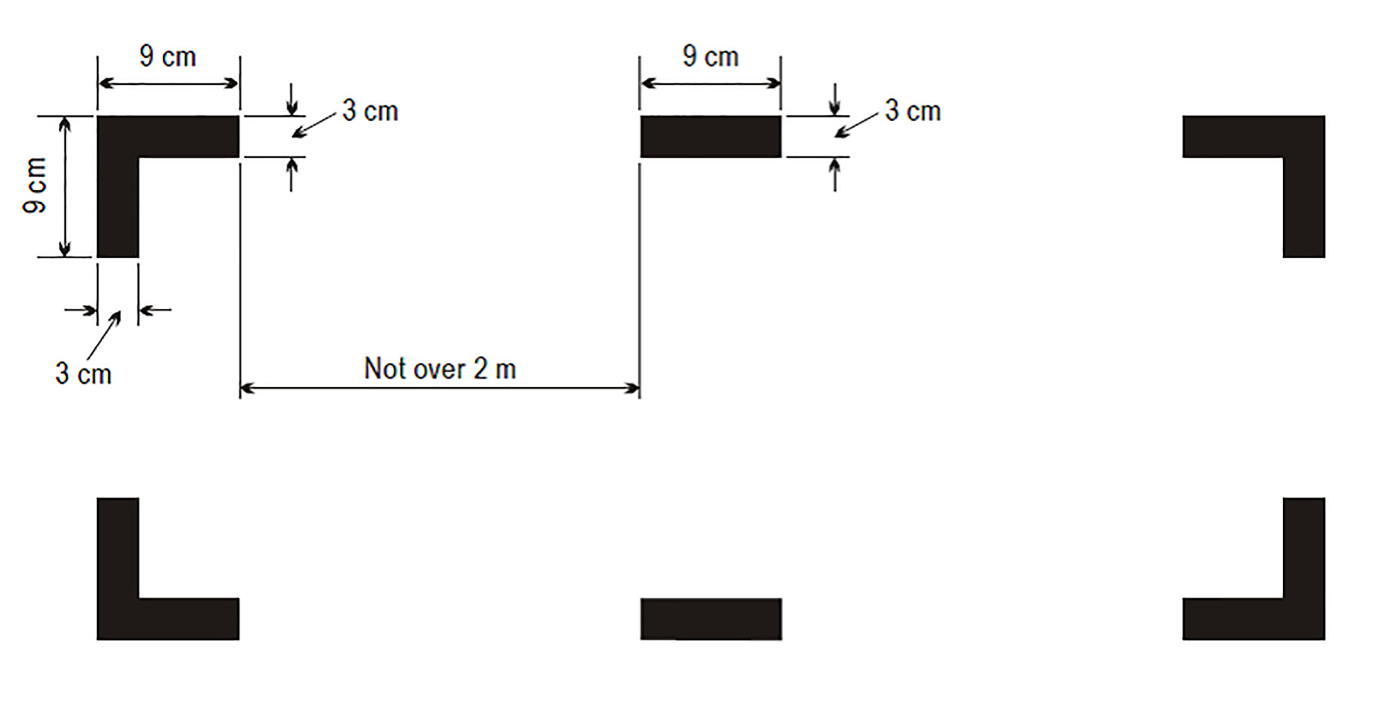
If areas of the helicopter’s fuselage suitable for break-in by rescue crews in an emergency are marked, such areas shall be marked as shown in Figure 1.
Figure 1
Marking of break-in points
AMC1 NCC.IDE.H.210 Marking of break-in points
ED Decision 2013/021/R
MARKINGS – COLOUR AND CORNERS
(a)The colour of the markings should be red or yellow and, if necessary, should be outlined in white to contrast with the background.
(b)If the corner markings are more than 2 m apart, intermediate lines 9 cm x 3 cm should be inserted so that there is no more than 2 m between adjacent markings.
NCC.IDE.H.215 Emergency locator transmitter (ELT)
Regulation (EU) 2016/1199
(a)Helicopters shall be equipped with at least one automatic ELT.
(b)An ELT of any type shall be capable of transmitting simultaneously on 121,5 MHz and 406 MHz.
AMC1 NCC.IDE.H.215 Emergency locator transmitter (ELT)
ED Decision 2013/021/R
ELT BATTERIES
Batteries used in the ELTs should be replaced (or recharged, if the battery is rechargeable) when the equipment has been in use for more than 1 cumulative hour, and also when 50% of their useful life (or for rechargeable, 50% of their useful life of charge), as established by the equipment manufacturer, has expired. The new expiry date for the replacement (or recharged) battery should be legibly marked on the outside of the equipment. The battery useful life (or useful life of charge) requirements of this paragraph do not apply to batteries (such as water-activated batteries) that are essentially unaffected during probable storage intervals.
AMC2 NCC.IDE.H.215 Emergency locator transmitter (ELT)
ED Decision 2021/008/R
TYPES OF ELTs AND GENERAL TECHNICAL SPECIFICATIONS
(a)Point (a) of AMC2 CAT.IDE.H.280 lists the applicable types of ELTs.
(b)To minimise the possibility of damage in the event of crash impact, the automatic ELT should be rigidly fixed to the aircraft structure, as far aft as is practicable, with its antenna and connections arranged so as to maximise the probability of the signal being transmitted after a crash.
(c)Any ELT carried should operate in accordance with the relevant provisions of ICAO Annex 10, Volume III and should be registered with the national agency responsible for initiating search and rescue or other nominated agency.
GM1 NCC.IDE.H.215 Emergency locator transmitter (ELT)
ED Decision 2021/008/R
TERMINOLOGY
GM1 CAT.IDE.H.280 provides explanations of terms used in point NCC.IDE.H.215 and in the related AMC.
GM2 NCC.IDE.H.215 Emergency locator transmitter (ELT)
ED Decision 2021/008/R
ADDITIONAL GUIDANCE
The guidance provided in GM2 CAT.IDE.H.280 is also applicable to point NCC.IDE.H.215.
NCC.IDE.H.225 Life-jackets
Regulation (EU) No 800/2013
(a)Helicopters shall be equipped with a life-jacket for each person on board or equivalent individual floatation device for each person on board younger than 24 months, which shall be worn or stowed in a position that is readily accessible from the seat or berth of the person for whose use it is provided, when:
(1)operated on a flight over water at a distance from land corresponding to more than 10 minutes flying time at normal cruising speed, where in the case of the critical engine failure, the helicopter is able to sustain level flight;
(2)operated on a flight over water beyond autorotational distance from the land, where in the case of critical engine failure, the helicopter is not able to sustain level flight; or
(3)taking off or landing at an aerodrome or operating site where the take-off or approach path is over water.
(b)Each life-jacket or equivalent individual flotation device shall be equipped with a means of electric illumination for the purpose of facilitating the location of persons.
AMC1 NCC.IDE.H.225(a) Life-jackets
ED Decision 2013/021/R
ACCESSIBILITY
The life-jacket should be accessible from the seat or berth of the person for whose use it is provided, with a safety belt or restraint system fastened.
AMC1 NCC.IDE.H.225(b) Life-jackets
ED Decision 2013/021/R
ELECTRIC ILLUMINATION
The means of electric illumination should be a survivor locator light as defined in the applicable ETSO issued by the Agency or equivalent.
GM1 NCC.IDE.H.225 Life-jackets
ED Decision 2013/021/R
SEAT CUSHIONS
Seat cushions are not considered to be flotation devices.
NCC.IDE.H.226 Crew survival suits
Regulation (EU) 2016/1199
Each crew member shall wear a survival suit when so determined by the pilot-in-command based on a risk assessment taking into account the following conditions:
(a)flights over water beyond autorotational distance or safe forced landing distance from land, where in the case of a critical engine failure, the helicopter is not able to sustain level flight; and
(b)the weather report or forecasts available to the commander/pilot-in-command indicate that the sea temperature will be less than plus 10 °C during the flight.
GM1 NCC.IDE.H.226 Crew survival suits
ED Decision 2013/021/R
ESTIMATING SURVIVAL TIME
(a)Introduction
(1)A person accidentally immersed in cold seas (typically offshore Northern Europe) will have a better chance of survival if he/she is wearing an effective survival suit in addition to a life-jacket. By wearing the survival suit, he/she can slow down the rate which his/her body temperature falls and, consequently, protect himself/herself from the greater risk of drowning brought about by incapacitation due to hypothermia.
(2)The complete survival suit system — suit, life-jacket and clothes worn under the suit — should be able to keep the wearer alive long enough for the rescue services to find and recover him/her. In practice the limit is about 3 hours. If a group of persons in the water cannot be rescued within this time, they are likely to have become so scattered and separated that location will be extremely difficult, especially in the rough water typical of Northern European sea areas. If it is expected that in water protection could be required for periods greater than 3 hours, improvements should, rather, be sought in the search and rescue procedures than in the immersion suit protection.
(b)Survival times
(1)The aim should be to ensure that a person in the water can survive long enough to be rescued, i.e. the survival time should be greater than the likely rescue time. The factors affecting both times are shown in Figure 1. The figure emphasises that survival time is influenced by many factors, physical and human. Some of the factors are relevant to survival in cold water and some are relevant in water at any temperature.
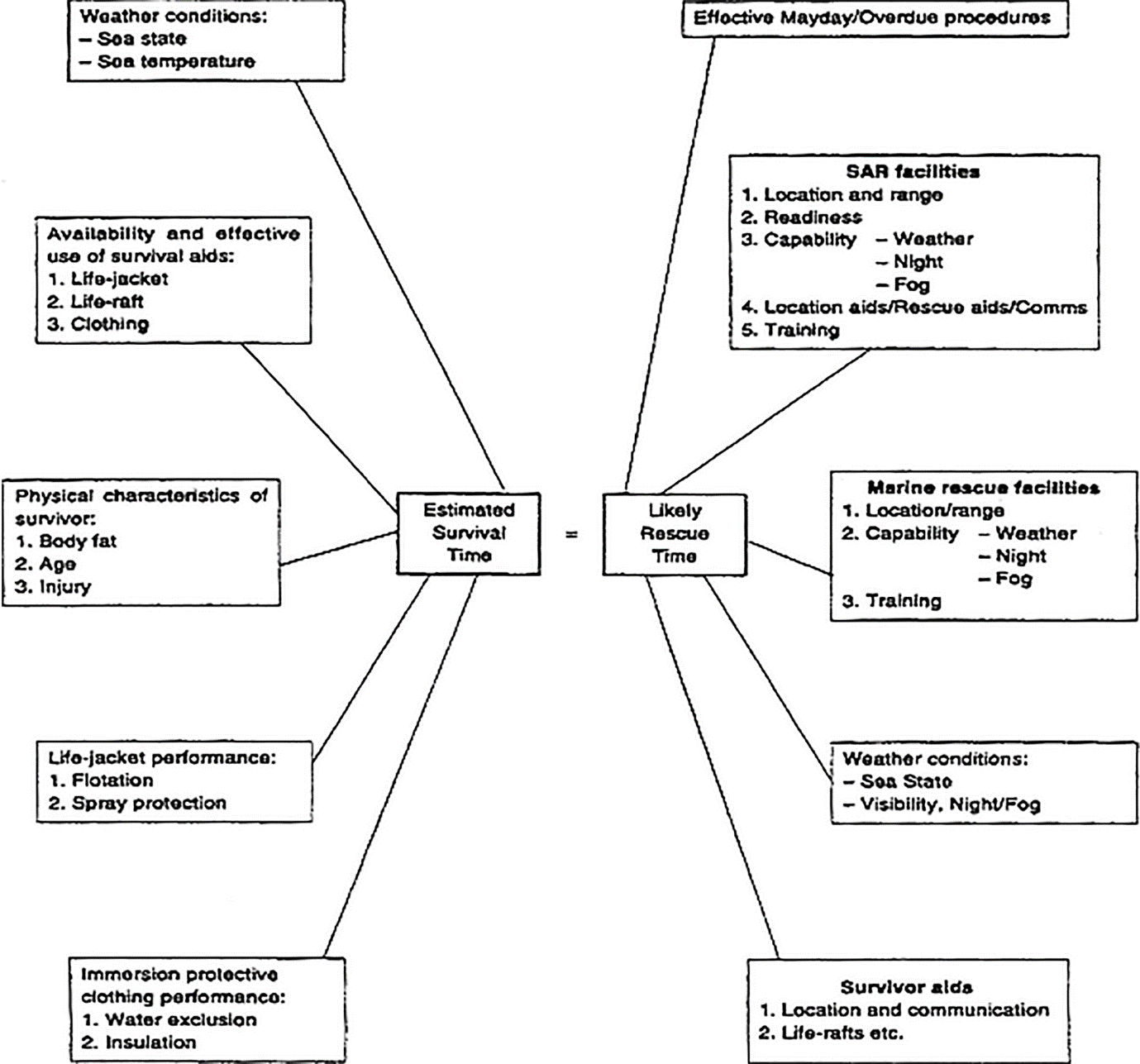
Figure 1: The survival equation
(2)Broad estimates of likely survival times for the thin individual offshore are given in Table 1 below. As survival time is significantly affected by the prevailing weather conditions at the time of immersion, the Beaufort wind scale has been used as an indicator of these surface conditions.
Table 1: Timescale within which the most vulnerable individuals are likely to succumb to the prevailing conditions.
Clothing assembly | Beaufort wind force | Times within which the most vulnerable individuals are likely to drown | |
(water temp 5 °C) | (water temp 13 °C) | ||
Working clothes (no immersion suit) | 0 – 2 | Within ¾ hour | Within 1 ¼ hours |
3 – 4 | Within ½ hour | Within ½ hour | |
5 and above | Significantly less than ½ hour | Significantly less than ½ hour | |
Immersion suit worn over working clothes (with leakage inside suit) | 0 – 2 | May well exceed 3 hours | May well exceed 3 hours |
3 – 4 | Within 2 ¾ hours | May well exceed 3 hours | |
5 and above | Significantly less than 2 ¾ hours. May well exceed 1 hour | May well exceed 3 hours | |
(3)Consideration should also be given to escaping from the helicopter itself should it submerge or invert in the water. In this case, escape time is limited to the length of time the occupants can hold their breath. The breath holding time can be greatly reduced by the effect of cold shock. Cold shock is caused by the sudden drop in skin temperature on immersion, and is characterised by a gasp reflex and uncontrolled breathing. The urge to breath rapidly becomes overwhelming and, if still submerged, the individual will inhale water resulting in drowning. Delaying the onset of cold shock by wearing an immersion suit will extend the available escape time from a submerged helicopter.
(4)The effects of water leakage and hydrostatic compression on the insulation quality of clothing are well recognised. In a nominally dry system the insulation is provided by still air trapped within the clothing fibres and between the layers of suit and clothes. It has been observed that many systems lose some of their insulating capacity either because the clothes under the 'waterproof' survival suit get wet to some extent or because of hydrostatic compression of the whole assembly. As a result of water leakage and compression, survival times will be shortened. The wearing of warm clothing under the suit is recommended.
(5)Whatever type of survival suit and other clothing is provided, it should not be forgotten that significant heat loss can occur from the head.
NCC.IDE.H.227 Life-rafts, survival ELTs and survival equipment on extended overwater flights
Regulation (EU) No 800/2013
Helicopters operated:
(a)on a flight over water at a distance from land corresponding to more than 10 minutes flying time at normal cruising speed, where in the case of the critical engine failure, the helicopter is able to sustain level flight; or
(b)on a flight over water at a distance corresponding to more than 3 minutes flying time at normal cruising speed, where in the case of the critical engine failure, the helicopter is not able to sustain level flight, and if so determined by the pilot-in-command by means of a risk assessment;
shall be equipped with:
(1)in the case of a helicopter carrying less than 12 persons, at least one life-raft with a rated capacity of not less than the maximum number of persons on board, stowed so as to facilitate their ready use in emergency;
(2)in the case of a helicopter carrying more than 11 persons, at least two life-rafts, stowed so as to facilitate their ready use in an emergency, sufficient together to accommodate all persons capable of being carried on board and, if one is lost the remaining life-raft(s) having the overload capacity sufficient to accommodate all persons on the helicopter;
(3)at least one survival ELT (ELT(S)) for each required life-raft; and
(4)life-saving equipment, including means of sustaining life, as appropriate to the flight to be undertaken.
AMC1 NCC.IDE.H.227 Life-rafts, survival ELTs and survival equipment on extended overwater flights
ED Decision 2013/021/R
LIFE-RAFTS AND EQUIPMENT FOR MAKING DISTRESS SIGNALS
(a)Each required life-raft should conform to the following specifications:
(1)be of an approved design and stowed so as to facilitate their ready use in an emergency;
(2)be radar conspicuous to standard airborne radar equipment;
(3)when carrying more than one life-raft on board, at least 50 % of the rafts should be able to be deployed by the crew while seated at their normal station, where necessary by remote control; and
(4)life-rafts that are not deployable by remote control or by the crew should be of such weight as to permit handling by one person. 40 kg should be considered a maximum weight.
(b)Each required life-raft should contain at least the following:
(1)one approved survivor locator light;
(2)one approved visual signalling device;
(3)one canopy (for use as a sail, sunshade or rain catcher) or other means to protect occupants from the elements;
(4)one radar reflector;
(5)one 20 m retaining line designed to hold the life-raft near the helicopter but to release it if the helicopter becomes totally submerged;
(6)one sea anchor; and
(7)one survival kit, appropriately equipped for the route to be flown, which should contain at least the following:
(i)one life-raft repair kit;
(ii)one bailing bucket;
(iii)one signalling mirror;
(iv)one police whistle;
(v)one buoyant raft knife;
(vi)one supplementary means of inflation;
(vii)sea sickness tablets;
(viii)one first-aid kit;
(ix)one portable means of illumination;
(x)500 ml of pure water and one sea water desalting kit; and
(xi)one comprehensive illustrated survival booklet in an appropriate language.
AMC1 NCC.IDE.H.227(b)(3) Life rafts, survival ELTs, and survival equipment on extended overwater flights
ED Decision 2021/008/R
SURVIVAL ELT
AMC1 CAT.IDE.H.300(b)(3) & CAT.IDE.H.305(b) provides the types of ELT that may be installed on a required life raft.
NCC.IDE.H.230 Survival equipment
Regulation (EU) No 800/2013
Helicopters operated over areas in which search and rescue would be especially difficult shall be equipped with:
(a)signalling equipment to make distress signals;
(b)at least one survival ELT (ELT(S)); and
(c)additional survival equipment for the route to be flown taking account of the number of persons on board.
AMC1 NCC.IDE.H.230 Survival equipment
ED Decision 2013/021/R
ADDITIONAL SURVIVAL EQUIPMENT
(a)The following additional survival equipment should be carried when required:
(1)500 ml of water for each four, or fraction of four, persons on board;
(2)one knife;
(3)first-aid equipment; and
(4)one set of air/ground codes.
(b)In addition, when polar conditions are expected, the following should be carried:
(1)a means of melting snow;
(2)one snow shovel and one ice saw;
(3)sleeping bags for use by 1/3 of all persons on board and space blankets for the remainder or space blankets for all passengers on board; and
(4)one arctic/polar suit for each crew member carried.
(c)If any item of equipment contained in the above list is already carried on board the aircraft in accordance with another requirement, there is no need for this to be duplicated.
AMC2 NCC.IDE.H.230 Survival equipment
ED Decision 2013/021/R
SURVIVAL ELT
An ELT(AP) may be used to replace one required ELT(S) provided that it meets the ELT(S) requirements. A water-activated ELT(S) is not an ELT(AP).
GM1 NCC.IDE.H.230 Survival equipment
ED Decision 2013/021/R
SIGNALLING EQUIPMENT
The signalling equipment for making distress signals is described in ICAO Annex 2, Rules of the Air.
GM2 NCC.IDE.H.230 Survival equipment
ED Decision 2013/021/R
AREAS IN WHICH SEARCH AND RESCUE WOULD BE ESPECIALLY DIFFICULT
The expression ‘areas in which search and rescue would be especially difficult’ should be interpreted, in this context, as meaning:
(a)areas so designated by the competent authority responsible for managing search and rescue; or
(b)areas that are largely uninhabited and where:
(1)the authority referred to in (a) has not published any information to confirm whether search and rescue would be or would not be especially difficult; and
(2)the authority referred to in (a) does not, as a matter of policy, designate areas as being especially difficult for search and rescue.
NCC.IDE.H.232 Helicopters certified for operating on water – miscellaneous equipment
Regulation (EU) No 800/2013
Helicopters certified for operating on water shall be equipped with:
(a)a sea anchor and other equipment necessary to facilitate mooring, anchoring or manoeuvring the helicopter on water, appropriate to its size, weight and handling characteristics; and
(b)equipment for making the sound signals prescribed in the International Regulations for Preventing Collisions at Sea, where applicable.
GM1 NCC.IDE.H.232 Helicopters certificated for operating on water – Miscellaneous equipment
ED Decision 2015/003/R
INTERNATIONAL REGULATIONS FOR PREVENTING COLLISIONS AT SEA
International Regulations for Preventing Collisions at Sea are those that were published by the International Maritime Organisation (IMO) in 1972.
NCC.IDE.H.235 All helicopters on flights over water – ditching
Regulation (EU) 2019/1384
Helicopters shall be designed for landing on water or certified for ditching in accordance with the relevant certification specifications or fitted with emergency flotation equipment when operated on a flight over water in a hostile environment at a distance from land corresponding to more than 10 minutes flying time at normal cruising speed.
AMC1 NCC.IDE.H.235 All helicopters on flight over water – ditching
ED Decision 2016/022/R
The considerations of AMC1 SPA.HOFO.165(d) should apply in respect of emergency flotation equipment.
NCC.IDE.H.240 Headset
Regulation (EU) No 800/2013
Whenever a radio communication and/or radio navigation system is required, helicopters shall be equipped with a headset with boom microphone or equivalent and a transmit button on the flight controls for each required pilot and/or crew member at his/her assigned station.
AMC1 NCC.IDE.H.240 Headset
ED Decision 2013/021/R
GENERAL
(a)A headset consists of a communication device that includes two earphones to receive and a microphone to transmit audio signals to the helicopter’s communication system. To comply with the minimum performance requirements, the earphones and microphone should match the communication system’s characteristics and the flight crew compartment environment. The headset should be adequately adjustable in order to fit the flight crew’s head. Headset boom microphones should be of the noise cancelling type.
(b)If the intention is to utilise noise cancelling earphones, the operator should ensure that the earphones do not attenuate any aural warnings or sounds necessary for alerting the flight crew on matters related to the safe operation of the helicopter.
GM1 NCC.IDE.H.240 Headset
ED Decision 2013/021/R
GENERAL
The term ‘headset’ includes any aviation helmet incorporating headphones and microphone worn by a flight crew member.
NCC.IDE.H.245 Radio communication equipment
Regulation (EU) No 800/2013
(a)Helicopters operated under IFR or at night, or when required by the applicable airspace requirements, shall be equipped with radio communication equipment that, under normal radio propagating conditions, shall be capable of:
(1)conducting two-way communication for aerodrome control purposes;
(2)receiving meteorological information;
(3)conducting two-way communication at any time during flight with those aeronautical stations and on those frequencies prescribed by the appropriate authority; and
(4)providing for communication on the aeronautical emergency frequency 121,5 MHz.
(b)When more than one communications equipment unit is required, each shall be independent of the other or others to the extent that a failure in any one will not result in failure of any other.
(c)When a radio communication system is required, and in addition to the flight crew interphone system required in NCC.IDE.H.155, helicopters shall be equipped with a transmit button on the flight controls for each required pilot and crew member at his/her assigned station.
GM1 NCC.IDE.H.245 Radio communication equipment
ED Decision 2013/021/R
APPLICABLE AIRSPACE REQUIREMENTS
For helicopters being operated under European air traffic control, the applicable airspace requirements include the Single European Sky legislation.
NCC.IDE.H.250 Navigation equipment
Regulation (EU) 2019/1384
(a)Helicopters shall be equipped with navigation equipment that will enable them to proceed in accordance with:
(1)the ATS flight plan, if applicable; and
(2)the applicable airspace requirements.
(b)Helicopters shall have sufficient navigation equipment to ensure that, in the event of the failure of one item of equipment at any stage of the flight, the remaining equipment shall allow safe navigation in accordance with (a), or an appropriate contingency action, to be completed safely.
(c)Helicopters operated on flights in which it is intended to land in IMC shall be equipped with navigation equipment capable of providing guidance to a point from which a visual landing can be performed. This equipment shall be capable of providing such guidance for each aerodrome at which it is intended to land in IMC and for any designated alternate aerodromes.
(d)When PBN is required the aircraft shall meet the airworthiness certification requirements for the appropriate navigation specification.
(e)Helicopters shall be equipped with surveillance equipment in accordance with the applicable airspace requirements.
GM1 NCC.IDE.H.250 Navigation equipment
ED Decision 2016/017/R
AIRCRAFT ELIGIBILITY FOR PBN SPECIFICATION NOT REQUIRING SPECIFIC APPROVAL
(a)The performance of the aircraft is usually stated in the AFM.
(b)Where such a reference cannot be found in the AFM, other information provided by the aircraft manufacturer as TC holder, the STC holder or the design organisation having a privilege to approve minor changes may be considered.
(c)The following documents are considered acceptable sources of information:
(1)AFM, supplements thereto and documents directly referenced in the AFM;
(2)FCOM or similar document;
(3)Service Bulletin or Service Letter issued by the TC holder or STC holder;
(4)approved design data or data issued in support of a design change approval;
(5)any other formal document issued by the TC or STC holders stating compliance with PBN specifications, AMC, Advisory Circulars (AC) or similar documents issued by the State of Design; and
(6)written evidence obtained from the State of Design.
(d)Equipment qualification data, in itself, is not sufficient to assess the PBN capabilities of the aircraft, since the latter depend on installation and integration.
(e)As some PBN equipment and installations may have been certified prior to the publication of the PBN Manual and the adoption of its terminology for the navigation specifications, it is not always possible to find a clear statement of aircraft PBN capability in the AFM. However, aircraft eligibility for certain PBN specifications can rely on the aircraft performance certified for PBN procedures and routes prior to the publication of the PBN Manual.
(f)Below, various references are listed which may be found in the AFM or other acceptable documents (see listing above) in order to consider the aircraft’s eligibility for a specific PBN specification if the specific term is not used.
(g)RNAV 5
(1)If a statement of compliance with any of the following specifications or standards is found in the acceptable documentation as listed above, the aircraft is eligible for RNAV 5 operations.
(i)B-RNAV;
(ii)RNAV 1;
(iii)RNP APCH;
(iv)RNP 4;
(v)A-RNP;
(vi)AMC 20-4;
(vii)JAA TEMPORARY GUIDANCE MATERIAL, LEAFLET NO. 2 (TGL 2);
(viii)JAA AMJ 20X2;
(ix)FAA AC 20-130A for en route operations;
(x)FAA AC 20-138 for en route operations; and
(xi)FAA AC 90-96.
(h)RNAV 1/RNAV 2
(1)If a statement of compliance with any of the following specifications or standards is found in the acceptable documentation as listed above, the aircraft is eligible for RNAV 1/RNAV 2 operations.
(i)RNAV 1;
(ii)PRNAV;
(iii)US RNAV type A;
(iv)FAA AC 20-138 for the appropriate navigation specification;
(v)FAA AC 90-100A;
(vi)JAA TEMPORARY GUIDANCE MATERIAL, LEAFLET NO. 10 Rev1 (TGL 10); and
(vii)FAA AC 90-100.
(2)However, if position determination is exclusively computed based on VOR-DME, the aircraft is not eligible for RNAV 1/RNAV 2 operations.
(i)RNP 1/RNP 2 continental
(1)If a statement of compliance with any of the following specifications or standards is found in the acceptable documentation as listed above, the aircraft is eligible for RNP 1/RNP 2 continental operations.
(i)A-RNP;
(ii)FAA AC 20-138 for the appropriate navigation specification; and
(iii)FAA AC 90-105.
(2)Alternatively, if a statement of compliance with any of the following specifications or standards is found in the acceptable documentation as listed above and position determination is primarily based on GNSS, the aircraft is eligible for RNP 1/RNP 2 continental operations. However, in these cases, loss of GNSS implies loss of RNP 1/RNP 2 capability.
(i)JAA TEMPORARY GUIDANCE MATERIAL, LEAFLET NO. 10 (TGL 10) (any revision); and
(ii)FAA AC 90-100.
(j)RNP APCH — LNAV minima
(1)If a statement of compliance with any of the following specifications or standards is found in the acceptable documentation as listed above, the aircraft is eligible for RNP APCH — LNAV operations.
(i)A-RNP;
(ii)AMC 20-27;
(iii)AMC 20-28;
(iv)FAA AC 20-138 for the appropriate navigation specification; and
(v)FAA AC 90-105 for the appropriate navigation specification.
(2)Alternatively, if a statement of compliance with RNP 0.3 GNSS approaches in accordance with any of the following specifications or standards is found in the acceptable documentation as listed above, the aircraft is eligible for RNP APCH — LNAV operations. Any limitation such as ‘within the US National Airspace’ may be ignored since RNP APCH procedures are assumed to meet the same ICAO criteria around the world.
(i)JAA TEMPORARY GUIDANCE MATERIAL, LEAFLET NO. 3 (TGL 3);
(ii)AMC 20-4;
(iii)FAA AC 20-130A; and
(iv)FAA AC 20-138.
(k)RNP APCH — LNAV/VNAV minima
(1)If a statement of compliance with any of the following specifications or standards is found in the acceptable documentation as listed above, the aircraft is eligible for RNP APCH — LNAV/VNAV operations.
(i)A-RNP;
(ii)AMC 20-27 with Baro VNAV;
(iii)AMC 20-28;
(iv)FAA AC 20-138; and
(v)FAA AC 90-105 for the appropriate navigation specification.
(2)Alternatively, if a statement of compliance with FAA AC 20-129 is found in the acceptable documentation as listed above, and the aircraft complies with the requirements and limitations of EASA SIB 2014-0496, the aircraft is eligible for RNP APCH — LNAV/VNAV operations. Any limitation such as ‘within the US National Airspace’ may be ignored since RNP APCH procedures are assumed to meet the same ICAO criteria around the world.
(l)RNP APCH — LPV minima
(1)If a statement of compliance with any of the following specifications or standards is found in the acceptable documentation as listed above, the aircraft is eligible for RNP APCH — LPV operations.
(i)AMC 20-28;
(ii)FAA AC 20-138 for the appropriate navigation specification; and
(iii)FAA AC 90-107.
(2)For aircraft that have a TAWS Class A installed and do not provide Mode-5 protection on an LPV approach, the DH is limited to 250 ft.
(m)RNAV 10
(1)If a statement of compliance with any of the following specifications or standards is found in the acceptable documentation as listed above, the aircraft is eligible for RNAV 10 operations.
(i)RNP 10;
(ii)FAA AC 20-138 for the appropriate navigation specification;
(iii)AMC 20-12;
(iv)FAA Order 8400.12 (or later revision); and
(v)FAA AC 90-105.
(n)RNP 4
(1)If a statement of compliance with any of the following specifications or standards is found in the acceptable documentation as listed above, the aircraft is eligible for RNP 4 operations.
(i)FAA AC 20-138B or later, for the appropriate navigation specification;
(ii)FAA Order 8400.33; and
(iii)FAA AC 90-105 for the appropriate navigation specification.
(o)RNP 2 oceanic
(1)If a statement of compliance with FAA AC 90-105 for the appropriate navigation specification is found in the acceptable documentation as listed above, the aircraft is eligible for RNP 2 oceanic operations.
(2)If the aircraft has been assessed eligible for RNP 4, the aircraft is eligible for RNP 2 oceanic.
(p)Special features
(1)RF in terminal operations (used in RNP 1 and in the initial segment of the RNP APCH)
(i)If a statement of demonstrated capability to perform an RF leg, certified in accordance with any of the following specifications or standards, is found in the acceptable documentation as listed above, the aircraft is eligible for RF in terminal operations.
(A)AMC 20-26; and
(B)FAA AC 20-138B or later.
(ii)If there is a reference to RF and a reference to compliance with AC 90-105, then the aircraft is eligible for such operations.
(q)Other considerations
(1)In all cases, the limitations in the AFM need to be checked, in particular the use of AP or FD which can be required to reduce the FTE primarily for RNP APCH, RNAV 1, and RNP 1.
(2)Any limitation such as ‘within the US National Airspace’ may be ignored since RNP APCH procedures are assumed to meet the same ICAO criteria around the world.
GM2 NCC.IDE.H.250 Navigation equipment
ED Decision 2016/017/R
GENERAL
(a)The PBN specifications for which the aircraft complies with the relevant airworthiness criteria are set out in the AFM, together with any limitations to be observed.
(b)Because functional and performance requirements are defined for each navigation specification, an aircraft approved for an RNP specification is not automatically approved for all RNAV specifications. Similarly, an aircraft approved for an RNP or RNAV specification having a stringent accuracy requirement (e.g. RNP 0.3 specification) is not automatically approved for a navigation specification having a less stringent accuracy requirement (e.g. RNP 4).
RNP 4
(c)For RNP 4, at least two LRNSs, capable of navigating to RNP 4, and listed in the AFM, may be operational at the entry point of the RNP 4 airspace. If an item of equipment required for RNP 4 operations is unserviceable, then the flight crew may consider an alternate route or diversion for repairs. For multi-sensor systems, the AFM may permit entry if one GNSS sensor is lost after departure, provided one GNSS and one inertial sensor remain available.
NCC.IDE.H.255 Transponder
Regulation (EU) No 800/2013
Helicopters shall be equipped with a pressure altitude reporting secondary surveillance radar (SSR) transponder and any other SSR transponder capability required for the route being flown.
AMC1 NCC.IDE.H.255 Transponder
ED Decision 2013/021/R
SSR TRANSPONDER
(a)The secondary surveillance radar (SSR) transponders of helicopters being operated under European air traffic control should comply with any applicable Single European Sky legislation.
(b)If the Single European Sky legislation is not applicable, the SSR transponders should operate in accordance with the relevant provisions of Volume IV of ICAO Annex 10.
NCC.IDE.H.260 Management of aeronautical databases
Regulation (EU) 2016/1199
(a)Aeronautical databases used on certified aircraft system applications shall meet data quality requirements that are adequate for the intended use of the data.
(b)The operator shall ensure the timely distribution and insertion of current and unaltered aeronautical databases to all aircraft that require them.
(c)Notwithstanding any other occurrence reporting requirements as defined in Regulation (EU) No 376/2014, the operator shall report to the database provider instances of erroneous, inconsistent or missing data that might be reasonably expected to constitute a hazard to flight.
In such cases, the operator shall inform flight crew and other personnel concerned, and shall ensure that the affected data is not used.
AMC1 NCC.IDE.H.260 Management of aeronautical databases
ED Decision 2017/003/R
AERONAUTICAL DATABASES
When the operator of an aircraft uses an aeronautical database that supports an airborne navigation application as a primary means of navigation used to meet the airspace usage requirements, the database provider should be a Type 2 DAT provider certified in accordance with Regulation (EU) 2017/373 or equivalent.
GM1 NCC.IDE.H.260 Management of aeronautical databases
ED Decision 2017/003/R
AERONAUTICAL DATABASE APPLICATIONS
(a)Applications using aeronautical databases for which Type 2 DAT providers should be certified in accordance with Regulation (EU) 2017/373 may be found in GM1 DAT.OR.100.
(b)The certification of a Type 2 DAT provider in accordance with Regulation (EU) 2017/373 ensures data integrity and compatibility with the certified aircraft application/equipment.
GM2 NCC.IDE.H.260 Management of aeronautical databases
ED Decision 2017/003/R
TIMELY DISTRIBUTION
The operator should distribute current and unaltered aeronautical databases to all aircraft requiring them in accordance with the validity period of the databases or in accordance with a procedure established in the operations manual if no validity period is defined.
GM3 NCC.IDE.H.260 Management of aeronautical databases
ED Decision 2017/003/R
STANDARDS FOR AERONAUTICAL DATABASES AND DAT PROVIDERS
(a)A ‘Type 2 DAT provider’ is an organisation as defined in Article 2(5)(b) of Regulation (EU) 2017/373.
(b)Equivalent to a certified ‘Type 2 DAT provider’ is defined in any Aviation Safety Agreement between the European Union and a third country, including any Technical Implementation Procedures, or any Working Arrangements between EASA and the competent authority of a third country.