
Filters
AMC1 UAM.OP.MVCA.160 Stowage of baggage and cargo
ED Decision 2025/010/R
STOWAGE PROCEDURES
The procedures established by the operator to ensure that baggage and cargo are adequately and securely stowed should take the following into account:
(a)each item should be stowed only at a location that can restrain it;
(b)weight limitations placarded on or adjacent to stowages should not be exceeded;
(c)under seat stowage should not be used unless the seat is equipped with a restraint bar and the baggage is of such size that it may adequately be restrained by such equipment;
(d)baggage and cargo should not be placed at locations where they could impede access to emergency equipment.
AMC2 UAM.OP.MVCA.160 Stowage of baggage and cargo
ED Decision 2025/010/R
CARRIAGE OF CARGO IN THE PASSENGER COMPARTMENT
The following should be observed when carrying cargo in the passenger compartment of a VCA:
(a)dangerous goods should not be allowed;
(b)the mass of cargo should not exceed the structural loading limits of the floor or seats;
(c)the number/type of restraint devices and their attachment points should be capable of restraining the cargo; and
(d)the location of the cargo should be such that, in the event of an emergency evacuation, it will neither hinder egress nor impair the crew’s view.
GM1 UAM.OP.MVCA.160 Stowage of baggage and cargo
ED Decision 2025/010/R
THE TERM ‘CARGO’
The term ‘cargo’ in point UAM.OP.MVCA.160(b) refers to anything that belongs to a passenger travelling but is not a piece of luggage (e.g. a musical instrument that may have to be restrained to the seat). Thus, point UAM.OP.MVCA.160(b) does not provide for the use of the cabin as cargo compartment.
UAM.OP.MVCA.165 Passenger seating
Regulation (EU) 2024/1111
With regard to potential emergency evacuation, the IAM operator shall establish procedures for passenger seating to ensure that passengers are seated where they will be able to assist the evacuation, and not impede it.
AMC1 UAM.OP.MVCA.165 Passenger seating
ED Decision 2025/010/R
PROCEDURES OF THE VCA OPERATOR
(a)The operator’s procedures regarding the allocation and occupation of seats giving direct access to an emergency exit should contain instructions that those seats be allocated in a non-discriminatory manner, consistent with the applicable requirements, to passengers who will be able to assist the flight crew and/or other passengers during evacuation.
(b)Passengers who, due to their condition, might hinder other passengers during evacuation or who might impede the flight crew in carrying out their duties, should not be allocated seats that permit direct access to emergency exits. Those passengers may be allowed to occupy such seats on the condition that each of the seats in the VCA gives direct access to an emergency exit and the operator has assessed the operational safety risks, considering among others whether this may impede the flight crew in carrying out their duties.
(c)The operator’s procedures should identify the person(s) designated by the VCA operator to determine passenger seating next to emergency exits.
UAM.OP.MVCA.170 Passenger briefing
Regulation (EU) 2024/1111
The IAM operator shall ensure that passengers are:
(a)given safety briefings and safety demonstrations in a manner that facilitates the execution of the applicable procedures in the event of an emergency; and
(b)provided with safety briefing material on which picture-type instructions indicate the operation of emergency equipment and emergency exits likely to be used by passengers.
AMC1 UAM.OP.MVCA.170 Passenger briefing
ED Decision 2025/010/R
PASSENGER BRIEFING AND SAFETY DEMONSTRATION
(a)Passenger briefing and safety demonstration should contain instructions on the following items, as applicable for the intended operation:
(1)the use of safety belts or restraint systems, including instructions on how to fasten and unfasten them;
(2)the location of emergency exits;
(3)the location and use of oxygen equipment, if carried on board; passengers should also be briefed on how to extinguish all smoking materials (e.g. cigarettes, cigars, vapes, etc.) when oxygen is being used;
(4)the location and use of life jackets, if carried on board;
(5)the location and use of handheld fire extinguishers, if carried in the passenger compartment;
(6)emergency lighting and marking;
(7)any cabin secured aspects, e.g. required position of seatbacks, tray tables, footrests, window blinds, etc., as applicable;
(8)correct stowage of baggage and the importance of leaving baggage behind in case of evacuation;
(9)the use and stowage of portable electronic devices (PEDs), including in-flight entertainment (IFE) systems;
(10)non-smoking instructions;
(11)the radial component of the downwash around the VCA;
(12)the use of life rafts and survival equipment, if carried on board.
(b)Passengers occupying seats with direct access to emergency exits should receive additional briefing on the operation and use of the emergency exit, assessment of the surrounding conditions for the safe use of the emergency exit, and recognition of emergency commands given by the crew.
(c)In addition to points (a) and (b), passengers should be instructed during flight in case of emergency, as appropriate to the circumstances.
AMC2 UAM.OP.MVCA.170 Passenger briefing
ED Decision 2025/010/R
PASSENGER BRIEFING AND SAFETY DEMONSTRATION
Briefing/demonstration referred to in AMC1 CAT.OP.MPA.170(a) should not be replaced by other means unless:
(a)the operator has developed a passenger training programme covering all safety and emergency procedures for a given VCA type; and
(b)only passengers who have been trained according to this programme and have flown on the VCA type within the last 90 days are carried on board without receiving briefing/demonstration.
AMC3 UAM.OP.MVCA.170 Passenger briefing
ED Decision 2025/010/R
PASSENGER BRIEFING IN SINGLE-PILOT OPERATIONS
(a)In single-pilot operations, passengers should be briefed:
(1)by ground personnel designated by the operator; or
(2)by the PIC, except during the critical phases of flight.
(b)In single-pilot operations, passengers may be briefed by means of audio instruction and/or safety video presentation either on ground or in the aircraft.
AMC4 UAM.OP.MVCA.170 Passenger briefing
ED Decision 2025/010/R
IN-FLIGHT ENTERTAINMENT (IFE) SYSTEMS
When IFE systems are available by means of equipment that can be handled by passengers, including PEDs provided by the operator for the purpose of IFE, appropriate information containing at least the following should be provided to passengers:
(a)instructions on how to safely operate the IFE system for personal use in normal conditions;
(b)restrictions, including stowage of retractable or loose items of equipment (e.g. screens or remote controls) during taxiing, take-off and landing, and in abnormal or emergency conditions.
GM1 UAM.OP.MVCA.170 Passenger briefing
ED Decision 2025/010/R
SAFETY BRIEFING MATERIAL
Useful guidance on safety briefing material may be found in GM2 CAT.OP.MVCA.170.
UAM.OP.MVCA.175 Flight preparation
Regulation (EU) 2024/1111
(a)An operational flight plan (OFP) shall be completed for each intended flight, taking into account the airspace in which the flight is to be conducted and the applicable rules of the air, aircraft performance, operating limitations, and relevant expected conditions along the route to be flown and at the vertiport or diversion location to be used.
(b)The flight shall not be commenced unless the PIC is satisfied that:
(1)all items stipulated in point 2.c of Annex V to Regulation (EU) 2018/1139 concerning the airworthiness and registration of the aircraft, instrument and equipment, mass and centre of gravity (CG) location, baggage and cargo, and aircraft operating limitations can be complied with;
(2)the aircraft is not operated against the requirements of the configuration deviation list (CDL);
(3)the parts of the operations manual (OM) that are required for the conduct of the planned flight are available;
(4)the documents, additional information and forms required to be available by point IAM.GEN.MVCA.180 are on board, unless permitted to be kept on the ground in accordance with point IAM.GEN.MVCA.181;
(5)current maps, charts and associated documentation or equivalent data are available for the intended operation of the aircraft, including any diversion that may reasonably be expected;
(6)space-based facilities, ground facilities and services that are required for the planned flight are available and adequate;
(7)the applicable requirements specified in the OM in respect of fuel/energy, oil, oxygen, minimum flight altitudes, vertiport operating minima, visibility and distance from cloud minima for VFR flights by day and the selection of adequate vertiports and diversion locations can be complied with for the planned flight;
(8)Reserved;
(9)any additional operational limitations can be complied with;
(10)any load carried is properly distributed and safely secured;
(11)an air traffic service (ATS) flight plan has been approved and flight clearance has been granted in accordance with the applicable rules of the air and the class(es) of airspace in which the operation will be conducted.
AMC1 UAM.OP.MVCA.175 Flight preparation
ED Decision 2025/010/R
OPERATIONAL FLIGHT PLAN
(a)The operational flight plan used and the entries made during flight should contain the following items:
(1)VCA registration;
(2)VCA type and variant;
(3)date of flight;
(4)flight identification;
(5)name(s) of the flight crew member(s);
(6)duty assignment of the flight crew member(s);
(7)place (vertiport) of departure;
(8)time of departure (actual off-block time, take-off time);
(9)place (vertiport) of arrival (planned and actual);
(10)time of arrival (actual landing and on-block time);
(11)type of operation (VFR day; commercial air transport operation, VEMS, non-commercial operation, training flight, etc.);
(12)route and route segments with checkpoints/waypoints, distances, time and tracks;
(13)planned cruising speed and flying times between checkpoints/waypoints (estimated, revised, and actual times overhead);
(14)minimum flight altitudes and minimum levels;
(15)planned altitudes and flight levels;
(16)fuel/energy calculations (records of in-flight fuel/energy checks);
(17)fuel/energy on board when powering on lift and thrust units;
(18)safe landing options at the point of commitment;
(19)vertiports or diversion locations along the route for the purpose of diversion;
(20)initial ATS flight plan clearance and subsequent reclearance, if applicable;
(21)in-flight replanning calculations; and
(22)meteorological information, as specified in point (a) of point MET.TR.215 of Part-MET.
(b)Items that are readily available in other documentation or from another acceptable source or are irrelevant to the type of operation may be omitted in the operational flight plan.
(c)The operational flight plan and its use should be described in the operations manual.
(d)All entries in the operational flight plan should be made concurrently and be permanent in nature.
OPERATIONAL FLIGHT PLAN — VEMS AND LOCAL AREA OPERATIONS
(e)For VEMS and local area operations with VCA, the operational flight plan may be established in a simplified form. Local area operations should be defined in the operations manual.
(f)No entries should be required in the operational flight plan during the flight.
OPERATIONAL FLIGHT PLAN PRODUCED BY A COMPUTERISED FLIGHT-PLANNING SYSTEM
(g)When the IAM operator uses a computerised flight-planning system to produce an operational flight plan, the functionality of this system should be described in the operations manual.
(h)If the computerised flight-planning system is used in conjunction with energy level calculations and checks, the proper functionality of the software should be tested after each upgrade. The test should verify that the changes to the software do not affect the final output.
GM1 UAM.OP.MVCA.175 Flight preparation
ED Decision 2025/010/R
CONVERSION TABLES
The documentation should include any conversion tables necessary to support operations where metric heights, altitudes and flight levels are used.
UAM.OP.MVCA.177 Submission of an air traffic services (ATS) flight plan
Regulation (EU) 2024/1111
(a)The IAM operator shall submit an ATS flight plan as required by the applicable rules of the air for the class(es) of airspace in which the operation will be conducted.
(b)If the submission of an ATS flight plan is not required by the applicable rules of the air for the class(es) of airspace in which the operation will be conducted, the IAM operator shall ensure that adequate information is deposited with the appropriate ATS unit to permit alerting services to be activated if necessary.
(c)If the submission of an ATS flight plan is required but it is impossible to submit it from the site where the operation starts, the ATS flight plan shall be transmitted as soon as possible after take-off by the PIC or the IAM operator.
AMC1 UAM.OP.MVCA.177 Submission of an air traffic services (ATS) flight plan
ED Decision 2025/010/R
FLIGHT WITHOUT AN ATS FLIGHT PLAN
(a)When unable to submit or close the ATS flight plan, the operator should establish procedures, instructions, and a list of nominated persons to be responsible for alerting search and rescue (SAR) services.
(b)To ensure that each flight is located at all times, these instructions should:
(1)provide the nominated person(s) with at least the information required to be included in a VFR flight plan, and the location, date, and estimated time for re-establishing communications;
(2)if a VCA is overdue or missing, ensure that the appropriate ATS or SAR service is notified; and
(3)ensure that the information will be retained at a designated location until the completion of the flight.
UAM.OP.MVCA.192 Fuel/energy scheme – selection of vertiports and diversion locations
Regulation (EU) 2024/1111
(a)The PIC shall select and specify in the operational flight plan and, if so required, in the ATS flight plan, for normal operations, including training, and for the purpose of diversion:
(1)at least two safe landing options at the destination, which may be reached from the point of commitment for landing; and
(2)one or more vertiports or diversion locations to ensure safe landing in case a diversion is necessary following a CFP at any moment during the flight.
(b)For the purpose of selecting vertiports and diversion locations in accordance with point (a), the PIC shall consider whether:
(1)the actual and forecast weather conditions indicate that at the estimated time of use the conditions at the selected vertiports and diversion locations will be at or above the applicable minima established in accordance with point UAM.OP.MVCA.111;
(2)the CMP of the VCA allows for safe landing at the selected vertiports or diversion locations;
(3)any required additional operational approvals are held.
(c)The PIC shall apply appropriate safety margins to flight planning to take possible deterioration of the meteorological conditions into account at the estimated time of landing compared to the available forecast.
AMC1 UAM.OP.MVCA.192 Fuel/energy scheme — selection of vertiports and diversion locations
ED Decision 2025/010/R
ACCESS TO INFORMATION
The IAM operator should ensure that the PIC has access to up-to-date information regarding vertiports and diversion locations, including their operational status and meteorological conditions.
AMC2 UAM.OP.MVCA.192 Fuel/energy scheme — selection of vertiports and diversion locations
ED Decision 2025/010/R
POINT OF COMMITMENT
The point of commitment at the destination is a reference point that should be defined based on all the following:
(a)the planned safe landing options can be reached from that point taking into account the CMP following a CFP;
(b)after that point, landing at the committed landing site should be guaranteed;
(c)the safe landing options should be weather-permissible, i.e. for the anticipated time of use, meteorological reports, or forecasts, or any combination of these, should indicate that the meteorological conditions will be at or above the VMC visibility and distance from cloud minima as specified in point SERA.5001 of Regulation (EU) No 923/2012 for the airspace class being flown, unless operating as a special VFR flight.
AMC3 UAM.OP.MVCA.192 Fuel/energy scheme — selection of vertiports and diversion locations
ED Decision 2025/010/R
PLANNING MINIMA AND SAFETY MARGINS FOR THE DEPARTURE VERTIPORT
(a)To allow for a safe landing in case of an abnormal or emergency situation after take-off, the appropriate meteorological information provided to the PIC should indicate that the actual and forecast meteorological conditions at the vertiport of departure are expected to remain at or above the visibility and distance from cloud minima as specified in point SERA.5001 of Regulation (EU) No 923/2012 for the airspace class being flown, unless operating as a special VFR flight.
PLANNING MINIMA AND SAFETY MARGINS FOR THE DESTINATION VERTIPORT OR ANOTHER SAFE LANDING OPTION AT THE DESTINATION VERTIPORT
(b)The PIC should ensure that the duration of the flight and the actual and forecast meteorological conditions, based on appropriate meteorological information, are such that during a period commencing either 1 hour before the estimated time of arrival or at the time of pre-flight planning, whichever is later, and ending 1 hour after the estimated time of arrival at the destination vertiport or at another planned safe landing option, an approach and landing are possible at or above visibility and distance from cloud minima as specified in point SERA.5001 of Regulation (EU) No 923/2012 for the airspace class being flown, unless operating as a special VFR flight.
(c)As some of the meteorological information specified in point (e) of point MET.TR.215 of Part-MET is airfield-specific, the PIC should exercise caution when associating it with nearby vertiports or diversion locations.
PLANNING MINIMA FOR VERTIPORTS AND DIVERSION LOCATIONS ALONG THE ROUTE
(d)The planning minima, in terms of visibility and distance from cloud, for an approach and landing at vertiports or diversion locations along the route may be below those specified in point SERA.5001 of Regulation (EU) No 923/2012 for the airspace class being flown. In any case, the PIC should ensure that the VFR flight is conducted in conditions of visibility and distance from clouds equal to or greater than those specified in point SERA.5001 or point SERA.5005, unless operating as a special VFR flight.
GM1 UAM.OP.MVCA.192 Fuel/energy scheme — selection of vertiports and diversion locations
ED Decision 2025/010/R
POINT OF COMMITMENT
When the minimum number of planned safe landing options at the destination is two, they may include:
(a)the destination vertiport and another vertiport; or
(b)the destination vertiport and a diversion location; or
(c)two separate runways/FATO/TLOF at the destination vertiport.
GM2 UAM.OP.MVCA.192 Fuel/energy scheme — selection of vertiports and diversion locations
ED Decision 2025/010/R
APPROPRIATE METEOROLOGICAL INFORMATION
Useful guidance material as regards appropriate meteorological information may be found in:
—GM1 CAT.OP.MPA.192(c);(d) on the use of aerodrome reports and forecasts;
—GM2 CAT.OP.MPA.192(c);(d) on supplemental meteorological information using digital imagery.
UAM.OP.MVCA.193 Safe landing options at the destination
Regulation (EU) 2024/1111
The PIC shall commit to land at one of the safe landing options in accordance with point UAM.OP.MVCA.192, when the current assessment of the meteorological conditions, traffic, and other operational conditions indicate that a safe landing can be performed at the committed landing site at the estimated time of use.
AMC1 UAM.OP.MVCA.193 Safe landing options at the destination
ED Decision 2025/010/R
TRAFFIC AND OTHER OPERATIONAL CONDITIONS
(a)The PIC should commit to land at one of the safe landing options:
(1)following an energy system check and prediction indicating that the remaining energy is sufficient to perform a safe landing at the committed landing option; and
(2)after checking that the landing option is available.
(b)If the safe landing options are co-located at the destination vertiport, the PIC should ensure that no other aircraft is taking off or landing at any of them at the same time when the landing of the VCA is expected, unless the landing options are independent and operation at one of them does not affect safe landing at the other one.
UAM.OP.MVCA.200 Special refuelling or defuelling of VCA
Regulation (EU) 2024/1111
(a)Special refuelling or defuelling shall be performed only if the IAM operator has:
(1)developed standard operating procedures on the basis of a risk assessment; and
(2)established a training programme for its personnel involved in such operations.
(b)Special refuelling or defuelling applies to:
(1)refuelling with lift and thrust units powered on;
(2)refuelling/defuelling with passengers embarking, on board, or disembarking; and
(3)refuelling/defuelling with wide-cut fuel.
(c)Refuelling procedures with lift and thrust units powered on, and any change to those procedures, shall require the prior approval of the competent authority.
AMC1 UAM.OP.MVCA.200 Special refuelling or defuelling of VCA
ED Decision 2025/010/R
REFUELLING WHEN LIFT AND THRUST UNITS ARE POWERED ON
(a)Refuelling when lift and thrust units are powered on should only be conducted:
(1)with no passengers embarking or disembarking; however, passengers may be on board;
(2)if allowed by the operator of vertiport or diversion location, as applicable;
(3)in accordance with any specific procedures and limitations in the AFM;
(4)using JET A or JET A-1 fuel types; and
(5)with the appropriate RFFS facilities or equipment available.
(b)In addition, operational procedures in the operations manual should specify that at least the following precautions are taken:
(1)all necessary information should be exchanged in advance with the vertiport or diversion location operator, and with the refuelling operator;
(2)the procedures to be used by crew members should be defined;
(3)the procedures to be used by the operator’s ground operations personnel that are in charge of refuelling or assisting in emergency evacuation should be described;
(4)the operator’s training programmes for crew members and for the operator’s ground operations personnel should be described;
(5)the minimum distance between the VCA turning parts and the refuelling vehicle or installations should be defined when the refuelling takes place outside a vertiport;
(6)a handheld fire extinguisher with the equivalent of 5 kg of dry powder should be immediately available and ready for use;
(7)a means for a two-way communication between the crew and the person in charge of refuelling should be defined and established;
(8)if fuel vapour is detected inside the VCA, or any other hazard arises, refuelling/defuelling should be stopped immediately;
(9)the PIC should stay at the controls, constantly monitor the refuelling process, and be ready to shut off the lift and thrust units and evacuate at all times; and
(10)any additional precautions should be taken, as determined by the operator’s risk assessment.
AMC2 UAM.OP.MVCA.200 Special refuelling or defuelling of VCA
ED Decision 2025/010/R
REFUELLING WHEN LIFT AND THRUST UNITS ARE POWERED ON WITH PASSENGERS ON BOARD
In addition to AMC1 UAM.OP.MVCA.200, for refuelling with passengers on board, the operational procedures in the operations manual should specify that at least the following precautions are taken:
(a)the positioning of the VCA and the corresponding evacuation strategy should be defined taking into account the wind as well as the refuelling facilities or vehicles;
(b)on a vertiport or diversion location, the ground area beneath the exits that are intended for emergency evacuation should be kept clear;
(c)additional passenger briefing as well as instructions should be defined, and the ‘NO SMOKING’ signs should be on unless ‘NO SMOKING’ placards are installed;
(d)interior lighting should be set to enable the identification of emergency exits;
(e)the use of doors during refuelling should be defined: doors on the refuelling side should remain closed, while doors on the opposite side should remain unlocked or, weather permitting, open, unless otherwise specified in the AFM;
(f)at least one suitable person capable of implementing emergency procedures for firefighting, communications, as well as for initiating and directing an evacuation, should remain at a specified location; this person should not be the qualified pilot at the controls or the person performing the refuelling; and
(g)unless passengers are regularly trained in emergency evacuation procedures, an additional crew member or ground crew member should be assigned to assist passengers to rapidly evacuate the VCA.
AMC3 UAM.OP.MVCA.200 Special refuelling or defuelling of VCA
ED Decision 2025/010/R
REFUELLING OR DEFUELLING WITH PASSENGERS EMBARKING, ON BOARD OR DISEMBARKING
(a)The VCA should not be refuelled/defuelled with Avgas (aviation gasoline) or wide-cut type fuel or a mixture of these types of fuel when passengers are embarking, on board, or disembarking.
(b)For all other types of fuel, the necessary precautions should be taken and qualified personnel should be ready to initiate and direct passenger evacuation from the VCA by using the most practical and expeditious means available.
AMC4 UAM.OP.MVCA.200 Special refuelling or defuelling of VCA
ED Decision 2025/010/R
REFUELLING WITH PASSENGERS DISEMBARKING OR EMBARKING WHEN THE LIFT AND THRUST UNITS ARE POWERED OFF
(a)When the lift and thrust units are powered off, the efficiency and speed of passengers disembarking from and re-embarking the VCA should be such that disembarking before refuelling and re-embarking after refuelling is the general practice, except for VEMS.
(b)VEMS operators should refer to Part-SPA Subpart O.
AMC5 UAM.OP.MVCA.200 Special refuelling or defuelling of VCA
ED Decision 2025/010/R
REFUELLING OR DEFUELLING WITH WIDE-CUT FUEL
Refuelling/defuelling with wide-cut fuel should be conducted only if the operator has established appropriate procedures, taking into account the high risk of using wide-cut fuel types.
GM1 UAM.OP.MVCA.200 Special refuelling or defuelling of VCA
ED Decision 2025/010/R
SCOPE
The requirements on special refuelling or defuelling of VCA apply to VCA using conventional fuel.
GM2 UAM.OP.MVCA.200 Special refuelling or defuelling of VCA
ED Decision 2025/010/R
RISK ASSESSMENT
(a)The risk assessment, required by point UAM.OP.MVCA.200(a)(1), is intended to explain why special refuelling/defuelling is needed, identify any additional hazards, and describe how the additional risks are controlled.
(b)The operators’ risk assessment may include but may not be limited to the following risks, hazards and mitigation measures:
(1)risk related to refuelling with lift and thrust units powered on;
(2)risk related to the shutting down of the lift and thrust units, including the risk of failures during start-up;
(3)environmental conditions, such as wind limitations, displacement of exhaust gases, and blade sailing;
(4)risk related to human factors and fatigue management, especially for single-pilot operations for long periods of time;
(5)risk mitigation, such as the safety features of the fuel installation, rescue and firefighting (RFF) capability, number of personnel available, ease of emergency evacuation of the VCA, etc.;
(6)assessment of the use of radio-transmitting equipment;
(7)determination of the use of passenger seat belts;
(8)assessment of the use of PED(s);
(9)if passengers are to disembark, consider passenger disembarkation before refuelling rather than after; and
(10)if passengers are to embark, consider passenger embarkation after refuelling rather than before.
GM3 UAM.OP.MVCA.200 Special refuelling or defuelling of VCA
ED Decision 2025/010/R
PROCEDURES FOR REFUELLING/DEFUELLING WITH WIDE-CUT FUEL
The IAM operator should refer to GM3 CAT.OP.MPA.200, if applicable.
UAM.OP.MVCA.205 Charging or swapping of VCA batteries while passengers embark, are on board, or disembark
Regulation (EU) 2024/1111
(a)The charging or swapping of VCA batteries while passengers embark, are on board, or disembark shall be performed only if the IAM operator has:
(1)developed standard operating procedures on the basis of a risk assessment; and
(2)established a training programme for its personnel involved in such operations.
AMC1 UAM.OP.MVCA.205 Charging or swapping of VCA batteries while passengers embark, are on board, or disembark
ED Decision 2025/010/R
RISK ASSESSMENT AND NECESSARY PRECAUTIONS
(a)The operator should assess as a minimum the following hazards, risks and mitigation measures related to charging or swapping of batteries while passengers are embarking, on board or disembarking, as applicable:
(1)fires;
(2)battery overcharging;
(3)battery short circuit;
(4)stability of electrical currents when charging batteries;
(5)ambient conditions under which battery charging will take place;
(6)available mitigation means, such as the safety features of the charging installation, RFF capability, fire extinguishers that are specifically designed to combat a battery fire, available personnel, ease of emergency VCA evacuation, etc.
(b)The operator should take the necessary precautions to avoid or mitigate the risks of overcharging, overheating, short circuit and fire when charging or swapping batteries with passengers embarking, on board, or disembarking.
(c)Qualified personnel should be ready to initiate and direct passenger evacuation from the VCA by using the most practical and expeditious means available, where necessary.
AMC2 UAM.OP.MVCA.205 Charging or swapping of VCA batteries while passengers embark, are on board, or disembark
ED Decision 2025/010/R
SWAPPING OF BATTERIES
The removal of a battery from a VCA and/or the installation of a battery on a VCA (swapping of batteries), regardless of whether passengers are embarking, on board, or disembarking, should be certified by a person authorised as ‘certifying staff’ in accordance with Regulation (EU) No 1321/2014.
GM1 UAM.OP.MVCA.205 Charging or swapping of VCA batteries while passengers embark, are on board, or disembark
ED Decision 2025/010/R
(a)Charging or swapping of batteries — potential risks
Battery overcharging may lead to heat generation and in some cases, to a so-called thermal runaway. In the case of batteries based on lithium ion technology, overcharging can lead to the cell opening and possibly to fire and explosion.
Battery short circuit is a serious safety hazard that can be prevented with proper precautions. A short circuit may occur when the battery gets in touch with some metallic parts or when it is not properly installed. As a result, a large current flows through the short circuit, creating heat and possibly causing the battery to leak or explode.
Unstable electrical currents when charging lithium ion batteries may lead to their cells becoming unstable and causing a fire.
(b)Charging or swapping of batteries — recommended precautions
During VCA certification, manufacturers are responsible to demonstrate fire protection and containment of the thermal runaway within the propulsion batteries based on, e.g., MOC VTOL.2325 Fire Protection, MOC VTOL.2330 Fire Protection in designated fire zones, and MOC VTOL.2440 Lift/thrust system installation fire protection of SC-VTOL.
In addition, the following precautions may be taken by the operator as necessary:
—training of the staff member or the contractor, who is tasked with charging or swapping batteries to understand and minimise the associated risks;
—provision of information to the staff member or the contractor regarding the maximum ambient temperatures at which charging may take place and the acceptable ambient conditions and voltage/ power ranges in order to avoid overcharging;
—to avoid overheating, batteries should not be exposed to or charged in direct sunlight or near any type of hot work (e.g. welding), heated surface, open flame or ignition source;
—the environment in which batteries are being charged should be free from extreme humidity, as any moisture in the air or the environment can also affect the stability of the battery;
—avoiding high charge and discharge currents when lithium ion batteries are being charged; and
—as battery fire can burn quickly and fiercely, using fire extinguishers that are specifically designed to contain a battery fire at the place of charging or swapping batteries to at least extend the time for passengers to evacuate the VCA.
GM2 UAM.OP.MVCA.205 Charging or swapping of VCA batteries while passengers embark, are on board, or disembark
ED Decision 2025/010/R
CHARGING OF BATTERIES — ELECTROMAGNETIC EXPOSURE
Electromagnetic exposure during charging of battery packs mounted on VCA may, in certain situations, have a negative impact on people with pacemakers, implantable defibrillators or other implanted devices. Passengers known to bear such devices may be advised by the staff member or the contractor, who is tasked by the operator with charging or swapping batteries to keep distance from the charging cable or the charger.
UAM.OP.MVCA.216 Use of headsets
Regulation (EU) 2024/1111
(a)Each pilot required to be on duty at their assigned station shall wear a headset with boom microphone or equivalent. The headset shall be used as the primary device for voice communications with ATS units.
(b)The position of the boom microphone or equivalent in the cockpit shall allow its use for two-way radio communications when the VCA is taxiing under its own power and whenever deemed necessary by the PIC.
UAM.OP.MVCA.220 Emergency evacuation assisting means
Regulation (EU) 2024/1111
The IAM operator shall establish procedures to ensure that before taxiing or ground movement, takeoff and landing, and when safe and practicable to do so, all emergency evacuation assisting means that deploy automatically are armed.
UAM.OP.MVCA.225 Seats, safety belts and restraint systems
Regulation (EU) 2024/1111
(a)Pilots
During take-off and landing, and whenever deemed necessary by the PIC in the interest of safety, each pilot shall be properly secured by all safety belts and restraint systems provided on their seats.
(b)Passengers
(1)Before take-off and landing, and during taxiing or ground movement, and whenever deemed necessary in the interest of safety, the PIC shall be satisfied that each passenger on board occupies a seat with their safety belt or restraint system properly secured.
(2)The IAM operator shall make provisions for multiple occupancy of aircraft seats that is only allowed on specified seats. The PIC shall be satisfied that aircraft seats are not used for multiple occupancy other than by one adult and one infant, with the latter being properly secured by a supplementary loop belt or other restraint device.
UAM.OP.MVCA.230 Securing of passenger compartment
Regulation (EU) 2024/1111
(a)The IAM operator shall establish procedures to ensure that before taxiing or ground movement, take-off and landing, all exits and escape paths are unobstructed.
(b)The PIC shall ensure that before take-off and landing, and whenever deemed necessary in the interest of safety, all equipment and baggage is properly stowed and secured.
UAM.OP.MVCA.235 Life jackets
Regulation (EU) 2024/1111
The IAM operator shall establish procedures to ensure that, when operating a VCA over water, the duration of the flight and the conditions to be encountered during the flight are duly considered when deciding whether life jackets are to be worn by all aircraft occupants.
UAM.OP.MVCA.240 Smoking on board
Regulation (EU) 2024/1111
The PIC shall not allow smoking on board at any time.
UAM.OP.MVCA.245 Meteorological conditions
Regulation (EU) 2024/1111
(a)The PIC shall:
(1)commence the flight; or
(2)if applicable, continue beyond the point from which a revised ATS flight plan applies in the event of in-flight replanning;
(3)continue towards the planned destination vertiport,
only when the current meteorological reports or a combination of current reports and forecasts indicate that the expected meteorological conditions at the departure vertiport, along the route to be flown, and at the destination vertiport, at the time of arrival, are at or above the planning minima established in accordance with point UAM.OP.MVCA.111.
UAM.OP.MVCA.285 Use of supplemental oxygen
Regulation (EU) 2024/1111
The PIC shall ensure that all pilots engaged in the performance of duties essential to the safe operation of the VCA during flight use supplemental oxygen continuously whenever the cabin altitude exceeds 10 000 ft for a period of more than 30 minutes and whenever the cabin altitude exceeds 13 000 ft.
UAM.OP.MVCA.295 Use of airborne collision avoidance system (ACAS)
Regulation (EU) 2024/1111
The IAM operator shall establish operational procedures and training programmes when an ACAS is installed and serviceable so that the flight crew is appropriately trained in the avoidance of collisions and competent in the use of ACAS II equipment.
GM1 UAM.OP.MVCA.295 Use of airborne collision avoidance system (ACAS)
ED Decision 2025/010/R
OPERATIONAL PROCEDURES AND TRAINING PROGRAMMES
When ACAS is installed and serviceable, useful guidance material as regards the operational procedures and training programmes established by the operator may be found in GM1 CAT.OP.MPA.295.
SUBPART C — VTOL-CAPABLE AIRCRAFT (VCA) PERFORMANCE AND OPERATING LIMITATIONS
UAM.POL.VCA.050 Scope
Regulation (EU) 2024/1111
This Subpart establishes performance requirements and operating limitations for IAM operations with VTOL-capable aircraft (VCA).
UAM.POL.VCA.100 Type of operation
Regulation (EU) 2024/1111
VCA shall be operated in accordance with the applicable performance requirements for the intended type of operation to be conducted.
AMC1 UAM.POL.VCA.100 Type of operation
ED Decision 2025/010/R
VCA TYPE CERTIFICATION FOR IAM OPERATIONS
The VCA should be type-certified in accordance with the requirements of SC-VTOL Category ‘Enhanced’ or with any other equivalent certification basis. The equivalency is determined by EASA.
GM1 UAM.POL.VCA.100 Type of operation
ED Decision 2025/010/R
SPECIAL CONDITION FOR SMALL-CATEGORY VTOL-CAPABLE AIRCRAFT (SC-VTOL)
VCA type certification according to SC-VTOL Category ‘Enhanced’ is required for commercial and non-commercial operations over congested areas.
Type certification under SC-VTOL applies to a small VCA with a maximum operational passenger seating configuration (MOPSC) of 9 or less and a maximum certified take-off mass of 5 700 kg or less.
UAM.POL.VCA.105 VTOL-capable aircraft (VCA) performance data
Regulation (EU) 2024/1111
VCA shall be operated in accordance with the certified performance data and limitations contained in the AFM.
AMC1 UAM.POL.VCA.105 VTOL-capable aircraft (VCA) performance data
ED Decision 2025/010/R
PERFORMANCE DATA
Performance data that allows achieving compliance with the performance requirements of Annex IX (Part-IAM) should be included in the AFM. If performance data, as required for VCA operations, is not available in the AFM, then other data that allows achieving compliance with the performance requirements of Annex IX (Part-IAM) should be included in the OM-B.
UAM.POL.VCA.110 General performance requirements
Regulation (EU) 2024/1111
(a)The mass of the VCA:
(1)at the start of the take-off; or
(2)in the event of in-flight replanning, at the point from which the revised operational flight plan applies;
shall not be greater than the mass at which the requirements of this Subpart can be complied with for the flight to be conducted, considering expected reductions in mass as the flight proceeds and such fuel jettisoning as applicable.
(b)The approved performance data contained in the AFM shall be used to determine compliance with the requirements of this Subpart, supplemented as necessary with other data as prescribed in the relevant requirement. The IAM operator shall specify such other data in the operations manual (OM). When applying the factors prescribed in this Subpart, any operational factors already incorporated in the performance data contained in the AFM shall be considered to avoid double application of factors.
(c)When showing compliance with the requirements of this Subpart, the following parameters shall be taken into account:
(1)the mass of the VCA;
(2)the configuration of the VCA;
(3)the environmental conditions, in particular:
(i)density altitude;
(ii)wind:
(A)except as provided in point (C), for take-off, take-off flight path and landing, the correction for wind shall not be more than 50 % of any reported steady headwind component of 5 kt or greater;
(B)when take-off and landing with a tailwind component is permitted in the AFM, and in all cases for the take-off flight path, the correction for tailwind shall not be less than 150 % of any reported wind component;
(C)when precise wind-measuring equipment enables the accurate measurement of wind velocity over the point of take-off and landing, wind components in excess of 50 % may be taken into account by the IAM operator, provided that the IAM operator demonstrates to the competent authority that the proximity to the FATO and accuracy enhancements of the wind-measuring equipment provide an equivalent level of safety;
(4)the operating techniques; and
(5)the operation of any systems that have an adverse effect on the VCA performance.
AMC1 UAM.POL.VCA.110 General performance requirements
ED Decision 2025/010/R
CORRECTION FOR WIND
The PIC should apply the correction required in accordance with point UAM.POL.VCA.110(c) on the reported wind component and use the resulting value for correcting other performance parameters (e.g. TODRV, LDRV) as specified in the AFM.
GM1 UAM.POL.VCA.110 General performance requirements
ED Decision 2025/010/R
DENSITY ALTITUDE
Point (c)(3)(i) of point UAM.POL.VCA.110 refers to the pre-flight performance calculation of density altitude, essentially but not only for take-off and landing, using reported pressure altitude and temperature.
For in-flight replanning, if necessary, the pressure altitude and temperature at the destination as reported would be used, not the altitude read by the sensors. Therefore, neither the pressure altitude nor the GNSS altitude available in flight will ever be used for the purpose of point (c)(3)(i) of point UAM.POL.VCA.110.
GM2 UAM.POL.VCA.110 General performance requirements
ED Decision 2025/010/R
REPORTED HEADWIND COMPONENT
The reported headwind component is the one reported at the time of flight planning. It may be used provided that there is no significant change of unfactored wind prior to take-off.
UAM.POL.VCA.115 Obstacle accountability
Regulation (EU) 2024/1111
For operations to/from final approach and take-off areas (FATO), the IAM operator shall, during pre-fight planning and for the purpose of obstacle-clearance calculations:
(a)consider an obstacle located beyond the FATO, in the take-off flight path or the missed approach flight path, if its lateral distance to the nearest point on the surface below the intended flight path is not farther than the following:
(1)for flights to be conducted in accordance with VFR:
(i)“0,75 × D”;
(ii)plus the greater of “0,25 × D” or “3 m”;
(iii)plus:
(A)0,10 × distance DR for operations under VFR by day; or
(B)Reserved;
(b)consider an obstacle located in the backup or lateral transition area for take-offs using a backup or a lateral transition procedure, if its lateral distance from the nearest point on the surface below the intended flight path is not farther than:
(1)“0,75 × D”;
(2)plus the greater of “0,25 × D” or “3 m”;
(3)plus:
(i)0,10 × distance DR for operations under VFR by day; or
(ii)reserved;
(c)disregard obstacles situated beyond the FATO in the take-off flight path or the missed approach flight path if their lateral distance to the nearest point on the surface below the intended flight path is farther than the following:
(1)3 × D for VFR day operations if it is assured that navigational accuracy can be achieved by reference to suitable visual cues during the climb;
(2)reserved.
GM1 UAM.POL.VCA.115 Obstacle accountability
ED Decision 2025/010/R
DIMENSION ‘D’
The diameter ‘D’ is defined in point (6) of MOC VTOL.2115 Take-off performance. It should be published in metres and feet, rounded up to the next tenth. If the VCA changes its dimensions during taxi or parking (e.g. folding wings), the corresponding Dtaxi and Dparking should also be provided.
GM2 UAM.POL.VCA.115 Obstacle accountability
ED Decision 2025/010/R
DISTANCE ‘DR’
For the purpose of obstacle accountability in the take-off flight path or the missed approach flight path, ‘DR’ is the horizontal distance that the VCA has travelled from the end of the TODA or when a backup take-off procedure is being used, from the back of the FATO.
UAM.POL.VCA.120 Take-off
Regulation (EU) 2024/1111
(a)The take-off mass of the VCA shall not exceed the maximum take-off mass specified in the AFM for the certified take-off procedure or procedures to be used.
(b)The IAM operator shall take into account:
(1)the appropriate parameters of point UAM.POL.VCA.110(c); and
(2)the obstacles identified in accordance with point UAM.POL.VCA.115.
(c)In addition, for VCA operations from a FATO:
(1)the take-off mass shall be such that:
(i)it is possible to reject the take-off and land on the FATO if a CFP has been recognised at or before the take-off decision point (TDP);
(ii)the rejected take-off distance required (RTODRV) does not exceed the rejected take-off distance available (RTODAV); and
(iii)the TODRV does not exceed the TODAV, unless the VCA with a CFP recognised at or before the TDP can, when continuing the take-off, clear all obstacles to the end of the TODRV by a vertical margin of not less than 10,7 m (35 ft).
(2)That part of the take-off up to and including TDP shall be conducted in sight of the surface such that a rejected take-off can be conducted safely.
(d)For take-offs using a backup or lateral transition procedure, with a CFP recognised at or before the TDP, all obstacles in the backup or lateral transition area shall be cleared by an adequate margin.
AMC1 UAM.POL.VCA.120 Take-off
ED Decision 2025/010/R
TAKE-OFF PROCEDURE
(a)The procedure used for take-off should be compatible with the certified performance for take-off obtained during the type certification of the VCA.
(b)The certified take-off performance of a VCA should allow for conventional take-offs (ConvTO) and/or vertical take-offs (VTO) and/or elevated conventional take-offs (eConvTO), as described in MOC VTOL.2115 Take-off performance (see Figure 1 below).
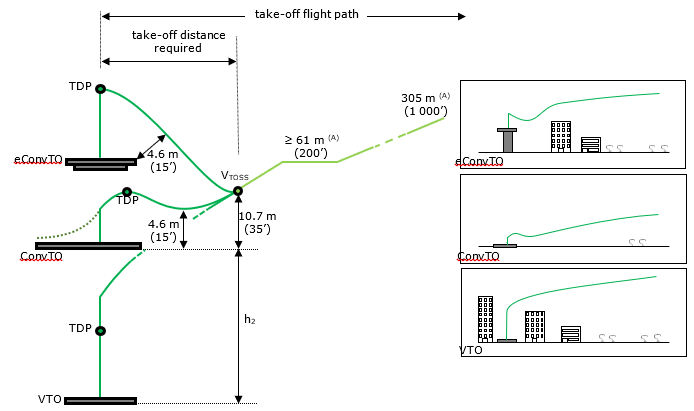
Figure 1: Possible take-off paths
AMC2 UAM.POL.VCA.120 Take-off
ED Decision 2025/010/R
APPLICATION OF TODRV
The selected height at which safe obstacle clearance and a positive climb gradient are achieved, following a CFP recognised before or at the TDP, should be determined with the use of AFM data, and be at least 10.7 m (35 ft) above:
(a)the take-off surface; or
(b)as an alternative, a level height defined by the highest obstacle in the TODRV.
AMC3 UAM.POL.VCA.120 Take-off
ED Decision 2025/010/R
OBSTACLE CLEARANCE IN THE BACKUP AREA
(a)For ConvTO and eConvTO using a backup or a lateral transition procedure in accordance with point UAM.POL.VCA.120(d), the PIC should take into account the following factors:
(1)in the backup: the PIC has few visual cues and should rely upon the altimeter and sight picture through the front or floor window (if flight path guidance is not provided) to achieve an accurate rearward flight path;
(2)in the rejected take-off (RTO): the PIC should be able to manage the descent against a varying forward speed whilst still ensuring adequate clearance from obstacles until the VCA gets in close proximity for landing on the FATO;
(3)in the continued take-off (CTO): the PIC should be able to accelerate to VTOSS whilst ensuring adequate clearance from obstacles.
(b)Point UAM.POL.VCA.120(d) may be complied with by establishing that:
(1)in the backup area no obstacles are located within the safety zone below the rearward flight path when described in the AFM (see Figure 2); in the absence of such data in the AFM, the operator should contact the manufacturer in order to define a safety zone; or
(2)during the backup, the RTO and the CTO manoeuvres, as well as obstacle clearance, are demonstrated to the competent authority.
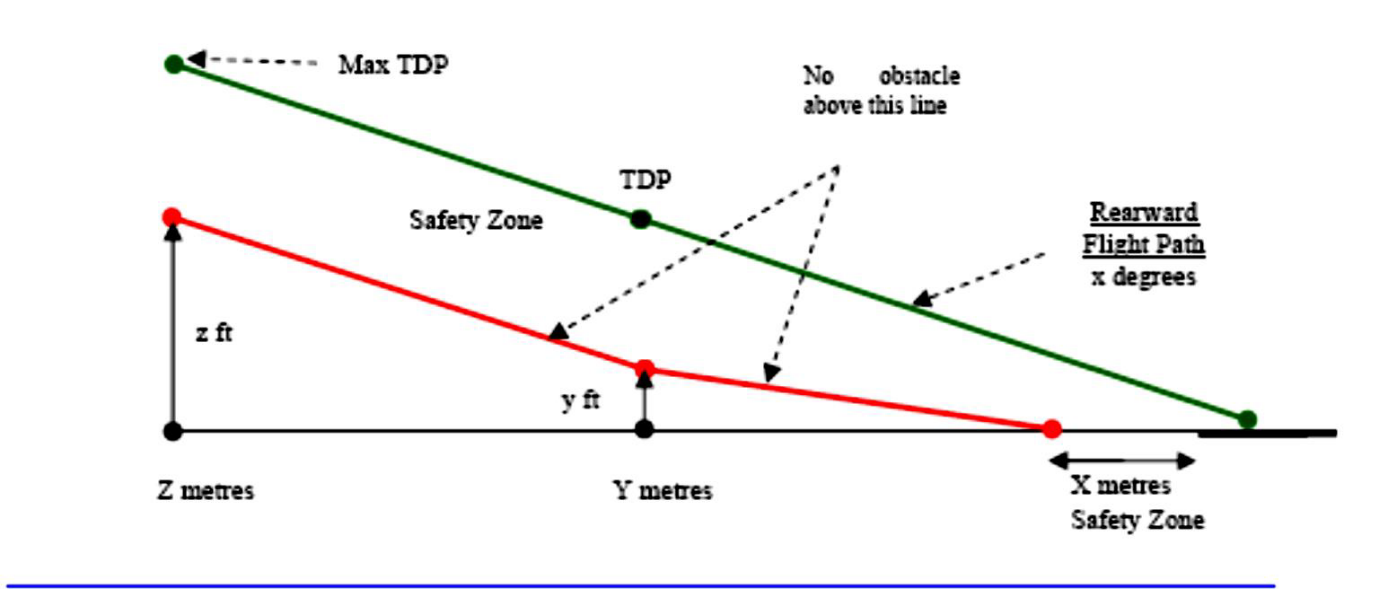
Figure 2: Rearward flight path
(c)An obstacle in the backup area is considered if its lateral distance from the nearest point on the surface below the intended flight path is not farther than:
(1)0.75 × D; plus
(2)0.25 × D or 3 m, whichever is greater; plus
(3)0.10 × DR for VFR day; DR is in this case the distance travelled from the back of the FATO (see Figure 3).
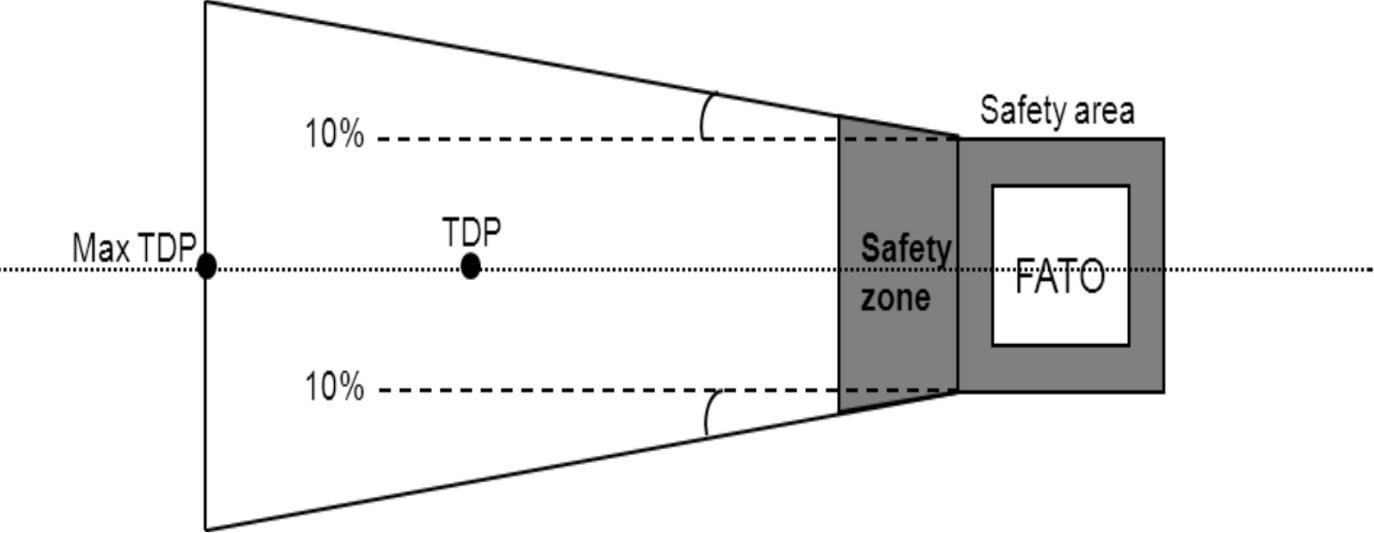
Figure 3: Obstacle accountability
GM1 UAM.POL.VCA.120 Take-off
ED Decision 2025/010/R
TAKE-OFF PROCEDURES
(a)The take-off procedures define take-off profiles and scheduled data for various environmental conditions and masses. Associated with such profiles and conditions are the minimum operating surfaces, take-off distances and climb performance distances; these are provided (usually in graphic form) with the take-off mass and the take-off decision point (TDP).
(b)The minimum dimensions of the take-off surface should be compatible with the chosen take-off procedure. For example, for a vertical take-off (VTO) procedure, the minimum FATO dimensions should be 1.5 D, while for a forward take-off procedure, the minimum FATO dimensions should be the length of the rejected take-off distance required (RTODRV).
(c)The landing surface and the height of the TDP are directly related to the ability of the VCA to reject the take-off and land on the surface, following a CFP event before or at TDP.
Following a CFP event at or after the TDP, a CMP should exist to perform a continued take-off (CTO) which provides obstacle clearance and distance to reach a point from where climb performance in the first and subsequent segments is assured.
The operator should be aware that if the TDP is lower than the top of the vertical segment, it is possible that the rejected take-off (RTO) cannot be performed safely from a given height upwards while meeting the CMP following a CFP. If the RTO is not a foreseen option, then the TDP may be set at the bottom of the vertical segment.
Where the TDP is shifted upwards, it will not affect the shape of the continued take-off profile but will shift the min-dip upwards by the same amount that the revised TDP has been increased — with respect to the basic TDP.
Such assertions are concerned only with the vertical or the backup procedures and can be regarded as achievable under the following circumstances:
—when the take-off procedure is flown, it is based upon a profile contained in the AFM — with the exception of the necessity to perform an RTO;
—the TDP, if shifted upwards (or upwards and backward in the backup procedure), will be the height at which performance is available to perform CTO following a CFP; and
—if obstacles are permitted in the backup area, they should continue to be permitted with a revised TDP.
GM2 UAM.POL.VCA.120 Take-off
ED Decision 2025/010/R
APPLICATION OF TODRV
The TODRV provides safe obstacle clearance following a CFP being recognised at TDP. It is the projected horizontal distance from the start of a take-off procedure to:
(a)the point where the VCA reaches 10,7 m (35 ft) above the take-off surface with the minimum climb gradient of 4.5 %, for a conventional take-off (ConvTO);
(b)the point where, after the dropdown segment, the VCA reaches 10,7 m (35 ft) above the take-off surface with the minimum climb gradient of 4.5 %, for an elevated conventional take-off (eConvTO);
(c)the point where the VCA reaches 10,7 m (35 ft) above the high hover height (h2) established in the AFM with the minimum climb gradient of 4.5 %, for a vertical take-off (VTO).
UAM.POL.VCA.125 Take-off flight path
Regulation (EU) 2024/1111
(a)From the end of the take-off distance required for VCA (TODRV), following a CFP being recognised at or after the take-off decision point (TDP):
(1)the take-off mass shall be such that the take-off flight path provides vertical clearance, above all obstacles located in the climb path, of not less than 10,7 m (35 ft) for operations under VFR by day;
(2)when a change of direction of more than 15° is made, allowance shall be made for the ability to maintain the climb gradient to comply with the obstacle-clearance requirements in accordance with the AFM; this change of direction is not to be initiated before reaching a height of 61 m (200 ft) above the take-off surface unless it is part of an approved take-off procedure in the AFM.
(b)When showing compliance with point (a), the relevant parameters of point UAM.POL.VCA.110(c) shall be considered at the vertiport, diversion location or operating site of departure.
GM1 UAM.POL.VCA.125 Take-off flight path
ED Decision 2025/010/R
END OF THE TAKE-OFF FLIGHT PATH
The take-off flight path ends at 1 000 ft above the highest accounted obstacle in the take-off flight path in congested areas or whenever the VCA reaches the minimum flight altitude/height as established in accordance with Regulation (EU) No 923/2012.
UAM.POL.VCA.130 En route
Regulation (EU) 2024/1111
(a)The mass of the VCA and the flight path at all points along the route following a critical failure for performance (CFP), and taking into account the meteorological conditions expected for the flight, shall permit compliance with the following:
(1)Reserved.
(2)Reserved.
(3)The mass of the VCA shall permit its operation at or above the minimum level established in accordance with point SERA.5005(f) of the Annex (Part-SERA) to Regulation (EU) No 923/2012 and a descent from the cruising altitude to the landing decision point (LDP) above the vertiport, diversion location or operating site where the landing can be conducted in accordance with point UAM.POL.VCA.135.
(b)When showing compliance with point (a), all the following shall apply:
(1)the CFP is assumed to occur at the most critical point along the route;
(2)the effects of winds on the flight path are considered;
(3)fuel jettisoning, if applicable, is planned to be performed only to an extent consistent with reaching the vertiport, diversion location or operating site with the required fuel/energy reserves and using a safe procedure; and
(4)fuel jettisoning, if applicable, is not planned below 300 m (1 000 ft) above terrain.
UAM.POL.VCA.135 Landing
Regulation (EU) 2024/1111
(a)The landing mass of the VCA at the estimated time of landing shall not exceed the maximum mass specified in the AFM for the certified landing procedure to be used.
(b)The IAM operator shall take into account:
(1)the relevant parameters of point UAM.POL.VCA.110(c); and
(2)the obstacles identified in accordance with point UAM.POL.VCA.115.
(c)If a critical failure for performance (CFP) is recognised at any point at or before the landing decision point (LDP), it is possible either to land and stop within the runway or FATO, or perform a balked landing by clearing all obstacles in the flight path by a vertical margin of 10,7 m (35 ft).
(d)If a CFP is recognised at any point at or after the LDP, it is possible to land and stop within the runway or FATO by clearing all obstacles in the approach path.
AMC1 UAM.POL.VCA.135 Landing
ED Decision 2025/010/R
LANDING PROCEDURE
The procedure used for landing should be compatible with the certified performance for landing obtained during the type certification of the VCA (ref.: MOC VTOL.2130 Landing).
GM1 UAM.POL.VCA.135 Landing
ED Decision 2025/010/R
LANDING PROCEDURE
(a)The certified landing performance of a VCA may allow for a conventional landing (ConvL) procedure or a vertical landing (VL) procedure.
The ConvL path starts at the landing decision point (LDP) and ends at the point where the aircraft reaches a stop at the FATO on the ground (after which it may taxi).
The VL path might be required when landing at a vertiport in a congested environment.
The operator may choose to have, from a point along the approach after the LDP, a pure vertical trajectory.
(b)In certain cases, in addition to ConvL or VL, the certified performance of a VCA may allow for ConvL with a roll-on.
GM2 UAM.POL.VCA.135 Landing
ED Decision 2025/010/R
START OF THE LANDING FLIGHT PATH
The landing flight path starts at 1 000 ft above the highest obstacle in congested areas or at the minimum flight altitude/height as established in accordance with Regulation (EU) No 923/2012.
GM3 UAM.POL.VCA.135 Landing
ED Decision 2025/010/R
LANDING DECISION POINT (LDP)
The LDP is identified with a combination of height, vertical speed and airspeed and/or ground speed.
(a)The LDP is defined as the last point from which a balked landing can be performed. After LDP,
a balked landing is not assured.
(b)Following a CFP before or after the LDP, a VCA certified in the Category ‘Enhanced’ is deemed capable of a CFSL.
LANDING DISTANCE REQUIRED FOR VCA (LDRV)
(c)The LDRV is the horizontal distance required to land and come to a stop from a point 15 m (50 ft) above the landing surface (Figure 4).
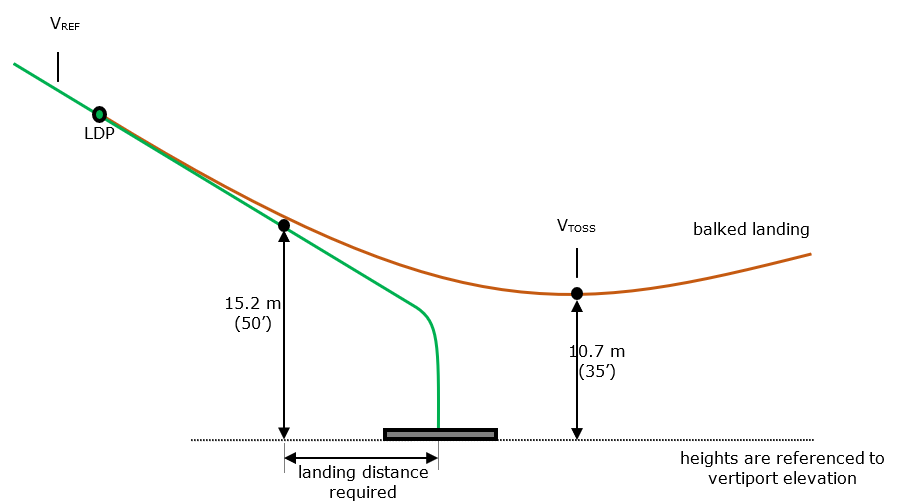
Figure 4: Landing path
UAM.POL.VCA.140 Mass and balance, and loading
Regulation (EU) 2024/1111
(a)During any phase of the operation, the loading, mass, and centre of gravity (CG) of the VCA shall comply with the limitations specified in the AFM, or the operations manual (OM), if more restrictive.
(b)The IAM operator shall establish the mass and the CG of any aircraft it operates by actual weighing prior to initial entry into service and thereafter at intervals of 4 years if individual VCA masses are used, or at intervals of 9 years if fleet masses are used. The accumulated effects of modifications and repairs on the mass and balance of the aircraft shall be considered and properly documented. The VCA shall be reweighed if the effect of modifications on its mass and balance is not accurately known.
(c)The weighing shall be accomplished by the manufacturer of the aircraft or by an approved maintenance organisation.
(d)The IAM operator shall determine the mass of all operating items and crew members (pilots and, if applicable, technical crew), included in the VCA dry operating mass, by actual weighing or by using standard masses. The influence of their position on the aircraft’s CG shall be determined.
(e)The IAM operator shall establish the mass of the traffic load, including any ballast, by actual weighing or by determining the mass of the traffic load in accordance with standard passenger and, if applicable, baggage masses.
(f)The IAM operator can use standard masses for other load items if it demonstrates to the competent authority that these items have the same mass or that their masses are within specified tolerances.
(g)The IAM operator shall determine the mass of the fuel load and/or of the energy storage unit as follows:
(1)for the fuel load, by using the actual density or, if not known, the density calculated in accordance with a method specified in the operations manual (OM);
(2)for the energy storage unit, by weighing or by using standard masses specified in the OM.
(h)The IAM operator shall ensure that the loading of:
(1)the VCA is performed under the supervision of qualified personnel; and
(2)the traffic load is consistent with the data used for the calculation of the aircraft mass and balance.
(i)The IAM operator shall comply with additional structural limits such as the floor strength limitations, the maximum load per running metre, the maximum mass per cargo compartment, and the maximum seating limit.
(j)The IAM operator shall specify in the OM the principles and methods applied for the loading and in the mass and balance system that meet the requirements of points (a) to (i). That system shall cover all types of the operator’s intended operations.
AMC1 UAM.POL.VCA.140 Mass and balance, loading
ED Decision 2025/010/R
CENTRE OF GRAVITY (CG) LIMITS — OPERATIONAL CG ENVELOPE AND IN-FLIGHT CG
(a)Forward and aft CG limits are specified in the AFM. These limits allow for a proper trim setting for take-off and ensure that the certification stability and control criteria are met throughout the whole flight.
(b)The IAM operator should ensure that these limits are respected by:
(1)defining and applying operational margins to the certified CG envelope in order to compensate for the following deviations and errors:
(i)deviations of the actual CG at empty or operating mass from published values due, for example, to weighing errors, unaccounted modifications and/or equipment variations;
(ii)deviations in the distribution of baggage and cargo in the various compartments as compared with the assumed load distribution as well as inaccuracies in the actual mass of baggage and cargo;
(iii)deviations in the actual passenger seating from the seating distribution assumed when preparing the mass and balance documentation. Large CG errors may occur when ‘free seating’, i.e. freedom of passengers to select any seat when entering the VCA, is permitted;
(iv)deviations of the actual CG of cargo and passenger load within individual cargo compartments or cabin sections from the normally assumed mid position;
(v)deviations of the CG caused by any configuration change, unless already covered by the certified limits;
(vi)deviations caused by in-flight change of loading;
(vii)deviations caused by the difference between the actual passenger masses and standard passenger masses when such masses are used; and
(2)defining and applying operational procedures in order to:
(i)ensure even distribution of passengers in the cabin;
(ii)take into account any significant CG travel during flight caused by passenger/crew movement; and
(ii)take into account any significant CG travel during flight caused by fuel consumption, if applicable.
AMC2 UAM.POL.VCA.140 Mass and balance, loading
ED Decision 2025/010/R
WEIGHING OF A VCA
(a)New VCA that have been weighed at the factory may be operated without reweighing if the mass and balance records have been adjusted for alterations or modifications to the VCA. VCA transferred from one EU operator to another EU operator do not have to be weighed prior to use by the receiving operator unless more than 4 years have elapsed since the VCA was last weighed.
(b)The mass and CG position of a VCA should be revised whenever the cumulative changes to the dry operating mass or CG exceed ± 0.5 % of the maximum landing mass or CG envelope respectively. This may be done by weighing the VCA or by calculation.
(c)When weighing a VCA, normal precautions should be taken consistent with good practices such as:
(1)checking for completeness of the VCA and equipment;
(2)determining that fluids are properly accounted for;
(3)ensuring that the VCA is clean; and
(4)ensuring that weighing is accomplished in an enclosed building.
(d)Any equipment used for weighing should be properly calibrated, zeroed, and used in accordance with the manufacturer’s instructions. Each scale should be calibrated either by the manufacturer, by a civil department of weights and measures or by an appropriately authorised organisation within 2 years or within a time period defined by the manufacturer of the weighing equipment, whichever is less. The equipment should enable the mass of the VCA to be established accurately. A single accuracy criterion for weighing equipment cannot be given. However, the weighing accuracy is considered satisfactory if the accuracy criteria in Table 1 are met by the individual scales/cells of the weighing equipment used.
Table 1: Accuracy criteria for weighing equipment
For a scale/cell load | An accuracy of below |
2 000 kg | ±1 % |
from 2 000 kg to 20 000 kg | ±20 kg |
above 20 000 kg | ±0.1 % |
AMC3 UAM.POL.VCA.140 Mass and balance, loading
ED Decision 2025/010/R
DRY OPERATING MASS OF THE VCA
The dry operating mass includes:
(a)the pilot(s), technical crew member(s) and their baggage, as applicable;
(b)catering and removable passenger service equipment, if applicable.
AMC4 UAM.POL.VCA.140 Mass and balance, loading
ED Decision 2025/010/R
MASS VALUES FOR THE PILOT(S) AND TECHNICAL CREW MEMBER(S), IF APPLICABLE
(a)The operator should use the following mass values for the pilot(s) and technical crew member(s), as applicable, to determine the dry operating mass:
(1)actual weighed masses including baggage; or
(2)standard masses, including baggage, of 85 kg.
(b)The operator should correct the dry operating mass to account for any additional baggage.
The position of any additional baggage should be accounted for when establishing the CG of the VCA.
AMC5 UAM.POL.VCA.140 Mass and balance, loading
ED Decision 2025/010/R
MASS VALUES FOR PASSENGERS, THEIR CLOTHING AND PERSONAL BELONGINGS AND FOR BAGGAGE
(a)When the actual number of passenger seats in the VCA is less than 6, passenger mass may be calculated on the basis of a statement made by, or on behalf of, each passenger plus a predetermined mass to account for clothing and personal belongings.
The predetermined mass for clothing and personal belongings should be established by the operator on the basis of studies relevant to its particular operation. In any case, it should not be less than 4 kg for clothing and personal belongings such as an overcoat, an umbrella, a small handbag or purse, reading material or a small camera or laptop.
The passengers’ stated mass and the mass of passengers’ clothing and personal belongings should be checked prior to boarding and, if necessary, adjusted. The operator should establish a procedure in the operations manual on when to select actual or standard masses and the procedure to be followed when determining mass based on verbal statements.
(b)When determining the actual mass by weighing, the passengers’ mass and the mass of passengers’ clothing and personal belongings should be weighed immediately prior to boarding the VCA.
(c)When using standard mass values, the standard mass values in Table 2 below should be used. The standard masses include the mass of any infant carried by an adult on one passenger seat. Infants occupying separate passenger seats should be considered ‘children’ for the purpose of this AMC.
Table 2: Standard masses for passengers — VCA with a total number of passenger seats of 19 or less
Passenger seats: | 1–5 | 6– 9 | 10–19 |
Male | 104 kg | 96 kg | 92 kg |
Female | 86 kg | 78 kg | 74 kg |
Children | 35 kg | 35 kg | 35 kg |
(1)As baggage is weighed separately, 6 kg may be deducted from male and female masses in Table 2.
(2)For operations where a survival suit is provided to passengers, 3 kg should be added to the passenger mass value.
(d)Mass values for baggage
For VCA with 19 passenger seats or less, the actual mass of any passenger baggage carried in the VCA should be determined by weighing.
(e)Other standard masses may be used provided that they are calculated on the basis of a detailed weighing survey plan and that a reliable statistical analysis method is applied. The operator should advise the competent authority about the intent of the passenger weighing survey and explain the survey plan in general terms. The revised standard mass values should only be used in circumstances comparable with those under which the survey was conducted. If the revised standard masses exceed those in Table 2, then such higher values should be used.
(f)On any flight identified as carrying passengers whose mass, including clothing and personal belongings, are expected to significantly deviate from the standard passenger mass, the operator should determine the actual mass of such passengers by weighing or by adding an adequate mass increment.
AMC6 UAM.POL.VCA.140 Mass and balance, loading
ED Decision 2025/010/R
PROCEDURE FOR ESTABLISHING REVISED STANDARD MASS VALUES FOR PASSENGERS AND BAGGAGE
To establish revised standard mass values for passengers and baggage, the IAM operator should refer to the procedure described in AMC2 CAT.POL.MAB.100(e).
GM1 UAM.POL.VCA.140 Mass and balance, loading
ED Decision 2025/010/R
STATISTICAL EVALUATION OF PASSENGER AND BAGGAGE DATA
The IAM operator may use the statistical method described in GM2 CAT.POL.MAB.100(e) to establish the mass of the traffic load.
GM2 UAM.POL.VCA.140 Mass and balance, loading
ED Decision 2025/010/R
GUIDANCE ON PASSENGER WEIGHING SURVEYS
The IAM operator may use the guidance on passenger weighing surveys provided in
GM3 CAT.POL.MAB.100(e).
UAM.POL.VCA.145 Mass and balance data, and mass and balance documentation
Regulation (EU) 2024/1111
(a)The IAM operator shall establish mass and balance data and shall produce mass and balance documentation prior to each flight, specifying the load and its distribution. The mass and balance documentation shall enable the PIC to determine that the load and its distribution is such that the mass and balance limits of the aircraft are not exceeded. The mass and balance documentation shall contain the following information:
(1)VCA registration and type;
(2)flight identification, number and date;
(3)full name of the PIC;
(4)full name of the person that has prepared the documentation;
(5)dry operating mass and the corresponding CG of the aircraft;
(6)mass of the fuel or energy storage unit at take-off, and the mass of trip fuel;
(7)mass of consumables other than fuel, if applicable;
(8)traffic load components, including passengers, baggage, freight and ballast;
(9)take-off mass, landing mass, and zero fuel mass;
(10)applicable aircraft CG positions; and
(11)the limiting mass and CG values.
The information above shall be available in flight-planning documents or in mass and balance systems.
(b)When mass and balance data and mass and balance documentation are generated by a computerised mass and balance system, the operator shall:
(1)verify the integrity of the output data to ensure that the data is within the AFM limitations; and
(2)specify the instructions and procedures for its use in its operations manual (OM).
(c)The person that supervises the loading of the aircraft shall confirm by handwritten signature or equivalent that the load and its distribution are in accordance with the mass and balance documentation given to the PIC. The PIC shall indicate their acceptance by handwritten signature or equivalent.
(d)The IAM operator shall specify procedures for last-minute changes to the load to ensure that:
(1)any last-minute change following the completion of the mass and balance documentation is brought to the attention of the PIC and entered in the flight-planning documents containing the mass and balance documentation;
(2)the maximum last-minute change allowed in passenger numbers or hold load is specified; and
(3)new mass and balance documentation is prepared if the maximum passenger number is exceeded.
AMC1 UAM.POL.VCA.145 Mass and balance data, documentation
ED Decision 2025/010/R
CONTENT OF THE MASS AND BALANCE DOCUMENTATION
The mass and balance documentation should include guidance to the PIC whenever a non-standard method has been used for determining the mass of the load.
AMC2 UAM.POL.VCA.145 Mass and balance data, documentation
ED Decision 2025/010/R
CENTRE OF GRAVITY (CG) POSITION
The CG position should be in the mass and balance documentation unless:
(a)the load distribution is in accordance with a pre-calculated balance table; or
(b)it can be shown that for the planned operations a correct balance can be ensured, whatever the real load is.
AMC3 UAM.POL.VCA.145 Mass and balance data, documentation
ED Decision 2025/010/R
INTEGRITY OF THE MASS AND BALANCE DOCUMENTATION
The operator should verify the integrity of the mass and balance data and documentation generated by a computerised mass and balance system at intervals not exceeding 6 months. The operator should establish a system to check that amendments to its input data are incorporated properly in the system and that the system operates correctly on a continuous basis.
AMC4 UAM.POL.VCA.145 Mass and balance data, documentation
ED Decision 2025/010/R
SIGNATURE OR EQUIVALENT
When a signature by hand is impracticable or it is desirable to arrange the equivalent verification by electronic means, the following conditions should be applied in order to render an electronic signature equivalent to a conventional handwritten signature:
(a)electronic ‘signing’ by entering a personal identification number (PIN) code with the appropriate security level, etc.;
(b)entering the PIN code generates a print-out of the individual’s name and professional capacity on the relevant document(s) in such a way that it is evident to anyone that needs that information who has signed the document;
(c)the computer system logs information to indicate when and where each PIN code has been entered;
(d)the use of the PIN code is, from a legal and responsibility point of view, considered fully equivalent to a handwritten signature;
(e)the requirements for record-keeping remain unchanged; and
(f)all personnel concerned are made aware of the conditions associated with electronic signature and this is documented.
SUBPART D — INSTRUMENTS, DATA AND EQUIPMENT
SECTION 1 — VTOL-capable aircraft (VCA)
UAM.IDE.VCA.050 Scope
Regulation (EU) 2024/1111
This Section establishes the requirements for IAM operations with VTOL-capable aircraft (VCA).
UAM.IDE.VCA.100 Instruments and equipment
Regulation (EU) 2024/1111
(a)The instruments, data and equipment required by this Subpart, as well as by the type-certification requirements and airspace requirements, shall be installed on or carried in the VCA according to the conditions under which the operation is to be conducted.
Instruments and equipment required by this Subpart, as well as by the type-certification requirements and airspace requirements, shall be approved in accordance with the applicable airworthiness requirements, except for the following items:
(1)first-aid kits;
(2)survival and signalling equipment;
(3)sea anchors and equipment for mooring; and
(4)child restraint devices.
(b)Instruments and equipment not required by this Annex, as well as any other equipment which is not required pursuant to this Regulation, but carried on a flight, shall comply with the following:
(1)the information provided by these instruments, equipment or accessories shall not be used by the pilot to comply with Annex II and with point 2.1 of Annex IX to Regulation (EU) 2018/1139 or with points UAM.IDE.MVCA.330, and UAM.IDE.MVCA.345 of this Annex; and
(2)the instruments and equipment shall not affect the airworthiness of the aircraft, even in the case of failure or malfunction.
(c)If equipment is to be used by the pilot at their assigned station during the flight, it shall be installed so as to be easily operable from that station. When a single item of equipment is to be used by more than one person at their assigned stations, it shall be installed so as to be readily operable from any station.
(d)Those instruments that are used by the pilot shall be so arranged as to permit the pilot to see the indications readily from their assigned station with the minimum practicable deviation from the position and line of vision that the pilot normally assumes when looking forward along the flight path.
(e)All required emergency equipment shall be easily accessible for immediate use.
GM1 UAM.IDE.VCA.100 Instruments and equipment
ED Decision 2025/010/R
INSTRUMENTS AND EQUIPMENT
Any installed instrument or item of equipment, as well as their installation, should comply with Commission Regulation (EU) No 748/2012.
GM2 UAM.IDE.VCA.100 Instruments and equipment
ED Decision 2025/010/R
REQUIRED INSTRUMENTS AND EQUIPMENT THAT NEED NOT BE APPROVED
The functionality of the required instruments and equipment, listed in point UAM.IDE.VCA.100(a), that need not be approved in accordance with Commission Regulation (EU) No 748/2012, is checked against recognised industry standards appropriate to the intended purpose. The maintenance of these instruments and equipment is ensured by the IAM operator.
GM3 UAM.IDE.VCA.100 Instruments and equipment
ED Decision 2025/010/R
NOT REQUIRED INSTRUMENTS AND EQUIPMENT
Examples of non-installed instruments and equipment, not required by this Regulation, but carried on a flight, may be the following:
(a)portable EFBs;
(b)PEDs carried by flight crew or cabin crew; and
(c)non-installed passenger entertainment equipment.
UAM.IDE.VCA.105 Minimum equipment required for a flight
Regulation (EU) 2024/1111
A flight shall not commence when any of the aircraft instruments, items of equipment or functions required for the intended flight are inoperative or missing, unless:
(a)the aircraft is operated in accordance with the operator’s minimum equipment list (MEL); or
(b)the operator is approved by the competent authority to operate the aircraft within the constraints of the master minimum equipment list (MMEL) in accordance with point ORO.MLR.105(j) of Annex III.
AMC1 UAM.IDE.VCA.105 Minimum equipment for a flight
ED Decision 2025/010/R
MANAGEMENT OF THE STATUS OF CERTAIN INSTRUMENTS, EQUIPMENT OR FUNCTIONS
(a)The IAM operator should control and retain the status of the instruments, equipment or functions that are required for the intended operation and that are not controlled for the purpose of continuing airworthiness management.
(b)The IAM operator should define responsibilities and procedures to retain and control the status of the instruments, equipment or functions that are required for the intended operation and that are not controlled for the purpose of continuing airworthiness management.
GM1 UAM.IDE.VCA.105 Minimum equipment for a flight
ED Decision 2025/010/R
MANAGEMENT OF THE STATUS OF CERTAIN INSTRUMENTS, EQUIPMENT OR FUNCTIONS
Instruments, equipment or functions that are required for the intended operation and that are not controlled for the purpose of continuing airworthiness management, may be but are not limited to equipment related to navigation approvals as FM immunity or certain software versions.
SECTION 2 — Manned VTOL-capable aircraft (MVCA)
UAM.IDE.MVCA.050 Scope
Regulation (EU) 2024/1111
This Section establishes additional requirements for IAM operations with manned VTOL-capable aircraft (MVCA).
UAM.IDE.MVCA.115 Operating lights
Regulation (EU) 2024/1111
A VCA operated under VFR by day shall be equipped with anti-collision lights.
AMC1 UAM.IDE.MVCA.115 Operating lights
ED Decision 2025/010/R
ANTI-COLLISION LIGHTS
(a)An anti-collision light system should be installed to attract attention to the VCA and provide sufficient visibility in a timely manner for other aircraft to avoid a collision, especially in congested areas. The system should consist of one or more approved anti-collision lights.
Each anti-collision light should be either aviation red or aviation white.
(b)If installed, red flashing anti-collision lights (rotating beacons) should not affect the vision of the pilot or detract from the visibility of the position lights. The red flashing lights should be turned on when the lift and thrust units are powered on prior to taxiing or movement of the VCA on the ground and should be turned off at the end of the flight.
(c)If installed, white flashing anti-collision lights (strobes) should be so located that the pilot’s vision is not impaired. The white flashing lights should be turned on prior to take-off and turned off immediately after landing.
UAM.IDE.MVCA.125 Flight instruments and associated equipment
Regulation (EU) 2024/1111
(a)The VCA shall be equipped with the flight instruments and equipment specified in its type-certification approval for flights to be conducted in accordance with VFR by day.
(b)Additional flight instruments and equipment shall be installed on or carried in the VCA, as necessary, according to the expected operating conditions and crew workload.
GM1 UAM.IDE.MVCA.125 Flight instruments and associated equipment
ED Decision 2025/010/R
TYPE-CERTIFICATION APPROVAL
The required flight instruments/equipment are those specified in the certified type design definition of the VCA for the intended operations.
UAM.IDE.MVCA.140 Fuel/energy measuring and displaying equipment
Regulation (EU) 2024/1111
(a)The VCA shall be equipped with means of measuring and displaying to the pilot in flight the remaining usable amount of fuel/energy.
(b)A conservative estimate of the amount of fuel/energy necessary to complete the remaining part of the flight shall be displayed to the pilot in flight unless provided by other means as per point UAM.OP.VCA.195(a).
AMC1 UAM.IDE.MVCA.140 Fuel/energy measuring and displaying equipment
ED Decision 2025/010/R
EQUIPMENT REQUIREMENTS
(a)The VCA should be equipped with means of:
(1)measuring the remaining usable amount of fuel/energy;
(2)providing a conservative estimate in flight of the amount of fuel/energy necessary to complete the remaining part of the flight based on the approved individual fuel/energy scheme of the operator;
(3)displaying to the PIC the comparison between points (1) and (2) updated at regular intervals, as well as upon request; and
(4)warning the PIC when the amount of fuel/energy necessary to complete the flight estimated in point (2) is greater than the remaining usable fuel/energy measured in point (1).
(b)The estimation in point (a)(2) should:
(1)be updated at intervals to allow the VCA to reach the destination following the actual flight routing with the onset of the warning in point (a)(4);
(2)take into account actual wind conditions, and updated weather information issued through dedicated service providers; and
(3)take into account any existing or possible failure or malfunction of the VCA system or any existing or possible abnormal flight condition.
(c)The VCA should be equipped with an in-flight replanning function that indicates to the PIC the area where a diversion is possible and indicate vectors to a suitable diversion location.
(d)As an alternative to points (a)(2), (a)(3), (a)(4), (b) and (c), the operator may implement a procedure in accordance with AMC1 UAM.OP.VCA.195.
UAM.IDE.MVCA.145 Height-determination equipment
Regulation (EU) 2024/1111
(a)The VCA shall, for flights over water, be equipped with a means to determine the height of the aircraft in relation to the water surface, capable of emitting an audio warning below a preset value and a visual warning at a height selectable by the pilot, when operating:
(1)at a distance from land corresponding to more than 3 minutes flying time at normal cruising speed;
(2)reserved;
(3)reserved;
(4)out of sight of the land.
AMC1 UAM.IDE.MVCA.145 Height-determination equipment
ED Decision 2025/010/R
RADIO ALTIMETER
A radio altimeter capable of emitting an audio warning below a preset height and a visual warning at a height selectable by the PIC may be used to meet the safety objective of point UAM.IDE.MVCA.145.
AMC2 UAM.IDE.MVCA.145 Height-determination equipment
ED Decision 2025/010/R
AUDIO AND VISUAL WARNING
(a)The audio warning should be a voice warning. The voice warning alert should be distinguishable from other warnings and should contain a clear and concise voice message. The height at which the audio warning is triggered should be such as to provide adequate time for the PIC to take corrective action. The voice warning should be triggered only whilst descending through the preset datum height and be inhibited whilst ascending.
(b)The visual warning should require minimal interpretation by the PIC for both an instantaneous impression of absolute height and the rate of change of height.
GM1 UAM.IDE.MVCA.145 Height-determination equipment
ED Decision 2025/010/R
TAWS
A VCA equipped with a TAWS is considered to meet the requirements of point UAM.IDE.MVCA.145.
GM2 UAM.IDE.MVCA.145 Height-determination equipment
ED Decision 2025/010/R
It is recommended that an audio warning be triggered at a height in the range of 100–160 ft. The datum should not be adjustable in flight. Once triggered, the audio warning message should sound within 0.5 seconds.
UAM.IDE.MVCA.170 Crew interphone system
Regulation (EU) 2024/1111
For operations with more than one crew member, the VCA shall be equipped with an interphone system, including headsets and microphones, for use by all the crew members.
AMC1 UAM.IDE.MVCA.170 Crew interphone system
ED Decision 2025/010/R
TYPE OF CREW INTERPHONE
The crew interphone system should not be of a handheld type.
UAM.IDE.MVCA.180 Public address system (PAS)
Regulation (EU) 2024/1111
The VCA shall be equipped with a PAS, unless the IAM operator is able to demonstrate that when in flight, the pilot’s voice is audible and intelligible at all passengers’ seats.
AMC1 UAM.IDE.MVCA.180 Public address system (PAS)
ED Decision 2025/010/R
PAS SPECIFICATION
When required, the PAS should:
(a)operate independently of the crew interphone system except for handsets, headsets, microphones, selector switches and signalling devices;
(b)following a total failure of its primary electrical system, provide reliable operation for a minimum of 10 minutes.
UAM.IDE.MVCA.185 Cockpit voice recorder (CVR)
Regulation (EU) 2024/1111
(a)A VCA with an MCTOM of more than 5 700 kg shall be equipped with a CVR.
(b)The CVR shall be capable of retaining the data recorded during at least the preceding 2 hours.
(c)The CVR shall record with reference to a timescale on means other than magnetic tape or magnetic wire:
(1)voice communications transmitted from or received in the flight crew compartment by radio;
(2)crew members’ voice communications using the interphone system and the public address system (PAS), if installed;
(3)the aural environment of the flight crew compartment, including the audio signals received from the flight crew microphone;
(4)voice or audio signals identifying navigation or approach aids introduced into a headset or a speaker.
(d)The CVR shall, depending on the availability of electrical power, record as early as possible during the cockpit checks at the beginning of the flight prior to the VCA being capable of moving under its own power until the cockpit checks immediately following lift and thrust units powering off at the end of the flight. In any case, the CVR shall automatically start to record prior to the aircraft moving under its own power and shall continue to record until the termination of the flight.
(e)A function to modify CVR recordings shall be at the disposal of the PIC so that recordings made prior to the operation of that function cannot be retrieved using normal replay or copying techniques.
(f)If the CVR is not deployable, it shall have a device to assist in locating it under water with a minimum underwater transmission time of 90 days. If the CVR is deployable, it shall have an automatic emergency locator transmitter (ELT).
AMC1 UAM.IDE.MVCA.185 Cockpit voice recorder (CVR)
ED Decision 2025/010/R
CVR OPERATIONAL PERFORMANCE REQUIREMENTS
The operational performance requirements for CVRs should be those laid down in EUROCAE Document 112B dated August 2023, or any later equivalent standard accepted by EASA.
UAM.IDE.MVCA.190 Flight data recorder (FDR)
Regulation (EU) 2024/1111
(a)A VCA with an MCTOM of more than 5 700 kg shall be equipped with a FDR that uses a digital method of recording and storing data, and for which a method of readily retrieving that data from the storage medium is available.
(b)The FDR shall record the parameters required to determine accurately the flight path, speed, attitude, engine(s) power, operation, configuration, and any parameter that has been established during the type certification of the VCA and shall be capable of retaining the data recorded during at least the preceding 25 hours.
(c)Data shall be obtained from the VCA sources that enable accurate correlation with information displayed to the pilot(s).
(d)The FDR shall automatically start to record the data not later than the VCA is capable of moving under its own power and shall stop automatically following lift and thrust units powering off at the end of the flight.
(e)If the FDR is not deployable, it shall have a device to assist in locating it under water with a minimum underwater transmission time of 90 days. If the FDR is deployable, it shall have an automatic ELT.