
Filters
NCO.IDE.H.165 Marking of break-in points
Regulation (EU) 2025/133
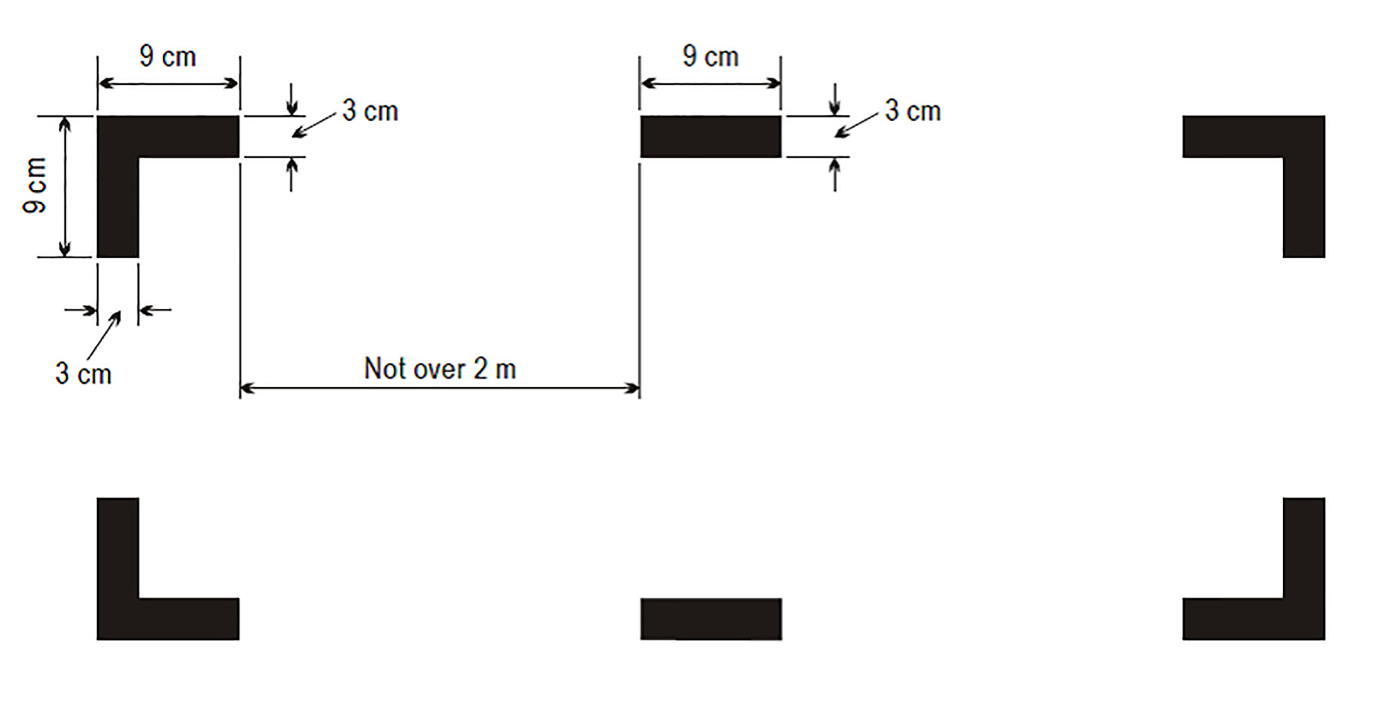
If areas of the rotorcraft’s fuselage suitable for breaking in by rescue crews in an emergency are marked, such areas shall be marked as shown in Figure 1.
Figure 1 Marking of break-in points
AMC1 NCO.IDE.H.165 Marking of break-in points
ED Decision 2014/016/R
MARKINGS — COLOUR AND CORNERS
(a)The colour of the markings should be red or yellow and, if necessary, should be outlined in white to contrast with the background.
(b)If the corner markings are more than 2 m apart, intermediate lines 9 cm x 3 cm should be inserted so that there is no more than 2 m between adjacent markings.
NCO.IDE.H.170 Emergency locator transmitter (ELT)
Regulation (EU) 2025/133
(a)Rotorcraft certified for a maximum operational passenger seating configuration above six shall be equipped with:
(1)an automatic ELT; and
(2)one survival ELT (ELT(S)) in a life-raft or lifejacket when the rotorcraft is operated at a distance from land corresponding to more than 3 minutes flying time at normal cruising speed.
(b)Rotorcraft certified for a maximum operational passenger seating configuration of six or less shall be equipped with an ELT(S) or a personal locator beacon (PLB), carried by a crew member or a passenger, or with an automatic ELT.
(c)ELTs of any type and PLBs shall be capable of transmitting simultaneously on 121,5 MHz and 406 MHz.
AMC1 NCO.IDE.H.170 Emergency locator transmitter (ELT)
ED Decision 2014/016/R
BATTERIES
(a)All batteries used in ELTs or PLBs should be replaced (or recharged, if the battery is rechargeable) when the equipment has been in use for more than 1 cumulative hour or in the following cases:
(1)Batteries specifically designed for use in ELTs and having an airworthiness release certificate (EASA Form 1 or equivalent) should be replaced (or recharged, if the battery is rechargeable) before the end of their useful life in accordance with the maintenance instructions applicable to the ELT.
(2)Standard batteries manufactured in accordance with an industry standard and not having an airworthiness release certificate (EASA Form 1 or equivalent), when used in ELTs should be replaced (or recharged, if the battery is rechargeable) when 50 % of their useful life (or for rechargeable, 50 % of their useful life of charge), as established by the battery manufacturer, has expired.
(3)All batteries used in PLBs should be replaced (or recharged, if the battery is rechargeable) when 50 % of their useful life (or for rechargeable, 50 % of their useful life of charge), as established by the battery manufacturer, has expired.
(4)The battery useful life (or useful life of charge) criteria in (1),(2) and (3) do not apply to batteries (such as water-activated batteries) that are essentially unaffected during probable storage intervals.
(b)The new expiry date for a replaced (or recharged) battery should be legibly marked on the outside of the equipment.
AMC2 NCO.IDE.H.170 Emergency locator transmitter (ELT)
ED Decision 2021/008/R
TYPES OF ELT AND GENERAL TECHNICAL SPECIFICATIONS
(a)The ELT required by this provision should be one of the following:
(1)Automatic fixed (ELT(AF)). An automatically activated ELT that is permanently attached to an aircraft and is designed to aid SAR teams in locating the crash site.
(2)Automatic portable (ELT(AP)). An automatically activated ELT that is rigidly attached to an aircraft before a crash, but is readily removable from the aircraft after a crash. It functions as an ELT during the crash sequence. If the ELT does not employ an integral antenna, the aircraft-mounted antenna may be disconnected and an auxiliary antenna (stored on the ELT case) attached to the ELT. The ELT can be tethered to a survivor or a life-raft. This type of ELT is intended to aid SAR teams in locating the crash site or survivor(s).
(3)Automatic deployable (ELT(AD)). An ELT that is rigidly attached to the aircraft before the crash and that is automatically deployed and activated by an impact, and, in some cases, also by water sensors. This type of ELT should float in water and is intended to aid SAR teams in locating the crash site. The ELT(AD) may be either a stand-alone beacon or an inseparable part of a deployable recorder.
(4)Survival ELT (ELT(S)). An ELT that is removable from an aircraft, stowed so as to facilitate its ready use in an emergency, and manually activated by a survivor. An ELT(S) may be activated manually or automatically (e.g. by water activation). It should be designed either to be tethered to a life-raft or a survivor. A water-activated ELT(S) is not an ELT(AP).
(b)To minimise the possibility of damage in the event of crash impact, the automatic ELT should be rigidly fixed to the aircraft structure, as far aft as is practicable, with its antenna and connections arranged so as to maximise the probability of the signal being transmitted after a crash.
(c)Any ELT carried should operate in accordance with the relevant provisions of ICAO Annex 10, Volume III, and should be registered with the national agency responsible for initiating search and rescue or other nominated agency.
AMC3 NCO.IDE.H.170 Emergency locator transmitter (ELT)
ED Decision 2014/016/R
PLB TECHNICAL SPECIFICATIONS
(a)A personal locator beacon (PLB) should have a built-in GNSS receiver with a cosmicheskaya sistyema poiska avariynich sudov — search and rescue satellite-aided tracking (COSPAS-SARSAT) type approval number. However, devices with a COSPAS-SARSAT number belonging to series 700 are excluded as this series of numbers identifies the special-use beacons not meeting all the technical requirements and all the tests specified by COSPAS-SARSAT.
(b)Any PLB carried should be registered with the national agency responsible for initiating search and rescue or other nominated agency.
AMC4 NCO.IDE.H.170 Emergency locator transmitter (ELT)
ED Decision 2014/016/R
BRIEFING ON PLB USE
When a PLB is carried by a passenger, he/she should be briefed on its characteristics and use by the pilot-in-command before the flight.
GM1 NCO.IDE.H.170 Emergency locator transmitter (ELT)
ED Decision 2021/008/R
TERMINOLOGY
GM1 CAT.IDE.H.280 contains explanations of terms used in point NCO.IDE.H.170 and in the related AMC.
NCO.IDE.H.175 Flight over water
Regulation (EU) 2025/133
(a)Rotorcraft shall be equipped with a lifejacket for each person on board or equivalent individual flotation device for each person on board younger than 24 months, which shall be worn or stowed in a position that is readily accessible from the seat or berth of the person for whose use it is provided, when:
(1)flying over water beyond autorotational distance from land where, in case of the critical engine failure, the rotorcraft is not able to sustain level flight; or
(2)flying over water beyond gliding distance from land where, in case of critical engine failure, the gyroplane is not able to sustain level flight; or
(3)flying over water at a distance of land corresponding to more than 10 minutes flying at normal cruising speed, where, in case of the critical engine failure, the rotorcraft is able to sustain level flight; or
(4)taking off or landing at an aerodrome/operating site where the take-off or approach path is over water.
(b)Each life-jacket or equivalent individual flotation device shall be equipped with a means of electric illumination for the purpose of facilitating the location of persons.
(c)The pilot-in-command of a rotorcraft operated on a flight over water at a distance from land corresponding to more than 30 minutes flying time at normal cruising speed or 50 NM, whichever is less, shall determine the risks to survival of the occupants of the rotorcraft in the event of a ditching, based on which he or she shall determine the carriage of:
(1)equipment for making the distress signals;
(2)life-rafts in sufficient numbers to carry all persons on board, stowed so as to facilitate their ready use in emergency; and
(3)life-saving equipment, to provide the means of sustaining life, as appropriate to the flight to be undertaken.
(d)The pilot-in-command shall determine the risks to survival of the occupants of the rotorcraft in the event of a ditching, when deciding if the life-jackets required in point (a) shall be worn by all occupants.
AMC1 NCO.IDE.H.175 Flight over water
ED Decision 2025/023/R
ACCESSIBILITY OF LIFE-JACKETS
The life-jacket, if not worn, should be accessible from the seat or berth of the person for whose use it is provided, with a safety belt or a restraint system fastened.
RISK ASSESSMENT
(a)When conducting the risk assessment, the pilot-in-command should base their decision, as far as is practicable, on the Implementing Rules and AMC applicable to the operation of the rotorcraft.
(b)The pilot-in-command should, for determining the risk, take the following operating environment and conditions into account:
(1)sea state;
(2)sea and air temperatures;
(3)the distance from land suitable for making an emergency landing; and
(4)the availability of search and rescue facilities.
GM1 NCO.IDE.H.175 Flight over water
ED Decision 2014/016/R
SEAT CUSHIONS
Seat cushions are not considered to be flotation devices.
NCO.IDE.H.180 Survival equipment
Regulation (EU) 2025/133
Rotorcraft, operated over areas in which search and rescue would be especially difficult, shall be equipped with such signalling devices and life-saving equipment, including means of sustaining life, as may be appropriate to the area overflown.
AMC1 NCO.IDE.H.180 Survival equipment
ED Decision 2025/023/R
GENERAL
Rotorcraft operated across areas in which search and rescue would be especially difficult should be equipped with the following:
(a)signalling equipment to make the distress signals;
(b)at least one ELT(S) or a PLB, carried by the pilot-in-command or a passenger; and
(c)additional survival equipment for the route to be flown taking account of the number of persons on board.
AMC2 NCO.IDE.H.180 Survival equipment
ED Decision 2025/023/R
ADDITIONAL SURVIVAL EQUIPMENT
(a)The following additional survival equipment should be carried when required:
(1)500 ml of water for each four, or fraction of four, persons on board;
(2)one knife;
(3)first-aid equipment; and
(4)one set of air/ground codes.
(b)If any item of equipment contained in the above list is already carried on board the rotorcraft in accordance with another requirement, there is no need for this to be duplicated.
GM1 NCO.IDE.H.180 Survival equipment
ED Decision 2014/016/R
SIGNALLING EQUIPMENT
The signalling equipment for making distress signals is described in ICAO Annex 2, Rules of the Air.
GM2 NCO.IDE.H.180 Survival equipment
ED Decision 2014/016/R
AREAS IN WHICH SEARCH AND RESCUE WOULD BE ESPECIALLY DIFFICULT
The expression ‘areas in which search and rescue would be especially difficult’ should be interpreted, in this context, as meaning:
(a)areas so designated by the competent authority responsible for managing search and rescue; or
(b)areas that are largely uninhabited and where:
(1)the authority referred to in (a) has not published any information to confirm whether search and rescue would be or would not be especially difficult; and
(2)the authority referred to in (a) does not, as a matter of policy, designate areas as being especially difficult for search and rescue.
NCO.IDE.H.185 All rotorcraft on flights over water – ditching
Regulation (EU) 2025/133
Rotorcraft flying over water in a hostile environment beyond a distance of 50 NM from land shall be either of the following:
(a)designed for landing on water in accordance with the relevant certification specifications;
(b)certified for ditching in accordance with the relevant certification specifications;
(c)fitted with emergency flotation equipment.
AMC1 NCO.IDE.H.185 All rotorcraft on flights over water – ditching
ED Decision 2025/023/R
The considerations of AMC1 SPA.HOFO.165(d) should apply in respect of emergency flotation equipment.
NCO.IDE.H.190 Radio communication equipment
Regulation (EU) 2025/133
(a)Where required by the airspace being flown, rotorcraft shall be equipped with radio communication equipment capable of conducting two-way communication with those aeronautical stations and on those frequencies to meet airspace requirements.
(b)Radio communication equipment, if required by (a), shall provide for communication on the aeronautical emergency frequency 121,5 MHz.
(c)When more than one communication equipment unit is required, each shall be independent of the other or others to the extent that a failure in any one will not result in failure of any other.
(d)When a radio communication system is required, and in addition to the flight crew interphone system required in NCO.IDE.H.135, rotorcraft shall be equipped with a transmit button on the flight controls for each required pilot and/or crew member at his or her working station.
NCO.IDE.H.195 Navigation equipment
Regulation (EU) 2019/1384
(a)Helicopters operated over routes that cannot be navigated by reference to visual landmarks shall be equipped with navigation equipment that will enable them to proceed in accordance with:
(1)the ATS flight plan, if applicable; and
(2)the applicable airspace requirements.
(b)Helicopters shall have sufficient navigation equipment to ensure that, in the event of the failure of one item of equipment at any stage of the flight, the remaining equipment shall allow safe navigation in accordance with (a), or an appropriate contingency action, to be completed safely.
(c)Helicopters operated on flights in which it is intended to land in IMC shall be equipped with navigation equipment capable of providing guidance to a point from which a visual landing can be performed. This equipment shall be capable of providing such guidance for each aerodrome at which is intended to land in IMC and for any designated alternate aerodromes.
(d)For PBN operations the aircraft shall meet the airworthiness certification requirements for the appropriate navigation specification.
(e)Helicopters shall be equipped with surveillance equipment in accordance with the applicable airspace requirements.
AMC1 NCO.IDE.H.195 Navigation equipment
ED Decision 2014/016/R
NAVIGATION WITH VISUAL REFERENCE TO LANDMARKS
Where helicopters, with the surface in sight, can proceed according to the ATS flight plan by navigation with visual reference to landmarks, no additional equipment is needed to comply NCO.IDE.H.195(a)(1).
GM1 NCO.IDE.H.195 Navigation equipment
ED Decision 2025/023/R
APPLICABLE AIRSPACE REQUIREMENTS
For rotorcraft that are operated under European air traffic control, the applicable airspace requirements include the Single European Sky legislation.
GM2 NCO.IDE.H.195 Navigation equipment
ED Decision 2016/018/R
AIRCRAFT ELIGIBILITY FOR PBN SPECIFICATION NOT REQUIRING SPECIFIC APPROVAL
(a)The performance of the aircraft is usually stated in the AFM/POH.
(b)Where such a reference cannot be found in the AFM/POH, other information provided by the aircraft manufacturer as TC holder, the STC holder or the design organisation having a privilege to approve minor changes may be considered.
(c)The following documents are considered acceptable sources of information:
(1)AFM/POH, supplements thereto, and documents directly referenced in the AFM/POH;
(2)FCOM or similar document;
(3)Service Bulletin or Service Letter issued by the TC holder or STC holder;
(4)approved design data or data issued in support of a design change approval;
(5)any other formal document issued by the TC or STC holders stating compliance with PBN specifications, AMC, Advisory Circulars (AC) or similar documents issued by the State of Design; and
(6)written evidence obtained from the State of Design.
(d)Equipment qualification data, in itself, is not sufficient to assess the PBN capabilities of the aircraft, since the latter depend on installation and integration.
(e)As some PBN equipment and installations may have been certified prior to the publication of the PBN Manual and the adoption of its terminology for the navigation specifications, it is not always possible to find a clear statement of aircraft PBN capability in the AFM/POH. However, aircraft eligibility for certain PBN specifications can rely on the aircraft performance certified for PBN procedures and routes prior to the publication of the PBN Manual.
(f)Below, various references are listed which may be found in the AFM/POH or other acceptable documents (see listing above) in order to consider the aircraft’s eligibility for a specific PBN specification if the specific term is not used.
(g)RNAV 5
(1)If a statement of compliance with any of the following specifications or standards is found in the acceptable documentation as listed above, the aircraft is eligible for RNAV 5 operations.
(i)B-RNAV;
(ii)RNAV 1;
(iii)RNP APCH;
(iv)RNP 4;
(v)A-RNP;
(vi)AMC 20-4;
(vii)JAA TEMPORARY GUIDANCE MATERIAL, LEAFLET NO. 2 (TGL 2)
(viii)JAA AMJ 20X2;
(ix)FAA AC 20-130A for en route operations;
(x)FAA AC 20-138 for en route operations; and
(xi)FAA AC 90-96.
(h)RNAV 1/RNAV 2
(1)If a statement of compliance with any of the following specifications or standards is found in the acceptable documentation as listed above, the aircraft is eligible for RNAV 1/RNAV 2 operations.
(i)RNAV 1;
(ii)PRNAV;
(iii)US RNAV type A;
(iv)FAA AC 20-138 for the appropriate navigation specification;
(v)FAA AC 90-100A;
(vi)JAA TEMPORARY GUIDANCE MATERIAL, LEAFLET NO. 10 Rev1 (TGL 10); and
(vii)FAA AC 90-100.
(2)However, if position determination is exclusively computed based on VOR-DME, the aircraft is not eligible for RNAV 1/RNAV 2 operations.
(i)RNP 1/RNP 2 continental
(1)If a statement of compliance with any of the following specifications or standards is found in the acceptable documentation as listed above, the aircraft is eligible for RNP 1/RNP 2 continental operations.
(i)A-RNP;
(ii)FAA AC 20-138 for the appropriate navigation specification; and
(iii)FAA AC 90-105.
(2)Alternatively, if a statement of compliance with any of the following specifications or standards is found in the acceptable documentation as listed above and position determination is primarily based on GNSS, the aircraft is eligible for RNP 1/RNP 2 continental operations. However, in these cases, loss of GNSS implies loss of RNP 1/RNP 2 capability.
(i)JAA TEMPORARY GUIDANCE MATERIAL, LEAFLET NO. 10 (TGL 10) (any revision); and
(ii)FAA AC 90-100.
(j)RNP APCH — LNAV minima
(1)If a statement of compliance with any of the following specifications or standards is found in the acceptable documentation as listed above, the aircraft is eligible for RNP APCH — LNAV operations.
(i)A-RNP;
(ii)AMC 20-27;
(iii)AMC 20-28;
(iv)FAA AC 20-138 for the appropriate navigation specification; and
(v)FAA AC 90-105 for the appropriate navigation specification.
(2)Alternatively, if a statement of compliance with RNP 0.3 GNSS approaches in accordance with any of the following specifications or standards is found in the acceptable documentation as listed above, the aircraft is eligible for RNP APCH — LNAV operations. Any limitation such as ‘within the US National Airspace’ may be ignored since RNP APCH procedures are assumed to meet the same ICAO criteria around the world.
(i)JAA TEMPORARY GUIDANCE MATERIAL, LEAFLET NO. 3 (TGL 3);
(ii)AMC 20-4;
(iii)FAA AC 20-130A; and
(iv)FAA AC 20-138.
(k)RNP APCH — LNAV/VNAV minima
(1)If a statement of compliance with any of the following specifications or standards is found in the acceptable documentation as listed above, the aircraft is eligible for RNP APCH — LNAV/VNAV operations.
(i)A-RNP;
(ii)AMC 20-27 with Baro VNAV;
(iii)AMC 20-28;
(iv)FAA AC 20-138; and
(v)FAA AC 90-105 for the appropriate navigation specification.
(2)Alternatively, if a statement of compliance with FAA AC 20-129 is found in the acceptable documentation as listed above, and the aircraft complies with the requirements and limitations of EASA SIB 2014-04102, the aircraft is eligible for RNP APCH — LNAV/VNAV operations. Any limitation such as ‘within the US National Airspace’ may be ignored since RNP APCH procedures are assumed to meet the same ICAO criteria around the world.
(l)RNP APCH — LPV minima
(1)If a statement of compliance with any of the following specifications or standards is found in the acceptable documentation as listed above, the aircraft is eligible for RNP APCH — LPV operations.
(i)AMC 20-28;
(ii)FAA AC 20-138 for the appropriate navigation specification; and
(iii)FAA AC 90-107.
(2)For aircraft that have a TAWS Class A installed and do not provide Mode-5 protection on an LPV approach, the DH is limited to 250 ft.
(m)RNAV 10
(1)If a statement of compliance with any of the following specifications or standards is found in the acceptable documentation as listed above, the aircraft is eligible for RNAV 10 operations.
(i)RNP 10;
(ii)FAA AC 20-138 for the appropriate navigation specification;
(iii)AMC 20-12;
(iv)FAA Order 8400.12 (or later revision); and
(v)FAA AC 90-105.
(n)RNP 4
(1)If a statement of compliance with any of the following specifications or standards is found in the acceptable documentation as listed above, the aircraft is eligible for RNP 4 operations.
(i)FAA AC 20-138B or later, for the appropriate navigation specification;
(ii)FAA Order 8400.33; and
(iii)FAA AC 90-105 for the appropriate navigation specification.
(o)RNP 2 oceanic
(1)If a statement of compliance with FAA AC 90-105 for the appropriate navigation specification is found in the acceptable documentation as listed above, the aircraft is eligible for RNP 2 oceanic operations.
(2)If the aircraft has been assessed eligible for RNP 4, the aircraft is eligible for RNP 2 oceanic.
(p)Special features
(1)RF in terminal operations (used in RNP 1 and in the initial segment of the RNP APCH)
(i)If a statement of demonstrated capability to perform an RF leg, certified in accordance with any of the following specifications or standards, is found in the acceptable documentation as listed above, the aircraft is eligible for RF in terminal operations:
(A)AMC 20-26; and
(B)FAA AC 20-138B or later.
(ii)If there is a reference to RF and a reference to compliance with AC 90-105, then the aircraft is eligible for such operations.
(q)Other considerations
(1)In all cases, the limitations in the AFM/POH need to be checked, in particular the use of AP or FD which can be required to reduce the FTE primarily for RNP APCH, RNAV 1, and RNP 1.
(2)Any limitation such as ‘within the US National Airspace’ may be ignored since RNP APCH procedures are assumed to meet the same ICAO criteria around the world.
GM3 NCO.IDE.H.195 Navigation equipment
ED Decision 2016/018/R
GENERAL
(a)The PBN specifications for which the aircraft complies with the relevant airworthiness criteria are set out in the AFM/POH, together with any limitations to be observed.
(b)Because functional and performance requirements are defined for each navigation specification, an aircraft approved for an RNP specification is not automatically approved for all RNAV specifications. Similarly, an aircraft approved for an RNP or RNAV specification having a stringent accuracy requirement (e.g. RNP 0.3 specification) is not automatically approved for a navigation specification having a less stringent accuracy requirement (e.g. RNP 4).
RNP 4
(c)For RNP 4, at least two LRNSs, capable of navigating to RNP 4, and listed in the AFM/POH, may be operational at the entry point of the RNP 4 airspace. If an item of equipment required for RNP 4 operations is unserviceable, then the pilot-in-command may consider an alternate route or diversion for repairs. For multi-sensor systems, the AFM/POH may permit entry if one GNSS sensor is lost after departure, provided one GNSS and one inertial sensor remain available.
AMC1 NCO.IDE.H.195(a) Navigation equipment
ED Decision 2022/012/R
NAVIGATION EQUIPMENT — RNAV SUBSTITUTION
An RNAV system may be used to substitute for conventional navigation aids and radio equipment, without monitoring of the raw data from conventional navigation aids, under the conditions defined in AMC1 NCO.IDE.A.195(a).
GM1 NCO.IDE.H.195(a) Navigation equipment
ED Decision 2022/012/R
NAVIGATION EQUIPMENT — SCOPE OF RNAV SUBSTITUTION
(a)Applications of RNAV substitution include use to:
(1)determine aircraft position relative to or distance from a VOR, marker, DME fix or a named fix defined by a VOR radial or NDB bearing;
(2)navigate to or from a VOR, or NDB, except as lateral guidance in the FAS of an IAP;
(3)hold over a VOR, NDB, or DME fix;
(4)fly an arc based upon DME;
(5)fly an overlay of a conventional departure, arrival, approach or route except as lateral guidance in the FAS of an IAP.
(b)RNAV substitution for ADF, marker and VOR may be used where airborne and/or ground-based equipment is not available.
(c)RNAV substitution for DME may be used where the ground-based DME transponder is unserviceable or the airborne DME transceiver is found to be unserviceable in flight. Caution must be exercised by the pilot-in-command when calculating and using GNSS distances to the active waypoint as reference points are often different.
GM2 NCO.IDE.H.195(a) Navigation equipment
ED Decision 2022/012/R
NAVIGATION EQUIPMENT — SUITABILITY OF THE RNAV SYSTEM FOR RNAV SUBSTITUTION
GNSS (E)TSOs are referenced in AMC1 NCO.IDE.A.195(a) since most of the aircraft conducting NCO are equipped with an RNAV stand-alone system which exclusively bases its positioning on GNSS.
GM3 NCO.IDE.H.195(a) Navigation equipment
ED Decision 2022/012/R
NAVIGATION EQUIPMENT — RNAV SUBSTITUTION — OPERATING PROCEDURE
Although RNAV substitution may not be used for lateral guidance in the FAS, this does not preclude the use of the RNAV system to fly the FAS, provided that raw data from the associated conventional navigation aids is monitored.
AMC1 NCO.IDE.H.195(b) Navigation equipment
ED Decision 2022/012/R
APPROPRIATE CONTINGENCY ACTION
An appropriate contingency action is an alternative offered in NCO.IDE.H.195(b) to completion of the planned flight to a safe landing, either at the planned destination or a destination alternate, using normal procedures and using navigation equipment meeting the requirements of NCO.IDE.H.100, installed for redundancy or as a backup.
The contingency action should be considered before flight and take into account the information identified by flight preparation according to NCO.OP.135. It may depend on the flight and availability of navigation solutions (satellites, ground navaids, etc.) and weather conditions (IMC, VMC) along the flight.
The contingency action addresses partial loss of navigation capability. An appropriate contingency action to meet the requirements of NCO.IDE.H.195(b) does not rely on the performance of any function of the item of equipment whose potential failure is being considered. For example, in considering the failure of a VOR/LOC/DME receiver, none of the functions of that receiver should be relied upon in the contingency action.
Examples of contingency actions include:
—seeking navigational assistance from ATS, using communication, navigation and surveillance systems that remain operational, to enable a safe instrument approach or a safe descent to VMC;
—unusually long periods of dead reckoning.
A contingency action is required such that the failure of one item of navigation equipment has a reasonable likelihood of a safe outcome to the flight, consistent with other risks to which the operation is exposed.
NCO.IDE.H.200 Transponder
Regulation (EU) 2025/133
Where required by the airspace being flown, rotorcraft shall be equipped with a secondary surveillance radar (SSR) transponder with all the required capabilities.
AMC1 NCO.IDE.H.200 Transponder
ED Decision 2025/023/R
GENERAL
(a)The secondary surveillance radar (SSR) transponders of rotorcraft operated under European air traffic control should comply with any applicable single European sky legislation.
(b)If the Single European Sky legislation is not applicable, the SSR transponders should operate in accordance with the relevant provisions of Volume IV of ICAO Annex 10.
NCO.IDE.H.205 Management of aeronautical databases
Regulation (EU) 2016/1199
(a)Aeronautical databases used on certified aircraft system applications shall meet data quality requirements that are adequate for the intended use of the data.
(b)The pilot-in-command shall ensure the timely distribution and insertion of current and unaltered aeronautical databases to the aircraft that require them.
(c)Notwithstanding any other occurrence reporting requirements as defined in Regulation (EU) No 376/2014, the pilot-in-command shall report to the database provider instances of erroneous, inconsistent or missing data that might be reasonably expected to constitute a hazard to flight.
In such cases, the pilot-in-command shall not use the affected data.
AMC1 NCO.IDE.H.205 Management of aeronautical databases
ED Decision 2017/003/R
AERONAUTICAL DATABASES
When the operator of an aircraft uses an aeronautical database that supports an airborne navigation application as a primary means of navigation used to meet the airspace usage requirements, the database provider should be a Type 2 DAT provider certified in accordance with Regulation (EU) 2017/373 or equivalent.
GM1 NCO.IDE.H.205 Management of aeronautical databases
ED Decision 2017/003/R
AERONAUTICAL DATABASE APPLICATIONS
The certification of a Type 2 DAT provider in accordance with Regulation (EU) 2017/373 ensures data integrity and compatibility with the certified aircraft application/equipment.
GM2 NCO.IDE.H.205 Management of aeronautical databases
ED Decision 2017/003/R
TIMELY DISTRIBUTION
The operator should distribute current and unaltered aeronautical databases to all aircraft requiring them in accordance with the validity period of the databases or in accordance with an established procedure if no validity period is defined.
GM3 NCO.IDE.H.205 Management of aeronautical databases
ED Decision 2017/003/R
STANDARDS FOR AERONAUTICAL DATABASES AND DAT PROVIDERS
(a)A ‘Type 2 DAT provider’ is an organisation as defined in Article 2(5)(b) of Regulation (EU) 2017/373.
(b)Equivalent to a certified ‘Type 2 DAT provider’ is defined in any Aviation Safety Agreement between the European Union and a third country, including any Technical Implementation Procedures, or any Working Arrangements between EASA and the competent authority of a third country.
SUBPART E: SPECIFIC REQUIREMENTS
SECTION 1 – General
NCO.SPEC.100 Scope
Regulation (EU) 2015/140
This subpart establishes specific requirements to be followed by a pilot-in-command conducting non-commercial specialised operations with other-than complex motor-powered aircraft.
AMC1 NCO.SPEC.100 Scope
ED Decision 2019/019/R
CRITERIA
The pilot-in-command should consider the following criteria to determine whether an activity falls within the scope of specialised operations:
(a)the aircraft is flown close to the surface to fulfil the mission;
(b)abnormal manoeuvres are performed;
(c)special equipment is necessary to fulfil the mission and which affects the manoeuvrability of the aircraft;
(d)substances are released from the aircraft during the flight where these substances are either harmful or affect the manoeuvrability of the aircraft;
(e)external loads or goods are lifted or towed;
(f)persons enter or leave the aircraft during flight; or
(g)the flight falls under the definition of 'maintenance check flight'.
GM1 NCO.SPEC.100 Scope
ED Decision 2025/023/R
LIST OF SPECIALISED OPERATIONS
(a)Specialised operations include the following activities:
(1)helicopter external loads operations;
(2)rotorcraft survey operations;
(3)human external cargo operations;
(4)parachute operations and skydiving;
(5)agricultural flights;
(6)aerial photography flights;
(7)glider towing;
(8)aerial advertising flights;
(9)calibration flights;
(10)construction work flights, including stringing power line operations, clearing saw operations;
(11)oil spill work;
(12)avalanche mining operations;
(13)survey operations, including aerial mapping operations, pollution control activity;
(14)news media flights, television and movie flights;
(15)special events flights, including such as flying display, competition flights;
(16)aerobatic flights;
(17)animal herding and rescue flights and veterinary dropping flights;
(18)maritime funeral operations;
(19)scientific research flights (other than those under Annex I to Regulation (EU) 2018/1139);
(20)cloud seeding; and
(21)maintenance check flights.
(b)For other operations, the pilot-in-command can apply the criteria specified in AMC1 NCO.SPEC.100 to determine whether an activity falls within the scope of specialised operations.
NCO.SPEC.105 Checklist
Regulation (EU) No 379/2014
(a)Before commencing a specialised operation, the pilot-in-command shall conduct a risk assessment, assessing the complexity of the activity to determine the hazards and associated risks inherent in the operation and establish mitigating measures.
(b)A specialised operation shall be performed in accordance with a checklist. Based on the risk assessment, the pilot-in-command shall establish such checklist appropriate to the specialised activity and aircraft used, taking account of any section of this subpart.
(c)The checklist that is relevant to the duties of the pilot-in-command, crew members and task specialists shall be readily accessible on each flight.
(d)The checklist shall be regularly reviewed and updated, as appropriate.
GM1 NCO.SPEC.105 Checklist
ED Decision 2025/023/R
DEVELOPMENT OF CHECKLISTS
For developing the checklist, the pilot-in-command should duly take into account at least the following items:
(a)nature and complexity of the activity:
(1)the nature of the flight and the risk exposure, e.g. low height;
(2)the complexity of the activity taking into account the necessary pilot skills and level of experience, ground support, safety and individual protective equipment;
(3)the operational environment and geographical area, e.g., congested hostile environment, mountainous areas, sea areas, or desert areas;
(4)the result of the risk assessment and evaluation;
(b)aircraft and equipment:
(1)the category of aircraft to be used for the activity should be indicated, e.g. helicopter/gyroplane/aeroplane, single-/multi-engined;
(2)all equipment required for the activity should be listed;
(c)crew members:
(1)crew composition;
(2)minimum crew experience and training provisions; and
(3)recency provisions;
(d)task specialists:
(1)description of the task specialists’ function(s)
(2)minimum crew experience and training provisions; and
(3)recency provisions;
(4)briefing;
(e)aircraft performance:
this chapter should detail the specific performance requirements to be applied, in order to ensure an adequate power margin;
(f)normal procedures and emergency procedures:
(1)operating procedures for the flight crew, including the coordination with task specialists;
(2)ground procedures for the task specialists;
(g)ground equipment:
this chapter should detail the nature, number and location of ground equipment required for the activity;
(h)records:
it should be determined which records specific to these flight(s) are to be kept, such as task details, aircraft registration, pilot-in-command, flight times, weather and any remarks, including a record of occurrences affecting flight safety or the safety of persons or property on the ground.
GM2 NCO.SPEC.105 Checklists
ED Decision 2014/016/R
TEMPLATE FORMS
The following templates are examples, which could be used for developing checklist.
(a)Template Form A — Risk assessment (RA)
Date:RA ofResponsible: |
Purpose: |
Type of operation and brief description: |
Participants, working group: |
Preconditions, assumptions and simplifications: |
Data used: |
Description of the analysis method: |
External context: |
—Regulatory requirements —Approvals —Environmental conditions (visibility, wind, turbulence, contrast, light, elevation, etc.; unless evident from the checklists) —Stakeholders and their potential interest |
Internal context: |
—Type(s) of aircraft —Personnel and qualifications —Combination/similarity with other operations/SOPs —Other RA used/considered/plugged in |
Existing barriers and emergency preparedness: |
Monitoring and follow up: |
Description of the risk: |
Risk evaluation: |
Conclusions: |
(b)Template Form B — Hazard identification (HI)
Date:HI ofResponsible:
Phase of operation | Haz ref | Hazard / accidental event | Cause / threat | Current Treatment Measures (TM) | Further treatment required | TM ref | Comment |
Haz ref:A unique number for hazards, e.g., for use in a database
TM ref:A unique number for the treatment method
(c)Template Form C — Mitigating measures
Date:………………..RA ofResponsible:………………………
Phase of operation | Haz ref | Hazard/ accidental event | Current Treatment Measures (TM)/ controls | TM ref | L | C | Further treatment required |
Haz ref:A unique number for hazards, e.g., for use in a database
TM ref:A unique number for the treatment method
L:Likelihood (probability)
C:Consequence
(d)Template register A — Risk register
Ref | Operation/ Procedure | Ref | Generic hazard | Ref | Accidental event | Treatment/ control | L | C | Monitoring |
L:Likelihood (probability)
C:Consequence
NCO.SPEC.110 Pilot-in-command responsibilities and authority
Regulation (EU) 2016/1119
Whenever crew members or task specialists are involved in the operation, the pilot-in-command shall
(a)ensure compliance of crew members and task specialists with NCO.SPEC.115 and NCO.SPEC.120;
(b)not commence a flight if any crew member or task specialist is incapacitated from performing duties by any cause such as injury, sickness, fatigue or the effects of any psychoactive substance;
(c)not continue a flight beyond the nearest weather-permissible aerodrome or operating site when any crew member or task specialist’s capacity to perform duties is significantly reduced from causes such as fatigue, sickness or lack of oxygen;
(d)ensure that crew members and task specialists comply with the laws, regulations and procedures of those States where operations are conducted;
(e)ensure that all crew members and task specialists are able to communicate with each other in a common language; and
(f)ensure that task specialists and crew members use supplemental oxygen continuously whenever he/she determines that at the altitude of the intended flight the lack of oxygen might result in impairment of the faculties of crew members or harmfully affect task specialists. If the pilot-in-command cannot determine how the lack of oxygen might affect the occupants on board, he/she shall ensure that task specialists and crew members use supplemental oxygen continuously whenever the cabin altitude exceeds 10 000 ft for a period of more than 30 minutes and whenever the cabin altitude exceeds 13 000 ft.
AMC1 NCO.SPEC.110(f) Pilot-in-command responsibilities and authority
ED Decision 2016/018/R
DETERMINATION OF SUPPLEMENTAL OXYGEN NEED
When determining the need for supplemental oxygen carriage and use, the pilot-in-command should:
(a)in the preflight phase:
(1)be aware of hypoxia conditions and associated risks;
(2)consider the following objective conditions for the intended flight:
(i)altitude;
(ii)duration of the flight; and
(iii)any other relevant operational conditions;
(3)consider individual conditions of flight crew members and task specialists in relation to:
(i)altitude of the place of residence;
(ii)smoking;
(iii)experience in flights at high altitudes;
(iv)actual medical conditions and medications;
(v)age;
(vi)disabilities; and
(vii)any other relevant factor that may be detected, or reported by the person; and
(4)when relevant, ensure that all flight crew members and task specialists are briefed on hypoxia conditions and symptoms, as well as on the usage of supplemental oxygen equipment.
(b)during flight:
(1)monitor for early symptoms of hypoxia conditions; and
(2)if detecting early symptoms of hypoxia conditions:
(i)consider to return to a safe altitude, and
(ii)ensure that supplemental oxygen is used, if available.
GM1 NCO.SPEC.110(f) Pilot-in-command responsibilities and authority
ED Decision 2016/018/R
DETERMINATION OF SUPPLEMENTAL OXYGEN NEED
(a)The responsibility of the pilot-in-command for safety of all persons on board, as required by NCO.GEN.105(a)(1), includes the determination of need for supplemental oxygen use.
(b)The altitudes above which NCO.SPEC.110(f) requires oxygen to be available and used are applicable to those cases when the pilot-in-command cannot determine the need for supplemental oxygen. However, if the pilot-in-command is able to make this determination, he/she may elect in the interest of safety to require oxygen also for operations at or below such altitudes.
(c)The pilot-in-command should be aware that flying below altitudes mentioned in NCO.SPEC.110(f) does not provide absolute protection against hypoxia symptoms, should individual conditions and aptitudes be prevalent.
GM2 NCO.SPEC.110(f) Pilot-in-command responsibilities and authority
ED Decision 2016/018/R
DETERMINATION OF OXYGEN NEED — BEFORE FLIGHT
Detailed information and guidance on hypoxia conditions and symptoms, content of the briefing on hypoxia and assessment of individual conditions may be found in the EASA leaflet ‘Hypoxia’.
DETERMINATION OF OXYGEN NEED — IN FLIGHT
Several methods for monitoring hypoxia early symptoms may be used and some methods may be aided by personal equipment, such as finger-mounted pulse oximeters. Detailed information and guidance on entering hypoxia conditions, on hypoxia symptoms early detection, and on use of personal equipment such as finger-mounted pulse oximeters or equivalent may be found in the EASA leaflet ‘Hypoxia’.
NCO.SPEC.115 Crew responsibilities
Regulation (EU) 2018/1042
(a)The crew member shall be responsible for the proper execution of his/her duties. Crew duties shall be specified in the checklist.
(b)During critical phases of the flight or whenever deemed necessary by the pilot-in-command in the interest of safety, the crew member shall be restrained at his/her assigned station, unless otherwise specified in the checklist.
(c)During flight, the flight crew member shall keep his/her safety belt fastened while at his/her station.
(d)During flight, at least one qualified flight crew member shall remain at the controls of the aircraft at all times.
(e)The crew member shall not undertake duties on an aircraft:
(1)if he/she knows or suspects that he/she is suffering from fatigue as referred to in 7.f. of Annex IV to Regulation (EC) No 216/2008 or feels otherwise unfit to perform his/her duties; or
(2)when under the influence of psychoactive substances or for other reasons as referred to in 7.g of Annex IV to Regulation (EC) No 216/2008.
(f)The crew member who undertakes duties for more than one operator shall:
(1)maintain his/her individual records regarding flight and duty times and rest periods as referred to in Annex III (Part-ORO), Subpart FTL to Regulation (EU) No 965/2012, if applicable; and
(2)provide each operator with the data needed to schedule activities in accordance with the applicable FTL requirements.
(g)The crew member shall report to the pilot-in-command:
(1)any fault, failure, malfunction or defect, which he/she believes may affect the airworthiness or safe operation of the aircraft, including emergency systems; and
(2)any incident that was endangering, or could endanger, the safety of the operation.
AMC1 NCO.SPEC.115(a) Crew responsibilities
ED Decision 2023/007/R
PILOT DUTIES — RECORDING OF FLIGHT TIME
(a)The pilot should only record flight time for the purpose of meeting experience requirements in specialised operations defined in AMC1 ORO.FC.146(e);(f)&(g) and AMC1 SPO.SPEC.HESLO.100 if NCO.SPEC applies.
(b)The list of specialised operations in GM1 NCO.SPEC.100 may be used for the purpose of (a).
NCO.SPEC.120 Task specialists responsibilities
Regulation (EU) 2018/394
(a)The task specialist shall be responsible for the proper execution of his/her duties. Task specialists’ duties shall be specified in the checklist.
(b)During critical phases of the flight or whenever deemed necessary by the pilot-in-command in the interest of safety, the task specialist shall be restrained at his/her assigned station, unless otherwise specified in the checklist.
(c)The task specialist shall ensure that he/she is restrained when carrying out specialised tasks with external doors opened or removed.
(d)The task specialist shall report to the pilot-in-command:
(1)any fault, failure, malfunction or defect, which he/she believes may affect the airworthiness or safe operation of the aircraft, including emergency systems; and
(2)any incident that was endangering, or could endanger, the safety of the operation.
NCO.SPEC.125 Safety briefing
Regulation (EU) No 379/2014
(a)Before take-off, the pilot-in-command shall brief task specialists on:
(1)emergency equipment and procedures;
(2)operational procedures associated with the specialised task before each flight or series of flights.
(b)The briefing referred to in (a)(2) may not be required if task specialists have been instructed on the operational procedures before the start of the operating season in that calendar year.
AMC1 NCO.SPEC.125 Safety briefing
ED Decision 2014/016/R
TASK SPECIALISTS
(a)Safety briefings should ensure that task specialists are familiar with all aspects of the operation, including their responsibilities.
(b)Such briefings should include, as appropriate:
(1)behaviour on the ground and in-flight, including emergency procedures;
(2)procedures for boarding and disembarking;
(3)procedures for loading and unloading the aircraft;
(4)use of doors in normal and emergency operations;
(5)use of communication equipment and hand signals;
(6)precautions in case of a landing on sloping ground; and
(7)in addition to the items listed from (b)(1) to (b)(6) before take-off:
(i)location of emergency exits;
(ii)restrictions regarding smoking;
(iii)restrictions regarding the use of portable electronic equipment; and
(iv)stowage of tools and hand baggage.
(c)Briefings may be given as a verbal presentation or by issuing the appropriate procedures and instructions in written form. Before commencement of the flight, their understanding should be confirmed.
NCO.SPEC.130 Minimum obstacle clearance altitudes – IFR flights
Regulation (EU) No 379/2014
The pilot-in-command shall establish minimum flight altitudes for each flight providing the required terrain clearance for all route segments to be flown in IFR. The minimum flight altitudes shall not be lower than those published by the State overflown.
NCO.SPEC.145 Simulated situations in flight
Regulation (EU) No 379/2014
Unless a task specialist is on-board the aircraft for training, the pilot-in-command shall, when carrying task specialists, not simulate:
(a)situations that require the application of abnormal or emergency procedures; or
(b)flight in instrument meteorological conditions (IMC).
NCO.SPEC.150 Ground proximity detection
Regulation (EU) No 379/2014
If installed, the ground proximity warning system may be disabled during those specialised tasks, which by their nature require the aircraft to be operated within a distance from the ground below that which would trigger the ground proximity warning system.
NCO.SPEC.155 Airborne collision avoidance system (ACAS II)
Regulation (EU) No 379/2014
Notwithstanding NCO.OP.200, the ACAS II may be disabled during those specialised tasks, which by their nature require the aircraft to be operated within a distance from each other below that which would trigger the ACAS.
NCO.SPEC.160 Release of dangerous goods
Regulation (EU) No 379/2014
The pilot-in-command shall not operate an aircraft over congested areas of cities, towns or settlements or over an open-air assembly of persons when releasing dangerous goods.
NCO.SPEC.165 Carriage and use of weapons
Regulation (EU) 379/2014
(a)The pilot-in-command shall ensure that, when weapons are carried on a flight for the purpose of a specialised task, these are secured when not in use.
(b)The task specialist using the weapon shall take all necessary measures to prevent the aircraft and persons on board or on the ground from being endangered.
NCO.SPEC.170 Performance and operating criteria – aeroplanes
Regulation (EU) 379/2014
When operating an aeroplane at a height of less than 150 m (500 ft) above a non-congested area, for operations of aeroplanes that are not able to sustain level flight in the event of a critical engine failure, the pilot-in-command shall have:
(a)established operational procedures to minimise the consequences of an engine failure; and
(b)briefed all crew members and task specialists on board on the procedures to be carried out in the event of a forced landing.
NCO.SPEC.172 Performance and operating criteria – gyroplanes
Regulation (EU) 2025/133
When operating a gyroplane at a height of less than 150 m (500 ft) above a non-congested area, for operations of gyroplanes that are not able to sustain level flight in the event of a critical engine failure, the pilot-in-command shall have:
(a)established operational procedures to minimise the consequences of an engine failure; and
(b)briefed all crew members and task specialists on board on the procedures to be carried out in the event of a forced landing.
NCO.SPEC.175 Performance and operating criteria – helicopters
Regulation (EU) No 379/2014
(a)The pilot-in-command may operate an aircraft over congested areas provided that:
(1)the helicopter is certified in category A or B; and
(2)safety measures are established to prevent undue hazard to persons or property on the ground
(b)The pilot-in-command shall have:
(1)established operational procedures to minimise the consequences of an engine failure; and
(2)briefed all crew members and task specialists on board on the procedures to be carried out in the event of a forced landing.
(c)The pilot-in-command shall ensure that the mass at take-off, landing or hover shall not exceed the maximum mass specified for:
(1)a hover out of ground effect (HOGE) with all engines operating at the appropriate power rating; or
(2)if conditions prevail that a HOGE is not likely to be established, the helicopter mass shall not exceed the maximum mass specified for a hover in ground effect (HIGE) with all engines operating at the appropriate power rating, provided prevailing conditions allow a hover in ground effect at the maximum specified mass.
GM1 NCO.SPEC.175(c) Performance and operating criteria – helicopters
ED Decision 2014/016/R
GENERAL
(a)Even when the surface allows a hover in ground effect (HIGE), the likelihood of, for example, dust or blowing snow may necessitate hover out of ground effect (HOGE) performance.
(b)Wind conditions on some sites, particularly downdraft in mountainous areas, may require a reduction in the helicopter mass in order to ensure that an out of ground effect hover can be achieved at the operational site in the conditions prevailing.
SECTION 2 – Helicopter external sling load operations (HESLO)
NCO.SPEC.HESLO.100 Checklist
Regulation (EU) No 379/2014
The checklist for HESLO shall contain:
(a)normal, abnormal and emergency procedures;
(b)relevant performance data;
(c)required equipment;
(d)any limitations; and
(e)responsibilities and duties of the pilot-in-command, and, if applicable, crew members and task specialists.
GM1 NCO.SPEC.HESLO.100 Checklist
ED Decision 2017/011/R
REFERENCES
The following references to the AMC and GM of Annex VIII (Part-SPO) provide further guidance for the development of checklists.
(a)AMC1 SPO.SPEC.HESLO.100 provides a generic framework for the development of standard operating procedures (SOP) for HESLO operations. This AMC can be regarded as a good practice example for developing the checklist for HESLO operations.
(b)GM1 SPO.SPEC.HESLO.100 provides guidance for initial pilot training for HESLO types 1, 2, 3 and 4.
NCO.SPEC.HESLO.105 Specific HESLO equipment
Regulation (EU) No 379/2014
The helicopter shall be equipped with at least:
(a)one cargo safety mirror or alternative means to see the hook(s)/load; and
(b)one load meter, unless there is another method of determining the weight of the load.
NCO.SPEC.HESLO.110 Transportation of dangerous goods
Regulation (EU) No 379/2017
The operator transporting dangerous goods to or from unmanned sites or remote locations shall apply to the competent authority for an exemption from the provisions of the Technical Instructions if they intend not to comply with the requirements of those Instructions.
SECTION 3 – Human external cargo operations (HEC)
NCO.SPEC.HEC.100 Checklist
Regulation (EU) 379/2014
The checklist for HEC shall contain:
(a)normal, abnormal and emergency procedures;
(b)relevant performance data;
(c)required equipment;
(d)any limitations; and
(e)responsibilities and duties of the pilot-in-command, and, if applicable, crew members and task specialists.
GM1 NCO.SPEC.HEC.100 Checklist
ED Decision 2014/016/R
REFERENCES
AMC1 SPO.SPEC.HEC.100 of Annex VIII (Part-SPO) provides a generic framework for the development of SOP for HEC operations. This AMC can be regarded as a good practice example for developing the checklist for HEC operations.
NCO.SPEC.HEC.105 Specific HEC equipment
Regulation (EU) 2019/1384
(a)The helicopter shall be equipped with:
(1)hoist operations equipment or cargo hook;
(2)one cargo safety mirror or alternative means to see the hook; and
(3)one load meter, unless there is another method of determining the weight of the load.
(b)The installation of all hoist and cargo hook equipment other than a simple PCDS, and any subsequent modifications shall have an airworthiness approval appropriate to the intended function.
SECTION 4 – Parachute operations (PAR)
NCO.SPEC.PAR.100 Checklist
Regulation (EU) No 379/2014
The checklist for PAR shall contain:
(a)normal, abnormal and emergency procedures;
(b)relevant performance data;
(c)required equipment;
(d)any limitations; and
(e)responsibilities and duties of the pilot-in-command, and, if applicable, crew members and task specialists.
NCO.SPEC.PAR.105 Carriage of crew members and task specialists
Regulation (EU) No 379/2014
The requirement laid down in NCO.SPEC.120(c) shall not be applicable for task specialists performing parachute jumping.
NCO.SPEC.PAR.110 Seats
Regulation (EU) No 379/2014
Notwithstanding NCO.IDE.A.140(a)(1) and NCO.IDE.H.140(a)(1), the floor of the aircraft may be used as a seat, provided means are available for the task specialist to hold or strap on.
NCO.SPEC.PAR.115 Supplemental oxygen
Regulation (EU) No 379/2014
Notwithstanding NCO.SPEC.110(f), the requirement to use supplemental oxygen shall not be applicable for crew members other than the pilot-in-command and for task specialists carrying out duties essential to the specialised task, whenever the cabin altitude:
(a)exceeds 13 000 ft, for a period of not more than 6 minutes;, or
(b)exceeds 15 000 ft, for a period of not more 3 minutes.
NCO.SPEC.PAR.120 Release of dangerous goods
Regulation (EU) 2019/1384
Notwithstanding point NCO.SPEC.160, parachutists may carry smoke trail devices and exit the aircraft for the purpose of parachute display over congested areas of cities, towns or settlements or over an open-air assembly of persons, provided those devices are manufactured for that purpose.
SECTION 5 – Aerobatic flights (ABF)
NCO.SPEC.ABF.100 Checklist
Regulation (EU) No 379/2014
The checklist for ABF shall contain:
(a)normal, abnormal and emergency procedures;
(b)relevant performance data;
(c)required equipment;
(d)any limitations; and
(e)responsibilities and duties of the pilot-in-command, and, if applicable, crew members and task specialists.
NCO.SPEC.ABF.105 Documents and information
Regulation (EU) No 379/2014
The following documents and information listed in NCO.GEN.135(a) need not be carried during aerobatic flights:
(a)details of the filed ATS flight plan, if applicable;
(b)current and suitable aeronautical charts for the route/area of the proposed flight and all routes along which it is reasonable to expect that the flight may be diverted; and
(c)procedures and visual signals information for use by intercepting and intercepted aircraft.
NCO.SPEC.ABF.110 Equipment
Regulation (EU) No 379/2014
The following equipment requirements need not be applicable to aerobatic flights:
(a)first-aids kit as laid down in NCO.IDE.A.145 and NCO.IDE.H.145;
(b)hand-fire extinguishers as laid down in NCO.IDE.A.160 and NCO.IDE.H.180; and
(c)emergency locator transmitters or personal locator beacons as laid down in NCO.IDE.A.170 and NCO.IDE.H.170.
SECTION 6 – Maintenance Check Flights (MCF)
NCO.SPEC.MCF.100 Levels of maintenance check flights
Regulation (EU) 2019/1384
Before conducting a maintenance check flight, the operator shall determine the applicable level of the maintenance check flight as follows:
(a)a “Level A” maintenance check flight for a flight where the use of abnormal or emergency procedures, as defined in the aircraft flight manual, is expected, or where a flight is required to prove the functioning of a backup system or other safety devices;
(b)a “Level B” maintenance check flight for any maintenance check flight other than a “Level A” maintenance check flight.
NCO.SPEC.MCF.105 Operational limitations
Regulation (EU) 2019/1387
(a)By way of derogation from point NCO.GEN.105(a)(4) of this Annex, a maintenance check flight may be conducted with an aircraft that has been released to service with incomplete maintenance in accordance with points M.A.801(f) of Annex I (Part-M), 145.A.50(e) of Annex II (Part-145) or ML.A.801(f) of Annex Vb (Part-ML) to Commission Regulation (EU) No 1321/2014.
(b)By way of derogation from point NCO.IDE.A.105 or NCO.IDE.H.105, the pilot-in-command may conduct a flight with inoperative or missing items of equipment or functions required for the flight if those inoperative or missing items of equipment or functions have been identified in the checklist referred to in point NCO.SPEC.MCF.110.
NCO.SPEC.MCF.110 Checklist and safety briefing
Regulation (EU) 2019/1384
(a)The checklist referred to in point NCO.SPEC.105 shall be updated as needed before each maintenance check flight and shall consider the operating procedures that are planned to be followed during the particular maintenance check flight.
(b)Notwithstanding point NCO.SPEC.125(b), a safety briefing of the task specialist shall be required before each maintenance check flight.
GM1 NCO.SPEC.MCF.110 Checklist and safety briefing
ED Decision 2019/019/R
SPECIFIC PROCEDURES
Specific preparation for a maintenance check flight (MCF) is essential. In addition to the standard considerations before a typical flight (weather, aircraft weight and balance, pre-flight inspection, checklists, etc.), the pilot should:
(a) inform ATC of the particular MCF;
(b)if needed, agree on the appropriate airspace;
(c)understand the airworthiness status of the aircraft;
(d)assess the complexity of the flight; and
(e)develop appropriate strategies to mitigate potential risks.
The operator planning to conduct an MCF should develop checklists for the in-flight assessment of the unreliable systems, considering relevant abnormal and emergency procedures. When developing the checklists, the operator should consider the applicable documentation available from the type certificate holder or other valid documentation.
The pilot-in-command should only allow on board the persons needed for the purpose of the flight and brief the crew and task specialist on abnormal and emergency procedures relevant for the MCF.
NCO.SPEC.MCF.120 Flight crew requirements
Regulation (EU) 2019/1384
When selecting a flight crew member for a maintenance check flight, the operator shall consider the aircraft complexity and the level of the maintenance check flight as defined in point NCO.SPEC.MCF.100.
AMC1 NCO.SPEC.MCF.120 Flight crew requirements
ED Decision 2019/019/R
SELECTION OF PILOT-IN-COMMAND FOR A LEVEL-A MCF
The operator may select a flight instructor to act as pilot-in-command for a ‘Level A’ MCF on other than complex motor-powered aircraft.
NCO.SPEC.MCF.125 Crew composition and persons on board
Regulation (EU) 2019/1384
(a)The pilot-in-command shall identify the need for additional crew members or task specialists, or both, before each intended maintenance check flight, taking into consideration the expected flight crew member or task specialist workload and the risk assessment.
(b)The pilot-in-command shall not allow persons on board other than those required under point (a) during a “Level A” maintenance check flight.
GM1 NCO.SPEC.MCF.125 Crew composition and persons on board
ED Decision 2019/019/R
TASK SPECIALIST
The task specialist should be trained as necessary in crew coordination procedures as well as emergency procedures and be appropriately equipped.
NCO.SPEC.MCF.130 Simulated abnormal or emergency procedures in flight
Regulation (EU) 2019/1387
By way of derogation from point NCO.SPEC.145, a pilot-in-command may simulate situations that require the application of abnormal or emergency procedures with a task specialist on board if the simulation is required to meet the intention of the flight and if it has been identified in the check list referred to in point NCO.SPEC.MCF.110 or in operating procedures.
NCO.SPEC.MCF.140 Systems and equipment
Regulation (EU) 2019/1384
When a maintenance check flight is intended to check the proper functioning of a system or equipment, that system or equipment shall be identified as potentially unreliable, and appropriate mitigation measures shall be agreed prior to the flight in order to minimise risks to flight safety.