
The higher airspace is how EASA refers to the area above which planes normally fly and below “space”, where insufficient lift or buoyancy can be generated for usual aircraft operations, though the limits of this higher airspace are still not globally defined or agreed on.
We have covered the basics in the article: Higher Airspace Operations: What if the sky is not the limit?
In this article, we elaborate on new aircraft designs that can make use of the higher airspace and the benefits that society can expect from Higher Airspace Operations.
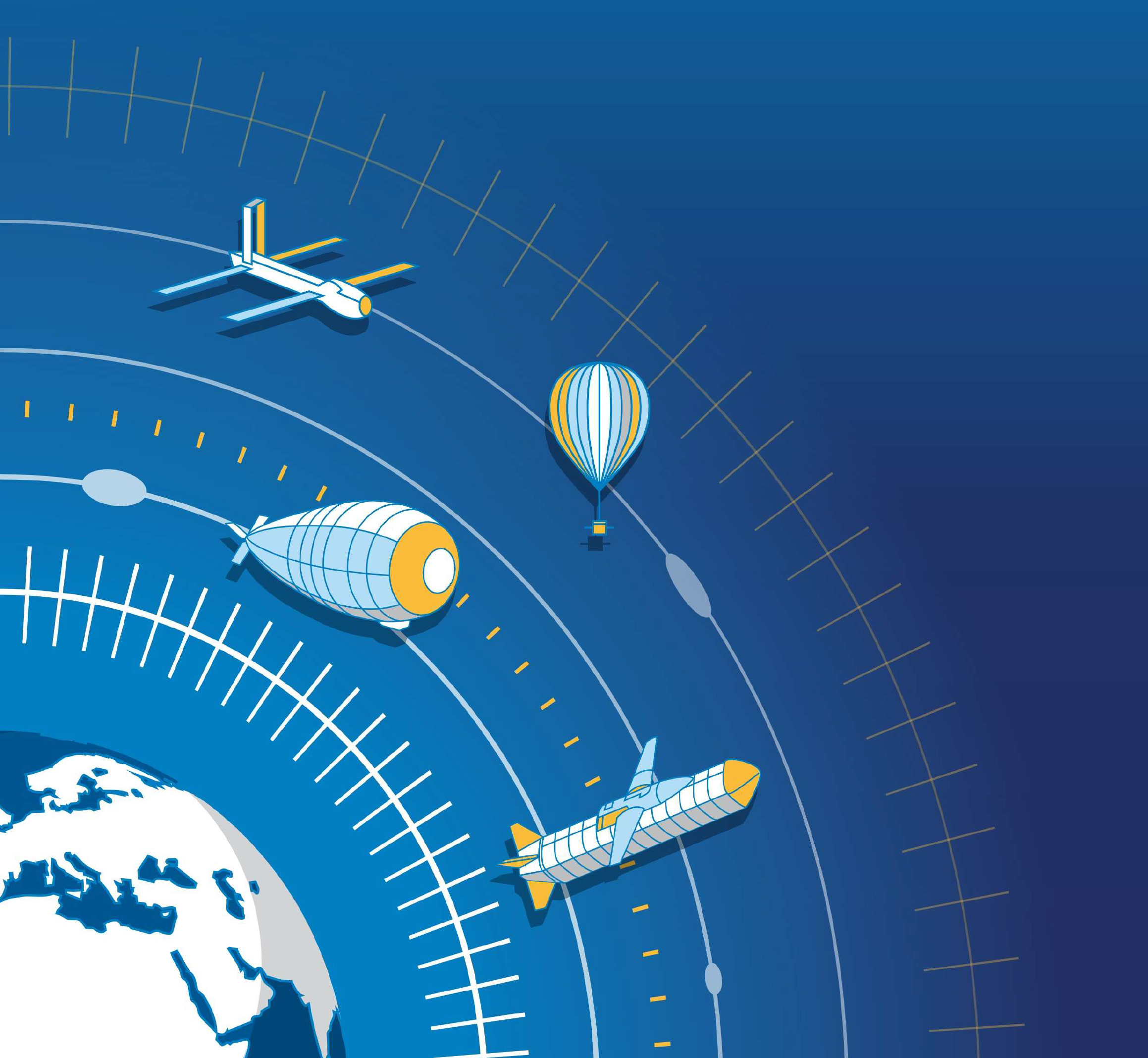 What kind of aircraft could be using the higher airspace and for what purposes?
The higher airspace can be “home” to different types of aircraft, with a wide velocity spectrum – from very slow to ultrafast. It is also a transiting zone for vehicles on their way to space. Here we will focus on aircraft that will operate in higher airspace which would mostly fall under the remit of EASA, as long as they fall under the definition of civil aircraft.
Higher-Altitude Platform Systems ( - or Pseudo Satellites)
These are expected to make up the largest “population” of the higher airspace. They are very light vehicles, with wide wingspans, often wider than that of conventional airplanes. They are normally powered by the sun through solar cells and can stay in the airspace for a long time, slowly gliding around. Higher-Altitude Platform Systems can be used, among others, for telecommunications, navigational purposes and earth observation. They have the potential to replace or complement services provided by low-earth-orbit artificial satellites. Their advantage is that they can be deployed quickly, brought down to earth for updates and then relaunched again into the higher airspace. Despite the name, they qualify as aircraft and therefore they fall under EASA’s remit.
Balloons
Balloons can reach much higher altitudes than High-Altitude Platform Systems, often exceeding 30 kilometres in the stratosphere. Some reach or exceed even 40 kilometres altitude. Like High-Altitude Platform Systems, they are reusable, able to descend, retrieved for maintenance or upgrades and relaunched. They use helium or hydrogen for lift and remain mostly stationary due to predictable stratospheric wind patterns. Their applications include, for example, scientific research, internet connectivity, earth observation, and military surveillance. Another interesting use of balloons is the so called “near-space” tourism, where industry can offer passengers a gateway to the edge of space without rockets. These balloons provide a gentle ascent to the stratosphere, where travellers can experience Earth’s curvature and the blackness of space from a pressurised capsule. Compared to High-Altitude Platform Systems, balloons offer lower costs and longer endurance, but face challenges like weather drift and payload limits.
Supersonic and hypersonic aircraft
Such aircraft could be used for the transport of passengers and goods, flying higher and much faster. Supersonic aircraft means that the speed is above the speed of sound, so, higher than 1236 kilometres per hour. With hypersonic aircraft, speed is five times the speed of sound - over 6000 kilometres per hour. Imagine flying from Portugal to New Zealand in only a few hours! However, high speed transportation can only become viable if it is affordable for passengers and done in an environmentally sustainable way. The impact on environment and noise pollution of such operations are still a challenge that needs to be addressed before such operations could become part of our lives.
Benefits from operations in higher airspace and related research
Innovation
 Operations in higher airspace require a different approach than traditional air or space operations, leading to innovative concepts and discoveries which tend to have a spill-over effect. Research can lead to improvements, for instance, in the areas of design, propulsion, solar power generation, autonomous systems, lightweight composite materials, advanced energy storage technologies, to name a few, that can strengthen broader aerospace and industrial innovation.
Environment
As mentioned above, some of the aircraft that can make use of the higher airspace use greener technologies such as solar power and hydrogen. If such aircraft can replace satellites, which require rocket propulsion to be launched – so, more fossil fuel and less green resources – there would be environmental gains. In addition, High-Altitude Platform Systems and Balloons can be more easily retrieved, leading to less “space trash”. Such systems can also contribute to climate and atmospheric research, supporting better understanding and mitigation of environmental challenges through continuous, high-resolution monitoring of the Earth’s surface and atmosphere.
Speed
Higher airspace offers the possibility for faster travelling, useful for instance, in case of emergencies. It can enable rapid deployment of critical infrastructure or delivery of urgent medical or humanitarian supplies to remote or isolated areas.
Connectivity
Platforms operating in higher airspace can enhance global communication by providing broadband connectivity to underserved regions, thereby helping bridge the digital divide. They can also complement satellites, improving resilience and reducing latency in global networks.
Observation and security
Higher Airspace Operations offer improved capabilities for Earth observation, environmental monitoring, and border or maritime surveillance. They can also provide valuable data for agriculture and disaster management.
Economic growth and cooperation
Activities in higher airspace can stimulate new markets, create employment, and encourage international collaboration on regulation and best practices. Developing governance frameworks for this domain fosters transparency, safety and sustainable use of near-space, while reinforcing cooperation between the aviation and space sectors.
As you see, even before large-scale operations take place in higher airspace, we can already start to benefit from the work to make such operations a reality. EASA is also taking part in researching and accompanying the industry developments to support innovation and ensure that aviation remains safe and with increasingly less impact on the environment.
You can follow all the developments on EASA Pro (available in English only).