What is EASAs strategy to implement this in countries? The NAAs will need some instructions on how to allow this. Now they are holding back and not working towards this solution, at least not in my country.
They point at airport regulations and say that it can not be done.
General Aviation
Public communityPublic - visible to all visitors to the platform.
Open to join - users can join this community without approval.
Invite only - users can only join this community if they are added/invited by community managers.
-
Comment
Niklas Larsson commented on John FRANKLIN's topic in General Aviation
-
Comment
Niklas Larsson commented on Niklas Larsson's topic in General Aviation
Niklas Larsson • 4 years agoThanks a lot for your inputs. We have now received most of the parts and will continue to prepare the paperwork and the "surgery". :)
-
Michel MASSON posted in General Aviation
4 years ago PublicFAAST Stall, Spin, and Upset Recovery Training
https://medium.com/faa/stall-spin-and-upset-recovery-training-eb1f69ab6…Through its analysis of GA accident data, the US General Aviation Joint Steering Committee (GAJSC) suggests that proficiency training and education in aircraft stalls, spins, and upsets, including unusual attitudes, can reduce the incidence of Loss of Control (LOC) and associated accidents. The information provided in this Feb. 2022 briefing will help pilots understand and recognize, mitigate and recover from aircraft upset.
-
Comment
Uschi Wagner commented on John FRANKLIN's event in General Aviation
Uschi Wagner • 4 years agoHi John, do you know if anything like this is planned in 2022 again?
-
Michel MASSON posted in General Aviation
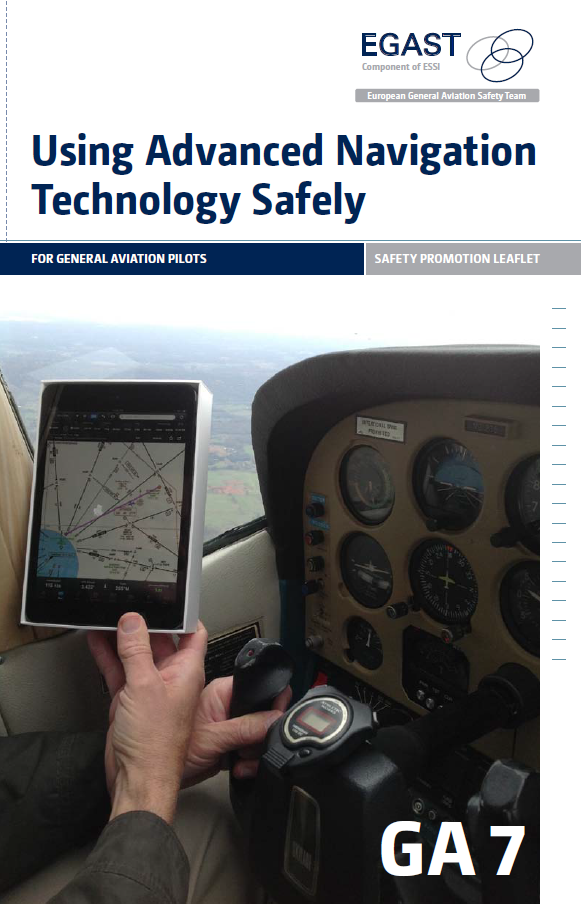
4 years ago PublicDo you know EGAST Leaflet GA7 Using Advanced Navigation Technology Safely?
https://www.easa.europa.eu/document-library/general-publications/egast-…
Authored at the time by my close Safety Promotion colleague Clement Audard, now Senior Expert Safety Assessment in the EASA Certification Directorate.
Available also in Spanish thanks to AESA.
-
ROBERTO DICIOTTI posted in General Aviation
4 years ago PublicGoodmorning everyone,
I have a question for you all.
Can a pilot with LAPL (A) be admitted to attend a course to become a CRI (A)? -
John FRANKLIN created an event in General Aviation
-
John FRANKLIN created an event in General Aviation
-
Comment
Axel-Stéphane Smorgrav commented on Vladimir FOLTIN's topic in General Aviation
Axel-Stéphane Smorgrav • 4 years agoI appear to have missed this post when it was published almost a year ago, but I did see the video on YouTube on the subject. I also watched quite a few other videos on the subject, including the in-flight testing by Flyer Magazine in January 2021, and videos by PilotAware, particularly that which explains the issues with aerial obscuration. I have also taken the time to read parts of the Horvath feasability study on using the mobile network in the context of electronic conspicuity, particularly the conclusions. And I have read NPA 2021-14.
There are a few things that really surprise me.
First of all I am surprised that one can suggest using portable (non-installed) devices for which one cannot presume the effectiveness, in order to meet a regulatory obligation to make oneself conspicuous to USSP or anyone. At least the aerial would need to be mounted outside in order to avoid obscuration.
Second I am really surprised that it is suggested that the public mobile network can be used for the same, given the conclusions of the Horvath report.
Next I do have some questions about the ISM band devices. There are already several technologies that exist, including FLARM and PilotAware, and more seem to be coming. Although these devices will be sending the same data frames, the frequencies, and I assume the encoding, is different from one system to the next. Would the USSPs be forced to support all existing and future ADS-B Light ISM band devices?
Thinking about iConspicuity beyond U-Space, PilotAware partly relies on its ATOM ground stations. Today those ground stations are managed by volunteers with absolutely no service level agreement or installation standards, so nothing guarantees the quality nor the availability of the signal or the service. I absolutely love the ingenuity and the concepts, which seem to somewhat inspired by TIS-B, but can we rely on such a system for iConspicuity?
An increasing number of light, general aviation aircraft, including UL, are already equipped with ADS-B 1090 ES. The Trig TT21, 22, 31 transponders seem to be extremely popular in light aircraft, and can easily and inexpensively be made transmitting 1090 ES. All ADS-B IN receivers I know are dual-band 1090/978. UAT and services like TIS-B to broadcast mode C/S and FLARM targets, and FIS-B to transmit information about active restriction areas and meteorological information would be a great incentive to all of powered GA to adopt ADS-B or UAT. And isn't ADS-B at some point going to replace SSR?
-
Jyrki Paajanen posted in General Aviation
4 years ago PublicHi GA Community!
A little reminder to give pilots with third-country licences something to do whilst waiting for better weather:
As you may have seen in recent Europe Air Sports and AOPA bulletins, 2022 will finally bring an end to the exemption for being based in the EU and flying third-country registered aircraft with third country licences (e.g. Flying N-registered aircraft with FAA licence, when living permanently in the EU).
The current exemption runs out on 20 June 2022 and will not be renewed. From then on you will need an EU licence.
We have kept extending that exemption possibility year after year to await the entry into application of the licencing annex to the EU-USA BASA. That annex is now in force and Member States are processing applications to validate licences to meet the deadline. The text of the annex can be found here:
https://www.easa.europa.eu/sites/default/files/dfu/tip-l_final_signe.pdf
The main rules on converting from FAA to EU licence, are in section B, starting on page 12.
The EASA Basic Regulation (Article 2(1)(b)(ii) ) determines that the operation of aircraft is subject to the Basic Regulation, if they are “registered in a third country and operated by an aircraft operator established, residing or with a principal place of business in the territory to which the Treaties apply ”. This means also holding a Part-FCL licence to fly a third-country registered aircraft.
Therefore, if you are based in the EU and flying with a third country licence, I recommend you get in touch with your local licencing authority asap to talk through the process of transferring to an EASA licence. I realise that many people may not like the way the BASA turned out, and may not like the rules, but please remember that the transfer takes months. If you want to transfer and continue flying, initiate the transfer now, or risk being grounded next summer.
Let’s make sure no-one gets unnecessarily grounded :-)
Regards,
Jyrki Paajanen