
Published in the June 2026 GA Newsletter Norway
Author Hans Edvard Sunde - CAA Norway
Republished and promoted in the EASA Community on behalf of Thomas Hytten, CAA Norway
Summer icing
As we know from meteorology, warm air can hold far more water vapour than cold air. In very cold air, there is relatively little moisture available to form ice. In warmer air, the opposite is true.
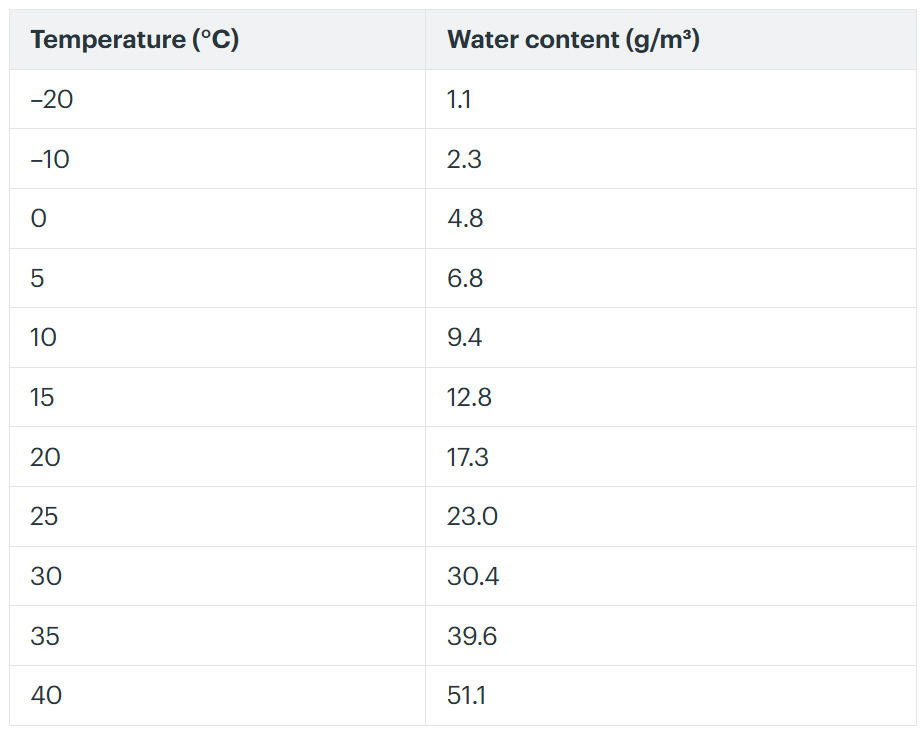
The table below shows the maximum amount of water vapour air can hold before it condenses into visible water:
At this point, the attentive reader may ask: ice cannot form unless the temperature is below 0°C, so why talk about icing in warm summer air?
There are two main reasons.
First, airflow over an aerofoil is accelerated and the pressure drops. This applies not only to wings, but also to propellers, control surfaces, rotor blades and fan blades at the front of a turbine engine. When pressure drops, temperature drops too. As a result, ice may form locally even when the outside air temperature is above freezing.
Second, the engine intake can also create a pressure drop with the same cooling effect. In carburettor engines, the classic venturi is designed to create a low-pressure area. This alone can reduce the air temperature by several degrees.
But there is more. The low pressure in the venturi draws fuel into the airflow, where it evaporates. Evaporation requires energy, and that energy is taken from the heat in the surrounding air. The airflow is therefore cooled even further inside the carburettor.
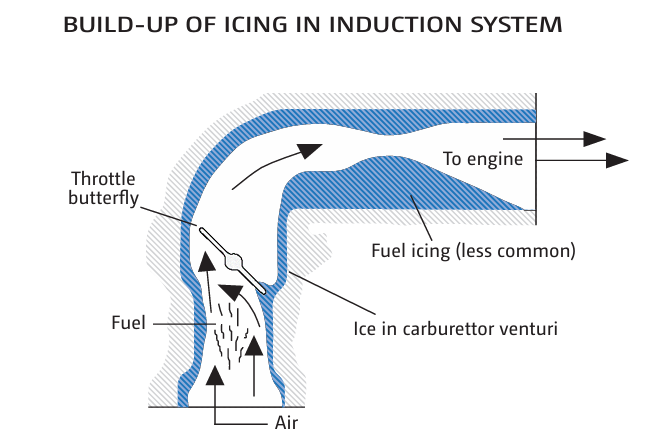
Picture from the EGAST Leaflet GA 5 Piston Engine Icing | EASA
You may have experienced the same effect if you have ever spilt petrol on your hand: it feels cold almost immediately. Petrol evaporates much more readily than water and therefore has a strong cooling effect. Fuel evaporation can lower the temperature by as much as 30°C. This means that carburettor icing can occur even when the outside air temperature is as high as 35°C. At that point, the main question is how much moisture the air contains. If the air is saturated, it may contain around 40 grams of water per cubic metre at 35°C, compared with only about 2 grams per cubic metre at –10°C.
It may seem counter-intuitive, but carburettor icing can be much more severe in summer than in winter.
Tip: Carburettor heat is just as relevant in summer as in winter.
Tip: Carburettor heat usually uses surplus heat from the engine. During prolonged idle power, for example during a simulated engine failure, carburettor heat may become less effective.
Please log in or sign up to comment.