
Thanks Michel Masson for the inspiring read ... let's get ready for the new read!
Michel MASSON posted in General Aviation
NTSB Final Report On Fatal 2022 North Las Vegas Collision
Pilot and controller error cited, ATC staffing issues also noted.
https://www.avweb.com/aviation-news/fatal-collision-report-restates-acc…
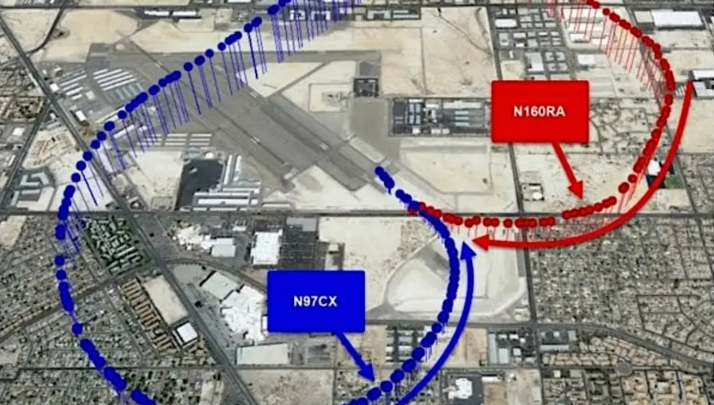
A lot can be learned for this NTSB Aviation Investigation Final Report on a fatal midair collision accident between a Piper Malibu (trajectory in blue in the picture below) and a Cessna 172 (red) in July 2022.
Picture credit: NTSB.
Abul Kalam Azad commented on Michel MASSON's topic in General Aviation
Thanks Michel Masson for the inspiring read ... let's get ready for the new read!
Michel MASSON created a topic in General Aviation
Michel MASSON created a topic in General Aviation
Nika Khvedelidze posted in General Aviation
Dear GA community,
I want to bring your attention about portable fire extinguishers that need to be located in NCO aircraft (airplane and helicopter). Based on articles "NCO.IDE.A.160 Hand fire extinguishers" and "NCO.IDE.H.160 Hand fire extinguishers" of Regulation (EU) No 965/2012 (Air Ops), NCO operators (except ELA 2 airplane and helicopter) are required to install at least 1 hand fire extinguishers:
(1) in the flight crew compartment; and
(2) in each passenger compartment that is separate from the flight crew compartment, except if the compartment is readily accessible to the flight crew.
In the meantime EASA does not clearly defines what types of fire extinguishing agents are acceptable to be used in aircraft. The only regulation I found is Regulation (EU) 2015/640 (Part-26 - "26.170 Fire extinguishers" - https://eur-lex.europa.eu/legal-content/EN/TXT/PDF/?uri=CELEX:02015R064…) which states that large airplane and helicopter shall not use halon as an extinguishing agent if the first individual certificate of airworthiness is issued on or after 18 May 2019.
Alternatively, I found FAA's "Advisory Circular 20-42D (Hand Fire Extinguishers for use in Aircraft - https://www.faa.gov/documentLibrary/media/Advisory_Circular/AC_20-42D.p…)" which clearly states and recommends types of extinguishing agents allowed to be used in aircraft.
In general, ICAO's Annex 6, Part II (International General Aviation Operations) states that:
"2.4.2.3 Any agent used in a built-in fire extinguisher for each lavatory disposal receptacle for towels, paper or waste in
an aeroplane for which the individual certificate of airworthiness is first issued on or after 31 December 2011 and any
extinguishing agent used in a portable fire extinguisher in an aeroplane for which the individual certificate of airworthiness is
first issued on or after 31 December 2018 shall:
a) meet the applicable minimum performance requirements of the State of Registry; and
b) not be of a type listed in the 1987 Montreal Protocol on Substances that Deplete the Ozone Layer as it appears in the
Eighth Edition of the Handbook for the Montreal Protocol on Substances that Deplete the Ozone Layer, Annex A,
Group II.
Note.— Information concerning extinguishing agents is contained in the UNEP Halons Technical Options Committee
Technical Note No. 1 — New Technology Halon Alternatives and FAA Report No. DOT/FAA/AR-99-63, Options to the
Use of Halons for Aircraft Fire Suppression Systems."
I wonder to get to know practice you follow when determining whether certain type of extinguishing agent is suitable for aircraft use or not.
Thank you your attention for this matter!

Claes M Johansson posted in General Aviation
Topic: National CAA interpretation of Part DTO.GEN.210 (a)(2)
We have in a DTO experienced our national CAA requiring the appointment of a temporary HoT substituting the ordinary HoT in order to continue flight training operations due to the latter having knee surgery. The CAA references AMC 1 to the mentioned rule as the rationale for this decision.
Since this AMC deals with the competence and experience required to be suitable for appointment to the role of HoT, it seems a bit fare fetched to interpret the ”acceptable means” of holding an unrestricted instructor certificate as implying that a temporary unfit situation during a pre-planned period, not affecting mental or managerial abilities, would disqualify the HoT from fulfilling his responsibilities during that period.
Indeed it seems that, would such an interpretation be relevant, then all HoT :s must also stay current on all ratings, and classes their DTOs or ATOs provide training for. Surely not the case is it?
My questions are:
Has any other CAA:s (than Sweden) made a similar interpretation? Is there any other EASA guidelines apart from the AMC that may be referenced?
Mika Järvenpää commented on Mikko Sinervä's topic in General Aviation

There were some new info published in the mean time and thus I feel good it to be visible here too even thought I’m assuming EASA is well aware and collaborating with FAA and US DoT anyway. We were going this through at GSMA ACJA meeting as well where US DoT was present.
https://www.transportation.gov/hasscoe/highlights-electronic-conspicuit…
Michel MASSON created a topic in General Aviation
Michel MASSON created a topic in General Aviation
Henry Pottkämper posted in General Aviation
Topic: Upgrade from LAPL(A) to PPL(A) - Requirements and Crediting
I would like to discuss the changes to the solo hours requirements between:
1. *Commission Implementing Regulation (EU) 2022/844* of 30 May 2022, and
2. *Commission Implementing Regulation (EU) 2024/2076* of 24 July 2024.
Let’s consider a student who completed their:
- **LAPL(A) training** with the minimum requirements of 30 hours (6 solo, including 3 cross-country solo). The solo flights were supervised by a Flight Instructor (FI) qualified for LAPL only.
- After training, the student logged an additional 30 hours as pilot-in-command (PIC).
Comparison of Requirements
Under Regulation (1), the requirements for upgrading include, among others:
"…at least 15 hours of flight time on aeroplanes after the issue of the LAPL(A), of which at least 10 shall be flight instruction completed in a training course at a DTO or an ATO. That training course shall include at least four hours of supervised solo flight time…"
Under Regulation (2), the new requirements for upgrading are:
"…applicants shall have completed at least all of the following with an instructor qualified to instruct for a PPL(A):
(i) 5 hours of dual flight instruction;
(ii) solo flight time as specified in point (a)(2) [which is…10 hours of supervised solo flight time, including at least 5 hours of solo cross-country]."
Key Differences
The main difference is the impact of the instructor's qualification. Under Regulation (1), the student needed to complete an additional 4 hours of supervised solo flight time. However, under Regulation (2), the student must now complete an additional 10 hours of supervised solo flight time. This is because the solo flight time logged during LAPL(A) training under the supervision of an LAPL-only FI no longer counts under the new rules, as supervision by a PPL-qualified FI is now mandatory.
Concerns
This change appears to be a step back and seems contrary to the goal of "improvements for general aviation," as stated in the title of Regulation (EU) 2024/2076. Requiring the student to log an additional 10 hours of solo flight time during PPL(A) training, after having already accumulated 15 or more hours of PIC time post-LAPL(A) training, seems redundant and inefficient.
What’s your opinion on this matter? Am I missing something?