
Filters
ANNEX IV — Part-ATS
SPECIFIC REQUIREMENTS FOR PROVIDERS OF AIR TRAFFIC SERVICES
SUBPART A — ADDITIONAL ORGANISATION REQUIREMENTS FOR PROVIDERS OF AIR TRAFFIC SERVICES (ATS.OR)
SECTION 1 — GENERAL REQUIREMENTS
GM1 Annex IV (Part-ATS)
ED Decision 2020/008/R
GENERAL
In the context of the AMC and GM to Part-ATS, the terms listed below have the following meaning:
—'accepting air traffic controller (ATCO)’ refers to the air traffic controller next to take control of an aircraft;
—'accepting control unit’ refers to the air traffic control unit next to take control of an aircraft;
—‘advisory airspace’ refers to an airspace of defined dimensions, or designated route, within which air traffic advisory service is available;
—‘advisory route’ refers to a designated route along which air traffic advisory service is available;
—‘airborne collision avoidance system (ACAS)’ refers to an aircraft system based on secondary surveillance radar (SSR) transponder signals which operates independently of ground-based equipment to provide advice to the pilot on potential conflicting aircraft that are equipped with SSR transponders;
—‘aircraft address’ refers to a unique combination of 24 bits available for assignment to an aircraft for the purpose of air-ground communications, navigation and surveillance;
—‘air-taxiing’ refers to the movement of a helicopter/vertical take-off and landing (VTOL) aircraft above the surface of an aerodrome, normally in ground effect and at a ground speed normally less than 37 km/h (20 kt). The actual height may vary, and some helicopters may require air-taxiing above 8 m (25 ft) above ground level (AGL) to reduce ground effect turbulence or provide clearance for cargo slingloads;
—‘air traffic’ refers to all aircraft in flight or operating on the manoeuvring area of an aerodrome;
—‘approach sequence’ refers to the order in which two or more aircraft are cleared to approach to land at the aerodrome;
—‘base turn’ refers to a turn executed by the aircraft during the initial approach between the end of the outbound track and the beginning of the intermediate or final approach track. The tracks are not reciprocal. Base turns may be designated as being made either in level flight or while descending, according to the circumstances of each individual procedure;
—‘change-over point’ refers to the point at which an aircraft navigating on an ATS route segment defined by reference to very high-frequency omnidirectional radio ranges is expected to transfer its primary navigational reference from the facility behind the aircraft to the next facility ahead of the aircraft. Change-over points are established to provide the optimum balance in respect of signal strength and quality between facilities at all levels to be used and to ensure a common source of azimuth guidance for all aircraft operating along the same portion of a route segment;
—‘common point’ refers to a point on the surface of the earth common to the tracks of two aircraft, used as a basis for the application of separation (e.g. significant point, waypoint, navigation aid, fix);
—‘controller-pilot’ refers to in different contexts the interaction between air traffic controllers and pilots;
—‘cruise climb’ refers to an aeroplane cruising technique resulting in a net increase in altitude as the aeroplane mass decreases;
—‘decision altitude (DA) or decision height (DH)’ refers to a specified altitude or height in a 3D instrument approach operation at which a missed approach must be initiated if the required visual reference to continue the approach has not been established. DA is referenced to mean sea level, and DH is referenced to the threshold elevation. The required visual reference is that section of the visual aids or of the approach area which should have been in view for sufficient time for the pilot to have made an assessment of the aircraft position and rate of change of position, in relation to the desired flight path. In Category III operations with a DH, the required visual reference is that specified for the particular procedure and operation;
—‘discrete code’ refers to a four-digit SSR code with the last two digits not being ‘00’;
—‘emergency phase’ refers to a generic term meaning, as the case may be, uncertainty phase, alert phase or distress phase;
—‘estimated elapsed time’ refers to the estimated time required to proceed from one significant point to another;
—‘expected approach time’ refers to the time at which air traffic control (ATC) expects that an arriving aircraft, following a delay, will leave the holding fix to complete its approach for a landing. The actual time of leaving the holding fix will depend upon the approach clearance;
—‘filed flight plan’ refers to the flight plan as filed with an air traffic services unit by the pilot or a designated representative, without any subsequent changes. When the word ‘message’ is used as a suffix to this term, it denotes the content and format of the filed flight plan data as transmitted;
—‘flight path monitoring’ refers to the use of ATS surveillance systems for the purpose of providing aircraft with information and advice relative to significant deviations from nominal flight path, including deviations from the terms of their ATC clearances;
—‘ground effect’ refers to a condition of improved performance (lift) due to the interference of the surface with the airflow pattern of the rotor system when a helicopter or other VTOL aircraft is operating near the ground. Rotor efficiency is increased by ground effect to a height of about one rotor diameter for most helicopters;
—‘initial approach segment’ refers to that segment of an instrument approach procedure between the initial approach fix and the intermediate approach fix or, where applicable, the final approach fix or point;
—‘landing area’ refers to that part of a movement area intended for the landing or take-off of aircraft;
—‘minimum fuel’ is a term to be used to describe a situation in which an aircraft’s fuel supply has reached a state where the flight is committed to land at a specific aerodrome and no additional delay can be accepted;
—‘multilateration (MLAT) system’ refers to a group of equipment configured to provide position derived from the SSR transponder signals (replies or squitters) primarily using time difference of arrival (TDOA) techniques. Additional information, including identification, can be extracted from the received signals);
—‘normal operating zone (NOZ)’ refers to airspace of defined dimensions extending to either side of a published instrument approach procedure final approach course or track. Only that half of the NOZ adjacent to a no transgression zone (NTZ) is taken into account in independent parallel approaches;
—‘no transgression zone (NTZ)’ refers to, in the context of independent parallel approaches, a corridor of airspace of defined dimensions located centrally between the two extended runway centre lines, where a penetration by an aircraft requires an air traffic controller intervention to manoeuvre any threatened aircraft on the adjacent approach;
—‘obstacle clearance altitude (OCA)’ refers to the lowest altitude above the elevation of the relevant runway threshold or the aerodrome elevation as applicable, used in establishing compliance with appropriate obstacle clearance criteria. The OCA is referenced to mean sea level;
—‘obstacle clearance height (OCH)’ refers to the lowest height above the elevation of the relevant runway threshold or the aerodrome elevation as applicable, used in establishing compliance with appropriate obstacle clearance criteria. OCH is referenced to the threshold elevation or in the case of non-precision approach procedures to the aerodrome elevation or the threshold elevation if that is more than 2 m (7 ft) below the aerodrome elevation. An OCH for a circling approach procedure is referenced to the aerodrome elevation;
—‘onward clearance time’ refers to the time at which an aircraft can expect to leave the fix at which it is being held;
—‘procedural ATC service’ refers to a term that is used to indicate that information derived from an ATS surveillance system is not required for the provision of air traffic control service;
—‘procedural separation’ refers to the separation used when providing the procedural air traffic control service;
—’procedure turn’ refers to a manoeuvre in which a turn is made away from a designated track followed by a turn in the opposite direction to permit the aircraft to intercept and proceed along the reciprocal of the designated track. Procedure turns are designated ‘left’ or ‘right’ according to the direction of the initial turn. Procedure turns may be designated as being made either in level flight or while descending, according to the circumstances of each individual procedure;
—‘PSR blip’ refers to the visual indication, in a non-symbolic form, on a situation display, of the position of an aircraft obtained by primary radar;
—‘radar approach’ refers to an approach in which the final approach phase is executed under the direction of an air traffic controller using radar;
—‘radar clutter’ refers to the visual indication, on a situation display, of unwanted signals;
—‘radar contact’ refers to the situation which exists when the radar position of a particular aircraft is seen and identified on a situation display;
—‘reporting point’ refers to a specified geographical location in relation to which the position of an aircraft can be reported;
—‘runway-holding position’ refers to a designated position intended to protect a runway, an obstacle limitation surface, or an instrument landing system (ILS)/microwave landing system (MLS) critical/sensitive area at which taxiing aircraft and vehicles shall stop and hold unless otherwise authorised by the aerodrome control tower. In radiotelephony phraseologies, the expression ‘holding point’ is used to designate the runway-holding position;
—‘runway incursion’ refers to any occurrence at an aerodrome involving the incorrect presence of an aircraft, vehicle or person on the protected area of a surface designated for the landing and take-off of aircraft;
—‘runway strip’ refers to a defined area including the runway and stopway, if provided, intended to:
(a) reduce the risk of damage to aircraft running off a runway; and
(b) protect aircraft flying over it during take-off or landing operations;
—‘segregated parallel operations’ refers to simultaneous operations on parallel or near-parallel instrument runways in which one runway is used exclusively for approaches and the other runway is used exclusively for departures;
—‘SSR response’ refers to the visual indication, in a non-symbolic form, on a situation display, of a response from an SSR transponder in reply to an interrogation;
—‘stopway’ refers to a defined rectangular area on the ground at the end of take-off run available, prepared as a suitable area in which an aircraft can be stopped in the case of an abandoned take-off;
—‘total estimated elapsed time’ refers to, for IFR flights, the estimated time required from take-off to arrive over that designated point, defined by reference to navigation aids, from which it is intended that an instrument approach procedure will be commenced, or, if no navigation aid is associated with the destination aerodrome, to arrive over the destination aerodrome. For VFR flights, it refers to the estimated time required from take-off to arrive over the destination aerodrome;
—‘touchdown’ refers to the point where the nominal glide path intercepts the runway. ‘Touchdown’ as defined above is only a datum and is not necessarily the actual point at which the aircraft will touch the runway;
—‘touchdown zone’ refers to the portion of a runway, beyond the threshold, intended as the first point of contact between landing aircraft and the runway;
—‘visual surveillance system’ refers to an electro-optical system providing an electronic visual presentation of traffic and any other information necessary to maintain situational awareness at an aerodrome and its vicinity.
ATS.OR.100 Ownership
Regulation (EU) 2017/373
(a)An air traffic services provider shall notify the competent authorities of:
(1)its legal status, its ownership structure and any arrangements having a significant impact on control over its assets;
(2)any links with organisations not involved in the provision of air navigation services, including commercial activities in which they are engaged either directly or through related undertakings, which account for more than 1 % of their expected revenue; furthermore, it shall notify any change of any single shareholding which represents 10 % or more of their total shareholding.
(b)An air traffic services provider shall take all necessary measures to prevent any situation of conflict of interests that could compromise the impartial and objective provision of its services.
ATS.OR.105 Open and transparent provision of service
Regulation (EU) 2017/373
In addition to point ATM/ANS.OR.A.075 of Annex III, the air traffic service provider shall neither engage in conduct that would have as its object or effect the prevention, restriction or distortion of competition, nor shall they engage in conduct that amounts to an abuse of a dominant position, in accordance with applicable Union and national law.
ATS.OR.110 Coordination between aerodrome operators and air traffic services providers
Commission Implementing Regulation (EU) 2020/469
An air traffic services provider shall establish arrangements with the operator of the aerodrome at which it provides air traffic services to ensure adequate coordination of activities and services provided as well as exchange of relevant data and information.
AMC1 ATS.OR.110 Coordination between aerodrome operators and air traffic services providers
ED Decision 2020/008/R
ESTABLISHMENT AND IDENTIFICATION OF STANDARD TAXI ROUTES
(a)The air traffic services provider, in coordination with the aerodrome operator, should assess the necessity for establishing standard routes for taxiing aircraft on an aerodrome between runways, aprons and maintenance areas.
(b)When established, such routes should be direct, simple and, where practicable, designed to avoid traffic conflicts.
(c)Standard routes for taxiing aircraft should be identified by designators distinctively different from those of the runways and ATS routes.
AMC2 ATS.OR.110 Coordination between aerodrome operators and air traffic services providers
ED Decision 2020/008/R
INFORMATION EXCHANGE ON THE AERODROME CONDITIONS AND OPERATIONAL STATUS OF AERODROME FACILITIES
The air traffic services provider should establish arrangements with the aerodrome operator for the exchange of information regarding the aerodrome conditions, in particular the operational conditions of the movement area, including the existence of temporary hazards, and the operational status of any associated facilities at the aerodrome(s) with which they are concerned.
AMC3 ATS.OR.110 Coordination between aerodrome operators and air traffic services providers
ED Decision 2020/008/R
APRON MANAGEMENT SERVICES
The air traffic services provider should establish arrangements, including a coordination procedure, with the aerodrome operator and, when applicable, with the other organisation(s) providing apron management services. The coordination procedure between the provider(s) of apron management services and the air traffic services provider should contain at least the following:
(a)the boundaries of the respective areas of responsibilities as described according to ADR.OPS.D.005 of Regulation (EU) No 139/2014;
(b)the handover points between apron and manoeuvring area;
(c)the holding areas;
(d)the means of guidance for the aircraft taxiing;
(e)the operational information to be exchanged between both parties; and
(f)the push back operations, when interfering with the manoeuvring area.
AMC4 ATS.OR.110 Coordination between aerodrome operators and air traffic services providers
ED Decision 2020/008/R
COORDINATION FOR LOW-VISIBILITY OPERATIONS
The air traffic services provider should establish arrangements with the aerodrome operator and, where established, with the apron management services provider(s) for the relevant aspects and the definition of the respective responsibilities in conducting low-visibility operations (LVOs), in addition to those established in ATS.TR.265(b).
AMC5 ATS.OR.110 Coordination between aerodrome operators and air traffic services providers
ED Decision 2020/008/R
COORDINATION FOR RUNWAYS INSPECTIONS
The air traffic services provider should coordinate with the aerodrome operator the conduct of routine and non-routine runway inspections.
AMC6 ATS.OR.110 Coordination between aerodrome operators and air traffic services providers
ED Decision 2020/008/R
INFORMATION ON THE SAFE USE OF THE MANOEUVRING AREA
When a not previously notified condition pertaining to the safe use by aircraft of the manoeuvring area is reported to or observed by the aerodrome air traffic controllers or by aerodrome flight information services (AFIS) officers, the air traffic services provider should inform the aerodrome operator, and should ensure that operations on that part of the manoeuvring area are terminated until otherwise advised by the aerodrome operator.
GM1 ATS.OR.110 Coordination between aerodrome operators and air traffic services providers
ED Decision 2020/008/R
COORDINATION FOR THE AERODROME MANUAL
The air traffic services provider should establish close coordination with the aerodrome operator to participate in the development of the elements of the aerodrome manual pertaining to the services it provides.
ATS.OR.115 Coordination between military units and air traffic services providers
Commission Implementing Regulation (EU) 2020/469
Without prejudice to Article 6 of Regulation (EC) No 2150/2005, an air traffic services provider shall ensure that its air traffic services units, either routinely or on request, in accordance with locally agreed procedures, provide appropriate military units with pertinent flight plan and other data concerning flights of civil aircraft in order to facilitate their identification.
ATS.OR.120 Coordination between meteorological services providers and air traffic services providers
Commission Implementing Regulation (EU) 2020/469
(a)To ensure that aircraft receive the most up-to-date meteorological information for aircraft operations, an air traffic services provider shall make arrangements with the associated meteorological services provider for air traffic services personnel:
(1)in addition to using indicating instruments, to report, if observed by air traffic services personnel or communicated by aircraft, such other meteorological elements as may be agreed upon;
(2)to report as soon as possible meteorological phenomena of operational significance, if observed by air traffic services personnel or communicated by aircraft, which have not been included in the aerodrome meteorological report;
(3)to report as soon as possible pertinent information concerning pre-eruption volcanic activity, volcanic eruptions and information concerning volcanic ash cloud. In addition, area control centres and flight information centres shall report the information to the associated meteorological watch office and volcanic ash advisory centres (VAACs).
(b)An air traffic services provider shall ensure that close coordination is maintained between area control centres, flight information centres and associated meteorological watch offices such that information on volcanic ash included in NOTAM and SIGMET messages is consistent.
ATS.OR.125 Coordination between aeronautical information services and air traffic services providers
Commission Implementing Regulation (EU) 2020/469
(a)An air traffic services provider shall provide to the relevant aeronautical information services provider the aeronautical information to be published as necessary to permit the utilisation of such air traffic services.
(b)To ensure that the aeronautical information services providers obtain information to enable them to provide up-to-date preflight information and to meet the need for in-flight information, an air traffic services provider and aeronautical information services provider shall make arrangements to report to the responsible aeronautical information services provider, with a minimum of delay:
(1)information on aerodrome conditions;
(2)the operational status of associated facilities, services and navigation aids within their area of responsibility;
(3)the occurrence of volcanic activity observed by air traffic services personnel or reported by aircraft;
(4)any other information considered to be of operational significance.
(c)Before introducing changes to systems for air navigation under its responsibility, an air traffic services provider shall:
(1)ensure close coordination with the aeronautical information services provider(s) concerned;
(2)take due account of the time needed by the aeronautical information services provider for the preparation, production and issuance of relevant material for promulgation;
(3)provide the information in a timely manner to the aeronautical information services provider concerned.
(d)An air traffic services provider shall observe the predetermined, internationally agreed aeronautical information regulation and control (AIRAC) effective dates in addition to 14 days postage time when submitting to aeronautical information services providers the raw information or data, or both, subject to the AIRAC cycle.
GM1 ATS.OR.125(a) Coordination between aeronautical information services and air traffic services providers
ED Decision 2020/008/R
PUBLICATION OF REDUCED RUNWAY SEPARATION MINIMA
The air traffic services provider should arrange to publish all applicable procedures related to the application of reduced runway separation minima as in AMC9 ATS.TR.210(c)(2)(i) in the aeronautical information publication (AIP) and to include them also in the local ATC instructions.
GM2 ATS.OR.125(a) Coordination between aeronautical information services and air traffic services providers
ED Decision 2020/008/R
PROMULGATION OF INFORMATION ON AFIS
The air traffic services provider should arrange to report information regarding the availability of AFIS and related procedures for its inclusion in the relevant parts of the AIP in the same manner as in the case of aerodromes provided with air traffic control service, in accordance with Appendix I to Annex VI (Part-AIS). The information includes but is not limited to the following:
(a)identification of the aerodrome;
(b)location and identification of the AFIS unit;
(c)hours of operation of the AFIS unit. For aerodromes where there is an alternation of the air traffic control service and AFIS provision, hours of operation of both services;
(d)lateral and vertical limits of the associated airspace;
(e)language(s) used;
(f)detailed description of the services provided, including alerting service and, if applicable, use of direction-finding;
(g)special procedures for application by pilots; and
(h)any other pertinent information.
GM1 ATS.OR.125(c) Coordination between aeronautical information services and air traffic services providers
ED Decision 2020/008/R
ORIGIN OF AERONAUTICAL INFORMATION
Information to be reported by the air traffic services provider to the AIS provider for the purpose of air traffic services may originate also from other entities, such as the aerodrome operator, the apron management services provider, CNS service providers, etc.
GM1 ATS.OR.125(d) Coordination between aeronautical information services and air traffic services providers
ED Decision 2020/008/R
Of particular importance are changes to aeronautical information that affect charts and/or computer-based navigation systems which qualify to be notified by the aeronautical information regulation and control (AIRAC) system, as stipulated in AIS.OR.505 and AIS.TR.505.
ATS.OR.127 Coordination by air traffic services providers in U-space airspace
Regulation (EU) 2021/665
Air traffic services providers shall:
(a)provide on a non-discriminatory basis the relevant traffic information regarding manned aircraft that is necessary as part of the common information services referred to in Commission Implementing Regulation (EU) 2021/664 for a U-Space airspace established in the controlled airspace where the air traffic service provider is designated to provide its services;
(b)establish the coordination procedures and communication facilities between appropriate air traffic service units, U-space service providers and, where applicable, single common information service providers permitting provision of this data.
AMC1 ATS.OR.127(a) Coordination by air traffic services providers in U-space airspace
ED Decision 2022/023/R
INFORMATION ON MANNED AIRCRAFT
Air traffic services providers should make arrangements with operators of manned special operations, which are exempted from the requirements on flight plan submission time according to point SERA.4001(d), to receive the earliest possible notification of an intended manned operation, either directly or through common information services when a single common information service provider is designated.
ATS.OR.130 Time in air traffic services
Commission Implementing Regulation (EU) 2020/469
(a)An air traffic services provider shall ensure that air traffic services units are equipped with clocks indicating the time in hours, minutes and seconds, clearly visible from each operating position in the unit concerned.
(b)An air traffic services provider shall ensure that air traffic services unit clocks and other time-recording devices are checked as necessary to ensure correct time to within plus or minus 30 seconds of UTC. Wherever data link communications are utilised by an air traffic services unit, clocks and other time- recording devices shall be checked as necessary to ensure correct time to within 1 second of UTC.
(c)The correct time shall be obtained from a standard time station or, if not possible, from another unit which has obtained the correct time from such station.
ATS.OR.135 Contingency arrangements
Commission Implementing Regulation (EU) 2020/469
An air traffic services provider shall develop contingency plans as required in point ATM/ANS.OR.A.070 of Annex III in close coordination with the air traffic services providers responsible for the provision of services in adjacent portions of airspace and, as appropriate, with airspace users concerned.
GM1 ATS.OR.135 Contingency arrangements
ED Decision 2020/008/R
The various circumstances surrounding each ATS contingency situation preclude the establishment of exact detailed procedures to be followed.
GM2 ATS.OR.135 Contingency arrangements
ED Decision 2020/008/R
RADIO COMMUNICATION CONTINGENCIES IN AIR TRAFFIC CONTROL SERVICE
(a)General
Air traffic control contingencies related to communications, i.e. circumstances preventing an air traffic controller from communicating with aircraft under control, may be caused by either a failure of ground radio equipment, a failure of airborne equipment, or by the control frequency being inadvertently blocked by an aircraft or a ground transmitter, or any unauthorised use. The duration of such events may be for prolonged periods and appropriate action to ensure that the safety of aircraft is not affected should therefore be taken immediately.
(b)Complete ground radio failure
(1)In the event of complete failure of the ground radio equipment used for air traffic control service, the air traffic controller should:
(i)attempt to establish radio communications on the emergency frequency 121.500 MHz;
(ii)without delay inform all adjacent control positions or air traffic control units, as applicable, of the failure;
(iii)apprise such positions or units of the current traffic situation;
(iv)request their assistance, in respect of aircraft which may establish communications with those positions or units, in establishing and maintaining separation between such aircraft; and
(v)instruct adjacent control positions or air traffic control units to hold or re-route all controlled flights outside the area of responsibility of the position or air traffic control unit that has experienced the failure until such time that the provision of normal services can be resumed,
unless able to continue to provide air traffic services by means of other available communication channels.
(2)In order to reduce the impact of complete ground radio equipment failure on the safety of air traffic, the air traffic services provider should establish contingency procedures to be followed by control positions and air traffic control units in the event of such failures. Where agreed between affected air traffic services providers, such contingency procedures should provide for the delegation of control to an adjacent control position or air traffic control unit in order to permit a minimum level of services to be provided as soon as possible, following the ground radio failure and until normal operations can be resumed.
(c)Blocked frequency
In the event that the control frequency is inadvertently blocked by an aircraft transmitter, the following additional steps should be taken:
(1)attempt to identify the aircraft concerned;
(2)if the aircraft blocking the frequency is identified, attempts should be made to establish communication with that aircraft, e.g. on the emergency frequency 121.500 MHz, by SELCAL, through the aircraft operator’s company frequency if applicable, on any VHF frequency designated for air-to-air use by flight crews or any other communication means or, if the aircraft is on the ground, by direct contact; and
(3)if communication is established with the aircraft concerned, the flight crew should be instructed to take immediate action to stop inadvertent transmissions on the affected control frequency.
(d)Unauthorised use of ATC frequency
Instances of false and deceptive transmissions on air traffic control frequencies which may impair the safety of aircraft can occasionally occur. In the event of such occurrences, the air traffic control unit concerned should:
(1)correct any false or deceptive instructions or clearances which have been transmitted;
(2)advise all aircraft on the affected frequency(ies) that false and deceptive instructions or clearances are being transmitted;
(3)instruct all aircraft on the affected frequency(ies) to verify instructions and clearances before taking action to comply;
(4)if practical, instruct aircraft to change to another frequency; and
(5)if possible, advise all aircraft affected when the false and deceptive instructions or clearances are no longer being transmitted.
GM3 ATS.OR.135 Contingency arrangements
ED Decision 2020/008/R
CONTINGENCY PROCEDURES FOR AIR TRAFFIC SERVICES UNITS WHEN A VOLCANIC ASH CLOUD IS REPORTED OR FORECAST
If a volcanic ash cloud is reported or forecast in the airspace for which the air traffic services unit is responsible, the following actions should be taken, as appropriate:
(a)relay pertinent information immediately to flight crews whose aircraft could be affected to ensure that they are aware of the ash cloud’s current and forecast position and the flight levels affected;
(b)accommodate requests for re-routing or level changes to the extent practicable;
(c)suggest re-routing to avoid or exit areas of reported or forecast ash clouds when requested by the pilot or deemed necessary by the air traffic controller; and
(d)when practicable, request a special air-report when the route of flight takes the aircraft into or near the forecast ash cloud and provide such special air-reports to the appropriate agencies.
GM4 ATS.OR.135 Contingency arrangements
ED Decision 2020/008/R
Guidance on contingency planning for air navigation services providers, including air traffic services providers, may be found in:
(a)ICAO Annex 11 - Attachment C ‘Material relating to contingency planning’; and
(b)the ‘EUROCONTROL Guidelines for Contingency Planning of Air Navigation Services (including Service Continuity)’ Edition 2.0 of 06/04/2009, available at:
and in its complementary document named ‘Reference Guide to EUROCONTROL Guidelines for Contingency Planning of Air Navigation Services (including Service Continuity)’ Edition 2.0 of 06/04/2009, available at:
ATS.OR.140 Failure and irregularity of systems and equipment
Commission Implementing Regulation (EU) 2020/469
An air traffic services provider shall establish appropriate arrangements for air traffic services units to immediately report any failure or irregularity of communication, navigation and surveillance systems or any other safety-significant systems or equipment which could adversely affect the safety or efficiency of flight operations or the provision of air traffic services, or both.
GM1 ATS.OR.140 Failure and irregularity of systems and equipment
ED Decision 2020/008/R
ATS.OR.140 is complementary to the existing requirements on reporting stemming from Regulation (EU) No 376/2014 and on the reporting arrangements that ATM/ANS providers have to establish in accordance with principles and requirements on the management system set in ATM/ANS.OR.B.005 in Annex III to Regulation (EU) 2017/373. However, the primary objective of ATS.OR.140 is the timely dissemination of information needed for the safe and efficient air traffic control service and flight information service provision (e.g. information on changes in the availability of radio navigation services). The arrangements should also support the timely issuance of NOTAMs concerning the relevant information to be disseminated, in accordance with the applicable requirements in ATM/ANS.OR.A.085 in Annex III to Regulation (EU) 2017/373.
ATS.OR.145 Operation of air traffic control service
Commission Implementing Regulation (EU) 2020/469
An air traffic services provider shall ensure that information on aircraft movements, together with a record of ATC clearances issued to such aircraft, are so displayed as to permit ready analysis in order to maintain an efficient flow of air traffic with adequate separation between aircraft.
AMC1 ATS.OR.145 Operation of air traffic control service
ED Decision 2020/008/R
PRESENTATION AND UPDATING OF FLIGHT PLAN AND CONTROL DATA AND OTHER RELEVANT INFORMATION FOR THE AIR TRAFFIC CONTROL SERVICE PROVISION
(a)The air traffic services provider should ensure that sufficient information and data are presented in such a manner as to enable the air traffic controller to have a complete representation of the current air traffic situation within the air traffic controller’s area of responsibility and, when relevant, movements on the manoeuvring area of aerodromes.
(b)The presentation should be updated in accordance with the progress of aircraft in order to facilitate the timely detection and resolution of conflicts as well as to facilitate and provide a record of coordination with adjacent air traffic services units and control sectors.
(c)An appropriate representation of the airspace configuration, including significant points and information related to such points, should be provided.
(d)Data to be presented should include relevant information from flight plans and position reports as well as clearance and coordination data.
(e)The information display may be generated and updated automatically, or the data may be entered and updated by authorised personnel.
(f)Data generated automatically should be presented to the air traffic controller in a timely manner. The presentation of information and data for individual flights should continue until such time as the data is no longer required for the purpose of providing control, including conflict detection and the coordination of flights, or until terminated by the air traffic controller.
(g)All information and data as in point (a), including data related to individual aircraft, should be presented in a manner minimising the potential for misinterpretation or misunderstanding.
GM1 ATS.OR.145 Operation of air traffic control
ED Decision 2020/008/R
PRESENTATION AND UPDATING OF FLIGHT PLAN AND CONTROL DATA AND OTHER RELEVANT INFORMATION FOR THE AIR TRAFFIC CONTROL SERVICE PROVISION
Human factors principles should be considered when establishing the provisions and procedures stipulated in ATS.OR.145. The SESAR Joint Undertaking has developed a project titled ‘Human Performance in Automation Support’ (Project Nr. 16.05), which addressed the subject. The relevant final Project Report may be found at https://www.sesarju.eu/sites/default/files/DEL_16.05-D09-Final_Project_Report_.00.01.00.pdf.
GM2 ATS.OR.145 Operation of air traffic control service
ED Decision 2020/008/R
PRESENTATION AND UPDATING OF FLIGHT PLAN AND CONTROL DATA AND OTHER RELEVANT INFORMATION FOR THE AIR TRAFFIC CONTROL SERVICE PROVISION
Other information required or desirable for the air traffic control service provision may be but is not limited to:
(a)relevant meteorological information;
(b)NOTAMs;
(c)airspace-related information;
(d)status of radio navigation services and visual aids;
(e)aerodrome conditions and the operational status of associated facilities, where appropriate;
(f)unmanned free balloons; and
(g)others.
GM3 ATS.OR.145 Operation of air traffic control service
ED Decision 2020/008/R
PRESENTATION AND UPDATING OF FLIGHT PLAN AND CONTROL DATA AND OTHER RELEVANT INFORMATION FOR THE AIR TRAFFIC CONTROL SERVICE PROVISION
(a)The required flight plan and control data may be presented through the use of paper flight progress strips or electronic flight progress strips, by other electronic presentation forms or by a combination of presentation methods.
(b)The air traffic services provider should specify the procedures for annotating data and provisions specifying the types of data to be entered on flight progress strips, including the use of symbols.
ATS.OR.150 Transfer of responsibility for control and transfer of communications
Commission Implementing Regulation (EU) 2020/469
Air traffic services provider shall establish applicable coordination procedures for transfer of responsibility for control of flights, including transfer of communications and transfer of control points, in letters of agreement and operation manuals, as appropriate.
GM1 ATS.OR.150 Transfer of responsibility for control and transfer of communications
ED Decision 2020/008/R
GUIDANCE ON LETTERS OF AGREEMENT BETWEEN AIR TRAFFIC SERVICES UNITS
Guidance on the drafting of operational Letters of Agreement between air traffic services units may be found in the EUROCONTROL Guidelines ‘Common Format Letter of Agreement
Between Air Traffic Services Units’ Edition 5.0 of 15.10.2019, available at https://www.eurocontrol.int/publication/common-format-letter-agreement-between-air-traffic-services-units.
GM2 ATS.OR.150 Transfer of responsibility for control and transfer of communications
ED Decision 2020/008/R
TRANSFER OF COMMUNICATION
(a)Except when separation minima based on ATS surveillance systems specified in AMC1 ATS.TR.210(c)(2), AMC6 ATS.TR.220 and point (d) of AMC7 ATS.TR.220 are being applied, the transfer of air-ground communications of an aircraft from the transferring to the accepting control unit should be made 5 minutes before the time at which the aircraft is estimated to reach the common control area boundary unless otherwise agreed between the two air traffic control units concerned.
(b)Between two air traffic services units applying separation minima based on ATS surveillance systems specified in AMC1 ATS.TR.210(c)(2), AMC6 ATS.TR.220 and point (d) of AMC7 ATS.TR.220 at the time of transfer of control, the transfer of air-ground communications of an aircraft from the transferring to the accepting control unit should be made immediately after the accepting control unit has agreed to assume control.
(c)The transfer of air-ground communications to the aerodrome air traffic controller should be effected at such a point, level, or time, that clearance to land or alternative instructions, as well as information on essential local traffic, can be issued in a timely manner.
(d)The accepting control unit should notify the transferring unit in the event that communication with the aircraft is not established as expected.
(e)In cases where a portion of a control area is so situated that the time taken by aircraft to traverse it is of a limited duration, agreement should be reached to provide for direct transfer of communication between the units responsible for the adjacent control areas, provided that the intermediate unit is fully informed of such traffic. The intermediate unit should retain responsibility for coordination and for ensuring that separation is maintained between all traffic within its area of responsibility.
(f)An aircraft may be permitted to communicate temporarily with a control unit other than the unit controlling the aircraft.
SECTION 2 — SAFETY OF SERVICES
ATS.OR.200 Safety management system
Regulation (EU) 2017/373
An air traffic services provider shall have in place a safety management system (SMS), which may be an integral part of the management system required in point ATM/ANS.OR.B.005, that includes the following components:
(1)Safety policy and objectives
(i)Management commitment and responsibility regarding safety which shall be included in the safety policy.
(ii)Safety accountabilities regarding the implementation and maintenance of the SMS and the authority to make decisions regarding safety.
(iii)Appointment of a safety manager who is responsible for the implementation and maintenance of an effective SMS;
(iv)Coordination of an emergency response planning with other service providers and aviation undertakings that interface with the ATS provider during the provision of its services.
(v)SMS documentation that describes all the elements of the SMS, the associated SMS processes and the SMS outputs.
(2)Safety risk management
(i)A process to identify hazards associated to its services which shall be based on a combination of reactive, proactive and predictive methods of safety data collection.
(ii)A process that ensures analysis, assessment and control of the safety risks associated with identified hazards.
(iii)A process to ensure that its contribution to the risk of aircraft accidents is minimised as far as is reasonably practicable.
(3)Safety assurance
(i)Safety performance monitoring and measurement means to verify the safety performance of the organisation and validate the effectiveness of the safety risk controls.
(ii)A process to identify changes which may affect the level of safety risk associated with its service and to identify and manage the safety risks that may arise from those changes.
(iii)A process to monitor and assess the effectiveness of the SMS to enable the continuous improvement of the overall performance of the SMS.
(4)Safety promotion
(i)Training programme that ensures that the personnel are trained and competent to perform their SMS duties.
(ii)Safety communication that ensures that the personnel are aware of the SMS implementation.
AMC1 ATS.OR.200(1); (2); (3) Safety management system
ED Decision 2017/001/R
GENERAL — NON-COMPLEX ATS PROVIDERS
(a)The safety policy should include a commitment to improve towards the highest safety standards, comply with all the applicable legal requirements, meet all the applicable standards, consider the best practices and provide the appropriate resources.
(b)In cooperation with other stakeholders, the air traffic services provider should develop, coordinate and maintain an emergency response plan (ERP) that ensures orderly and safe transition from normal to emergency operations and return to normal operations. The ERP should determine the actions to be taken by the air traffic services provider or specified individuals in an emergency and reflect the size, nature and complexity of the activities performed by the air traffic services provider.
(c)Safety risk management may be performed using hazard checklists or similar risk management tools or processes, which are integrated into the activities of the air traffic services provider.
(d)An air traffic services provider should manage safety risks related to changes. Management of changes should be a documented process to identify external and internal changes that may have an adverse effect on safety. It should make use of the air traffic services provider’s existing hazard identification, risk assessment and mitigation processes.
(e)An air traffic services provider should identify persons who fulfil the role of safety managers and who are responsible for coordinating the safety management system (SMS). These persons may be accountable managers or individuals with an operational role in the air traffic services provider.
(f)Within the air traffic services provider, responsibilities should be identified for hazard identification, risk assessment and mitigation.
AMC1 ATS.OR.200(1)(i) Safety management system
ED Decision 2017/001/R
SAFETY POLICY — COMPLEX ATS PROVIDERS
(a)The safety policy should:
(1)be signed by the accountable manager;
(2)reflect organisational commitments regarding safety and its proactive and systematic management;
(3)be communicated, with visible endorsement, throughout the air traffic services provider;
(4)include safety reporting principles;
(5)include a commitment to:
(i)improve towards the highest safety standards;
(ii)comply with all the applicable legal requirements, meet all the applicable standards and consider the best practices;
(iii)provide appropriate resources; and
(iv)enforce safety as one primary responsibility of all managers and staff;
(6)include the safety reporting procedures;
(7)clearly indicate which types of operational behaviours are unacceptable, and include the conditions under which disciplinary action would not apply; and
(8)be periodically reviewed to ensure it remains relevant and appropriate.
(b)Senior management should:
(1)continually promote the safety policy to all personnel and demonstrate their commitment to it;
(2)provide necessary human and financial resources for its implementation; and
(3)establish safety objectives and performance standards.
GM1 ATS.OR.200(1)(i) Safety management system
ED Decision 2017/001/R
SAFETY POLICY — COMPLEX ATS PROVIDERS
Operational behaviour, when disciplinary action would not apply, could be where someone is not blamed for reporting something which would not have been otherwise detected.
GM2 ATS.OR.200(1)(i) Safety management system
ED Decision 2017/001/R
SAFETY POLICY — COMPLEX ATS PROVIDERS
(a)The safety policy should state that the purpose of safety reporting and internal investigations is to improve safety, not to apportion blame to individuals.
(b)An air traffic services provider may combine the safety policy with the policy required by ATM/ANS.OR.B.005(a)(2).
GM3 ATS.OR.200(1)(i) Safety management system
ED Decision 2017/001/R
SAFETY POLICY — NON-COMPLEX ATS PROVIDERS
(a)The safety policy should state that the purpose of safety reporting is to improve safety, not to apportion blame to individuals.
(b)An air traffic services provider may combine the safety policy with the policy required by ATM/ANS.OR.B.005(a)(2).
AMC1 ATS.OR.200(1)(ii) Safety management system
ED Decision 2017/001/R
ACCOUNTABILITIES — COMPLEX ATS PROVIDERS
The SMS of the air traffic services provider should ensure that:
(a)everyone involved in the safety aspects of the provision of air traffic services has an individual safety responsibility for their own actions;
(b)managers should be responsible for the safety performance of their respective departments or divisions; and
(c)the top management of the provider carries an overall safety responsibility.
GM1 ATS.OR.200(1)(ii) Safety management system
ED Decision 2017/001/R
SAFETY ACTION GROUP — COMPLEX ATS PROVIDERS
(a)A safety action group may be established as a standing group or as an ad hoc group to assist or act on behalf of the safety review board as defined in point (b) of AMC2 ATS.OR.200(1)(ii);(iii).
(b)More than one safety action group may be established depending on the scope of the task and the specific expertise required.
(c)The safety action group should report to and take strategic direction from the safety review board and should comprise managers, supervisors and personnel from operational areas.
(d)The safety action group should:
(1)monitor operational safety;
(2)resolve identified risks;
(3)assess the impact on safety of operational changes; and
(4)ensure that safety actions are implemented within agreed timescales.
(e)The safety action group should review the effectiveness of previous safety recommendations and safety promotion.
(f)Members of the safety action group should participate in the local runway safety team as per GM2 ADR.OR.D.027 ‘Safety programmes’.
AMC1 ATS.OR.200(1)(ii);(iii) Safety management system
ED Decision 2017/001/R
ORGANISATION AND ACCOUNTABILITIES
An air traffic service provider should:
(a)identify the safety manager who, irrespective of other functions, has ultimate responsibility and accountability, on behalf of the organisation, for the implementation and maintenance of the SMS;
(b)clearly define lines of safety accountability throughout the organisation, including a direct accountability for safety on the part of senior management;
(c)identify the accountabilities of all members of management, irrespective of other functions, as well as of employees, with respect to the safety performance of the SMS;
(d)document and communicate safety responsibilities, accountabilities and authorities throughout the organisation; and
(e)define the levels of management with authority to make decisions regarding safety risk tolerability.
AMC2 ATS.OR.200(1)(ii);(iii) Safety management system
ED Decision 2017/001/R
ORGANISATION AND ACCOUNTABILITIES — COMPLEX ATS PROVIDERS
The SMS of the air traffic services provider should encompass safety by including a safety manager and a safety review board in the organisational structure.
(a)Safety manager
(1)The safety manager should act as the focal point and be responsible for the development, administration and maintenance of an effective SMS. He or she should be independent of line management, and accountable directly to the highest organisational level.
(2)The role of the safety manager should, as a minimum, be to:
(i)ensure that hazard identification, risk analysis and management are undertaken in accordance with the SMS processes;
(ii)monitor the implementation of actions taken to mitigate risks;
(iii)provide periodic reports on safety performance;
(iv)ensure maintenance of safety management documentation;
(v)ensure that there is safety management training available and that it meets acceptable standards;
(vi)provide advice on safety matters; and
(vii)monitor initiation and follow-up of internal occurrence/accident investigations.
(3)The safety manager should have:
(i)adequate practical experience and expertise in air traffic services or a similar area;
(ii)adequate knowledge of safety and quality management;
(iii)adequate knowledge of the working methods and operating procedures; and
(iv)comprehensive knowledge of the applicable requirements in the area of air traffic services.
(b)Safety review board
(1)The safety review board should be a high-level committee that considers matters of strategic safety in support of the accountable manager’s safety accountability.
(2)The board should be chaired by the accountable manager and composed of heads of functional areas.
(3)The safety review board should, as a minimum:
(i)monitor safety performance against safety policy and objectives;
(ii)ensure that any safety action is taken in a timely manner; and
(iii)monitor the effectiveness of the air traffic services provider’s SMS processes.
(4)The safety review board should ensure that appropriate resources are allocated to achieve the planned safety performance.
(5)The safety manager or any other relevant person may attend, as appropriate, safety review board meetings. He or she may communicate to the accountable manager all information, as necessary, to allow decision-making based on safety data.
GM1 ATS.OR.200(1)(iii) Safety management system
ED Decision 2017/001/R
SAFETY MANAGER — COMPLEX ATS PROVIDERS
(a)Depending on the size of the air traffic services provider and the nature and complexity of their activities, the safety manager may be assisted by additional safety personnel in the performance of all the safety-management-related tasks.
(b)Regardless of the organisational set-up, it is important that the safety manager remains the unique focal point as regards the development, administration and maintenance of the air traffic services provider’s SMS.
GM2 ATS.OR.200(1)(iii) Safety management system
ED Decision 2017/001/R
SAFETY MANAGER — NON-COMPLEX AIR TRAFFIC SERVICES PROVIDERS
In the case of a non-complex air traffic services provider, the function of the safety manager could be combined with another function within the organisation provided that sufficient independence is guaranteed.
AMC1 ATS.OR.200(1)(iv) Safety management system
ED Decision 2017/001/R
COORDINATION OF EMERGENCY RESPONSE PLANNING FOR ATS PROVIDERS — COMPLEX ATS PROVIDERS
(a)An air traffic services provider should develop, coordinate and maintain a plan for its response to an emergency. It should:
(1)reflect the nature and complexity of the activities performed by the air traffic services provider;
(2)ensure an orderly and safe transition from normal to emergency operations;
(3)ensure safe continuation of operations or return to normal operations as soon as practicable; and
(4)ensure coordination with the ERPs of other organisations, where appropriate.
(b)For emergencies occurring at the aerodrome or in its surroundings, the plan should be aligned with the aerodrome ERP and be coordinated with the aerodrome operator.
GM1 ATS.OR.200(1)(iv) Safety management system
ED Decision 2017/001/R
TYPES OF EMERGENCIES
At least the following types of emergencies may be considered:
(a)aircraft emergencies;
(b)natural phenomena (e.g. extreme weather conditions);
(c)acts of terrorism;
(d)loss of the ability to communicate with the aircraft; and
(e)loss of the air traffic services unit.
GM2 ATS.OR.200(1)(iv) Safety management system
ED Decision 2017/001/R
COORDINATION OF THE EMERGENCY RESPONSE PLANNING FOR ATS PROVIDERS — COMPLEX ATS PROVIDERS
For aerodrome-related emergencies, please refer to GM4 ADR.OPS.B.005(a) ‘Aerodrome Emergency Planning’.
AMC1 ATS.OR.200(1)(v) Safety management system
ED Decision 2017/001/R
SAFETY MANAGEMENT MANUAL (SMM) — COMPLEX ATS PROVIDERS
The safety management manual should be the key instrument for communicating the approach to safety for the air traffic services provider. The SMM should document all aspects of safety management, including but not limited to the:
(a)scope of the SMS;
(b)safety policy and objectives;
(c)safety accountability of the accountable manager;
(d)safety responsibilities, accountabilities and authorities of key safety personnel throughout the air traffic services provider;
(e)documentation control procedures;
(f)hazard identification and safety risk management schemes;
(g)safety performance monitoring;
(h)incident investigation and reporting;
(i)emergency response planning;
(j)management of change (including organisational changes with regard to safety responsibilities and changes to functional systems); and
(k)safety promotion.
AMC2 ATS.OR.200(1)(v) Safety management system
ED Decision 2017/001/R
SAFETY RECORDS — COMPLEX ATS PROVIDERS
Safety records that should be maintained and retained include but are not limited to:
(a)certificates;
(b)limited certificates;
(c)declarations;
(d)safety policy;
(e)safety accountabilities/responsibilities;
(f)safety occurrences;
(g)emergency response plan;
(h)SMS documentation;
(i)training and competence;
(j)occurrence reports;
(k)safety risk assessments including safety assessment of changes to the functional system;
(l)determination of either complex or non-complex organisation; and
(m)approved alternative means of compliance.
GM1 ATS.OR.200(1)(v) Safety management system
ED Decision 2017/001/R
SAFETY MANAGEMENT MANUAL (SMM) — COMPLEX ATS PROVIDERS
The SMM may be contained in (one of) the manual(s) of the air traffic services provider.
GM1 ATS.OR.200(3)(i) Safety management system
ED Decision 2017/001/R
SAFETY ASSURANCE — COMPLEX ATS PROVIDERS
(a)Leading indicators
(1)Metrics that measure inputs to the safety system (either within an organisation, a sector or across the total aviation system) to manage and improve safety performance.
(2)Leading indicators measure the specific features of the aviation safety system designed to support continuous improvement and to give an indication of likely future safety performance. They are designed to help identify whether the providers and regulators are taking actions and/or have processes in place that are effective in lowering the risk.
(b)Lagging indicators
Metrics that measure the outcome of the service delivery by measuring events that have already occurred and that impact safety performance. There are two subsets of lagging indicators:
(1)Outcome indicators: These include only the occurrences that one aims to prevent, for example fatal or catastrophic accidents. Depending on the system, the severity of the occurrences that are included as outcome indicators can be adjusted to include all accidents and serious incidents.
(2)Precursor indicators: These indicators do not manifest themselves in accidents or serious incidents. They indicate less severe system failures or ‘near misses’, and are used to assess how frequently the system comes close to severe failure. Because they are typically more numerous than outcome indicators, they can be used for trend monitoring.
(c)Safety management system
In the case of a complex air traffic services provider, the SMS should include all of these measures. Risk management efforts, however, should be targeted at leading indicators and precursor events. The reason for doing this is to reduce the number of accidents and serious incidents.
(d)Differing levels of safety performance monitoring
(1)Measurements of safety in terms of undesirable events, such as accidents and incidents, are examples of ‘lagging indicators’, which can capture safety performance a posteriori. Such indicators give valuable signals to all involved in air traffic services — providers, regulators, and recipients — of the levels of safety being experienced and of the ability of the organisations concerned to take appropriate mitigation action.
However, other types of measurement — ‘leading indicators’ — can give a wider perspective of the safety ‘health’ of the functional system, and focus on systemic issues, such as safety maturity and SMS performance.
(2)A holistic approach to performance monitoring is an essential input to decision-making with regard to safety. It is important to ensure that good safety performance is attributable to good performance of the SMS, not simply to lack of incidents or accidents. It is also essential that the metrics chosen match the requirements of the stakeholders and decision-makers involved in safety improvement.
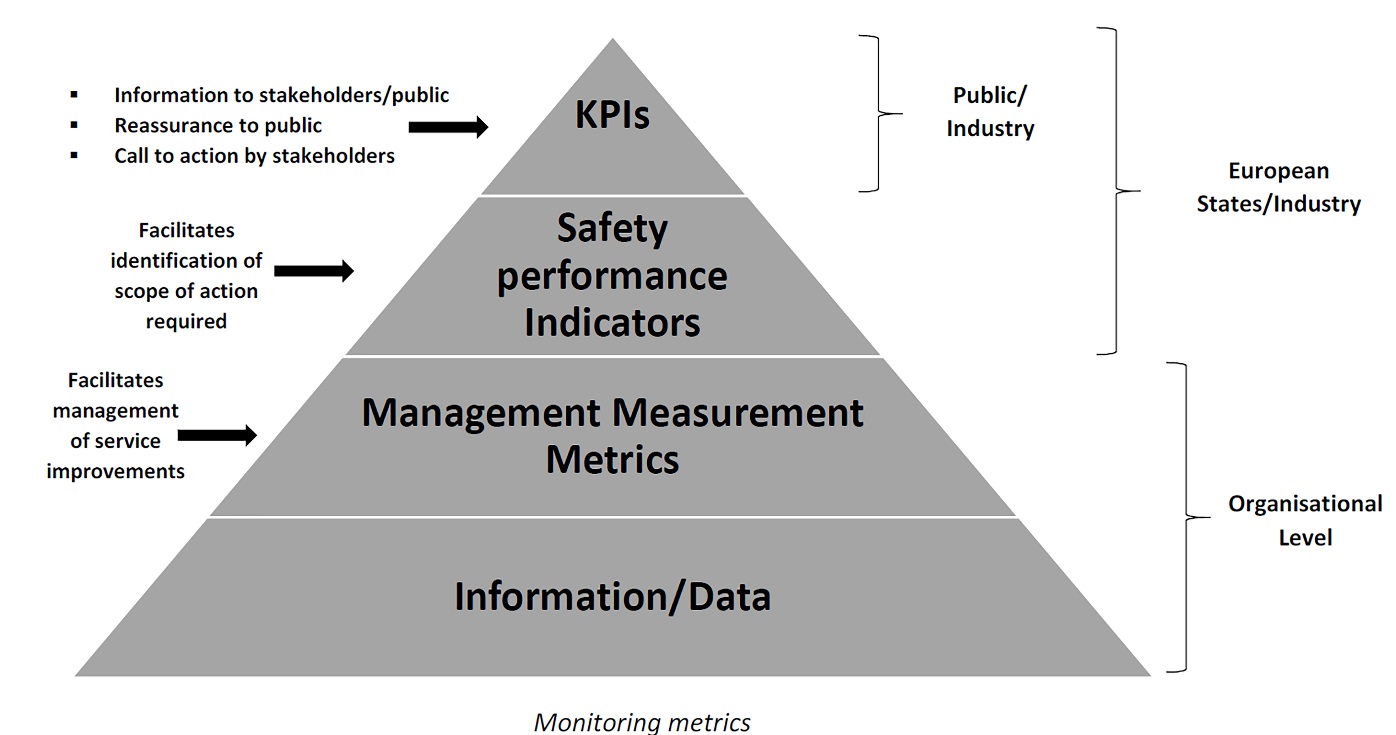
(3)As shown in the diagram, stakeholders in the wider aviation industry and the general public require relatively small numbers of safety indicators (safety performance indicators or key performance indicators) which can give an instant ‘feel’ for the overall position regarding safety performance. Conversely, those involved in the management of services concerned need a more detailed set of metrics on which to base decisions regarding the management of the services and facilities being reviewed.
AMC1 ATS.OR.200(3)(iii) Safety management system
ED Decision 2017/001/R
CONTINUOUS IMPROVEMENT OF THE SMS — COMPLEX ATS PROVIDERS
An air traffic services provider should continuously improve the effectiveness of its SMS by:
(a)developing and maintaining a formal process to identify the causes of substandard performance of the SMS;
(b)establishing one or more mechanisms to determine the implications of substandard performance of the SMS;
(c)establishing one or more mechanisms to eliminate or mitigate the causes of substandard performance of the SMS; and
(d)developing and maintaining a process for the proactive evaluation of facilities, equipment, documentation, processes and procedures (through internal audits, surveys, etc.).
GM1 ATS.OR.200(3)(iii) Safety management system
ED Decision 2017/001/R
CONTINUOUS IMPROVEMENT OF THE SMS — COMPLEX ATS PROVIDERS
(a)Substandard performance of the SMS can manifest itself in two ways. Firstly, where the SMS processes themselves do not fit their purpose (e.g. not adequately enabling the air traffic services provider to identify, manage and mitigate hazards and their associated risks) resulting in the safety performance of the service being impacted in a negative way. Secondly, where the SMS processes fit their purpose, but are not applied correctly or adequately by the personnel whose safety accountabilities and responsibilities are discharged through the application of the SMS. Personnel who have safety accountabilities and responsibilities are considered an essential part of the effectiveness of the SMS and viewed as part of the SMS.
(b)Therefore, by detecting substandard performance of the SMS, the air traffic services provider can take action to improve the SMS processes themselves or to improve the application of the SMS processes by those with safety accountabilities and responsibilities resulting in an improvement to the safety performance.
(c)Continuous improvement of the effectiveness of the safety management processes can be achieved through:
(1)proactive and reactive evaluations of facilities, equipment, documentation, processes and procedures through safety audits and surveys; and
(2)reactive evaluations in order to verify the effectiveness of the system for control and mitigation of risks.
(d)In the same way that continuous improvement is sought through safety performance monitoring and measurement (see GM1 ATM/ANS.OR.B.005(a)(3) and GM1 ATS.OR.200(3)(i)) by the use of leading and lagging indicators, continuous improvement of the SMS provides the air traffic services provider with safety assurance for the service.
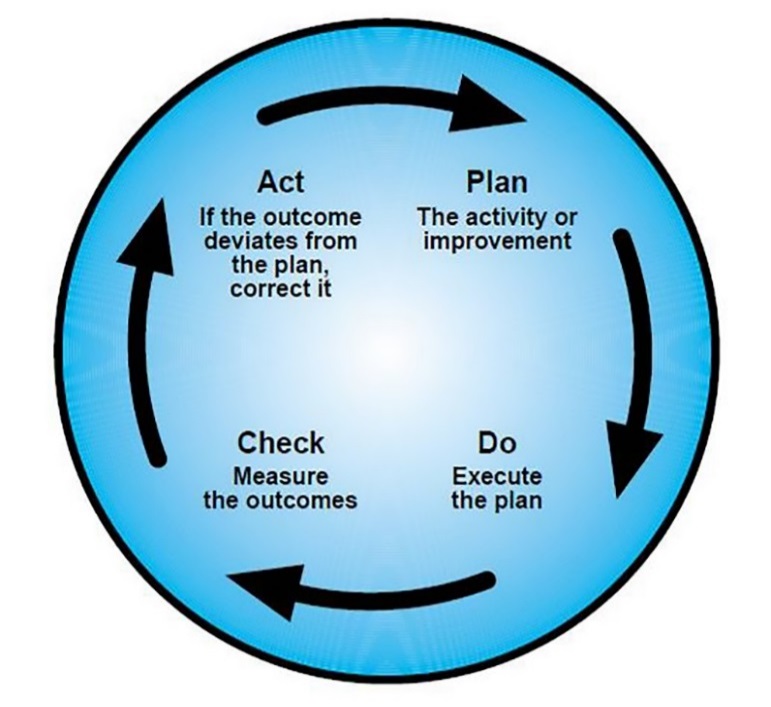
(e)As with safety performance monitoring, the continuous improvement of the SMS lends itself to a process that can be summarised as:
(1)Identify where there are potential weaknesses or opportunities for improvement;
(2)Identify what goes right and disseminate as best practice;
(3)Identify what can be done to tackle weaknesses or lead to improvement;
(4)Set performance standards for the actions identified;
(5)Monitor performance against the standards;
(6)Take corrective actions to improve performance; and
(7)Repeat the process by using the continuous improvement model below:
(f)Taking into account that the SMS is being required to manage safety, it can be assumed that by continuously improving the effectiveness of the SMS, ATS providers should be able to better manage and mitigate, and ultimately control the safety risks associated with the provisions of their services.
AMC1 ATS.OR.200(4)(i) Safety management system
ED Decision 2017/001/R
TRAINING AND COMMUNICATION — COMPLEX ATS PROVIDERS
(a)Training
(1)All personnel should receive safety training as appropriate for their safety responsibilities.
(2)Adequate records of all safety training provided should be kept.
(b)Communication
(1)The ATS provider should establish communication about safety matters that:
(a)ensures that all personnel are aware of the safety management activities as appropriate for their safety responsibilities;
(b)conveys critical information, especially relating to assessed risks and analysed hazards;
(c)explains why particular actions are taken; and
(d)explains why safety procedures are introduced or changed.
(2)Regular meetings with personnel where information, actions and procedures are discussed, may be used to communicate safety matters.
GM1 ATS.OR.200(4)(i) Safety management system
ED Decision 2017/001/R
TRAINING — COMPLEX ATS PROVIDERS
The safety training programme may consist of self-instruction (e.g. newsletters, flight safety magazines), classroom training, e-learning or similar training provided by training organisations.
ATS.OR.205 Safety assessment and assurance of changes to the functional system
Regulation (EU) 2017/373
(a)For any change notified in accordance with point ATM/ANS.OR.A.045(a)(1), the air traffic services provider shall:
(1)ensure that a safety assessment is carried out covering the scope of the change, which is:
(i)the equipment, procedural and human elements being changed;
(ii)interfaces and interactions between the elements being changed and the remainder of the functional system;
(iii)interfaces and interactions between the elements being changed and the context in which it is intended to operate;
(iv)the life cycle of the change from definition to operations including transition into service;
(v)planned degraded modes of operation of the functional system; and
(2)provide assurance, with sufficient confidence, via a complete, documented and valid argument that the safety criteria identified via the application of point ATS.OR.210 are valid, will be satisfied and will remain satisfied.
(b)An air traffic services provider shall ensure that the safety assessment referred to in point (a) comprises:
(1)the identification of hazards;
(2)the determination and justification of the safety criteria applicable to the change in accordance with point ATS.OR.210;
(3)the risk analysis of the effects related to the change;
(4)the risk evaluation and, if required, risk mitigation for the change such that it can meet the applicable safety criteria;
(5)the verification that:
(i)the assessment corresponds to the scope of the change as defined in point (a)(1);
(ii)the change meets the safety criteria;
(6)the specification of the monitoring criteria necessary to demonstrate that the service delivered by the changed functional system will continue to meet the safety criteria.
GM1 ATS.OR.205(a)(1) Safety assessment and assurance of changes to the functional system
ED Decision 2017/001/R
GENERAL
(a)The safety assessment should be conducted by the air traffic services provider itself. It may also be carried out by another organisation, on its behalf, provided that the responsibility for the safety assessment remains with the air traffic services provider.
(b)A safety assessment needs to be performed when a change affects a part of the functional system managed by the provider of air traffic services and that is being used in the provision of its (air traffic) services. The safety assessment or the way it is conducted does not depend on whether the change is a result of a business decision or a decision to improve safety.
GM2 ATS.OR.205(a)(1) Safety assessment and assurance of changes to the functional system
ED Decision 2017/001/R
SCOPE OF THE CHANGE
(a)The description of the elements being changed includes the nature, functionality, location, performance, maintenance tasks, training and responsibilities of these elements, where applicable. The description of interfaces and interactions, between machines and between humans and machines, should include communication means, e.g. language, phraseology, protocol, format, order and timing and transmission means, where applicable. In addition, it includes the description of the context in which they operate.
(b)There are two main aspects to consider in evaluating the scope of a change:
(1)The interactions within the changed functional system;
(2)The interactions within the changing functional system, i.e. those that occur during transitions from the current functional system to the changed functional system. During such transitions, components are replaced/installed in the functional system. These installation activities are interactions within the changing functional system and are to be included within the scope of the change.
As each transition can be treated as a change to the functional system, the identification of both the above has a common approach described below.
(c)The scope of the change is defined as the set of the changed components and affected components. In order to identify the affected components and the changed components, it is necessary to:
(1)know which components will be changed;
(2)know which component’s (components’) behaviour might be directly affected by the changed components, although it is (they are) not changed itself (themselves);
(3)detect indirectly affected components by identifying:
(i)new interactions introduced by the changed or directly affected components; and/or
(ii)interactions with changed or directly affected components via the environment.
(4)Furthermore, directly and indirectly affected components will be identified as a result of applying the above iteratively to any directly and indirectly affected components that have been identified previously.
The scope of the change is the set of changed, directly impacted and indirectly impacted components identified when the iteration identifies no new components.
(d)The context in which the changed service is intended to operate (see ATS.OR.205(a)(1)(iii)) includes the interface through which the service will be delivered to its users.
GM3 ATS.OR.205(a)(1) Safety assessment and assurance of changes to the functional system
ED Decision 2017/001/R
TRAINING
If the change modifies the way people interact with the rest of the functional system, then a training might be required before the change becomes operational. Care should be taken when training operational staff before the change is operational, as the training may change the behaviour of the operational staff when they interact with the existing functional system before any other part of the change is made, and so may have to be treated as a transitional stage of the change.
For example, as a result of training, air traffic controllers (ATCOs) may come to expect information or alerts to be presented differently. People may also need refreshment training periodically in order to ensure that their performance does not degrade over time. The training needed before operation forms part of the design of the change, while the refreshment training is part of the maintenance of the functional system after the change is in operation.
GM4 ATS.OR.205(a)(1) Safety assessment and assurance of changes to the functional system
ED Decision 2017/001/R
DESCRIPTION OF THE SCOPE — ‘MULTI-ACTOR CHANGE’
In reference to ‘multi-actor change’, please refer to GM1 ATM/ANS.OR.C.005(b)(1) Safety support assessment and assurance of changes to the functional system.
GM1 ATS.OR.205(a)(1)(iii) Safety assessment and assurance of changes to the functional system
ED Decision 2017/001/R
INTERACTIONS
The identification of changed interactions is necessary in order to identify the scope of the change because any changed behaviour in the system comes about via a changed interaction. Changed interaction happens via an interaction at an interface of the functional system and the context in which it operates. Consequently, identification of both interfaces and interactions is needed to be sure that all interactions have identified interfaces and all interfaces have identified interactions. From this, all interactions and interfaces that will be changed can be identified.
AMC1 ATS.OR.205(a)(2) Safety assessment and assurance of changes to the functional system
ED Decision 2017/001/R
FORM OF ASSURANCE
The air traffic services provider should ensure that the assurance required by ATS.OR.205(a)(2) is documented in a safety case.
AMC2 ATS.OR.205(a)(2) Safety assessment and assurance of changes to the functional system
ED Decision 2017/001/R
COMPLETENESS OF THE ARGUMENT
The argument should be considered complete when it shows, as applicable, that:
(a)the safety assessment in ATS.OR.205(b) has produced a sufficient set of non-contradictory valid safety criteria;
(b)safety requirements have been placed on the elements changed and on those elements affected by the change;
(c)the safety requirements as implemented meet the safety criteria;
(d)all safety requirements have been traced from the safety criteria to the level of the architecture at which they have been satisfied;
(e)each component satisfies its safety requirements;
(f)each component operates as intended, without adversely affecting the safety; and
(g)the evidence is derived from known versions of the components and the architecture and known sets of products, data and descriptions that have been used in the production or verification of those versions.
GM1 to AMC2 ATS.OR.205(a)(2) Safety assessment and assurance of changes to the functional system
ED Decision 2017/001/R
COMPLETENESS OF THE ARGUMENT
(a)Sufficiency of safety criteria
(1)A sufficient set of safety criteria is one where the safety goal of the change is validly represented by the set of individual safety criteria, each criterion of which must be valid in its own right and not contradict another criterion or any other subset of criteria. A valid criterion is a correct, complete and unambiguous statement of the desired property. An individual valid criterion does not necessarily represent a complete safety criterion. An example of an invalid criterion is that the maximum take-off weight must not exceed 225 Tonnes because weight is measured in Newtons and not in Tonnes. An example of an incomplete criterion is that the accuracy must be 5 m because no reliability attribute is present. This implies it must always be within 5 m, which is impossible in practice.
(2)Optimally, a sufficient set of criteria would consist of the minimum set of non-overlapping valid criteria and it is preferable to a set containing overlapping criteria.
(3)Criteria that are not relevant, i.e. ones that do not address the safety goal of the change at all, should be removed from the set as they contribute nothing, may contradict other valid criteria and may serve to confuse.
(4)There are two forms of overlap: complete overlap and partial overlap.
(i)In the first case, one or more criteria can be removed and the set would remain sufficient, i.e. there are unnecessary criteria.
(ii)In the second case, (partially overlapping criteria) if any criterion were to be removed, the set would not be sufficient. Consequently, all criteria are necessary; however, validating the set would be much more difficult. Showing that a set of criteria with significant overlap do not contradict each other is extremely difficult and consequently prone to error.
(5)It may, in fact, be simpler to develop an architecture that supports non-overlapping criteria than to attempt to validate a partially overlapping set of criteria.
(b)Safety requirements
(1)The safety requirements are design characteristics/items of the functional system to ensure that the system operates as specified. Based on the verification/demonstration of these characteristics/items, it could be concluded that the safety criteria are met.
(2)The highest layer of safety requirements represents the desired safety behaviour of the change at its interface with the operational context.
(3)In almost all cases, verification that a system behaves as specified cannot be accomplished, to an acceptable level of confidence, at the level of its interface with its operational environment. To this end, the system verification should be decomposed into verifiable parts, taking into account the following principles:
(i)Verification relies on requirements placed on these parts via a hierarchical decomposition of the top level requirements, in accordance with the constraints imposed by the chosen architecture.
(ii)At the lowest level, this decomposition places requirements on elements, where verification that the implementation satisfies its requirements can be achieved by testing.
(iii)At higher levels in the architecture, during integration, verified elements of different types are combined into subsystems/components, in order to verify more complete parts of the system.
(iv)While they cannot be fully tested, other verification techniques may be used to provide sufficient levels of confidence that these subsystems/components do what they are supposed to do.
(v)Consequently, since decomposing the system into verifiable parts relies on establishing requirements for those parts, then safety requirements are necessary.
(4)The architecture may not have requirements. During development, the need to argue satisfaction of safety criteria, which cannot be performed at the system level for any practical system, drives the architecture because verifiability depends on the decomposition of the system into verifiable parts.
(c)Satisfaction of safety criteria
(1)The concept laid down in AMC2 ATS.OR.205(a)(2) is that, provided each element meets its safety requirements, the system will meet its safety criteria. This will be true provided (2) and (3) below are met.
(2)The activity needed to meet this objective consists of obtaining sufficient confidence that the set of safety requirements is complete and correct, i.e. that:
(i)the architectural decomposition of the elements leads to a complete and correct set of safety requirements being allocated to each sub-element;
(ii)each safety requirement is a correct, complete and unambiguous statement of the desired behaviour and does not contradict another requirement or any other subset of requirements; and
(iii)the safety requirements allocated to an element necessitate the complete required safety behaviour of the element in the target environment.
(3)This should take into account specific aspects such as:
(i)the possible presence of functions within the element that produce unnecessary behaviour. For instance, in the case where a previously developed element is used, activities should be undertaken to identify all the possible behaviours of the element. If any of these behaviours is not needed for the foreseen use, then additional requirements may be needed to make sure that these functions will not be solicited or inadvertently activated in operation or that the effects of any resulting behaviour are mitigated;
(d)other requirements that are not directly related to the desired behaviour of the functional system. These requirements often relate to technical aspects of the system or its components. Activities should ensure that each of these requirements does not compromise the safety of the system, i.e. does not contradict the safety requirements or criteria.
(e)Traceability of requirements
The traceability requirement can be met by tracing to the highest-level element in the architectural hierarchy that has been shown to satisfy its requirements, by verifying it in isolation.
(f)Satisfaction of safety requirements
(1)The component view taken must be able to support verification, i.e. the component must be verifiable.
(2)Care should be taken in selecting subsystems that are to be treated as components for verification to ensure that they are small and simple enough to be verifiable.
(g)Adverse effects on safety
(1)Interactions of all changed components or components affected by the change, operating in their defined context, have to be identified and assessed for safety in order to be able to show that they do not adversely affect safety. This assessment must include the failure conditions for all components and the behaviour of the services delivered to the component including failures in those services.
(2)Interactions between changing components, as they are installed during transitions into operation, and the context in which they operate have to be identified and assessed for safety in order to be able to show that they do not adversely affect safety. This assessment must include the failure conditions for all installation activities.
In some cases, installing components during transition into operation may cause disruption to services other than the one being changed. These services fall within the scope of the change (see GM1 ATM/ANS.OR.A.045(c); (d)), and consequently the safety effects failures of these services, due to failures of the installation activities, have to be assessed as well and, if necessary, their impacts mitigated.
(3)Interactions in complex systems are dealt with in ATM/ANS.OR.A.045(e)(1).
(h)Configuration identification
(1)AMC2 ATS.OR.205(a)(2), point (f) is only about configuration of the evidence and should not be interpreted as configuration management of the changed functional system. However, since the safety case is based on a set of elements and the way they are joined together, the safety case will only be valid if the configuration remains as described in the safety case.
(2)Evidence for the use of a component should rely on testing activities considering the actual usage domains and contexts. When the same component is used in different parts of the system or in different systems, it may not be possible to rely on testing in a single context since it is unlikely that the contexts for each use will be the same or can be covered by a single set of test conditions. This applies equally to the reuse of evidence gathered from testing subsystems.
AMC3 ATS.OR.205(a)(2) Safety assessment and assurance of changes to the functional system
ED Decision 2019/022/R
ASSURANCE — SOFTWARE
(a) When a change to a functional system includes the introduction of new software or modifications to existing software, the ATS provider should ensure the existence of documented software assurance processes necessary to produce evidence and arguments that demonstrate that the software behaves as intended (software requirements), with a level of confidence consistent with the criticality of the required application.
(b) The ATS provider should use the software experience gained to confirm that the software assurance processes are effective and, when used, the allocated software assurance levels (SWALs) and the rigour of the assurances are appropriate. For that purpose, the effects from a software malfunction (i.e. the inability of a programme to perform a required function correctly) or failure (i.e. the inability of a programme to perform a required function) reported according to the relevant requirements on reporting and assessment of service occurrences should be assessed in comparison with the effects identified for the system concerned as per the severity classification scheme.
AMC4 ATS.OR.205(a)(2) Safety assessment and assurance of changes to the functional system
ED Decision 2019/022/R
ASSURANCE — SOFTWARE ASSURANCE PROCESSES
(a) The software assurance processes should provide evidence and arguments that they, as a minimum, demonstrate the following:
(1) The software requirements correctly state what is required by the software, in order to meet the upper level requirements, including the allocated system safety requirements as identified by the safety assessment of changes to the functional system (AMC2 ATS.OR.205(a)(2)). For that purpose, the software requirements should:
(i) be correct, complete and compliant with the upper level requirements; and
(ii) specify the functional behaviour, in nominal and downgraded modes, timing performances, capacity, accuracy, resource usage on the target hardware, robustness to abnormal operating conditions and overload tolerance, as appropriate, of the software.
(2) The traceability is addressed in respect of all software requirements as follows:
(i) Each software requirement should be traced to the same level of design at which its satisfaction is demonstrated.
(ii) Each software requirement allocated to a component should either be traced to an upper level requirement or its need should be justified and assessed that it does not affect the satisfaction of the safety requirements allocated to the component.
(3) The software implementation does not contain functions that adversely affect safety.
(4) The functional behaviour, timing performances, capacity, accuracy, resource usage on the target hardware, robustness to abnormal operating conditions and overload tolerance, of the implemented software comply with the software requirements.
(5) The software verification is correct and complete, and is performed by analysis and/or testing and/or equivalent means, as agreed with the competent authority.
(b) The evidence and arguments produced by the software assurance processes should be derived from:
(1) a known executable version of the software;
(2) a known range of configuration data; and
(3) a known set of software items and descriptions, including specifications, that have been used in the production of that version, or can be justified as applicable to that version.
(c) The software assurance processes should determine the rigour to which the evidence and arguments are produced.
(d) The software assurance processes should include the necessary activities to ensure that the software life cycle data can be shown to be under configuration control throughout the software life cycle, including the possible evolutions due to changes or problems’ corrections. They should include, as a minimum:
(1) configuration identification, traceability and status accounting activities, including archiving procedures;
(2) problem reporting, tracking and corrective actions management; and
(3) retrieval and release procedures.
(e) The software assurance processes should also cover the particularities of specific types of software such as COTS, non-development software and previously developed software where generic assurance processes cannot be applied. The software assurance processes should include other means to give sufficient confidence that the software meets the safety objectives and requirements, as identified by the safety risk assessment and mitigation processes. If sufficient assurance cannot be provided, complementary mitigation means aiming at decreasing the impact of specific failure modes of this type of software, should be applied. This may include but is not limited to:
(1)software and/or system architectural considerations;
(2)existing service level experience; and
(3)monitoring.
GM1 to AMC4 ATS.OR.205(a)(2) Safety assessment and assurance of changes to the functional system
ED Decision 2019/022/R
ASSURANCE — SOFTWARE ASSURANCE PROCESS
In reference to the terms ‘correct and complete software verification’, ‘software timing performances’, ‘software capacity’, ‘software accuracy’, ‘software resource usage’, ‘software robustness’, ‘overload tolerance’, ‘software life cycle data’ and ‘COTS’, please refer to GM1 to AMC6 ATM/ANS.OR.C.005(a)(2) ‘Safety support assessment and assurance of changes to the functional system’.
GM2 to AMC4 ATS.OR.205(a)(2) Safety assessment and assurance of changes to the functional system
ED Decision 2019/022/R
ASSURANCE — SOFTWARE ASSURANCE LEVELS
(a) The assurance required by AMC4 ATS.OR.205(a)(2) can be provided with a level of confidence consistent with the criticality of the software in order to generate an appropriate and sufficient body of evidence to help to establish the required confidence in the argument.
(b) The use of the SWAL concept can be helpful to provide an explicit link between the criticality of the software and the rigour of the assurance.
(c) The use of multiple SWALs would also allow the possibility of managing several criticalities of the different software components within the system (with partitioning or other architectural strategies) by the same set of software assurance processes. When the software assurance processes employ on several SWALs, they should define for each SWAL the rigour of the assurances to achieve compliance with the objectives set out in AMC4 ATS.OR.205(a)(2). As a minimum:
(1) the rigour should increase as the criticality of the service supported by the software solution increases; and
(2) the variation in rigour of the evidence and arguments per SWAL should include a classification of the activities and objectives according to the following criteria:
(i) required to be achieved with independence, i.e. the verification process activities are performed by a person (or persons) other than the developer of the item being verified;
(ii) required to be achieved; and
(iii) not required.
GM3 to AMC4 ATS.OR.205(a)(2) Safety assessment and assurance of changes to the functional system
ED Decision 2019/022/R
ASSURANCE — SOFTWARE ASSURANCE LEVELS ALLOCATION
The process to allocate a SWAL to a software consistently with its foreseen criticality, as identified by the risk assessment and mitigation process, should consider the following elements:
(a) The allocated SWAL should relate the rigour of the software assurances to the foreseen criticality of the software by using the combination of the used severity classification scheme with the likelihood of occurrence of a certain adverse effect.
(b) The allocated SWAL should be commensurate with the worst credible effect that software malfunctions (i.e. the inability of a programme to perform a required function correctly) or failures (i.e. the inability of a programme to perform a required function) may cause. It should, in particular, take into account the risks associated with software malfunctions or failures and the architecture and/or procedural defences.
(c) The software components that cannot be shown to be independent of one another should be allocated to the SWAL of the most critical of the dependent components. In this context, the term ‘software components’ is understood to be a building block that can be fitted or connected together with other reusable blocks of software to combine and create a custom software application, and ‘independent software components’ are those software components which are not rendered inoperative by the same failure condition.
(d) The allocated SWALs should be consistent with the levels defined in the software assurance processes of the ATS provider and of the non-ATS provider(s), when the safety case is based on the evidence presented in the corresponding safety support case(s).
GM4 to AMC4 ATS.OR.205(a)(2) Safety assessment and assurance of changes to the functional system
ED Decision 2019/022/R
ASSURANCE — EXAMPLES OF EXISTING INDUSTRIAL STANDARDS
(a) The service provider is responsible for the definition of the software assurance processes. In this definition of processes, the service provider may consider the guidance material contained in existing industrial standards for the software assurance considerations of software. It should be considered that not all standards address all aspects required and the service provider may need to define additional software assurance processes. The guidance material typically includes:
(1) objectives of the software life cycle processes;
(2) activities for satisfaction of those objectives;
(3) descriptions of the evidence, in the form of software life cycle data, that indicates that the objectives have been satisfied;
(4) variations according to the SWAL, to accommodate the different levels of rigour of the software assurances; and
(5) particular aspects (e.g. previously developed software) that may be applicable to certain applications.
(b) The following table presents some of the existing industrial standards (at the latest available issue) used by the stakeholders:
Document title | Reference | Date |
Software Integrity Assurance Considerations for Communication, Navigation, Surveillance and Air Traffic Management (CNS/ATM) Systems. | EUROCAE ED-109A/ RTCA DO-278A | January 2012 |
Guidelines for ANS Software Safety Assurance | EUROCAE ED-153 | August 2009 |
Functional safety of electrical/electronic/ programmable electronic safety-related systems – Part 3: Software requirements | IEC 61508 – Part 3 | April 2010 |
Software Considerations in Airborne Systems and Equipment Certification | EUROCAE ED-12C/ RTCA DO-178C | January 2012 |
EUROCAE ED-109A/RTCA DO-278A and EUROCAE ED-12C/RTCA DO-178C make reference to some external documents (supplements), which are integral part of the standard for the use of some particular technologies and development techniques. The supplements are the following:
(1) Formal Methods Supplement to ED-12C and ED-109A (EUROCAE ED-216/RTCA DO-333)
(2) Object-Oriented Technology and related Techniques Supplement to ED-12C and ED-109A (EUROCAE ED-217/RTCA DO-332)
(3) Model-Based Development and Verification Supplement to ED-12C and ED-109A (EUROCAE ED-218/RTCA DO-331)
When tools are used during the software development lifecycle, EUROCAE ED-215/RTCA DO-330 ‘Software Tool Qualification Considerations’ may be considered in addition to EUROCAE ED-12C/RTCA DO-178C and EUROCAE ED-109A/RTCA DO-278A.
(c) The definition of the software assurance processes may be based on one of these industrial standards, without combining provisions from different standards as far as the consistency and validation of each of the industrial standards have only been performed at individual level by each specific standardisation group.
GM5 to AMC4 ATS.OR.205(a)(2) Safety assessment and assurance of changes to the functional system
ED Decision 2019/022/R
ASSURANCE — SWAL COORDINATION
(a) Within the scope of this Regulation, only the ATS provider can identify hazards, assess the associated risks and mitigate or propose mitigating measures where necessary. This requirement is also applicable to software assurance evidence which may include information on the mitigation measures established to address software failures or unintended behaviours.
(b) ATS and non-ATS providers may rely on different sets of software assurance processes and, if applicable, different sets of SWALs.
(c) For a particular change to the functional system, the safety assessment performed by the ATS provider, and documented in the safety case, may rely on evidence associated with the services provided by a non-ATS provider, as documented in its corresponding safety support case. It should as a minimum demonstrate that the rigour of the assurances produced by the non-ATS provider within the safety support case provides the adequate level of confidence for the purpose of the ATS safety demonstration in the safety case.
(d) If SWALs are used, the ATS provider should evaluate the adequacy of the SWALs defined in the software assurance processes of the non-ATS providers and the consistency of the allocated SWALs for the parts of the functional system affected by the change at the non-ATS provider.
GM1 ATS.OR.205(a)(2) Safety assessment and assurance of changes to the functional system
ED Decision 2017/001/R
SAFETY CRITERIA
‘Safety criteria will remain satisfied’ means that the safety criteria continue to be satisfied after the change is implemented and put into operation. The safety case needs to provide assurance that the monitoring requirements of ATS.OR.205(b)(6) are suitable for demonstrating, during operation, that the safety criteria remain satisfied and, therefore, the argument remains valid.
GM2 ATS.OR.205(a)(2) Safety assessment and assurance of changes to the functional system
ED Decision 2017/001/R
ASSURANCE LEVELS
The use of assurance level concepts, e.g. design assurance levels (DAL), software assurance levels (SWAL), hardware assurance levels (HWAL), can be helpful in generating an appropriate and sufficient body of evidence to help establish the required confidence in the argument.
GM3 ATS.OR.205(a)(2) Safety assessment and assurance of changes to the functional system
ED Decision 2017/001/R
SAFETY REQUIREMENTS
The following non-exhaustive list contains examples of safety requirements that specify:
(a)for equipment, the complete behaviour, in terms of functions, accuracy, timing, order, format, capacity, resource usage, robustness to abnormal conditions, overload tolerance, availability, reliability, confidence and integrity;
The complete behaviour is limited to the scope of the change. Safety requirements should only apply to the parts of a system affected by the change. In other words, if parts of a system can be isolated from each other and only some parts are affected by the change, then these are the only parts that are of concern;
(b)for people, their performance in terms of tasks (e.g. accuracy, response times, acceptable workload, reliability, confidence, skills, and knowledge in relation to their tasks);
(c)for procedures, the circumstances for their enactment, the resources needed to perform the procedure (i.e. people and equipment), the sequence of actions to be performed and the timing and accuracy of the actions; and
(d)interactions between all parts of the system.
GM1 ATS.OR.205(b) Safety assessment and assurance of changes to the functional system
ED Decision 2017/001/R
SAFETY ASSESSMENT METHODS
(a)The air traffic services provider can use a standard safety assessment method or it can use its own safety assessment method to assist with structuring the process. However, the application of a method is not a guarantee of the quality of the results. It is therefore not sufficient for a safety case to claim that the assurance provided is adequate due to compliance with a standard or method.
(b)There are databases available that describe different safety assessment methods, tools and techniques38 that can be used by the air traffic services provider. The provider must ensure that the safety assessment method is adequate for the change being assessed and that the assumptions inherent in the use of the method are recognised and accommodated appropriately.
AMC1 ATS.OR.205(b)(1) Safety assessment and assurance of changes to the functional system
ED Decision 2017/001/R
COMPLETENESS OF HAZARD IDENTIFICATION
The air traffic services provider should ensure that hazard identification:
(a)targets complete coverage of any condition, event, or circumstance related to the change, which could, individually or in combination, induce a harmful effect;
(b)has been performed by personnel trained and competent for this task; and
(c)need only include hazards that are generally considered as credible.
AMC2 ATS.OR.205(b)(1) Safety assessment and assurance of changes to the functional system
ED Decision 2017/001/R
HAZARDS TO BE IDENTIFIED
The following hazards should be identified:
(a)New hazards, i.e. those introduced by the change relating to the:
(1)failure of the functional system; and
(2)normal operation of the functional system; and
(b)Already existing hazards that are affected by the change and are related to:
(1)the existing parts of the functional systems; and
(2)hazards outside the functional system, for example, those inherent to aviation.
GM1 ATS.OR.205(b)(1) Safety assessment and assurance of changes to the functional system
ED Decision 2017/001/R
HAZARD IDENTIFICATION
(a)Completeness of hazard identification
In order to achieve completeness in the identification of hazards, it might be beneficial to aggregate hazards and to formulate them in a more abstract way, e.g. at the service level. This might in turn have drawbacks when analysing and evaluating the risk of the hazards. The appropriate level of detail in the set of hazards and their formulation, therefore, depends on the change and the way the safety assessment is executed.
Only credible hazards need to be identified. A credible hazard is one that has a material effect on the risk assessment. A hazard will not be considered credible when it is either highly improbable that the hazard will occur or that the accident trajectories it initiates will materialise. In other words, a hazard need not be considered if it can be shown that it induces an insignificant risk.
(b)Sources of hazards
(1)Hazards introduced by failures or nominal operations of the ATM/ANS functional systems may include the following factors and processes:
(i)design factors, including equipment, procedural and task design;
(ii)operating practices, including the application of procedures under actual operating conditions and the unwritten ways of operating;
(iii)communications, including means, terminology, order, timing and language and including human–human, human–machine and machine–machine communications;
(iv)installation issues;
(v)equipment and infrastructure, including failures, outages, error tolerances, nuisance alerts, defect defence systems and delays; and
(vi)human performance, including restrictions due to fatigue and medical conditions, and physical limitations, when considered relevant to the change assessment.
(2)Hazards introduced in the context in which the ATM/ANS functional system operates may include the following factors and processes:
(i)wrong, insufficient or delayed information and inadequate services delivered by third parties;
(ii)personnel factors, including working conditions, company policies for and actual practice of recruitment, training and allocation of resources, when considered relevant to the change;
(iii)organisational factors, including the incompatibility of production and safety goals, the allocation of resources, operating pressures and the safety culture;
(iv)work environment factors such as ambient noise, temperature, lighting, annoyance, ergonomics and the quality of man–machine interfaces; and
(v)external threats such as fire, electromagnetic interference and sources of distraction, when considered relevant to the change.
(3)The hazards introduced in the context in which the ATM/ANS services are delivered may include the following factors and processes:
(i)errors, failures, non-compliance and misunderstandings between the airborne and ground domains;
(ii)traffic complexity, including traffic growth, fleet mix and different types of traffic, when considered relevant to the change;
(iii)wrong, insufficient or delayed information delivered by third parties;
(iv)inadequate service provisioning by third parties; and
(v)external physical factors, including terrain, weather phenomena, volcanoes and animal behaviour, when considered relevant to the change.
(c)Methods to identify hazards
(1)The air traffic services provider may use a combination of tools and techniques, including functional analysis, what if techniques, brainstorming sessions, expert judgement, literature search (including accident and incident reports), queries of accident and incident databases in order to identify hazards.
(2)The air traffic services provider needs to make sure that the method is appropriate for the change and produces (either individually or in combination) a valid (necessary and sufficient) set of hazards. This may be aided by drawing up a list of the functions associated with part of the functional system being changed. The air traffic services provider needs to make sure their personnel that use these techniques are appropriately trained to apply these methods and techniques.
AMC1 ATS.OR.205(b)(2) Safety assessment and assurance of changes to the functional system
ED Decision 2017/001/R
DETERMINATION OF THE SAFETY CRITERIA FOR THE CHANGE
When determining the safety criteria for the change being assessed, the air traffic services provider should, in accordance with ATS.OR.210, ensure that:
(a)the safety criteria support a risk analysis that is:
(1)relative or absolute, i.e. refers to:
(i)the difference in safety risk of the system due to the change (relative); or
(ii)the difference in safety risk of the system and a similar system (can be absolute or relative); and
(iii)the safety risk of the system after the change (absolute); and
(2)objective, whether risk is expressed numerically or not;
(b)the safety criteria are measurable to an adequate degree of certainty;
(c)the set of safety criteria can be represented totally by safety risks, by other measures that relate to safety risk or a mixture of safety risks and these other measures;
(d)the set of safety criteria should cover the change; the safety criteria selected are consistent with the overall safety objectives established by the air traffic services provider through its SMS and represented by its annual and business plan and safety key performance indicators; and
(e)where a safety risk or a proxy cannot be compared against its related safety criteria with acceptable certainty, the safety risk should be constrained and actions should be taken, in the long term, so as to manage safety and ensure that the air traffic services provider’s overall safety objectives are met.
AMC1 ATS.OR.205(b)(3) Safety assessment and assurance of changes to the functional system
ED Decision 2017/001/R
COMPLETENESS OF RISK ANALYSIS
The air traffic services provider should ensure that the risk analysis is carried out by personnel trained and competent to perform this task and should also ensure that:
(a)a complete list of harmful effects in relation to the identified:
(1)hazards, when the safety criteria are expressed in terms of safety risk, or proxies, when the safety criteria are expressed in relation to proxies; and
(2)hazards introduced due to implementation
is produced; and
(b)the risk contributions of all hazards and proxies are evaluated; and
(c)risk analysis is conducted in terms of risk or in terms of proxies or a combination of them, using specific measurable properties that are related to operational safety risk; and
(d)results can be compared against the safety criteria.
AMC2 ATS.OR.205(b)(3) Safety assessment and assurance of changes to the functional system
ED Decision 2017/001/R
SEVERITY CLASSIFICATION OF ACCIDENTS LEADING TO HARMFUL EFFECTS
When performing a risk analysis in terms of risk, the air traffic services provider should ensure that the harmful effects of all hazards are allocated a safety severity category and that, where there is more than one safety severity category of harm, any severity classification scheme satisfies the following criteria:
(a)The scheme is independent of the causes of the accidents that it classifies, i.e. the severity of the worst accident does not depend upon whether it was caused by an equipment malfunction or human error;
(b)The scheme permits unique assignment of every harmful effect to a severity category;
(c)The severity categories are expressed in terms of a single scalar quantity and in terms relevant to the field of their application;
(d)The level of granularity (i.e. the span of the categories) is appropriate to the field of their application;
(e)The scheme is supported by rules for assigning a harmful effect unambiguously to a severity category; and
(f)The scheme is consistent with the air traffic services providers views of the severity of the harmful effects covered and can be shown to incorporate societal views of their severity.
AMC1 ATS.OR.205(b)(4) Safety assessment and assurance of changes to the functional system
ED Decision 2017/001/R
RISK EVALUATION
The air traffic services provider should ensure that the risk evaluation includes:
(a)an assessment of the identified hazards for a notified change, including possible mitigation means, in terms of risk or in terms of proxies or a combination of them;
(b)a comparison of the risk analysis results against the safety criteria taking the uncertainty of the risk assessment into account; and
(c)the identification of the need for risk mitigation or reduction in uncertainty or both.
GM1 to AMC1 ATS.OR.205(b)(4) Safety assessment and assurance of changes to the functional system
ED Decision 2017/001/R
RISK ANALYSIS IN TERMS OF PROXIES — EXAMPLES
Point (c) of AMC1 ATS.OR.205(b)(2) allows safety assessment to be performed in terms of risk, proxies or a combination of risk and proxies. This GM provides two examples to illustrate the use of proxies in safety analysis.
(a)Use of proxies when assessing the safety of a wind farm installation
(1)A wind farm is to be introduced on or near an aerodrome. It is assumed that before the introduction of the wind farm, the safety risk of the air traffic services being provided at the aerodrome was acceptable. To return to this level after the introduction of the farm, the change would also be acceptable.
A diagram showing the effects this has on the risk at the aerodrome is shown below:
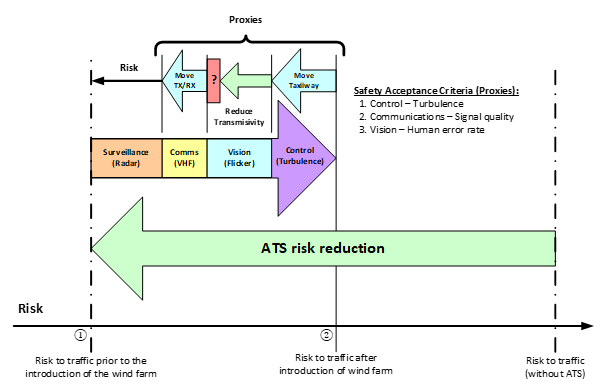
Figure 1: Evaluation of risks after the introduction of wind farm
(2)The risk due to the introduction of the wind farm will rise from ① to ②, if not mitigated, because:
(i)turbulence will increase and so may destabilise manoeuvring of aircraft;
(ii)the movement of the blades will cause radio interference (communications radio and surveillance radar) and so communications may be lost or aircraft may be hidden from view on the radar screen; and
(iii)the flicker in the peripheral vision of ATCOs, caused by the rotation of the blades, may capture attention and increase their perception error rate.
(3)The problem of analysing the safety impact can be split into these areas of concern since they do not interact or overlap and so satisfy the independence criterion (b) of AMC2 ATS.OR.210(a). However, whilst it can be argued that each is a circumstantial hazard and that in each case a justifiable qualitative relationship can be established linking the hazard with the resulting accident (so satisfying the causality criterion (a) of AMC2 ATS.OR.210(a)), the actual or quantitative logical relationship is, in each case, extremely difficult to determine. Conditions for seeking proxies have, therefore, been established:
—Performing a risk evaluation using actual risk may not be worthwhile due to the considerable cost and effort involved; and
—The first two criteria for proxies have been satisfied.
Consequently, it may be possible to find proxies that can be used more simply and effectively than performing an analysis based on risk.
(4)The solutions proposed below are for illustrative purposes only. There are many other solutions and, for each change, several should be investigated. In this example, the following proxies, which satisfy the measurability criterion (c) of AMC2 ATS.OR.210(a), are used to set safety criteria:
(i)Turbulence can be measured and predicted by models so the level of turbulence can be a proxy.
In this example, let’s assume the only significant effect of turbulence is to light aircraft using a particular taxiway. It is possible to predict the level of turbulence at different sites on the aerodrome and an alternative taxiway is found where the level of turbulence after the introduction of the wind farm will be less than that currently encountered on the present taxiway. This can be confirmed during operation after the change by monitoring.
(ii)Signal quality can be also be predicted by models and measured so it can be used as a proxy.
In this example, it is possible to move the communications transmitter and receiver aerials so that communications are not affected by interference. Sites can be found using modelling and the signal quality confirmed prior to moving the aerials by trial installations during periods when the aerodrome is not operating.
(iii)Human error rate in detecting events on the manoeuvring area can be measured in simulations and can be used as a proxy.
It is suggested that increasing the opaqueness of the glass in the control tower will reduce the effects of flicker on the ATCOs, but there is no direct relationship between the transmissivity and the effects of flicker. It is, therefore, decided to make a simulation of the control tower and measure the effects of flicker on human error rate using glass of different levels of transmissivity.
However, there is a conflict between increasing the opaqueness of the glass to reduce the effects of flicker and decreasing it to improve direct vision, which is needed so that manoeuvring aircraft can be seen clearly. In other words, the simulation predicts a minimum for the human error rate that relates to a decrease, as the effects of flicker decrease, followed by an increase, as the effects of a lack of direct vision increase. This minimum is greater than the human error rate achieved by the current system and so the risk of the wind farm, in respect of flicker, cannot be completely mitigated. This is shown by the red box with a question mark in it on the diagram.
(5)Finally, the argument for the performance of surveillance radars is commonly performed using risk. This can be repeated in this case since the idea is to filter the effects of the interference without increasing the risk. Moreover, if necessary, a system may be added (or a current one improved) to reduce the risk simply and economically and the effects of the additional system may be argued using risk.
(6)Since risks can be combined, the safety impacts of the changes to the surveillance radar by filtering the effects of the interference together with the addition of another system or the improvement of the current system can be established by summing the risks associated with these two kinds of change.
(7)In these circumstances, it is not possible to argue objectively that the risk of introducing the wind farm has been mitigated, as risks cannot be summed with proxies. This demonstrates the difficulties of using proxies. However, it may be possible to argue convincingly, albeit subjectively, that installing another system or improving the current system improves the current level of risk by a margin large enough to provide adequate compensation for the unmitigated effects of flicker.
(8)In summary, this example shows how proxies and risks can be combined in a single assurance case to argue that a change to a functional system can be introduced safely. It also demonstrates that the strategies available to demonstrate safety are not generic, but are dependent on identifying analysable qualities or quantities related to specific properties of the system or service that are impacted by the change.
(b)Use of proxies when changing to electronic flight strips
(1)An air traffic services provider considers the introduction of a digital strip system in one of its air traffic control towers to replace the paper flight progress strips currently in use. This change is expected to have an impact on several aspects of the air traffic control service that is provided such as the controller’s recollection of the progress of the flight, the mental modelling of the traffic situation and the communication and task allocation between controllers. A change of the medium, from paper to digital, might, therefore, have implications on the tower operations, and, hence, on the safety of the air traffic. The actual relation between the change of the strip medium and the risk for the traffic is, however, difficult to establish.
(2)The influence of the quantity on the risk is globally known, but cannot easily be quantified. One difficulty is that strip management is at the heart of the air traffic control operations: the set of potential sequences of events from a strip management error to an accident or incident is enormous. This set includes, for example, the loss of the call sign at the moment a ground controller needs to intervene in a taxiway conflict, and whether this results in an incident depends, for example, on the visibility. This set also includes the allocation of a wrong standard instrument departure (SID) to an aircraft, and whether this results in an accident depends, for example, on the runway configuration.
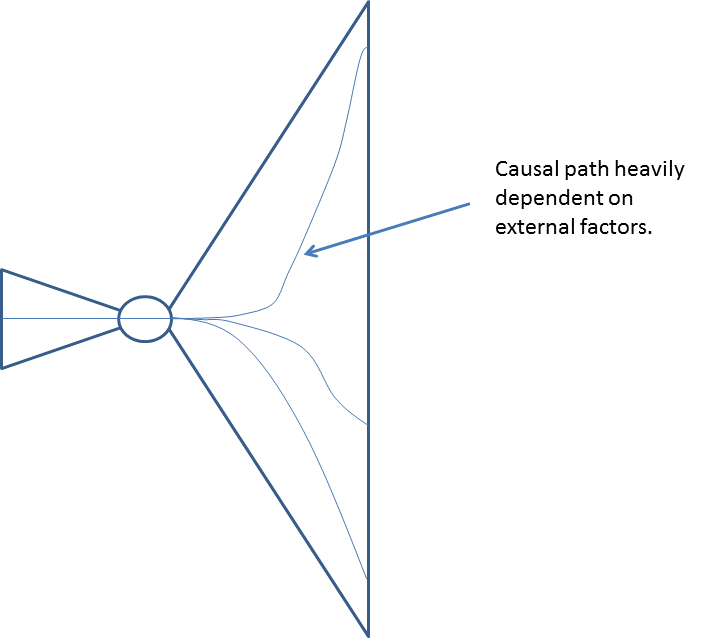
Figure 2: Notional Bow Tie Model of a strip management error
(3)The Bow Tie Model of a strip management error has, figuratively speaking, a vertically stretched right part. This expresses that a hazard — such as the loss of a single strip — may have many different outcomes which heavily depend on factors that have nothing to do with the cause of the hazard — factors such as the status of the aircraft corresponding to the absent strip, that aircraft’s position on the aerodrome, the traffic situation and the visibility.
(4)Another difficulty with the relationship between the change of the medium and the risk to the air traffic is that several human and cultural aspects are involved. The difficulty lies in the largely unknown causal relationship between these human and cultural aspects and the occurrences of accidents and incidents. As an example of this, it is noted that strip manipulation — like moving a strip into another bay, or making a mark to indicate that a landing clearance is given — assists a controller in distinguishing the potential from the actual developments. The way of working with paper strips generates impressions in a wider variety than digital strips by their physical nature: handling paper strips has tactile, auditory and social aspects. This difference in these aspects may lead to a difference in the quality of the controller’s situation awareness which may lead to a difference in the efficacy of the controller’s instructions and advisories, which may lead to a difference in the occurrence of accidents and incidents. However, the relation between the change of the medium and the risk for the air traffic is difficult to assess and would require a great deal of effort, time and experimentation to quantify.
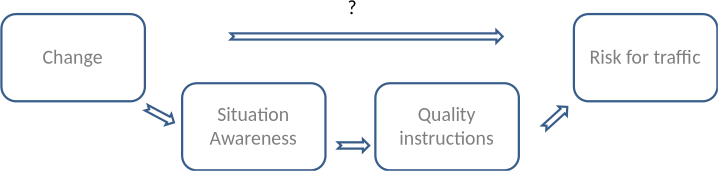
Figure 3: Relation between the change of flight strip and the risk
(5)There is probably a relation between the change of the flight progress strip medium and the risk for air traffic: a new human–machine interface may have an effect on the situation awareness of some individual controllers in some circumstances, which might have an effect on whether, when and what instructions are given, and this in turn influences the aircraft movements, and, hence, the risks. The question by what amount risks increase or decrease is very hard to answer.
(6)Performing a risk evaluation using actual risk may not be worthwhile due to the difficulties and considerable cost and effort involved in assessing the risk of the change directly. Therefore, the use of proxies might be preferred. A quantity is only considered an appropriate proxy if it satisfies the criteria in point AMC2 ATS.OR.210(a):
(i)Causality: The quantity used as proxy can be expected to be influenced by the change, and the risk can be expected to be influenced by the quantity. In addition to this causal relationship, a criterion can be formulated and agreed upon that expresses by which amount the value of the quantity may shift due to the change. Note that the influence of the proxy on the risk cannot easily be quantified, otherwise it might be more beneficial to use risk as a measure and the quantity as an auxiliary function.
(ii)Measurability: The influence of the change on the quantity can be assessed before as well as after the change.
(iii)Independence: When the proxy selected does not cover all hazards, a set of proxies should be used. Any proxy of that set should be sufficiently isolated from other proxies to be treated independently.

Figure 4: Relation between proxy and risk
(7)There is a relationship between the change and the proxy, and there is a relationship between the proxy and the risk to traffic. The first relationship can be assessed (indicated by the ‘!’), while the second cannot (indicated by the ‘?’). An acceptance criterion is typically formulated for the amount the proxy value might increase or decrease.
(8)Proxy 1: Head-down time. The head-down time is a good proxy as it satisfies the conditions of:
(i)Causality: It is known that more head-down time leads to a higher risk but there is no well-established or generally accepted statement in literature in terms of: ‘x % more head-down time implies y% more accidents’, not to mention for the specific circumstances of the specific air traffic control tower. The causal relationship indicated in Figure 4 can be established because:
(A)the head-down time can be expected to change as the manipulation, writing and reading of digital strips might cost more, or perhaps less, attention and effort than the handling of paper strips;
(B)the loss of head-up time of ground and runway controllers implies less surveillance, at least less time for the out-of-the-window-view in good visibility, and this implies a later or less probable detection of conflicts; and
(C)an example of an acceptance criterion reads: ‘The introduction of the digital strip system does not lead to a significant increase in the head down time’.
(ii)Measurability: The influence of the change on the head-down time can be assessed before the change by means of real-time human-in-the-loop experiments in which controllers are tasked to handle equal amounts of traffic in equal circumstances, one time using paper strips and another time using digital strips. The percentage of head-down time can then be determined by observing the controllers by cameras and eye-trackers.
(9)Proxy 2: Fraction of erroneous SID allocations. The fraction of erroneous SID allocations is a good proxy as it satisfies the conditions of:
(i)Causality: It can be imagined that an erroneous SID selected in the flight management system (FMS) might lead to accidents, but the precise conditional probability is small and difficult to estimate as it depends on several external factors such as the flight paths of the correct and incorrect SIDs, the presence of other traffic, the timing and geometry of the trajectories, the cloud base or the vigilance of the controller. The causal relationship indicated in Figure 4 can be established because:
(A)the number of incorrect SIDs indicated on electronic strips can be expected to be less than on paper strips, because of the possibilities of systematic checks with respect to runway allocation, runway configuration, SID allocation of the predecessor and destination in the flight plan;
(B)the allocation of an incorrect SID to an aircrew might lead to a situation in which the aircraft manoeuvres in an unanticipated way, possibly leading to a conflict with another aircraft, for example departing from a parallel runway; and
(C)an example of an acceptance criterion reads: ‘The introduction of the digital strip system should lead to a decrease of the fraction of erroneous SID allocations of more than 20 %’.
(ii)Measurability: The influence of the change on the fraction of erroneous SID allocations can be assessed before the change by means of an analysis of the causes and occurrences of such errors and the estimated efficacy of the systematic checks. The fractions can be assessed after the change by the statistics of the event reports.
(10)Finally, the last condition of independence of proxies is also satisfied. For the purpose of this example, the proxies in (5) and (6) form a set of independent proxies that are complete, i.e. they cover all identified hazards introduced by the replacement of paper strips by a digital strip system.
AMC2 ATS.OR.205(b)(4) Safety assessment and assurance of changes to the functional system
ED Decision 2020/008/R
RISK MITIGATION
When the risk evaluation results show that the safety criteria cannot be satisfied, then the air traffic services provider should either abandon the change or propose additional means of mitigating the risk. If risk mitigation is proposed, then the air traffic services provider should ensure that it identifies:
(a)all of the elements of the functional system, e.g. training, procedures that need to be reconsidered; and
(b)for each part of the amended change, those parts of the safety assessment (requirements from (1) to (6) listed in ATS.OR.205(b)) that need to be repeated in order to demonstrate that the safety criteria will be satisfied.
GM1 ATS.OR.205(b)(4) Safety assessment and assurance of changes to the functional system
ED Decision 2017/001/R
RISK ANALYSIS IN TERMS OF SAFETY RISK
(a)Risk analysis
When a risk assessment of a set of hazards is executed, in terms of risk:
(1)the frequency or probability of the occurrence of the hazard should be determined;
(2)the possible sequences of events from the occurrence of a hazardous event to the occurrence of an accident, which may be referred to as accident trajectories, should be identified. The contributing factors and circumstances that distinguish the different trajectories from one another should also be identified, as should any mitigations between a hazardous event and the associated accident;
(3)the potential harmful effects of the accident, including those resulting from a simultaneous occurrence of a combination of hazards, should be identified;
(4)the severity of these harmful effects should be assessed, using a defined severity scheme according to point (f) of AMC2 ATS.OR.205(b)(3); and
(5)the risk of the potential harmful effects of all the accidents, given the occurrence of the hazard, should be determined, taking into account the probabilities that the mitigations may fail as well as succeed, and that particular accident trajectories will be followed when particular contributing factors and circumstances occur.
(b)Severity schemes
The severity determination should take place according to a severity classification scheme.
The purpose of a severity classification scheme is to facilitate the management and control of risk. A severity class is, in effect, a container within which accidents can be placed if their severities are considered similar. Each container can be given a value which represents the consequences, i.e. small for accidents causing little harm and big for accidents causing a lot of harm. The sum of the probabilities of all the accidents assigned to a severity class multiplied by the value that is related to the severity class, is the risk associated with that class. If the value that represents severity for all classes is scalar, then the total risk is the sum of the risks in each severity class.
(1)Single-risk value severity schemes
Such schemes use a single severity category to represent harm to humans. Other categories representing other kinds of harm e.g. damage to aircraft and loss of separation, may be present but do not represent harm to humans. In these circumstances, risk analysis would actually be reduced to frequency/probability analysis.
(2)Multiple-risk value severity schemes
Multiple-risk value severity schemes, which use a number of severity categories to classify different levels of harm, facilitate the management and control of risk in a number of ways. At the simplest level, the distribution of accidents across the severity classes gives a picture of whether the risk profile of a system is well balanced. For example, many accidents in the top and bottom severity classes with few in between suggests an imbalance in risk, perhaps due to an undue amount of attention having been paid to some types of accident at the expense of others. More detailed management and control of risk includes:
(i)Severity classes may be used as the basis for reporting accident statistics.
(ii)Severity classes combined with frequency (or probability) classes can be used to define criteria for decision-making regarding risk acceptance.
(iii)The total risk associated with one or more severity classes can be managed and controlled. For example, the sum of the risk from all severity classes represents the total risk and may be used as a basis for making decisions about changes.
(iv)Similarly, the risk associated with accident types of different levels of severity can be compared. For example, comparing runway infringement accidents with low speed taxiway accidents would allow an organisation to focus their efforts on mitigating the accident type with greatest risk.
(c)The air traffic services provider should coordinate its severity scheme(s) when performing multi-actor changes to ensure adequate assessment. This includes coordination with air traffic services providers outside of the EU.
AMC1 ATS.OR.205(b)(5) Safety assessment and assurance of changes to the functional system
ED Decision 2017/001/R
VERIFICATION
The air traffic services provider should ensure that verification activities of the safety assessment process include verification that:
(a)the full scope of the change is addressed throughout the whole assessment process, i.e. all the elements of the functional system or environment of operation that are changed and those unchanged elements that depend upon them and on which they depend are identified;
(b)the way the service behaves complies with and does not contradict any applicable requirements placed on the changed service or the conditions attached to the providers certificate;
(c)the specification of the way the service behaves is complete and correct;
(d)the specification of the operational context is complete and correct;
(e)the risk analysis is complete as per AMC1 ATS.OR.205(b)(3);
(f)the safety requirements are correct and commensurate with the risk analysis;
(g)the design is complete and correct with reference to the specification and correctly addresses the safety requirements;
(h)the design was the one analysed; and
(i)the implementation, to the intended degree of confidence, corresponds to that design and behaves only as specified in the given operational context.
GM1 ATS.OR.205(b)(5) Safety assessment and assurance of changes to the functional system
ED Decision 2017/001/R
OUTCOME OF RISK EVALUATION
The purpose of risk evaluation is to evaluate the risk of the change and to compare that against the safety criteria with the following outcomes in mind:
(a)A possible (desired) outcome is that the assessed risk satisfies the safety criteria. This implies that the change is assessed as sufficiently safe to implement.
(b)Another possible outcome is that the assessed risk does not satisfy the safety criteria. This might lead to the decision to refine the risk analysis, to the decision to add mitigating means, or to the decision to abandon the change.
GM2 ATS.OR.205(b)(5) Safety assessment and assurance of changes to the functional system
ED Decision 2017/001/R
RISK EVALUATION — UNCERTAINTY
(a)The outcome of a risk analysis is uncertain due to modelling, estimates, exclusion of rare circumstances or contributing factors, incident and safety event underreporting, false or unclear evidence, different expert opinions, etc. The uncertainty may be indicated explicitly, e.g. by means of an uncertainty interval, or implicitly, e.g. by means of a reference to the sources the estimates are based upon.
(b)Where possible sequences of events, contributing factors and circumstances are excluded in order to simplify the risk estimate, which may be necessary to make the estimate of risks feasible, arguments and evidence justifying this should be provided in the safety case. This may result in increasing the uncertainty of the risk estimations.
GM3 ATS.OR.205(b)(5) Safety assessment and assurance of changes to the functional system
ED Decision 2017/001/R
RISK EVALUATION — FORMS OF RISK EVALUATION
The risk evaluation can take several forms, even within the safety assessment of a single change, depending on the nature of the risk analysis and the safety criteria:
(a)If a set of safety requirements has been created and can be unambiguously and directly related to the safety criteria, then the risk evaluation takes the form of justifying that these requirements satisfy the safety criteria;
(b)If the safety criteria have been established in terms of the likelihood of the hazards and the severity of their effects, then the risk evaluation takes the form of verifying that the assessed risks satisfy the safety criteria in terms of risks; and
(c)If the values of all relevant proxies have been determined, then the risk evaluation takes the form of verifying that these values satisfy the safety criteria in terms of proxies.
GM4 ATS.OR.205(b)(5) Safety assessment and assurance of changes to the functional system
ED Decision 2017/001/R
TYPE OF RISK MITIGATION
Risk mitigation may be achieved in the following ways:
(a)an improvement of the performance of a functional subsystem;
(b)an additional change of the ATM/ANS functional system;
(c)an improvement of the services delivered by third parties;
(d)a change in the physical environment; or
(e)any combination of the above-mentioned methods.
GM1 ATS.OR.205(b)(5)(ii) Safety assessment and assurance of changes to the functional system
ED Decision 2017/001/R
VERIFICATION OF SAFETY CRITERIA
As the complete behaviour of the change is reflected in satisfying the safety criteria for the change, no safety requirements are set at system or change level. Nevertheless, safety requirements can be placed on the architecture and the components affected by the change.
AMC1 ATS.OR.205(b)(6) Safety assessment and assurance of changes to the functional system
ED Decision 2017/001/R
MONITORING OF INTRODUCED CHANGE
The air traffic services provider should ensure that within the safety assessment process for a change, the monitoring criteria, that are to be used to demonstrate that the safety case remains valid during the operation of the changed functional system, are identified and documented. These criteria are specific to the change and should be such that they indicate that:
(a)the assumptions made in the argument remain valid;
(b)critical proxies remain as predicted in the safety case and are no more uncertain; and
(c)other properties that may be affected by the change remain within the bounds predicted by the safety case.
GM1 ATS.OR.205(b)(6) Safety assessment and assurance of changes to the functional system
ED Decision 2017/001/R
MONITORING OF INTRODUCED CHANGE
(a)Monitoring is intended to maintain confidence in the safety case during operation of the changed functional system. At entry into service, the safety criteria become performance criteria rather than design criteria. Monitoring is, therefore, only applicable following entry into service of the change.
(b)Monitoring is likely to be of internal parameters of the functional system that provide a good indication of the performance of the service. These parameters may not be directly observable at the service level, i.e. at the interface of the service with the operational context. For example, where a function is provided by multiple redundant resources, the availability of the function will be so high that monitoring it may not be useful. However, monitoring the availability of individual resources, which fail much more often, may be a useful indicator of the performance of the overall function.
ATS.OR.210 Safety criteria
Regulation (EU) 2017/373
(a)An air traffic services provider shall determine the safety acceptability of a change to a functional system, based on the analysis of the risks posed by the introduction of the change, differentiated on basis of types of operations and stakeholder classes, as appropriate.
(b)The safety acceptability of a change shall be assessed by using specific and verifiable safety criteria, where each criterion is expressed in terms of an explicit, quantitative level of safety risk or another measure that relates to safety risk.
(c)An air traffic services provider shall ensure that the safety criteria:
(1)are justified for the specific change, taking into account the type of change;
(2)when fulfilled, predict that the functional system after the change will be as safe as it was before the change or the air traffic services provider shall provide an argument justifying that:
(i)any temporary reduction in safety will be offset by future improvement in safety; or
(ii)any permanent reduction in safety has other beneficial consequences;
(3)when taken collectively, ensure that the change does not create an unacceptable risk to the safety of the service;
(4)support the improvement of safety whenever reasonably practicable.
AMC1 ATS.OR.210(a) Safety criteria
ED Decision 2017/001/R
OTHER MEASURES RELATED TO SAFETY RISKS
When the air traffic services provider specifies the safety criteria with reference to another measure that relates to safety risk, it should use one or more of the following:
(a)proxies;
(b)recognised standards and/or codes of practice; and
(c)the safety performance of the existing functional system or a similar system elsewhere.
AMC2 ATS.OR.210(a) Safety criteria
ED Decision 2017/001/R
OTHER MEASURES RELATED TO SAFETY RISKS — PROXIES
Proxies for safety risk, used as safety criteria for those parts of the functional system affected by the change, can only be employed when:
(a)a justifiable causal relationship exists between the proxy and the harmful effect, e.g. proxy increase/decrease causes risk increase/decrease;
(b)a proxy is sufficiently isolated from other proxies to be treated independently; and
(c)the proxy is measurable, quantitatively or qualitatively, to an adequate degree of certainty.