
Filters
ANNEX XIII — Part-PERS
REQUIREMENTS FOR SERVICE PROVIDERS CONCERNING PERSONNEL TRAINING AND COMPETENCE ASSESSMENT
SUBPART A — AIR TRAFFIC SAFETY ELECTRONICS PERSONNEL
SECTION 1 — GENERAL REQUIREMENTS
ATSEP.OR.100 Scope
Regulation (EU) 2017/373
(a)This Subpart establishes the requirements to be met by the service provider with respect to the training and the competence assessment of air traffic safety electronics personnel (ATSEP).
(b)For the service providers applying for a limited certificate in accordance with points (a) and (b) of point ATM/ANS.OR.A.010 and/or declaring its activities in accordance with point ATM/ANS.OR.A.015, the minimum requirements to be met with respect to the training and the competence assessment of ATSEP may be determined by the competent authority. Those minimum requirements shall be based on qualification, experience and recent experience, to maintain specific equipment or types of equipment and ensuring equivalent level of safety.
GM1 ATSEP.OR.100 Scope
ED Decision 2020/020/R
GENERAL
It is acknowledged that ‘power supply’ and ‘air conditioning’ systems and equipment can be critical elements of the aviation safety chain and that personnel should be competent in those areas. Personnel that maintain these systems should not be considered as ATSEP. In general, ATSEP do not work on these systems, but rather control and manage the release of power supply and air conditioning systems, to and from operational service.
ATSEP.OR.105 Training and competence assessment programme
Regulation (EU) 2017/373
In accordance with point ATM/ANS.OR.B.005(a)(6), the service provider employing ATSEP shall establish a training and competence assessment programme to cover the duties and responsibilities to be performed by ATSEP.
When ATSEP are employed by a contracted organisation, the service provider shall ensure that those ATSEP have received the applicable training and competences foreseen in this Subpart.
AMC1 ATSEP.OR.105 Training and competence assessment
ED Decision 2020/020/R
GENERAL — METEOROLOGICAL SERVICE PROVIDERS, AERONAUTICAL INFORMATION SERVICE PROVIDERS, DATA SERVICE PROVIDERS, FLIGHT PROCEDURE DESIGN SERVICE PROVIDERS
(a)Service providers should identify authorised personnel who are competent to operate, maintain, release from, and return into operations equipment of the functional system.
(b)Service providers could demonstrate compliance with the relevant requirements of Subpart A — AIR TRAFFIC SAFETY ELECTRONICS PERSONNEL of Annex XIII (Part-PERS) to Regulation (EU) 2017/373 by performing a gap analysis (e.g. a specific compliance matrix) that describes and compares the requirements for the training of the persons identified as air traffic safety electronics personnel (ATSEP), as well as for their qualification, experience, and recent experience, and by maintaining specific equipment or types of equipment to ensure an equivalent level of safety thereof.
(c)The gap analysis (e.g. specific compliance matrix) that is referred to in point (b) should also detail the competence assessment(s) to be conducted by the service providers for ATSEP that meet the applicable requirements, and include copies or references of all the documents that are required for demonstrating compliance.
GM1 to AMC1 ATSEP.OR.105(b) Training and competence
ED Decision 2020/020/R
GENERAL — METEOROLOGICAL SERVICE PROVIDERS, AERONAUTICAL INFORMATION SERVICE PROVIDERS, DATA SERVICE PROVIDERS, FLIGHT PROCEDURE DESIGN SERVICE PROVIDERS
The gap analysis (e.g. specific compliance matrix) should:
(a)describe the qualification, experience, and recent experience of the ATSEP;
(b)indicate for which requirements of Subpart A of Part-PERS exemptions should be granted;
(c)indicate the training, including the required examinations and assessments, to be provided to the ATSEP; and
(d)include an assessment that confirms that the compliance of the ATSEP with the training, examination, and assessment requirements that are described in the analysis can be considered as equivalent to the successful completion of the training that is required by Regulation (EU) 2017/373 for the purpose of demonstrating compliance.
GM2 to AMC1 ATSEP.OR.105(b) Training and competence assessment programme
ED Decision 2020/020/R
GENERAL — METEOROLOGICAL SERVICE PROVIDERS, AERONAUTICAL INFORMATION SERVICE PROVIDERS, DATA SERVICE PROVIDERS, FLIGHT PROCEDURE DESIGN SERVICE PROVIDERS
The authorised persons who are competent to operate, maintain, release from, and return into operations equipment of the functional system may be information technology (IT) personnel or technicians with maintenance tasks at a service provider.
GM1 ATSEP.OR.105 Training and competence assessment programme
ED Decision 2017/001/R
GENERAL
The training and competence assessment programme should include:
(a)the training policy;
(b)the description of all training activities and the interrelations between different training activities;
(c)the description of the function/role of the phase/course supervisor, instructors and assessors;
(d)the description of the qualifications of instructional and competence assessment personnel;
(e)the target group of learners;
(f)the description of the minimum qualification of learners or required entry levels (‘learner’ is the generic term for a person performing a learning activity without any reference to his or her status (ab initio/student/trainee));
(g)the description of knowledge outcome and performance objectives;
(h)the record of supervisory, instructional and competence assessment personnel participating in a course;
(i)the training environment (e.g. infrastructure, equipment, etc.);
(j)the training methodology (e.g. classroom instruction, self-study, computer-based training (CBT), on-the-job training (OJT), etc.);
(k)the training material;
(l)the training schedule;
(m)the competence assessment method (e.g. pre-course, on-training evaluation, post-course, etc.);
(n)the record of individual learners training and competence assessment; and
(o)the feedback mechanisms.
GM2 ATSEP.OR.105 Training and competence assessment programme
ED Decision 2017/001/R
CHANGE OF ORGANISATION
When already qualified and experienced ATSEP move from one service provider to another, the receiving service provider may conduct an analysis and/or competence assessment of their previous training. Any identified training shortcomings, relative to their new duties assignments should be addressed through additional training.
ATSEP.OR.110 Record-keeping
Regulation (EU) 2017/373
In addition to point ATM/ANS.OR.B.030, the service provider employing ATSEP shall maintain records of all the training completed by ATSEP, as well as the competence assessment of ATSEP and make such records available:
(a)on request, to the ATSEP concerned;
(b)on request, and with the agreement of the ATSEP, to the new employer when the ATSEP is employed by a new entity.
ATSEP.OR.115 Language proficiency
Regulation (EU) 2017/373
The service provider shall ensure that ATSEP are proficient in the language(s) required to perform their duties.
AMC1 ATSEP.OR.115 Language proficiency
ED Decision 2017/001/R
LANGUAGE LEVEL
Service providers should determine the level of language proficiency based on the particular ATSEP duties, the safety criticality of the system ATSEP will need to work on, and taking into account the language requirements related to operating instructions, manuals, and the need to communicate across operational boundaries that require a common language.
SECTION 2 — TRAINING REQUIREMENTS
ATSEP.OR.200 Training requirements — General
Regulation (EU) 2017/373
A service provider shall ensure that ATSEP:
(a)have successfully completed:
(1)the basic training as set out in point ATSEP.OR.205;
(2)the qualification training as set out in point ATSEP.OR.210;
(3)the system/equipment rating training as set out in point ATSEP.OR.215;
(b)have completed continuation training in accordance with point ATSEP.OR.220.
GM1 ATSEP.OR.200 Training requirements — General
ED Decision 2020/020/R
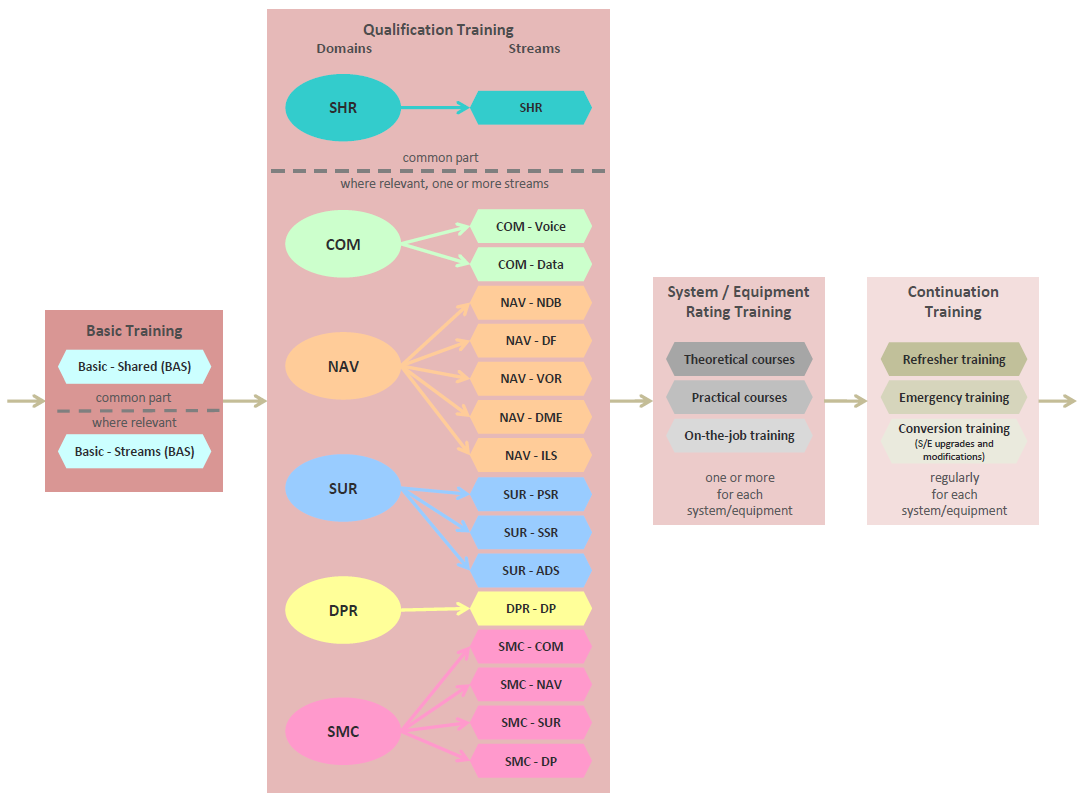
ATSEP TRAINING PHASES
The following diagram illustrates the phases of ATSEP training:
GM2 ATSEP.OR.200 Training requirements — General
ED Decision 2017/001/R
STRUCTURE SYLLABI
Guidance material on how to read the tables in the appendices contained in this Subpart A of
ANNEX XIII is provided in Appendix 5a.
GM1 ATSEP.OR.200(a) Training requirements — General
ED Decision 2017/001/R
BASIC TRAINING
For the purpose of this section, ‘basic training’ is understood as being training designed to impart fundamental knowledge of the service provider’s operational environment.
QUALIFICATION TRAINING
For the purpose of this section, ‘qualification training’ is understood as being training designed to impart knowledge and skills appropriate to the qualification stream to be pursued in the service provider’s operational environment.
SYSTEM/EQUIPMENT RATING TRAINING
For the purpose of this section, ‘system/equipment rating training’ is understood as being training designed to impart system/equipment-related knowledge and skills leading towards operational competence.
CONTINUATION TRAINING
For the purpose of this section, ‘continuation training’ is understood as being training designed to maintain and/or augment existing knowledge and skills related to the ATSEP assigned responsibilities and duties.
ATSEP.OR.205 Basic training
Regulation (EU) 2017/373
(a)The basic training of ATSEPs shall comprise:
(1)the subjects, topics, and sub-topics contained in Appendix 1 (Basic training — Shared);
(2)where relevant to service provider's activities, the subjects contained in Appendix 2 (Basic training — Streams).
(b)A service provider may determine the most suitable educational requirements for its candidate ATSEP and, consequently, adapt the number and/or level of subjects, topics or sub-topics referred to in point (a) where relevant.
GM1 ATSEP.OR.205 Basic training
ED Decision 2017/001/R
MINIMUM TRAINING
The basic training contained within the requirement is the minimum training that needs to be followed by all who aim at becoming ATSEP. However, service providers may decide to add additional subjects or topics that may be specific to their national or local environment.
COMPOSITION OF COURSES
Basic training may be provided as a stand-alone course or as part of a larger initial training course (i.e. basic plus qualification training).
AMC1 ATSEP.OR.205(a) Basic training
ED Decision 2020/020/R
GENERAL
The selection of the subjects, topics, and subtopics should be tailored to:
(a)the duties of the ATSEP regarding the service provider’s activities; and
(b)prior experience and education of the candidate ATSEP.
AMC1 ATSEP.OR.205(a)(1) Basic training
ED Decision 2017/001/R
SHARED
The objectives contained in Appendix 1a to this AMC should be included in the basic training course.
AMC1 ATSEP.OR.205(a)(2) Basic training
ED Decision 2017/001/R
STREAMS
The topics, sub-topics and objectives contained in Appendix 2a to this AMC should be included in the basic training course.
GM1 ATSEP.OR.205(b) Basic training
ED Decision 2020/020/R
ENTRY LEVEL
In some instances, only a limited number of training objectives will need to be taught to ATSEP learners. This is usually the case when the entry level of learners includes some form of previous qualification (e.g. engineering degree or diploma). In this case, the length of training and the number of objectives may be less than that of a course directed to learners who have little or no engineering or technical qualifications. If no engineering or technical qualifications are required prior to starting the basic training, then it may be necessary to include additional objectives in the training that will prepare learners to deal with the basic training.
ATSEP.OR.210 Qualification training
Regulation (EU) 2017/373
The qualification training of ATSEPs shall comprise:
(a)the subjects, topics, and sub-topics contained in Appendix 3 (Qualification training — Shared);
(b)where relevant to its activities, at least one of the qualification streams, contained in Appendix 4 (Qualification training — Streams).
AMC1 ATSEP.OR.210 Qualification training
ED Decision 2020/020/R
GENERAL
The selection of the subjects, topics, and subtopics should be tailored to:
(a)the duties of the ATSEP regarding the service provider’s activities; and
(b)prior experience and education of the candidate ATSEP.
AMC2 ATSEP.OR.210 Qualification training
ED Decision 2017/001/R
SHARED
The objectives contained in Appendix 3a to this AMC should be included in the qualification training course.
GM1 ATSEP.OR.210 Qualification training
ED Decision 2017/001/R
MINIMUM TRAINING
The qualification training contained within the requirement is the minimum training that needs to be followed by all who aim at becoming ATSEP. However, service providers may decide to add additional subjects or topics that may be specific to their national or local environment.
COMPOSITION OF COURSES
Qualification training may be provided as (a) stand-alone course(s) or as part of a larger course.
AMC1 ATSEP.OR.210(a) Qualification training
ED Decision 2017/001/R
STREAMS
The objectives contained in Appendix 4a to this AMC should be included in the qualification training course.
GM1 ATSEP.OR.210(b) Qualification training
ED Decision 2017/001/R
STREAMS
For the purpose of this section, ‘streams’ is understood as being a cluster of training objectives that support a particular area of work.
ATSEP.OR.215 System and equipment rating training
Regulation (EU) 2017/373
(a)The system and equipment rating training of ATSEPs shall be applicable to the duties to be performed and include one or several of the following:
(1)theoretical courses;
(2)practical courses;
(3)on-the-job training.
(b)The system and equipment rating training shall ensure that candidate ATSEP acquire knowledge and skills pertaining to:
(1)the functionality of the system and equipment;
(2)the actual and potential impact of ATSEP actions on the system and equipment;
(3)the impact of the system and equipment on the operational environment.
GM1 ATSEP.OR.215 System and equipment rating training
ED Decision 2017/001/R
SYSTEM AND EQUIPMENT RATING
A system and equipment rating is the authorisation which allows the ATSEP to perform operational tasks on specific system/equipment and may, optionally, include an association with operational site/s, location/s and/or maintenance task levels. The award of this rating follows the successful assessment of operational competence.
The term ‘rating’ in the definition of ‘system/equipment rating training’ should not be associated with the definition of ‘rating’ in Regulation (EC) No 216/2008.
ATSEP.OR.220 Continuation training
Regulation (EU) 2017/373
The continuation training of ATSEPs shall comprise refresher, equipment/systems upgrades and modifications, and/or emergency training.
AMC1 ATSEP.OR.220 Continuation training
ED Decision 2017/001/R
GENERAL
The frequency and duration of continuation training should be determined by taking into account the ATSEP task exposure (recency) as well as the complexity of the operation and of the maintenance of systems.
GM1 ATSEP.OR.220 Continuation training
ED Decision 2017/001/R
REFRESHER TRAINING
(a)For the purpose of this section, ‘refresher training’ is understood as being training designed to review, reinforce or upgrade existing knowledge and skills (including team skills).
(b)Refresher training may periodically include training to refresh and augment ATSEP team skills. Team skills include but are not limited to communication, negotiation, decision-making, conflict resolution and listening skills.
EMERGENCY TRAINING
(c)‘Emergency training’ is understood as being training designed to broaden knowledge, skills, and behaviour in case of emergency, unusual or degraded situation. Most of the training will be site-specific or may make use of incident or accident analysis.
(d)The term ‘emergency’ is considered as a serious, unexpected and/or potentially dangerous situation requiring immediate action(s), e.g. complete loss of any of the following:
—radar display picture;
—Electronic Flight Progress Strip system;
—main, standby and emergency communications on multiple frequencies due to external interference blocking the radiotelephony channels.
(e)The term ‘unusual situation’ is considered as a set of circumstances which are neither habitually nor commonly experienced and for which an ATSEP has not developed a practised response.
(f)The term ‘degraded situation’ is considered as a situation that is the result of a technical system failure or malfunction or a set of circumstances arising from human error or violation of rules affecting the quality of the service provided (i.e. the service continues to be available, even though in a reduced or limited way). For instance, external main supply’s failure to a Category III ILS localiser field site cabin or a normally dual channel DME having a fault on one channel.
SECTION 3 — COMPETENCE ASSESSMENT REQUIREMENTS
ATSEP.OR.300 Competence assessment — General
Regulation (EU) 2017/373
A service provider shall ensure that ATSEP:
(a)have been assessed as competent before performing their duties;
(b)are subject to ongoing competence assessment in accordance with point ATSEP.OR.305.
GM1 ATSEP.OR.300(a) Competence assessment — General
ED Decision 2017/001/R
MEANING
‘Competence’ is understood as a situation where ATSEP possess the required level of knowledge, technical and behavioural skills and experience, and language proficiency when required, in order to be authorised to perform duties on the system and equipment they are competent to work on.
ATSEP.OR.305 Assessment of initial and ongoing competence
Regulation (EU) 2017/373
A service provider employing ATSEP shall:
(a)establish, implement and document processes for:
(1)assessing the initial and ongoing competence of ATSEP;
(2)addressing a failure or degradation of ATSEP competence, including an appeal process;
(3)ensuring the supervision of personnel who have not been assessed as competent;
(b)define the following criteria against which initial and ongoing competence shall be assessed:
(1)technical skills;
(2)behavioural skills;
(3)knowledge.
GM1 ATSEP.OR.305(a)(1) Assessment of initial and ongoing competence
ED Decision 2017/001/R
INITIAL COMPETENCE ASSESSMENT
If the competence assessment is done by the same person training the ATSEP learner during the S/E training phase, the service provider should have in place a process to reduce biases.
GM1 ATSEP.OR.305(a)(3) Assessment of initial and ongoing competence
ED Decision 2017/001/R
SUPERVISION OF NON-COMPETENT PERSONNEL
Supervision of personnel for lack of competence may be necessary due to a number of circumstances including but not restricted to:
(a)the ATSEP still being trained;
(b)the ATSEP undergoing remedial training due to loss of competence; and
(c)the ATSEP having lost competence due to extended absence from tasks that require competence.
GM1 ATSEP.OR.305(b)(2) Assessment of initial and ongoing competence
ED Decision 2017/001/R
BEHAVIOURAL SKILLS
Behavioural skills are non-technical skills and attitudes that ATSEP need to perform effectively. Examples of potential behavioural skills criteria related to initial and ongoing competence are:
(a)cooperation within a team;
(b)attitudes towards safety and security;
(c)flexibility;
(d)analytical thinking; and
(e)ability to communicate effectively.
SECTION 4 — INSTRUCTORS AND ASSESSORS REQUIREMENTS
ATSEP.OR.400 ATSEP training instructors
Regulation (EU) 2017/373
A service provider employing ATSEP shall ensure that:
(a)ATSEP training instructors are suitably experienced in the field where instruction is to be given;
(b)on-the-job training instructors have successfully completed an on-the-job-training course and have the skills to intervene in instances where safety may be compromised during the training.
ATSEP.OR.405 Technical skills assessors
Regulation (EU) 2017/373
A service provider employing ATSEP shall ensure that technical skills assessors have successfully completed an assessor course and are suitably experienced to assess the criteria defined in point ATSEP.OR.305(b).
AMC1 ATSEP.OR.405 Technical-skill assessors
ED Decision 2020/020/R
EXPERIENCE
To be considered suitably experienced, technical skills assessors should:
(a)have clear understanding of the service provider’s assessment process and procedures applicable;
(b)have clear understanding of the performance required of the ATSEP during the assessment and/or on-going assessment;
(c)have the ability to evaluate, in an objective and independent manner, whether the ATSEP has achieved or is maintaining the level of performance required;
(d)have the ability to assess and, if required, act when intervention is necessary to ensure that safety is not compromised;
(e)have the ability to analyse and accurately describe and/or record strengths and weaknesses of an ATSEP performance; and
(f)use appropriate interpersonal and communication skills to brief and debrief an ATSEP, if required.
GM1 ATSEP.OR.405 Technical skills assessors
ED Decision 2017/001/R
GENERAL
The technical skills assessor is the person who is considered suitable to determine whether an ATSEP is technically competent to operate, maintain, release from and return into operations systems that are necessary for the provision of services. This assessment may be in any context where assessment of technical skills is required, e.g. assessment of first competence, ongoing competence.
GM2 ATSEP.OR.405 Technical-skill assessors
ED Decision 2020/020/R
ASSESSMENT RESPONSIBILITIES
(a)Where a technical-skill assessor works regularly with an ATSEP and he or she is required to assess the ATSEP, then continuous assessment may be appropriate, i.e. assessment may be achieved by the technical assessor observing the standard of an ATSEP’s work on a continuous basis during normal operational duties. In that case, the technical-skill assessor should inform the ATSEP of when they will be assessed.
(b)If the appointed technical assessor also acts as line manager to the individual ATSEP, the service provider should have in place a process to reduce biases. Responsibility for determining competence lies with the person having the safety accountability for the ATSEP function.
APPENDICES TO ANNEX XIII
Appendix 1 — Basic training — Shared
Regulation (EU) 2017/373
Subject 1: INDUCTION
TOPIC 1 BASIND — Induction
Sub-topic 1.1 — Training and Assessment Overview
Sub-topic 1.2 — National Organisation
Sub-topic 1.3 — Workplace
Sub-topic 1.4 — ATSEP role
Sub-topic 1.5 — European/Worldwide Dimension
Sub-topic 1.6 — International Standards and Recommended Practices
Sub-topic 1.7 — Data Security
Sub-topic 1.8 — Quality Management
Sub-topic 1.9 — Safety Management System
Sub-topic 1.10 — Health and Safety
Subject 2: AIR TRAFFIC FAMILIARISATION
TOPIC 1 BASATF — Air Traffic Familiarisation
Sub-topic 1.1 — Air Traffic Management
Sub-topic 1.2 — Air Traffic Control
Sub-topic 1.3 — Ground-based Safety Nets
Sub-topic 1.4 — Air Traffic Control Tools and Monitoring Aids
Sub-topic 1.5 — Familiarisation
Appendix 1a — Basic training — Shared
ED Decision 2020/020/R
The subjects, topics and sub-topics are repeated in this AMC for the convenience of the reader and do not form a part of it.
ATSEP UOID (Unique Objective IDentifier) | CORPUS | T A X | CONTENT |
ATSEP.BAS | ATSEP BASIC | ||
ATSEP.BAS.IND | INDUCTION | ||
ATSEP.BAS.IND_1 | INDUCTION | ||
ATSEP.BAS.IND_1.1 | Training and Assessment Overview | ||
ATSEP.BAS.IND_1.1.1 | Describe the training scheme and progression towards ATSEP competence | 2 | Initial (Basic and Qualification), S/E Rating and Continuation training; course aims, objectives, and topics |
ATSEP.BAS.IND_1.1.2 | State the assessment requirements, procedures, and methods | 1 | - |
ATSEP.BAS.IND_1.2 | National Organisation | ||
ATSEP.BAS.IND_1.2.1 | Describe the organisational structure, purpose and functions of the service provider(s) and regulatory structures | 2 | e.g. headquarters, control centres, training facilities, airports, outstations, civil/military interfaces, regulatory interfaces |
ATSEP.BAS.IND_1.2.2 | Describe the structure and functions of the major departments within the service provider | 2 | e.g. organisational handbook (plans, concepts and structure, finance model) |
ATSEP.BAS.IND_1.2.3 | State appropriate accountabilities and responsibilities of the service provider(s) and competent authority | 1 | - |
ATSEP.BAS.IND_1.3 | Workplace | ||
ATSEP.BAS.IND_1.3.1 | State the role of trade unions and professional organisations | 1 | e.g. international, European, national, local level |
ATSEP.BAS.IND_1.3.2 | Consider security of site facilities and personnel against unlawful interference | 2 | Environmental, physical and information security measures, employee vetting, and reference checks |
ATSEP.BAS.IND_1.3.3 | Describe actions when suspecting a security breach | 2 | e.g. inform police, security agencies and managers; follow the security manual and/or contingency plan |
ATSEP.BAS.IND_1.4 | ATSEP Role | ||
ATSEP.BAS.IND_1.4.1 | Describe the key responsibilities of an ATSEP | 2 | - |
ATSEP.BAS.IND_1.5 | European/Worldwide Dimension | ||
ATSEP.BAS.IND_1.5.1 | Explain the relationship between States and its relevance to ATM operations | 2 | e.g. harmonisation, flow management, bilateral agreement, sharing of ATM relevant data, major studies, research programmes, and policy documents |
ATSEP.BAS.IND_1.5.2 | Define the regulatory framework of international and national ATM | 1 | e.g. ICAO, European and national concepts, responsibilities |
ATSEP.BAS.IND_1.5.3 | State the purpose of a range of international bodies | 1 | ICAO, EU, EASA e.g. ECAC, EUROCONTROL, RTCA, EUROCAE |
ATSEP.BAS.IND_1.6 | International Standards and Recommended Practices | ||
ATSEP.BAS.IND_1.6.1 | Explain how the regulatory environment of ICAO notifies and implements legislation | 2 | ICAO Annexes |
ATSEP.BAS.IND_1.6.2 | State which major/key ATM engineering ‘standards’ and ‘practices’ are applicable | 1 | e.g. ICAO Annex 10, ICAO Doc 8071, ICAO Doc 9426-3, available EUROCONTROL standards, guidance material on reliability, maintainability and availability |
ATSEP.BAS.IND_1.7 | Data Security | ||
ATSEP.BAS.IND_1.7.1 | Explain the importance of ATM security | 2 | - |
ATSEP.BAS.IND_1.7.2 | Describe the security of operational data | 2 | Secure, restricted access by authorised personnel |
ATSEP.BAS.IND_1.7.3 | Explain security policies and practices for information and data | 2 | Backup, storing, hacking, confidentiality, copyright |
ATSEP.BAS.IND_1.7.4 | Describe the possible external interventions which may interrupt or corrupt ATM services | 2 | Introduction of software viruses, illegal broadcasts, jamming, spoofing |
ATSEP.BAS.IND_1.8 | Quality Management | ||
ATSEP.BAS.IND_1.8.1 | Explain the need for quality management | 2 | e.g. ISO, EFQM (European Foundation for Quality Management) |
ATSEP.BAS.IND_1.8.2 | Explain the need for configuration management | 2 | Importance for safe operations |
ATSEP.BAS.IND_1.9 | Safety Management System | ||
ATSEP.BAS.IND_1.9.1 | Explain why there is a need for high-level safety requirements for ATM/ANS activities | 2 | Safety policy and rules, system safety cases, system safety requirements |
ATSEP.BAS.IND_1.10 | Health and Safety | ||
ATSEP.BAS.IND_1.10.1 | Explain personal safety responsibilities in the work environment | 2 | Safety statement, first aid, rules about climbing |
ATSEP.BAS.IND_1.10.2 | Explain potential hazards to health and safety generated by equipment, or contained within the work environment | 2 | e.g. health consequences of electric shock and static discharges, precautions with chemical products (batteries), mechanical hazards (rotating machinery/antennas), toxic materials (beryllium), biological hazards, faulty earthing |
ATSEP.BAS.IND_1.10.3 | Describe fire safety and first-aid regulations and practices | 2 | Requirements and rules e.g. standards |
ATSEP.BAS.IND_1.10.4 | State any applicable legal requirements and safety rules | 1 | National, international regulations e.g. for working on power supply and/or air conditioning |
ATSEP.BAS.IND_1.10.5 | Describe the main features and uses of the different types of fire detectors and extinguishers | 2 | e.g. VESDA, Type A, B, C, D extinguishers |
ATSEP.BAS.ATF | AIR TRAFFIC FAMILIARISATION | ||
ATSEP.BAS.ATF_1 | AIR TRAFFIC FAMILIARISATION | ||
ATSEP.BAS.ATF_1.1 | Air Traffic Management | ||
ATSEP.BAS.ATF_1.1.1 | Define Air Traffic Management | 1 | ICAO, EU regulations |
ATSEP.BAS.ATF_1.1.2 | Describe operational ATM functions | 2 | ATFCM, ATS, ASM |
ATSEP.BAS.ATF_1.1.3 | Describe ATM concepts and associated terminology | 2 | e.g. concepts: FUA, free flight, gate-to-gate, performance-based ATM operations (PBN, RCP), operational concepts (ICAO, EUROCONTROL, SESAR) |
ATSEP.BAS.ATF_1.1.4 | Explain the operational importance of technical services required for ATM | 2 | e.g. Interoperability |
ATSEP.BAS.ATF_1.1.5 | State future developments in systems and/or ATM/ANS practices which may have an impact on services provided | 1 | e.g. data link, satellite-based navigation, gate-to-gate (CDM), ATC tools, continuous approach, 4D trajectory, business trajectory, SWIM, NOP, SESAR (UDPP, modes of separation), ASAS |
ATSEP.BAS.ATF_1.1.6 | List the standard units of measurement used in aviation | 1 | Speed, distance, vertical distance, time, direction, pressure, temperature |
ATSEP.BAS.ATF_1.2 | Air Traffic Control | ||
ATSEP.BAS.ATF_1.2.1 | Define airspace organisation | 1 | ICAO Annex 11, Regulation (EU) No 923/2012 e.g. FIR, UTA, TMA, CTR, ATS routes |
ATSEP.BAS.ATF_1.2.2 | Describe commonly used airspace terminologies and concepts | 2 | e.g. sectorisation, identification of ATS routes, restricted airspace, significant points |
ATSEP.BAS.ATF_1.2.3 | State the general organisation of aerodromes | 1 | e.g. obstacle limitation surfaces, different departure and arrival trajectories, approach and landing categories, operational status of radio navigation aids |
ATSEP.BAS.ATF_1.2.4 | State the purpose of ATC | 1 | ICAO Doc 4444 |
ATSEP.BAS.ATF_1.2.5 | State the organisation of ATC services | 1 | ICAO Doc 4444 e.g. area, approach, aerodrome control services |
ATSEP.BAS.ATF_1.3 | Ground-based Safety Nets | ||
ATSEP.BAS.ATF_1.3.1 | Describe the purpose of ground-based safety nets | 2 | e.g. STCA, MSAW, APW, runway incursion alerts |
ATSEP.BAS.ATF_1.4 | Air Traffic Control Tools and Monitoring Aids | ||
ATSEP.BAS.ATF_1.4.1 | Explain the main characteristics and use of ATC support and monitoring tools | 2 | e.g. MTCD, sequencing and metering tools (AMAN, DMAN), ASMGCS, CLAM, RAM, CORA |
ATSEP.BAS.ATF_1.5 | Familiarisation | ||
ATSEP.BAS.ATF_1.5.1 | Take account of the tasks of ATC | 2 | e.g. simulation, role play, PC, Part Task Trainer, observations in the operational environment |
ATSEP.BAS.ATF_1.5.2 | Explain the need for good communication, coordination and cooperation between operational staff | 2 | e.g. handovers, MIL/CIV, planner/tactical, SV Tech (SMC) and SV ATCO, site visit(s) to ATC units |
ATSEP.BAS.ATF_1.5.3 | Consider the purpose, function and role of various operational stations in respect of ATM-related operations | 2 | Site visit(s) to ATC units e.g. meteorological services providers, remote sites, airport operations |
ATSEP.BAS.ATF_1.5.4 | Define the phases of flight | 1 | Take-off, climb, cruise, descent and initial approach, final approach and landing |
ATSEP.BAS.ATF_1.5.5 | Recognise the cockpit environment and associated equipment, in relation to ATC | 1 | Relevant pilot HMI e.g. familiarisation flight or cockpit simulator training (where practicable), antenna |
ATSEP.BAS.ATF_1.5.6 | Define airborne collision avoidance systems | 1 | ACAS, EGPWS e.g. TCAS |
ATSEP.BAS.AIS | AERONAUTICAL INFORMATION SERVICES | ||
ATSEP.BAS.AIS_1 | AERONAUTICAL INFORMATION SERVICES (AIS) | ||
ATSEP.BAS.AIS_1.1 | Aeronautical Information Services | ||
ATSEP.BAS.AIS_1.1.1 | State the organisation of the AIS | 1 | - |
ATSEP.BAS.AIS_1.1.2 | Define the AIP | 1 | e.g. contents of AIP, AIC and types of publication: AIRAC, non- AIRAC, data collection and preparation, data format, distribution channels, supporting systems and tools |
ATSEP.BAS.AIS_1.1.3 | Define the aeronautical charting service | 1 | Types of aeronautical charts, operational use of charts, supporting systems and tools |
ATSEP.BAS.AIS_1.1.4 | Define the NOTAM services | 1 | - |
ATSEP.BAS.AIS_1.1.5 | Define the ATS Reporting Office | 1 | e.g. purpose of flight plans and other ATS messages, types of flight plans (FPL and RPL), contents of flight plans and other ATS messages, distribution of flight plans and other ATS messages, supporting systems and tools |
ATSEP.BAS.AIS_1.1.6 | Define the European AIS Database | 1 | e.g. central single source, validation, redundancy, EAD structure |
ATSEP.BAS.AIS_1.1.7 | Define procedures for providing Communications, Navigation and Surveillance (CNS) data | 1 | Information of a permanent nature, information of a temporary nature, status report of NAVAIDs |
ATSEP.BAS.MET | METEOROLOGY | ||
ATSEP.BAS.MET_1 | METEOROLOGY (MET) | ||
ATSEP.BAS.MET_1.1 | Introduction to Meteorology | ||
ATSEP.BAS.MET_1.1.1 | State the relevance of meteorology in aviation | 1 | Influence on the operation of aircraft, flying conditions, aerodrome conditions |
ATSEP.BAS.MET_1.1.2 | State the weather prediction and measurement systems available | 1 | wind, visibility, temperature, pressure, humidity, cloud base |
ATSEP.BAS.MET_1.2 | Impact on Aircraft and ATS Operation | ||
ATSEP.BAS.MET_1.2.1 | State the meteorological conditions and their impact on aircraft operations | 1 | e.g. wind, visibility, temperature/humidity, clouds, precipitation, pressure, density |
ATSEP.BAS.MET_1.2.2 | State the meteorological conditions hazardous to aircraft operations | 1 | e.g. turbulence, thunderstorms, icing, squall, macro bursts, wind shear, contaminated runway |
ATSEP.BAS.MET_1.2.3 | Explain the impact of meteorological conditions and hazards on ATS operations | 2 | Increased vertical and horizontal separation, low visibility procedures, anticipation of flights not adhering to tracks, diversions, missed approaches e.g. effects on equipment performance |
ATSEP.BAS.MET_1.2.4 | Explain the effects of weather on propagation | 2 | e.g. anaprop, rain noise, sunspots |
ATSEP.BAS.MET_1.3 | Meteorological Parameters and Information | ||
ATSEP.BAS.MET_1.3.1 | List the main meteorological parameters | 1 | Wind, visibility, temperature, pressure, humidity |
ATSEP.BAS.MET_1.3.2 | List the most common weather messages and broadcasts used in aviation | 1 | Meteorology messages: TAF, METAR, SNOWTAM, SIGMET Broadcasts: ATIS/VOLMET e.g. Regulation (EU) 2017/373 – Annex V (Part-MET) |
ATSEP.BAS.MET_1.4 | Meteorological Systems | ||
ATSEP.BAS.MET_1.4.1 | Explain the basic principles of the main meteorological systems in use | 2 | e.g. weather display and information systems, wind speed (anemometer), wind direction (weather vane), visibility (types of IRVR, forward scatter), temperature probes, pressure (aneroid barometers), humidity, cloud base (laser ceilometers) |
Appendix 2 — Basic training — Streams
Regulation (EU) 2017/373