
Filters
GM2 to AMC2 ATS.TR.155(c)(3) ATS surveillance services
ED Decision 2020/008/R
PROCEDURES FOR RADAR APPROACHES
(a)During the period that an air traffic controller is engaged in giving surveillance radar approaches, he or she should not be responsible for any duties other than those directly connected with such approaches.
(b)Air traffic controllers conducting radar approaches should be provided with information regarding the OCAs/OCHs established for the types of approach to be conducted.
(c)Prior to commencement of a radar approach, the air traffic controller should inform the aircraft of the:
(1)runway to be used;
(2)applicable OCA/OCH;
(3)angle of the nominal glide path and the approximate rate of descent to be maintained; and
(4)procedure to be followed in the event of radio communication failure unless the procedure has been published in AIPs.
(d)When a radar approach cannot be continued due to any circumstance, the aircraft should be immediately informed that a radar approach or continuation thereof is not possible. The approach should be continued if this is possible using non-radar facilities or if the pilot reports that the approach can be completed visually; otherwise, an alternative clearance should be given.
(e)Aircraft making a radar approach should be reminded, when on final approach, to check that the wheels are down and locked.
(f)Unless otherwise prescribed by the air traffic services provider, the air traffic controller conducting the approach should notify the aerodrome air traffic controller or, when applicable, the procedural air traffic controller when an aircraft making a radar approach is approximately 15 km (8 NM) from touchdown. If landing clearance is not received at this time, a subsequent notification should be made at approximately 8 km (4 NM) from touchdown and landing clearance requested.
(g)Clearance to land or any alternative clearance received from the aerodrome air traffic controller or, when applicable, the procedural air traffic controller should normally be passed on to the aircraft before it reaches a distance of 4 km (2 NM) from touchdown.
(h)An aircraft making a radar approach should:
(1)be directed to execute a missed approach in the following circumstances:
(i)when the aircraft appears to be dangerously positioned on final approach; or
(ii)for reasons involving traffic conflictions; or
(iii)if no clearance to land has been received from the procedural air traffic controller by the time the aircraft reaches a distance of 4 km (2 NM) from touchdown or such other distance as has been agreed with the aerodrome control tower; or
(iv)on instructions by the aerodrome air traffic controller;
or
(2)be advised to consider executing a missed approach in the following circumstances:
(i)when the aircraft reaches a position from which it appears that a successful approach cannot be completed; or
(ii)if the aircraft is not visible on the situation display for any significant interval during the last 4 km (2 NM) of the approach; or
(iii)if the position or identification of the aircraft is in doubt during any portion of the final approach.
In all such cases, the reason for the instruction or the advice should be given to the pilot.
(i)Unless otherwise required by exceptional circumstances, radar instructions concerning a missed approach should be in accordance with the prescribed missed approach procedure and should include the level to which the aircraft is to climb and heading instructions to keep the aircraft within the missed approach area during the missed approach procedure.
GM3 to AMC2 ATS.TR.155(c)(3) ATS surveillance services
ED Decision 2020/008/R
FINAL APPROACH PROCEDURES — SURVEILLANCE RADAR APPROACH
(a)A surveillance radar approach should only be performed with equipment suitably sited and a situation display specifically marked to provide information on position relative to the extended centre line of the runway to be used and distance from touchdown, and which is specifically approved for the purpose by the competent authority.
(b)When conducting a surveillance radar approach, the air traffic controller should comply with the following:
(1)at or before the commencement of the final approach, the aircraft should be informed of the point at which the surveillance radar approach will be terminated;
(2)the aircraft should be informed when it is approaching the point at which it is computed that descent should begin, and just before reaching that point it should be informed of the OCA/OCH and instructed to descend and check the applicable minima;
(3)azimuth instructions should be given as follows:
(i)the pilot should be informed at regular intervals of the aircraft’s position in relation to the extended centre line of the runway. Heading corrections should be given as necessary to bring the aircraft back on to the extended centre line;
(ii)in the case of azimuth deviations, the pilot should not take corrective action unless specifically instructed to do so;
(4)except as provided in point (c), information on distance from touchdown should normally be passed on at every 2 km (each NM);
(5)pre-computed levels through which the aircraft should be passing to maintain the glide path should also be transmitted at every 2 km (each NM) at the same time as the distance; and
(6)the surveillance radar approach should be terminated:
(i)at a distance of 4 km (2 NM) from touchdown, except as provided in point (c); or
(ii)before the aircraft enters an area of continuous radar clutter; or
(iii)when the pilot reports that a visual approach can be effected,
whichever is the earliest.
(c)When, as determined by the competent authority, the accuracy of the radar equipment permits, surveillance radar approaches may be continued to the threshold of the runway, or to a prescribed point less than 4 km (2 NM) from touchdown, in which case:
(1)distance and level information should be given at each km (each half NM);
(2)transmission should not be interrupted for intervals of more than 5 seconds while the aircraft is within a distance of 8 km (4 NM) from touchdown; and
(3)the air traffic controller should not be responsible for any duties other than those directly connected with a particular approach.
(d)Levels through which the aircraft should pass to maintain the required glide path, and the associated distances from touchdown, should be pre-computed and displayed in such a manner as to be readily available to the air traffic controller concerned.
GM1 ATS.TR.155(c)(3) ATS surveillance services
ED Decision 2020/008/R
VECTORING — DEFINITION OF INITIAL AND INTERMEDIATE APPROACH PHASES
The initial and intermediate approach phases of an approach executed under the direction of an air traffic controller comprise those parts of the approach from the time vectoring is initiated for the purpose of positioning the aircraft for a final approach until the aircraft is on final approach and:
(a)established on the final approach path of a pilot-interpreted aid; or
(b)reports that it is able to complete a visual approach; or
(c)ready to commence a surveillance radar approach.
AMC1 ATS.TR.155(c)(4) ATS surveillance services
ED Decision 2020/008/R
NAVIGATION ASSISTANCE
An identified aircraft observed to deviate significantly from its intended route or designated holding pattern should be advised accordingly. Appropriate action should also be taken if, in the opinion of the air traffic controller such deviation is likely to affect the service being provided.
GM1 ATS.TR.155(c)(5) ATS surveillance services
ED Decision 2020/008/R
INFORMATION REGARDING ADVERSE WEATHER
(a)Information that an aircraft appears likely to penetrate an area of adverse weather should be issued in sufficient time to permit the pilot to decide on an appropriate course of action, including that of requesting advice on how best to circumnavigate the adverse weather area, if so desired.
(b)Depending on the capabilities of the ATS surveillance system, areas of adverse weather may not be presented on the situation display. An aircraft’s weather radar will normally provide better detection and definition of adverse weather than radar sensors in use by air traffic services.
(c)In vectoring an aircraft for circumnavigating any area of adverse weather, the air traffic controller should ascertain that the aircraft can be returned to its intended or assigned flight path within the coverage of the ATS surveillance system and, if this does not appear possible, inform the pilot of the circumstances.
AMC1 ATS.TR.155(c)(6) ATS surveillance services
ED Decision 2020/008/R
ATS SURVEILLANCE SERVICES — PROCEDURES FOR TRANSFER OF CONTROL
(a)Where ATS surveillance services are being provided, transfer of control should be effected, whenever practicable, so as to enable the uninterrupted provision of ATS surveillance services.
(b)Where SSR and/or ADS-B and/or MLAT is (are) used and the display of position indications with associated labels is provided for, transfer of control of aircraft between adjacent control positions or between adjacent air traffic control units may be effected without prior coordination, provided that:
(1)updated flight plan information on the aircraft about to be transferred, including the discrete assigned SSR code or, with respect to Mode S and ADS-B, the aircraft identification, is provided to the accepting air traffic controller prior to transfer;
(2)the ATS surveillance system coverage provided to the accepting air traffic controller is such that the aircraft concerned is presented on the situation display before the transfer is effected and is identified on, but preferably before, receipt of the initial call;
(3)when the air traffic controllers are not physically adjacent, two-way direct-speech facilities, which permit communications to be established instantaneously, are available between them at all times;
(4)the transfer point or points and all other conditions of application, such as direction of flight, specified levels, transfer of communication points, and especially an agreed minimum separation between aircraft, including that applicable to succeeding aircraft on the same route, about to be transferred as observed on the situation display, have been made the subject of specific instructions (for intra-unit transfer) or of a specific letter of agreement between two adjacent air traffic control units;
(5)the instructions or letter of agreement specify explicitly that the application of this type of transfer of control may be terminated at any time by the accepting air traffic controller, normally with an agreed advance notice; and
(6)the accepting air traffic controller is informed of any level, speed or vectoring instructions given to the aircraft prior to its transfer and which modify its anticipated flight progress at the point of transfer.
(c)The minimum agreed separation between aircraft about to be transferred (see point (b)(4)) and the advance notice (see point (b)(5)) should be determined taking into account all relevant technical, operational and other circumstances. If circumstances arise in which these agreed conditions can no longer be satisfied, air traffic controllers should revert to the procedure in point (d) until the situation is resolved.
(d)Where primary radar is being used, and where another type of ATS surveillance system is employed but the provisions in point (b) are not applied, the transfer of control of aircraft between adjacent control positions or between two adjacent air traffic services units may be effected, provided that:
(1)identification has been transferred to or has been established directly by the accepting air traffic controller;
(2)when the air traffic controllers are not physically adjacent, two-way direct-speech facilities which permit communications to be established instantaneously between them are available at all times;
(3)separation from other controlled flights conforms to the minima authorised for use during transfer of control between the sectors or units concerned;
(4)the accepting air traffic controller is informed of any level, speed or vectoring instructions applicable to the aircraft at the point of transfer; and
(5)radio communication with the aircraft is retained by the transferring air traffic controller until the accepting air traffic controller has agreed to assume responsibility for providing the ATS surveillance services to the aircraft. Thereafter, the aircraft should be instructed to change over to the appropriate channel, and from that point the responsibility is that of the accepting air traffic controller.
GM1 to AMC1 ATS.TR.155(c)(6) ATS surveillance services
ED Decision 2020/008/R
ATS SURVEILLANCE SERVICES — PROCEDURES FOR TRANSFER OF CONTROL
Transfer of control based on the procedures specified in AMC1 ATS.TR.155(c)(6) may be carried out without systematic use of the bidirectional speech facilities available between the adjacent units concerned, provided that:
(a)the detailed conditions applicable for the transfer are the subject of a bilateral agreement; and
(b)the minimum distance between successive aircraft during the period of transfer is agreed as one of the following values:
(1)19 km (10 NM) when SSR information is used in accordance with the provisions of AMC1 ATS.TR.155(c)(6), provided that an overlapping radar coverage of at least 56 km (30 NM) between units involved exists; or
(2)9.3 km (5 NM) when the conditions of point (b)(1) apply and both units involved possess electronic aids for immediate recognition of release and acceptance of aircraft under radar transfer.
GM1 ATS.TR.155(c)(6) ATS surveillance services
ED Decision 2020/008/R
PROCEDURES FOR TRANSFER OF CONTROL IN ATS SURVEILLANCE SERVICES
Guidance on procedures for transfer of control in the ATS surveillance services provision may be found in the EUROCONTROL document titled ‘Guidelines for the Application of European Coordination and Transfer Procedures’ Edition 1.0 of 25 October 2012, which is available at: https://www.eurocontrol.int/publication/guidelines-application-european-coordination-and-transfer-procedures
GM1 ATS.TR.155(c)(7) ATS surveillance services
ED Decision 2020/008/R
PROCEDURES FOR AIR TRAFFIC CONTROL SERVICE IN CASE OF ATS SURVEILLANCE SYSTEM FAILURE
In the event of complete failure of the ATS surveillance system, where air-ground communications remain, the air traffic controllers should plot the positions of all aircraft already identified, take the necessary action to establish procedural separation between the aircraft and, if necessary, limit the number of aircraft permitted to enter the area.
GM2 ATS.TR.155(c)(7) ATS surveillance services
ED Decision 2020/008/R
SEPARATION APPLICATION IN CASE OF ATS SURVEILLANCE SYSTEM FAILURE
As an emergency measure, in the event of complete failure of the ATS surveillance system, where air-ground communications remain, the use of flight levels spaced by half the applicable vertical separation minimum may be resorted to temporarily if standard procedural separation cannot be provided immediately.
GM3 ATS.TR.155(c)(7) ATS surveillance services
ED Decision 2020/008/R
ATS SURVEILLANCE SYSTEM FAILURE — DATA DEGRADATION
In order to reduce the impact of a degradation of aircraft position source data (for example, a receiver autonomous integrity monitoring (RAIM) outage for GNSS), the air traffic services provider should establish contingency procedures to be followed by air traffic services units in the event of data degradation.
GM1 ATS.TR.155(c)(9) ATS surveillance services
ED Decision 2020/008/R
DISPLAY OF ATS SURVEILLANCE-BASED SAFETY-RELATED ALERTS AND WARNINGS
ATS surveillance systems should provide for the display of safety-related alerts and warnings, including conflict alert, conflict prediction, minimum safe altitude warning and unintentionally duplicated SSR codes and aircraft identification.
GM2 ATS.TR.155(c)(9) ATS surveillance services
ED Decision 2020/008/R
SHORT-TERM CONFLICT ALERT (STCA) PROCEDURES
The generation of STCAs is a function based on surveillance data, integrated into an air traffic control system. The objective of the STCA function is to assist the air traffic controller in preventing collision between aircraft by generating, in a timely manner, an alert of a potential or actual infringement of separation minima. Procedures and related instructions concerning the use of the STCA function should specify, inter alia:
(a)the types of flight which are eligible for generation of alerts;
(b)the sectors or areas of airspace within which the STCA function is implemented;
(c)the method of displaying the STCA to the air traffic controller;
(d)in general terms, the parameters for generation of alerts as well as alert warning time;
(e)the volumes of airspace within which STCA can be selectively inhibited and the conditions under which this will be permitted;
(f)conditions under which specific alerts may be inhibited for individual flights; and
(g)procedures applicable in respect of volume of airspace or flights for which STCA or specific alerts have been inhibited.
GM3 ATS.TR.155(c)(9) ATS surveillance services
ED Decision 2020/008/R
MINIMUM SAFE ALTITUDE WARNING (MSAW) PROCEDURES
The generation of MSAWs is a function of an ATS surveillance data-processing system. The objective of the MSAW function is to assist in the prevention of controlled flight into terrain accidents by generating, in a timely manner, a warning of the possible infringement of a minimum safe altitude. Procedures and related instructions concerning the use of the MSAW function should specify, inter alia:
(a)the types of flight which are eligible for generation of MSAW;
(b)the sectors or areas of airspace for which MSAW minimum safe altitudes have been defined and within which the MSAW function is implemented;
(c)the values of the defined MSAW minimum safe altitudes;
(d)the method of displaying the MSAW to the air traffic controller;
(e)the parameters for generation of a MSAW as well as warning time; and
(f)conditions under which the MSAW function may be inhibited for individual aircraft tracks as well as procedures applicable in respect of flights for which MSAW has been inhibited.
AMC1 ATS.TR.155(c)(10) ATS surveillance services
ED Decision 2020/008/R
INTERRUPTION OR TERMINATION OF ATS SURVEILLANCE SERVICES
An aircraft which has previously been informed that it is provided with an ATS surveillance service should immediately be informed when, for any reason, the service is interrupted or terminated.
AMC1 ATS.TR.155(e) ATS surveillance services
ED Decision 2020/008/R
INFORMATION REGARDING TRAFFIC ON A CONFLICTING PATH
(a)Information regarding traffic on a conflicting path should be given, whenever practicable, in the following form:
(1)relative bearing of the conflicting traffic in terms of the 12-hour clock;
(2)distance from the conflicting traffic in kilometres or nautical miles;
(3)direction in which the conflicting traffic appears to be proceeding; and
(4)level and type of aircraft or, if unknown, relative speed of the conflicting traffic, e.g. slow or fast.
(b)Pressure-altitude-derived level information, even when unverified, should be used in the provision of collision hazard information because such information, particularly if available from an otherwise unknown aircraft (e.g. a VFR flight) and given to the pilot of a known aircraft, could facilitate the location of a collision hazard.
(c)If the level information has not been verified, the accuracy of the information should be considered uncertain and the pilot should be informed accordingly.
GM1 to AMC1 ATS.TR.155(e) ATS surveillance services
ED Decision 2020/008/R
INFORMATION REGARDING TRAFFIC ON A CONFLICTING PATH
With reference to point (a)(1) of AMC1 ATS.TR.155(e): In cases where using the terms of the 12-hour clock is not practicable, like when the aircraft is turning, the direction of the unknown aircraft may be given by compass points, e.g. northwest, south, etc.
GM2 to AMC1 ATS.TR.155(e) ATS surveillance services
ED Decision 2020/008/R
INFORMATION REGARDING TRAFFIC ON A CONFLICTING PATH
With reference to point (a)(4) of AMC1 ATS.TR.155(e): The level may be described either as a flight level, altitude or height, or as a relative vertical distance from the aircraft provided with traffic information (e.g. 1 000 ft above or 1 000 ft below).
AMC1 ATS.TR.155(f) ATS surveillance services
ED Decision 2020/008/R
TOLERANCE VALUE FOR PRESSURE-ALTITUDE-DERIVED LEVEL INFORMATION
The tolerance value used to determine that the pressure-altitude-derived level information displayed to the air traffic controller is accurate should be ±60 m (±200 ft) in RVSM airspace. In other airspace, it should be ±90 m (±300 ft), except that the competent authority may specify a smaller criterion, but not less than ±60 m (±200 ft), if this is found to be more practical.
AMC2 ATS.TR.155(f) ATS surveillance services
ED Decision 2020/008/R
VERIFICATION OF PRESSURE-ALTITUDE-DERIVED LEVEL INFORMATION
The verification should be effected by simultaneous comparison with altimeter-derived level information received from the same aircraft by radiotelephony. Geometric height information should not be used to determine if altitude differences exist.
GM1 ATS.TR.155(f) ATS surveillance services
ED Decision 2020/008/R
ERRONEOUS LEVEL INFORMATION IN AIR TRAFFIC CONTROL SERVICE PROVISION
(a)If the displayed level information is not within the approved tolerance value or when a discrepancy in excess of the approved tolerance value is detected subsequent to verification, the pilot should be advised accordingly and requested to check the pressure setting and confirm the aircraft’s level.
(b)If, following confirmation of the correct pressure setting, the discrepancy continues to exist, the following actions should be taken by the air traffic controller according to circumstances:
(1)request the pilot to stop Mode C or ADS-B altitude data transmission, provided this does not cause the loss of position and identity information, and notify the next control positions or air traffic control unit concerned with the aircraft of the action taken; or
(2)inform the pilot of the discrepancy and request that the relevant operation continue in order to prevent loss of position and identity information of the aircraft and, when so prescribed by the local instructions, override the label-displayed level information with the reported level. In addition, the air traffic control unit should notify the next control position or air traffic control unit concerned with the aircraft of the action taken.
(c)It should be highlighted that the airborne collision avoidance system (ACAS) will accept Mode C replies that are erroneous, and it is possible to issue a resolution advisory (RA) based on these inputs. When the measures described in point (b)(1) cannot be implemented, the air traffic controller should take into account the likelihood of generating ACAS RA in the air traffic services provision.
GM2 ATS.TR.155(f) ATS surveillance services
ED Decision 2020/008/R
ERRONEOUS LEVEL INFORMATION IN FLIGHT INFORMATION SERVICE PROVISION
The procedures for the verification of pressure-altitude-derived displayed information in the provision of flight information service should be established taking into consideration GM1 ATS.TR.155(f), and approved by the competent authority.
AMC1 ATS.TR.155(g) ATS surveillance services
ED Decision 2020/008/R
VERIFICATION OF LEVEL OCCUPANCY
(a)In accordance with AMC1 ATS.TR.155(f), the criterion which should be used to determine that a specific level is occupied by an aircraft should be ±60 m (±200 ft) in RVSM airspace. In other airspace, this criterion should be ±90 m (±300 ft), except that the competent authority may specify a smaller criterion, but not less than ±60 m (±200 ft), if this is found to be more practical.
(b)Aircraft maintaining a level
An aircraft should be considered to be maintaining its assigned level as long as the pressure-altitude-derived level information indicates that it is within the appropriate tolerances of the assigned level, as specified in point (a).
(c)Aircraft vacating a level
An aircraft cleared to leave a level should be considered to have commenced its manoeuvre and vacated the previously occupied level when the pressure-altitude-derived level information indicates a change of more than 90 m (300 ft) in the anticipated direction from its previously assigned level.
(d)Aircraft passing a level in climb or descent
An aircraft in climb or descent should be considered to have crossed a level when the pressure-altitude-derived level information indicates that it has passed this level in the required direction by more than 90 m (300 ft).
(e)Aircraft reaching a level
An aircraft should be considered to have reached the level to which it has been cleared when the elapsed time of three display updates, three sensor updates or 15 seconds, whichever is the greater, has passed since the pressure-altitude-derived level information has indicated that it is within the appropriate tolerances of the assigned level, as specified in point (a).
ATS.TR.160 Provision of air traffic services for flight testing
Commission Implementing Regulation (EU) 2020/469
Additional or alternative conditions and procedures to those contained in this Subpart B, to be applied by air traffic services units for the provision of air traffic services for flight testing, may be specified by the competent authority.
GM1 ATS.TR.160 Provision of air traffic services for flight testing
ED Decision 2020/008/R
SPECIAL AND ALTERNATIVE CONDITIONS AND OPERATING PROCEDURES FOR AIR TRAFFIC SERVICES PROVIDERS PROVIDING SERVICES TO FLIGHT TESTS
(a)While flight tests are regularly conducted in compliance with the standards and the provisions specified in Subpart B of Annex IV, some of them need to follow specific additional or alternative conditions and procedures approved by the competent authority to meet the needs of flight tests carried out during the flight. This is also the case for flight tests involving more than one aircraft in the same flight test. These special provisions will not jeopardise the safety of the other airspace users and the population in the area overflown.
(b)In order to ensure safe operations within the provision of air traffic service for flight tests control, the air traffic controllers, FIS officers and AFIS officers providing these services may need to have specific knowledge of flight tests and/or be briefed, depending on the specificities of the flight profiles.
(c)Air traffic controllers that provide air traffic services to flight tests (flight test air traffic controllers) may need to obtain their specific competence through a dedicated training as specified in Commission Regulation (EU) 2015/340.
(d)Air traffic services for flight tests should be provided through dedicated and specific procedures. These procedures should address the following:
(1) Compatibility with other airspace users
(i) In order to ensure the compatibility of the flight test with other airspace users and to ensure safe operations and an acceptable rate of success of the flight test, the air traffic services provider should ensure proper coordination at all levels, including strategic, pre-tactical and real-time coordination.
(ii) The air traffic services unit providing services to flight tests is responsible for ensuring compatibility of their activities with other airspace users.
(2) Flight plan
The air traffic services unit should obtain all the necessary details related to flight tests (e.g. from the design organisation or the entity wishing to carry out the flight test).
(3) Flight tests with limited manoeuvrability
(i)During certain phases of the flight test, the capability to normally perform manoeuvres may only be possible after a necessary period of time (e.g. for the flight crew to get into a configuration that allows the execution of these manoeuvres).
(ii)The air traffic services provider should obtain the necessary information about the phases of flight and the duration if known.
(iii)For the conduct of these flights, the use of a temporarily reserved area is preferred. If unable, after prior coordination with the relevant air traffic services units neighbouring the flight tests, the use of a transponder should be mandated.
(iv)The real-time information on the development of the flight test as described in points (i)(ii)(iii) above does not relieve the air traffic services unit responsible for providing services to the flight tests from the obligation, when applicable, to ensure traffic separation and assure compatibility with all airspace users.
(e)The above-mentioned procedures are not exhaustive and additional provisions may be necessary to meet the needs of flight tests. The paramount principle is anyhow to make provisions without contradicting the standards and the provisions specified in Subpart B of Annex IV.
SECTION 2 - AIR TRAFFIC CONTROL SERVICE
ATS.TR.200 Application
Commission Implementing Regulation (EU) 2020/469
Air traffic control service shall be provided:
(a)to all IFR flights in airspace Classes A, B, C, D and E;
(b)to all VFR flights in airspace Classes B, C and D;
(c)to all special VFR flights;
(d)to all aerodrome traffic at controlled aerodromes.
ATS.TR.205 Provision of air traffic control service
Commission Implementing Regulation (EU) 2020/469
The parts of air traffic control service described in point ATS.TR.105(a) shall be provided by the various units as follows:
(a)area control service by either of the following units:
(1)an area control centre;
(2)the unit providing approach control service in a control zone or in a control area of limited extent which is designated primarily for the provision of approach control service and where no area control centre is established;
(b)approach control service by either of the following units:
(1)an approach control unit when it is necessary or desirable to establish a separate unit;
(2)an aerodrome control tower or area control centre when it is necessary or desirable to combine under the responsibility of one unit the functions of the approach control service with those of the aerodrome control service or the area control service;
(c)aerodrome control service: by an aerodrome control tower.
AMC1 ATS.TR.205 Provision of air traffic control service
ED Decision 2020/008/R
SECTORS AND WORKING POSITIONS AT AIR TRAFFIC CONTROL UNITS
The air traffic services provider should:
(a)determine the area of responsibility for individual control sectors within an air traffic control unit, when applicable;
(b)where there is more than one air traffic controller working position within a unit or sector, define the duties and responsibilities of the individual working positions.
GM1 ATS.TR.205 Provision of air traffic control service
ED Decision 2020/008/R
PROVISION OF APPROACH CONTROL SERVICE
Approach control service may be provided by a unit co-located with an area control centre (ACC), or by a control sector within an ACC.
AMC1 ATS.TR.205(c) Provision of air traffic control service
ED Decision 2020/008/R
FUNCTIONS OF AERODROME CONTROL TOWERS
(a)Aerodrome control towers should issue information, instructions and clearances to aircraft under their control to achieve a safe, orderly and expeditious flow of air traffic on and in the vicinity of an aerodrome with the objective of preventing collision(s) between:
(1)aircraft flying within the designated area of responsibility of the control tower, including the aerodrome traffic circuits;
(2)aircraft operating on the manoeuvring area;
(3)aircraft landing and taking off;
(4)aircraft and vehicles operating on the manoeuvring area; and
(5)aircraft on the manoeuvring area and obstructions on that area.
(b)Control of all flight operations on and in the vicinity of an aerodrome, as well as of vehicles and personnel on the manoeuvring area, should be continuously maintained by:
(1)visual observation, which can be achieved directly by out-of-the-window observation or through the use of a visual surveillance system; and
(2)an ATS surveillance system where available, in accordance with ATS.TR.245.
(c)If there are other aerodromes within a control zone, traffic at all aerodromes within such a zone should be coordinated so that traffic circuits do not conflict.
GM1 to AMC1 ATS.TR.205(c) Provision of air traffic control service
ED Decision 2020/008/R
USE OF A VISUAL SURVEILLANCE SYSTEM IN AERODROME AIR TRAFFIC SERVICES
(a)A visual surveillance system will normally consist of a number of integrated elements, including sensor(s), data transmission links, data processing systems and situation displays.
(b)Visual surveillance systems used in the provision of aerodrome control services shall have an appropriate level of reliability, availability and integrity. The possibility of system failures or significant system degradations which may cause complete or partial interruptions of service should be assessed and taken into account in the definition of the level of service provided in order to ensure that there is no degradation in the safety level of the services provided. Backup facilities or alternative operational procedures should be provided.
(c)Visual surveillance systems should be capable of receiving, processing and displaying, in an integrated manner, data from all connected resources.
(d)Further information on visual surveillance systems in aerodrome air traffic services may be found in EASA ED Decision 2019/004/R, at https://www.easa.europa.eu/document-library/agency-decisions/ed-decision-2019004r.
GM1 ATS.TR.205(c) Provision of air traffic control service
ED Decision 2020/008/R
POSITIONS AT THE AERODROME CONTROL TOWER
(a)The functions of an aerodrome control tower may be performed by different control or working positions, such as:
(1)aerodrome air traffic controller, normally responsible for operations on the runway and aircraft flying within the area of responsibility of the aerodrome control tower;
(2)ground air traffic controller, normally responsible for traffic on the manoeuvring area with the exception of runways; and
(3)clearance delivery position, normally responsible for delivery of start-up and ATC clearances to departing IFR flights.
(b)Where parallel or near-parallel runways are used for simultaneous operations, individual aerodrome air traffic controllers should be responsible for operations on each of the runways.
ATS.TR.210 Operation of air traffic control service
Commission Implementing Regulation (EU) 2020/469
(a)In order to provide air traffic control service, an air traffic control unit shall:
(1)be provided with information on the intended movement of each aircraft, or variations therefrom, and with current information on the actual progress of each aircraft;
(2)determine from the information received, the relative positions of known aircraft to each other;
(3)issue clearances, instructions or information, or all of them, for the purpose of preventing collision between aircraft under its control and of expediting and maintaining an orderly flow of traffic;
(4)coordinate clearances as necessary with other units:
(i)whenever an aircraft might otherwise conflict with traffic operated under the control of such other units;
(ii)before transferring control of an aircraft to such other units.
(b)Clearances issued by air traffic control units shall provide separation:
(1)between all flights in airspace Classes A and B;
(2)between IFR flights in airspace Classes C, D and E;
(3)between IFR flights and VFR flights in airspace Class C;
(4)between IFR flights and special VFR flights;
(5)between special VFR flights unless otherwise prescribed by the competent authority.
Where requested by the pilot of an aircraft and agreed by the pilot of the other aircraft and if so prescribed by the competent authority for the cases listed under point (2) of the first paragraph in airspace Classes D and E, a flight may be cleared subject to maintaining own separation in respect of a specific portion of the flight below 3 050 m (10 000 ft) during climb or descent, during day in visual meteorological conditions.
(c)Except for cases of operations on parallel or near-parallel runways referred to in point ATS.TR.255, or when a reduction in separation minima in the vicinity of aerodromes can be applied, separation by an air traffic control unit shall be obtained by at least one of the following:
(1)vertical separation, obtained by assigning different levels selected from the table of cruising levels in Appendix 3 to the Annex to Implementing Regulation (EU) No 923/2012, except that the correlation of levels to track as prescribed therein shall not apply whenever otherwise indicated in appropriate aeronautical information publications or ATC clearances. The vertical separation minimum shall be a nominal 300 m (1 000 ft) up to and including FL 410 and a nominal 600 m (2 000 ft) above that level. Geometric height information shall not be used to establish vertical separation;
(2)horizontal separation, obtained by providing either of the following:
(i)longitudinal separation, by maintaining an interval between aircraft operating along the same, converging or reciprocal tracks, expressed in time or distance;
(ii)lateral separation, by maintaining aircraft on different routes or in different geographical areas.
(d)When the air traffic controller becomes aware that the type of separation or minimum used to separate two aircraft cannot be maintained, the air traffic controller shall establish another type of separation or another minimum prior to the time when the current separation minimum would be infringed.
AMC1 ATS.TR.210(a)(3) Operation of air traffic control service
ED Decision 2020/008/R
HORIZONTAL SPEED CONTROL INSTRUCTIONS — GENERAL
(a)In order to facilitate a safe and orderly flow of traffic, aircraft may, subject to conditions specified by the air traffic services provider, be instructed to adjust speed in a specified manner.
(b)Flight crews should be given adequate notice of planned speed control.
(c)Speed control instructions should remain in effect unless explicitly cancelled or amended by the air traffic controller.
(d)Speed control should not be applied to aircraft entering or established in a holding pattern.
(e)Speed adjustments should, as far as practicable, be limited to those necessary to establish and/or maintain a desired separation minimum or spacing. Instructions involving frequent changes of speed, including alternate speed increases and decreases, should be avoided.
(f)When the flight crew inform the air traffic control unit concerned that they are unable to comply with a speed instruction, the air traffic controller should apply an alternative method to achieve the desired spacing between the aircraft concerned.
(g)Except where otherwise approved by the competent authority, at levels at or above 7 600 m (FL 250), speed adjustments should be expressed in multiples of 0.01 Mach; at levels below 7 600 m (FL 250), speed adjustments should be expressed in multiples of 20 km/h (10 kt) based on indicated airspeed (IAS).
(h)The air traffic controller should advise the flight crew when a speed control restriction is no longer required.
GM1 to AMC1 ATS.TR.210(a)(3) Operation of air traffic control service
ED Decision 2020/008/R
HORIZONTAL SPEED CONTROL INSTRUCTIONS — GENERAL
(a)In order to establish a desired spacing between two or more successive aircraft, the air traffic controller should first either reduce the speed of the last aircraft, or increase the speed of the leading aircraft, then adjust the speed(s) of the other aircraft in order.
(b)In order to maintain a desired spacing using speed control techniques, specific speeds need to be assigned to all the aircraft concerned.
(c)The true airspeed (TAS) of an aircraft will decrease during descent when maintaining a constant IAS. When two descending aircraft maintain the same IAS, and the leading aircraft is at the lower level, the TAS of the leading aircraft will be lower than that of the following aircraft. The distance between the two aircraft will thus be reduced unless a sufficient speed differential is applied. For the purpose of calculating a desired speed differential between two succeeding aircraft, 11 km/h (6 kt) IAS per 300 m (1 000 ft) height difference may be used as a general rule. At levels below 2 450 m (FL 80), the difference between IAS and TAS is negligible for speed control purposes.
(d)The time and distance required to achieve a desired spacing will increase with higher levels, higher speeds, and when the aircraft is in a clean configuration (see point (b) of GM1 to AMC2 ATS.TR.210(a)(3))).
GM2 to AMC1 ATS.TR.210(a)(3) Operation of air traffic control service
ED Decision 2020/008/R
HORIZONTAL SPEED CONTROL INSTRUCTIONS — AIRCRAFT PERFORMANCE AT HIGH LEVEL
When an aircraft is heavily loaded and at a high level, its ability to change speed may, in some cases, be very limited.
GM3 to AMC1 ATS.TR.210(a)(3) Operation of air traffic control service
ED Decision 2020/008/R
CANCELLATION OF HORIZONTAL SPEED INSTRUCTION
Cancellation of any speed control instruction does not relieve the flight crew of compliance with speed limitations associated with airspace classifications as specified in SERA.6001 ‘Classification of airspaces’ of and in Appendix 4 to Regulation (EU) No 923/2012.
AMC2 ATS.TR.210(a)(3) Operation of air traffic control service
ED Decision 2020/008/R
HORIZONTAL SPEED CONTROL INSTRUCTIONS — DESCENDING AND ARRIVING AIRCRAFT
(a)The air traffic controller should only apply speed reductions to less than 460 km/h (250 kt) IAS for turbojet aircraft during initial descent from cruising level with the concurrence of the flight crew.
(b)The air traffic controller should use only minor speed adjustments not exceeding plus/minus 40 km/h (20 kt) IAS for aircraft on intermediate and final approach.
(c)The air traffic controller should not apply speed control to aircraft after passing a point 7 km (4 NM) from the threshold on final approach.
GM1 to AMC2 ATS.TR.210(a)(3) Operation of air traffic control service
ED Decision 2020/008/R
HORIZONTAL SPEED CONTROL INSTRUCTIONS — DESCENDING AND ARRIVING AIRCRAFT
(a)The air traffic controller should, when practicable, authorise an aircraft to absorb a period of notified terminal delay by cruising at a reduced speed for the latter portion of its flight.
(b)The air traffic controller may instruct an aircraft to maintain its ‘maximum speed’, ‘minimum clean speed’, ‘minimum speed’, a specified speed or a speed equal to or less/more than a specified speed. ‘Minimum clean speed’ signifies the minimum speed at which an aircraft can be flown in a clean configuration, i.e. without deployment of lift-augmentation devices, speed brakes or landing gear.
(c)The air traffic controller should avoid issuing instructions for an aircraft to simultaneously maintain a high rate of descent and reduce its speed, as such manoeuvres are normally not compatible. Any significant speed reduction during descent may require the aircraft to temporarily level off to reduce speed before continuing descent.
(d)The air traffic controller should permit arriving aircraft to operate in a clean configuration for as long as possible. Below 4 550 m (FL 150), speed reductions for turbojet aircraft to not less than 410 km/h (220 kt) IAS, which will normally be very close to the minimum speed of turbojet aircraft in a clean configuration, may be used.
AMC3 ATS.TR.210(a)(3) Operation of air traffic control service
ED Decision 2020/008/R
VERTICAL SPEED CONTROL INSTRUCTIONS — GENERAL
(a)In order to facilitate a safe and orderly flow of traffic, the air traffic controller may instruct aircraft to adjust rate of climb or rate of descent. The air traffic controller may apply vertical speed control between two or more climbing aircraft or two or more descending aircraft in order to establish or maintain a specific vertical separation minimum.
(b)The air traffic controller should, as far as practicable, limit vertical speed adjustments to those necessary to establish and/or maintain a desired separation minimum, and should avoid instructions involving frequent changes of climb/descent rates.
(c)When the flight crew inform the air traffic control unit concerned that they are unable to comply with a specified rate of climb or descent, the air traffic controller should apply an alternative method to achieve an appropriate separation minimum between aircraft, without delay.
(d)The air traffic controller should advise aircraft when a rate of climb/descent restriction is no longer required.
GM1 to AMC3 ATS.TR.210(a)(3) Operation of air traffic control service
ED Decision 2020/008/R
VERTICAL SPEED CONTROL INSTRUCTIONS — GENERAL
(a)The air traffic controller may instruct an aircraft to expedite climb or descent as appropriate to or through a specified level, or to reduce its rate of climb or rate of descent.
(b)The air traffic controller may instruct climbing aircraft to maintain a specified rate of climb, a rate of climb equal to or greater than a specified value or a rate of climb equal to or less than a specified value.
(c)The air traffic controller may instruct descending aircraft to maintain a specified rate of descent, a rate of descent equal to or greater than a specified value or a rate of descent equal to or less than a specified value.
(d)In applying vertical speed control, the air traffic controller should ascertain to which level(s) climbing aircraft can sustain a specified rate of climb or, in the case of descending aircraft, the specified rate of descent which can be sustained.
(e)Air traffic controllers should be aware of aircraft performance characteristics and limitations in relation to a simultaneous application of horizontal and vertical speed limitations.
AMC4 ATS.TR.210(a)(3) Operation of air traffic control service
ED Decision 2020/008/R
HOLDING CLEARANCE AND INSTRUCTIONS
When delay is expected, the ACC should clear aircraft to the holding fix, and:
(a)include holding instructions; and
(b)communicate in such clearances an expected approach time or onward clearance time, as applicable.
GM1 to AMC4 ATS.TR.210(a)(3) Operation of air traffic control service
ED Decision 2020/008/R
HOLDING CLEARANCE AND INSTRUCTIONS
(a)In the event of extended delays, aircraft should be advised of the anticipated delay as early as possible and, when practicable, be instructed or given the option to reduce speed en-route in order to absorb the delay.
(b)Holding and holding pattern entry should be accomplished in accordance with procedures published in AIPs. If entry and holding procedures have not been published or if the procedures are not known to a flight crew, the appropriate air traffic control unit should specify the designator of the location or aid to be used, the inbound track, radial or bearing, direction of turn in the holding pattern as well as the time of the outbound leg or the distances between which to hold.
(c)Air traffic services units should normally hold aircraft at a designated holding fix.
(d)For the purpose of maintaining a safe and orderly flow of traffic, an aircraft may be instructed to orbit at its present or at any other position, provided the required obstacle clearance is ensured.
AMC5 ATS.TR.210(a)(3) Operation of air traffic control service
ED Decision 2020/008/R
APPROACH SEQUENCE
(a)The approach sequence should be established in a manner which will facilitate the arrival of the maximum number of aircraft with the least average delay. Priority in the approach sequence should be given to:
(1)an aircraft which anticipates being compelled to land because of factors affecting the safe operation of the aircraft (engine failure, below minimum fuel state, etc.);
(2)hospital aircraft or aircraft carrying any sick or seriously injured person requiring urgent medical attention;
(3)aircraft engaged in search and rescue operations; and
(4)other aircraft as may be determined by the competent authority.
(b)Succeeding aircraft should be cleared for approach when:
(1)the preceding aircraft has reported that it is able to complete its approach without encountering IMC; or
(2)the preceding aircraft is in communication with and sighted by the aerodrome control tower, and reasonable assurance exists that a normal landing can be accomplished; or
(3)timed approaches are used, the preceding aircraft has passed the defined point inbound, and reasonable assurance exists that a normal landing can be accomplished; or
(4)the use of an ATS surveillance system confirms that the required longitudinal spacing between succeeding aircraft has been established.
GM1 to AMC5 ATS.TR.210(a)(3) Operation of air traffic control service
ED Decision 2020/008/R
APPROACH SEQUENCE — SEQUENCING AND SPACING OF INSTRUMENT APPROACHES
(a)Timed approach procedures
(1)The following procedure should be utilised as necessary to expedite the approaches of a number of arriving aircraft:
(i)a suitable point on the approach path, which shall be capable of being accurately determined by the pilot, should be specified, to serve as a checkpoint in timing successive approaches;
(ii)aircraft should be given a time at which to pass the specified point inbound, which time should be determined with the aim of achieving the desired interval between successive landings on the runway while respecting the applicable separation minima at all times, including the period of runway occupancy.
(2)The time at which aircraft shall pass the specified point should be determined by the unit providing approach control service and notified to the aircraft sufficiently in advance to permit the pilot to arrange the flight path accordingly.
(3)Each aircraft in the approach sequence should be cleared to pass the specified point inbound at the previously notified time, or any revision thereof, after the preceding aircraft has reported passing the point inbound.
(b)Interval between successive approaches
In determining the time interval or longitudinal distance to be applied between successive approaching aircraft, the relative speeds between succeeding aircraft, the distance from the specified point to the runway, the need to apply wake turbulence separation, runway occupancy times, the prevailing meteorological conditions as well as any condition which may affect runway occupancy times should be considered. When an ATS surveillance system is used to establish an approach sequence, the minimum distance to be established between succeeding aircraft should be specified in local instructions. Local instructions should additionally specify the circumstances under which any increased longitudinal distance between approaches may be required as well as the minima to be used under such circumstances.
AMC6 ATS.TR.210(a)(3) Operation of air traffic control service
ED Decision 2020/008/R
EXPECTED APPROACH TIME
(a)The appropriate air traffic services unit should determine an expected approach time for an arriving aircraft that will be subjected to a delay of 10 minutes or more.
(b)The expected approach time should be transmitted to the aircraft as soon as practicable and preferably not later than at the commencement of its initial descent from cruising level.
(c)A revised expected approach time should be transmitted to the aircraft without delay whenever it differs from that previously transmitted by 5 minutes or more, or such lesser period of time as has been established by the competent authority or agreed between the air traffic services units concerned.
(d)An expected approach time should be transmitted to the aircraft by the most expeditious means whenever it is anticipated that the aircraft will be required to hold for 30 minutes or more.
(e)The holding fix to which an expected approach time relates should be identified together with the expected approach time whenever circumstances are such that this would not otherwise be evident to the pilot.
AMC7 ATS.TR.210(a)(3) Operation of air traffic control service
ED Decision 2020/008/R
ONWARD CLEARANCE TIME
In the event that an aircraft is held en-route or at a location or aid other than the initial approach fix (IAF), the appropriate air traffic services unit should, as soon as practicable, give the aircraft concerned an expected onward clearance time from the holding fix. The aircraft should also be advised if further holding at a subsequent holding fix is expected.
AMC8 ATS.TR.210(a)(3) Operation of air traffic control service
ED Decision 2020/008/R
INSTRUMENT APPROACH
(a)The approach control unit should specify the instrument approach procedure to be used by arriving aircraft. When a flight crew requests an alternative instrument approach procedure, the approach control unit should clear it accordingly, if circumstances permit.
(b)If a pilot reports or it is clearly apparent to the air traffic control unit that the pilot is not familiar with an instrument approach procedure, the initial approach level, the point (in minutes from the appropriate reporting point) at which base turn or procedure turn will be started, the level at which the procedure turn is to be carried out and the final approach track should be specified, except that only the last-mentioned need be specified if the aircraft is to be cleared for a straight-in approach. The frequency(-ies) of the navigation aid(s) to be used as well as the missed approach procedure should also be specified when deemed necessary.
GM1 to AMC8 ATS.TR.210(a)(3) Operation of air traffic control service
ED Decision 2020/008/R
INSTRUMENT APPROACH
If visual reference to terrain is established before completion of the approach procedure, the entire procedure should nevertheless be executed unless the aircraft requests and is cleared for a visual approach.
AMC9 ATS.TR.210(a)(3) Operation of air traffic control service
ED Decision 2020/008/R
VISUAL APPROACH
(a)Subject to the conditions described in point (b), clearance for an IFR flight to execute a visual approach may be requested by a flight crew or initiated by the air traffic controller. In the latter case, the concurrence of the flight crew should be required.
(b)An IFR flight should only be cleared to execute a visual approach, provided the pilot can maintain visual reference to the terrain and:
(1)the reported ceiling is at or above the level of the beginning of the initial approach segment for the aircraft so cleared; or
(2)the pilot reports at the level of the beginning of the initial approach segment or at any time during the instrument approach procedure that the meteorological conditions are such that with reasonable assurance a visual approach and landing can be completed.
(c)Except between aircraft performing successive visual approaches as described in point (d), separation should be provided between an aircraft cleared to execute a visual approach and other arriving and departing aircraft.
(d)For successive visual approaches, separation should be maintained by the air traffic controller until the pilot of a succeeding aircraft reports having the preceding aircraft in sight. The aircraft should then be instructed to follow and maintain own separation from the preceding aircraft.
(e)In case of aircraft performing successive visual approaches and instructed to maintain own separation as in point (d), and the distance between such aircraft is less than the appropriate wake turbulence minimum, the air traffic controller should issue a caution of possible wake turbulence.
GM1 to AMC9 ATS.TR.210(a)(3) Operation of air traffic control service
ED Decision 2020/008/R
VISUAL APPROACH
Air traffic controllers should exercise caution in initiating a visual approach when there is a reason to believe that the flight crew concerned is not familiar with the aerodrome and its surrounding terrain. Air traffic controllers should also take into consideration the prevailing traffic and meteorological conditions when initiating visual approaches. The responsibility of the pilot to inform the air traffic control unit, if an ATC clearance is not satisfactory, is specified in point (b)(2) of SERA.8015 of Regulation (EU) 923/2012.
AMC10 ATS.TR.210(a)(3) Operation of air traffic control service
ED Decision 2020/008/R
INFORMATION FOR ARRIVING AIRCRAFT
(a)As early as practicable after an aircraft has established communication with the unit providing approach control service, the following elements of information, in the order listed, should be transmitted to the aircraft, with the exception of such elements which are known to have been already received by the aircraft:
(1)Type of approach and runway-in-use
(2)Meteorological information, as follows:
(i)surface wind direction and speed, including significant variations therein;
(ii)visibility and, when applicable, runway visual range (RVR);
(iii)present weather;
(iv)cloud below 1 500 m (5 000 ft) or below the highest minimum sector altitude, whichever is greater; cumulonimbus; if the sky is obscured, vertical visibility when available;
(v)air temperature;
(vi)dew point temperature, inclusion determined on the basis of a regional air navigation agreement;
(vii)altimeter setting(s);
(viii)any available information on significant meteorological phenomena in the approach area; and
(ix)trend-type landing forecast, when available.
(3)Current runway surface conditions, in case of precipitants or other temporary hazards
(4)Changes in the operational status of visual and non-visual aids essential for approach and landing
(b)At the commencement of final approach, the following information should be transmitted to aircraft:
(1)significant changes in the mean surface wind direction and speed;
(2)the latest information, if any, on wind shear and/or turbulence in the final approach area; and
(3)the current visibility representative of the direction of approach and landing or, when provided, the current RVR value(s) and the trend.
(c)During final approach, the following information should be transmitted without delay:
(1)the sudden occurrence of hazards (e.g. unauthorised traffic on the runway);
(2)significant variations in the current surface wind, expressed in terms of minimum and maximum values;
(3)significant changes in runway surface conditions;
(4)changes in the operational status of required visual or non-visual aids; and
(5)changes in observed RVR value(s), in accordance with the reported scale in use, or changes in the visibility representative of the direction of approach and landing.
GM1 to AMC10 ATS.TR.210(a)(3) Operation of air traffic control service
ED Decision 2020/008/R
INFORMATION FOR ARRIVING AIRCRAFT
Significant variations are specified in point (a)(3) of MET.TR.205 of Annex V. However, if the air traffic controller possesses wind information in the form of components, the significant changes are:
(a)mean headwind component: 19 km/h (10 kt);
(b)mean tailwind component: 4 km/h (2 kt); and
(c)mean crosswind component: 9 km/h (5 kt).
AMC11 ATS.TR.210(a)(3) Operation of air traffic control service
ED Decision 2020/008/R
START-UP TIME PROCEDURES
(a)Start-up time procedures should be implemented where necessary to avoid congestion and excessive delays on the manoeuvring area or when necessary to comply with applicable air traffic flow management (ATFM) regulations. Start-up time procedures should be contained in local instructions and should specify the criteria and conditions for determining when and how start-up times should be calculated and issued to departing flights.
(b)When so requested by the pilot prior to engine start, the aerodrome control tower should give an expected take-off time, unless engine start-up time procedures are employed.
(c)A start-up clearance should only be withheld under circumstances or conditions specified by the air traffic services provider.
(d)If a start-up clearance is withheld, the aerodrome control tower should advise the flight crew of the reason.
AMC12 ATS.TR.210(a)(3) Operation of air traffic control service
ED Decision 2020/008/R
INFORMATION TO AIRCRAFT BY AERODROME CONTROL TOWERS — AERODROME AND METEOROLOGICAL INFORMATION
(a)Prior to taxiing for take-off, the aerodrome control tower should advise aircraft of the following elements of information, in the order listed, with the exception of such elements which are known to have been already received by the aircraft:
(1)the runway to be used;
(2)the surface wind direction and speed, including significant variations therein;
(3)the QNH altimeter setting and, either on a regular basis in accordance with local arrangements or if so requested by the aircraft, the QFE altimeter setting;
(4)the air temperature for the runway to be used, in the case of turbine-engined aircraft;
(5)the visibility representative of the direction of take-off and initial climb, if less than 10 km, or, when applicable, the RVR value(s) for the runway to be used; and
(6)the correct time.
(b)Prior to take-off, the aerodrome control tower should advise aircraft of:
(1)any significant changes in the surface wind direction and speed, the air temperature, and the visibility or RVR value(s) given in accordance with point (a); and
(2)significant meteorological conditions in the take-off and climb-out area, except when it is known that the information has already been received by the aircraft.
(c)Prior to entering the traffic circuit or commencing its approach to land, the relevant air traffic controller unit should provide aircraft with the following elements of information, in the order listed, with the exception of such elements which are known to have been already received by the aircraft:
(1)the runway to be used;
(2)the surface wind direction and speed, including significant variations therein;
(3)the QNH altimeter setting and, either on a regular basis in accordance with local arrangements or if so requested by the aircraft, the QFE altimeter setting; and
(4)changes in observed RVR value(s), in accordance with the reported scale in use, or changes in the visibility representative of the direction of approach and landing.
GM1 to AMC12 ATS.TR.210(a)(3) Operation of air traffic control service
ED Decision 2020/008/R
SIGNIFICANT METEOROLOGICAL CONDITIONS IN THE TAKE-OFF AND CLIMB-OUT AREA
Significant meteorological conditions include the occurrence or expected occurrence of cumulonimbus or thunderstorm, moderate or severe turbulence, wind shear, hail, moderate or severe icing, severe squall line, freezing precipitation, severe mountain waves, sandstorm, dust storm, blowing snow, tornado or waterspout in the take-off and climb-out area.
AMC13 ATS.TR.210(a)(3) Operation of air traffic control service
ED Decision 2020/008/R
TAXI CLEARANCE
(a)Prior to issuing a taxi clearance, the air traffic controller should determine where the aircraft concerned is parked. Taxi clearances should contain concise instructions and adequate information so as to assist the flight crew in following the correct taxi routes, in avoiding collision with other aircraft or objects and in minimising the potential for the aircraft inadvertently entering an active runway.
(b)When a taxi clearance contains a taxi limit beyond a runway, it should contain an explicit clearance to cross or an instruction to hold short of that runway at a corresponding holding point.
GM1 to AMC13 ATS.TR.210(a)(3) Operation of air traffic control service
ED Decision 2020/008/R
TAXI CLEARANCE
Where standard taxi routes have not been published, the air traffic controller should, whenever possible, describe a taxi route, for example, by use of taxiway and runway designators or alternative identifiers. Other relevant information, such as an aircraft to follow or give way to, should also be provided to a taxiing aircraft.
GM2 to AMC13 ATS.TR.210(a)(3) Operation of air traffic control service
ED Decision 2020/008/R
HELICOPTER TAXI OPERATIONS
(a)The provisions in points (b) to (f) may be considered and applied when wheeled helicopters or vertical take-off and landing (VTOL) aircraft taxi on the surface.
(b)Ground taxiing uses less fuel than air-taxiing and minimises air turbulence. However, under certain conditions, such as rough, soft or uneven terrain, it may become necessary to air-taxi for safety considerations. Helicopters with articulating rotors (usually designs with three or more main rotor blades) are subject to ‘ground resonance’ and may, on rare occasions, suddenly lift off the ground to avoid severe damage or destruction.
(c)When it is requested or necessary for a helicopter to proceed at a slow speed above the surface, normally below 37 km/h (20 kt) and in ground effect, air-taxiing may be authorised.
(d)Instructions which require small aircraft or helicopters to taxi in close proximity to taxiing helicopters should be avoided and consideration should be given to the effect of turbulence from taxiing helicopters on arriving and departing light aircraft.
(e)A frequency change should not be issued to single-pilot helicopters hovering or air-taxiing. Whenever possible, control instructions from the next air traffic services unit should be relayed as necessary until the pilot is able to change frequency.
(f)Most light helicopters are flown by one pilot and require the constant use of both hands and feet to maintain control during low-altitude/low-level flight. Although flight control friction devices assist the pilot, changing frequency near the ground could result in inadvertent ground contact and consequent loss of control
GM3 to AMC13 ATS.TR.210(a)(3) Operation of air traffic control service
ED Decision 2020/008/R
TAXI CLEARANCE ACROSS A RUNWAY-IN-USE
When issuing a crossing instruction of a runway-in-use to a taxiing aircraft, air traffic controllers should ensure that the crossing instruction is issued on the same frequency as that utilised for the issuing of take-off and landing clearances on that runway. Any subsequent instruction to change frequency should be issued to the taxiing aircraft after it has vacated the runway
AMC14 ATS.TR.210(a)(3) Operation of air traffic control service
ED Decision 2020/008/R
TAXIING ON A RUNWAY-IN-USE
(a)For the purpose of expediting air traffic, aircraft may be permitted to taxi on the runway-in-use, provided no delay or risk to other aircraft will result. Where control of taxiing aircraft is provided by a ground air traffic controller and the control of runway operations by an aerodrome air traffic controller, a clearance to taxi on the runway-in-use should be issued by the aerodrome air traffic controller once direct two-way communications between the pilot and the aerodrome air traffic controller have been established. Any subsequent instruction to change frequency should be issued by the aerodrome air traffic controller to the taxiing aircraft after it has vacated the runway.
(b)If the aerodrome air traffic controller is unable to determine, either visually or via an ATS surveillance system, that a vacating or crossing aircraft has cleared the runway, the aircraft should be requested to report when it has vacated the runway. The report should be made when the entire aircraft is beyond the relevant runway-holding position.
AMC15 ATS.TR.210(a)(3) Operation of air traffic control service
ED Decision 2020/008/R
USE OF RUNWAY-HOLDING POSITIONS
(a)The air traffic controller should not hold aircraft closer to a runway-in-use than at a runway-holding position, except as in cases specified in point (b).
(b)Aircraft should not be permitted to line up and hold on the approach end of a runway-in-use whenever another aircraft is effecting a landing, until the landing aircraft has passed the point of intended holding.
GM1 to AMC15 ATS.TR.210(a)(3) Operation of air traffic control service
ED Decision 2020/008/R
RUNWAY-HOLDING POSITIONS
The locations of runway-holding positions in relation to runways are specified in CS ADR-DSN.D.335 ‘Holding bays, runway-holding positions, intermediate holding positions, and road-holding positions’ and in CS ADR-DSN.D.340 ‘Location of holding bays, runway-holding positions, intermediate holding positions, and road-holding positions’ of EASA ED Decision 2014/013/R ‘Certification Specifications and Guidance Material For Aerodromes Design’, as last amended.
AMC16 ATS.TR.210(a)(3) Operation of air traffic control service
ED Decision 2020/008/R
RUNWAY INCURSION OR OBSTRUCTED RUNWAY
In the event that the aerodrome air traffic controller, after a take-off clearance or a landing clearance has been issued, becomes aware of a runway incursion or the imminent occurrence thereof, or the existence of any obstruction on or in close proximity to the runway likely to impair the safety of an aircraft taking off or landing, he or she should take appropriate action as follows:
(a)cancel the take-off clearance for a departing aircraft;
(b)instruct a landing aircraft to execute a go-around or missed approach; and
(c)in all cases inform the aircraft of the runway incursion or obstruction and its location in relation to the runway.
GM1 to AMC16 ATS.TR.210(a)(3) Operation of air traffic control service
ED Decision 2020/008/R
RUNWAY INCURSION OR OBSTRUCTED RUNWAY
Animals and flocks of birds may constitute an obstruction with regard to runway operations. In addition, an aborted take-off or a go-around executed after touchdown may expose the aeroplane to the risk of overrunning the runway. Moreover, a low-altitude missed approach may expose the aeroplane to the risk of a tail strike. Pilots may therefore have to exercise their judgement, in accordance with SERA.2015 in Regulation (EU) No 923/2012, concerning the authority of the pilot-in-command of an aircraft.
GM2 to AMC16 ATS.TR.210(a)(3) Operation of air traffic control service
ED Decision 2020/008/R
CANCELLING A TAKE-OFF CLEARANCE FOR DEPARTING AIRCRAFT
(a)If a take-off clearance has to be cancelled before the take-off run has commenced, the pilot should be instructed to hold position and to acknowledge the instruction.
(b)In certain circumstances, the aerodrome air traffic controller may consider that it is necessary to cancel a take-off clearance after the aircraft has commenced the take-off run. In this event, the pilot should be instructed to stop immediately and to acknowledge the instruction.
(c)The cancellation of a take-off clearance after an aircraft has commenced its take-off run should only occur when the aircraft will be in serious and imminent danger should it continue. Air traffic controllers should be aware of the potential for an aircraft to overrun the end of the runway if the take-off is abandoned at a late stage; this is particularly so with large aircraft or those operating close to their performance limit, such as at maximum take-off mass, in high ambient temperatures or when the runway braking action may be adversely affected. Because of this risk, even if a take-off clearance is cancelled, the pilot-in-command may consider it safer to continue the take-off than to attempt to stop the aircraft.
(d)Air traffic controllers should also be aware of the possibility that an aircraft that abandons its take-off may suffer overheated brakes or another abnormal situation and should be prepared to declare the appropriate category of emergency or to provide other suitable assistance.
AMC17 ATS.TR.210(a)(3) Operation of air traffic control service
ED Decision 2020/008/R
AERODROME CONTROL — TAKE-OFF CLEARANCE
(a)The aerodrome control tower may issue a take-off clearance to an aircraft when there is reasonable assurance that the separation for departing aircraft as in AMC7 ATS.TR.210(c)(2)(i), or the separation prescribed in accordance with AMC9 ATS.TR.210(c)(2)(i) for reduced runway separation minima between aircraft using the same runway, will exist when the aircraft commences take-off.
(b)When an ATC clearance is required prior to take-off, the aerodrome control tower should not issue the take-off clearance until the ATC clearance has been transmitted to and acknowledged by the aircraft concerned. The ATC clearance should be forwarded to the aerodrome control tower with the least possible delay after receipt of a request made by the tower or prior to such request if practicable.
(c)Subject to point (b), the take-off clearance should be issued when the aircraft is ready for take-off and at or approaching the departure runway, and the traffic situation permits. To reduce the potential for misunderstanding, the take-off clearance should include the designator of the departure runway.
GM1 to AMC17 ATS.TR.210(a)(3) Operation of air traffic control service
ED Decision 2020/008/R
AERODROME CONTROL — CLEARANCE FOR IMMEDIATE TAKE-OFF
In the interest of expediting traffic, a clearance for immediate take-off may be issued to an aircraft before it enters the runway.
AMC18 ATS.TR.210(a)(3) Operation of air traffic control service
ED Decision 2020/008/R
AERODROME CONTROL — CLEARANCE TO LAND
The aerodrome control tower may clear an aircraft to land when there is reasonable assurance that the separation established in AMC8 ATS.TR.210(c)(2)(i), or the separation prescribed in accordance with AMC9 ATS.TR.210(c)(2)(i) for reduced runway separation minima between aircraft using the same runway, will exist when the aircraft crosses the runway threshold, provided that a clearance to land should not be issued until a preceding landing aircraft has crossed the runway threshold. To reduce the potential for misunderstanding, the landing clearance should include the designator of the landing runway.
AMC19 ATS.TR.210(a)(3) Operation of air traffic control service
ED Decision 2020/008/R
AERODROME CONTROL — PRIORITY FOR LANDING
In the provision of aerodrome control service, priority for landing should be given to:
(a)an aircraft which anticipates being compelled to land because of factors affecting the safe operation of the aircraft (e.g. engine failure, shortage of fuel, etc.);
(b)hospital aircraft or aircraft carrying any sick or seriously injured persons requiring urgent medical attention;
(c)aircraft engaged in search and rescue operations; and
(d)other aircraft as may be determined by the competent authority.
GM1 to AMC19 ATS.TR.210(a)(3) Operation of air traffic control service
ED Decision 2020/008/R
AERODROME CONTROL — PRIORITY FOR LANDING
(a)An aircraft landing or in the final stages of an approach to land should normally have priority over an aircraft intending to depart from the same or an intersecting runway.
(b)If an aircraft enters an aerodrome traffic circuit without proper authorisation, it should be permitted to land if its actions indicate that it so desires. If circumstances warrant, aircraft which are in contact with the air traffic controller may be instructed to give way so as to remove as soon as possible the hazard introduced by such unauthorised operation. In no case should permission to land be withheld indefinitely.
(c)In cases of emergency, it may be necessary, in the interest of safety, for an aircraft to enter a traffic circuit and effect a landing without proper authorisation. Air traffic controllers should recognise the possibilities of emergency action and render all assistance possible.
AMC20 ATS.TR.210(a)(3) Operation of air traffic control service
ED Decision 2020/008/R
VISUAL DEPARTURE
(a)An IFR flight may be cleared to execute a visual departure:
(1)when requested by the pilot; or
(2)prior to take-off, when initiated by the air traffic controller and accepted by the pilot by a read-back of the ATC clearance.
(b)When implemented, visual departure should be applied under the following conditions:
(1)the meteorological conditions in the direction of take-off and the following climb-out are such that they do not impair the procedure up to the established altitude published in the AIP, e.g. minimum flight altitude (MFA) or minimum sector altitude (MSA);
(2)the procedure is to be applied during the daytime;
(3)the pilot is responsible for maintaining obstacle clearance until the specified altitude. Further clearance (route, heading, point) should be specified by the air traffic controller; and
(4)separation is provided between an aircraft cleared to execute a visual departure and other aircraft, in accordance with the airspace classification.
(c)Any additional local restrictions should be agreed upon in consultation between the air traffic services provider and operators.
GM1 to AMC20 ATS.TR.210(a)(3) Operation of air traffic control service
ED Decision 2020/008/R
VISUAL DEPARTURE
If the aircraft is in or may enter airspace class D during the application of the visual departure, attention is drawn to the requirement to provide timely VFR traffic information deemed relevant for the aircraft executing the visual departure. Flight crews should be made aware when the application of the visual departure may lead the departing aircraft to enter airspace classes E, F or G.
GM2 to AMC20 ATS.TR.210(a)(3) Operation of air traffic control service
ED Decision 2020/008/R
FLIGHT CREW ACCEPTANCE OF VISUAL DEPARTURE
Flight crew acceptance of the clearance for visual departure will indicate that the aircraft take-off performance characteristics allow an early turn after take-off.
AMC21 ATS.TR.210(a)(3) Operation of air traffic control service
ED Decision 2020/008/R
MISSED APPROACHES INSTRUCTIONS
When issuing instructions for a missed approach to a flight conducting an instrument approach procedure, the air traffic controller should adhere to the published missed approach procedure. The air traffic controller should issue modifications to the published missed approach procedure only in presence of safety reasons.
GM1 ATS.TR.210(a)(3) Operation of air traffic control service
ED Decision 2020/008/R
AERODROME CONTROL — CLEARANCES IN THE TRAFFIC CIRCUIT
(a)The clearance to enter the traffic circuit should be issued to an aircraft whenever it is desired that the aircraft approach the landing area in accordance with current traffic circuits but traffic conditions do not yet allow a landing clearance to be issued. Depending on the circumstances and traffic conditions, an aircraft may be cleared to join at any position in the traffic circuit.
(b)When so instructed by the air traffic controller, pilots should obtain approval prior to turning on to any of the aerodrome traffic circuit legs. When extending an aerodrome traffic circuit leg, pilots should report to the air traffic control unit as soon as there is a risk that visual contact with the runway cannot be maintained.
(c)An arriving aircraft executing an instrument approach should normally be cleared to land straight in unless visual manoeuvring to the landing runway is required.
GM2 ATS.TR.210(a)(3) Operation of air traffic control service
ED Decision 2020/008/R
AERODROME CONTROL — INSTRUCTIONS FOR LANDING AND ROLL-OUT MANOEUVRES
(a)When necessary or desirable in order to expedite traffic, the aerodrome control tower may request a landing aircraft to:
(1)hold short of an intersecting runway after landing;
(2)land beyond the touchdown zone of the runway;
(3)vacate the runway at a specified exit taxiway; and
(4)expedite vacating the runway.
(b)In requesting a landing aircraft to perform a specific landing and/or roll-out manoeuvre, the type of aircraft, runway length, location of exit taxiways, reported braking action on runway and taxiway, and prevailing meteorological conditions should be considered. A HEAVY aircraft should not be requested to land beyond the touchdown zone of a runway.
(c)When necessary or desirable, e.g. due to low-visibility conditions, a landing or a taxiing aircraft may be instructed to report when a runway has been vacated. The report should be made when the entire aircraft is beyond the relevant runway-holding position.
GM3 ATS.TR.210(a)(3) Operation of air traffic control service
ED Decision 2020/008/R
FORMULATION OF INSTRUCTIONS AND INFORMATION TO AIRCRAFT ON THE GROUND
As the view from the flight deck of an aircraft is normally restricted, the air traffic controller should ensure that instructions and information which require the flight crew to employ visual detection, recognition and observation are phrased in a clear, concise and complete manner.
GM4 ATS.TR.210(a)(3) Operation of air traffic control service
ED Decision 2020/008/R
INFORMATION ON JET BLAST AND PROPELLER SLIPSTREAM
(a)In issuing clearances or instructions, air traffic controllers should take into account the hazards caused by jet blast and propeller slipstream to taxiing aircraft, to aircraft taking off or landing, particularly when intersecting runways are being used, and to vehicles and personnel operating on the aerodrome.
(b)Jet blast and propeller slipstream can produce localised wind velocities of sufficient strength to cause damage to other aircraft, vehicles and personnel operating within the affected area.
GM5 ATS.TR.210(a)(3) Operation of air traffic control service
ED Decision 2020/008/R
DESIGNATED POSITIONS OF AIRCRAFT IN THE AERODROME TRAFFIC AND TAXI CIRCUIT IN RELATION TO AERODROME CONTROL TOWER CLEARANCES
The following positions of aircraft in the traffic and taxi circuits, as shown in Figure 1, are the positions where aircraft normally receive aerodrome control tower clearances. Aircraft should be watched closely as they approach these positions so that proper clearances may be issued without delay. Where practicable, all clearances should be issued without waiting for aircraft to initiate the call.
—Position 1. Aircraft initiates call to taxi for departing flight. Runway-in-use information and taxi clearances given.
—Position 2. If there is conflicting traffic, the departing aircraft will be held at this position. Engine run-up will, when required, normally be performed here.
—Position 3. Take-off clearance is issued here if not practicable at position 2.
—Position 4. Clearance to land is issued here as practicable.
—Position 5. Clearance to taxi to apron is issued here.
—Position 6. Parking information is issued here if necessary.
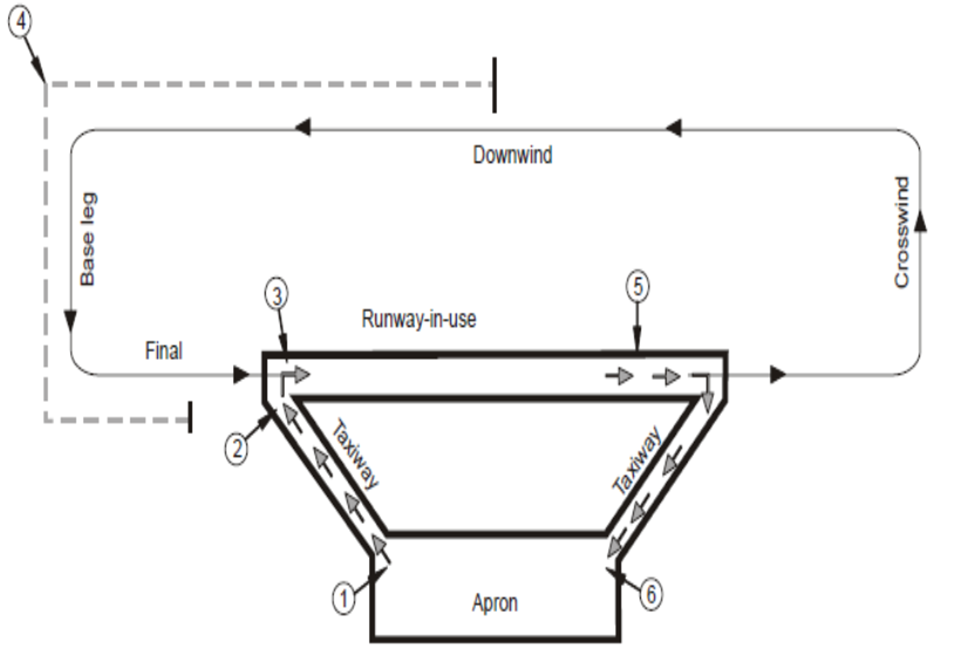
Figure 1
GM6 ATS.TR.210(a)(3) Operation of air traffic control service
ED Decision 2020/008/R
AERODROME CONTROL — PRIORITY FOR DEPARTURE
Departures should normally be cleared in the order in which aircraft are ready for take-off, except that deviations may be made from this order of priority to facilitate the maximum number of departures with the least average delay. Factors which should be considered in relation to the departure sequence include, inter alia:
(a)types of aircraft and their relative performance;
(b)routes to be followed after take-off;
(c)any specified minimum departure interval between take-offs;
(d)need to apply wake turbulence separation minima;
(e)aircraft which should be afforded priority; and
(f)aircraft subject to ATFM requirements.
GM7 ATS.TR.210(a)(3) Operation of air traffic control service
ED Decision 2020/008/R
AERODROME CONTROL — PRIORITY FOR DEPARTURE AND ATFM MEASURES
For aircraft subject to ATFM requirements, it is the responsibility of the pilot and the operator to ensure that the aircraft is ready to taxi in time to meet any required departure time, bearing in mind that once a departure sequence is established on the taxiway system, it can be difficult, and sometimes impossible, to change the order.
GM1 ATS.TR.210(b) Operation of air traffic control service
ED Decision 2020/008/R
CLEARANCES TO FLY MAINTAINING OWN SEPARATION WHILE IN VISUAL METEOROLOGICAL CONDITIONS
(a)If there is a possibility that flight under visual meteorological conditions (VMC) may become impracticable, an IFR flight should be provided with alternative instructions to be complied with in the event that flight in VMC cannot be maintained for the term of the clearance.
(b)The pilot of an IFR flight, on observing that conditions are deteriorating and considering that operation in VMC will become impossible, should inform the air traffic control unit before entering instrumental meteorological conditions (IMC) and should proceed in accordance with the alternative instructions given.
GM2 ATS.TR.210(b) Operation of air traffic control service
ED Decision 2020/008/R
CLEARANCES TO FLY MAINTAINING OWN SEPARATION WHILE IN VISUAL METEOROLOGICAL CONDITIONS
(a)The provision of vertical or horizontal separation by an air traffic unit is not applicable in respect of any specified portion of a flight cleared subject to maintaining own separation and remaining in VMC. It is for the aircraft so cleared to ensure, for the duration of the clearance, that it is not operated in such proximity to other flights as to create a collision hazard.
(b)It is axiomatic that a VFR flight must remain in VMC at all times. Accordingly, the issuance of a clearance to a VFR flight to fly subject to maintaining own separation and remaining in VMC has no other object than to signify that, for the duration of the clearance, separation from other aircraft by air traffic control unit is not provided.
(c)It should be noted that the objectives of the air traffic control service as prescribed in ATS.TR.100 do not include prevention of collision with terrain. Pilots are responsible for ensuring that any clearances issued by air traffic control units are safe in this respect. When vectoring or assigning a direct routing not included in the flight plan, which takes an IFR flight off published ATS route or instrument procedure, the procedures in point (a)(5) of ATS.TR.235 apply.
AMC1 ATS.TR.210(c) Operation of air traffic control service
ED Decision 2020/008/R
EMERGENCY SEPARATION APPLICATION
(a)If, during an emergency situation, it is not possible to ensure that the applicable horizontal separation can be maintained, emergency separation of half the applicable vertical separation minimum may be used, i.e. a nominal 150 m (500 ft) between aircraft in airspace where a vertical separation minimum of 300 m (1 000 ft) is applied, and a nominal 300 m (1 000 ft) between aircraft in airspace where a 600 m (2 000 ft) vertical separation minimum is applied.
(b)When emergency separation is applied, the flight crews concerned should be advised that emergency separation is being applied, and informed of the actual minimum used. Additionally, all flight crews concerned should be provided with essential traffic information.
GM1 to AMC1 ATS.TR.210(c) Operation of air traffic control service
ED Decision 2020/008/R
SEPARATION APPLICATION IN CASE OF ATS SURVEILLANCE SYSTEM FAILURE
As an emergency measure, in the event of complete failure of the ATS surveillance system where air-ground communications remain, the use of flight levels spaced by half the applicable vertical separation minimum may be resorted to temporarily if standard procedural separation cannot be provided immediately.
GM2 ATS.TR.210(c) Operation of air traffic control service
ED Decision 2020/008/R
PROCEDURAL SEPARATION — APPLICATION OF LARGER SEPARATION MINIMA UNDER SPECIFIC CIRCUMSTANCES
Larger separations than the specified minima should be applied whenever exceptional circumstances such as unlawful interference or navigational difficulties call for extra precautions. This should be done with due regard to all relevant factors so as to avoid impeding the flow of air traffic by the application of excessive separations.
AMC1 ATS.TR.210(c)(1) Operation of air traffic control
ED Decision 2020/008/R
PROCEDURAL SEPARATION — SEPARATION OF AIRCRAFT HOLDING IN FLIGHT
(a)Aircraft established in adjacent holding patterns should, except when lateral separation between the holding areas exists as determined by the air traffic services provider and approved by the competent authority, be separated by the applicable vertical separation minimum.
(b)Except when lateral separation exists, the air traffic controller should apply vertical separation between aircraft holding in flight and other aircraft, whether arriving, departing or en-route, whenever the other aircraft concerned are within 5 minutes flying time of the holding area or within a distance established by the air traffic services provider and approved by the competent authority (see Figure 2).
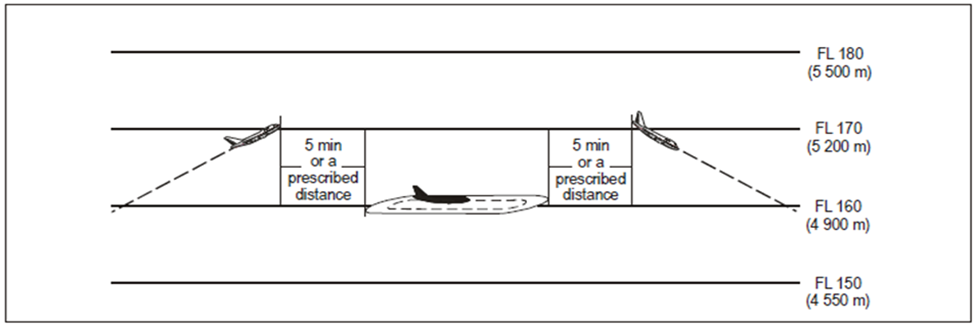
Figure 2 Separation between holding aircraft and en-route aircraft
GM1 to AMC1 ATS.TR.210(c)(1) Operation of air traffic control service
ED Decision 2020/008/R
SEPARATION OF AIRCRAFT HOLDING IN FLIGHT
Criteria and procedures for the simultaneous use of adjacent holding patterns should be prescribed in local instructions.
GM1 ATS.TR.210(c)(1) Operation of air traffic control service
ED Decision 2020/008/R
VERTICAL SEPARATION APPLICATION
Vertical separation is obtained by requiring aircraft using prescribed altimeter setting procedures to operate at different levels expressed in terms of flight levels or altitudes, in accordance with the provisions in ATS.TR.125, ATS.TR.130, ATS.TR.135 and ATS.TR.140.
GM2 ATS.TR.210(c)(1) Operation of air traffic control service
ED Decision 2020/008/R
APPLICATION OF VERTICAL SEPARATION DURING CLIMB OR DESCENT
(a)An aircraft may be cleared to a level previously occupied by another aircraft after the latter has reported vacating it, except when:
(1)severe turbulence is known to exist;
(2)the higher aircraft is effecting a cruise climb; or
(3)the difference in aircraft performance is such that less than the applicable separation minimum may result;
in which case such clearance should be withheld until the aircraft vacating the level has reported at or passing another level separated by the required minimum.
(b)When the aircraft concerned are entering or established in the same holding pattern, consideration should be given to aircraft descending at markedly different rates and, if necessary, additional measures such as specifying a maximum descent rate for the higher aircraft and a minimum descent rate for the lower aircraft should be applied to ensure that the required separation is maintained.
GM3 ATS.TR.210(c)(1) Operation of air traffic control service
ED Decision 2020/008/R
GEOMETRIC HEIGHT INFORMATION
Geometric height information is generated by airborne systems such as, for instance, GPS or radio altimeters.
AMC1 ATS.TR.210(c)(2) Operation of air traffic control service
ED Decision 2020/008/R
HORIZONTAL SEPARATION MINIMA BASED ON ATS SURVEILLANCE SYSTEM
(a)Unless otherwise prescribed in accordance with point (b), or AMC6 ATS.TR.220, or point (d) of AMC7 ATS.TR.220, or ATS.TR.255, the horizontal separation minimum based on radar and/or ADS-B and/or MLAT systems should be 9.3 km (5.0 NM).
(b)If so established by the air traffic services provider and approved by the competent authority, the separation minimum in point (a) may be reduced but not below:
(1)5.6 km (3.0 NM) when radar and/or ADS-B and/or MLAT systems’ capabilities at a given location so permit; and
(2)4.6 km (2.5 NM) between succeeding aircraft which are established on the same final approach track within 18.5 km (10 NM) of the runway threshold. A reduced separation minimum of 4.6 km (2.5 NM) may be applied, provided:
(i)the average runway occupancy time of landing aircraft is proven, by means such as data collection and statistical analysis and methods based on a theoretical model, not to exceed 50 seconds;
(ii)braking action is reported as good and runway occupancy times are not adversely affected by runway contaminants such as slush, snow or ice;
(iii)an ATS surveillance system with appropriate azimuth and range resolution and an update rate of 5 seconds or less is used in combination with suitable displays;
(iv)the aerodrome air traffic controller is able to observe, visually or by means of surface movement radar (SMR), MLAT system or a surface movement guidance and control system (SMGCS), the runway-in-use and associated exit and entry taxiways;
(v)wake turbulence separation minima in AMC6 ATS.TR.220 or in point (d) of AMC7 ATS.TR.220, or as may be prescribed by the air traffic services provider and approved by the competent authority (e.g. for specific aircraft types), do not apply;
(vi)aircraft approach speeds are closely monitored by the air traffic controller and when necessary adjusted so as to ensure that separation is not reduced below the minimum;
(vii)aircraft operators and pilots have been made fully aware of the need to exit the runway in an expeditious manner whenever the reduced separation minimum on final approach is applied; and
(viii)procedures concerning the application of the reduced minimum are published in AIPs.
GM1 to AMC1 ATS.TR.210(c)(2) Operation of air traffic control service
ED Decision 2020/008/R
CRITERIA FOR APPLICATION OF HORIZONTAL SEPARATION BASED ON RADAR AND/OR ADS-B AND/OR MLAT SYSTEMS
(a)The separation minimum or minima based on radar and/or ADS-B and/or MLAT systems to be applied should be prescribed by the air traffic services provider and approved by the competent authority according to the capability of the particular ATS surveillance system or sensor to accurately identify the aircraft position in relation to the centre of a position symbol, PSR blip, SSR response and taking into account factors which may affect the accuracy of the ATS surveillance system-derived information, such as aircraft range from the radar site and the range scale of the situation display in use.
(b)Separation based on the use of ADS-B, SSR and/or MLAT, and/or PSR position symbols and/or PSR blips should be applied so that the distance between the centres of the position symbols and/or PSR blips, representing the positions of the aircraft concerned, is never less than a prescribed minimum.
(c)Separation based on the use of PSR blips and SSR responses should be applied so that the distance between the centre of the PSR blip and the nearest edge of the SSR response (or centre, when authorised by the competent authority) is never less than a prescribed minimum.
(d)Separation based on the use of ADS-B position symbols and SSR responses should be applied so that the distance between the centre of the ADS-B position symbol and the nearest edge of the SSR response (or the centre, when authorised by the competent authority) is never less than a prescribed minimum.
(e)Separation based on the use of SSR responses should be applied so that the distance between the closest edges of the SSR responses (of the centres, when authorised by the competent authority) is never less than a prescribed minimum.
(f)In no circumstances should the edges of the position indications touch or overlap unless vertical separation is applied between the aircraft concerned, irrespective of the type of position indication displayed and separation minimum applied.
AMC2 ATS.TR.210(c)(2) Operation of air traffic control service
ED Decision 2020/008/R
SPECIFIC CONDITIONS AND LIMITATIONS FOR THE APPLICATION OF SEPARATION MINIMA BASED ON ATS SURVEILLANCE SYSTEM
(a)The separation minima based on ATS surveillance systems specified in AMC1 ATS.TR.210(c)(2), AMC6 ATS.TR.220 and point (d) of AMC7 ATS.TR.220 may be applied between an aircraft taking off and a preceding departing aircraft or other identified traffic, provided there is reasonable assurance that the departing aircraft will be identified within 2 km (1 NM) from the end of the runway, and that, at the time, the required separation will exist.
(b)The separation minima specified based on ATS surveillance systems should not be applied between aircraft holding over the same holding fix.
AMC3 ATS.TR.210(c)(2) Operation of air traffic control service
ED Decision 2020/008/R
PROCEDURAL SEPARATION — REDUCTION IN LATERAL AND LONGITUDINAL SEPARATION MINIMA
(a)Provided that prior consultation with airspace users is undertaken and that an appropriate safety assessment has shown that an acceptable level of safety is maintained, the lateral and longitudinal separation minima established in:
—AMC6 ATS.TR.210(c)(2)(i); and
may be reduced in the following circumstances:
(1)when special electronic or other aids enable the pilot-in-command of an aircraft to determine accurately the aircraft’s position and when adequate communication facilities exist for that position to be transmitted without delay to the appropriate air traffic control unit; or
(2)when, in association with rapid and reliable communication facilities, information of an aircraft’s position, derived from an ATS surveillance system, is available to the appropriate air traffic control unit; or
(3)when RNAV-equipped aircraft operate within the coverage of electronic aids that provide the necessary updates to maintain navigation accuracy.
(b)In addition to the circumstances mentioned in point (a), the lateral and longitudinal separation minima established in:
—AMC6 ATS.TR.210(c)(2)(i); and
may be reduced in the vicinity of aerodromes if:
(1)adequate separation can be provided by the aerodrome air traffic controller when each aircraft is continuously visible to this air traffic controller; or
(2)each aircraft is continuously visible to flight crews of the other aircraft concerned and the pilots thereof report that they can maintain their own separation; or
(3)in the case of one aircraft following another, the flight crew of the succeeding aircraft reports that the other aircraft is in sight and separation can be maintained.
GM1 ATS.TR.210(c)(2)(i) Operation of air traffic control service
ED Decision 2020/008/R
PROCEDURAL SEPARATION — LONGITUDINAL SEPARATION APPLICATION
(a)Longitudinal separation should be applied so that the spacing between the estimated positions of the aircraft being separated is never less than a prescribed minimum. Longitudinal separation between aircraft following the same or diverging tracks may be maintained by application of speed control, including the Mach number technique. When applicable, use of the Mach number technique should be prescribed on the basis of a regional air navigation agreement.
(b)Longitudinal separation between supersonic aircraft during the transonic acceleration and supersonic phases of flight should normally be established by appropriate timing of the start of transonic acceleration rather than by the imposition of speed restrictions in supersonic flight.
(c)Time-based separation applied in accordance with AMC1 ATS.TR.210(c)(2)(i),
AMC2 ATS.TR.210(c)(2)(i) and AMC5 ATS.TR.210(c)(2)(i) may be based on position information and estimates derived from voice reports, controller-pilot data link communications (CPDLC) or ADS-C.
(d)For the purpose of application of longitudinal separation, the terms ‘same track’, ‘reciprocal tracks’ and ‘crossing tracks’ have the following meanings:
(1)Same track (see Figure 3)
Same direction tracks and intersecting tracks or portions thereof, the angular difference of which is less than 45 degrees or more than 315 degrees, and whose protected airspaces overlap
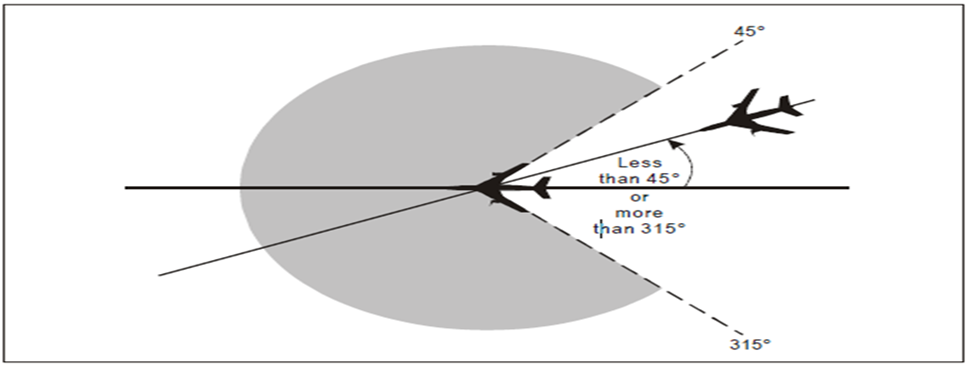
Figure 3: Aircraft on same track
(2)Reciprocal tracks (see Figure 4)
Opposite tracks and intersecting tracks or portions thereof, the angular difference of which is more than 135 degrees but less than 225 degrees, and whose protected airspaces overlap
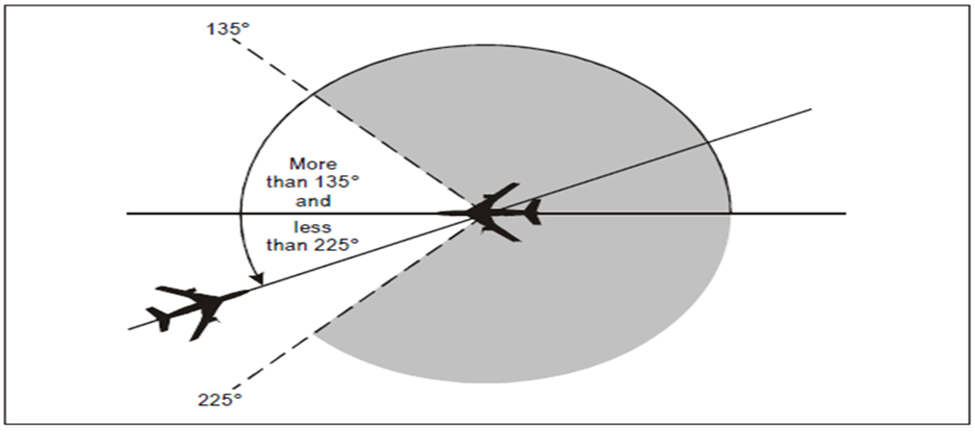
Figure 4: Aircraft on reciprocal tracks
(3)Crossing tracks (see Figure 5)
Intersecting tracks or portions thereof other than those specified in points (1) and (2)
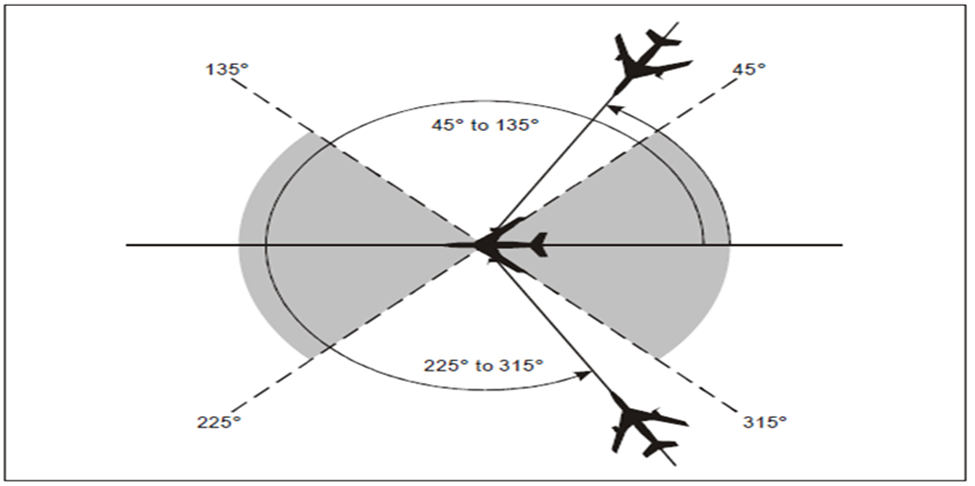
Figure 5: Aircraft on crossing tracks
AMC1 ATS.TR.210(c)(2)(i) Operation of air traffic control service
ED Decision 2020/008/R
PROCEDURAL SEPARATION — LONGITUDINAL SEPARATION MINIMA BASED ON TIME — AIRCRAFT MAINTAINING THE SAME LEVEL
For aircraft flying at the same level, the longitudinal separation minima based on time should be one of the following:
(a)Aircraft flying on the same track and same level
(1)15 minutes (see Figure 6); or
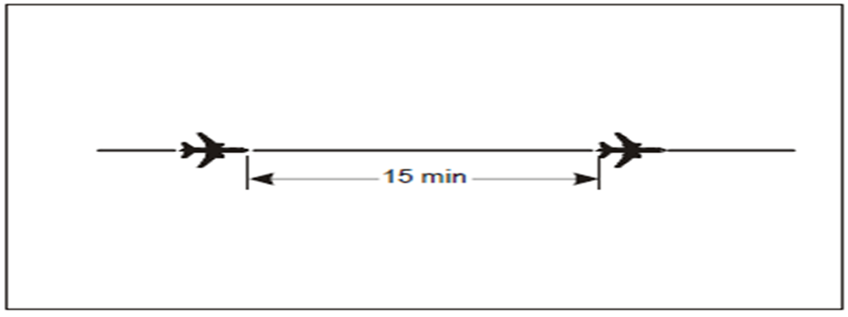
Figure 6: 15-minute separation between aircraft on the same track and same level
(2)10 minutes if navigation aids permit frequent determination of position and speed (see Figure 7); or
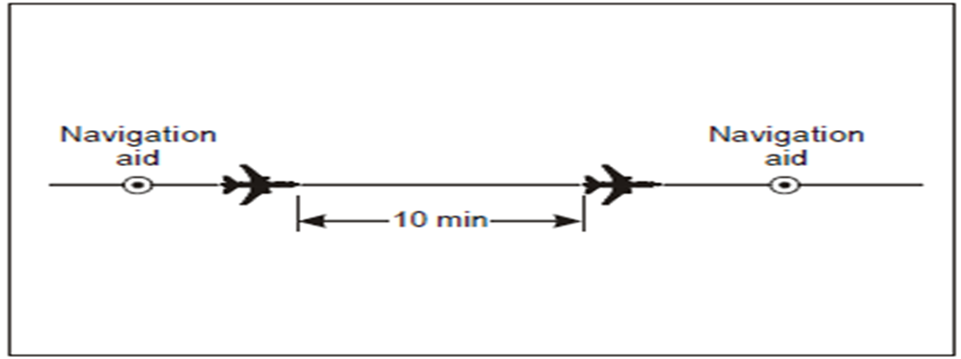
Figure 7: 10-minute separation between aircraft on the same track and same level
(3)5 minutes in the following cases, provided that in each case the preceding aircraft is maintaining a TAS of 37 km/h (20 kt) or more faster than the succeeding aircraft (see Figure 8)
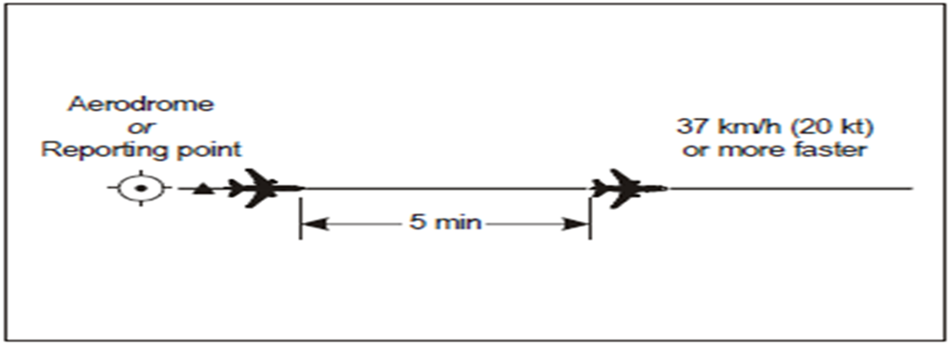
Figure 8: 5-minute separation between aircraft on the same track and same level
(i)between aircraft that have departed from the same aerodrome;
(ii)between en-route aircraft that have reported over the same exact significant point;
(iii)between departing and en-route aircraft after the en-route aircraft has reported over a fix that it is so located in relation to the departure point as to ensure that 5-minute separation can be established at the point the departing aircraft will join the air route; or
(4)3 minutes in the cases listed under point (a)(3), provided that in each case the preceding aircraft is maintaining a TAS of 74 km/h (40 kt) or more faster than the succeeding aircraft (see Figure 9)
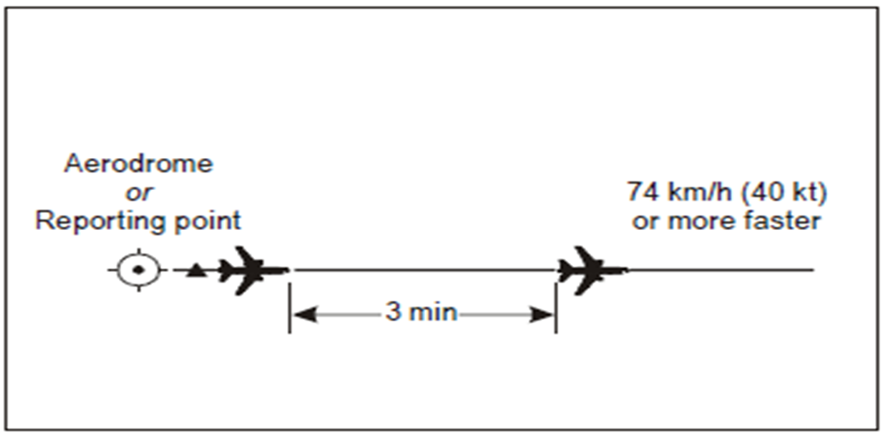
Figure 9: 3-minute separation between aircraft on the same track and same level
(b)Aircraft flying on crossing tracks
(1)15 minutes at the point of intersection of the tracks (see Figure 10); or
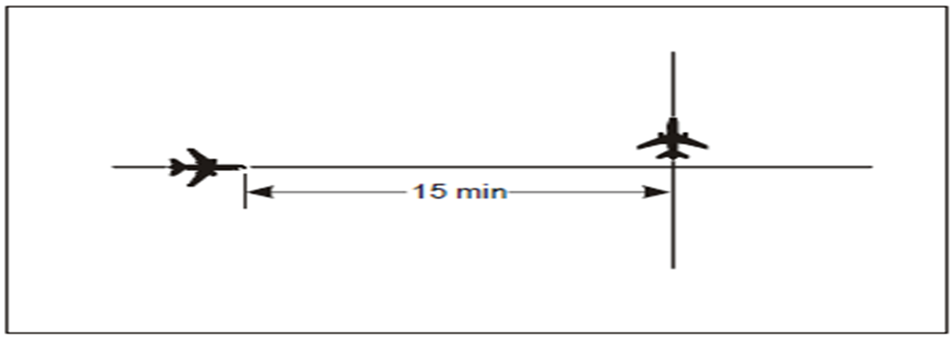
Figure 10: 15-minute separation between aircraft on crossing tracks and same level
(2)10 minutes if navigation aids permit frequent determination of position and speed (see Figure 11).
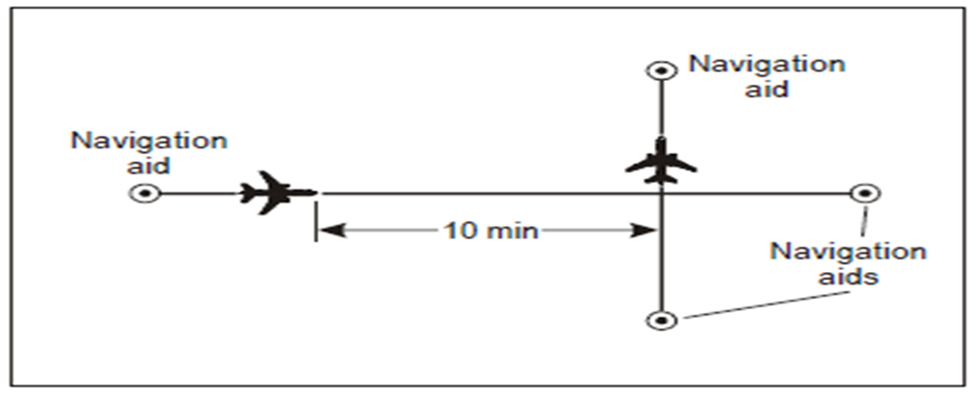
Figure 11: 10-minute separation between aircraft on crossing tracks and same level
AMC2 ATS.TR.210(c)(2)(i) Operation of air traffic control service
ED Decision 2020/008/R
PROCEDURAL SEPARATION — LONGITUDINAL SEPARATION MINIMA BASED ON TIME — AIRCRAFT CLIMBING OR DESCENDING
For aircraft climbing or descending, the longitudinal separation minima based on time should be one of the following:
(a)Aircraft on the same track
When an aircraft will pass through the level of another aircraft on the same track, the following minimum longitudinal separation should be provided:
(1)15 minutes while vertical separation does not exist (see Figures 12 and 13); or
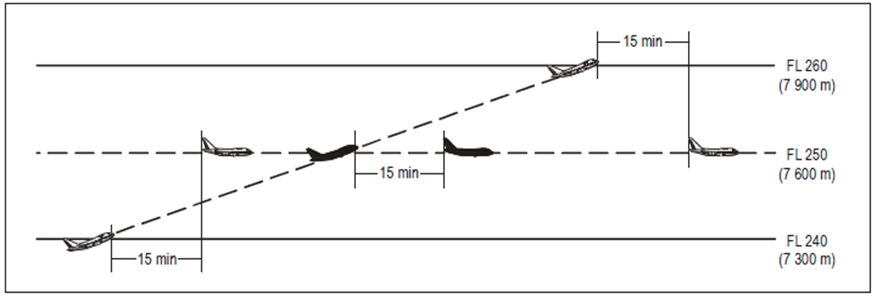
Figure 12: 15-minute separation between aircraft climbing and on the same track
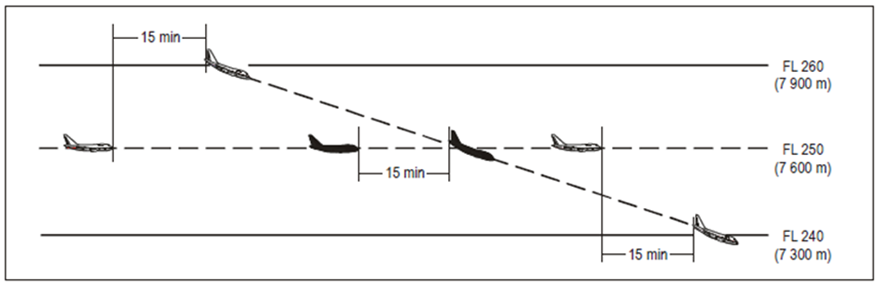
Figure 13: 15-minute separation between aircraft descending and on the same track
(2)10 minutes while vertical separation does not exist, provided that such separation is authorised only where ground-based navigation aids or GNSS permit frequent determination of position and speed (see Figures 14 and 15); or
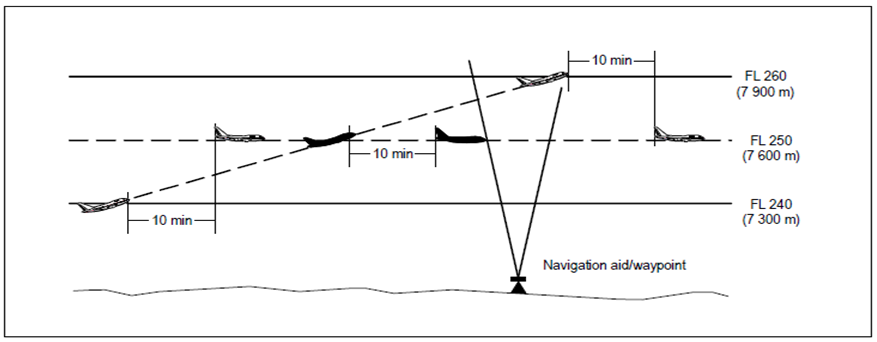
Figure 14: 10-minute separation between aircraft climbing and on the same track
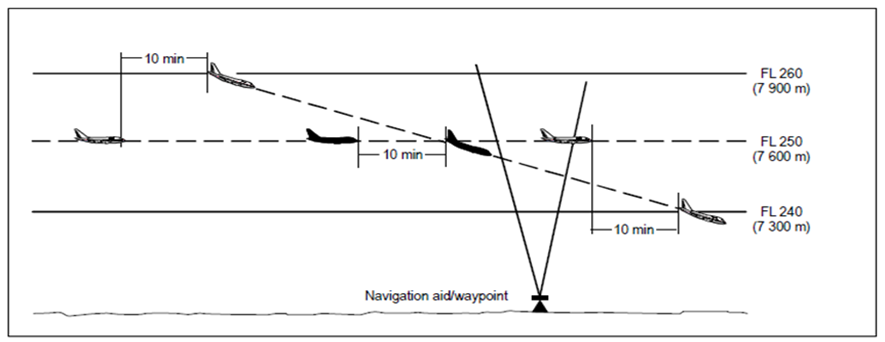
Figure 15: 10-minute separation between aircraft descending and on the same track
(3)5 minutes while vertical separation does not exist, provided that:
(i)the level change is commenced within 10 minutes of the time the second aircraft has reported over a common point which should be derived from ground-based navigation aids or by GNSS; and
(ii)when issuing the clearance through third-party communication or CPDLC, a restriction should be added to the clearance to ensure that the 10-minute condition is satisfied (see Figures 16 and 17).
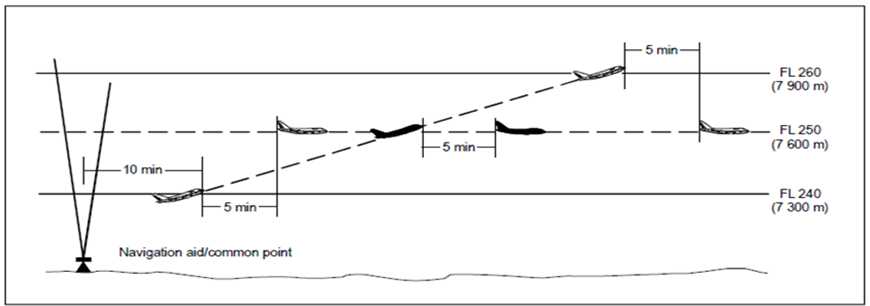
Figure 16: 5-minute separation between aircraft climbing and on the same track
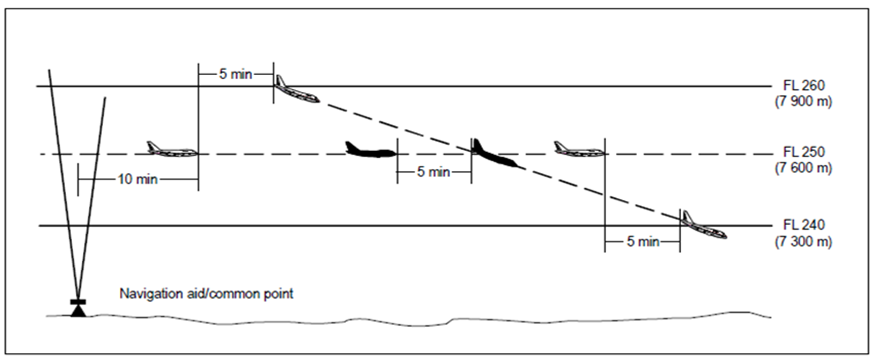
Figure 17: 5-minute separation between aircraft descending and on the same track
(b)Aircraft on crossing tracks
(1)15 minutes while vertical separation does not exist (see Figures 18 and 19); or
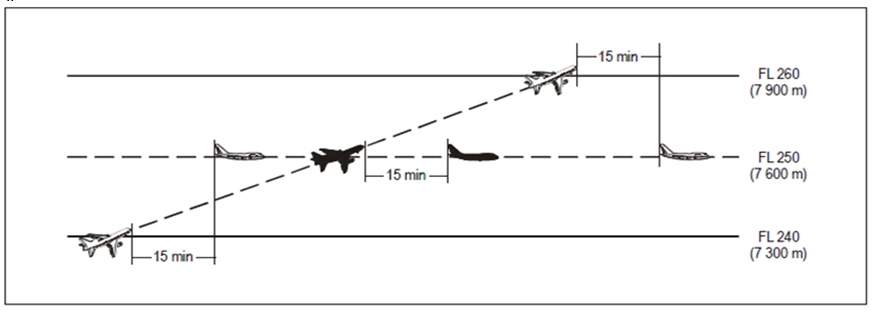
Figure 18: 15-minute separation between aircraft climbing and on crossing tracks
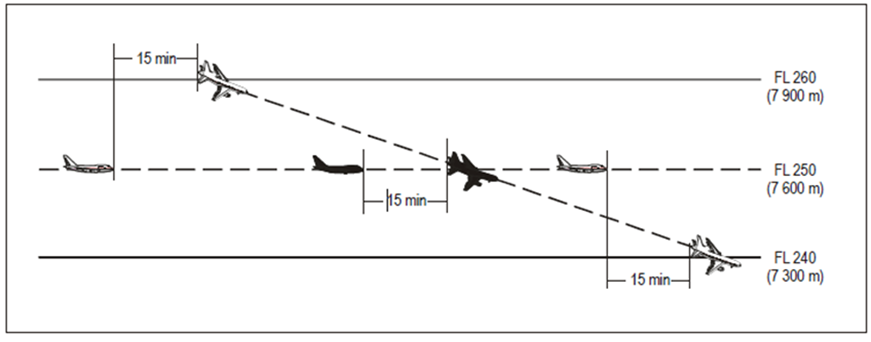
Figure 19: 15-minute separation between aircraft descending and on crossing tracks
(2)10 minutes while vertical separation does not exist if navigation aids permit frequent determination of position and speed (see Figures 20 and 21).
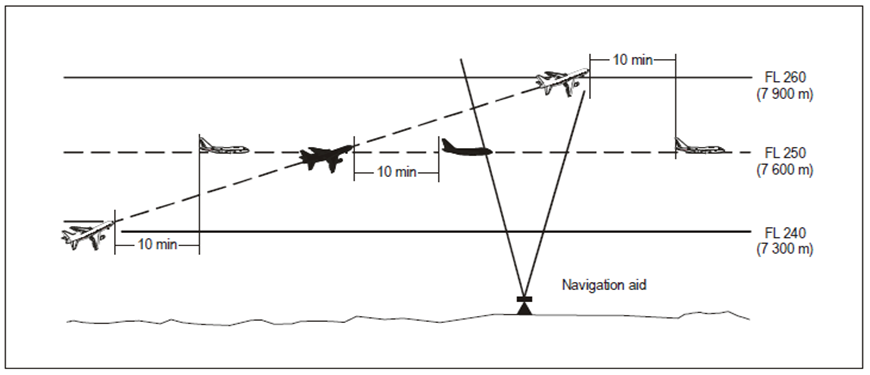
Figure 20: 10-minute separation between aircraft climbing and on crossing tracks
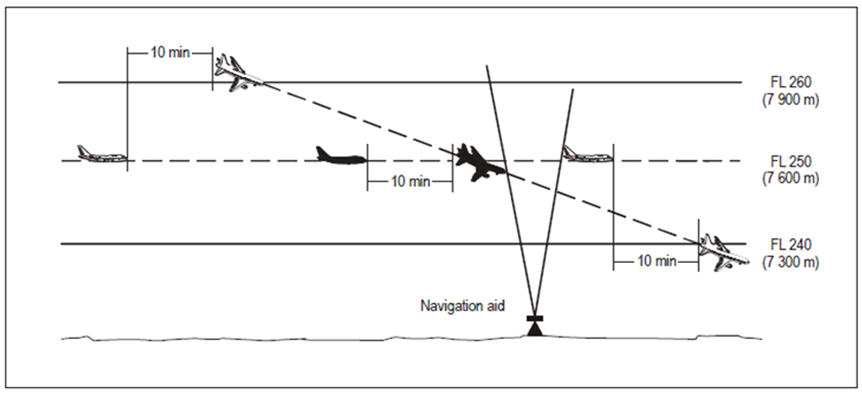
Figure 21: 10-minute separation between aircraft descending and on crossing tracks
(c)Aircraft on reciprocal tracks
Where lateral separation is not provided, vertical separation should be provided for at least 10 minutes prior to and after the time the aircraft are estimated to pass, or are estimated to have passed (see Figure 22). Provided it has been determined that the aircraft have passed each other, this minimum need not apply.
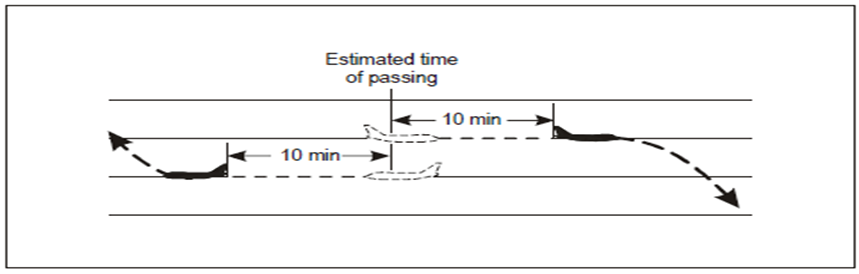
Figure 22: 10-minute separation between aircraft on reciprocal tracks
AMC3 ATS.TR.210(c)(2)(i) Operation of air traffic control service
ED Decision 2020/008/R
PROCEDURAL SEPARATION — LONGITUDINAL SEPARATION MINIMA BASED ON DISTANCE USING DISTANCE MEASURING EQUIPMENT (DME) AND/OR GNSS — AIRCRAFT AT THE SAME CRUISING LEVEL
Longitudinal separation minima based on distance using distance measuring equipment (DME) and/or GNSS should be established between aircraft at the same cruising level, as follows:
(a)Aircraft on the same track
(1)37 km (20 NM), provided:
(i)each aircraft utilises:
(A)the same ‘on-track’ DME station when both aircraft are utilising DME; or
(B)an ‘on-track’ DME station and a collocated waypoint when one aircraft is utilising DME and the other is utilising GNSS; or
(C)the same waypoint when both aircraft are utilising GNSS; and
(ii)separation is checked by obtaining simultaneous DME and/or GNSS readings from the aircraft at frequent intervals to ensure that the minimum will not be infringed (see Figure 23);
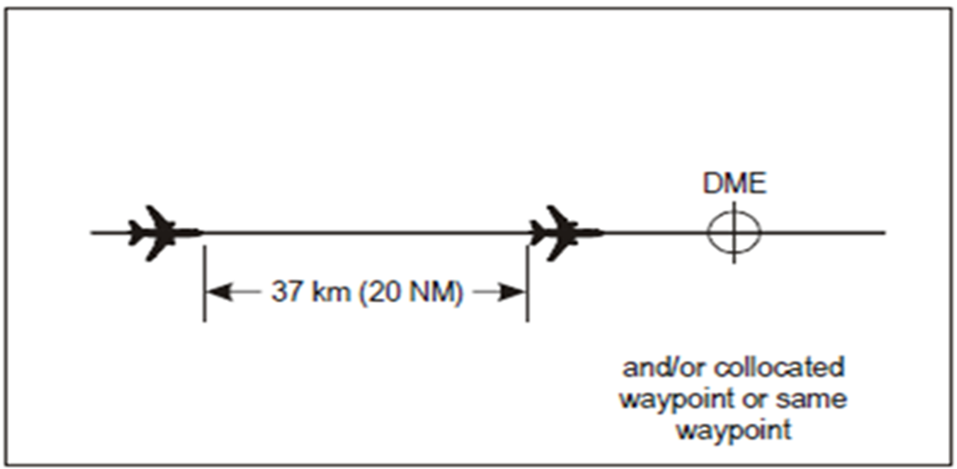
Figure 23: 37 km (20 NM) DME and/or GNSS-based separation between aircraft on the same track and same level
(2)19 km (10 NM), provided:
(i)the leading aircraft maintains a TAS of 37 km/h (20 kt) or more faster than the succeeding aircraft;
(ii)each aircraft utilises:
(A)the same ‘on-track’ DME station when both aircraft are utilising DME; or
(B)an ‘on-track’ DME station and a collocated waypoint when one aircraft is utilising DME and the other is utilising GNSS; or
(C)the same waypoint when both aircraft are utilising GNSS; and
(iii)separation is checked by obtaining simultaneous DME and/or GNSS readings from the aircraft at such intervals as are necessary to ensure that the minimum is established and will not be infringed (see Figure 24).
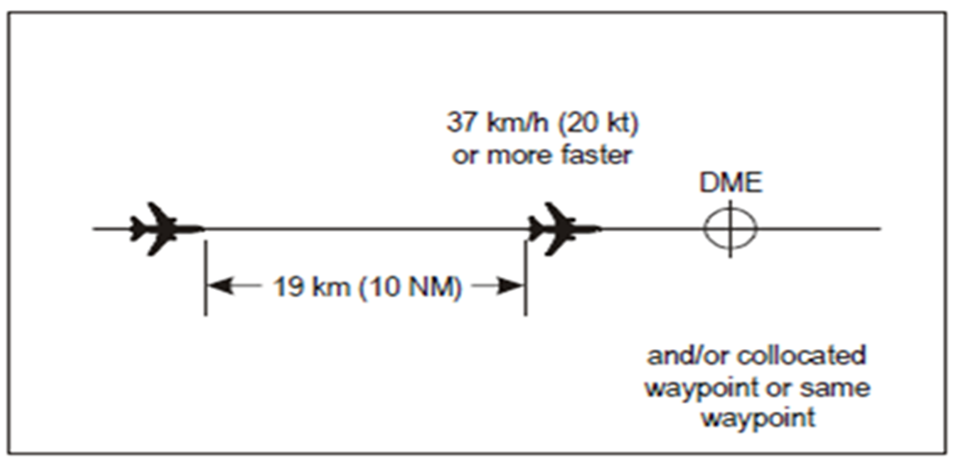
Figure 24: 19 km (10 NM) DME and/or GNSS-based separation between aircraft on the same track and same level
(b)Aircraft on crossing tracks
The longitudinal separation prescribed in point (a) should also apply, provided each aircraft reports distance from the DME station and/or collocated waypoint or same waypoint located at the crossing point of the tracks and that the relative angle between the tracks is less than 90 degrees (see Figures 25 and 26).
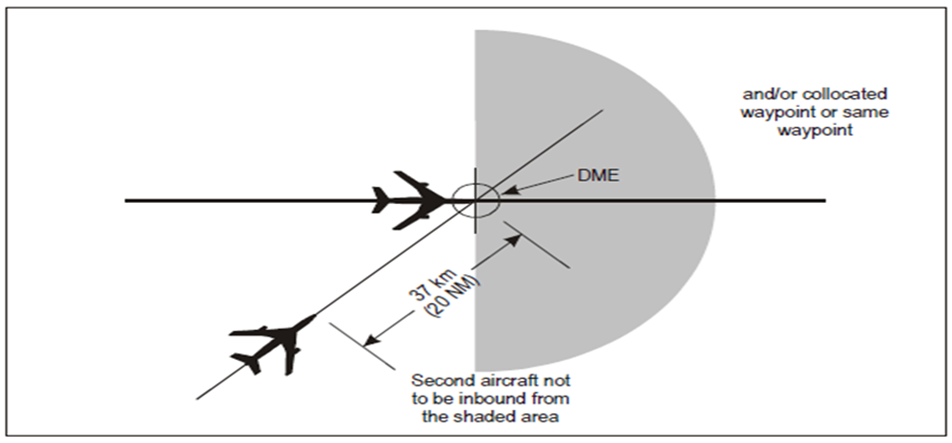
Figure 25: 37 km (20 NM) DME and/or GNSS-based separation between aircraft on crossing tracks and the same level
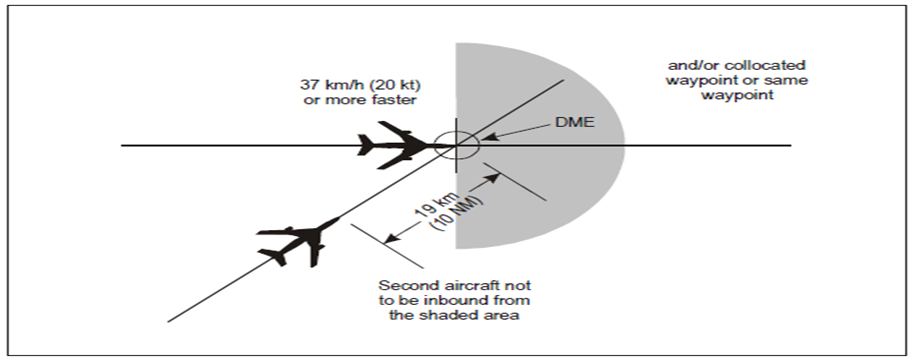
Figure 26: 19 km (10 NM) DME and/or GNSS-based separation between aircraft on crossing tracks and the same level
AMC4 ATS.TR.210(c)(2)(i) Operation of air traffic control service
ED Decision 2020/008/R
PROCEDURAL SEPARATION — LONGITUDINAL SEPARATION MINIMA BASED ON DISTANCE USING DISTANCE MEASURING EQUIPMENT (DME) AND/OR GNSS — AIRCRAFT CLIMBING OR DESCENDING
Longitudinal separation minima based on distance using distance measuring equipment (DME) AND/OR GNSS should be established between aircraft climbing or descending, as follows:
(a)Aircraft on the same track
19 km (10 NM) while vertical separation does not exist, provided:
(1)each aircraft utilises:
(i)the same ‘on-track’ DME station when both aircraft are utilising DME; or
(ii)an ‘on-track’ DME station and a collocated waypoint when one aircraft is utilising DME and the other is utilising GNSS; or
(iii)the same waypoint when both aircraft are utilising GNSS; and
(2)one aircraft maintains a level while vertical separation does not exist; and
(3)separation is established by obtaining simultaneous DME and/or GNSS readings from the aircraft (see Figures 27 and 28).
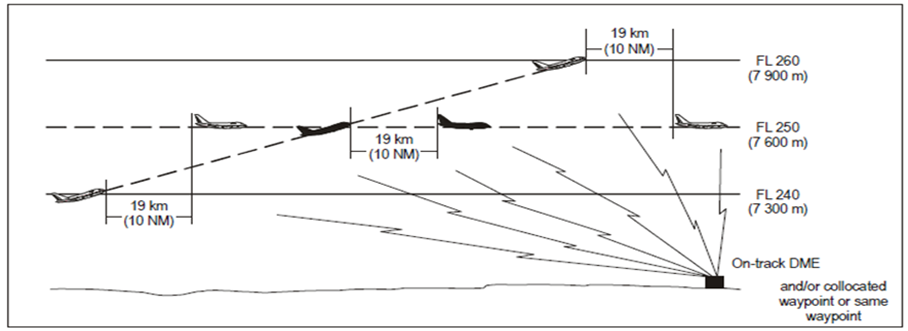
Figure 27: 19 km (10 NM) DME and/or GNSS-based separation between aircraft climbing and on the same track
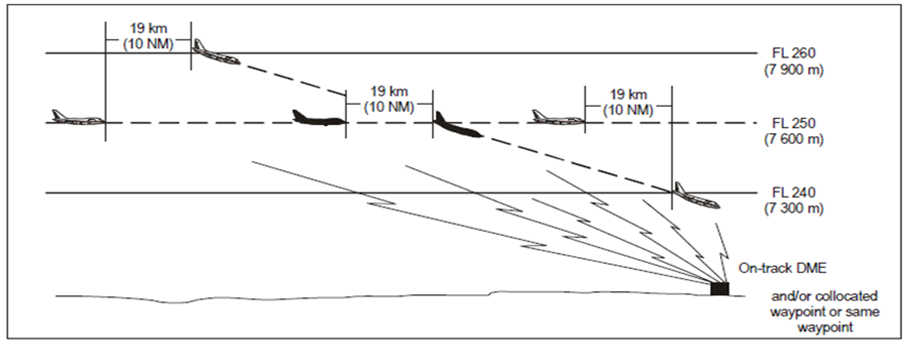
Figure 28: 19 km (10 NM) DME and/or GNSS-based separation between aircraft descending and on the same track
(b)Aircraft on reciprocal tracks
Aircraft utilising on-track DME and/or collocated waypoint or same waypoint may be cleared to climb or descend through the levels occupied by other aircraft utilising on-track DME and/or collocated waypoint or same waypoint, provided that it has been positively established that the aircraft have passed each other and are at least 10 NM apart, or such other value determined by the air traffic services provider and approved by the competent authority.
GM1 to AMC3 ATS.TR.210(c)(2)(i) and AMC4 ATS.TR.210(c)(2)(i) Operation of air traffic control service
ED Decision 2020/008/R
PROCEDURAL SEPARATION — LONGITUDINAL SEPARATION MINIMA BASED ON DISTANCE USING DISTANCE MEASURING EQUIPMENT (DME) AND/OR GNSS — APPLICATION
(a)Where the term ‘on track’ is used in the provisions relating to the application of longitudinal separation minima using DME and/or GNSS, it means that the aircraft is flying either directly inbound to or directly outbound from the station/waypoint.
(b)Separation should be established by maintaining not less than the specified distance(s) between aircraft positions as reported by reference to DME in conjunction with other appropriate navigation aids and/or GNSS. This type of separation should be applied between two aircraft using DME, or two aircraft using GNSS, or one aircraft using DME and one aircraft using GNSS. Direct controller-pilot VHF voice communication should be maintained while such separation is used.
(c)For the purpose of applying GNSS-based separation minimum, a distance derived from an integrated navigation system incorporating GNSS input is regarded as equivalent to GNSS distance.
(d)When applying these separation minima between any aircraft with area navigation capability, air traffic controllers should specifically request GNSS-derived distance.
AMC5 ATS.TR.210(c)(2)(i) Operation of air traffic control service
ED Decision 2020/008/R
PROCEDURAL SEPARATION — LONGITUDINAL SEPARATION MINIMA WITH MACH NUMBER TECHNIQUE BASED ON TIME
When the Mach number technique is applied and provided that:
(a)the aircraft concerned have reported over the same common point and follow the same track or continuously diverging tracks until some other form of separation is provided; or
(b)if the aircraft have not reported over the same common point and it is possible to ensure, by radar, ADS-B or other means, that the appropriate time interval will exist at the common point from which they either follow the same track or continuously diverging tracks,
minimum longitudinal separation between turbojet aircraft on the same track, whether in level, climbing or descending flight should be:
(1)10 minutes. In this case, the preceding aircraft should maintain a true Mach number equal to or greater than that maintained by the following aircraft; or
(2)between 9 and 5 minutes inclusive, provided that the preceding aircraft is maintaining a true Mach number greater than the following aircraft in accordance with the following:
(i)9 minutes if the preceding aircraft is Mach 0.02 faster than the following aircraft;
(ii)8 minutes if the preceding aircraft is Mach 0.03 faster than the following aircraft;
(iii)7 minutes if the preceding aircraft is Mach 0.04 faster than the following aircraft;
(iv)6 minutes if the preceding aircraft is Mach 0.05 faster than the following aircraft;
(v)5 minutes if the preceding aircraft is Mach 0.06 faster than the following aircraft.
AMC6 ATS.TR.210(c)(2)(i) Operation of air traffic control service
ED Decision 2020/008/R
PROCEDURAL SEPARATION — LONGITUDINAL SEPARATION MINIMA WITH MACH NUMBER TECHNIQUE BASED ON DISTANCE USING RNAV
(a)The air traffic controller should not apply RNAV distance-based separation minima after having received pilot advice indicating navigation equipment deterioration or failure.
(b)A 150 km (80 NM) RNAV distance-based separation minimum with Mach number technique may be used on same-direction tracks in lieu of a 10-minute longitudinal separation minimum with Mach number technique, provided that:
(1)each aircraft reports its distance to or from the same ‘on-track’ common point;
(2)separation between aircraft at the same level is checked by obtaining simultaneous RNAV distance readings from the aircraft at frequent intervals to ensure that the minimum will not be infringed (see Figure 29);
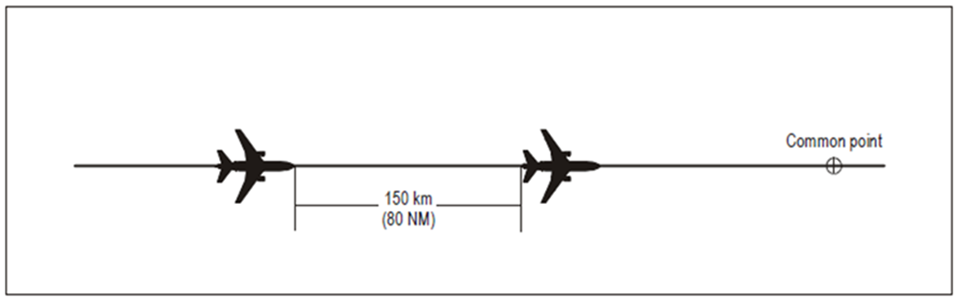
Figure 29: 150 km (80 NM) RNAV-based separation between aircraft at the same level
(3)separation between aircraft climbing or descending is established by obtaining simultaneous RNAV distance readings from the aircraft (see Figures 30 and 31); and
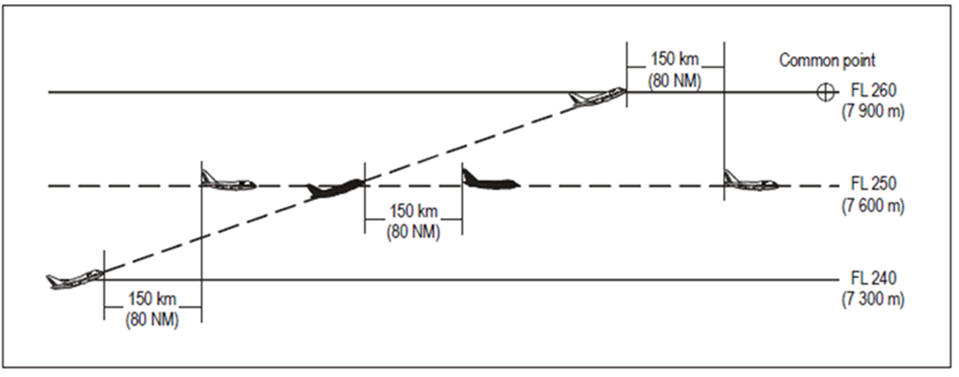
Figure 30: 150 km (80 NM) RNAV-based separation between aircraft climbing and on the same track
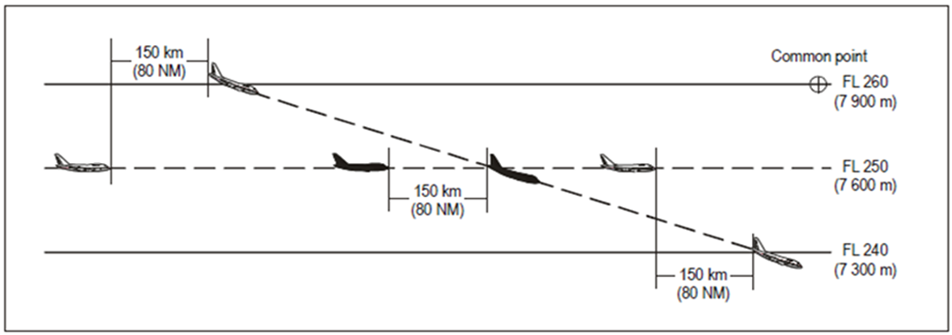
Figure 31: 150 km (80 NM) RNAV-based separation between aircraft descending and on the same track
(4)in the case of aircraft climbing or descending, one aircraft maintains a level while vertical separation does not exist.
(c)Aircraft on reciprocal tracks
Aircraft utilising RNAV may be cleared to climb or descend to or through the levels occupied by other aircraft utilising RNAV, provided it has been positively established by simultaneous RNAV distance readings to or from the same ‘on-track’ common point that the aircraft have passed each other and are at least 150 km (80 NM) apart (see Figure 32).
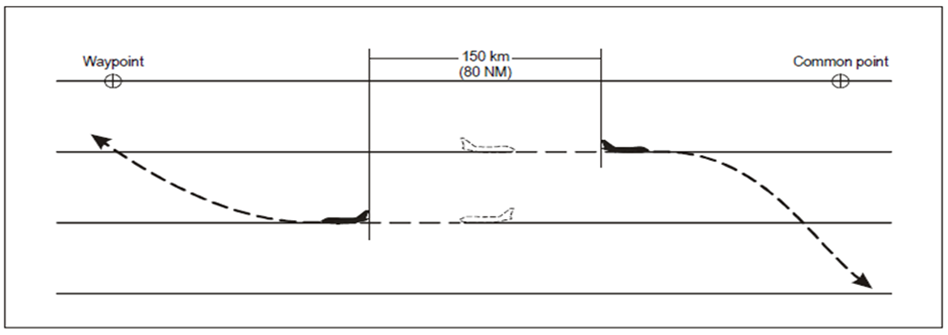
Figure 32: 150 km (80 NM) RNAV-based separation between aircraft on reciprocal tracks
GM1 to AMC5 ATS.TR.210(c)(2)(i) and AMC6 ATS.TR.210(c)(2)(i) Operation of air traffic control service
ED Decision 2020/008/R
PROCEDURAL SEPARATION — LONGITUDINAL SEPARATION MINIMA WITH MACH NUMBER TECHNIQUE
Guidance on the application of the Mach number technique for separation of subsonic aircraft is available in ICAO Doc 9426 ‘Air Traffic Services Planning Manual’.
GM1 to AMC6 ATS.TR.210(c)(2)(i) Operation of air traffic control service
ED Decision 2020/008/R
LONGITUDINAL SEPARATION MINIMA WITH MACH NUMBER TECHNIQUE BASED ON DISTANCE USING RNAV — APPLICATION
(a)Separation should be established by maintaining not less than the specified distance between aircraft positions as reported by reference to RNAV equipment. Direct controller-pilot communications should be maintained, while such separation is used. Where high-frequency or general-purpose extended-range VHF air-ground communication channels are used for area control service and are worked by air-ground communicators, suitable arrangements should be made to permit direct controller-pilot communications, or monitoring by the air traffic controller of all air-ground communications.
(b)To assist pilots to readily provide the required RNAV distance information, such position reports should, wherever possible, be referenced to a common waypoint ahead of both aircraft.
(c)RNAV distance-based separation may be applied between RNAV-equipped aircraft when operating on designated RNAV routes or on ATS routes defined by VOR.
(d)To facilitate application of the procedure where a considerable change of level is involved, a descending aircraft may be cleared to some convenient level above the lower aircraft, or a climbing aircraft to some convenient level below the higher aircraft, to permit a further check on the separation that will be obtained while vertical separation does not exist.
AMC7 ATS.TR.210(c)(2)(i) Operation of air traffic control service
ED Decision 2020/008/R
RUNWAY SEPARATION MINIMA BETWEEN DEPARTING AIRCRAFT AND OTHER AIRCRAFT USING THE SAME RUNWAY
Except as provided in AMC9 ATS.TR.210(c)(2)(i) as regards reduced runway separation minima between aircraft using the same runway, and in ATS.TR.220 as regards time-based wake turbulence separation minima, the aerodrome control tower should not permit a departing aircraft to commence take-off until:
(a)the preceding departing aircraft has crossed the end of the runway-in-use; or
(b)the preceding departing aircraft has started a turn; or
(c)all preceding landing aircraft are clear of the runway-in-use (see Figure 33).
Position limits to be reached by a landed aircraft (A) or a departing aircraft (B or C) before an arriving aircraft may be cleared to cross the threshold of the runway-in-use or a departing aircraft may be cleared to take off, unless otherwise prescribed.
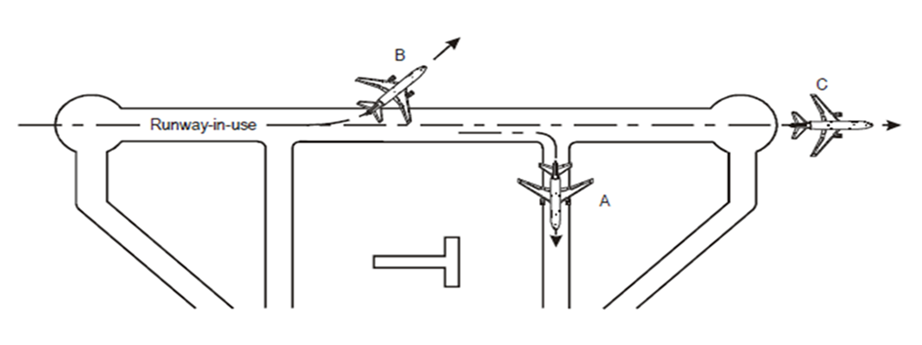
Figure 33: Separation between departing and arriving aircraft
AMC8 ATS.TR.210(c)(2)(i) Operation of air traffic control service
ED Decision 2020/008/R
RUNWAY SEPARATION OF LANDING AIRCRAFT AND PRECEDING LANDING AND DEPARTING AIRCRAFT USING THE SAME RUNWAY
Except as provided AMC9 ATS.TR.210(c)(2)(i) as regards reduced runway separation minima between aircraft using the same runway, and in ATS.TR.220 as regards time-based wake turbulence separation minima, the aerodrome control tower should not permit a landing aircraft to cross the runway threshold on its final approach until:
(a)the preceding departing aircraft has crossed the end of the runway-in-use; or
(b)the preceding departing aircraft has started a turn; or
(c)all preceding landing aircraft are clear of the runway-in-use (see Figure 33).
AMC9 ATS.TR.210(c)(2)(i) Operation of air traffic control service
ED Decision 2020/008/R
REDUCED RUNWAY SEPARATION MINIMA BETWEEN AIRCRAFT USING THE SAME RUNWAY
(a)The air traffic services provider may prescribe lower minima than those established in AMC7 ATS.TR.210(c)(2)(i) concerning separation of departing aircraft, and in AMC8 ATS.TR.210(c)(2)(i) concerning separation of landing aircraft and preceding landing and departing aircraft using the same runway, after consultation with the operators. The safety assessment to be performed in support of the application of reduced separation minima should be carried out for each runway for which the reduced minima are intended, taking into account factors such as:
(1)runway length;
(2)aerodrome layout; and
(3)types/categories of aircraft involved.
(b)Reduced runway separation minima should only be applied during the hours of daylight from 30 minutes after local sunrise to 30 minutes before local sunset.
(c)For the purpose of reduced runway separation, aircraft should be classified as follows:
(1)Category 1 aircraft: single-engine propeller aircraft with a maximum certificated take-off mass (MCTOM) of 2 000 kg or less;
(2)Category 2 aircraft: single-engine propeller aircraft with a maximum certificated take-off mass of more than 2 000 kg but less than 7 000 kg; and twin-engine propeller aircraft with a maximum certificated take-off mass of less than 7 000 kg; and
(3)Category 3 aircraft: all other aircraft.
(d)Reduced runway separation minima should not apply between a departing aircraft and a preceding landing aircraft.
(e)Reduced runway separation minima should be subject to the following conditions:
(1)wake turbulence separation minima should be applied;
(2)visibility should be at least 5 km and ceiling shall not be lower than 300 m (1 000 ft);
(3)tailwind component should not exceed 5 kt;
(4)there should be available means, such as suitable landmarks, to assist the air traffic controller in assessing the distances between aircraft. A surface movement ATS surveillance system that provides the air traffic controller with position information on aircraft may be utilised, provided that approval for operational use of such equipment includes a safety assessment to ensure that all requisite operational and performance requirements are met;
(5)minimum separation continues to exist between two departing aircraft immediately after take-off of the second aircraft;
(6)traffic information should be provided to the flight crew of the succeeding aircraft concerned; and
(7)the braking action should not be adversely affected by runway contaminants such as ice, slush, snow and water.
(f)Reduced runway separation minima which may be applied at an aerodrome should be determined for each separate runway. The separation to be applied should in no case be less than the following minima:
(1)landing aircraft:
(i)a succeeding landing Category 1 aircraft may cross the runway threshold when the preceding aircraft is a Category 1 or 2 aircraft which either:
(A)has landed and has passed a point at least 600 m from the threshold of the runway, is in motion and will vacate the runway without backtracking; or
(B)is airborne and has passed a point at least 600 m from the threshold of the runway;
(ii)a succeeding landing Category 2 aircraft may cross the runway threshold when the preceding aircraft is a Category 1 or 2 aircraft which either:
(A)has landed and has passed a point at least 1 500 m from the threshold of the runway, is in motion and will vacate the runway without backtracking; or
(B)is airborne and has passed a point at least 1 500 m from the threshold of the runway;
(iii)a succeeding landing aircraft may cross the runway threshold when a preceding Category 3 aircraft:
(A)has landed and has passed a point at least 2 400 m from the threshold of the runway, is in motion and will vacate the runway without backtracking; or
(B)is airborne and has passed a point at least 2 400 m from the threshold of the runway;
(2)departing aircraft:
(i)a Category 1 aircraft may be cleared for take-off when the preceding departing aircraft is a Category 1 or 2 aircraft which is airborne and has passed a point at least 600 m from the position of the succeeding aircraft;
(ii)a Category 2 aircraft may be cleared for take-off when the preceding departing aircraft is a Category 1 or 2 aircraft which is airborne and has passed a point at least 1 500 m from the position of the succeeding aircraft; and
(iii)an aircraft may be cleared for take-off when a preceding departing Category 3 aircraft is airborne and has passed a point at least 2 400 m from the position of the succeeding aircraft.
AMC10 ATS.TR.210(c)(2)(i) Operation of air traffic control service
ED Decision 2020/008/R
PROCEDURAL CONTROL — MINIMUM SEPARATION BETWEEN DEPARTING AIRCRAFT
(a)The aerodrome air traffic controller should apply a 1-minute separation if aircraft are to fly on tracks diverging by at least 45 degrees immediately after take-off so that lateral separation is provided (see Figure 34).
(b)When:
(1)aircraft are using parallel runways; or
(2)in a context of operations on diverging runways which do not cross, the pilot has accepted a take-off direction which is not into the wind, in accordance with the procedure described in point (b) of GM1 ATS.TR.260,
this minimum may be reduced, provided instructions covering the procedure have been established by the air traffic services provider and approved by the competent authority and lateral separation is effected immediately after take-off.
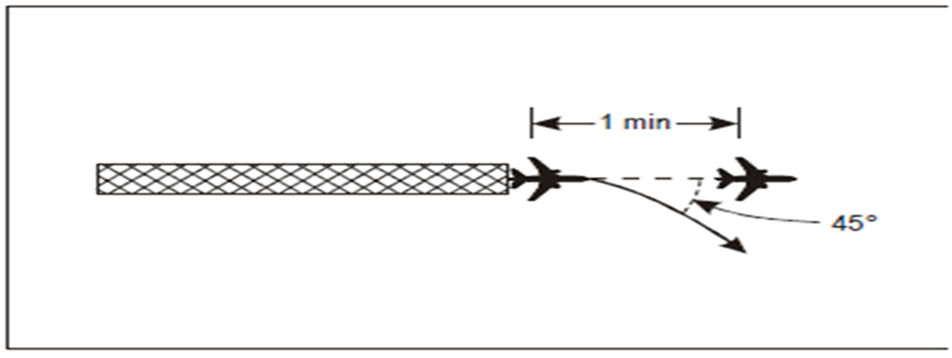
Figure 34: 1-minute separation between departing aircraft following tracks diverging by at least 45 degrees
(c)The air traffic controller should apply a 2-minute separation between take-offs when the preceding aircraft is 74 km/h (40 kt) or more faster than the succeeding aircraft and both aircraft will follow the same track (see Figure 35).
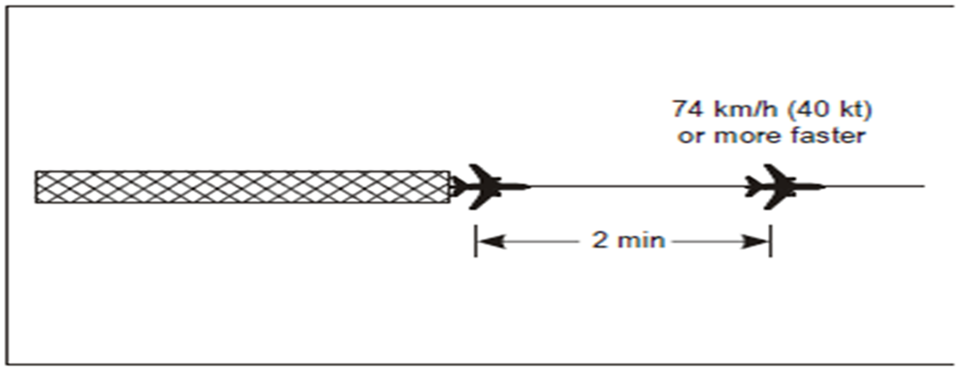
Figure 35: 2-minute separation between aircraft following the same track
(d)The air traffic controller should apply a 5-minute separation while vertical separation does not exist if a departing aircraft will be flown through the level of a preceding departing aircraft and both aircraft propose to follow the same track (see Figure 36). The air traffic controller should take action to ensure that the 5-minute separation will be maintained or increased while vertical separation does not exist.
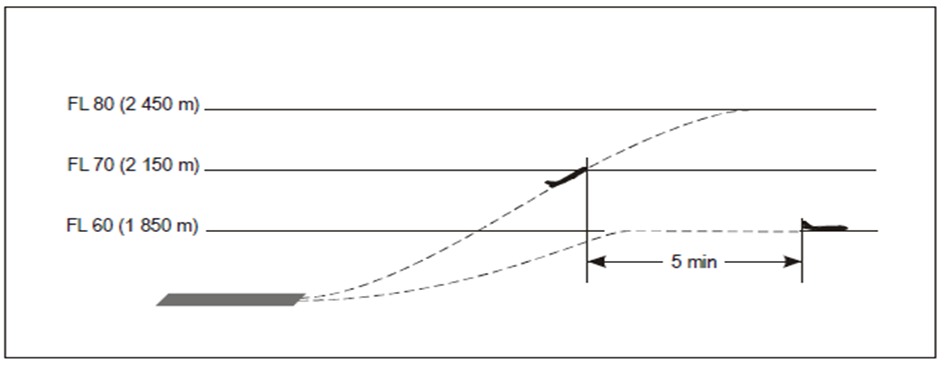
Figure 36: 5-minute separation of departing aircraft following the same track
AMC11 ATS.TR.210(c)(2)(i) Operation of air traffic control service
ED Decision 2020/008/R
PROCEDURAL CONTROL — SEPARATION OF DEPARTING AIRCRAFT FROM ARRIVING AIRCRAFT
The following separation should be applied when take-off clearance is based on the position of an arriving aircraft:
(a)If an arriving aircraft is making a complete instrument approach, a departing aircraft may take off:
(1)in any direction until an arriving aircraft has started its procedure turn or base turn leading to final approach;
(2)in a direction which is different by at least 45 degrees from the reciprocal of the direction of approach after the arriving aircraft has started procedure turn or base turn leading to final approach, provided that the take-off will be made at least 3 minutes before the arriving aircraft is estimated to be over the beginning of the instrument runway (see Figure 37).
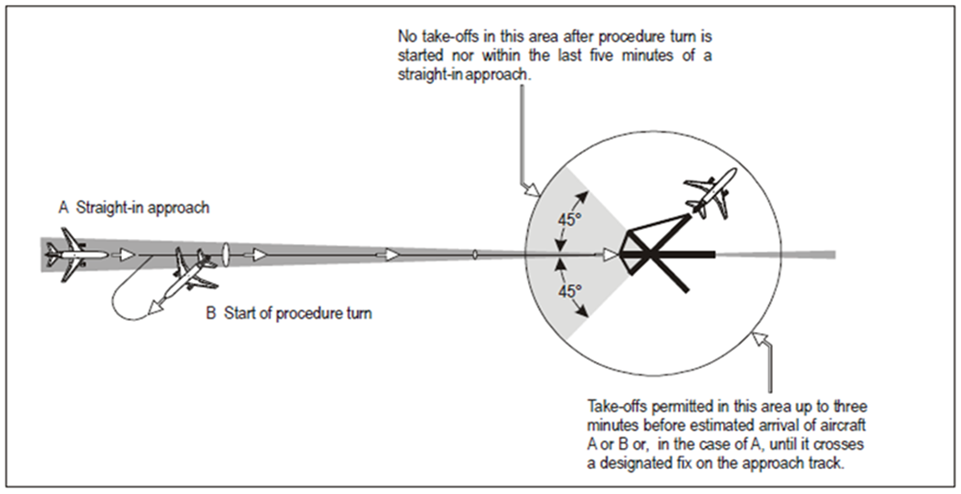
Figure 37: Separation of departing aircraft from arriving aircraft
(b)If an arriving aircraft is making a straight-in approach, a departing aircraft may take off:
(1)in any direction until 5 minutes before the arriving aircraft is estimated to be over the instrument runway;
(2)in a direction which is different by at least 45 degrees from the reciprocal of the direction of approach of the arriving aircraft:
(i)until 3 minutes before the arriving aircraft is estimated to be over the beginning of the instrument runway (see Figure 37); or
(ii)before the arriving aircraft crosses a designated fix on the approach track; the location of such fix should be determined by the air traffic services provider after consultation with the operators, and approved by the competent authority.
AMC1 ATS.TR.210(c)(2)(ii) Operation of air traffic control service
ED Decision 2020/008/R
PROCEDURAL CONTROL — LATERAL SEPARATION CRITERIA AND MINIMA
Lateral separation should be applied by one of the following means:
(a)By reference to the same or different geographic locations
By position reports which positively indicate that the aircraft are over different geographic locations as determined visually or by reference to a navigation aid (see Figure 38).
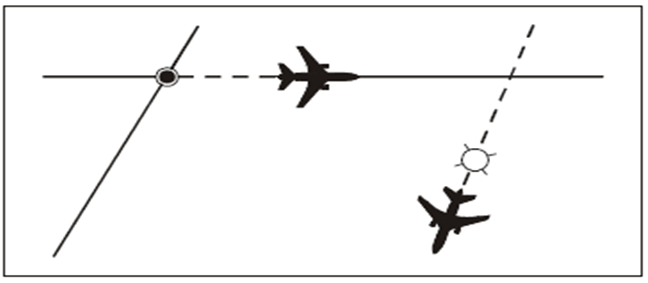
Figure 38: Using same or different geographic locations
(b)By use of NDB, VOR or GNSS on intersecting tracks or ATS routes
By requiring aircraft to fly on specified tracks which are separated by a minimum amount appropriate to the navigation aid employed. Lateral separation between two aircraft exists when:
(1)(VOR) both aircraft are established on radials diverging by at least 15 degrees and at least one aircraft is at a distance of 28 km (15 NM) or more from the facility (see Figure 39);
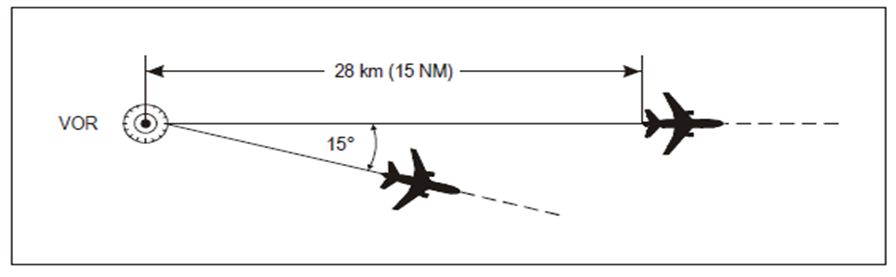
Figure 39: Separation using the same VOR
(2)(NDB) both aircraft are established on tracks to or from the NDB which are diverging by at least 30 degrees and at least one aircraft is at a distance of 28 km (15 NM) or more from the facility (see Figure 40);
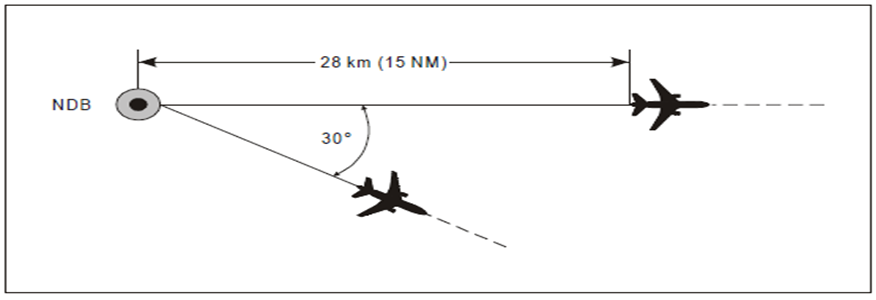
Figure 40: Separation using the same NDB
(3)(GNSS/GNSS) each aircraft is confirmed to be established on a track with zero offset between two waypoints and at least one aircraft is at a minimum distance from a common point as specified in Table 1 below; or
(4)(VOR/GNSS) the aircraft using VOR is established on a radial to or from the VOR and the other aircraft using GNSS is confirmed to be established on a track with zero offset between two waypoints and at least one aircraft is at a minimum distance from a common point as specified in the table below.
Aircraft 1: VOR or GNSS Aircraft 2: GNSS | ||
Angular difference between tracks measured at the common point | FL010-FL090 Distance from a common point | FL200-FL600 Distance from a common point |
15-135 | 27.8 km (15 NM) | 43 km (23 NM) |
The distances in the table are ground distances. States must take into account the distance (slant range) from the source of a DME signal to the receiving antenna when DME is being utilised to provide range information. | ||
(c)By use of different navigation aids or methods
Lateral separation between aircraft using different navigation aids, or when one aircraft is using RNAV equipment, should be established by ensuring that the derived protected airspaces for the navigation aid(s) or RNP do not overlap.
(d)Lateral separation of aircraft on published instrument flight procedures for arrivals and departures
Lateral separation of departing and/or arriving aircraft, using instrument flight procedures, will exist where:
(1)the distance between any combination of RNAV 1 with RNAV 1, or RNP 1, RNP APCH or RNP AR APCH tracks is not less than 13 km (7 NM); or
(2)the distance between any combination of RNP 1, RNP APCH or RNP AR APCH tracks is not less than 9.3 km (5 NM); or
(3)the protected areas of tracks designed using obstacle clearance criteria do not overlap and provided operational error is considered.
(e)RNAV operations where RNP is specified on parallel tracks or ATS routes
Within designated airspace or on designated routes, where RNP is specified, lateral separation between RNAV-equipped aircraft may be obtained by requiring aircraft to be established on the centre lines of parallel tracks or ATS routes spaced at a distance which ensures that the protected airspace of the tracks or ATS routes does not overlap.
(f)Transitioning into airspace where a greater lateral separation minimum applies
Lateral separation will exist when aircraft are established on specified tracks which:
(1)are separated by an appropriate minimum; and
(2)diverge by at least 15 degrees until the applicable lateral separation minimum is established,
provided that it is possible to ensure, by means approved by the competent authority, that aircraft have the navigation capability necessary to ensure accurate track guidance.
GM1 to AMC1 ATS.TR.210(c)(2)(ii) Operation of air traffic control service
ED Decision 2020/008/R
PROCEDURAL CONTROL — LATERAL SEPARATION OF AIRCRAFT ON PUBLISHED INSTRUMENT FLIGHT PROCEDURES FOR ARRIVALS AND DEPARTURES
ICAO Circular 324 ‘Guidelines for Lateral Separation of Arriving and Departing Aircraft on Published Adjacent Instrument Flight Procedures’ contains information on separation of arrival and departure tracks using non-overlapping protected areas based on obstacle clearance criteria, as provided for in ICAO Doc 8168 ‘Procedures for Air Navigation Services — Aircraft Operations, Volume II — Construction of Visual and Instrument Flight Procedures’.
GM1 ATS.TR.210(c)(2)(ii) Operation of air traffic control service
ED Decision 2020/008/R
PROCEDURAL CONTROL — LATERAL SEPARATION APPLICATION
(a)Lateral separation should be applied so that the distance between those portions of the intended routes for which the aircraft are to be laterally separated is never less than an established distance to account for navigational inaccuracies plus a specified buffer. This buffer should be determined by the air traffic services provider and approved by the competent authority and included in the lateral separation minima as an integral part thereof.
(b)Lateral separation of aircraft is obtained by requiring operation on different routes or in different geographical locations as determined by visual observation, by the use of navigation aids or by the use of RNAV equipment.
(c)Where a route flown by an aircraft involves a specified turn which will result in the minimum lateral separation being infringed, another type of separation or another minimum shall be established prior to the aircraft commencing the turn (see Figures 41 and 42).
(d)For flyover waypoints, aircraft are required to first fly over the waypoint before executing the turn. After the turn, the aircraft may either navigate to join the route immediately after the turn or navigate to the next defined waypoint before rejoining the route. This will require additional lateral separation on the overflown side of the turn (See Figure 41).
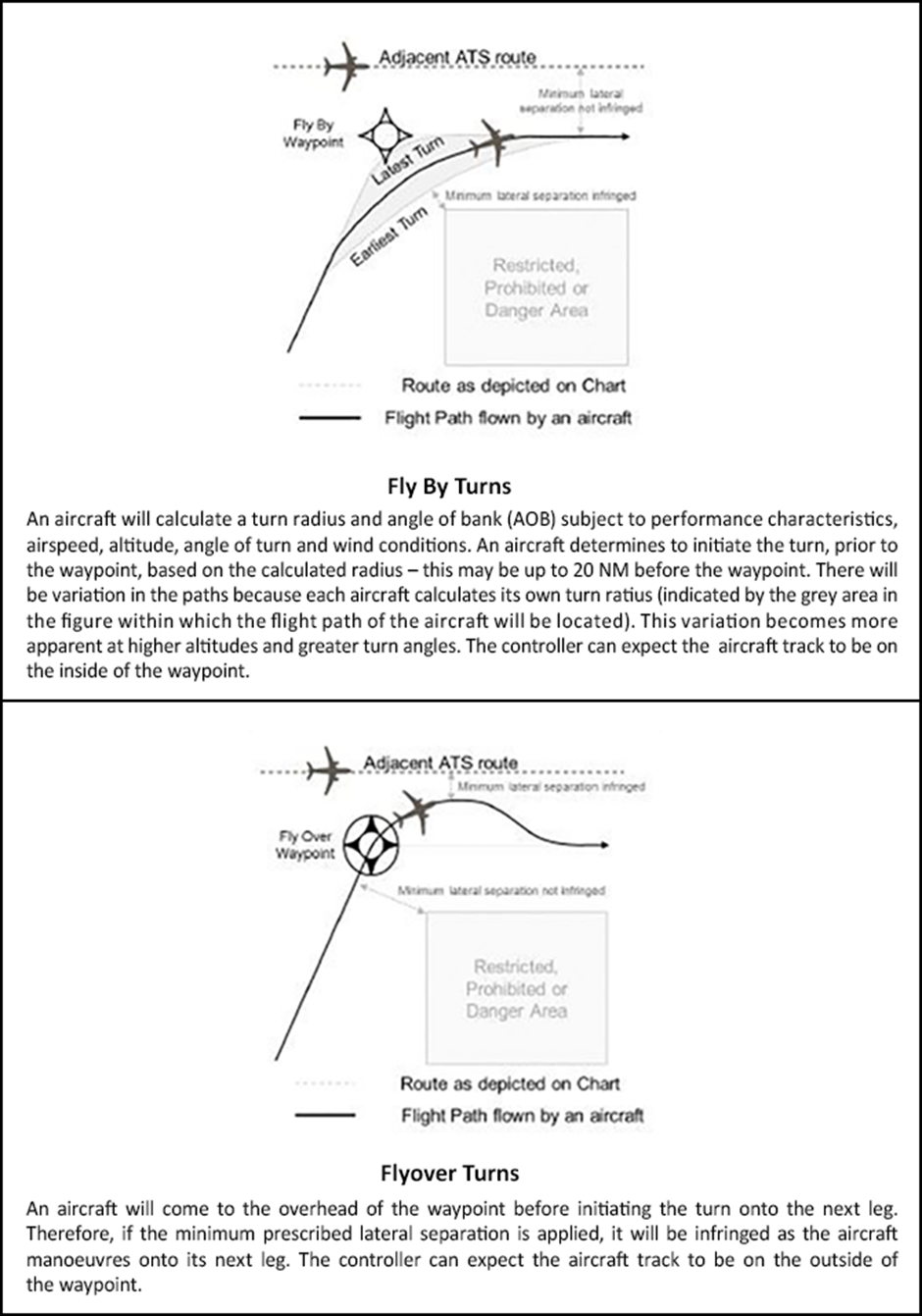
Figure 41: Turn over flyover waypoint and turn at fly-by waypoint
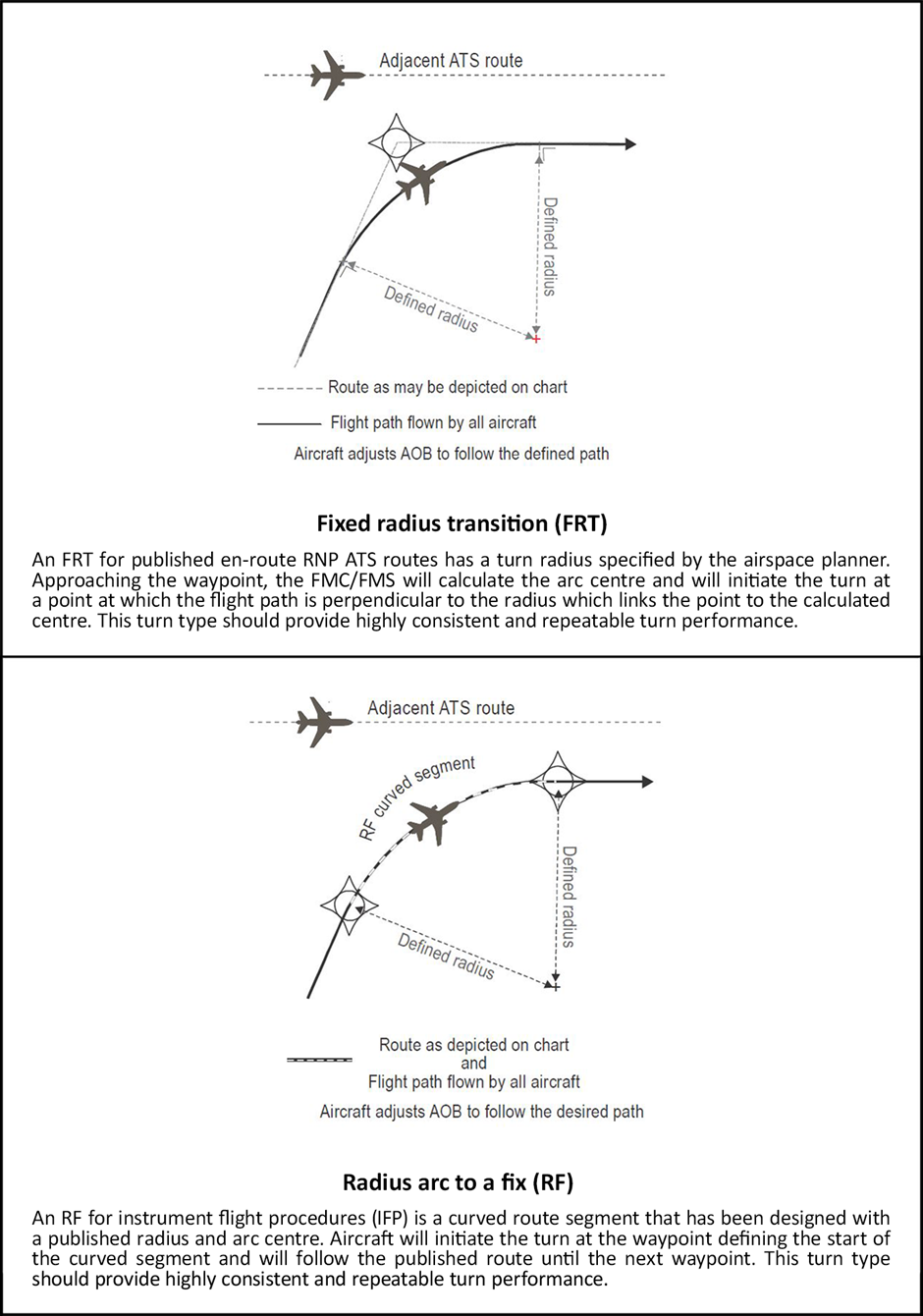
Figure 42: Fixed radius transition (FRT) and radius arc to a Fix (RF) turn
GM1 ATS.TR.210(d) Operation of air traffic control service
ED Decision 2020/008/R
APPLICATION OF SEPARATION MINIMA TO IDENTIFIED AIRCRAFT
(a)When the control of an identified aircraft is to be transferred to a control sector that will provide the aircraft with procedural separation, the transferring air traffic controller should ensure that appropriate procedural separation is established between that aircraft and any other controlled aircraft before the transfer is effected.
(b)When the control of an identified aircraft is to be transferred to a control sector that will provide the aircraft with procedural separation, such separation should be established by the transferring air traffic controller before the aircraft reaches the limits of the transferring air traffic controller’s area of responsibility, or before the aircraft leaves the relevant area of surveillance coverage.