
Filters
ATS.TR.215 Selection and notification of separation minima for the application of point ATS.TR.210(c)
Commission Implementing Regulation (EU) 2020/469
(a)The selection of separation minima for application within a given portion of airspace shall be made by the air traffic services provider responsible for the provision of air traffic services and approved by the competent authority concerned.
(b)For traffic that will pass from one into the other of neighbouring airspaces and for routes that are closer to the common boundary of the neighbouring airspaces than the separation minima applicable in the circumstances, the selection of separation minima shall be made in consultation with the air traffic services providers responsible for the provision of air traffic services in neighbouring airspace.
(c)Details of the selected separation minima and of their areas of application shall be notified:
(1)to the air traffic services units concerned;
(2)to pilots and aircraft operators through aeronautical information publications, where separation is based on the use by aircraft of specified navigation aids or specified navigation techniques.
ATS.TR.220 Application of wake turbulence separation
Commission Implementing Regulation (EU) 2020/469
(a)Air traffic control units shall apply wake turbulence separation minima to aircraft in the approach and departure phases of flight in either of the following circumstances:
(1)an aircraft is operating directly behind another aircraft at the same altitude or less than 300 m (1 000 ft) below it;
(2)both aircraft are using the same runway, or parallel runways separated by less than 760 m (2 500 ft);
(3)an aircraft is crossing behind another aircraft, at the same altitude or less than 300 m (1 000 ft) below it.
(b)Paragraph (a) shall not apply to arriving VFR flights and to arriving IFR flights executing visual approach when the aircraft has reported the preceding aircraft in sight and has been instructed to follow and maintain own separation from that aircraft. In those cases, the air traffic control unit shall issue caution for wake turbulence.
AMC1 ATS.TR.220 Application of wake turbulence separation
ED Decision 2024/006/R
CATEGORISATION OF AIRCRAFT FOR THE PURPOSES OF WAKE TURBULENCE SEPARATION MINIMA APPLICATION
Wake turbulence separation minima should be based on a grouping of aircraft types into four categories according to the maximum certificated take-off mass as follows:
(a)SUPER (S) if so identified by the competent authority;
(b)HEAVY (H) — all aircraft types of 136 000 kg or more;
(c)MEDIUM (M) — aircraft types less than 136 000 kg but more than 7 000 kg; and
(d)LIGHT (L) — aircraft types of 7 000 kg or less.
[applicable until 30 April 2025 - ED Decision 2020/008/R]
CATEGORISATION OF AIRCRAFT FOR THE PURPOSES OF WAKE TURBULENCE SEPARATION MINIMA APPLICATION
Wake turbulence separation minima should be based on a grouping of aircraft types into four categories according to the maximum certificated take-off mass as follows:
(a)SUPER (J)— aircraft types listed as such in ICAO Doc 8643 ‘Aircraft Type Designators’, latest edition;
(b)HEAVY (H) — all aircraft types of 136 000 kg or more, with the exception of aircraft types covered in point (a);
(c)MEDIUM (M) — aircraft types less than 136 000 kg but more than 7 000 kg; and
(d)LIGHT (L) — aircraft types of 7 000 kg or less.
[applicable from 1 May 2025 - ED Decision 2024/006/R]
GM1 to AMC1 ATS.TR.220 Application of wake turbulence separation
ED Decision 2020/008/R
For the Airbus A380-800 aircraft, with a maximum take-off mass in the order of 560 000 kg, it is recommended to apply an increase of the wake turbulence separation minima associated with the HEAVY category.
AMC2 ATS.TR.220 Application of wake turbulence separation
ED Decision 2020/008/R
TIME-BASED WAKE TURBULENCE LONGITUDINAL SEPARATION MINIMA — ARRIVING AIRCRAFT
Except for arriving VFR flights, and for arriving IFR flights executing visual approach, the following separation minima should be applied to aircraft landing behind a SUPER, a HEAVY or a MEDIUM aircraft:
(a)MEDIUM aircraft behind SUPER aircraft: 3 minutes;
(b)MEDIUM aircraft behind HEAVY aircraft: 2 minutes;
(c)LIGHT aircraft behind SUPER aircraft: 4 minutes; and
(d)LIGHT aircraft behind a HEAVY or MEDIUM aircraft: 3 minutes.
AMC3 ATS.TR.220 Application of wake turbulence separation
ED Decision 2020/008/R
TIME-BASED WAKE TURBULENCE LONGITUDINAL SEPARATION MINIMA — DEPARTING AIRCRAFT
(a)A separation minimum of 3 minutes should be applied for a LIGHT or MEDIUM aircraft and 2 minutes for a HEAVY aircraft taking off behind a SUPER aircraft when the aircraft are using:
(1)the same runway;
(2)parallel runways separated by less than 760 m (2 500 ft);
(3)crossing runways if the projected flight path of the second aircraft will cross the projected flight path of the first aircraft at the same altitude or less than 300 m (1 000 ft) below; and
(4)parallel runways separated by 760 m (2 500 ft) or more if the projected flight path of the second aircraft will cross the projected flight path of the first aircraft at the same altitude or less than 300 m (1 000 ft) below.
(b)A separation minimum of 4 minutes should be applied for a LIGHT or MEDIUM aircraft when taking off behind an SUPER aircraft from:
(1)an intermediate part of the same runway; or
(2)an intermediate part of a parallel runway separated by less than 760 m (2 500 ft).
(c)A separation minimum of 2 minutes should be applied between a LIGHT or MEDIUM aircraft taking off behind a HEAVY aircraft or a LIGHT aircraft taking off behind a MEDIUM aircraft when the aircraft are using:
(1)the same runway (see Figure 43);
(2)parallel runways separated by less than 760 m (2 500 ft) (see Figure 43);
(3)crossing runways if the projected flight path of the second aircraft will cross the projected flight path of the first aircraft at the same altitude or less than 300 m (1 000 ft) below (see Figure 44); and
(4)parallel runways separated by 760 m (2 500 ft) or more if the projected flight path of the second aircraft will cross the projected flight path of the first aircraft at the same altitude or less than 300 m (1 000 ft) below (see Figure 44).
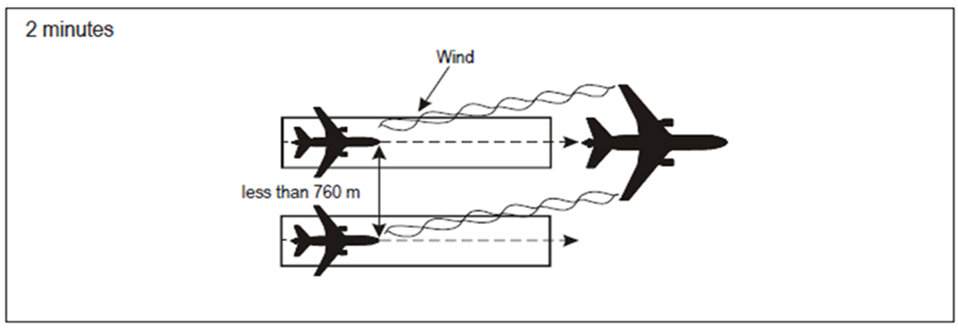
Figure 43: 2-minute separation for following aircraft
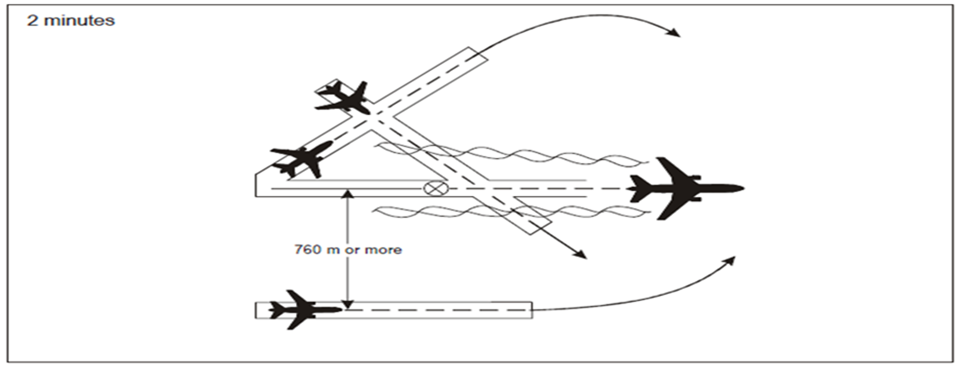
Figure 44: 2-minute wake turbulence separation for crossing aircraft
(d)A separation minimum of 3 minutes should be applied (see Figure 45) between a LIGHT or MEDIUM aircraft when taking off behind a HEAVY aircraft or a LIGHT aircraft when taking off behind a MEDIUM aircraft from:
(1)an intermediate part of the same runway; or
(2)an intermediate part of a parallel runway separated by less than 760 m (2 500 ft).
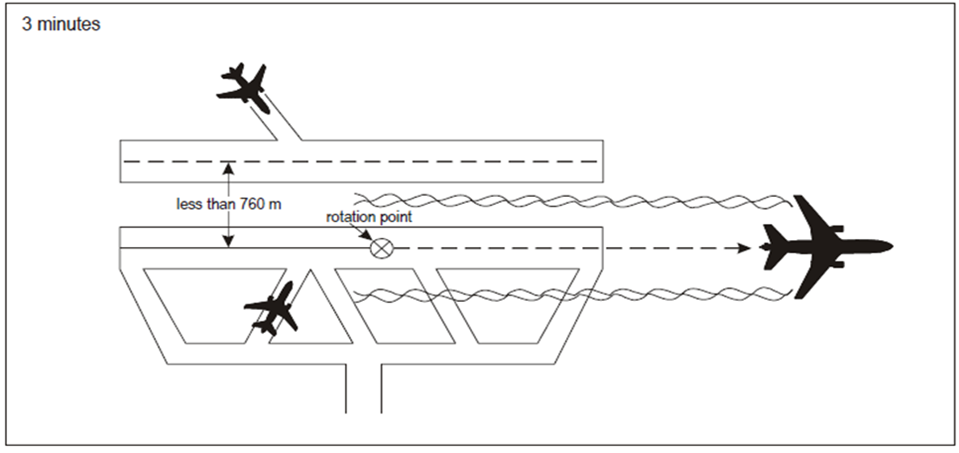
Figure 45: 3-minute wake turbulence separation for following aircraft
AMC4 ATS.TR.220 Application of wake turbulence separation
ED Decision 2020/008/R
TIME-BASED WAKE TURBULENCE LONGITUDINAL SEPARATION MINIMA — DISPLACED LANDING THRESHOLD
(a)A separation minimum of 3 minutes should be applied between a LIGHT or MEDIUM aircraft and a SUPER aircraft when operating on a runway with a displaced landing threshold when:
(1)a departing LIGHT or MEDIUM aircraft follows a SUPER aircraft arrival; or
(2)an arriving LIGHT or MEDIUM aircraft follows a SUPER aircraft departure,
if the projected flight paths are expected to cross.
(b)A separation minimum of 2 minutes should be applied between a LIGHT or MEDIUM aircraft and a HEAVY aircraft and between a LIGHT aircraft and a MEDIUM aircraft when operating on a runway with a displaced landing threshold when:
(1)a departing LIGHT or MEDIUM aircraft follows a HEAVY aircraft arrival and a departing LIGHT aircraft follows a MEDIUM aircraft arrival; or
(2)an arriving LIGHT or MEDIUM aircraft follows a HEAVY aircraft departure and an arriving LIGHT aircraft follows a MEDIUM aircraft departure,
if the projected flight paths are expected to cross.
AMC5 ATS.TR.220 Application of wake turbulence separation
ED Decision 2020/008/R
TIME-BASED WAKE TURBULENCE LONGITUDINAL SEPARATION MINIMA — OPPOSITE DIRECTION
(a)A separation minimum of 3 minutes should be applied between a LIGHT or MEDIUM aircraft and a SUPER aircraft when the SUPER aircraft is making a low or missed approach and the LIGHT or MEDIUM aircraft is:
(1)utilising an opposite-direction runway for take-off; or
(2)landing on the same runway in the opposite direction, or on a parallel opposite-direction runway separated by less than 760 m (2 500 ft).
(b)A separation minimum of 2 minutes should be applied between a LIGHT or MEDIUM aircraft and a HEAVY aircraft and between a LIGHT aircraft and a MEDIUM aircraft when the heavier aircraft is making a low or missed approach and the lighter aircraft is:
(1)utilising an opposite-direction runway for take-off (see Figure 46); or
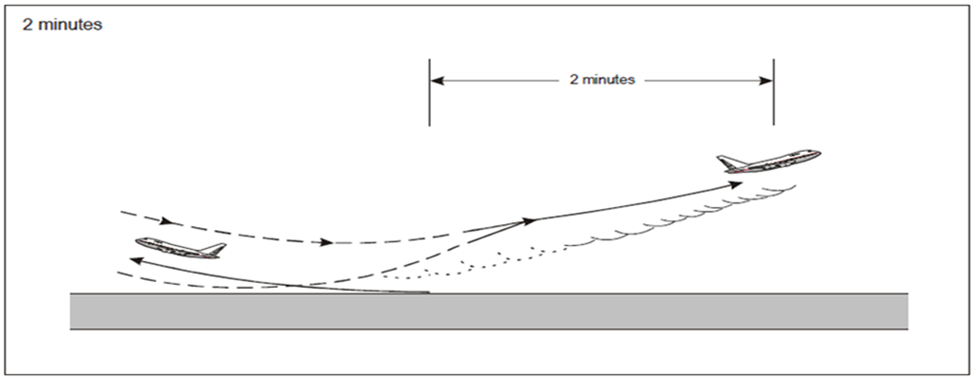
Figure 46: 2-minute wake turbulence separation for opposite-direction take-off
(2)landing on the same runway in the opposite direction, or on a parallel opposite-direction runway separated by less than 760 m (2 500 ft) (see Figure 47).
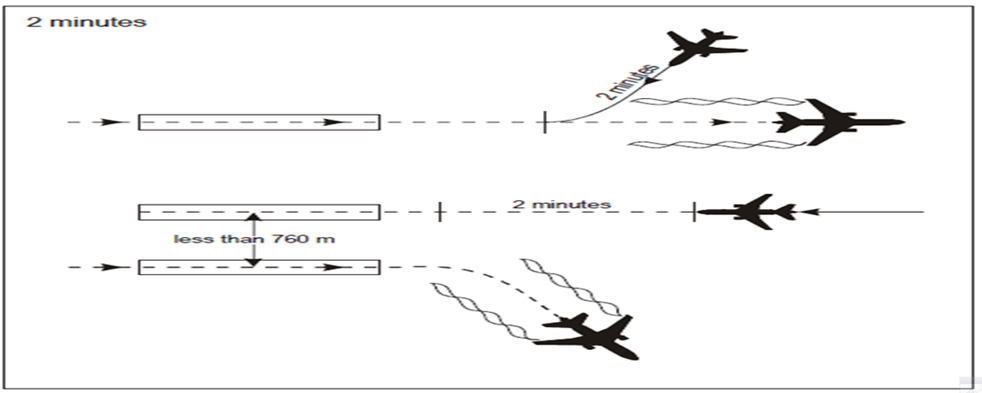
Figure 47: 2-minute wake turbulence separation for opposite-direction landing
AMC6 ATS.TR.220 Application of wake turbulence separation
ED Decision 2020/008/R
DISTANCE-BASED WAKE TURBULENCE SEPARATION MINIMA BASED ON ATS SURVEILLANCE SYSTEM
The following distance-based wake turbulence separation minima should be applied to aircraft being provided with an ATS surveillance service in the approach and departure phases:
PRECEDING AIRCRAFT | SUCCEEDING AIRCRAFT | WAKE TURBULENCE RADAR SEPARATION MINIMA |
SUPER or HEAVY | SUPER | Not required. In this case, separation reverts to radar separation minima as established by the air traffic services provider and approved by the competent authority. |
SUPER | HEAVY | 11.1 km (6.0 NM) |
SUPER | MEDIUM | 13.0 km (7.0 NM) |
SUPER | LIGHT | 14.8 km (8.0 NM) |
HEAVY | HEAVY | 7.4 km (4.0 NM) |
HEAVY | MEDIUM | 9.3 km (5.0 NM) |
HEAVY | LIGHT | 11.1 km (6.0 NM) |
MEDIUM | LIGHT | 9.3 km (5 NM) |
GM1 to AMC6 ATS.TR.220 Application of wake turbulence separation
ED Decision 2020/008/R
Figures 48 and 49 illustrate the application of the separation minima between HEAVY, MEDIUM and LIGHT aircraft prescribed in AMC6 ATS.TR.220.
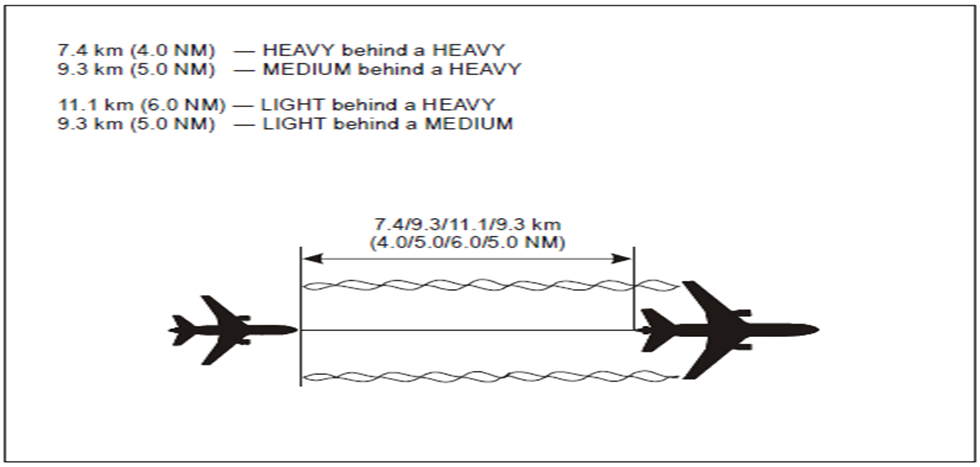
Figure 48: Operating directly behind
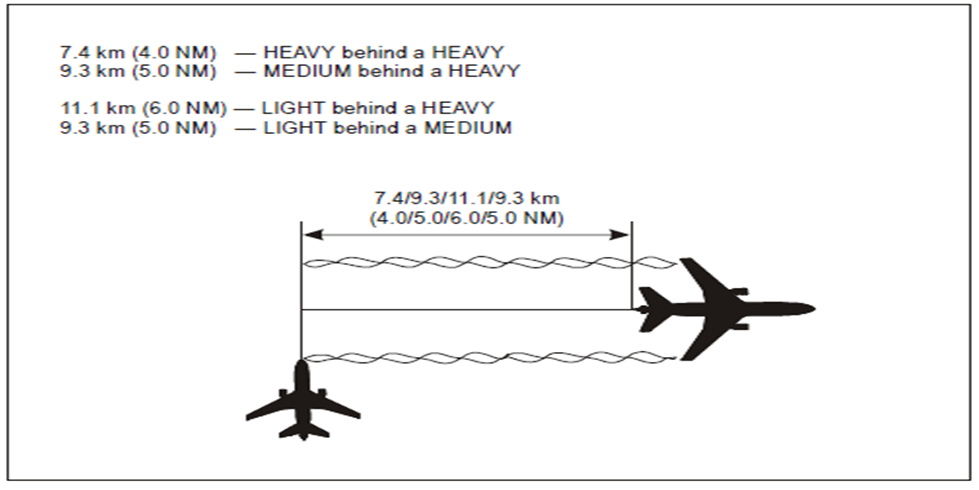
Figure 49: Crossing behind
AMC7 ATS.TR.220 Application of wake turbulence separation
ED Decision 2020/008/R
RECAT-EU WAKE TURBULENCE SEPARATION MINIMA
(a)As an alternative to the wake turbulence separation minima prescribed in AMC1 to AMC6 ATS.TR.220, an air traffic services provider may decide to implement RECAT-EU or parts thereof, subject to the approval of the competent authority.
(b)The following wake vortex aircraft groupings, based on the allocation of aircraft types to six categories according to both maximum certificated take-off mass and wingspan, and associated separation minima should be used when applying RECAT-EU:
(1)‘SUPER HEAVY’ — all aircraft types of 100 000 kg or more, and a wingspan between 72 m and 80 m;
(2)‘UPPER HEAVY’ — all aircraft types of 100 000 kg or more, and a wingspan between 60 m and 72 m;
(3)‘LOWER HEAVY’ — all aircraft types of 100 000 kg or more, and a wingspan below 52 m;
(4)‘UPPER MEDIUM’ — aircraft types less than 100 000 kg but more than 15 000 kg, and a wingspan above 32 m;
(5)‘LOWER MEDIUM’ — aircraft types less than 100 000 kg but more than 15 000 kg, and a wingspan below 32 m;
(6)‘LIGHT’ — all aircraft types of 15 000 kg or less (without wingspan criterion).
(c)Aircraft types with maximum certificated take-off mass of 100 000 kg or more, and wingspan between 52 m and 60 m are included in one of the above categories on the basis of specific analyses.
(d)RECAT-EU wake turbulence distance-based separation minima for arriving and departing aircraft when ATS surveillance service is provided should be:
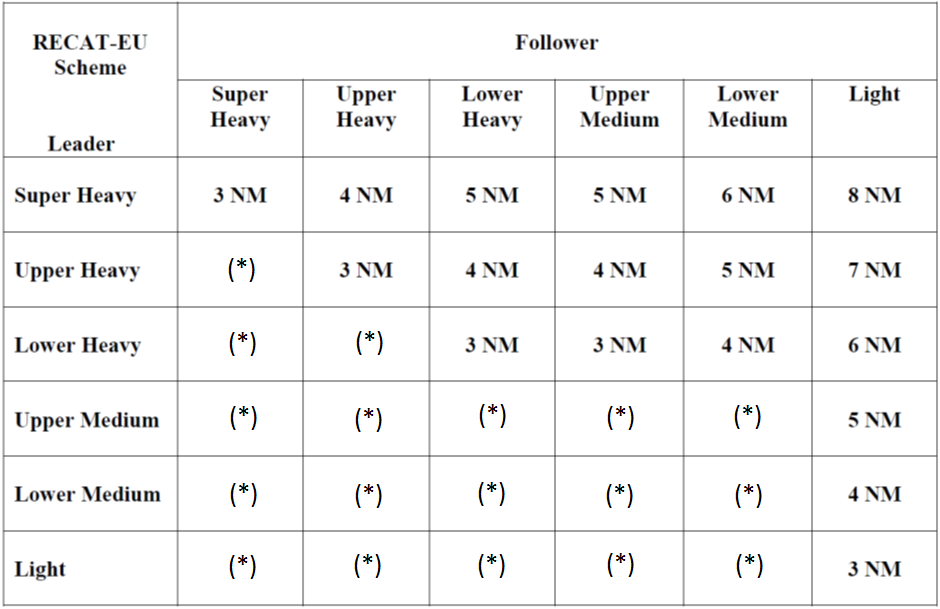
(*) means that the separation minimum to be applied is the horizontal separation minimum based on an ATS surveillance system (established in accordance with ), and should remain compatible with runway capacity.
(e)RECAT-EU wake turbulence time-based separation minima between departing aircraft should be:
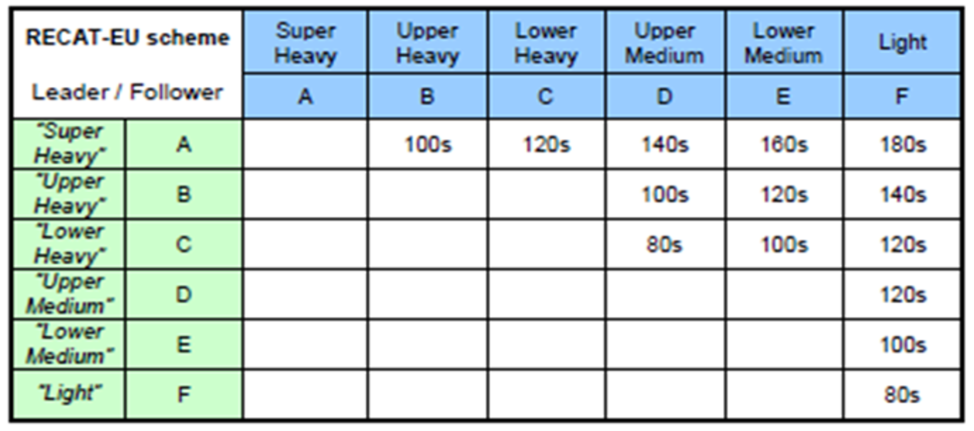
(f)Wake turbulence time-based separation minima between departing aircraft should be applied by determining airborne times between successive aircraft.
(g)An additional 60 seconds should be applied to all the wake turbulence time-based separation minima above when taking off from:
(1)an intermediate part of the same runway; or
(2)an intermediate part of a parallel runway separated by less than 760 m (2 500 ft).
GM1 to AMC7 ATS.TR.220 Application of wake turbulence separation
ED Decision 2020/008/R
APPLICATION OF RECAT-EU WAKE TURBULENCE SEPARATION SCHEME
(a)The implementation of RECAT-EU or parts thereof is considered to be a change to the air traffic services provider functional system and, as such, is supported by a safety assessment, in accordance with ATS.OR.205. Any such implementation should provide clear operational benefits.
(b)While the ICAO flight plan remains unchanged, the RECAT-EU wake vortex aircraft grouping should be displayed to air traffic controllers using the associated aircraft type information available in the flight data processing system.
(c)A list of aircraft types for each RECAT-EU aircraft grouping, in particular with respect to new aircraft types, is maintained by EASA and is available at https://www.easa.europa.eu/easa-and-you/air-traffic-management#group-easa-downloads.
GM1 ATS.TR.220 Application of wake turbulence separation
ED Decision 2020/008/R
WAKE TURBULENCE EFFECTS INDUCED BY HELICOPTERS
(a)Helicopters should be kept well clear of light aircraft when hovering or while air-taxiing.
(b)Helicopters produce vortices when in flight and there is some evidence that, per kilogramme of gross mass, their vortices are more intense than those of fixed-wing aircraft. When hovering in ground effect or air taxiing, helicopters generate downwash producing high-velocity outwash vortices to a distance approximately three times the diameter of the rotor.
ATS.TR.225 Responsibility for control
Commission Implementing Regulation (EU) 2020/469
(a)A controlled flight shall be under the control of only one air traffic control unit at any given time.
(b)Responsibility for the control of all aircraft operating within a given block of airspace shall be vested in a single air traffic control unit. However, control of an aircraft or groups of aircraft may be delegated to other air traffic control units provided that coordination between all air traffic control units concerned is assured.
ATS.TR.230 Transfer of responsibility for control
Regulation (EU) 2023/1771
(a)Place or time of transfer
The responsibility for the control of an aircraft shall be transferred from one air traffic control unit to another as follows:
(1)Between two units providing area control service
The responsibility for the control of an aircraft shall be transferred from a unit providing area control service in a control area to the unit providing area control service in an adjacent control area at the time of crossing the common control area boundary as estimated by the area control centre having control of the aircraft or at such other point or time as has been agreed between the two units.
(2)Between a unit providing area control service and a unit providing approach control service or between two units providing approach control service
The responsibility for the control of an aircraft shall be transferred from one unit to another, and vice versa, at a point or time agreed between the two units.
(3)Between a unit providing approach control service and an aerodrome control tower
(i)Arriving aircraft – The responsibility for the control of an arriving aircraft shall be transferred, as specified in letters of agreement and operation manuals, as appropriate, from the unit providing approach control service to the aerodrome control tower when the aircraft is in either of the following states:
(A)is in the vicinity of the aerodrome, and:
(a)it is considered that approach and landing will be completed in visual reference to the ground, or
(b)it has reached uninterrupted VMC;
(B)is at a prescribed point or level;
(C)has landed.
(ii)Departing aircraft – The responsibility for control of a departing aircraft shall be transferred, as specified in letters of agreement and operation manuals, as appropriate, from the aerodrome control tower to the unit providing approach control service:
(A)when VMC prevail in the vicinity of the aerodrome:
(a)prior to the time the aircraft leaves the vicinity of the aerodrome, or
(b)prior to the aircraft entering instrument meteorological conditions (IMC), or
(c)at a prescribed point or level;
(B)when IMC prevail at the aerodrome:
(a)immediately after the aircraft is airborne, or
(b)at a prescribed point or level.
(4)Between control sectors or positions within the same air traffic control unit
The responsibility for control of an aircraft shall be transferred from one control sector or position to another control sector or position within the same air traffic control unit at a point, level or time, as specified in air traffic services unit instructions.
(b)Coordination of transfer
(1)Responsibility for control of an aircraft shall not be transferred from one air traffic control unit to another without the consent of the accepting control unit, which shall be obtained in accordance with points (2), (3), (4) and (5).
(2)The transferring control unit shall communicate to the accepting control unit the appropriate parts of the current flight plan and any control information pertinent to the transfer requested.
(3)Where transfer of control is to be effected using ATS surveillance systems, the control information pertinent to the transfer shall include information regarding the position and, if required, the track and speed of the aircraft, as observed by ATS surveillance systems immediately prior to the transfer.
(4)Where transfer of control is to be effected using ADS-C data, the control information pertinent to the transfer shall include the four-dimensional position and other information as necessary.
(5)The accepting control unit shall:
(i)indicate its ability to accept control of the aircraft on the terms specified by the transferring control unit, unless by prior agreement between the two units concerned the absence of any such indication is understood to signify acceptance of the terms specified, or indicate any necessary changes thereto;
(ii)specify any other information or clearance for a subsequent portion of the flight, which it requires the aircraft to have at the time of transfer.
(6)Unless otherwise specified by an agreement between the two control units concerned, the accepting control unit shall not notify the transferring control unit when it has established two-way voice or data link communications, or both, with and assumed control of the aircraft concerned.
(7)Standardised phraseology shall be used in the coordination between air traffic services units or sectors, or both. Only when standardised phraseology cannot serve an intended transmission, plain language shall be used.
(c)The coordination of transfer of control between units that provide area control service within the ICAO EUR region, or when so agreed with or between other air traffic control units, shall be supported by automated processes as defined in Appendix 2.
AMC1 ATS.TR.230 Transfer of responsibility for control
ED Decision 2020/008/R
COORDINATION IN RESPECT OF THE AIR TRAFFIC CONTROL SERVICE PROVISION — GENERAL
Agreements between air traffic control units or sectors and local instructions concerning coordination and transfer of control of flights should cover the following, as applicable:
(a)definition of areas of responsibility and common interest, airspace structure and airspace classification(s);
(b)any delegation of responsibility for the provision of air traffic services;
(c)procedures for the exchange of flight plan and control data, including use of automated and/or verbal coordination messages;
(d)means of communication;
(e)requirements and procedures for approval requests;
(f)significant points, levels or times for transfer of control;
(g)significant points, levels or times for transfer of communication;
(h)conditions applicable to the transfer and acceptance of control, such as specified altitudes/flight levels, specific separation minima or spacing to be established at the time of transfer, and the use of automation;
(i)ATS surveillance system coordination procedures;
(j)SSR code assignment procedures;
(k)procedures for departing traffic;
(l)designated holding fixes and procedures for arriving traffic;
(m)applicable contingency procedures; and
(n)any other provisions or information relevant to the coordination and transfer of control of flights.
GM1 ATS.TR.230 Transfer of responsibility for control
ED Decision 2020/008/R
COORDINATION IN RESPECT OF THE AIR TRAFFIC CONTROL SERVICE PROVISION — GENERAL
(a)The coordination and transfer of control of a flight between successive air traffic control units and control sectors should be effected by a dialogue comprising the following stages:
(1)notification of the flight in order to prepare for coordination, as necessary;
(2)coordination of conditions of transfer of control by the transferring air traffic control unit;
(3)coordination, if necessary, and acceptance of conditions of transfer of control by the accepting control unit; and
(4)transfer of control to the accepting control unit or control sector.
(b)Air traffic control units should, to the extent possible, establish and apply standardised procedures for the coordination and transfer of control of flights, in order, inter alia, to reduce the need for verbal coordination. Such coordination procedures should be specified in letters of agreement and local instructions, as applicable.
GM2 ATS.TR.230 Transfer of responsibility for control
ED Decision 2020/008/R
LETTERS OF AGREEMENT AND OPERATION MANUALS
Relevant information contained in letters of agreement should be included in the operation manual of the air traffic services units concerned.
AMC1 ATS.TR.230(a) Transfer of responsibility for control
ED Decision 2020/008/R
COORDINATION BETWEEN AIR TRAFFIC CONTROL UNITS PROVIDING AIR TRAFFIC SERVICE WITHIN CONTIGUOUS CONTROL AREAS — TRANSFER OF CONTROL
(a)The responsibility for the control of an aircraft should be transferred from the air traffic control unit to the next unit at the time of crossing the common control area boundary as determined by the unit having control of the aircraft or at such other point or time as has been agreed between the two units.
(b)Where specified in letters of agreement between the air traffic control units concerned, and when transferring an aircraft, the transferring unit should notify the accepting control unit that the aircraft is in position to be transferred, and specify that the responsibility for control should be assumed by the accepting control unit forthwith at the time of crossing the control boundary or other transfer control point specified in letters of agreement between the air traffic control units or at such other point or time coordinated between the two units.
(c)If the transfer of control time or point is other than forthwith, the accepting control unit should not alter the clearance of the aircraft prior to the agreed transfer of control time or point without the approval of the transferring unit.
(d)If transfer of communication is used to transfer an aircraft to an accepting control unit, responsibility for control should not be assumed until the time of crossing the control area boundary or other transfer of control point specified in letters of agreement between the air traffic control units.
GM1 ATS.TR.230(a)(2) Transfer of responsibility for control
ED Decision 2020/008/R
DIVISION OF CONTROL BETWEEN A UNIT PROVIDING AREA CONTROL SERVICE AND A UNIT PROVIDING APPROACH CONTROL SERVICE
(a)Except when otherwise specified in letters of agreement or local instructions, or by the ACC concerned in individual cases, a unit providing approach control service may issue clearances to any aircraft released to it by an ACC without reference to the ACC. However, when an approach has been missed, the ACC should, if affected by the missed approach, be advised immediately and subsequent action should be coordinated between the ACC and the unit providing approach control service as necessary.
(b)An ACC may, after coordination with the unit providing approach control service, release aircraft directly to aerodrome control towers if the entire approach will be made under VMC.
GM1 ATS.TR.230(a)(3) Transfer of responsibility for control
ED Decision 2020/008/R
DIVISION OF CONTROL BETWEEN A UNIT PROVIDING APPROACH CONTROL SERVICE AND A UNIT PROVIDING AERODROME CONTROL SERVICE
(a)A unit providing approach control service should retain control of arriving aircraft until such aircraft have been transferred to the aerodrome control tower and are in communication with the aerodrome control tower. Letters of agreement or local instructions, appropriate to the airspace structure, terrain, meteorological conditions and air traffic services facilities available, should establish rules for the transfer of arriving aircraft.
(b)A unit providing approach control service may authorise an aerodrome control tower to release an aircraft for take-off subject to the discretion of the aerodrome control tower with respect to arriving aircraft.
(c)Aerodrome control towers should, when so prescribed in letters of agreement or local instructions, obtain approval from the unit providing approach control service prior to authorising operation of special VFR flights.
GM2 ATS.TR.230(a)(3) Transfer of responsibility for control
ED Decision 2020/008/R
TRANSFER OF FLIGHTS BETWEEN ACC AND AERODROME CONTROL TOWER
Even though there is an approach control unit, control of certain flights may be transferred directly from an ACC to an aerodrome control tower and vice versa, subject to prior arrangement between the units concerned for the relevant part of approach control service to be provided by the ACC or the aerodrome control tower, as applicable.
GM1 ATS.TR.230(a)(3)(i) Transfer of responsibility for control
ED Decision 2020/008/R
COORDINATION OF STANDARD CLEARANCES FOR ARRIVING AIRCRAFT
(a)Wherever possible, the air traffic services providers concerned should establish standardised procedures for transfer of control between the air traffic control units concerned and standard clearances for arriving aircraft.
(b)Where standard clearances for arriving aircraft are in use and, provided no terminal delay is expected, clearance to follow the appropriate standard instrumental arrival (STAR) will normally be issued by the ACC without prior coordination with or approval from the approach control unit or the aerodrome control tower, as applicable.
(c)Prior coordination of clearances should be required only in the event that a variation to the standard clearance or the standardised transfer of control procedures is necessary or desirable for operational reasons.
(d)Provision should be made to:
(1)ensure that the approach control unit is at all times kept informed of the sequence of aircraft following the same STAR; and
(2)display the designators of assigned STARs to the ACC, the approach control unit and/or the aerodrome control tower, as applicable.
GM1 ATS.TR.230(a)(3)(ii) Transfer of responsibility for control
ED Decision 2020/008/R
COORDINATION OF STANDARD CLEARANCES FOR DEPARTING AIRCRAFT
(a)Wherever possible, the air traffic services providers concerned should establish standardised procedures for transfer of control between the air traffic control units concerned and standard clearances for departing aircraft.
(b)Where standard clearances for departing aircraft have been agreed to between the units concerned, the aerodrome control tower will normally issue the appropriate standard clearance without prior coordination with or approval from the approach control unit or ACC.
(c)Prior coordination of clearances should be required only in the event that a variation to the standard clearance or the standardised transfer of control procedures is necessary or desirable for operational reasons; for example, in the case of a change on the cleared initial flight level.
(d)Provision should be made to:
(1)ensure that the approach control unit at all times is kept informed of the sequence in which aircraft will depart as well as the runway to be used; and
(2)display the designators of assigned standard instrumental departures (SIDs) to the aerodrome control tower, the approach control unit and/or the ACC as applicable.
AMC1 ATS.TR.230(a)(4) Transfer of responsibility for control
ED Decision 2020/008/R
COORDINATION BETWEEN CONTROL POSITIONS WITHIN THE SAME UNIT
Appropriate flight plan and control information should be exchanged between control positions within the same air traffic control unit, in respect of:
(a)all aircraft for which responsibility for control will be transferred from one control position to another;
(b)aircraft operating in such close proximity to the boundary between control sectors that control of traffic within an adjacent sector may be affected;
(c)all aircraft for which responsibility for control has been delegated by an air traffic controller using procedural methods to an air traffic controller using an ATS surveillance system, as well as other aircraft affected.
AMC1 ATS.TR.230(b)(2) Transfer of responsibility for control
ED Decision 2020/008/R
COORDINATION BETWEEN AIR TRAFFIC CONTROL UNITS PROVIDING AIR TRAFFIC SERVICES WITHIN CONTIGUOUS CONTROL AREAS — GENERAL
(a)Air traffic control units should forward from unit to unit, as the flight progresses, necessary flight plans and control information. When so required by agreement between air traffic services providers concerned, flight plans and flight progress information for flights along specified routes or portions of routes in close proximity to flight information region (FIR) boundaries should also be provided to the air traffic control units in charge of the FIRs adjacent to such routes or portions of routes.
(b)The flight plan and control information in point (b) of ATS.TR.230 should be transmitted in sufficient time to permit reception and analysis of the data by the receiving unit(s) and necessary coordination between the units concerned.
AMC2 ATS.TR.230(b)(2) Transfer of responsibility for control
ED Decision 2020/008/R
EXCHANGE OF MOVEMENT AND CONTROL DATA BETWEEN A UNIT PROVIDING AREA CONTROL SERVICE AND A UNIT PROVIDING APPROACH CONTROL SERVICE
(a)The unit providing approach control service should keep the ACC promptly advised of pertinent data on controlled traffic.
(b)The ACC should keep the unit providing approach control service promptly advised of pertinent data on controlled traffic.
(c)The ACC should normally forward to the unit providing approach control service information on arriving aircraft not less than 15 minutes before the estimated time of arrival and should revise such information as necessary
GM1 to AMC2 ATS.TR.230(b)(2) Transfer of responsibility for control
ED Decision 2020/008/R
EXCHANGE OF MOVEMENT AND CONTROL DATA FROM A UNIT PROVIDING APPROACH CONTROL SERVICE TO A UNIT PROVIDING AREA CONTROL SERVICE
Pertinent data on controlled traffic should include:
(a)runway(s)-in-use and expected type of instrument approach procedure;
(b)lowest vacant level at the holding fix available for use by the ACC;
(c)average time interval or distance between successive arrivals as determined by the unit providing approach control service;
(d)revision of the expected approach time issued by the ACC when the calculation of the expected approach time by the unit providing approach control service indicates a variation of 5 minutes or such other time as has been agreed between the two air traffic control units concerned;
(e)arrival times over the holding fix when these vary by 3 minutes, or such other time as has been agreed between the two air traffic control units concerned, from those previously estimated;
(f)cancellations by aircraft of IFR flight if these will affect levels at the holding fix or expected approach times of other aircraft;
(g)aircraft departure times or, if agreed between the two air traffic control units concerned, the estimated time at the control area boundary or other specified point;
(h)all available information relating to overdue or unreported aircraft; and
(i)missed approaches which may affect the ACC.
GM2 to AMC2 ATS.TR.230(b)(2) Transfer of responsibility for control
ED Decision 2020/008/R
EXCHANGE OF MOVEMENT AND CONTROL DATA FROM A UNIT PROVIDING AREA CONTROL SERVICE TO A UNIT PROVIDING APPROACH CONTROL SERVICE
Pertinent data on controlled traffic should include:
(a)identification, type and point of departure of arriving aircraft;
(b)estimated time and proposed level of arriving aircraft over holding fix or other specified point;
(c)actual time and proposed level of arriving aircraft over holding fix if the aircraft is released to the unit providing approach control service after arrival over the holding fix;
(d)requested type of IFR approach procedure if different from that specified by the approach control unit;
(e)expected approach time issued;
(f)when required, statement that an aircraft has been instructed to contact the unit providing approach control service;
(g)when required, statement that an aircraft has been released to the unit providing approach control service including, if necessary, the time and conditions of release; and
(h)anticipated delay to departing traffic due to congestion.
AMC3 ATS.TR.230(b)(2) Transfer of responsibility for control
ED Decision 2020/008/R
EXCHANGE OF MOVEMENT AND CONTROL DATA BETWEEN A UNIT PROVIDING APPROACH CONTROL SERVICE AND A UNIT PROVIDING AERODROME CONTROL SERVICE
(a)An aerodrome control tower should keep the unit providing approach control service promptly advised of pertinent data on relevant controlled traffic.
(b)The unit providing approach control service should keep the aerodrome control tower promptly advised of pertinent data on controlled traffic.
GM1 to AMC3 ATS.TR.230(b)(2) Transfer of responsibility for control
ED Decision 2020/008/R
EXCHANGE OF MOVEMENT AND CONTROL DATA FROM AN AERODROME CONTROL TOWER TO A UNIT PROVIDING APPROACH CONTROL SERVICE
Pertinent data on controlled traffic should include:
(a)arrival and departure times;
(b)when required, statement that the first aircraft in an approach sequence is in communication with and is sighted by the aerodrome control tower, and that reasonable assurance exists that a landing can be accomplished;
(c)all available information relating to overdue or unreported aircraft;
(d)information concerning missed approaches; and
(e)information concerning aircraft that constitute essential local traffic to aircraft under the control of the unit providing approach control service.
GM2 to AMC3 ATS.TR.230(b)(2) Transfer of responsibility for control
ED Decision 2020/008/R
EXCHANGE OF MOVEMENT AND CONTROL DATA FROM A UNIT PROVIDING APPROACH CONTROL SERVICE TO AN AERODROME CONTROL TOWER
Pertinent data on controlled traffic should include:
(a)estimated time and proposed level of arriving aircraft over the aerodrome, at least 15 minutes prior to estimated arrival;
(b)when required, a statement that an aircraft has been instructed to contact the aerodrome control tower and that control shall be assumed by that unit; and
(c)anticipated delay to departing traffic due to congestion
GM1 ATS.TR.230(b)(2) Transfer of responsibility for control
ED Decision 2020/008/R
COORDINATION BETWEEN AIR TRAFFIC CONTROL UNITS FOR APPROVAL REQUESTS
(a)If the flying time from the departure aerodrome of an aircraft to the boundary of an adjacent control area is less than the specified minimum required to permit transmission of the necessary flight plan and control information to the accepting control unit after take-off and to allow adequate time for reception, analysis and coordination, the transferring control unit should, prior to departure, forward that information to the accepting control unit together with a request for approval. The required time period should be specified in letters of agreement or local instructions, as appropriate. In the case of revisions to a previously transmitted current flight plan, and control data being transmitted earlier than this specified time period, no approval from the accepting control unit should be required.
(b)In the case of an aircraft in flight requiring an initial clearance when the flying time to the boundary of an adjacent control area is less than a specified minimum, the aircraft should be held within the transferring air traffic control unit’s control area until the flight plan and control information have been forwarded together with a request for approval, and coordination effected with the adjacent air traffic control unit.
(c)In the case of an aircraft requesting a change in its current flight plan, or of a transferring air traffic control unit proposing to change the current flight plan of an aircraft, and the flying time of the aircraft to the control area boundary is less than a specified minimum, the revised clearance should be withheld pending approval of the proposal by the adjacent air traffic control unit.
(d)When boundary estimate data is to be transmitted for approval by the accepting control unit, the time in respect of an aircraft not yet departed should be based on the estimated time of departure as determined by the air traffic control unit in whose area of responsibility the departure aerodrome is located. In respect of an aircraft in flight requiring an initial clearance, the time should be based on the estimated elapsed time from the holding fix to the boundary plus the time expected to be needed for coordination.
GM2 ATS.TR.230(b)(2) Transfer of responsibility for control
ED Decision 2020/008/R
COORDINATION BETWEEN AIR TRAFFIC CONTROL UNITS FOR TAKE-OFF AND CLEARANCE EXPIRY TIMES
(a)The take-off time should be specified by the ACC when it is necessary to:
(1)coordinate the departure with traffic not released to the unit providing approach control service; and
(2)provide en-route separation between departing aircraft following the same track.
(b)If the take-off time is not specified, the unit providing approach control service should determine it when necessary to coordinate the departure with traffic released to it.
(c)A clearance expiry time should be specified by the ACC if a delayed departure would conflict with traffic not released to the unit providing approach control service. If, for traffic reasons of its own, a unit providing approach control service has to specify in addition its own clearance expiry time, this should not be later than that specified by the ACC.
GM3 ATS.TR.230(b)(2) Transfer of responsibility for control
ED Decision 2020/008/R
COORDINATION BETWEEN AIR TRAFFIC SERVICES UNITS FOR CHANGE FROM IFR TO VFR
An air traffic control unit receiving notification of an aircraft’s intention to change from IFR to VFR flight should, as soon as practicable thereafter, so inform all other air traffic services units to whom the IFR flight plan was addressed, except those units through whose regions or areas the flight has already passed.
AMC1 ATS.TR.230(b)(7) Transfer of responsibility for control
ED Decision 2020/008/R
PHRASEOLOGIES TO BE USED IN THE COORDINATION BETWEEN AIR TRAFFIC SERVICES UNITS
(a)When, in accordance with ATS.TR.120, communications between air traffic services units or sectors are effected in English language, the following phraseology should be used for the coordination:
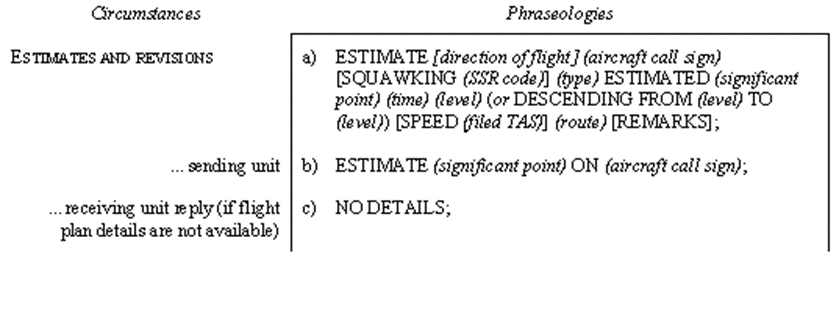
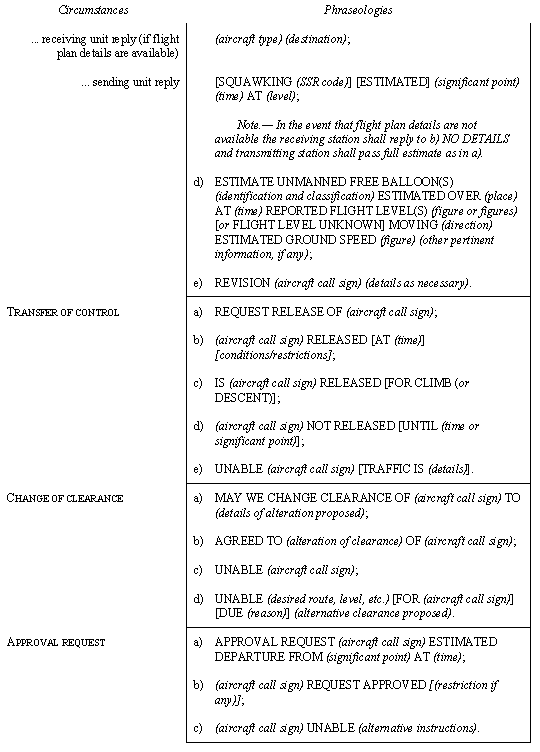
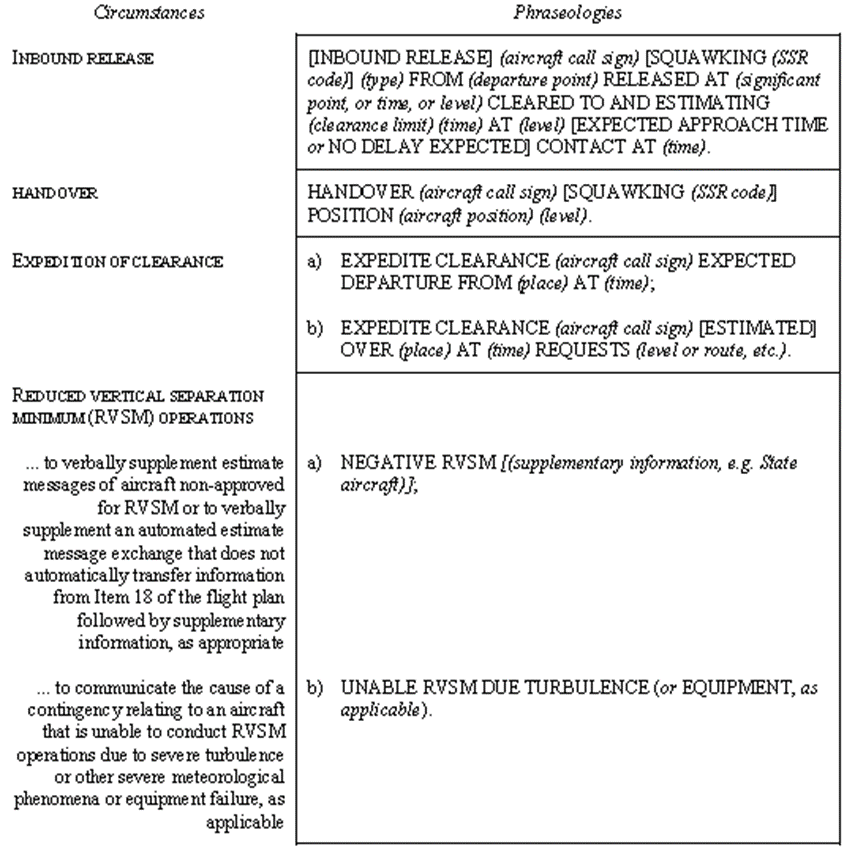
(b)When, in accordance with ATS.TR.120, communications between air traffic services units or sectors are effected in a mutually agreed language other than English, the air traffic services provider(s) should coordinate to develop and use a phraseology for coordination between such units or sectors.
ATS.TR.235 ATC clearances
Commission Implementing Regulation (EU) 2020/469
(a)ATC clearances shall be based solely on the requirements for providing air traffic control service.
(1)Clearances shall be issued solely for expediting and separating air traffic and be based on known traffic conditions which affect safety in aircraft operation. Such traffic conditions include not only aircraft in the air and on the manoeuvring area over which control is being exercised, but also any vehicular traffic or other obstructions not permanently installed on the manoeuvring area in use.
(2)Air traffic control units shall issue such ATC clearances as necessary to prevent collisions and to expedite and maintain an orderly flow of air traffic.
(3)ATC clearances shall be issued early enough to ensure that they are transmitted to the aircraft in sufficient time for it to comply with them.
(4)When the pilot-in-command of an aircraft informs an air traffic control unit that an ATC clearance is not satisfactory, the air traffic control unit shall issue an amended clearance, if practicable.
(5)When vectoring or assigning a direct routing not included in the flight plan, which takes an IFR flight off published ATS route or instrument procedure, an air traffic controller providing ATS surveillance service shall issue clearances such that the prescribed obstacle clearance exists at all times until the aircraft reaches the point where the pilot re-joins the flight plan route, or joins a published ATS route or instrument procedure.
(b)Contents of clearances
An ATC clearance shall indicate:
(1)aircraft identification as shown in the flight plan;
(2)clearance limit;
(3)route of flight:
(i)the route of flight shall be detailed in each clearance when deemed necessary;
(ii)the phrase ‘cleared flight planned route’ shall not be used when granting a re-clearance;
(4)level or levels of flight for the entire route or part thereof and changes of levels if required;
(5)any necessary instructions or information on other matters, such as ATFM departure slot if applicable, approach or departure manoeuvres, communications and the time of expiry of the clearance.
(c)In order to facilitate the delivery of the elements in point (b), an air traffic services provider shall assess the necessity for establishing standard departure and arrival routes and associated procedures to facilitate the:
(1)safe, orderly and expeditious flow of air traffic;
(2)description of the route and procedure in ATC clearances.
(d)Clearances for transonic flight
(1)The ATC clearance relating to the transonic acceleration phase of a supersonic flight shall extend at least to the end of that phase.
(2)The ATC clearance relating to the deceleration and descent of an aircraft from supersonic cruise to subsonic flight shall seek to provide for uninterrupted descent, at least during the transonic phase.
(e)Changes in clearance regarding route or level
(1)When issuing a clearance covering a requested change in route or level, the exact nature of the change shall be included in the clearance.
(2)When traffic conditions will not permit clearance of a requested change, the word ‘UNABLE’ shall be used. When warranted by circumstances, an alternative route or level shall be offered.
(f)Conditional clearances
Conditional phrases, such as ‘behind landing aircraft’ or ‘after departing aircraft’, shall not be used for movements affecting the active runway or runways except when the aircraft or vehicles concerned are seen by the appropriate air traffic controller and pilot. The aircraft or vehicle causing the condition in the clearance issued shall be the first aircraft or vehicle to pass in front of the other aircraft concerned. In all cases, a conditional clearance shall be given in the following order and consist of:
(1)the call sign;
(2)the condition;
(3)the clearance;
(4)a brief reiteration of the condition.
(g)Read-back of clearances, instructions and safety-related information
(1)The air traffic controller shall listen to the read-back concerning safety-related parts of ATC clearances and instructions as specified in points SERA.8015(e)(1) and (2) of the Annex to Implementing Regulation (EU) No 923/2012, to ascertain that the clearance or instruction, or both, have been correctly acknowledged by the flight crew and shall take immediate action to correct any discrepancies revealed by the read-back.
(2)Voice read-back of CPDLC messages shall not be required unless otherwise specified by the air traffic services provider.
(h)Coordination of clearances
An ATC clearance shall be coordinated between air traffic control units to cover the entire route of an aircraft or a specified portion thereof as follows.
(1)An aircraft shall be cleared for the entire route to the aerodrome of first intended landing in either of the following situations:
(i)when it has been possible, prior to departure, to coordinate the clearance between all the units under whose control the aircraft will come;
(ii)when there is reasonable assurance that prior coordination will be effected between those units under whose control the aircraft will subsequently come.
(2)When coordination as in point (1) has not been achieved or is not anticipated, the aircraft shall be cleared only to that point where coordination is reasonably assured; prior to reaching such point, or at such point, the aircraft shall receive further clearance, holding instructions being issued as appropriate.
(3)When prescribed by the air traffic services unit, aircraft shall contact a downstream air traffic control unit, for the purpose of receiving a downstream clearance prior to the transfer of control point.
(i)Aircraft shall maintain the necessary two-way communication with the current air traffic control unit whilst obtaining a downstream clearance.
(ii)A clearance issued as a downstream clearance shall be clearly identifiable as such to the pilot.
(iii)Unless coordinated, downstream clearances shall not affect the aircraft’s original flight profile in any airspace, other than that of the air traffic control unit responsible for the delivery of the downstream clearance.
(4)When an aircraft intends to depart from an aerodrome within a control area to enter another control area within a period of 30 minutes, or such other specific period of time as has been agreed between the area control centres concerned, coordination with the subsequent area control centre shall be effected prior to issuance of the departure clearance.
(5)When an aircraft intends to leave a control area for flight outside controlled airspace, and will subsequently re-enter the same or another control area, a clearance from the point of departure to the aerodrome of first intended landing may be issued. Such clearance or revisions thereto shall apply only to those portions of the flight conducted within controlled airspace.
GM1 ATS.TR.235 ATC clearances
ED Decision 2020/008/R
The issuance of ATC clearances by air traffic control units constitutes authority for an aircraft to proceed only in so far as known air traffic is concerned. ATC clearances do not constitute authority to violate any applicable regulations for promoting the safety of flight operations or for any other purpose; neither do clearances relieve a pilot-in-command of any responsibility whatsoever in connection with a possible violation of applicable rules and regulations.
GM1 ATS.TR.235(a)(5) ATC clearances
ED Decision 2020/008/R
ASSURANCE OF OBSTACLE CLEARANCE IN VECTORING
(a)Prescribed obstacle clearance will exist at all times when an air traffic controller issues clearances at or above the established minimum flight altitudes.
(b)When an IFR flight is being vectored, the pilot may be unable to determine the aircraft’s exact position in respect of obstacles in this area and consequently the altitude which provides the required obstacle clearance.
AMC1 ATS.TR.235(b) ATC clearances
ED Decision 2020/008/R
CONTENTS OF CLEARANCES FOR DEPARTING AIRCRAFT
Clearances for departing aircraft should specify, when necessary for the separation of aircraft:
(a)direction of take-off and turn after take-off;
(b)heading or track to be made good before taking up the cleared departure track;
(c)level to maintain before continuing climb to assigned level;
(d)time, point and/or rate at which a level change shall be made; and
(e)any other necessary manoeuvre consistent with safe operation of the aircraft.
GM1 to AMC1 ATS.TR.235(b) ATC clearances
ED Decision 2020/008/R
CORRECTION TO HEADING OR TRACK PRIOR TO TAKING UP THE CLEARED DEPARTURE TRACK
‘Track to be made good’ means that the pilot should correct for the wind effect and to fly a heading that would ensure keeping that track.
AMC2 ATS.TR.235(b) ATC clearances
ED Decision 2020/008/R
CONTENTS OF STANDARD CLEARANCES FOR DEPARTING AIRCRAFT
Standard clearances for departing aircraft should contain the following items:
(a)aircraft identification;
(b)clearance limit (normally destination aerodrome);
(c)designator of the assigned SID, if applicable;
(d)cleared level;
(e)allocated SSR code; and
(f)any other necessary instructions or information not contained in the SID description, e.g. instructions relating to change of frequency.
GM1 to AMC2 ATS.TR.235(b) ATC clearances
ED Decision 2020/008/R
CONTENTS OF STANDARD CLEARANCES FOR DEPARTING AIRCRAFT — COMMUNICATION FAILURE
(a)Clearances for departing aircraft may specify a cleared level other than that indicated in the filed flight plan for the en-route phase of flight, without a time or geographical limit for the cleared level. Such clearances will normally be used to facilitate the application of tactical control methods by air traffic control units, normally through the use of an ATS surveillance system.
(b)Where clearances for departing aircraft which contain no time or geographical limit for a cleared level are utilised, the action to be taken by an aircraft experiencing air-ground communication failure in the event that the aircraft has been radar-vectored away from the route specified in its current flight plan, should be prescribed on the basis of a regional air navigation agreement and included in the SID description or published in AIPs.
AMC3 ATS.TR.235(b) ATC clearances
ED Decision 2020/008/R
CLEARANCES FOR ARRIVING IFR FLIGHTS
An IFR flight should neither be cleared for an initial approach below the appropriate minimum altitude as specified by the State concerned nor descend below that altitude unless:
(a)the pilot has reported passing an appropriate point defined by a navigation aid or as a waypoint; or
(b)the pilot reports that the aerodrome is and can be maintained in sight; or
(c)the aircraft is conducting a visual approach; or
(d)the air traffic controller has determined the aircraft’s position through the use of an ATS surveillance system, and a lower minimum altitude has been specified for use when providing ATS surveillance services.
AMC4 ATS.TR.235(b) ATC clearances
ED Decision 2020/008/R
CONTENTS OF STANDARD CLEARANCES FOR ARRIVING AIRCRAFT
Standard clearances for arriving aircraft should contain the following items:
(a)aircraft identification;
(b)designator of the assigned STAR if applicable;
(c)runway-in-use, except when part of the STAR description;
(d)cleared level; and
(e)any other necessary instructions or information not contained in the STAR description, e.g. change of communications.
AMC1 ATS.TR.235(b)(2) ATC clearances
ED Decision 2020/008/R
SPECIFICATION OF CLEARANCE LIMIT
A clearance limit should be described by specifying the name of an appropriate significant point, or aerodrome, or controlled airspace boundary.
GM1 to AMC1 ATS.TR.235(b)(2) ATC clearances
ED Decision 2020/008/R
SPECIFICATION OF CLEARANCE LIMIT
(a)When prior coordination has been effected with units under whose control the aircraft will subsequently come, or if there is reasonable assurance that it can be effected a reasonable time prior to their assumption of control, the clearance limit should be the destination aerodrome or, if not practicable, an appropriate intermediate point, and coordination should be expedited so that a clearance to the destination aerodrome may be issued as soon as possible.
(b)If an aircraft has been cleared to an intermediate point in adjacent controlled airspace, the appropriate air traffic control unit will then be responsible for issuing, as soon as practicable, an amended clearance to the destination aerodrome.
(c)When the destination aerodrome is outside controlled airspace, the air traffic control unit responsible for the last controlled airspace through which an aircraft will pass should issue the appropriate clearance for flight to the limit of that controlled airspace.
GM1 ATS.TR.235(b)(3)(i) ATC clearances
ED Decision 2020/008/R
The phrase ‘cleared flight planned route’ may be used to describe any route or portion thereof, provided the route or portion thereof is identical to that filed in the flight plan and sufficient routing details are given to definitely establish the aircraft on its route. The phrases ‘cleared (designation) departure’ or ‘cleared (designation) arrival’ may be used when standard departure or arrival routes have been established and published in AIPs.
AMC1 ATS.TR.235(b)(4) ATC clearances
ED Decision 2020/008/R
INSTRUCTIONS IN CLEARANCES RELATING TO LEVELS
Instructions included in clearances relating to levels should consist of:
(a)cruising level(s) or, for cruise climb, a range of levels, and, if necessary, the point to which the clearance is valid with regard to the level(s);
(b)levels at which specified significant points are to be crossed, when necessary;
(c)the place or time for starting climb or descent, when necessary;
(d)the rate of climb or descent, when necessary; and
(e)detailed instructions concerning departure or approach levels, when necessary.
GM1 ATS.TR.235(b)(4) ATC clearances
ED Decision 2020/008/R
ASSIGNMENT OF FLIGHT LEVELS FOR CONTROLLED FLIGHTS
(a)Except when traffic conditions and coordination procedures permit authorisation of cruise climb, an air traffic control unit should normally authorise only one level for an aircraft beyond its control area, i.e. that level at which the aircraft will enter the next control area whether contiguous or not. It is the responsibility of the accepting control unit to issue clearance for further climb as appropriate. When relevant, aircraft will be advised to request en-route any cruising level changes desired.
(b)In so far as practicable, cruising levels of aircraft flying to the same destination should be assigned in a manner that will be correct for an approach sequence at destination.
(c)An aircraft at a cruising level should normally have priority over other aircraft requesting that cruising level. When two or more aircraft are at the same cruising level, the preceding aircraft should normally have priority.
GM1 ATS.TR.235(b)(5) ATC clearances
ED Decision 2020/008/R
CONTENT OF THE CLEARANCES — TIME OF EXPIRY
The time of expiry of the clearance indicates the time after which the clearance will be automatically cancelled if the flight has not been commenced.
GM1 ATS.TR.235(c) ATC clearances
ED Decision 2020/008/R
ESTABLISHMENT AND PROCEDURES FOR STANDARD ARRIVAL AND DEPARTURE ROUTES
Guidance related to the establishment of standard departure and arrival routes and associated procedures is available in ICAO Doc 9426 ‘ATS Planning Manual’ (Chapter 4, Appendix A).
AMC1 ATS.TR.235(d) ATC clearances
ED Decision 2020/008/R
CLEARANCES FOR TRANSONIC FLIGHT
(a)Air traffic control units should, whenever practicable, deliver clearance for the transonic acceleration phase to aircraft intending supersonic flight prior to departure.
(b)During the transonic and supersonic phases of a flight, amendments to the clearance should be kept to a minimum and should take due account of the operational limitations of the aircraft in these flight phases.
GM1 ATS.TR.235(e) ATC clearances
ED Decision 2020/008/R
CHANGE IN CLEARANCE REGARDING ROUTE
The nature of the change should include a description of the route and levels to the point where it joins the previously cleared route, or, if the aircraft will not rejoin the previous route, to the destination.
GM2 ATS.TR.235(e) ATC clearances
ED Decision 2020/008/R
CHANGE IN CLEARANCE REGARDING CRUISING LEVEL
If it is necessary to change the cruising level of an aircraft operating along an established ATS route extending partly within and partly outside controlled airspace and where the respective series of cruising levels are not identical, the change should, whenever possible, be effected within controlled airspace.
GM1 ATS.TR.235(g)(2 ATC clearances
ED Decision 2020/008/R
READ-BACK OF CPDLC MESSAGES
When so indicated by local safety assessments, the air traffic services provider may require that the receipt of some of the CPDLC message types (in particular those addressing trajectory changes) is acknowledged by voice.
GM1 ATS.TR.235(h)(1) ATC clearances
ED Decision 2020/008/R
CLEARANCE UPDATE
Where a clearance is issued covering the initial part of the flight solely as a means of expediting departing traffic, the succeeding en-route clearance will be as specified in point (h)(1) of ATS.TR.235 even though the aerodrome of first intended landing is under the jurisdiction of an ACC other than the one issuing the en-route clearance.
GM1 ATS.TR.235(h)(3)(i) ATC clearances
ED Decision 2020/008/R
AIR-GROUND COMMUNICATION FOR DELIVERY OF DOWNSTREAM CLEARANCES
Where practicable, and where data link communications are used to facilitate downstream clearance delivery, two-way voice communications between the pilot and the air traffic control unit providing the downstream clearance should be available.
ATS.TR.237 Dynamic reconfiguration of the U-space airspace
Regulation (EU) 2021/665
Air traffic control units shall:
(a)temporarily limit the area within the designated U-space airspace where UAS operations can take place in order to accommodate short-term changes in manned traffic demand by adjusting the lateral and vertical limits of the U-space airspace;
(b)ensure that the relevant U-space service providers and, where applicable, single common information service providers are notified in a timely and effective manner of the activation, deactivation and temporary limitations of the designated U-space airspace.
AMC1 ATS.TR.237(a) Dynamic reconfiguration of the U-space airspace
ED Decision 2022/023/R
IMPACT OF DYNAMIC AIRSPACE RECONFIGURATION ON UAS OPERATIONS
Air traffic control units should only apply dynamic reconfiguration of the U-space airspace if there is a risk of collision between manned and unmanned aircraft, causing the revised flight authorisation of UASs, or potentially causing the forced landing of unmanned aircraft.
AMC2 ATS.TR.237(a) Dynamic reconfiguration of the U-space airspace
ED Decision 2022/023/R
PRIORITY TO SPECIAL OPERATIONS
When intending to apply dynamic reconfiguration of the U-space airspace, air traffic control units should give priority to special operations, as defined in Article 4 of Regulation (EU) No 923/2012, whether performed by UASs or manned aircraft.
GM1 ATS.TR.237(a) Dynamic reconfiguration of the U-space airspace
ED Decision 2022/023/R
TIMELY RECEIPT OF INFORMATION
Air traffic control units are expected to coordinate with U-space service providers to ensure they will receive the information about UAS special operations in a timely manner so that that the air traffic control units can prioritise the traffic in the affected U-space airspace.
GM2 ATS.TR.237(a) Dynamic reconfiguration of the U-space airspace
ED Decision 2022/023/R
PROPORTIONATE RESPONSE
(a)For the purpose of supporting a more flexible use of the available airspace and to reduce the likelihood of forced landings, as airspace volumes are three-dimensional, Member States may consider dynamic reconfiguration of the U-space airspace in a three-dimensional multi-phased manner.
(b)The following multi-phased reconfiguration may be considered:
(1)Vertical limitation: limit the ceiling of UAS operations to a level such as the lowest limit of the applicable obstacle limitation surface (i.e. inner horizontal surface), when available. Lowering the ceiling of the U-space airspace would allow for continuous segregated operations as manned aircraft will fly above UASs. Keeping the U-space airspace partially active and usable for a prolonged period of time would safeguard the operation of UASs that fly at a lower altitude.
(2)Lateral limitation: deactivation of a U-space airspace section, where manned aircraft operations take place, down to ground. UAS flights outside the deactivated portion may continue. Hereby, the impact on UAS operations is limited to what is necessary.
(3)Full deactivation: fully deactivating the U-space airspace.
(c)As a result of the vertical and lateral limitation phases, UASs in flight will comply with updated UAS flight authorisations, as applicable, or immediately approach a predefined safety landing point, while because of the full deactivation phase they will proceed to such landing point. Safety landing points are appropriately selected by the UAS operator and submitted during UAS flight authorisation to ensure a quick landing without endangering people or surrounding property on the ground or damaging the UAS hardware.
AMC1 ATS.TR.237(b) Dynamic reconfiguration of the U-space airspace
ED Decision 2022/023/R
TIMELY NOTIFICATION
Air traffic control units should coordinate with the U-space service providers concerned to ensure they will be notified as early as possible of the dynamic reconfiguration of the U-space airspace, so that the UAS operators may anticipate and apply any required action.
GM1 ATS.TR.237(b) Dynamic reconfiguration of the U-space airspace
ED Decision 2022/023/R
EFFECTIVE COORDINATION
(a)Establishing a preset, minimum advance notice (in terms of time) could be difficult in many instances; however, analogy may be found in this respect in EUROCAE ED-269 ‘Minimum Operational Performance Standard for UAS Geo-Fencing’ (published on 1 June 2020), which specifies the minimum performance expected from a geofencing function to ensure that it will perform its intended sub-functions satisfactorily under all conditions normally encountered in a routine aeronautical operation.
(b)EUROCAE ED-269 indicates the issue of a caution alert to the UAS operators when the location where the operations are taking place is to become forbidden soon and will have to be exited soon enough to enable exit before active restriction; for example; considering the distance to fly back to the authorised limit (or distance to exit) divided by the anticipated ground speed to do so. A minimum value of 2 minutes is suggested. It is also recommended to have an advisory alert before the caution alert (either 10 minutes or 5 times the caution anticipation time).
(c)In any case, when data that results from the dynamic airspace reconfiguration is made available as part of the common information service, it may include starting/ending time of the reconfiguration; otherwise it is intended to be immediately applicable, until further notice.
(d)Except for emergency situations, coordination between air traffic control units and U-space service providers should allow for the completion of any authorised UAS flight that has started already, possibly through a revised UAS flight authorisation. In circumstances where the air traffic control unit considers that this would inappropriately postpone the airspace reconfiguration, UAS operators should at least be allowed sufficient time to reposition unmanned aircraft according to the adjusted geographical limits of the U-space airspace, or to safely proceed, without delay, to a landing site.
ATS.TR.240 Control of persons and vehicles at controlled aerodromes
Commission Implementing Regulation (EU) 2020/469
(a)The movement of persons or vehicles, including towed aircraft, on the manoeuvring area of an aerodrome shall be controlled by the aerodrome control tower as necessary to avoid hazard to them or to aircraft landing, taxiing or taking off.
(b)In conditions where low-visibility procedures are in operation:
(1)persons and vehicles operating on the manoeuvring area of an aerodrome shall be restricted to the essential minimum, and particular regard shall be given to the requirements to protect the critical and sensitive area or areas of radio navigation aids;
(2)subject to the provisions in point (c), the method or methods to separate vehicles and taxiing aircraft shall be as specified by the air traffic services provider and approved by the competent authority taking into account the aids available;
(3)when mixed ILS and MLS Category II or Category III precision instrument operations are taking place to the same runway continuously, the more restrictive ILS or MLS critical and sensitive areas shall be protected.
(c)Emergency vehicles proceeding to the assistance of an aircraft in distress shall be afforded priority over all other surface movement traffic.
(d)Subject to the provisions in point (c), vehicles on the manoeuvring area shall be required to comply with the following rules:
(1)vehicles and vehicles towing aircraft shall give way to aircraft which are landing, taking off or taxiing;
(2)vehicles shall give way to other vehicles towing aircraft;
(3)vehicles shall give way to other vehicles in accordance with air traffic services unit instructions;
(4)notwithstanding the provisions of points (1), (2) and (3), vehicles and vehicles towing aircraft shall comply with instructions issued by the aerodrome control tower.
AMC1 ATS.TR.240(a) Control of persons and vehicles at controlled aerodromes
ED Decision 2020/008/R
CONTROL OF OTHER THAN AIRCRAFT TRAFFIC ON THE MANOEUVRING AREA
(a)The movement of pedestrians or vehicles on the manoeuvring area should be subject to authorisation by the aerodrome control tower. Persons, including drivers of all vehicles, should be required to obtain authorisation from the aerodrome control tower before entry to the manoeuvring area. Notwithstanding such an authorisation, entry to a runway or runway strip or change in the operation authorised should be subject to a further specific authorisation by the aerodrome control tower.
(b)When an aircraft is landing or taking off, the air traffic controller should not permit vehicles to hold closer to the runway-in-use than:
(1)at a taxiway/runway intersection — at a runway-holding position; and
(2)at a location other than a taxiway/runway intersection — at a distance equal to the separation distance of the runway-holding position.
AMC2 ATS.TR.240(a) Control of persons and vehicles at controlled aerodromes
ED Decision 2020/008/R
UNCERTAINTY ON AIRCRAFT AND/OR VEHICLES POSITION ON THE MANOEUVRING AREA
In the event that the aerodrome air traffic controller becomes aware of an aircraft or vehicle that is lost or uncertain of its position on the manoeuvring area, he or she should immediately take appropriate action to safeguard operations and assist the aircraft or vehicle concerned in determining its position.
GM1 ATS.TR.240(b)(2) Control of persons and vehicles at controlled aerodromes
ED Decision 2020/008/R
CONTROL OF PERSONS AND VEHICLES AT AERODROMES
In prescribing the separation method(s) between vehicles and taxiing aircraft, the availability of lighting, markings, signals and signage should normally be taken into account.
GM1 ATS.TR.240(c) Control of persons and vehicles at controlled aerodromes
ED Decision 2020/008/R
PRIORITY TO EMERGENCY VEHICLES
When emergency vehicles are proceeding to the assistance of an aircraft in distress, all other movement of surface traffic should, to the extent practicable, be halted until it is determined that the progress of the emergency vehicles will not be impeded.
ATS.TR.245 Use of surface movement surveillance equipment at aerodromes
Commission Implementing Regulation (EU) 2020/469
Where deemed necessary, in the absence of visual observation of all or part of the manoeuvring area or to supplement visual observation, advanced surface movement guidance and control systems (A-SMGCS) or other suitable surveillance equipment, shall be utilised by the air traffic services unit in order to:
(a)monitor the movements of aircraft and vehicles on the manoeuvring area;
(b)provide directional information to pilots and vehicle drivers as necessary;
(c)provide advice and assistance for the safe and efficient movement of aircraft and vehicles on the manoeuvring area.
GM1 ATS.TR.245 Use of surface movement surveillance equipment at aerodromes
ED Decision 2020/008/R
FUNCTIONS OF SURFACE MOVEMENT RADAR IN SURFACE MOVEMENT CONTROL
The information displayed on an SMR display may be used to assist in:
(a)monitoring of aircraft and vehicles on the manoeuvring area for compliance with clearances and instructions;
(b)determining that a runway is clear of traffic prior to a landing or take-off;
(c)providing information on essential local traffic on or near the manoeuvring area;
(d)determining the location of aircraft and vehicles on the manoeuvring area;
(e)providing directional taxi information to aircraft when requested by the pilot or deemed necessary by the air traffic controller. Except under special circumstances, e.g. emergencies, such information should not be issued in the form of specific heading instructions; and
(f)providing assistance and advice to emergency vehicles.
GM2 ATS.TR.245 Use of surface movement surveillance equipment at aerodromes
ED Decision 2020/008/R
FUNCTIONS OF ADVANCED SURFACE MOVEMENT GUIDANCE AND CONTROL SYSTEMS — A-SMGCS IN SURFACE MOVEMENT CONTROL
When authorised and subject to conditions prescribed by the competent authority, the information provided on an A-SMGCS display may be used for the purpose of:
(a)determining the location of aircraft on the movement area and vehicles on the manoeuvring area. Where visual observation by the aerodrome air traffic controller is not possible, or whenever deemed beneficial by the aerodrome air traffic controller, the information provided by A-SMGCS may be used to replace visual observation;
(b)monitoring of aircraft and vehicles on the manoeuvring area for compliance with clearances and instructions;
(c)determining that a runway is clear of traffic or assisting in the assessment that a runway will be clear of traffic prior to a landing or take-off;
(d)providing information on essential local traffic on or near the manoeuvring area;
(e)providing directional taxi information to aircraft when requested by the pilot or deemed necessary by the air traffic controller. Such information should not be issued in the form of specific heading instructions (except in special circumstances, e.g. emergencies); and
(f)providing assistance and advice to emergency vehicles.
ATS.TR.250 Essential traffic and essential local traffic information
Commission Implementing Regulation (EU) 2020/469
(a)Essential traffic information shall be given to controlled flights concerned whenever they constitute essential traffic to each other.
(b)Essential local traffic information known to the air traffic controller shall be given without delay to departing and arriving aircraft concerned.
AMC1 ATS.TR.250(a) Essential traffic and essential local traffic information
ED Decision 2020/008/R
ESSENTIAL TRAFFIC INFORMATION — CONTENT
Essential traffic information should include the following information if relevant and available:
(a)direction of flight of aircraft concerned;
(b)type and wake turbulence category of aircraft concerned;
(c)level of aircraft concerned; and
(d)one of the following:
(1)estimated time over the reporting point nearest to where the level will be crossed; or
(2)relative bearing of the aircraft concerned in terms of the 12-hour clock as well as distance from the conflicting traffic; or
(3)actual or estimated position of the aircraft concerned.
GM1 ATS.TR.250(a) Essential traffic and essential local traffic information
ED Decision 2020/008/R
ESSENTIAL TRAFFIC INFORMATION — CONTENT
Subject to provisions in point (b) of ATS.TR.210, air traffic control units are required to provide separation between IFR flights in airspace classes A to E, and between IFR and VFR flights in classes B and C. Air traffic control units are not required to provide separation between VFR flights, except within airspace class B. Therefore, IFR or VFR flights may constitute essential traffic to IFR traffic, and IFR flights may constitute essential traffic to VFR traffic. However, a VFR flight would not constitute essential traffic to other VFR flights except within class B airspace.
AMC1 ATS.TR.250(b) Essential traffic and essential local traffic information
ED Decision 2020/008/R
ESSENTIAL LOCAL TRAFFIC INFORMATION
(a)Information on essential local traffic should be issued in a timely manner, either directly or through the unit providing approach control service when, in the judgement of the aerodrome air traffic control, such information is necessary in the interest of safety, or when requested by aircraft.
(b)Essential local traffic should be described so as to be easily identified.
ATS.TR.255 Operations on parallel or near-parallel runways
Commission Implementing Regulation (EU) 2020/469
When independent or dependent operations on instrument approach to or departure from parallel or near-parallel runways are conducted, procedures shall be established by the air traffic services provider and approved by the competent authority.
AMC1 ATS.TR.255 Operations on parallel or near-parallel runways
ED Decision 2020/008/R
REQUIREMENTS AND PROCEDURES FOR INDEPENDENT PARALLEL DEPARTURES
(a)Parallel runways may be used for independent instrument departures as follows:
(1)both runways are used exclusively for departures (independent departures); or
(2)one runway is used exclusively for departures while the other runway is used for a mixture of arrivals and departures (semi-mixed operation); or
(3)both runways are used for mixed arrivals and departures (mixed operation).
(b)Independent IFR departures should only be conducted from parallel runways when the conditions listed below are met:
(1)the runway centre lines are spaced by a minimum distance of 760 m (2 500 ft) (as also specified in CS ADR-DSN.B.055 ‘Minimum distance between parallel instrument runways’ in EASA ED Decision 2014/013/R ‘Certification Specifications and Guidance Material For Aerodromes Design’, as amended);
(2)the nominal departure tracks diverge by at least:
(i)15 degrees immediately after take-off; or
(ii)10 degrees where:
(A)both aircraft are flying an RNAV or RNP instrument departure; and
(B)the turn commences no more than 3.7 km (2.0 NM) from the departure end of the runway;
(3)a suitable ATS surveillance system capable of identification of the aircraft within 1.9 km (1.0 NM) from the end of the runway is available; and
(4)ATS operational procedures ensure that the required track divergence is achieved.
AMC2 ATS.TR.255 Operations on parallel or near-parallel runways
ED Decision 2020/008/R
REQUIREMENTS AND PROCEDURES FOR INDEPENDENT PARALLEL APPROACHES
Independent parallel approaches should only be conducted to parallel runways when the following conditions are met:
(a)separate air traffic controllers are responsible for the sequencing and spacing of arriving aircraft to each runway;
(b)as early as practicable after an aircraft has established communication, the approach control unit advises the aircraft that independent parallel approaches are in force;
(c)the following ATS surveillance criteria are met:
(1)for runway centreline spacing less than 1 310 m (4 300 ft) but not less than 1 035 m
(3 400 ft), an ATS surveillance system with:
(i)a minimum accuracy as follows:
(A)for SSR, an azimuth accuracy of 0.06 degrees (one sigma); or
(B)for MLAT or ADS-B, an accuracy of 30 m (100 ft);
(ii)an update of 2.5 seconds or less; and
(iii)a high-resolution display providing position prediction and deviation alert;
(2)for runway centreline spacing less than 1 525 m (5 000 ft) but not less than 1 310 m
(4 300 ft), provided that it is determined that the safety of aircraft operations is not adversely affected, an ATS surveillance system:
(i)with performance specifications equal to or better than:
(A)for SSR, a demonstrated minimum accuracy of 0.3 degrees (one sigma); or
(B)for MLAT or ADS-B, a demonstrated performance capability equivalent to or better than the SSR requirement;
(ii)with an update of 5 seconds or less;
(3)for runway centreline spacing of 1 525 m (5 000 ft) or more, a surveillance system with:
(i)a minimum SSR azimuth accuracy of 0.3 degrees (one sigma), or for MLAT or ADS-B, a demonstrated performance capability equivalent to or better than the SSR requirement; and
(ii)an update of 5 seconds or less;
(d)the instrument approach procedure that aligns the aircraft with the extended runway centre line is one of the following:
(1)a precision approach procedure;
(2)an approach with vertical guidance (APV) designed using the RNP AR APCH specification where:
(i)the RNP value for B, and the RNP value for C, if that segment of the approach is within the horizontal separation minimum of a parallel approach, does not exceed one quarter of the distance between runway centre lines (A) (see Figure 51); and
(ii)the RNP value for B, and the RNP value for C, if that part of the approach is within the horizontal separation minimum of a parallel approach, does not exceed (A-D)/2 (see Figure 51);
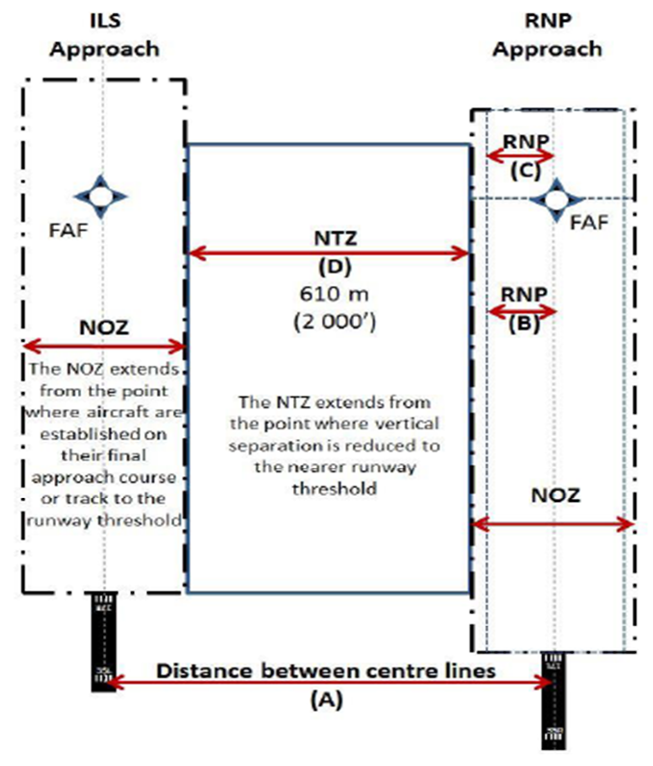
Figure 51: Distance between centre lines, NTZ and NOZ
(3)an APV procedure designed using either the RNP APCH or RNP AR APCH navigation specification, provided that:
(i)an appropriate documented safety assessment has shown that an acceptable level of safety can be met;
(ii)operations are approved by the competent authority; and
(iii)the instrument approach is demonstrated to protect the NTZ from infringement during normal operations;
(e)the nominal tracks of the missed approach procedures diverge by at least 30 degrees;
(f)an obstacle survey and evaluation is completed, as appropriate, for the areas adjacent to the final approach segments;
(g)aircraft are advised as early as possible, of the assigned runway, instrument approach procedure and any additional information considered necessary to confirm correct selection;
(h)the final approach course or track is intercepted by use of either:
(1)a published arrival and approach procedures that intercept with the IAF or the intermediate approach fix (IF); or
(2)vectoring, provided that:
(i)the final vector meets the following conditions:
(A)enable the aircraft to intercept at an angle not greater than 30 degrees;
(B)provide at least 1.9 km (1.0 NM) straight and level flight prior to the final approach course or track intercept; and
(C)enable the aircraft to be established on the final approach course or track in level flight for at least 3.7 km (2.0 NM) prior to intercepting the glide path or vertical path for the selected instrument approach procedure;
(ii)when assigning the final vector, the aircraft is advised of:
(A)the runway to which the approach is being made;
(B)its position relative to a fix on the final approach course or track;
(C)the altitude to be maintained until established on the final approach course or track, to the glide path or vertical path intercept point; and
(D)if required, clearance for the appropriate approach.
(i)an NTZ at least 610 m (2 000 ft) wide is established equidistant between extended runway centre lines and is depicted on the ATS surveillance system situation display;
(j)a minimum of a nominal 300 m (1 000 ft) vertical separation or, subject to ATS surveillance system capabilities, a minimum of 5.6 km (3.0 NM) horizontal separation is provided between aircraft on adjacent approaches until the aircraft are established inbound on a final approach course or track, or on an RNP AR APCH approach, and within the normal operating zone (NOZ);
(k)a minimum of 5.6 km (3.0 NM) horizontal separation, or a minimum of 4.6 km (2.5 NM) horizontal separation if so determined in accordance with point (a) of ATS.TR.215, is provided between aircraft established on the same final approach course or track, unless increased longitudinal separation is required due to wake turbulence;
(l)the approaches to each runway are monitored with an ATS surveillance system by separate air traffic controllers (referred to as monitoring controllers) different than those in point (a) above for each runway, or, if determined by a safety assessment and approved by the competent authority, by a single monitoring controller for no more than two runways:
(1)on dedicated radio channels, or when no such channels are available to the monitoring controller until landing, it is assured that:
(i)transfer of communication of aircraft to the respective aerodrome air traffic controller’s channel is effected before either of the two aircraft on adjacent final approach tracks intercepts the glide path or vertical path for the selected instrument approach procedure; and
(ii)the air traffic controller(s) monitoring the approaches to each runway are provided with the capability to override transmissions of aerodrome control on the respective radio channels for each arrival flow;
(2)so that when the nominal 300 m (1 000 ft) vertical separation is reduced:
(i)the applicable minimum longitudinal separation between aircraft on the same final approach course or track is maintained; and
(ii)aircraft do not penetrate the depicted NTZ by issuing instructions as follows:
(A)when it is observed that an aircraft overshoots the turn-on or continues on a track which will penetrate the NTZ, the aircraft is instructed to return immediately to the correct track; or
(B)when an aircraft is observed penetrating the NTZ, the aircraft on the adjacent final approach course or track is instructed to immediately climb and turn to the assigned altitude/height and heading (break-out procedure) in order to avoid the deviating aircraft. Where parallel approach obstacle assessment surfaces (PAOAS) criteria are applied for the obstacle assessment, the monitoring controller (see below in point (f)) should not issue the heading instruction to the aircraft below 120 m (400 ft) above the runway threshold elevation, and the heading instruction should not exceed 45 degrees track difference with the final approach course or track;
(3)the monitoring is provided until:
(i)separation as stipulated in point (b)(1) of AMC3 ATS.TR.210(c)(2) is applied, provided the established procedures ensure that monitoring controllers are advised whenever such separation is applied; or
(ii)the aircraft has landed, or in case of a missed approach, is at least 1.9 km (1.0 NM) beyond the departure end of the runway and adequate separation with any other traffic is established;
(m)the meteorological conditions under which independent parallel approaches are suspended for runway centre lines which are spaced less than 1 525 m (5 000 ft) are defined by the air traffic services provider and approved by the competent authority.
GM1 to AMC2 ATS.TR.255 Operations on parallel or near-parallel runways
ED Decision 2020/008/R
The information that independent parallel operations are in force may be provided through the ATIS broadcasts.
GM2 to AMC2 ATS.TR.255 Operations on parallel or near-parallel runways
ED Decision 2020/008/R
HIGH-RESOLUTION DISPLAY
With reference to point (c)(1)(iii) of AMC2 ATS.TR.255, a high-resolution display should:
(a)enable the air traffic controller to determine whether an aircraft is correctly aligned with the intended trajectory;
(b)depict the NTZ(s);
(c)be able to display any obstacle that would adversely affect a break-out procedure; and
(d)accurately reflect the azimuth accuracy prescribed in point (c)(1)(i)(A) of AMC2 ATS.TR.255.
GM3 to AMC2 ATS.TR.255 Operations on parallel or near-parallel runways
ED Decision 2020/008/R
PRECISION APPROACH PROCEDURE
With reference to point (d)(1) of AMC2 ATS.TR.255, the precision approach procedure that aligns the aircraft with the extended runway centre line may include one of the following: ILS, GLS, MLS or SBAS CAT I, when applicable, for the final approach segment.
GM4 to AMC2 ATS.TR.255 Operations on parallel or near-parallel runways
ED Decision 2020/008/R
PRECISION APPROACH PROCEDURE — DEMONSTRATION OF SAFETY
With reference to point (d)(3) of AMC2 ATS.TR.255, the demonstration of the safety of an APV procedure designed using either RNP APCH or RNP AR APCH navigation specification during simultaneous approaches may consider, inter alia:
(a)the collision risk from normal and residual (not mitigated) atypical errors;
(b)likelihood of ACAS nuisance alerting during normal operations;
(c)wake hazard;
(d)monitoring and available levels of system automation;
(e)data base management;
(f)flight management system input and related crew workload;
(g)impacts of meteorological conditions and other environmental factors; and
(h)training and published ATC break-out procedures.
GM5 to AMC2 ATS.TR.255 Operations on parallel or near-parallel runways
ED Decision 2020/008/R
SAFETY ASSESSMENT
With reference to point (l) of AMC2 ATS.TR.255, the conduct of safety assessments to enable the monitoring of not more than two runways by a single air traffic controller should review factors such as, but not limited to, complexity, times of operation, traffic mix and density, arrival rate, available levels of system automation, availability of back-up systems, impacts of meteorological conditions and other environmental factors.
GM6 to AMC2 ATS.TR.255 Operations on parallel or near-parallel runways
ED Decision 2020/008/R
MONITORING CONTROLLER
With reference to point (l) of :
(a)Independent operations on parallel runways can only be conducted if there are means to ensure that the objectives of the air traffic services would be fulfilled in a manner similar to what the application of separation minima (vertical or horizontal) would achieve.
(b)Considering the geometry of two aircraft operating simultaneously on the parallel runways, while longitudinal separation is applied between aircraft approaching the same runway, a lateral separation is needed between the aircraft operating on parallel approaches for the most critical scenario: two aircraft at the same time on each final approach.
(c)To provide the acceptable lateral separation in such circumstances, an NTZ is established. The NTZ is considered to provide the lateral separation from the moment vertical separation between aircraft on adjacent approaches no longer exists until aircraft have landed. The responsibility of air traffic controllers is to closely monitor the progress of the flights and to immediately react when an aircraft deviates towards the NTZ boundary.
(d)In that sense, the tasks of these air traffic controllers (referred to as ‘monitoring controllers’), are as follows:
(1)to ensure that the NTZ is not penetrated when vertical separation is reduced;
(2)to instruct aircraft observed to overshoot the turn-on or to continue on a track which will penetrate the NTZ to return immediately to the correct track;
(3)to ensure that the applicable minimum longitudinal separation between aircraft on the same final approach course or track is maintained;
(4)if no dedicated radio channels are available for the monitoring controllers to control aircraft until landing, to transfer communication with the aircraft to the respective channel of the aerodrome air traffic controller before either of the two aircraft on adjacent final approach tracks intercepts the glide path or vertical path for the selected instrument approach procedure. In this case, the controllers monitoring the approaches to each runway are provided with the capability to override transmissions of aerodrome control on the respective radio channels for each arrival flow;
(5)if dedicated radio channels are available for the monitoring controllers to relay the landing clearances received from the aerodrome air traffic controller, or when the aerodrome air traffic controller informs that visual separation can be applied, to transfer the communications to the aerodrome air traffic controller;
(6)when an aircraft is observed penetrating the NTZ, to instruct the aircraft on the adjacent final approach course or track to immediately climb and turn to an assigned altitude/height and heading (break-out procedures) in order to avoid the deviating aircraft. Where PAOAS criteria are applied for the obstacle assessment, the monitoring controller will not issue the heading instruction to the aircraft below 120 m (400 ft) above the runway threshold elevation, and the heading instruction will not exceed 45 degrees track difference with the final approach course or track; and
(7)to terminate monitoring when either:
(i)visual separation is applied provided that procedures ensure that both monitoring controllers are advised whenever visual separation is applied; or
(ii)the aircraft has landed or, in case of a missed approach, is at least 1 NM beyond the departure end of the runway and adequate separation with other traffic is established.
(e)When there is a large deviation from the final approach track, communication between the controllers and pilots involved is critical. For independent parallel approaches, monitoring controllers are required, for each runway, with separate control frequencies. The monitoring controller(s) can transmit on either of these frequencies, automatically overriding transmissions by the other aerodrome air traffic controllers, or can use dedicated radio channels, if available. It is essential that a check of the override capability at each monitor position be performed prior to the monitoring controllers assuming responsibility of the position. The air traffic services provider should take steps to ensure that, in the event of a deviation, the monitoring controller will be able to contact the deviating aircraft and the endangered aircraft immediately. This will involve studying the proportion of time during which communications are blocked.
(f)Monitoring of approaches to no more than two runways by a single monitoring controller may be permitted if determined by a safety assessment and approved by the competent authority, as described below.
(g)During simultaneous independent approach operations, participating aircraft are established on guidance to instrument approach procedures which have been designed to not interfere with one another. By remaining on their guidance, the aircraft are, by design, not threats to each other, and are considered separated. If either aircraft deviates from its lateral path defined by its assigned instrument approach, separation is no longer assured. To protect against operational errors, system or equipment failures, etc., Simultaneous Operations on Parallel or Near-Parallel Instrument Runways (SOIR) procedures require the monitoring controller to provide intervention as necessary. Monitoring controllers are required to identify and respond to such traffic transgressions in a timely manner to protect proximate traffic and minimise collision risk. Their responsibility is to recognise a deviation from a cleared lateral path, determine a manoeuvre for any nearby traffic that might be threatened by this deviation that will avoid a collision, and transmit this manoeuvre instruction to the threatened aircraft. If there is no threatened traffic, or after the threatened traffic has begun its escape manoeuvre, the monitoring controller will also attempt to instruct the deviating aircraft.
(h)The time budgeted for recognition by monitoring controller of potential collision during non-nominal events in simultaneous parallel approaches is in the order of seconds. System-generated alerts to the monitoring controller that can differentiate quickly and accurately between normal and non-nominal situations will be an enabling element of the operation. The region known as NTZ is used to provide air traffic controllers with time to identify that one aircraft on a simultaneous approach may threaten the other and to then take appropriate action to avoid a collision. Normally, a dedicated monitoring controller is assigned to each approach during simultaneous operations. However, since a single NTZ is defined in the space between simultaneous approaches, it may be possible for a single controller to effectively monitor and correct any transgressing aircraft. Approval of an alternate to the otherwise-required approach-specific monitor control positions should consider, as a minimum, the following elements unique to a specific approach pairing:
(1)Approach geometry complexity:
(i)displaced thresholds which cause non-coincident altitudes along the parallel tracks;
(ii)use of curved course transitions to final; and
(iii)short finals.
(2)Traffic mix and density:
(i)mix of light-heavy traffic necessitating varying longitudinal wake spacing; and
(ii)approach speed variations.
(3)Arrival rate and density:
(i)total traffic volume versus approach capacity; and
(ii)flow management consistency with traffic demand.
(4)Available levels of system automation:
(i)conformance monitoring tools; and
(ii)non-transgression alerting.
(5)Availability of back-up systems to provide continuity of:
(i)communication;
(ii)approach navigation (approach technology);
(iii)surveillance (independent, redundant sources); and
(iv)interdependency of CNS.
(6)The impacts of local meteorological conditions and other environmental factors:
(i)inversion on final that can cause wake vortices to not dissipate;
(ii)excessive tailwind;
(iii)high cross-winds;
(iv)gusty winds; and
(v)inconsistent wind patterns (e.g. caused by nearby obstacles or terrain).
GM7 to AMC2 ATS.TR.255 Operations on parallel or near-parallel runways
ED Decision 2020/008/R
SUSPENSION OF INDEPENDENT PARALLEL OPERATIONS DUE TO METEOROLOGICAL CONDITIONS
With reference to point (m) of :
(a)The meteorological conditions to be considered include, but are not limited to, the following:
(1)wind shear;
(2)turbulence;
(3)downdrafts; and
(4)crosswind and significant meteorological conditions such as thunderstorms, which might otherwise increase deviations from the final approach course or track to the extent that safety may be impaired.
(b)Guidance relating to meteorological conditions is contained in the ICAO Doc 9643 ‘Manual on Simultaneous Operations on Parallel or Near-Parallel Instrument Runways (SOIR)’.
AMC3 ATS.TR.255 Operations on parallel or near-parallel runways
ED Decision 2020/008/R
REQUIREMENTS AND PROCEDURES FOR DEPENDENT PARALLEL APPROACHES
Dependent parallel approaches should only be conducted to parallel runways when the following conditions are met:
(a)separate air traffic controllers are responsible for the sequencing and spacing of arriving aircraft to each runway;
(b)the runway centre lines are spaced by 915 m (3 000 ft) or more;
(c)the final approach course or track is intercepted by use of:
(1)vectoring; or
(2)a published arrival and approach procedures that intercepts with the IAF or the IF.
(d)an ATS surveillance system with a minimum SSR azimuth accuracy of 0.3 degrees (one sigma), or for MLAT or ADS-B a performance capability equivalent to or better than the SSR requirement can be demonstrated and an update period of 5 seconds or less is available;
(e)the instrument flight procedure that aligns the aircraft with the extended runway centre line is one of the following:
(1)a precision approach procedure;
(2)an APV procedure designed using the RNP AR APCH navigation specification, provided that the RNP value for B, and the RNP value for C if that segment of the approach is within the horizontal separation minimum of a parallel approach, does not exceed one quarter of the distance between runway centre lines (A) (See Figure 52);
(3)an APV procedure designed using the RNP AR APCH navigation specification that does not meet the provisions in point (2) above or an RNP APCH, provided that:
(i)an appropriate, documented safety assessment has shown that an acceptable level of safety can be met; and
(ii)operations are approved by the competent authority;
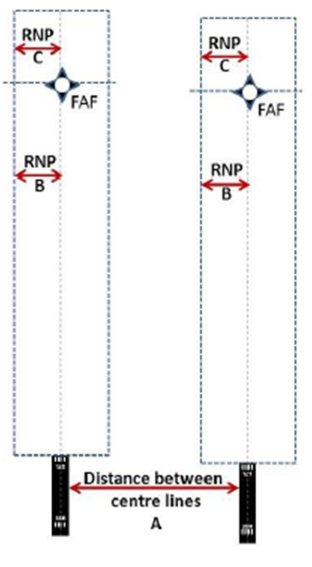
Figure 52: RNP value and distance between centre lines
(f)aircraft are advised that approaches are in use to both runways;
(g)the nominal tracks of the missed approach procedures diverge by at least 30 degrees;
(h)the approach control unit has the capability to override the frequencies used by the aerodrome control tower;
(i)a minimum of nominal 300 m (1 000 ft) vertical separation or a minimum of 5.6 km (3.0 NM) horizontal separation is provided between aircraft until established on the final approach courses or tracks of parallel approaches;
(j)the minimum horizontal separation to be provided between aircraft established on the same final approach course or track is 5.6 km (3.0 NM), or 4.6 km (2.5 NM) horizontal separation if so determined in accordance with ATS.TR.215, unless increased longitudinal separation is required due to wake turbulence;
(k)the minimum horizontal separation to be provided diagonally between successive aircraft on adjacent final approach courses or tracks is:
(1)3.7 km (2.0 NM) between successive aircraft on adjacent final approach courses or tracks more than 2 529 m (8 300 ft) apart (See figure 53); or
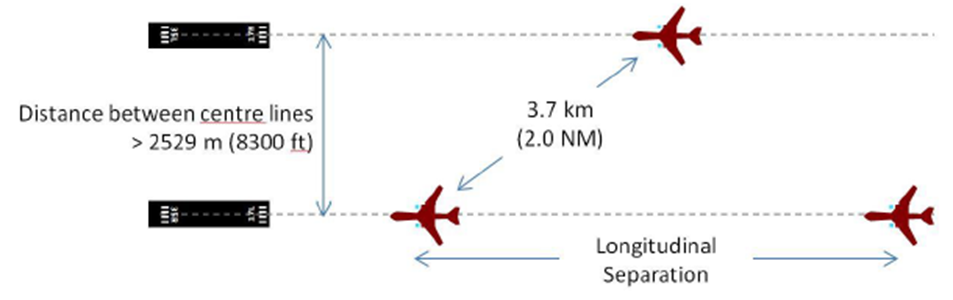
Figure 53: Diagonal separation for distance between centre lines greater than 2 529 m (8 300 ft)
(2)2.8 km (1.5 NM) between successive aircraft on adjacent final approach courses or tracks more than 1 097 m (3 600 ft) but not more than 2 529 m (8 300 ft) apart (see Figure 54); or
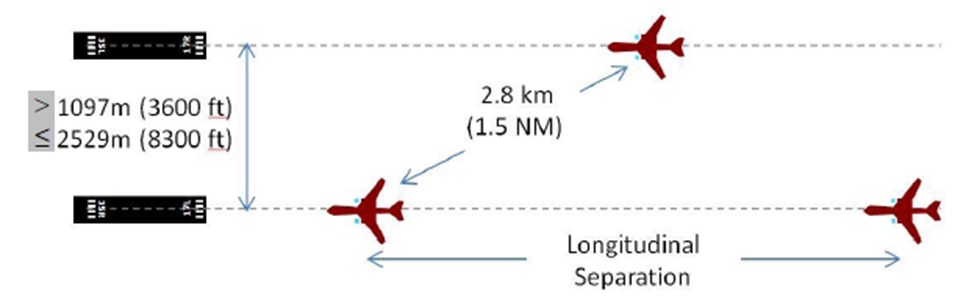
Figure 54: Diagonal separation for distance between centre lines greater than 1 097 m (3 600 ft) but less than or equal to 2 529 m (8 300 ft)
(3)1.9 km (1.0 NM) between successive aircraft on adjacent final approach courses or tracks more than 915 m (3 000 ft) but not more than 1 097 m (3 600 ft) apart (see Figure 55).
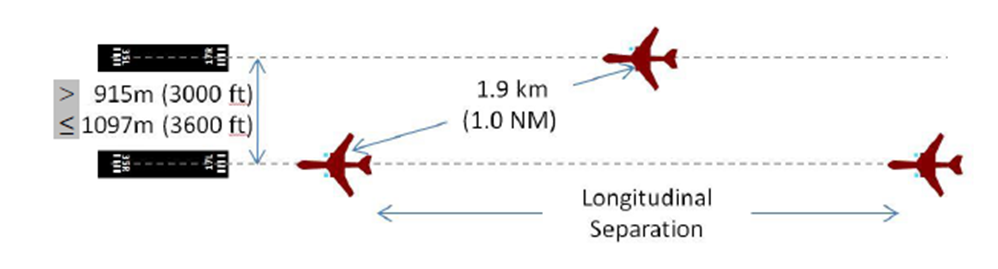
Figure 55: Diagonal separation for distance between centre lines greater than 915 m (3 000 ft) but less than or equal to
1 097 m (3 600 ft)
GM1 to AMC3 ATS.TR.255 Operations on parallel or near-parallel runways
ED Decision 2020/008/R
PRECISION APPROACH PROCEDURES
With reference to point (e)(1) of AMC3 ATS.TR.255, the precision approach procedure that aligns the aircraft with the extended runway centre line may include one of the following: ILS, GLS, MLS or SBAS CAT I, when applicable, for the final approach segment.
GM2 to AMC3 ATS.TR.255 Operations on parallel or near-parallel runways
ED Decision 2020/008/R
ATIS BROADCAST
With reference to point (f) of AMC3 ATS.TR.255, the information that dependent parallel operations are in force may be provided through the ATIS broadcasts.
AMC4 ATS.TR.255 Operations on parallel or near-parallel runways
ED Decision 2020/008/R
REQUIREMENTS AND PROCEDURES FOR SEGREGATED PARALLEL OPERATIONS
Segregated parallel operations should only be conducted on parallel runways when the following conditions are met:
(a)the runway centre lines are spaced by a minimum of 760 m (2 500 ft) (see Figure 56). Such minimum may be decreased by 30 m for each 150 m that the arrival runway is staggered toward the arriving aircraft, to a minimum of 300 m (see Figure 57), and should be increased by 30 m for each 150 m that the arrival runway is staggered away from the arriving aircraft (see Figure 58);
(b)the nominal departure track diverges immediately after take-off by at least 30 degrees from the missed approach track of the adjacent approach (see Figure 56);
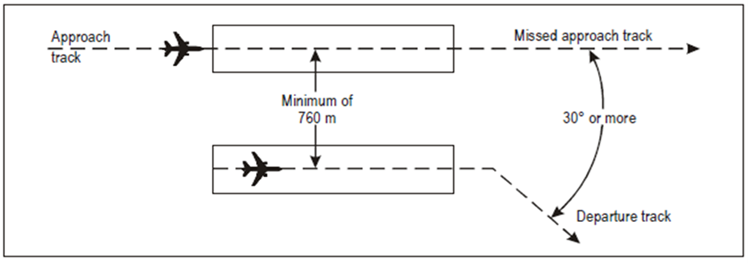
Figure 56: Segregated parallel operations
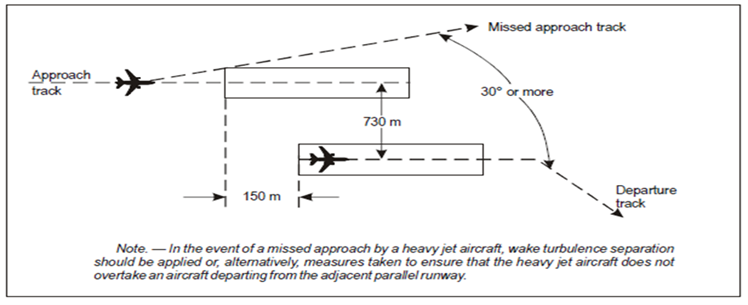
Figure 57: Segregated parallel operations where runways are staggered
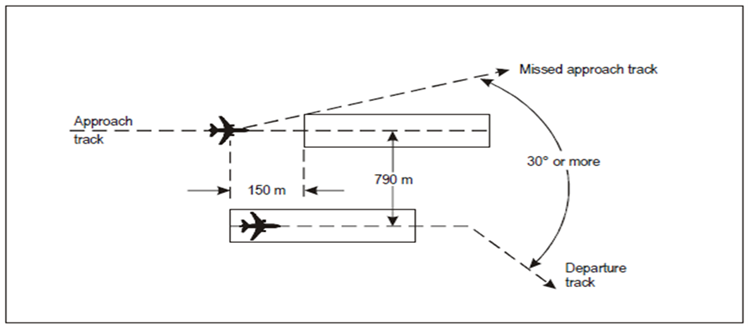
Figure 58: Segregated parallel operations where runways are staggered
(c)the instrument flight procedure that aligns the aircraft with the extended runway centre line is one of the following:
(1)precision approaches and/or APV (RNP AR APCH, RNP APCH);
(2)surveillance radar approach (SRA);
(3)visual approach; and
(d)a suitable ATS surveillance system and the appropriate ground facilities conform to the standard necessary for the specific type of approach in point (c) above.
GM1 to AMC2 ATS.TR.255; AMC3 ATS.TR.255 and AMC4 ATS.TR.255 Operations on parallel or near-parallel runways
ED Decision 2020/008/R
DETERMINATION THAT AN AIRCRAFT IS ESTABLISHED ON RNP AR APCH
(a)An aircraft conducting an RNP AR APCH procedure (in accordance with Regulation (EU) 2018/1048) is considered to be established for the entire approach procedure after the IAF or the IF, as applicable, provided that:
(1)the aircraft confirms that it is established on the RNP AR APCH procedure prior to a designated point, the location of which is to be determined by the competent authority;
(2)the designated point is positioned on the RNP AR APCH to ensure the applicable horizontal separation minimum (e.g. 5.6 km (3 NM)) from the adjacent approach procedure (see Figure 59). The designated point may normally be coincident with the IAF; and
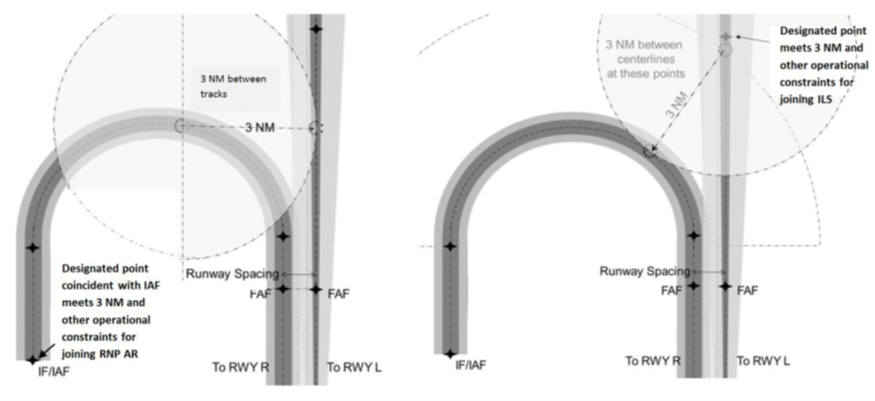
Figure 59: Established on RNP AR APCH concept (RNP AR APCH/precision approach with 3 NM separation minimum example)
(3)the designated point is readily apparent to the approach and monitoring air traffic controllers, to facilitate the application of the procedure. The designated point may be depicted on the situation display.
(b)Attention is drawn to the application of the appropriate wake turbulence separation between aircraft on the same approach, as established in ATS.TR.220.
(c)If, after reporting that it is established on the RNP AR APCH procedure, the aircraft is unable to execute the procedure, the pilot is expected to notify the air traffic controller immediately with a proposed course of action, and thereafter follow ATC instructions (e.g. break-out procedure).
(d)In circumstances where a break-out procedure becomes necessary during the application of the independent parallel approach procedure (for example, an aircraft penetrating the NTZ), monitoring controllers may issue climb and/or heading instructions to an aircraft established on an RNP AR APCH. Guidance on break-out procedures is contained in ICAO Doc 9643 ‘Manual on Simultaneous Operations on Parallel or Near-Parallel Instrument Runways (SOIR)’.
(e)To support a break-out instruction, an obstacle assessment is to be completed, in accordance with Regulation (EU) 2017/373. Guidance on obstacle assessment is contained in ICAO Doc 9643 ‘Manual on Simultaneous Operations on Parallel or Near-Parallel Instrument Runways (SOIR)’.
(f)Where appropriate, break-out procedures are published in the AIP and in the local instructions.
GM1 ATS.TR.255 Operations on parallel or near-parallel runways
ED Decision 2020/008/R
Guidance material relating to operations on parallel or near-parallel runways is contained in ICAO Doc 9643 ‘Manual on Simultaneous Operations on Parallel or Near-Parallel Instrument Runways (SOIR)’.
ATS.TR.260 Selection of the runway-in-use
Commission Implementing Regulation (EU) 2020/469
The aerodrome control tower shall select the runway-in-use for take-off and landing of aircraft taking into consideration the surface wind speed and direction as well as other local relevant factors, such as:
(a)runway configuration;
(b)meteorological conditions;
(c)instrument approach procedures;
(d)approach and landing aids available;
(e)aerodrome traffic circuits and air traffic conditions;
(f)length of the runway or runways;
(g)other factors indicated in local instructions.
AMC1 ATS.TR.260(g) Selection of the runway-in-use
ED Decision 2020/008/R
CONSIDERATION OF NOISE ABATEMENT IN THE SELECTION OF THE RUNWAY-IN-USE
(a)The aerodrome control tower should select runways for noise abatement purposes for landing operations only when they are equipped with suitable glide path guidance, e.g. ILS, or a visual approach slope indicator system for operations in VMC.
(b)Noise abatement should not be a determining factor in runway nomination under the following circumstances:
(1)if the runway surface conditions are adversely affected (e.g. by snow, slush, ice, water, mud, rubber, oil or other substances);
(2)for landing in conditions:
(i)when the ceiling is lower than 150 m (500 ft) above aerodrome elevation, or the visibility is less than 1 900 m; or
(ii)when the approach requires use of vertical minima greater than 100 m (300 ft) above aerodrome elevation and:
(A)the ceiling is lower than 240 m (800 ft) above aerodrome elevation; or
(B)the visibility is less than 3 000 m;
(3)for take-off when the visibility is less than 1 900 m;
(4)when wind shear has been reported or forecast or when thunderstorms are expected to affect the approach or departure; and
(5)when the crosswind component, including gusts, exceeds 28 km/h (15 kt), or the tailwind component, including gusts, exceeds 9 km/h (5 kt).
GM1 ATS.TR.260 Selection of the runway-in-use
ED Decision 2020/008/R
(a)Normally, an aircraft will land and take off into wind.
(b)Departing aircraft may be expedited by suggesting a take-off direction which is not into the wind. It is the responsibility of the pilot-in-command of an aircraft to decide between making such a take-off or waiting for take-off in a preferred direction.
GM1 ATS.TR.260(e) Selection of the runway-in-use
ED Decision 2020/008/R
DESCRIPTION OF AIR TRAFFIC CONDITIONS
When considering the air traffic conditions for the selection of the runway-in-use, the following elements, inter alia, should be evaluated:
(a)traffic complexity;
(b)traffic density;
(c)task complexity; and
(d)traffic typology (e.g. prevalent aircraft types operating at the aerodrome and preferred runway-in-use.
ATS.TR.265 Control of aerodrome surface traffic in low-visibility conditions
Commission Implementing Regulation (EU) 2020/469
(a)When there is a requirement for traffic to operate on the manoeuvring area in conditions of visibility which prevent the aerodrome control tower from applying visual separation between aircraft, and between aircraft and vehicles, the following shall apply:
(1)at the intersection of taxiways, an aircraft or vehicle on a taxiway shall not be permitted to hold closer to the other taxiway than the holding position limit defined by intermediate holding positions, stop bar or taxiway intersection marking, in accordance with the applicable aerodrome design specifications;
(2)the longitudinal separation method on taxiways shall be as specified for each particular aerodrome by the air traffic services provider and approved by the competent authority, taking into account the characteristics of the aids available for surveillance and control of ground traffic, the complexity of the aerodrome layout and the characteristics of the aircraft using the aerodrome.
(b)Procedures applicable to the start and continuation of low-visibility operations shall be established in accordance with point ATS.OR.110 and shall be approved by the competent authority.
GM1 ATS.TR.265(a)(1) Control of aerodrome surface traffic in low-visibility conditions
ED Decision 2020/008/R
HOLDING POSITION LIMITS
The definition of holding position limits by intermediate holding positions, stop bar or taxiway intersection marking is established in accordance with EASA ED Decision 2014/013/R ‘Certification Specification and Guidance Material for Aerodrome Design’, as amended.
AMC1 ATS.TR.265(b) Control of aerodrome surface traffic in low-visibility conditions
ED Decision 2020/008/R
PROCEDURES FOR CONTROL OF AERODROME TRAFFIC IN LOW-VISIBILITY OPERATIONS (LVOs)
(a)LVOs should be initiated by or through the aerodrome control tower.
(b)The aerodrome control tower should inform the approach control unit concerned when procedures for precision approach in LVOs will be applied and also when such procedures are no longer in force.
(c)Provisions regarding LVOs should specify:
(1)for the different types of LVOs, the RVR value(s) at which the LVOs procedures are to be implemented;
(2)the minimum navigation equipment requirements for LVOs;
(3)other facilities and aids required for LVOs, including aeronautical ground lights, which are to be monitored for normal operation;
(4)the criteria for and the circumstances under which downgrading of the navigation equipment from LVOs capability is to be made;
(5)the requirement to report any relevant equipment failure and degradation, without delay, to the flight crews concerned, the approach control unit, the aerodrome operator and, where established, the organisation(s) providing apron management services, and any other appropriate organisation;
(6)special procedures for the control of traffic on the manoeuvring area, including:
(i)the runway-holding positions to be used;
(ii)the minimum distance between an arriving and a departing aircraft to ensure protection of the sensitive and critical areas;
(iii)procedures to verify that aircraft and vehicles have vacated the runway; and
(iv)procedures applicable to the separation of aircraft and vehicles;
(7)the applicable spacing between successive approaching aircraft;
(8)the action(s) to be taken in the event that LVOs need to be discontinued, e.g. due to equipment failures; and
(9)any other relevant procedures or requirements.
(d)The aerodrome control tower should, prior to a period of application of low-visibility procedures, establish a record of vehicles and persons currently on the manoeuvring area and maintain this record during the period of application of these procedures to assist in assuring the safety of operations on that area.
ATS.TR.270 Authorisation of special VFR
Regulation (EU) 2024/403
(a)Special VFR flights may be authorised to operate within a control zone, subject to an ATC clearance. Except when permitted by the competent authority for helicopters in special cases such as but not limited to police, medical, search and rescue operations and firefighting flights, the following additional conditions shall be applied:
[applicable until 30 April 2025 - Commission Implementing Regulation (EU) 2020/469]
Special VFR flights may be authorised to operate within a control zone, subject to an ATC clearance. Except when otherwise permitted by the competent authority for helicopters in special cases such as, but not limited to, police, medical, search and rescue operations and firefighting flights, the following additional conditions shall apply:
[applicable from 1 May 2025 - Regulation (EU) 2024/403]
(1)such special VFR flights may be conducted during day only, unless otherwise permitted by the competent authority;
(2)by the pilot:
(i)clear of cloud and with the surface in sight;
(ii)the flight visibility is not less than 1 500 m or, for helicopters, not less than 800 m;
(iii)fly at a speed of 140 kt IAS or less to give adequate opportunity to observe other traffic and any obstacles in time to avoid a collision;
(3)An air traffic control unit shall not issue a special VFR clearance to aircraft to take off or land at an aerodrome within a control zone, or enter the aerodrome traffic zone or aerodrome traffic circuit when the reported meteorological conditions at that aerodrome are below the following minima:
(i)the ground visibility is less than 1 500 m or, for helicopters, less than 800 m;
(ii)the ceiling is less than 180 m (600 ft).
[applicable until 30 April 2025 - Commission Implementing Regulation (EU) 2020/469]
3)An air traffic control unit shall not issue a special VFR clearance to aircraft to take off or land at an aerodrome within a control zone, or enter the aerodrome traffic circuit within a control zone, when the reported meteorological conditions at that aerodrome are below the following minima:
(i)the ground visibility is less than 1 500m or, for helicopters, less than 800 m;
(ii)the ceiling is less than 180 m (600 ft).
[applicable from 1 May 2025 - Regulation (EU) 2024/403]
(b)An air traffic control unit shall handle requests for such an authorisation individually.
GM1 ATS.TR.270 Authorisation of special VFR
ED Decision 2020/008/R
SPECIAL VFR — DEVIATIONS
The list of type of operations subject to permit by the competent authority to deviate from the requirements for special VFR flights is not exhaustive. The competent authority may grant a permit for other kinds of helicopter operations such as power line inspections, helicopter hoist operations, etc.
GM1 ATS.TR.270(a)(3) Authorisation of special VFR
ED Decision 2024/006/R
SPECIAL VFR IN CONTROL ZONES
When the reported ground visibility at the aerodrome is less than 1 500 m, air traffic control units may issue a special VFR clearance for a flight crossing the control zone and not intending to take off or land at an aerodrome within a control zone, or enter the aerodrome traffic zone or aerodrome traffic circuit when the flight visibility reported by the pilot is not less than 1 500 m, or, for helicopters, not less than 800 m.
[applicable until 30 April 2025 - ED Decision 2020/008/R]
SPECIAL VFR IN CONTROL ZONES
When the reported ground visibility at the aerodrome is less than 1 500 m, air traffic control units may issue a special VFR clearance for a flight crossing the control zone and not intending to land at an aerodrome within the control zone, or enter the aerodrome traffic circuit when the flight visibility reported by the pilot is not less than 1 500 m, or, for helicopters, not less than 800 m.
[applicable from 1 May 2025 - ED Decision 2024/006/R]
SECTION 3 - FLIGHT INFORMATION SERVICE
ATS.TR.300 Application
Commission Implementing Regulation (EU) 2020/469
(a)Flight information service shall be provided by the appropriate air traffic services units to all aircraft which are likely to be affected by the information and which are in either of the following situations:
(1)provided with air traffic control service;
(2)otherwise known to the relevant air traffic services units.
(b)Where air traffic services units provide both flight information service and air traffic control service, the provision of air traffic control service shall have precedence over the provision of flight information service whenever the provision of air traffic control service so requires.
(c)A flight information service provider shall establish arrangements for:
(1)recording and transmission of information on the progress of flights;
(2)coordination and transfer of responsibility for the provision of flight information service.
GM1 ATS.TR.300(a)(2) Application
ED Decision 2020/008/R
PROVISION OF FLIGHT INFORMATION SERVICE TO AIRCRAFT OTHERWISE KNOWN TO AIR TRAFFIC SERVICES
In the context of flight information service, the expression ‘otherwise known to the relevant air traffic service unit’ transposed from the Standard in Section 4.1 of ICAO Annex 11, covers the cases when the aircraft is operating within uncontrolled airspace, where there are no requirements for the submission of a flight plan or for a continuous air-ground two-way communication with the air traffic services unit in charge of providing services in that portion of airspace. Therefore, the expression may be interpreted as traffic, the current flight details and intentions of which are known to the air traffic controllers/FIS officer/AFIS officer.
GM1 ATS.TR.300(b) Application
ED Decision 2020/008/R
It is recognised that in certain circumstances an aircraft on final approach, landing, take-off and climb may require to receive without delay essential information other than that pertaining to the air traffic control service provision.
AMC1 ATS.TR.300(c)(1) Application
ED Decision 2020/008/R
RECORDING AND TRANSMISSION OF INFORMATION ON THE PROGRESS OF FLIGHTS
Information on the actual progress of flights, including those of heavy or medium unmanned free balloons, under neither air traffic control service nor air traffic advisory service should be:
(a)recorded by the air traffic services unit serving the FIR within which the aircraft is flying in such a manner that it is available for reference and in case it is requested for alerting service and search and rescue action; and
(b)transmitted by the air traffic services unit receiving the information to other air traffic services units concerned, when so required for the purposes of the coordination between air traffic services units providing flight information service in adjacent FIRs in respect of IFR and VFR flights (see points (a) and (b) of GM2 ATS.TR.300(c)(2)).
GM1 to AMC1 ATS.TR.300(c)(1) Application
ED Decision 2020/008/R
RECORDING AND TRANSMISSION OF INFORMATION ON THE PROGRESS OF FLIGHTS
(a)Information on the progress of flights, including flight plan data, may be recorded through the use of paper flight progress strips or electronic flight progress strips, by other electronic presentation forms or by a combination of presentation methods.
(b)The air traffic services provider should specify the procedures for annotating data and provisions specifying the types of data to be entered on flight progress strips, including the use of symbols.
GM1 ATS.TR.300(c)(2) Application
ED Decision 2020/008/R
INFORMATION EXCHANGE IN CASE OF TERMINATION OF A CONTROLLED FLIGHT
In the case where a flight ceases to be operated as a controlled flight, i.e. by leaving controlled airspace or by cancelling its IFR flight and proceeding on VFR in airspace where VFR flights are not controlled, the air traffic control unit concerned should ensure that appropriate information on the flight is forwarded to air traffic services unit(s) responsible for the provision of flight information and alerting services for the remaining portion of the flight, in order to ensure that such services will be provided to the aircraft.
GM2 ATS.TR.300(c)(2) Application
ED Decision 2020/008/R
COORDINATION IN RESPECT OF THE PROVISION OF FLIGHT INFORMATION SERVICE AND ALERTING SERVICE
(a)Coordination between air traffic services units providing flight information service in adjacent FIRs should be effected in respect of IFR and VFR flights, in order to ensure continued flight information service to such aircraft in specified areas or along specified routes. Such coordination should be effected in accordance with an agreement between the air traffic services units concerned.
(b)The coordination of flights effected in accordance with point (a) should include transmission of the following information on the flight concerned:
(1)appropriate items of the current flight plan; and
(2)the time at which last contact was made with the aircraft concerned.
(c)This information should be forwarded to the air traffic services unit in charge of the next FIR in which the aircraft will operate prior to the aircraft entering such FIR.
(d)In order to assist in the identification of strayed or unidentified aircraft and thereby eliminate or reduce the need for interception, flight plan and flight progress information for flights along specified routes or portions of routes in close proximity to FIR boundaries should also be provided to the air traffic services units in charge of the FIRs adjacent to such routes or portions of routes.
(e)In circumstances where an aircraft has declared minimum fuel or is experiencing an emergency or in any other situation wherein the safety of the aircraft is not assured, the type of emergency and/or the circumstances experienced by the aircraft should be reported by the transferring unit to the accepting control unit and any other air traffic services unit that may be concerned with the flight and to the associated rescue coordination centres, if necessary.
ATS.TR.305 Scope of flight information service
Commission Implementing Regulation (EU) 2024/1111
(a)Flight information service shall include the provision of pertinent:
(1)SIGMET and AIRMET information;
(2)information concerning pre-eruption volcanic activity, volcanic eruptions and volcanic ash clouds;
(3)information concerning the release into the atmosphere of radioactive materials or toxic chemicals;
(4)information on changes in the availability of radio navigation services;
(5)information on changes in the condition of aerodromes and associated facilities, including information on the state of the aerodrome movement areas when they are affected by snow, ice or significant depth of water;
(6)information on unmanned free balloons;
(7)information on abnormal aircraft configuration and condition;
(7a)information on unmanned aircraft;
[applicable from 1 May 2025 – Regulation (EU) 2024/1111]
(8)any other information likely to affect safety.
(b)Flight information service provided to flights shall include, in addition to that outlined in point (a), the provision of information concerning:
(1)weather conditions reported or forecast at departure, destination and alternate aerodromes;
(2)collision hazards, to aircraft operating in airspace Classes C, D, E, F and G;
(3)for flight over water areas, in so far as practicable and when requested by a pilot, any available information such as radio call sign, position, true track, speed, etc. of surface vessels in the area;
(4)messages, including clearances, received from other air traffic services units to relay to aircraft.
(c)AFIS provided to flights shall include, in addition to relevant items outlined in points (a) and (b), the provision of information concerning:
(1)collision hazards with aircraft, vehicles and persons operating on the manoeuvring area;
(2)the runway-in-use.
(d)Air traffic services units shall transmit, as soon as practicable, special and non-routine air-reports to:
(1)other aircraft concerned;
(2)the associated meteorological watch office in accordance with Appendix 5 to Implementing Regulation (EU) No 923/2012;
(3)other air traffic services units concerned.
Transmissions to aircraft shall be repeated at a frequency and continued for a period of time which shall be determined by the air traffic services unit concerned.
(e)Flight information service provided to VFR flights shall include, in addition to that outlined in point (a), the provision of available information concerning traffic and weather conditions along the route of flight that are likely to make operation under the visual flight rules impracticable.
(f)When so prescribed by the competent authority, the AFIS unit shall manage the movement of vehicles and persons on the manoeuvring area in accordance with the set or subset of provisions in point ATS.TR.240.
AMC1 ATS.TR.305 Scope of flight information service
ED Decision 2020/017/R
TRANSMISSION OF INFORMATION
(a)Means of transmission
(1)Information should be disseminated to aircraft by one or more of the following means:
(i)the preferred method of directed transmission on the initiative of the appropriate air traffic services unit to an aircraft, ensuring that receipt is acknowledged; or
(ii)general call, unacknowledged transmission to all aircraft concerned; or
(iii)broadcast; or
(iv)data link.
(2)The use of general calls should be limited to cases where it is necessary to disseminate essential information to several aircraft without delay, e.g. the sudden occurrence of hazards, a change of the runway-in-use, or the failure of a key approach and landing aid.
(b)Transmission of special air-reports, SIGMET and AIRMET information
(1)Appropriate SIGMET and AIRMET information, as well as special air-reports which have not been used for the preparation of a SIGMET, should be disseminated to aircraft by one or more of the means specified in point (a) as established by the competent authority. Special air-reports should be transmitted with the least possible delay and disseminated to aircraft for a period of 60 minutes after their issuance.
(2)The special air-report, SIGMET and AIRMET information to be passed on to aircraft on ground initiative should cover a portion of the route up to 1 hour’s flying time ahead of the aircraft.
(c)Transmission of information concerning volcanic activity
Information concerning pre-eruption volcanic activity, volcanic eruptions and volcanic ash clouds (position of clouds and flight levels affected) should be disseminated to aircraft by one or more of the means specified in point (a) as established by the competent authority.
(d)Transmission of information concerning radioactive materials and toxic chemical clouds
Information on the release into the atmosphere of radioactive materials or toxic chemicals which could affect airspace within the area of responsibility of the air traffic services unit should be transmitted to aircraft by one or more of the means specified in point (a).
(e)Transmission of local special reports, SPECI and amended TAF
(1)Special reports and amended TAF should be transmitted on request and supplemented by:
(i)directed transmission from the appropriate air traffic services unit of selected special reports and amended TAF for the departure, destination and its alternate aerodromes, as listed in the flight plan; or
(ii)a general call on appropriate frequencies for the unacknowledged transmission to affected aircraft of selected special reports and amended TAF; or
(iii)continuous or frequent broadcast or the use of data link to make available current METAR and TAF in areas determined on the basis of regional air navigation agreements where traffic congestion dictates. VOLMET broadcasts and/or D-VOLMET should be used to serve this purpose.
(2)The passing of amended aerodrome forecasts to aircraft on the initiative of the appropriate air traffic services unit should be limited to that portion of the flight where the aircraft is within a specified time from the aerodrome of destination, such time being established on the basis of regional air navigation agreements.
(3)SPECI should, when issued for aerodromes not serving scheduled commercial air transport, be transmitted on request.
(f)Transmission of information on heavy or medium unmanned free balloons
Appropriate information on heavy or medium unmanned free balloons should be disseminated to aircraft by one or more of the means specified in point (a).
(g)Transmission of information to supersonic aircraft
The following information should be available at appropriate ACCs or flight information centres for aerodromes determined by the competent authority and should be transmitted on request to supersonic aircraft prior to commencement of deceleration/descent from supersonic cruise:
(1)current meteorological reports and forecasts, except that where communications difficulties are encountered under conditions of poor propagation, the elements transmitted may be limited to:
(i)mean surface wind, direction and speed (including gusts);
(ii)visibility or RVR;
(iii)amount and height of base of low clouds;
(iv)other significant information; and
(v)if appropriate, information regarding expected changes;
(2)operationally significant information on the status of facilities relating to the runway-in-use, including the precision approach category in the event that the lowest approach category promulgated for the runway is not available; and
(3)sufficient information on the runway surface conditions to permit assessment of the runway braking action.