

Filters
Appendix 5a — General guidelines
ED Decision 2020/020/R
SYLLABI STRUCTURE
This guidance material provides explanatory material on how to read the tables in the appendices contained in Subpart A of the AMC & GM to Part-PERS.
Four tables are provided:
(a)Basic training — Shared (Appendix 1a);
(b)Basic training — Streams (Appendix 2a);
(c)Qualification training — Shared (Appendix 3a); and
(d)Qualification training — Streams (Appendix 4a).
The tables have the following structure:
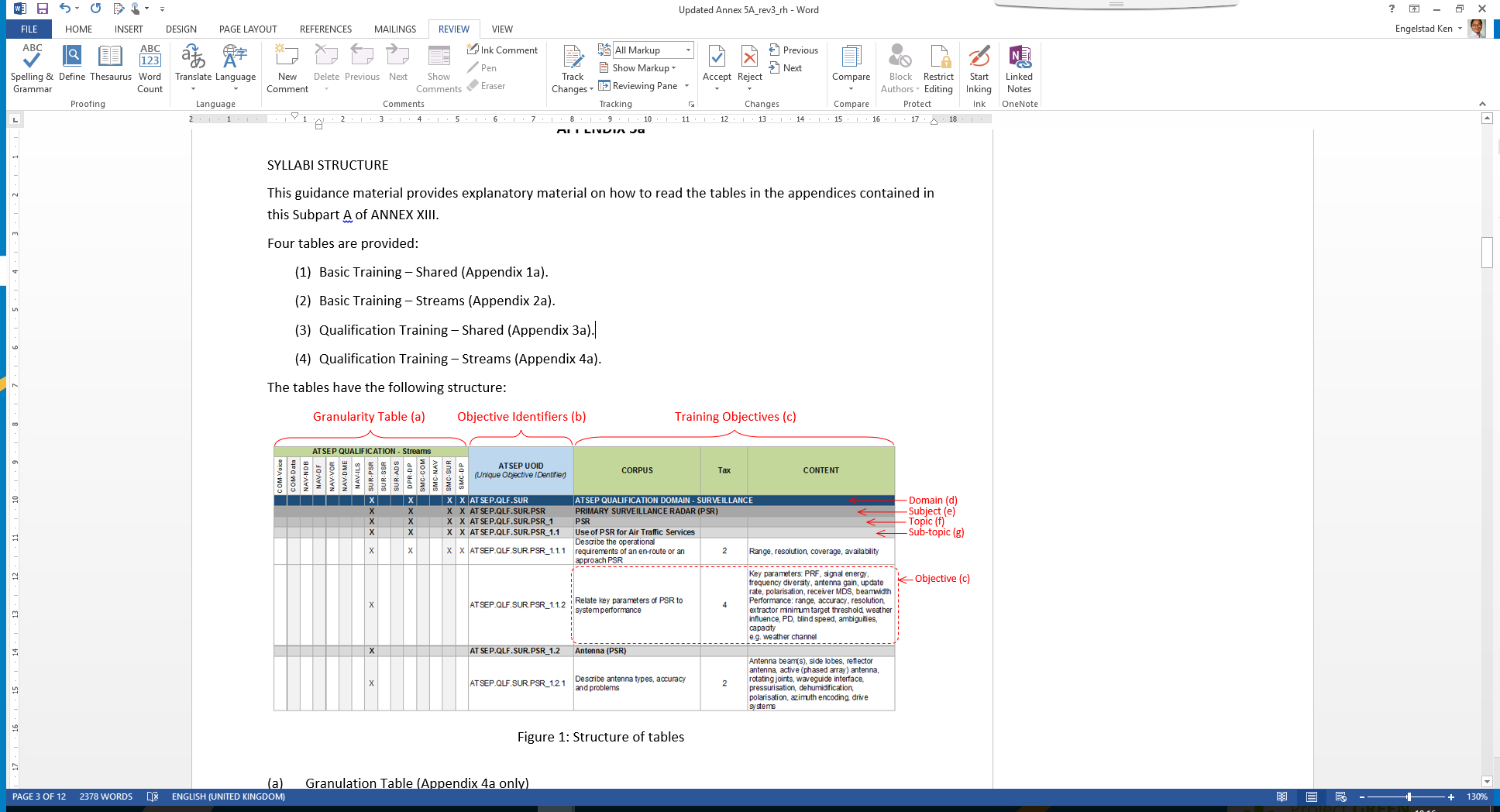
Figure 1: Structure of tables
(a)Granularity table (Appendix 4a only)
The granularity table indicates the stream(s) with which the objectives are associated. Where objectives are common to multiple streams, it is necessary to only include the objective once in the ATSEP training syllabus.
(b)ATSEP unique objective identifier (UOID)
This is a unique identifier for each objective. Where objectives are repeated across multiple streams, the UOID is linked to the parent domain.
The structure of the UOID is the following:
AREA.DOMAIN.SUBJECT_topic#.subtopic#.objective#
An example of a UOID decoding for ATSEP.QLF.SUR.PSR_1.2.1:
—ATSEP: fixed field that indicates the training area;
—QLF.SUR.: phase of training (qualification) and domain (surveillance);
—(Note: basic training uses only ‘BAS’ without a second field);
—PSR: subject (primary surveillance radar);
—_1: topic number (PSR);
—.2: subtopic number (antenna (PSR)); and
—.1: objective number (1).
(c)Training objectives
Each training objective contains three mandatory elements:
(1)Corpus
A description of the required performance. It always contains an action verb at the beginning of the sentence to ensure that the outcome is observable. The action verb is always associated with a defined taxonomy.
The tables at the end of this section list action verbs and their associated taxonomy levels. Those verbs and levels are used or may be used for training objectives.
(2)Taxonomy Level
A numerical representation of the classification of the action verb.
(i)Level 1: basic knowledge of the subject. It is the ability to remember essential points, memorise data, and retrieve it.
(ii)Level 2: the ability to understand and discuss the subject matter intelligently in order to describe and act on certain objects and events.
(iii)Level 3: thorough knowledge of the subject and the ability to apply it with accuracy. The ability to make use of the repertoire of knowledge to develop plans and activate them.
(iv)Level 4: the ability to establish a line of action within a unit of known applications by following the correct chronology and the adequate method to resolve a problem situation. This involves integrating known applications into a familiar situation.
(v)Level 5: the ability to analyse new situations in order to elaborate and apply one or another relevant strategy to solve a complex problem. The defining feature is that the situation is qualitatively different to those previously met, requiring judgement and evaluation of options.
The content illustrates and details performance.
When the items are in a list, each of them is to be addressed as a minimum.
‘e.g.’ is used to indicate optional content. All content following ‘e.g.’ is provided to illustrate the type of content that could be used to meet the objective.
When there is no mandatory content, the objective has to be performed according to the action verb.
Where content refers to other documents (e.g. ICAO SARPs, EU regulations, etc.), users should take care to use the most recent version(s) of the referenced document(s) or its/their parts.
(d)Domain
The domain is indicated through white text on blue background.
The following domains are defined:
QLF.SHRSHARED (common part for all qualification domains);
QLF.COMCOMMUNICATION;
QLF.NAVNAVIGATION;
QLF.SURSURVEILLANCE;
QLF.DPRDATA PROCESSING; and
QLF.SMCSYSTEM MONITORING AND CONTROL.
In addition, basic training is also considered to be a domain in the tables:
BASBASIC.
(e)Subject
The subject is indicated through black text on dark grey background.
A subject structures the domain into smaller elements.
(f)Topic
The topic is indicated through black text on mid grey background.
A topic structures the subject into smaller elements.
(g)Subtopic
The subtopic is indicated through black text on light grey background.
A subtopic structures the topic into smaller elements.
(h)Action verbs
The tables below list action verbs and their associated taxonomy levels that are used in training objectives.
Definition of verbs — Level 1
Verb | Definition | Example |
Define | State what it is and what its limits are; state the definition. | Define airborne safety nets. |
Draw | Produce a picture, pattern, or diagram. | Draw the MLAT system architecture. |
List | Say one after the other. | List the most common weather messages. |
Name | Give the name of objects or procedures. | Name a range of air-ground aviation-related network concepts. |
Recognise | Know what it is, because you have seen it before. | Recognise surveillance information on a display. |
State | Say or write in a formal or definite way. | State the function of a network management system. |
Definition of verbs — Level 2
Verb | Definition | Example |
Characterise | Describe the quality of features in something. | Characterise navigation methods. |
Consider | Think carefully about it. | Consider the benefits of Critical Incident Stress Management (CISM). |
Demonstrate | Describe and explain. Logically or mathematically, prove the truth of the statement. | Demonstrate the use of middleware in an ATM environment. |
Describe | Say what it is like or what happened. | Describe the elements of Global Navigation Satellite System (GNSS) in Europe. |
Differentiate | Show the difference between things. | Differentiate conventional navigation from area navigation. |
Explain | Give details about something or describe so that it can be understood. | Explain the function of FDP. |
Take account of | Take into consideration before deciding. | Take account of hardware/software compatibility. |
Definition of verbs — Level 3
Verb | Definition | Example |
Apply | Use something in a situation or activity. | Apply the principles of layers. |
Appreciate | Understand a situation and know what is involved in a problem-solving situation, to state a plan without applying it. | Appreciate how to troubleshoot a network. |
Calculate | Discover from information you already have by arithmetic; to think about a possible cause of action in order to form an opinion or decide what to do. | Calculate parameters of a line. |
Check | Make sure the information is correct (satisfactory). | Check the conformity of a system to ITU and national regulation. |
Decode | Turn into ordinary writing, decipher. | Decode a typical OLDI message. |
Estimate | Form an approximate judgement of a number, form an opinion. | Estimate the impact of security and integrity failure to the operational service. |
Identify | Associate oneself inseparably with, establish the identity. | Identify the major elements of the ADS-C system. |
Operate | Conduct work on equipment. | Operate measuring equipment. |
Perform | Carry into effect, go through, execute. | Perform measurements with generic radio test equipment. |
Use | Employ for a purpose, handle as instrument, put into operation. | Use appropriate vocabulary to communicate effectively on technical matters. |
Definition of verbs — Level 4
Verb | Definition | Example |
Adjust | Change to a new position, value or setting. | Adjust a generic radio receiver. |
Analyse | Examine minutely the constitution of. | Analyse the block diagram of a generic radio receiver. |
Justify | Show the rightness of a choice or of an option. | Justify the occasions when it is necessary to downgrade an ILS facility performance category. |
Relate | Establish link with. | Relate VOR station design to operational requirement. |
Definition of verbs — Level 5
Verb | Definition | Example |
Interpret | Decide on the meaning or significance of something when there is a choice. | Interpret ILS facility performance categories. |
(i)Acronyms
The following abbreviations are used in the tables:
AAIM | Aircraft Autonomous Integrity Monitoring |
ABAS | Aircraft-Based Augmentation System |
ACARS | Aircraft Communications Addressing and Reporting System |
ACAS | Airborne Collision Avoidance System |
ACC | Area Control Centre |
A/D | Analogue/Digital |
ADEX-P | ATS Data Exchange Presentation |
ADS | Automatic Dependent Surveillance |
ADS B | ADS — Broadcast |
ADS C | ADS — Contract |
ADF | Automatic Direction Finder |
AFDX | Avionics Full-duplex Ethernet Switch |
AFTN | Aeronautical Fixed Telecommunications Network |
AGC | Automatic Gain Control |
AIC | Aeronautical Information Circular |
AIDC | ATS Interfacility Data Communications |
AIP | Aeronautical Information Publication |
AIRAC | Aeronautical Information Regulation and Control |
AIS | Aeronautical Information Services |
ALARP | As Low As Reasonably Practicable |
AMAN | Arrival Manager |
AMHS | Aeronautical Message Handling System |
AMSS | Automatic Message Switching System |
ANS | Air Navigation Services |
ANSP | ANS Provider |
APV | Approach Procedure with Vertical guidance |
APW | Area Proximity Warning |
ARINC | Aeronautical Radio Incorporated |
ARTAS | ATC Radar Tracker and Server |
ASAS | Airborne Separation Assistance/Assurance System |
ASM | Airspace Management |
ASMGCS | Advanced SMGCS |
ASTERIX | All-purpose Structured EUROCONTROL Radar Information Exchange |
ATC | Air Traffic Control |
ATFCM | Air Traffic Flow and Capacity Management |
ATIS | Automatic Terminal Information Service |
ATM | Air Traffic Management |
ATN | Aeronautical Telecommunication Network |
ATS | Air Traffic Services |
ATSEP | Air Traffic Safety Electronics Personnel |
AUGUR | EUROCONTROL RAIM Prediction Tool |
BATAP | ‘Type-B’ Application-to-Application Protocol |
BDS | Binary Data Store |
BER | Bit Error Rate |
BITE | Built-In Test Equipment |
B-RNAV | Basic-RNAV |
CAA | Civil Aviation Authority |
CB | Cumulonimbus |
CBT | Computer-Based Training |
CDM | Collaborative Decision-Making |
CDTI | Cockpit Display of Traffic Information |
CFMU | Central Flow Management Unit |
CIDIN | Common ICAO Data Interchange Network |
CISM | Critical Incident Stress Management |
CIV | Civil |
CLAM | Cleared flight Level Adherence Monitoring |
CLIMAX | Multi-station carrier offset mode, with voting override |
CMS | Control and Monitoring System |
CNS/ATM | Communication Navigation and Surveillance/Air Traffic Management |
CORA | Conflict Resolution Advisory |
CORBA | Common Object Request Broker Architecture |
COTS | Commercial off-the-Shelf |
CPDLC | Controller-Pilot Data Link Communications |
CRT | Cathode Ray Tube |
CSU | Control Sector Unit |
CTR | Control Zone |
CVOR | Conventional VOR |
CWP | Controller Work Position |
DCL | Departure Clearance |
DDF | Doppler DF |
DDM | Difference of Depth of Modulation |
DF | Direction Finding |
DLIC | Data Link Initiation Capability |
DMAN | Departure Manager |
DME | Distance Measuring Equipment |
DPSK | Differential Phase Shift Keying |
DTMF | Dual Tone Modulation-Frequency |
DVOR | Doppler VOR |
EAD | European Aeronautical Database |
EAN | European ANSP Network |
EASA | European Aviation Safety Agency |
ECAC | European Civil Aviation Conference |
EFQM | European Foundation for Quality Management |
EGNOS | European Geostationary Navigation Overlay Service |
EGPWS | Enhanced Ground Proximity Warning System |
EHS | Enhanced Mode S |
EHT | Extremely High Tension |
EJB | Enterprise Java Bean |
ELS | Elementary Mode S |
EMC | Electromagnetic Compatibility |
EMI | Electromagnetic Interference |
ETFMS | Enhanced Tactical FMS |
EU | European Union |
EUROCAE | European Civil Aviation Electronics |
EUROCONTROL | European Organisation for the Safety of Air Navigation |
FAA | Federal Aviation Administration (US) |
FANS | Future Air Navigation Systems |
FDP | Flight Data Processing |
FDPS | FDP System |
FFM | Far Field Monitor |
FHA | Functional Hazard Assessment |
FIR | Flight Information Region |
FMS | Flight Management System |
FMTP | Flight Plan Messaging Transport Protocol |
FoM | Figures of Merit |
FPL | (Filed) Flight Plan |
FRUIT | False Reply Unsynchronised in Time |
FUA | Flexible Use of Airspace |
GALILEO | Satellite radio navigation system |
GBAS | Ground-Based Augmentation System |
GLONASS | GLObal’naya NAvigatsionnaya Sputnikovaya Sistema (Global Navigation Satellite System) |
GNSS | Global Navigation Satellite System |
GP | Glide Path |
GPS | Global Positioning System |
GRAS | Ground-based Regional Augmentation System |
GSA | GNSS Supervisory Authority |
GTC | Gain/Time Control |
HF | High Frequency |
HFDL | High Frequency Data Link |
HMI | Human-Machine Interface |
HPA | High Power Amplifier |
HSI | Horizontal Situation Indication |
HV | High Voltage |
HW | Hardware |
Hz | Hertz |
ICAO | International Civil Aviation Organization |
IDF | Interferometric DF |
IF | Intermediate Frequency |
IFF | Identification Friend/Foe |
IFPS | (Integrated) Initial Flight Plan Processing System |
ILS | Instrument Landing System |
INS | Inertial Navigation System |
I/O | Input/Output |
IP | Internet Protocol |
IRS | Inertial Reference System |
IRVR | Instrument Runway Visual Range |
I/Q | In phase and Quadrature |
ISDN | Integrated Services Digital Network |
ISLS | Interrogator Side Lobe Suppression |
IISLS | Improved Interrogator Side Lobe Suppression |
iTEC | Interoperability Through European Collaboration |
ITU | International Telecommunication Union |
ISO | International Standards Organisation |
LAM | Local Area Multilateration |
LAN | Local Area Network |
LAPB | Link Access Protocol, Balanced |
LCD | Liquid-Crystal Display |
LLZ | Localiser |
LNA | Low Noise Amplifier |
LVP | Low Visibility Procedures |
MDS | Minimum Detectable Signal |
MET | Meteorology |
METAR | Meteorological Actual Report |
MFC | Multi-Frequency Coding |
MHz | Megahertz |
MIL | Military |
MLAT | Multilateration |
MLS | Microwave Landing System |
MOTNE | Meteorological Operational Telecommunications Network Europe |
MRP | Multi-radar Processing |
MRT | Multi-radar Tracker |
MSAW | Minimum Safe Altitude Warning |
MSSR | Mono-pulse SSR |
MTBF | Mean Time Between Failure |
MTCD | Medium-Term Conflict Detection |
MTD | Moving Target Detection |
NAVAID | Navigation(al) Aid |
ND | Navigation Display |
NEAN | North European ADS-B Network |
NDB | Non-Directional Beacon |
NOP | Network Operations Plan |
NOTAM | Notice to Airmen |
NPA | Non-Precision Approach |
NRA | Non-Radar Area |
NSA | National Supervisory Authority |
OJTI | On-The-Job Training Instructor |
OLDI | On-Line Data Interchange |
OS | Operating System |
OSI | Open System Interconnection |
OST | On-site Training |
OTM | Object Transaction Monitor |
PA | Precision Approach |
PABX | Private Automatic Branch Exchange |
PBN | Performance-Based Navigation |
PCM | Pulse Code Modulation |
PD | Probability of Detection |
PENS | Pan-European Fixed Network Services |
PFD | Primary Flight Display |
PPI | Plan Position Indicator |
PRF | Pulse Repetition Frequency |
P-RNAV | Precision RNAV |
PSD | Phase Sensitive Detector |
PSSA | Preliminary System Safety Assessment |
PSR | Primary Surveillance Radar |
QoS | Quality of Service |
QNH | Q-code for atmospheric pressure at sea level |
Qsig | Quality of signal |
RAIM | Receiver Autonomous Integrity Monitoring |
RAPNET | (European) Regional Aeronautical Packet switched Network (CBN + DAKOS) |
RAPS | Recording, Analysis, Playback and Simulation system for radar data (COMSOFT) |
RDP | Radar Data Processing |
RCA | Remote Client Application |
RF | Radio Frequency |
RMI | Relative Magnetic Indicator |
RNAV | Area Navigation |
RNP | Required Navigation Performance |
RPL | Repetitive Flight Plan |
RSLS | Receiver Sidelobe Suppression |
R/T | Radiotelephony |
RTCA | Radio Technical Commission for Aeronautics |
RUP | Rational Unified Process |
RVR | Runway Visual Range |
RX | Receiver |
SAR | Specific Energy Absorption Rate |
SARPS | Standards And Recommended Practices |
SASS | Surveillance Analysis Support System |
SASS-C | SASS-Centre |
SASS-S | SASS-Sensor |
SATCOM | Satellite Communications |
SBAS | Satellite-Based Augmentation System |
SCAS | Surveillance Coverage Analysis Suite |
SCAT-1 | Special Category 1 |
SDM | Sum of Depth of Modulation |
SDP | Surveillance Data Processing |
S/E | System/Equipment |
SELCAL | Selective Calling |
SESAR | Single European Sky AM Research |
SID | Standard Instrument Departure |
SITA | Société Internationale de Télécommunications Aéronautiques (France) |
SMC | System Monitoring and Control |
SMR | Surface Movement Radar |
SMS | Safety Management System |
S/N | Signal/Noise |
SNOWTAM | NOTAM on Snow conditions |
SNMP | Simple Network Management Protocol |
SPI | Special Pulse Identification or Special Position Identification Pulse (SSR) |
SRC | Safety Regulation Commission (EUROCONTROL) |
SSA | System Safety Assessment |
SSR | Secondary Surveillance Radar |
STC | Sensitivity Time Control |
STCA | Short-Term Conflict Alert |
SV | Supervisor |
SW | Software |
SWALs | Software Assurance Levels |
SWIM | System Wide Information Management |
SWR | Standing Wave Ratio |
TACAN | UHF Tactical Air Navigation aid |
TAF | Terminal Area Forecast |
TCAS | Transponder Collision Avoidance System |
TCP | Transmission Control Protocol |
TDOA | Time Difference on Arrival |
TFT | Thin Film Transistor |
TIS | Traffic Information Service |
TMA | Terminal Area |
TRM | Team Resource Management |
TX | Transmitter |
UAT | Universal Access Transceiver |
UBSS | UNIX Basic System Software |
UHF | Ultra High Frequency |
UPS | Uninterruptible Power Supply |
UTA | Upper (Traffic) Control Area |
VCS | Voice Communications System |
VDF | VHF DF Station |
VDL | VHF Digital/Data Link |
VESDA | Very Early Smoke Detection Alarm |
VHF | Very High Frequency |
VOLMET | Routine Voice broadcasts for Meteorological Information |
VOR | VHF Omnidirectional Radio Range |
VORTAC | VOR and TACAN combination |
WAAS | Wide Area Augmentation System (US) |
WAM | Wide Area Multilateration |
WAN | Wide Area Network |
WGS84 | World Geodetic System 84 |