

Filters
Appendix 3
Regulation (EU) 2022/938
SNOWTAM FORMAT
heading) | (PRIORITY INDICATOR) | (ADDRESSES) | <≡ | |||||||||||||||||||||||||||||||
(DATE AND TIME (OF FILING) | (ORIGINATOR’S ( INDICATOR) | <≡ | ||||||||||||||||||||||||||||||||
(Abbreviated heading) | (SWAA* SERIAL NUMBER) | (LOCATION INDICATOR) | DATE-TIME OF ASSESSMENT | (OPTIONAL GROUP) | ||||||||||||||||||||||||||||||
S | W | * | * | <≡( | ||||||||||||||||||||||||||||||
SNOWTAM | (Serial number) | <≡ | ||||||||||||||||||||||||||||||||
Aeroplane performance calculation section | ||||||||||||||||||||||||||||||||||
(AERODROME LOCATION INDICATOR) | M | A) | <≡ | |||||||||||||||||||||||||||||||
(DATE/TIME OF ASSESSMENT (Time of completion of assessment in UTC)) | M | B) | | |||||||||||||||||||||||||||||||
(LOWER RUNWAY DESIGNATION NUMBER) | M | C) |
| | ||||||||||||||||||||||||||||||
(RUNWAY CONDITION CODE (RWYCC) ON EACH RUNWAY THIRD) (From Runway Condition Assessment Matrix (RCAM) 0, 1, 2, 3, 4, 5 or 6) | M | D) |
| / / | ||||||||||||||||||||||||||||||
(PER CENT COVERAGE CONTAMINANT FOR EACH RUNWAY THIRD) | C | E) |
| / / | ||||||||||||||||||||||||||||||
DEPTH (mm) OF LOOSE CONTAMINANT FOR EACH RUNWAY THIRD) | C | F) | / / | |||||||||||||||||||||||||||||||
(CONDITION DESCRIPTION OVER TOTAL RUNWAY LENGTH (Observed on each runway third, starting from threshold having the lower runway designation number)
| M | G) | / / | |||||||||||||||||||||||||||||||
(WIDTH OF RUNWAY TO WHICH THE RUNWAY CONDITIONS CODES APPLY, IF LESS THAN PUBLISHED WIDTH) | O | H) |
| <≡≡ | ||||||||||||||||||||||||||||||
Situational awareness section | ||||||||||||||||||||||||||||||||||
(REDUCED RUNWAY LENGTH, IF LESS THAN PUBLISHED LENGTH (m)) | O | I) | | |||||||||||||||||||||||||||||||
(DRIFTING SNOW ON THE RUNWAY) | O | J) | | |||||||||||||||||||||||||||||||
(LOOSE SAND ON THE RUNWAY) | O | K) | | |||||||||||||||||||||||||||||||
(CHEMICAL TREATMENT ON RUNWAY) | O | L) | | |||||||||||||||||||||||||||||||
(SNOWBANKS ON THE RUNWAY (If present, distance from runway centre line (m) followed by ‘L’, ‘R’ or ‘LR’ as applicable)) | O | M) | | |||||||||||||||||||||||||||||||
(SNOWBANKS ON A TAXIWAY) | O | N) | | |||||||||||||||||||||||||||||||
(SNOWBANKS ADJACENT TO THE RUNWAY) | O | O) | | |||||||||||||||||||||||||||||||
(TAXIWAY CONDITIONS) | O | P) | | |||||||||||||||||||||||||||||||
(APRON CONDITIONS) | O | R) | | |||||||||||||||||||||||||||||||
(MEASURED FRICTION COEFFICIENT) | O | S) | | |||||||||||||||||||||||||||||||
(PLAIN-LANGUAGE REMARKS) | O | T) | ) <<≡ | |||||||||||||||||||||||||||||||
NOTES:
| ||||||||||||||||||||||||||||||||||
SIGNATURE OF ORIGINATOR (not for transmission) | ||||||||||||||||||||||||||||||||||

INSTRUCTIONS FOR THE COMPLETION OF THE SNOWTAM FORMAT
1.General
(a)When reporting on more than one runway, repeat Items B to H (aeroplane performance calculation section).
(b)The letters used to indicate items are only used for reference purpose and shall not be included in the messages. The letters, M (mandatory), C (conditional) and O (optional) mark the usage and information and shall be included as explained below.
(c)Metric units shall be used and the unit of measurement shall not be reported.
(d)The maximum validity of SNOWTAM is 8 hours. New SNOWTAM shall be issued whenever a new runway condition report is received.
(e)A SNOWTAM cancels the previous SNOWTAM.
(f)The abbreviated heading ‘TTAAiiii CCCC MMYYGGgg (BBB)’ is included to facilitate the automatic processing of SNOWTAM messages in computer databanks. The explanation of these symbols is:
TT = data designator for SNOWTAM = SW;
AA = geographical designator for Member States, e.g. LF = FRANCE;
iiii = SNOWTAM serial number in a four-digit group;
CCCC = four-letter location indicator of the aerodrome to which the SNOWTAM refers;
MMYYGGgg = date/time of observation/measurement, whereby:
MM = month, e.g. January = 01, December = 12;
YY = day of the month;
GGgg = time in hours (GG) and minutes (gg) UTC;
(BBB) = optional group for:
Correction, in the case of an error, to a SNOWTAM message previously disseminated with the same serial number = COR. Brackets in (BBB) shall be used to indicate that this group is optional. When reporting on more than one runway and individual dates/times of observation/assessment are indicated by repeated Item B, the latest date/time of observation/assessment shall be inserted in the abbreviated heading (MMYYGGgg).
(g)The text ‘SNOWTAM’ in the SNOWTAM Format and the SNOWTAM serial number in a four-digit group shall be separated by a space, e.g. SNOWTAM 0124.
(h)For readability purposes for the SNOWTAM message, a linefeed shall be included after the SNOWTAM serial number, after Item A, and after the aeroplane performance calculation section.
(i)When reporting on more than one runway, repeat the information in the aeroplane performance calculation section from the date and time of assessment for each runway before the information in the situational awareness section.
(j)Mandatory information is:
1)AERODROME LOCATION INDICATOR;
2)DATE AND TIME OF ASSESSMENT;
3)LOWER RUNWAY DESIGNATOR NUMBER;
4)RUNWAY CONDITION CODE FOR EACH RUNWAY THIRD; and
5)CONDITION DESCRIPTION FOR EACH RUNWAY THIRD (when runway condition code (RWYCC) is reported 0–6)
2.Aeroplane performance calculation section
Item A — Aerodrome location indicator (four-letter location indicator).
Item B — Date and time of assessment (eight-figure date/time group giving time of observation as month, day, hour and minute in UTC).
Item C — Lower runway designator number ( nn[L] or nn[C] or nn[R]).
Only one runway designator shall be inserted for each runway and always the lower number.
Item D — Runway condition code for each runway third. Only one digit (0, 1, 2, 3, 4, 5 or 6) is inserted for each runway third, separated by an oblique stroke (n/n/n).
Item E — Per cent coverage for each runway third. When provided, insert 25, 50, 75 or 100 for each runway third, separated by an oblique stroke ([n]nn/[n]nn/[n]nn).
This information shall be provided only when there is a condition description for each runway third (Item G) that has been reported other than ‘DRY’.
When the conditions are not reported, this shall be signified by the insertion of ‘NR’ for the appropriate runway third(s).
Item F — Depth of loose contaminant for each runway third. When provided, insert in millimetres for each runway third, separated by an oblique stroke (nn/nn/nn or nnn/nnn/nnn).
This information shall only be provided for the following contamination types:
—standing water, values to be reported 04, then assessed value. Significant changes 3 mm;
—slush, values to be reported 03, then assessed value. Significant changes 3 mm;
—wet snow, values to be reported 03, then assessed value. Significant changes 5 mm; and
—dry snow, values to be reported 03, then assessed value. Significant changes 20 mm.
When the conditions are not reported, this shall be signified by the insertion of ‘NR’ for the appropriate runway third(s).
Item G — Condition description for each runway third. Any of the following condition descriptions for each runway third, separated by an oblique stroke, shall be inserted.
COMPACTED SNOW
DRY SNOW
DRY SNOW ON TOP OF COMPACTED SNOW
DRY SNOW ON TOP OF ICE
FROST
ICE
SLIPPERY WET
SLUSH
SPECIALLY PREPARED WINTER RUNWAY
STANDING WATER
WATER ON TOP OF COMPACTED SNOW
WET
WET ICE
WET SNOW
WET SNOW ON TOP OF COMPACTED SNOW
WET SNOW ON TOP OF ICE
DRY (only reported when there is no contaminant)
When the conditions are not reported, this shall be signified by the insertion of ‘NR’ for the appropriate runway third(s).
Item H — Width of runway to which the runway condition codes apply. The width in metres, if less than the published runway width, shall be inserted.
3.Situational awareness section
Elements in the situational awareness section shall end with a full stop.
Elements in the situational awareness section for which no information exists, or where the conditional circumstances for publication are not fulfilled, shall be left out completely.
Item I — Reduced runway length. The applicable runway designator and available length in metres shall be inserted (e.g. RWY nn [L] or nn [C] or nn [R] REDUCED TO [n]nnn).
This information is conditional when a NOTAM has been published with a new set of declared distances.
Item J — Drifting snow on the runway. When reported, ‘DRIFTING SNOW’ shall be inserted with a space ‘DRIFTING SNOW’ (RWY nn or RWY nn[L] or nn[C] or nn[R] DRIFTING SNOW).
Item K — Loose sand on the runway. When loose sand is reported on the runway, the lower runway designator shall be inserted with a space ‘LOOSE SAND’ (RWY nn or RWY nn[L] or nn[C] or nn[R] LOOSE SAND).
Item L — Chemical treatment on the runway. When chemical treatment has been reported applied, the lower runway designator shall be inserted with a space ‘CHEMICALLY TREATED’ (RWY nn or RWY nn[L] or nn[C] or nn[R] CHEMICALLY TREATED).
Item M — Snowbanks on the runway. When snowbanks are reported present on the runway, the lower runway designator shall be inserted with a space ‘SNOWBANK’ and with a space left ‘L’ or right ‘R’ or both sides ‘LR’, followed by the distance in metres from centre line separated by a space ‘FM CL’ (RWY nn or RWY nn[L] or nn[C] or nn[R] SNOWBANK Lnn or Rnn or LRnn FM CL).
Item N — Snowbanks on a taxiway. When snowbanks are present on taxiway(s), the taxiway(s) designator(s) shall be inserted with a space ‘SNOWBANKS’ (TWY [nn]n or TWYS [nn]n/[nn]n/[nn]n… or ALL TWYS SNOWBANKS).
Item O — Snowbanks adjacent to the runway. When snowbanks are reported present, penetrating the height profile in the aerodrome snow plan, the lower runway designator and ‘ADJ SNOWBANKS’ shall be inserted (RWY nn or RWY nn[L] or nn[C] or nn[R] ADJ SNOWBANKS).
Item P — Taxiway conditions. When taxiway conditions are reported slippery or poor, the taxiway designator followed by a space ‘POOR’ shall be inserted (TWY [n or nn] POOR or TWYS [n or nn]/[n or nn]/[n or nn] POOR… or ALL TWYS POOR).
Item R — Apron conditions. When apron conditions are reported slippery or poor, the apron designator followed by a space ‘POOR’ shall be inserted (APRON [nnnn] POOR or APRONS [nnnn]/[nnnn]/[nnnn] POOR or ALL APRONS POOR).
Item S — (NR) Not reported.
Item T — Plain-language remarks.
Appendix 4
Commission Implementing Regulation (EU) 2020/469
ASHTAM FORMAT
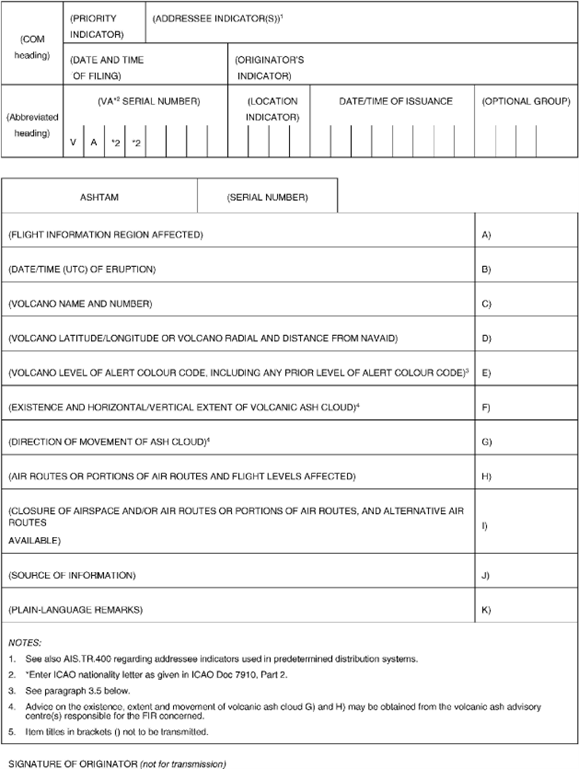
INSTRUCTIONS FOR THE COMPLETION OF THE ASHTAM FORMAT
1.General
1.1The ASHTAM provides information on the status of activity of a volcano when a change in its activity is, or is expected to be of operational significance. This information is provided using the volcano level of alert colour code given in 3.5 below.
1.2In the event of a volcanic eruption producing ash cloud of operational significance, the ASHTAM also provides information on the location, extent and movement of the ash cloud and the air routes and flight levels affected.
1.3Issuance of an ASHTAM giving information on a volcanic eruption, in accordance with section 3 below, shall not be delayed until complete information A to K is available but shall be issued immediately following receipt of notification that an eruption has occurred or is expected to occur, or a change in the status of activity of a volcano of operational significance has occurred or is expected to occur, or an ash cloud is reported. In the case of an expected eruption, and hence no ash cloud evident at that time, items A to E shall be completed and items F to I indicated as ‘not applicable’. Similarly, if a volcanic ash cloud is reported, e.g. by special air-report, but the source volcano is not known at that time, the ASHTAM shall be issued initially with items A to E indicated as ‘unknown’, and items F to K completed, as necessary, based on the special air-report, pending receipt of further information. In other circumstances, if information for a specific field A to K is not available indicate ‘NIL’.
1.4The maximum period of validity of ASHTAM is 24 hours a day. New ASHTAM shall be issued whenever there is a change in the level of alert.
2.Abbreviated heading
2.1Following the usual ‘Aeronautical fixed – telecommunications network (AFTN)’ communications header, the abbreviated heading ‘TT AAiiii CCCC MMYYGGgg (BBB)’ shall be included to facilitate the automatic processing of ASHTAM messages in computer databanks. The explanation of these symbols is:
TT =data designator for ASHTAM = VA;
AA =geographical designator for States, e.g. NZ = New Zealand;
iiii =ASHTAM serial number in a four-figure group;
CCCC =four-letter location indicator of the flight information region concerned;
MMYYGGgg =date/time of report, whereby:
MM =month, e.g. January = 01, December = 12;
YY =day of the month;
GGgg =time in hours (GG) and minutes (gg) UTC;
(BBB) =Optional group for correction to an ASHTAM message previously
disseminated with the same serial number = COR.
Brackets in (BBB) shall be used to indicate that this group is optional.
3.Content of ASHTAM
3.1Item A – Flight information region affected, plain-language equivalent of the location indicator given in the abbreviated heading, in this example: ‘Auckland Oceanic FIR’.
3.2Item B – Date and time (UTC) of first eruption.
3.3Item C – Name of volcano, and number of volcano as listed in ICAO Doc 9691 Manual on Volcanic Ash, Radioactive Material and Toxic Chemical Clouds, Appendix H, and on the World Map of Volcanoes and Principal Aeronautical Features.
3.4Item D – Latitude/Longitude of the volcano in whole degrees or radial and distance of volcano from NAVAID, as listed in the ICAO Doc 9691 Manual on Volcanic Ash, Radioactive Material and Toxic Chemical Clouds, Appendix H, and on the World Map of Volcanoes and Principal Aeronautical Features.
3.5Item E – Colour code for level of alert indicating volcanic activity, including any previous level of alert colour code as follows:
Level of alert colour code | Status of activity of volcano |
GREEN ALERT | Volcano is in normal, non-eruptive state. or, after a change from a higher alert level: Volcanic activity considered to have ceased, and volcano reverted to its normal, non-eruptive state. |
YELLOW ALERT | Volcano is experiencing signs of elevated unrest above known background levels. or, after a change from higher alert level: Volcanic activity has decreased significantly but continues to be closely monitored for possible renewed increase. |
ORANGE ALERT | Volcano is exhibiting heightened unrest with increased likelihood of eruption. or, Volcanic eruption is underway with no or minor ash emission [specify ash-plume height, if possible]. |
RED ALERT | Eruption is forecasted to be imminent with significant emission of ash into the atmosphere likely. or, Eruption is underway with significant emission of ash into the atmosphere [specify ash-plume height, if possible]. |
The colour code for the level of alert indicating the status of activity of the volcano and any change from a previous status of activity shall be provided to the area control centre by the responsible vulcanological agency in the Member State concerned, e.g. ‘RED ALERT FOLLOWING YELLOW’ OR ‘GREEN ALERT FOLLOWING ORANGE’.
3.6Item F – If volcanic ash cloud of operational significance is reported, the horizontal extent and base/top of the ash cloud shall be indicated using latitude/longitude (in whole degrees) and altitudes in thousands of metres (feet) and/or radial and distance from source volcano. Information initially may be based only on special air-report, but subsequent information may be more detailed based on advice from the responsible meteorological watch office and/or volcanic ash advisory centre.
3.7Item G – Forecast direction of movement of the ash cloud at selected levels shall be indicated based on advice from the responsible meteorological watch office and/or volcanic ash advisory centre.
3.8Item H – Air routes and portions of air routes and flight levels affected, or expected to become affected, shall be indicated.
3.9Item I – Closure of airspace, air routes or portions of air routes, and availability of alternative routes, shall be indicated.
3.10Item J – Source of the information, e.g. ‘special air-report’ or ‘vulcanological agency’, etc. The source of information shall always be indicated, whether an eruption has actually occurred or ash cloud reported, or not.
3.11Item K – Any operationally significant information, additional to the foregoing, shall be included in plain language.