
Filters
GM1 ADR.OPS.B.035(a)(2) Operations in winter conditions
ED Decision 2025/009/R
PREPARATION FOR DE-ICING/ANTI-ICING OPERATIONS IN COOPERATION WITH THE STAKEHOLDERS CONCERNED
(a)Coordination with ground handling organisations and aircraft operators to carry out winter operations includes the following elements for all stakeholders involved, as a minimum:
(1)exchanging the documents/procedures/manuals covering operations during the winter season,
(2)communicating local procedures for the aerodrome of operation, including instructions and procedures for operations during winter and cold weather, to the aircraft operators.
(b)Resources for de-icing/anti-icing operations should be pooled whenever feasible and efficient.
(c)The following activities should be carried out or checked, as a minimum:
(1)clearing snow and preventing the formation of ice and frost on aerodrome pavements,
(2)ensuring the adequate visibility of markings, signs and lights in winter conditions,
(3)forecasting weather and notifying the relevant parties of incoming adverse weather,
(4)providing refresher and/or continued training to personnel,
(5)arranging the recovery of used de-icing/anti-icing fluids in advance.
[applicable from 27 March 2028 — ED Decision 2025/009/R]
GM1 ADR.OPS.B.035(b)(3) Operation in winter conditions
ED Decision 2021/003/R
INFORMATION ON ALKALI-ORGANIC RUNWAY DE-/ANTI-ICING SUBSTANCES
During winter operations, the aircraft carbon brakes and open wheel/bay are exposed to alkali-organic salt runway de-/anti-icing substances during taxi, take-off and landing. A slush mixture of snow and alkali-organic salt de-/anti-icing substances could freeze onto the landing gear and inside the wheel well/bay. After landing gear retraction, the frozen slush deposits begin to melt. The resulting liquid flows into the core of the carbon brake, further contaminating the carbon discs. The presence of the alkali-organic salt creates a catalytic condition lowering the oxidation temperature of the carbon, resulting in structural deterioration of the carbon disc material and reducing the service life and longterm efficiency of the brakes.
It is very important that aircraft operators have information on the de-/anti-icing substances used at the aerodrome that they operate to and from, in order to assess the exposure of their aircraft to these substances and adjust their maintenance programme.
The information, when provided in the RCR or in the AIP, should be given using the following abbreviations/words:
(a)KAC, for potassium acetate fluids;
(b)KFOR, for potassium formate fluids;
(c)GAC, for glycerine acetate fluids;
(d)NAFO, for sodium formate solids;
(e)NAAC, for sodium acetate solids;
(f)EG, for ethylene glycol fluids;
(g)PG, for propylene glycol fluids;
(h)UREA; and
(i)SAND.
ADR.OPS.B.036 Operations on specially prepared winter runways
Delegated Regulation (EU) 2020/2148
(a)An aerodrome operator may, subject to the prior approval of the competent authority, establish and use procedures for the operation of aeroplanes on specially prepared winter runways, when the contaminant type is compacted snow or ice. Specially prepared winter runways may be associated with primary RWYCC 4; however, if treatment does not justify a RWYCC 4, the normal procedure in accordance with point ADR.OPS.B.037 shall apply.
(b)In order to obtain prior approval by the competent authority, the aerodrome operator shall:
(1)establish procedures which include the following:
(i)the type of equipment or the type, the quality and the quantity of the material, or both, which are used to improve runway surface condition and method of application;
(ii)monitoring the meteorological parameters;
(iii)management of loose contaminants;
(iv)assessment of the achieved results;
(2)obtain aeroplane data that relates to stopping performance on the runway with the special treatment from at least one aeroplane operator;
(3)analyse and process the data obtained under point (2), in order to demonstrate the capability to establish runway conditions in accordance with a given RWYCC;
(4)establish a maintenance programme that covers both preventive and corrective maintenance for equipment which is used in order to achieve consistent performance.
(c)The aerodrome operator shall establish and implement a programme to monitor the continuous effectiveness of the procedure. The programme shall use braking action reports from aeroplane data that shall be compared with the reported runway conditions.
(d)The aerodrome operator shall evaluate the performance of winter operations after the end of the winter period in order to identify necessity for:
(1)additional training requirements;
(2)update of the procedures;
(3)additional or different equipment and materials.
AMC1 ADR.OPS.B.036(b)(1)(i) Operations on specially prepared winter runways
ED Decision 2021/003/R
PROCEDURES FOR USE OF SAND OR GRIT
The aerodrome operator, when using sand or grit, should:
(a)if the runway is contaminated with compacted snow:
(1)use sand or grit at an application rate appropriate to achieve the desired effect;
(2)use sand or grit where the grain passes through a 4.75 mm sieve; and
(3)remove as completely as possible any loose contaminants;
(b)if the runway is contaminated with ice:
(1)remove as completely as possible any loose contaminants;
(2)use sand or grit at an application rate appropriate to achieve the desired effect; when the air temperature is stable and the surface temperature is below freezing, consider using frozen sand or grit; and
(3)use sand or grit where the grain passes through a 4.75 mm sieve;
(c)ensure that sand or grit maintains the required specifications until application.
GM1 ADR.OPS.B.036(b)(1)(i) Operations on specially prepared winter runways
ED Decision 2021/003/R
PROCEDURES FOR USE OF SAND OR GRIT
The application rate depends on several parameters including temperature, wind speed, vehicle speed, the quality of the material, wear and tear from operations and local experience. Consideration needs to be given to the application rate in order to achieve the desired effect. Very low application rate may only tolerate a very limited number of operations or pass by the sweeping machines, whereas higher application rates may be detrimental to the effectiveness of the treatment.
In order to ensure that the sand or grit is in contact with the aeroplane tyres during operations, the surface needs to be free of any loose contaminants. In practical terms, sand or grit is visible during operations.
Light precipitation or drifting snow needs to be removed to ensure the effectiveness of the treatment.
The need to ensure that the material maintains the required specification until application requires that actions be taken in order to ensure that no foreign objects are mixed with the sand or grit from origin to the dispenser vehicle, and storage is in a suitable environment to avoid the formation of frozen lumps.
AMC1 ADR.OPS.B.036(b)(1)(ii) Operations on specially prepared winter runways
ED Decision 2021/003/R
METEOROLOGICAL PARAMETERS
In order to ensure the effectiveness of the use of materials, the aerodrome operator should establish limitations and ranges for when the procedures may be applied using the following meteorological parameters:
(a)air temperature;
(b)surface temperature (when available);
(c)dew point; and
(d)wind speed and direction.
GM1 ADR.OPS.B.036(b)(1)(iii) Operations on specially prepared winter runways
ED Decision 2021/003/R
MANAGEMENT OF LOOSE SAND OR GRIT
Excess sand or grit no longer adhering to the surface can reduce aircraft braking performance and could be ingested by engines. When using sand or grit, it is essential that the aerodrome operator monitors the situation and removes loose sand or grit from the operational surfaces as soon as possible. Excess sand or grit can be efficiently removed by mechanical sweeping and blowing.
AMC1 ADR.OPS.B.036(b)(1)(iv) Operations on specially prepared winter runways
ED Decision 2021/003/R
ASSESSMENT OF ACHIEVED RESULTS
(a)The procedures should define the operational objectives for specially prepared winter runways.
(b)The aerodrome operator, when operating in accordance with the requirements for specially prepared winter runways, should monitor continuously and assess the achieved results.
(c)In case of deviations from operational objectives when materials are applied, the aerodrome operator should take mitigating actions to correct the achieved results and inform aeroplane operators as necessary.
GM1 ADR.OPS.B.036(b)(1)(iv) Operations on specially prepared winter runways
ED Decision 2021/003/R
ASSESSMENT OF ACHIEVED RESULTS
The operational objectives are aligned with the need to establish a runway surface at least with friction characteristics commensurate with RWYCC 4. This could mean a need to apply materials (sand, grit or chemicals) and to assess whether frozen sand can be applied.
If it is assessed that the treatment (frozen sand or other method) has not achieved the desired results (i.e. at least the equivalent of RWYCC 4), a specially prepared winter runway is reported with the appropriately downgraded RWYCC, and in the RCR free text field, the word ‘DOWNGRADED’ is used.
Depending on the actual weather and traffic conditions, the continuous monitoring and assessment of the achieved results may be carried out by the same staff operating the equipment for surface treatment or by staff operating an independent vehicle in contact with the equipment operator.
AMC1 ADR.OPS.B.036(b)(2) Operations on specially prepared winter runways
ED Decision 2021/003/R
AEROPLANE DATA
The aeroplane data related to stopping performance should:
(a)include a timestamp for each flight and be related to the subject runway;
(b)contain all necessary parameters for the chosen method of analysis, recorded with an appropriate frequency; and
(c)permit the isolation of the effective braking action.
If available, braking action information identified by a third party from aeroplane data may be used when it can be related to specific landings on the subject runway.
GM1 ADR.OPS.B.036(b)(2) Operations on specially prepared winter runways
ED Decision 2021/003/R
AEROPLANE DATA ANALYSIS
The analysis of aeroplane performance data for the purpose of deducing available braking action usually implies the isolation of the total friction force. Either isolating the friction coefficient or comparing the actual stopping capability with a reference capability permits identification of a RWYCC experienced by the aeroplane. Typically, this requires a technical or simulation model of the aeroplane performance produced by the manufacturer. The analysis may be performed through a third party or through the resources of the aeroplane manufacturer. The aeroplane operator planning to perform operations on a specially prepared winter runway needs to set up the arrangement with the aeroplane manufacturer.
AMC1 ADR.OPS.B.036(b)(3) Operations on specially prepared winter runways
ED Decision 2021/003/R
DEMONSTRATION OF CAPABILITY TO ESTABLISH THE RUNWAY SURFACE CONDITION IN ACCORDANCE WITH A GIVEN RUNWAY CONDITION CODE
In order to demonstrate the capability to establish the runway surface condition in accordance with a given RWYCC, the aerodrome operator should demonstrate with a statistical level of confidence of 95 per cent that the actual braking action indicated by aeroplane data is consistently the same as or better than that expected for the reported RWYCC.
GM1 ADR.OPS.B.036(b)(3) Operations on specially prepared winter runways
ED Decision 2021/003/R
DEMONSTRATION OF CAPABILITY TO ESTABLISH THE RUNWAY SURFACE CONDITION IN ACCORDANCE WITH A GIVEN RUNWAY CONDITION CODE
The statistical level of confidence is established by analysing data obtained from aeroplane operators and data from aerodrome operators. The analysis is done by the aerodrome operator.
The experienced RWYCC is compared with the RWYCC reported by the aerodrome operator. An analysis is performed to calculate the statistical level of confidence for the number of landings when the reported RWYCC was deemed the same as or better than the experienced RWYCC.
To obtain statistical significance, a representative number of landings on a winter-contaminated surface prepared such as intended to benefit from the improved braking action used in the demonstration should be as large as possible, but not less than 30.
GM1 ADR.OPS.B.036(b)(4) Operations on specially prepared winter runways
ED Decision 2021/003/R
MAINTENANCE PROGRAMME
(a)The maintenance programme should include at least the following equipment:
(1)sand spreaders including heating and pre-wetting equipment; and
(2)chemical spreaders.
(b)The maintenance programme should include regular verification of the accuracy of distribution rates and temperature measurements for material spreaders.
AMC1 ADR.OPS.B.036(c) Operations on specially prepared winter runways
ED Decision 2021/003/R
MONITORING PROGRAMME — PERFORMANCE INDICATORS
The aerodrome operator should:
(a)establish a system of performance indicators to systematically monitor the effectiveness of the procedures which are applied to support operations on specially prepared winter runways;
(b)record the performance indicators on a monthly basis during the winter season for each runway and review them on an annual basis; and
(c)prepare and make available an annual report, which includes comparison with the performance indicators of at least the previous 3 years.
GM1 ADR.OPS.B.036(c) Operations on specially prepared winter runways
ED Decision 2021/003/R
MONITORING PROGRAMME — PERFORMANCE INDICATORS
The following performance indicators may be used in order to monitor the success in correctly assessing and reporting the runway surface condition:
(a)Proportion of landings on reported RWYCC 4 versus total number of landings on specially prepared winter runways. The indicator aims to measure the frequency of operations on specially prepared winter runways where no downgrade has been used;
(b)Proportion of landings identified under (a) where the braking action computed based on aeroplane data was one RWYCC worse than the RCRs issued by the aerodrome operator;
(c)Proportion of landings identified under (a) where the braking action computed based on aeroplane data was two RWYCCs worse than the RCRs issued by the aerodrome operator.
(d)Number of movements on a contaminated runway (RWYCC 1–4) per total number of movements. This number provides an indication of the exposure of the aerodrome to winter conditions. Information concerning the contamination of the runway can be derived from the RCRs.
The indicators mentioned in (a), (b) and (c) provide information concerning the quality of the runway surface condition assessment.
Performance indicators should be recorded on a monthly basis.
ADR.OPS.B.037 Assessment of runway surface condition and assignment of runway condition code
Delegated Regulation (EU) 2020/2148
Whenever the contaminants listed in points ADR.OPS.A.060(a) to (e) are present on the surface of a runway, the aerodrome operator shall:
(a)assign a RWYCC based on the type and depth of the contaminant and temperature;
(b)inspect the runway whenever the runway surface condition may have changed due to meteorological conditions, assess the runway surface condition and assign a new RWYCC;
(c)use special air-reports to trigger reassessment of RWYCC.
AMC1 ADR.OPS.B.037(a) Assessment of runway surface condition and assignment of runway condition code
ED Decision 2021/003/R
RUNWAY CONDITION ASSESSMENT MATRIX (RCAM)
The aerodrome operator should use the following RCAM in order to assign the RWYCC:
Runway condition assessment matrix (RCAM) | |||
Assessment criteria | Downgrade assessment criteria | ||
RWYCC | Runway surface description | Aeroplane deceleration or directional control observation | Special air-report of runway braking action |
6 | DRY | - | - |
5 | —FROST —WET (The runway surface is covered by any visible dampness or water up to and including 3 mm depth) Up to and including 3 mm depth: —SLUSH —DRY SNOW —WET SNOW | Braking deceleration is normal for the wheel braking effort AND directional control is normal | GOOD |
4 | —SPECIALLY PREPARED WINTER RUNWAY -15°C and lower outside temperature —COMPACTED SNOW | Braking deceleration OR directional control is between good and medium | GOOD TO MEDIUM |
3 | —SLIPPERY WET —DRY SNOW or WET SNOW (any depth) ON TOP OF COMPACTED SNOW More than 3 mm depth: —DRY SNOW —WET SNOW Higher than -15°C outside air temperature: —COMPACTED SNOW | Braking deceleration is noticeably reduced for the wheel braking effort applied OR directional control is noticeably reduced | MEDIUM |
2 | More than 3 mm: —STANDING WATER —SLUSH | Braking deceleration OR directional control is between medium and poor | MEDIUM TO POOR |
1 | —ICE | Braking deceleration is significantly reduced for the wheel braking effort applied OR directional control is significantly reduced | POOR |
0 | —WET ICE —WATER ON TOP OF COMPACTED SNOW —DRY SNOW or WET SNOW ON TOP OF ICE | Braking deceleration is minimal to non-existent for the wheel braking effort applied OR directional control is uncertain | LESS THAN POOR |
Aerodromes which never experience or never report snow and ice conditions, may use the following simplified form of RCAM:
Runway condition assessment matrix (RCAM) | |||
Assessment criteria | Downgrade assessment criteria | ||
RWYCC | Runway surface description | Aeroplane deceleration or directional control observation | Special air-report of runway braking action |
6 | DRY | - | - |
5 | —WET (The runway surface is covered by any visible dampness or water up to and including 3 mm depth) | Braking deceleration is normal for the wheel braking effort AND directional control is normal | GOOD |
4 | Braking deceleration OR directional control is between good and medium | GOOD TO MEDIUM | |
3 | —SLIPPERY WET | Braking deceleration is noticeably reduced for the wheel braking effort applied OR directional control is noticeably reduced | MEDIUM |
2 | More than 3 mm: —STANDING WATER | Braking deceleration OR directional control is between medium and poor | MEDIUM TO POOR |
1 | Braking deceleration is significantly reduced for the wheel braking effort applied OR directional control is significantly reduced | POOR | |
0 | Braking deceleration is minimal to non-existent for the wheel braking effort applied OR directional control is uncertain | LESS THAN POOR | |
GM1 ADR.OPS.B.037(a) Assessment of runway surface condition and assignment of runway condition code
ED Decision 2021/003/R
AVAILABLE MEANS USED TO DETERMINE THE RWYCC
(a)The visual inspection of the movement area to assess the surface condition is the core method to determine the RWYCC. An overall assessment however implies more than that. The continuous monitoring of the development of the situation and the prevailing weather conditions is essential to ensure safe flight operations. Other aspects to be considered in the assessment result are the outside air temperature, the surface temperature, the dew point, the wind speed and direction, the effect of surface treatment, control and deceleration of the inspection vehicle, the special air-reports of braking action, the output from friction measuring devices, the weather forecast, etc. Due to interaction between them, a deterministic method on how these factors affect the RWYCC to be reported cannot be precisely defined.
(b)The RCAM supports the classification of runway surface conditions by their effect on aeroplane braking performance using a set of criteria identified and quantified based on the best industry knowledge, built upon dedicated flight testing and in-service experience. The thresholds at which a criterion changes the classification of a surface condition are intended to be reasonably conservative, without being excessively pessimistic.
(c)The following describes why the primary classification criteria in the RCAM have been set this way, and why it is important for aerodrome personnel to monitor and accurately report conditions when operating close to the boundaries of each RWYCC:
(1)Percentage of coverage with contamination in each runway third
A runway is considered contaminated whenever the extent of the coverage is more than a quarter of the surface of at least one third of the runway. It is important to note that whenever coverage is assessed to be below the 25 per cent threshold in each third, the computation assumption made by flight crew will be a dry runway (uniformly bare of moisture, water and contamination). It has been demonstrated that in conditions of contamination just below the reporting threshold but concentrated in the most unfavourable location, this assumption of dry runway still provides positive stop margins.
(2)Type of contaminant
Different contaminants affect the contact area between tyre and runway surface, where the stopping force is generated, in different ways. A water film of any depth leads to the partial (viscous aquaplaning) or total separation (dynamic aquaplaning) of the tyre from the surface. The smaller the surface, the smaller the force of adhesion, the less braking is available. Therefore, the maximum braking force decreases at higher speed and depends on contaminant depth. Other fluid contaminants have a similar effect. Hard contaminants, such as ice or compacted snow, prevent the contact between tyre and runway surface completely and at any speed, effectively providing a new surface that the tyre rolls on. A deterministic classification of the stopping performance can be made only for the contaminants listed in the RCAM. For other reportable contaminants (oil, mud, ash, etc.), a large variance in the aeroplane performance effect exists, or insufficient data is available to permit a deterministic classification. An exception is rubber contamination, for which in-service data indicates that an assumption of RWYCC 3 provides a satisfactory performance margin. Runway surface treatments with sand, grit or chemicals may be very effective or even detrimental depending on the conditions of the application, and no credit can be attributed to such treatment without verification and validation.
(3)Depth of the contamination
The industry accepts that the threshold for the effect of depth of fluid contaminants on aeroplane performance is at 3 mm. Below this threshold, any type of fluid contaminant can be removed from the tyre/runway contact zone either by forced drainage or by compressing it into the macrotexture of the surface, thus allowing adhesion between tyre and surface to exist, albeit on less than the full footprint surface area. This is the reason why contamination depths up to 3 mm are expected to provide similar stopping performance as a wet runway. It should be noted that the physical effects causing reduced friction forces begin to take effect from very small film thickness, therefore damp conditions are considered to provide no better braking action than a wet runway. Aerodrome personnel need to be aware of the fact that the capability to generate friction in wet (or with thin layers of fluid contaminants) conditions is very dependent upon the inherent qualities of the runway surface (friction characteristics) and may be less than normally expected on poorly drained, polished or rubber contaminated surfaces. Above the 3 mm threshold, the impact on friction forces is more significant, leading to classification in lower RWYCCs. Above this depth, and depending on the density of the fluid, additional drag effects start to apply, due to displacement or compression of the fluid and impingement on the airframe of the aeroplane. These latter effects depend on the depth of the fluid and affect the ability of the aeroplane to accelerate for take-off.
(4)Surface or air temperature
It is self-evident that close to the freezing point significant changes in surface conditions can occur very quickly. Surface temperature is more significant for the relevant physical effects, and surface and air temperature may be significantly different due to latency and radiation. However, surface temperature may not be readily available, and it is acceptable to use air temperature as a criterion for the contaminant classification. The threshold for the classification of compacted snow in RWYCC 4 (below OAT -15 degrees) or RWYCC 3 (above this temperature) is based on historical North American operational practice and may be very conservative, therefore other assessment means should be used to support the classification. Such assessment means should be based upon specific rationale, specific procedures and substantiating aeroplane data.
GM2 ADR.OPS.B.037(a) Assessment of runway surface condition and assignment of runway condition code
ED Decision 2021/003/R
ICE is considered to be untreated ice that covers the runway macrotexture.
AMC1 ADR.OPS.B.037(a);(b) Assessment of runway surface condition and assignment of runway condition code
ED Decision 2021/003/R
ASSIGNMENT OF RUNWAY CONDITION CODE
(a)The aerodrome operator should:
(1)assign a RWYCC 6, if 25 per cent or less area of a runway third is wet or covered by contaminant;
(2)describe in the plain-language remarks part of the situational awareness section of the RCR the location of the area that is wet or covered by the contaminant, if the distribution of the contaminant is not uniform;
(3)assign a RWYCC based on the contaminant that will most likely affect the aeroplane’s performance, if multiple contaminants are present and the total coverage is more than 25 per cent but no single contaminant covers more than 25 per cent of any runway third;
(4)not upgrade an assigned RWYCC 5, 4, 3, or 2; and
(5)not upgrade beyond RWYCC 3 an assigned RWYCC 1 or 0.
(b)The aerodrome operator may upgrade an assigned RWYCC 1 or 0 when all available means of assessing runway slipperiness, including properly operated and calibrated measuring devices, if available, have been used to support the decision.
(c)The aerodrome operator, when RWYCC 1 or 0 is upgraded, should assess the runway surface frequently during the period the higher RWYCC is in effect, to ensure that the runway surface condition does not deteriorate below the assigned code.
(d)The aerodrome operator, if sand or other runway treatments are used to support upgrading of the RWYCC, should assess the runway surface frequently to ensure the continued effectiveness of the treatment.
(e)The aerodrome operator should appropriately downgrade the RWYCC taking into consideration all available means of assessing runway slipperiness, including special air-reports.
(f)The aerodrome operator, when the primary assignment of the RWYCC in accordance with RCAM does not reflect the prevailing conditions accurately, and is supported by other observations, experience and local knowledge, should downgrade or upgrade the RWYCC. In this case:
(1)the RWYCC should be the downgraded or upgraded RWYCC following the overall assessment;
(2)the description of the runway surface contaminant will reflect the actual condition; and
(3)in the plain language remarks section of the RCR, the terms ‘UPGRADED’ or ‘DOWNGRADED’ should be used.
GM1 ADR.OPS.B.037(b) Assessment of runway surface condition and assignment of runway condition code
ED Decision 2021/003/R
SINGLE AND MULTIPLE CONTAMINANTS
When single or multiple contaminants are present, the RWYCC for any third of the runway is determined as follows:
(a)When the runway third contains a single contaminant, the RWYCC for that third is based directly on that contaminant in the RCAM as follows:
(1)If the contaminant coverage for that third is less than 10 per cent, a RWYCC 6 is to be generated for that third, and no contaminant is to be reported. If all thirds have less than 10 per cent contaminant coverage, no report is generated; or
(2)If the contaminant coverage for that third is greater than or equal to 10 per cent and less than or equal to 25 per cent, a RWYCC 6 is to be generated for that third and the contaminant reported at 25 per cent coverage; or
(3)If the contaminant coverage for that third is greater than 25 per cent, the RWYCC for that third is based on the contaminant present.
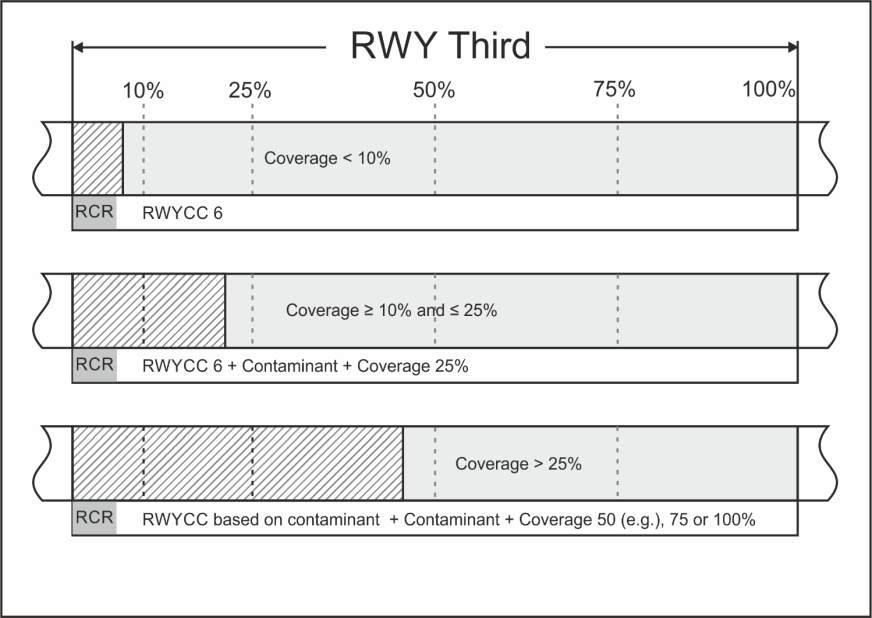
Figure 1: Single contaminant
(b)If multiple contaminants are present where the total coverage is more than 25 per cent but no single contaminant covers more than 25 per cent of any runway third, the RWYCC is based upon the judgement of the runway inspector, considering what contaminant will most likely be encountered by the aeroplane and its likely effect on the aeroplane’s performance. Typically, this would be the most widespread contaminant, but this is not an absolute.
(c)The structure of the RCAM is ranking the contaminants in the column ‘Runway surface description’ from top to bottom and is having the most slippery contaminants at the bottom. However, this ranking is not an absolute, as the RCAM by design is landing oriented and if judged in a take-off scenario, the ranking could be different due to drag effects of loose contaminants.
GM2 ADR.OPS.B.037(b) Assessment of runway surface condition and assignment of runway condition code
ED Decision 2021/003/R
DOWNGRADING AND UPGRADING
(a)The RCAM allows making an initial assessment based on visual observation of contaminants on the runway surface: their type, depth and coverage, as well as the outside air temperature. Downgrading and upgrading is an integral part of the assessment process and essential to developing relevant reports of the prevailing runway surface condition.
(b)Examples of aspects to be considered in assessing the runway slipperiness for the downgrade process:
(1)Prevailing weather conditions
(i)stable sub-freezing temperature
(ii)dynamic conditions
(iii)active precipitation.
(2)Observations
(3)Measurements
(i)friction measurements
(ii)vehicle behaviour
(iii)shoe scraping
(4)Experience (local knowledge)
(5)Special air-reports
(c)When the complete removal of contaminants cannot be achieved, but the RWYCC initially assigned does not reflect the real surface condition, the aerodrome personnel may apply the upgrade procedures. Upgrading is applicable only when the initial RWYCC is 0 or 1. Upgrading can only occur up to RWYCC 3.
(d)When upgrading RWYCC 0 and 1, a preponderance of evidence needs to exist pointing towards the higher RWYCC.
(e)When a friction measuring device is used for upgrading purposes, a preponderance of evidence needs to exist. In order to upgrade a RWYCC 0 or 1 to no higher than RWYCC 3, the friction measuring device needs to demonstrate an equivalent friction to that of a wet runway (RWYCC 5) or higher.
AMC1 ADR.OPS.B.037(c) Assessment of runway surface condition and assignment of runway condition code
ED Decision 2021/003/R
USE OF SPECIAL AIR-REPORT
(a)The aerodrome operator should:
(1)re-assess the runway surface condition if RWYCC 2 or better has been reported and two consecutive special air-reports of POOR runway braking action are received; and
(2)re-assess the runway surface condition and consider the suspension of operations on that runway when one pilot has reported a LESS THAN POOR runway braking action.
(b)The aerodrome operator may use a special air-report of runway braking action for upgrading purposes only if it is used in combination with other information qualifying for upgrading.
GM1 ADR.OPS.B.037(c) Assessment of runway surface condition and assignment of runway condition code
ED Decision 2021/003/R
USE OF SPECIAL AIR-REPORTS
Special air-reports typically provide aerodrome personnel and other pilots with an observation that can confirm the ground-based assessment of or alert to degraded conditions experienced in terms of braking capability and/or lateral control during the landing roll. The braking action observed is dependent on the type of aircraft, aircraft weight, runway portion used for braking, and other factors. Pilots will use the terms GOOD, GOOD TO MEDIUM, MEDIUM, MEDIUM TO POOR, POOR and LESS THAN POOR. When receiving a special air-report, the recipient needs to consider that it rarely applies to the full length of the runway and is limited to the specific sections of the runway surface in which sufficient wheel braking was applied to reach friction limitation. As special air-reports are subjective and contaminated runways may affect the performance of different aeroplane types in a different way, the reported braking action may not be directly applicable to another aeroplane.
ADR.OPS.B.040 Night operations
Regulation (EU) No 139/2014
The aerodrome operator shall ensure that means and procedures are established and implemented for providing safe conditions for aerodrome operation during night operations.
AMC1 ADR.OPS.B.040 Night Operations
ED Decision 2014/012/R
GENERAL
The aerodrome operator for aerodromes operated at night should, in collaboration with air traffic services provider, ensure that visual aids are installed, operated, and maintained to permit aircraft operations to be performed safely.
ADR.OPS.B.045 Low-visibility procedures
Commission Delegated Regulation (EU) 2022/208
(a)The aerodrome operator shall ensure that the aerodrome is provided with appropriate aerodrome equipment and facilities, and that appropriate low-visibility procedures are established and implemented where it is intended to be used for any of the following operations:
(1)low-visibility take-offs;
(2)approach and landing operations with visibility conditions less than 550 m RVR or DH less than 200 ft (60 m);
(3)operations with operational credits where the actual RVR is less than 550 m.
The low-visibility procedures shall coordinate the movement of aircraft and vehicles and shall restrict or prohibit activities on the movement area.
(b)The aerodrome operator shall establish and implement the low-visibility procedures in cooperation with the air traffic services provider. The low-visibility procedures shall include criteria for their preparation, initiation and termination. The criteria shall be based on RVR and cloud ceiling values.
(c)The aerodrome operator shall inform the aeronautical information services provider and air traffic services provider, as appropriate, of any change on the status of the aerodrome equipment and facilities that have an impact on low-visibility operations.
(d)The aerodrome operator shall provide information on low-visibility procedures to the aeronautical information services provider, for publication in the AIP.
(e)Low-visibility procedures, and any changes thereto, shall require prior approval by the competent authority.
AMC1 ADR.OPS.B.045(a)(1) Low-visibility procedures
ED Decision 2022/013/R
LOW-VISIBILITY TAKE-OFF (LVTO) WITH AN RVR LESS THAN 125 M
In addition to the low-visibility procedures which are required for LVTOs, the following should also apply to LVTOs with an RVR less than 125 m:
(1)if an ILS signal is used for lateral guidance, the ILS localiser signal meets the requirements for category III operations including the availability of a standby transmitter; and
(2)if an ILS signal is used, the low-visibility procedures should include protection of the ILS-sensitive area.
GM1 ADR.OPS.B.045(a)(1) Low-visibility procedures
ED Decision 2022/013/R
RUNWAY CENTRE LINE LIGHTS
The specifications for the required runway centre line lights are contained in CS ADR-DSN.M.690.
AMC1 ADR.OPS.B.045(a)(2) Low-visibility procedures
ED Decision 2022/013/R
SUITABILITY OF RUNWAYS — APPROACH AND LANDING OPERATIONS
(a)CAT II instrument approach operations may be conducted on a precision approach category II or III runway, using a CAT II instrument approach procedure.
(b)CAT III instrument approach operations may be conducted on a precision approach category III runway, using a CAT III instrument approach procedure.
(c)SA CAT I approach operations may be conducted in accordance with the following:
(1)the runway is a precision approach category I runway and an obstacle free zone (OFZ) is established;
(2)a CAT I instrument approach procedure that includes an OCH based on a radio altimeter is used;
(3)where an ILS/MLS is used, it is not promulgated with any restrictions affecting its usability and is not offset from the extended runway centre line;
(4)where a GBAS landing system (GLS) is used, it is not promulgated with any restrictions affecting its usability and should not be offset from the extended centre line;
(5)the glide path angle is 3.0o;
(6)the pre-threshold terrain is surveyed and either a precision approach terrain chart (ICAO Annex 4, Chapter 6) is published in the AIP or the required information is included in the aerodrome terrain and obstacle chart – ICAO (Electronic) (ICAO Annex 4, Chapter 5).
(d)SA CAT II approach operations may only be conducted in accordance with the following:
(1)the runway is a precision approach category I runway and an OFZ is established, and for operations with an RVR of less than 400 m, runway centre line lights are installed;
(2)a CAT II instrument approach procedure is used;
(3)where an ILS/MLS is used, it is not offset from the extended runway centre line and no restrictions affecting its usability are published in the AIP;
(4)where a GLS is used, it is not offset from the extended runway centre line and no restrictions affecting its usability are published in the AIP;
(4)where an ILS is used, it is certified to class II/D/2;
(5)the pre-threshold terrain is surveyed and either a precision approach terrain chart (ICAO Annex 4, Chapter 6) has been published or the required information is included in the aerodrome terrain and obstacle chart – ICAO (Electronic) (ICAO Annex 4, Chapter 5).
(e)The switch-over times of the different lighting elements on runways supporting SA CAT I/II approach operations should be as follows:
ELEMENT | SWITCH-OVER TIME |
Approach lighting system | 15 sec |
Runway edge light | 1 sec |
Visual approach slope indicators | 15 sec |
Runway threshold light | 1 sec |
Runway end light | 1 sec |
Stopway end | 1 sec |
Stopway edge | 15 sec |
Obstacle light | 15 sec |
(f)The switch-over time for runway edge lights may be increased to 15 sec if runway centre line lights are provided. In this case, the switch-over time for runway centre line lights should be 1 sec.
AMC1 ADR.OPS.B.045(a)(3) Low-visibility procedures
ED Decision 2022/013/R
SUITABILITY OF RUNWAYS FOR EFVS APPROACH AND LANDING OPERATIONS
(a)An EFVS-A operation may be conducted on a runway if:
(1)it is served by a straight-in instrument approach procedure in accordance with Part-FPD of Regulation (EU) 2017/373;
(2)an OFZ is established or a VSS is not penetrated by obstacles, and an instrument departure procedure is established;
(3)the touchdown zone (TDZ) RVR is available;
(4)low-visibility procedures are in effect;
(5)the switch-over time for runway edge, threshold and end lights meets the specifications in CS ADR-DSN.S.880 for CAT II/III runways.
(b)An EFVS-L operation may be conducted on a runway when, in addition to point (a):
(1)an aerodrome obstacle chart – ICAO Type A is published in the AIP; and
(2)a precision approach terrain chart – ICAO is published in the AIP.
AMC1 ADR.OPS.B.045(b) Low-visibility procedures
ED Decision 2022/013/R
GENERAL
(a)When low-visibility procedures (LVPs) are in effect:
(1)persons and vehicles operating on the movement area should be restricted to the essential minimum;
(2)the critical and sensitive areas of ILS/MLS/GLS should be safeguarded.
(b)The aerodrome operator should, in coordination with air traffic services, establish low-visibility taxi routes.
AMC2 ADR.OPS.B.045(b) Low-visibility procedures
ED Decision 2022/013/R
CRITERIA FOR THE PREPARATION OF LVPs
When establishing the RVR and cloud ceiling values below which LVPs should be prepared, the aerodrome operator should consider:
(a)the aerodrome layout and its complexity;
(b)the location of the control tower;
(c)the facilities and equipment available; and
(d)the density of traffic.
AMC1 ADR.OPS.B.045(c) Low-visibility procedures
ED Decision 2023/003/R
EQUIPMENT FAILURES TO BE REPORTED AND EFFECTS ON FLIGHT OPERATIONS
The following equipment failures should be reported if the system is degraded or unserviceable or if back-up procedures cannot provide the same level of service:
EQUIPMENT FAILURE TO BE REPORTED – LOW-VISIBILITY DEPARTURE OPERATIONS | ||
SYSTEM CONSIDERED | FAILURE TO BE REPORTED | EFFECT ON FLIGHT OPERATIONS |
ILS (Where used for guided take-off) | ILS localiser downgraded to CAT II ILS localiser downgraded to CAT I ILS out of service | No take-off guidance. Guided take-off not allowed No take-off guidance. Guided take-off not allowed No take-off guidance. Guided take-off not allowed |
MLS (Where used for guided take-off) | MLS downgraded to CAT II MLS downgraded to CAT I MLS out of service | No take-off guidance. Guided take-off not allowed No take-off guidance. Guided take-off not allowed No take-off guidance. Guided take-off not allowed |
GBAS (Where used for guided take-off) | GBAS downgraded to CAT II GBAS downgraded to CAT I GBAS out of service | No take-off guidance. Guided take-off not allowed No take-off guidance. Guided take-off not allowed No take-off guidance. Guided take-off not allowed |
RVR | Touchdown RVR system unserviceable Other RVR systems unserviceable | Restrictions depending on flight operations rules Restrictions depending on flight operations rules |
LIGHTING SYSTEMS | Runway lighting unserviceable Runway centre line lighting unserviceable Runway edge lighting unserviceable Taxiway lighting system unserviceable | Restrictions depending on flight operations rules Restrictions depending on flight operations rules Restrictions depending on flight operations rules Restrictions depending on flight operations rules |
ANCILLARY | Stop bars unserviceable Ceilometer unserviceable Anemometer unserviceable | No effect if runway protection is ensured by other means No effect No effect if other sources available; otherwise restrictions depending on flight operations rules |
EQUIPMENT FAILURE TO BE REPORTED – APPROACH AND LANDING OPERATIONS | ||
SYSTEM CONSIDERED | FAILURE TO BE REPORTED | EXPECTED EFFECT ON FLIGHT OPERATIONS |
ILS | ILS downgraded to CAT II ILS downgraded to CAT I ILS out of service Outer marker unserviceable Glide path out of service | Flight operations limited to CAT II Flight operations limited to CAT I Restricted to non-precision approach (or other precision approach aid if available) No limitation if replaced by published equivalent position; otherwise, restricted to non-precision approach Restricted to non-precision approach (e.g. localiser only) |
MLS | MLS downgraded to CAT II MLS downgraded to CAT I MLS out of service | Flight operations limited to CAT II Flight operations limited to CAT I Restricted to non-precision approach (or other precision approach aid if available) |
GBAS | GBAS downgraded to CAT II GBAS downgraded to CAT I GBAS out of service | Flight operations limited to CAT II Flight operations limited to CAT I Restricted to non-precision approach (or other precision approach aid if available) |
DME | DME (as alternative to marker beacons) unserviceable | No limitation if replaced by published equivalent position; otherwise restricted to non-precision approach |
RVR | Touchdown RVR system unserviceable Other RVR systems unserviceable | Restriction depending on flight operations rules Restriction depending on flight operations rules |
LIGHTING SYSTEMS | Approach lighting unserviceable Runway lighting unserviceable Runway centre line lighting unserviceable Runway edge lighting unserviceable TDZ lighting unserviceable Taxiway lighting system unserviceable | Restriction depending on flight operations rules Restriction depending on flight operations rules Restriction depending on flight operations rules Restriction depending on flight operations rules Restriction depending on flight operations rules Restriction depending on flight operations rules |
ANCILLARY | Stop bars unserviceable Ceilometer unserviceable Anemometer unserviceable | No effect if runway protection is ensured by other means No effect No effect if other sources available; otherwise, restriction depending on flight operations rules |
ADR.OPS.B.050 Operations in adverse weather conditions
Regulation (EU) No 139/2014
The aerodrome operator shall ensure that means and procedures are established and implemented to ensure the safety of aerodrome operations in adverse weather conditions.
AMC1 ADR.OPS.B.050 Operations in adverse weather conditions
ED Decision 2014/012/R
PROCEDURES
The aerodrome operator should, together with the air traffic services and other relevant parties operating at the aerodrome, establish and implement procedures required to mitigate the risk of operation of the aerodrome under adverse weather conditions such as strong winds, heavy rain, and thunderstorms, including the suspension of operations on the runway(s) if deemed necessary.
AMC2 ADR.OPS.B.050 Operations in adverse weather conditions
ED Decision 2025/009/R
RISK MITIGATION
(a)The operational procedures should cover the following key risk areas:
(1)ground collision between or with equipment, vehicles and aircraft,
(2)aircraft upset,
(3)taxiway/apron excursions,
(4)the environmental impact of the use of anti-icing chemicals,
(5)taxiway incursions,
(6)injury to persons,
(7)fire caused by thunderstorms.
(b)The procedures should cover at least the following situations, as applicable to the operational and geographical contexts:
(1)slippery apron,
(2)storms, lightning and heavy rain,
(3)high winds,
(4)low visibility,
(5)volcanic ash,
(6)intense heat,
(7)winter conditions, including freezing,
(8)working in confined spaces (e.g. the aircraft cargo compartment) in extreme temperatures,
(9)the operation of GSE in conditions of poor friction and in the presence of snow banks,
(10)additional guidance of vehicles around the aircraft and during push-back or towing in
low-visibility conditions.
[applicable from 27 March 2028 — ED Decision 2025/009/R]
ADR.OPS.B.055 Fuel quality
Regulation (EU) No 139/2014
The aerodrome operator shall verify that organisations involved in storing and dispensing of fuel to aircraft have procedures to ensure that aircraft are provided with uncontaminated fuel and of the correct specification.
AMC1 ADR.OPS.B.055 Fuel quality
ED Decision 2014/012/R
GENERAL
The aerodrome operator should verify, either by itself or through arrangements with third parties, that organisations involved in storing and dispensing of fuel to aircraft, implement procedures to:
(a)maintain the installations and equipment for storing and dispensing the fuel in such condition so as not to render unfit for use in aircraft;
(b)mark such installations and equipment in a manner appropriate to the grade of the fuel;
(c)take fuel samples at appropriate stages during the storing and dispensing of fuel to aircraft, and maintain records of such samples; and
(d)use adequately qualified and trained staff in storing, dispensing, and otherwise handling fuel on the aerodrome.
GM1 ADR.OPS.B.055 Fuel quality
ED Decision 2025/009/R
COMPLIANCE
The aerodrome operator, in order to ensure compliance, could use:
(a)audit reports to organisations involved in storing and dispensing of fuel to aircraft, or
(b)relevant national procedures providing for the assurance of fuel quality.
[applicable until 26 March 2028 — ED Decision 2014/012/R]
COMPLIANCE AND RECOMMENDED REFERENCES FOR FUEL SUPPLY STANDARDS
The aerodrome operator, in order to ensure compliance, could use:
(a)audit reports to organisations involved in storing and dispensing of fuel to aircraft;
(b)relevant national procedures providing for the assurance of fuel quality;
(c)the standards and instructions developed under the Joint Inspection Group (JIG) in relation to aviation fuel quality control:
(1)JIG 1 – Aviation Fuel Quality Control and Operating Standards for Into-Plane Fuelling Services,
(2)JIG 2 – Aviation Fuel Quality Controls and Operating Standards for Airport Depots and Hydrants,
(3)JIG 4 – Aviation Fuel Quality Control and Operating Standards for Smaller Airports,
(4)JIG/EI 1530 and EI 1533 – fuel quality assurance and traceability upstream to an aerodrome facility.
[applicable from 27 March 2028 — ED Decision 2025/009/R]
ADR.OPS.B.065 Visual aids and aerodrome electrical systems
Regulation (EU) No 139/2014
The aerodrome operator shall have procedures to ensure that aerodrome visual aids and electrical systems function as intended.
AMC1 ADR.OPS.B.065 Visual aids and aerodrome electrical systems
ED Decision 2021/003/R
GENERAL
(a)The aerodrome operator should establish a monitoring system of aerodrome ground lights so as to inform the air traffic services provider when safe operation is no longer possible.
(b)The aerodrome operator should establish procedures for the operation of visual aids and, in coordination with the air traffic services provider, procedures to be implemented in the event of unserviceability of stop bars. The procedures should cover the situation where the stop bars cannot be turned off because of a technical problem, and the measures to be taken should not undermine the principle that a lit stop bar must not be crossed.
(c)The aerodrome operator should establish procedures for the provision and removal of temporary markings, lights and signs.
GM1 ADR.OPS.B.065 Visual aids and aerodrome electrical systems
ED Decision 2021/003/R
UNSERVICEABILITY OF STOP BARS
In situations where the stop bars cannot be turned off because of a technical problem, the following contingency measures may, inter alia, be considered:
(a)physically disconnecting the respective lit stop bar from its power supply;
(b)physically obscuring the lights of the lit stop bar; and
(c)using a different route, until the malfunctioning system has been repaired.
In case of implementation of (a) or (b), a marshaller or a follow-me vehicle may need to be provided to lead the aircraft to cross the stop bar. Moreover, in case of implementation of (b), care is necessary to ensure correct implementation of the measure to avoid misunderstandings by the flight crew.
In any case, the measures taken do not undermine the principle that a lit stop bar must not be crossed, while maintenance action needs to be taken as soon as possible.
ADR.OPS.B.070 Aerodrome works safety
Regulation (EU) 2024/1400
(a)The aerodrome operator shall establish and implement a process for managing the aerodrome’s operational safety during works on the movement area.
(b)The process shall establish and document the responsibilities as regards:
(1)the authorisation to perform the works;
(2)the implementation of any proposed change to operational facilities;
(3)the date and time when operations in the facilities will be limited or discontinued;
(4)the methods by which such changes will be promulgated;
(5)the oversight and control of the work in progress;
(6)the compliance with all relevant movement area safety rules.
(c)The process for managing the aerodrome’s operational safety during works shall contain the following elements:
(1)a works’ planning procedure;
(2)a procedure for the safety assessment of the planned changes to the aerodrome’s operations or systems;
(3)a works’ authorisation procedure;
(4)a procedure for the promulgation of information related to the works;
(5)a procedure for worksite establishment and return to operations;
(6)a procedure for the monitoring, oversight and control of the works.
(d)Where reduced runway length operations are required due to works, the aerodrome operator shall develop and implement a procedure for such operations.
AMC1 ADR.OPS.B.070(c)(1) Aerodrome works safety
ED Decision 2024/004/R
WORKS PLANNING PROCEDURE
(a)The aerodrome operator should ensure that the works planning procedure provides for the planning and coordination of works on the movement area.
(b)The aerodrome operator, during the planning process, should involve, where appropriate, affected stakeholders such as air traffic services providers, organisations responsible for the provision of AMS, if established, aircraft operators and organisations responsible for the provision of ground handling services to review the requirements for the safe operations of the aerodrome during the proposed works.
AMC1 ADR.OPS.B.070(c)(2) Aerodrome works safety
ED Decision 2024/004/R
SAFETY ASSESSMENT OF PLANNED CHANGES
(a)The aerodrome operator should:
(1)complete beforehand, in coordination with the affected organisations, a safety assessment of all planned works to ensure that the risks to the safe operation of aircraft have been identified and appropriate measures are introduced to keep risks as low as reasonably practicable;
(2)document and make available to all affected organisations involved in the works or affected by any change in operations, the relevant procedures, actions and decisions; and
(3)verify, before implementation, that draft operational procedures, instructions or other information to be promulgated are appropriate and correct.
(b)Regular maintenance works may be covered by a general safety assessment pertaining to the respective maintenance.
AMC1 ADR.OPS.B.070(c)(3) Aerodrome works safety
ED Decision 2024/004/R
WORKS AUTHORISATION
(a)The aerodrome operator, prior to the commencement of works, should provide a works authorisation document to the party conducting the works.
(b)The authorisation document should contain specific permissions and conditions, which are already agreed between the aerodrome operator and the involved organisations. The party conducting the works should communicate the document to any subcontractors involved.
GM1 ADR.OPS.B.070(c)(3) Aerodrome works safety
ED Decision 2024/004/R
WORKS AUTHORISATION
The term ‘works authorisation’ refers to the approval by the aerodrome operator of the commencement of works.
AMC1 ADR.OPS.B.070(c)(5) Aerodrome works safety
ED Decision 2024/004/R
PROCEDURE FOR WORKSITE ESTABLISHMENT AND RETURN TO OPERATIONAL USE
MARKING AND LIGHTING OF UNSERVICEABLE AREAS
(a)The aerodrome operator should ensure that:
(1)unserviceability markers are displayed whenever any portion of a taxiway, apron or holding bay is unfit for the movement of aircraft but it is still possible for aircraft to bypass the area safely;
(2)on a movement area used at night, unserviceability lights should be used;
(3)unserviceability markers and lights are placed at intervals sufficiently close so as to delineate the unserviceable area. When lights are used to mark temporary unserviceable areas at night or during reduced visibility conditions, these lights should mark the extremities of the area. A minimum of four such lights should be used, except where the area is triangular in shape where a minimum of three lights may be used. The number of lights should be increased when the area is large or of unusual configuration. At least one light should be installed for each 7.5 m of peripheral distance of the area. If the lights are directional, they should be orientated so that, as far as possible, their beams are aligned in the direction from which aircraft or vehicles will approach. Where aircraft or vehicles will normally approach from several directions, consideration should be given to adding extra lights or using omnidirectional lights to show the area from these directions;
(4)unserviceability markers consist of conspicuous upstanding devices such as flags, cones or marker boards;
(5)unserviceability markers and lights meet the specifications described in
CS ADR.DSN.R.870;
(6)existing markings leading into a worksite are masked or the route is closed; and
(7)existing aeronautical ground lighting and signs leading into the worksite are extinguished or masked on the movement area when used at night or low visibility.
WORKSITE RETURN TO OPERATIONAL USE
(b)The procedure for returning the worksite to operational use should include at least the following:
(1)the removal from the worksite of personnel, vehicles, plants and unserviceability lights and markers;
(2)the inspection of the affected areas for operational serviceability including the condition of pavements, signs, lights and markings, presence of FOD or surface contaminants such as dirt, sand, or loose objects; and
(3)the notification of relevant authorities or affected organisations, using suitable means of communication, including the cancellation of relevant NOTAMs; and
(4)the use of appropriate checklists to record relevant actions.
RUNWAY PAVEMENT OVERLAYS
(c)The aerodrome operator should ensure that:
(1)when a runway is to be returned temporarily to an operational status before resurfacing is complete, the longitudinal slope of the temporary ramp, measured with reference to the existing runway surface or previous overlay course, should be:
(i)0.5 to 1.0 %for overlays up to and including 5 cm in thickness; and
(ii)not more than 0.5 % for overlays more than 5 cm in thickness.
(2)Before a runway being overlaid is returned to a temporary operational status, a runway centre line marking, conforming to the applicable specifications included in the aerodrome certification basis of the aerodrome, should be provided.
(3)The location of any temporary threshold should be identified by a 3.6-m wide transverse stripe.
GM1 ADR.OPS.B.070(c)(5) Aerodrome works safety
ED Decision 2024/004/R
USE OF TEMPORARY RUNWAY MARKINGS
(a)Circumstances may occur when it is not practicable to install permanent markings, for example during runway resurfacing. To provide sufficient visual guidance to aircraft, the following markings are considered:
(1)runway centre line;
(2)taxiway centre line lead on/off;
(3)runway edge line;
(4)runway threshold; and
(5)touchdown zone and aiming point markings.
(b)Centre line and edge marking widths can be replaced by temporary markings of reduced width from 0.9 m to 0.6 m, if required.
(c)Touchdown zone and aiming point markings are painted as soon as possible after the resurface of the runway.
(d)Threshold markings are painted as soon as possible, using temporary materials before making them permanent.
AMC1 ADR.OPS.B.070(c)(6) Aerodrome works safety
ED Decision 2024/004/R
MONITORING, OVERSIGHT AND CONTROL OF WORKS
(a)The aerodrome operator should hold prior to start-up and during the works regular site meetings to ensure that safety requirements are met and possible conflicts between the works and operations are resolved. Meetings should be documented. The following points should be considered:
(1)safety awareness in relation to work on the movement area;
(2)protection of construction workers from aerodrome hazards, including jet blast;
(3)procedure for quickly summoning emergency responders in case of a fire, spill, accident or similar event; and
(4)operational briefings on the interaction of the works with the aerodrome operations (e.g. runway(s) in use, expected visibility conditions, meteorological conditions, safety issues).
(b)The worksite control procedure established by the aerodrome operator should include, but not be limited to, the following elements:
(1)all contractor’s drivers should be escorted by a qualified vehicle operator or undergo appropriate driver training and testing in accordance with point ADR.OPS.B.024;
(2)access routes should be agreed upon in advance and clearly identified to minimise interference with operations on the aerodrome;
(3)possible changes to the existing road layout depending on the vehicle traffic levels;
(4)designation of staff access routes and if such routes do not exist, then a safety risk assessment should be conducted to ensure that access can be safely achieved;
(5)hours of operation of the works;
(6)any service clearance checks (underground location of services) that need to be undertaken before work commences to ensure that cables or pipes are not damaged;
(7)smoking restrictions;
(8)description, monitoring and enforcement of hot work restrictions (possibly involving a separate hot works permit);
(9)the requirement to use lookouts and/or listening watch on the appropriate ATS frequency, if required;
(10)if cranes are used, appropriate lighting and operating height restrictions to avoid infringement of obstacle limitation surfaces, obstacle protection surfaces, interference with radio navigation aids, surface movement radar and line of sight of ATS tower;
(11)procedures for crossing taxiways, if required;
(12)adequate FOD and dust control measures that should be taken by all contractors to cover all eventualities;
(13)requirement for vehicles entering or leaving the worksite to be cleaned to prevent mud or debris being deposited in the movement area;
(14)provision of an appropriate alerting mechanism to suspend work activities, in case of possible adverse meteorological conditions (e.g. lightning strikes, strong winds, snow, low visibility) or aircraft emergencies;
(15)measures to ensure that worksite floodlighting (light direction and/or height) does not affect aircraft and ATS operation.
(c)Where significant changes to markings or lightings are being made, the aerodrome operator should conduct a preliminary check to ensure that the changes have been correctly implemented and are functioning as intended.
(d)The aerodrome operator should obtain feedback from the parties involved to ensure the implementation of corrective actions, if necessary.
(e)The aerodrome operator should ensure that contractors have made available a point-of-contact outside normal working hours.
AMC1 ADR.OPS.B.070(d) Aerodrome works safety
ED Decision 2024/004/R
PROCEDURE FOR REDUCED RUNWAY LENGTH OPERATIONS
(a)The procedure for reduced runway length operations, when works require the reduction of the declared distances should include the following:
(1)the identification of potential hazards and assessment and mitigation of the associated risks, as necessary, before, during, and on cessation of operations with reduced declared distances available and works-in-progress to ensure the safety of aircraft operations;
(2)the calculation and establishment, where necessary, of a revised runway strip, runway safety area (RESA) and obstacle limitation surfaces, such as the approach and take-off climb surfaces;
(3)the establishment of a safety zone between the area of the runway that is in use and the worksite or unusable runway;
(4)the promulgation of the details of the reduced declared distances in accordance with point ADR.OPS.A.057 and, when possible, the broadcast of the information on automatic terminal information service (ATIS); and
(5)the assessment and mitigation of the impact on the ability of the rescue and firefighting services and the emergency services to perform their functions.
(b)The aerodrome operator, in cooperation with air traffic services, should be responsible for coordinating and managing the opening and closing of the runway and other parts of the movement area, as necessary, and the worksite.
(c)The aerodrome operator should coordinate and approve any tactical decision concerning aircraft operations, which deviate from the agreed operational procedures, with the exception of any tactical decisions with an urgent safety nature.
(d)The aerodrome operator should be responsible for monitoring the safety of aerodrome and aircraft operations in the proximity of the worksite, to ensure that timely and corrective action is taken, when necessary.
GM1 ADR.OPS.B.070(d) Aerodrome works safety
ED Decision 2024/004/R
RISKS RELATED TO REDUCED RUNWAY LENGTH OPERATIONS
Risks may result from inappropriate or potentially misleading display of visual aids, inappropriate or potentially misleading navigational aids, adverse environmental conditions or unusual meteorological conditions, and from restricted obstacle clearance and wingtip separation distances. Identified hazards may cover a wide range of topics, including those that pose a risk not only to aircraft but also to personnel, e.g. the potential risk from jet blast.
GM2 ADR.OPS.B.070(d) Aerodrome works safety
ED Decision 2024/004/R
SAFETY ZONES
The location, size, and shape of the safety zone depends on the temporary configuration of the runway, to provide for items such as RESA, jet blast protection and abbreviated or simple approach lighting system.
ADR.OPS.B.071 Closed runways and taxiways, or parts thereof
Regulation (EU) 2024/1400
(a)The aerodrome operator shall ensure that closed markings are displayed on:
(1)a runway or a taxiway, or a portion thereof, which is permanently closed to use by all aircraft;
(2)a temporarily closed runway or taxiway, or a portion thereof, except that such markings may be omitted when the closure is of a short duration and adequate warning is provided by air traffic services.
(b)By way of derogation from point (a), a closed marking need not be displayed on a permanently closed taxiway, or parts thereof, if entrance to the closed taxiway, or parts thereof, is marked and lit with unserviceability lights and markers.
(c)The aerodrome operator shall ensure that when a runway or a taxiway, or a portion thereof, is permanently closed, all runway and taxiway markings are physically removed.
(d)The aerodrome operator shall ensure that lighting on a closed runway or taxiway, or a portion thereof, is not operated, except as required for maintenance purposes.
(e)The aerodrome operator shall ensure that in addition to closed markings, when a runway, a taxiway, or a portion thereof, is closed and is intercepted by a usable runway or taxiway which is used at night, unserviceability lights shall be placed across the entrance to the closed area.
AMC1 ADR.OPS.B.071(a) Closed runways and taxiways, or parts thereof
ED Decision 2024/004/R
CLOSED MARKING
(a)The closed marking should be in accordance with CS ADR-DSN.R.855.
(b)On a runway, a closed marking should be placed at each end of the runway, or part thereof, declared closed and additional markings should be so placed that the maximum interval between markings does not exceed 300 m.
(c)On a taxiway, a closed marking should be placed at least at each end of the taxiway, or part thereof closed.
GM1 ADR.OPS.B.071(a)(2) Closed runways and taxiways, or parts thereof
ED Decision 2024/004/R
CLOSED RUNWAY AND TAXIWAY MARKINGS — AVOIDING THE LACK OF CONTRAST
(a)In certain circumstances, e.g. due to the colour of the material used during construction works, there may be insufficient contrast between the colour of the surface of the runway or taxiway and the colour of the respective closed runway or taxiway marking, even though the latter conforms to the applicable specifications.
This may result in the closed runway or taxiway markings not fulfilling their purpose. To avoid the lack of contrast, the closed runway or taxiway markings need to be included in an appropriate border, whose colour is black.
(b)At aerodromes where operations take place at night, the closed runway or taxiway markings would be made with reflective materials designed to enhance their visibility. Guidance on reflective materials is given in Part 4 ‘Visual Aids’ of ICAO Doc 9157 ‘Aerodrome Design Manual’.
AMC1 ADR.OPS.B.071(d) Closed runway and taxiways, or parts thereof
ED Decision 2024/004/R
UNSERVICEABILITY LIGHTS AT ENTRANCES OF CLOSED RUNWAYS AND TAXIWAYS OR PARTS THEREOF
Unserviceability lights should be in accordance with CS ADR-DSN.R.870 and should be placed across the entrance to the closed area at intervals not exceeding 3 m.
ADR.OPS.B.075 Safeguarding of aerodromes
Regulation (EU) No 139/2014
(a)The aerodrome operator shall monitor on the aerodrome and its surroundings:
(1)obstacle limitation and protection surfaces as established in accordance with the certification basis, and other surfaces and areas associated with the aerodrome, in order to take, within its competence, appropriate action to mitigate the risks associated with the penetration of those surfaces and areas;
(2)marking and lighting of obstacles in order to be able to take action within its competence, as appropriate; and
(3)hazards related to human activities and land use in order to take action within its competence, as appropriate.
(b)The aerodrome operator shall have procedures in place for mitigating the risks associated with obstacles, developments and other activities within the monitored areas that could impact safe operations of aircraft operating at, to or from the aerodrome.
AMC1 ADR.OPS.B.075 Safeguarding of aerodromes
ED Decision 2021/003/R
GENERAL
(a)The aerodrome operator should have procedures to monitor the changes in the obstacle environment, marking and lighting, and in human activities or land use on the aerodrome and the areas around the aerodrome, as defined in coordination with the Competent Authority. The scope, limits, tasks and responsibilities for the monitoring should be defined in coordination with the relevant air traffic services providers, and with the Competent Authority and other relevant authorities, and should ensure the protection of the sight lines from the established air traffic control tower, apron management services unit, and watch-room of the RFFS station(s), from permanent or temporary obstacles or activities.
(b)The limits of the aerodrome surroundings that should be monitored by the aerodrome operator are defined in coordination with the Competent Authority and should include the areas that can be visually monitored during the inspections of the manoeuvring area.
(c)The aerodrome operator should have procedures to mitigate the risks associated with changes on the aerodrome and its surroundings identified with the monitoring procedures. The scope, limits, tasks, and responsibilities for the mitigation of risks associated to obstacles or hazards outside the perimeter fence of the aerodrome should be defined in coordination with the relevant air traffic services providers, and with the Competent Authority and other relevant authorities.
(d)The risks caused by human activities and land use which should be assessed and mitigated should include:
(1)obstacles and the possibility of induced turbulence;
(2)the use of hazardous, confusing, and misleading lights;
(3)the dazzling caused by large and highly reflective surfaces;
(4)sources of non-visible radiation, or the presence of moving, or fixed objects which may interfere with, or adversely affect, the performance of aeronautical communications, navigation and surveillance systems; and
(5)non-aeronautical ground light near an aerodrome which may endanger the safety of aircraft and which should be extinguished, screened, or otherwise modified so as to eliminate the source of danger.
GM1 ADR.OPS.B.075(a)(1) Safeguarding of aerodromes
ED Decision 2014/012/R
OTHER SURFACES
Other surfaces associated with the aerodrome are surfaces that need to be established when operating in accordance with ICAO PANS-OPS Doc 8168 (Procedures for Air Navigation Services - Aircraft Operations), Volume II, as adopted into the national law. The term ‘surfaces’ in this meaning is not used uniformly in different sources of information where also terms ‘area’ or ‘zone’ may be used.
GM2 ADR.OPS.B.075(a)(1) Safeguarding of aerodromes
ED Decision 2014/012/R
OTHER AREAS TO BE MONITORED AND PROTECTED
Aeronautical communications, navigation and surveillance systems should be established and protected in accordance with the requirements of ICAO Annex 10.
ADR.OPS.B.080 Marking and lighting of vehicles and other mobile objects
Delegated Regulation (EU) 2020/2148
(a)The aerodrome operator shall ensure that vehicles and other mobile objects, excluding aircraft, on the movement area of the aerodrome are:
(1)marked by use of conspicuous colours, or display, at suitable locations, flags of appropriate size, chequered pattern and contrasting colours;
(2)lighted with low-intensity obstacle lights whose type and characteristics are appropriate to their function, if the vehicles and the aerodrome are used at night or in conditions of low visibility. The colour of the lights to be displayed shall be as follows:
(i)flashing blue for vehicles associated with emergency or security;
(ii)flashing yellow for other vehicles, including follow-me vehicles;
(iii)fixed red for objects with limited mobility.
(b)The aerodrome operator may exempt from point (a) aircraft servicing equipment and vehicles used only on aprons.
AMC1 ADR.OPS.B.080(a) Marking and lighting of vehicles and other mobile objects
ED Decision 2021/003/R
MARKING OF VEHICLES
(a)Vehicles to be marked should be coloured or display flags as follows:
(1)Red or yellowish green colour should preferably be used for marking emergency vehicles and yellow colour for service vehicles.
(2)When flags are used to mark vehicles, they should:
(i)be displayed around, on top of, or around the highest edge of the vehicle. Flags should not increase the hazard presented by the vehicle they mark;
(ii)not be less than 0.9 m on each side and should consist of a chequered pattern, each square having sides of not less than 0.3 m. The colours of the pattern should contrast each with the other and with the background against which they will be seen. Orange and white, or alternatively red and white should be used, except where such colours merge with the background.
LIGHTING OF VEHICLES
(b)Lighting of vehicles should be as follows:
(1)Low-intensity obstacle lights, Type C, should be displayed on vehicles;
(2)Low-intensity obstacle lights, Type C, displayed on vehicles associated with emergency or security should be flashing blue and those displayed on other vehicles should be flashing yellow;
(3)Low-intensity obstacle lights, Type D, should be displayed on follow-me vehicles.
(c)Low-intensity obstacle lights, Types C and D should be in accordance with the specifications contained in Table Q-1, CS ADR-DSN.U.930 and Figure U-1A or U-1B of CS-ADR-DSN, as appropriate.
AMC2 ADR.OPS.B.080(a) Marking and lighting of vehicles and other mobile objects
ED Decision 2021/003/R
MARKING OF MOBILE OBJECTS OTHER THAN VEHICLES
(a)Mobile objects, other than vehicles, to be marked should be coloured or display flags as follows:
(1)When they are marked by colour, conspicuous colours should be used.
(2)When they are marked by flags, the flags should:
(i)be displayed around, on top of, or around the highest edge of the object. Flags should not increase the hazard presented by the object they mark; and
(ii)not be less than 0.9 m on each side and should consist of a chequered pattern, each square having sides of not less than 0.3 m. The colours of the pattern should contrast each with the other and with the background against which they will be seen. Orange and white, or alternatively red and white should be used, except where such colours merge with the background.
LIGHTING OF MOBILE OBJECTS OTHER THAN VEHICLE
(b)Lighting of mobile objects, other than vehicles, should be as follows:
(1)Low-intensity obstacle lights, Type C, should be displayed on mobile objects;
(2)Low-intensity obstacle lights on objects with limited mobility, such as aerobridges, shall be fixed-red, and as a minimum be in accordance with the specifications for low-intensity obstacle lights, Type A, in Table Q-1 of CS-ADR-DSN. The intensity of the lights shall be sufficient to ensure conspicuity considering the intensity of the adjacent lights and the general levels of illumination against which they would normally be viewed.
GM1 ADR.OPS.B.080(a) Marking and lighting of vehicles and other mobile objects
ED Decision 2021/003/R
MOBILE OBJECTS OTHER THAN VEHICLES
The term ‘mobile objects’ covers all mobile equipment, such as passenger stairs, generators, as well as other similar equipment, which are not self-powered, and whose presence is required on the apron for the ground servicing of aircraft.
It also covers objects of reduced mobility, such as aerobridges, which are attached to the terminal building.
Moreover, it covers any other mobile equipment that may be needed to be used in the manoeuvring area for specific purposes.
ADR.OPS.B.090 Use of the aerodrome by aircraft exceeding the certified design characteristics of the aerodrome
Regulation (EU) 2024/1400
(a)In order to allow the use of the aerodrome or parts thereof by aircraft exceeding the code letter or the outer main gear wheel span, or both, of the certified design characteristics of the aerodrome, the aerodrome operator shall apply for the prior approval of the Competent Authority; such approval is not required for aircraft emergency situations.
(b)In the request for the prior approval of the Competent Authority for aircraft referred to in point (a), the aerodrome operator shall include an assessment of the impact of the following aircraft characteristics on the aerodrome infrastructure, its facilities, equipment, and operation, and vice versa:
(1)wingspan;
(2)outer main gear wheel span;
(3)wheel base;
(4)fuselage length;
(5)fuselage width;
(6)fuselage height;
(7)nose geometry;
(8)tail height;
(9)wing tip vertical clearance;
(10)cockpit view;
(11)distance from the pilot’s eye position to the nose landing gear;
(12)main landing gear layout;
(13)gear steering system;
(14)maximum aircraft mass;
(15)landing gear geometry, tyre pressure and aircraft classification values;
(16)engine characteristics;
(17)maximum passenger and fuel carrying capacity;
(18)flight performance.
GM1 ADR.OPS.B.090 Use of the aerodrome by aircraft exceeding the certified design characteristics of the aerodrome
ED Decision 2024/004/R
CERTIFIED AERODROME DESIGN CHARACTERISTICS
In accordance with point ADR.AR.C.035, the certificate is considered to include the aerodrome’s certification basis, the aerodrome manual, and, if relevant, any other operating conditions or limitations prescribed by the Competent Authority and any Deviation Acceptance and Action Documents (DAAD).
GM2 ADR.OPS.B.090 Use of the aerodrome by aircraft exceeding the certified aerodrome design characteristics
ED Decision 2024/004/R
WHEEL BASE
The clearance distance on a runway turn pad or on a taxiway is determined with regard to the dimensions of the outer main gear wheel span (OMGWS). For aeroplanes with an OMGWS between 6 m up to but not including 9 m, the clearance distance on a runway turn pad or on a curved portion of a taxiway is determined with regard to the OMGWS but with a further differentiation in reference to the wheel base (see CS ADR-DSN.B.095, CS ADR-DSN.D.240, and additionally CS ADR-DSN.D.250 and CS ADR-DSN.D.255). Point ADR.OPS.B.090 is also applicable in this case.
GM3 ADR.OPS.B.090 Use of the aerodrome by aircraft exceeding the certified design characteristics of the aerodrome
ED Decision 2024/004/R
ELEMENTS TO BE ASSESSED — AIRCRAFT CHARACTERISTICS
(a)Wingspan
(1)wake turbulence;
(2)gate selection;
(3)aerodrome maintenance services around the aeroplane;
(4)equipment for disabled aeroplane removal;
(5)de-icing; and
(6)the dimensions of aeroplane maintenance facilities.
(b)Wheel base
(1)terminal areas.
(c)Fuselage length
(1)passenger gates and terminal areas;
(2)the dimensions of aeroplane maintenance facilities.
(d)Fuselage height, in particular door sill height and wing height
(1)the operational limits of the air bridges;
(2)mobile steps;
(3)catering trucks;
(4)persons with reduced mobility;
(5)dimensions of the apron;
(6)door longitudinal position;
(7)potential obstacles close to the door (e.g. probes);
(8)fuelling; and
(9)de-icing.
(e)Tail height
(1)the dimensions of aeroplane maintenance facilities.
(f)Maximum aeroplane mass
(1)wake turbulence.
(g)Engine characteristics
(1)design of air bridges; and
(2)location of refuelling pits on the aircraft stand.
The engine characteristics include engine geometry and engine airflow characteristics, which may affect the aerodrome infrastructure as well as ground handling of the aeroplane and operations in adjacent areas which are likely to become affected by jet blast.
(h)Maximum passenger and fuel carrying capacity
(1)terminal facilities;
(2)fuel storage and distribution;
(3)air bridge loading configuration.
(i)Flight performance
(1)wake turbulence;
(2)noise.
ADDITIONAL ELEMENTS TO BE ASSESSED — AIRCRAFT GROUND SERVICING REQUIREMENTS
The following non-exhaustive list of aircraft ground servicing characteristics and requirements may affect the available aerodrome infrastructure:
(j)ground power;
(k)passengers embarking and disembarking;
(l)cargo loading and unloading;
(m)fuelling;
(n)pushback and towing;
(o)de-icing;
(p)taxiing and marshalling;
(q)aeroplane maintenance;
(r)RFFS;
(s)equipment areas;
(t)stand allocation; and
(u)disabled aircraft removal.
Each assessment is specific to a particular type of aircraft and to a particular operational context.
The assessment may require a review of the obstacle limitation surfaces at an aerodrome as described in Chapters H and J of CS-ADR-DSN. At aerodromes where low-visibility procedures are implemented, additional procedures may be implemented to safeguard the operation of aircraft. Additional processes that ensure suitable measures are in place to protect the signal produced by the ground-based radio navigation equipment may be necessary at aerodromes with precision instrument approaches.
Further guidance on this issue is contained in ICAO Circular 305-AN/177 and
ICAO Circular 301-AN/174.
In any case, the elements that have to be taken into account for the safety assessment are, without prejudice to other assessments that may have to be conducted, in accordance with other applicable requirements contained in Part-ADR.OPS.
AMC1 ADR.OPS.B.090(b) Use of the aerodrome by aircraft exceeding the certified design characteristics of the aerodrome
ED Decision 2024/004/R
ELEMENTS TO BE ASSESSED
The aerodrome operator should assess the characteristics of the aircraft that exceed the code letter and/or outer main gear wheel span and their related impact as follows:
(a)Wingspan
(1)taxiway/taxilane separation distances (including runway/taxiway separation distances);
(2)the dimensions of the obstacle free zone (OFZ);
(3)the location of the runway-holding position (due to the impact of the wingspan on OFZ dimensions);
(4)the dimensions of aprons and holding bays;
(5)shoulder dimensions.
(b)Outer main gear wheel span
(1)runway width;
(2)the dimensions of turn pads;
(3)taxiway width;
(4)taxiway fillets;
(5)the dimensions of aprons and holding bays.
(c)Wheel base
(1)the dimensions of turn pads;
(2)taxiway fillets;
(3)the dimensions of aprons and holding bays; and
(4)aeroplane stands.
(d)Fuselage length
(1)the dimensions of the movement area (taxiway, holding bays, and aprons);
(2)the aerodrome category for RFFS;
(3)ground movement and control (e.g. reduced clearance behind a longer aeroplane holding at an apron or a runway/intermediate holding position to permit the passing of another aeroplane);
(4)de-icing facilities; and
(5)clearances at the aircraft stand.
(e)Fuselage width
(1)aerodrome category for RFFS.
(f)Fuselage height
(1)location of the runway-holding position. The fuselage height is one of the criteria used to determine the location of the runway holding position (including the tail height and the distance from the nose to the highest part of the tail) of the critical aeroplane which shall be clear of the runway OFZ.
(g)Nose geometry
(1)location of the runway-holding position.
(h)Tail height
(1)the location of the runway-holding position;
(2)ILS critical and sensitive areas: In addition to the tail height of the critical aeroplane, tail composition, tail position, fuselage height and length can have an effect on ILS critical and sensitive areas;
(3)de-icing/anti-icing facilities;
(4)aeroplane parking position (in relation to aerodrome OLS);
(5)runway/parallel taxiway separation distances; and
(6)the clearance of any aerodrome infrastructure or facilities built over stationary or moving aeroplanes.
(i)Wing tip vertical clearance
(1)taxiway separation distances with height-limited objects;
(2)apron and holding bay clearances with height-limited objects;
(3)aerodrome signage clearances;
(4)service road locations; and
(5)aerodrome maintenance services (e.g. snow removal).
(j)Cockpit view (cockpit height, cockpit cut-off angle and the corresponding obscured segment)
(1)runway visual references (aiming point);
(2)runway sight distance;
(3)taxiing operations on straight and curved sections;
(4)markings and signs on runways, turn pads, taxiways, aprons and holding bays;
(5)lights: in low-visibility conditions, the number and spacing of visible lights when taxiing may depend on the cockpit view; and
(6)calibration of PAPI (pilot eye height above wheel height on approach).
(k)Distance from the pilot’s eye position to the nose landing gear
(1)taxiway fillets (wheel track);
(2)the dimensions of aprons and holding bays; and
(3)the dimensions of turn pads.
(l)Main landing gear layout
(1)aerodrome pavement system.
(m)Gear steering system
(1)dimensions of turn pads and the dimensions of aprons and holding bays.
(n)Maximum aeroplane mass;
(1)the mass limitation on existing bridges, tunnels, culverts and other structures under runways and taxiways;
(2)disabled aeroplane removal; and
(3)arresting systems when provided as an element of kinetic energy.
(o)Landing gear geometry, tyre pressure and aircraft classification values
(1)aerodrome pavement and associated shoulders.
(p)Engine characteristics
(1)runway shoulder width and composition (jet blast and ingestion issues during take-off and landing);
(2)shoulder width and composition of runway turn pads;
(3)taxiway shoulder width and composition (jet blast and ingestion issues during taxiing);
(4)bridge width (jet blast under the bridge);
(5)dimensions and location of blast protection fences;
(6)location and structural strength of signs;
(7)characteristics of runway and taxiway edge lights;
(8)separation between aeroplanes and adjacent ground service personnel, vehicles or passengers;
(9)design of engine run-up areas and holding bays;
(10)design and use of functional areas adjacent to the manoeuvring area;
(11)snow removal procedures;
(12)engine geometry
(i)number of engines;
(ii)location of engines (span and length);
(iii)vertical clearance of engines;
(iv)vertical and horizontal extent of possible jet blast or propeller wash.
(13)engine airflow
(i)idle, breakaway and take-off thrust exhaust velocities;
(ii)thrust reverser fitment and flow patterns;
(iii)inlet suction effects at ground level.
(q)Maximum passenger and fuel carrying capacity
(1)aerodrome emergency planning;
(2)aerodrome rescue and firefighting.
(r)Flight performance
(1)runway width;
(2)runway length;
(3)the OFZ;
(4)runway/taxiway separation;
(5)aiming point marking.
ADR.OPS.B.095 Hot spots
Regulation (EU) 2024/1400
(a)Whenever necessary, the aerodrome operator shall designate a location or several locations on the movement area of the aerodrome as “hot spot(s)”, as part of the safety programme it has established in accordance with ADR.OR.D.027.
(b)Once a hot spot has been identified, the aerodrome operator shall implement measures to remove the hazard, and if this is not immediately possible, provide the relevant aeronautical data to the responsible aeronautical information services (AIS) unit for publication in the aeronautical information publication (AIP).
GM1 ADR.OPS.B.095(b) Hot spots
ED Decision 2024/004/R
STRATEGIES TO MITIGATE THE RISK OF HOT SPOT(S)
Strategies to manage and mitigate the risk from hot spots, depending on the case, include, but are not limited to, the following:
(a)construction of new taxiways;
(b)additional visual aids (signs, markings and lighting);
(c)establishment of alternative routings;
(d)the mitigation of blind spots in the aerodrome control tower;
(e)awareness campaigns; and
(f)publishing the hot spot in the AIP.
GM2 ADR.OPS.B.095(b) Hot spots
ED Decision 2024/004/R
EXAMPLES OF HOT SPOT(S) CHARTS
Examples of how hot spots are shown on charts are provided in Figures 1, 2, and 3 below.
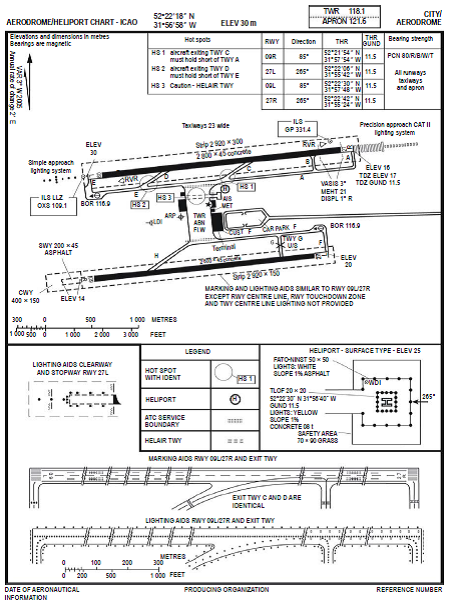
Figure 1
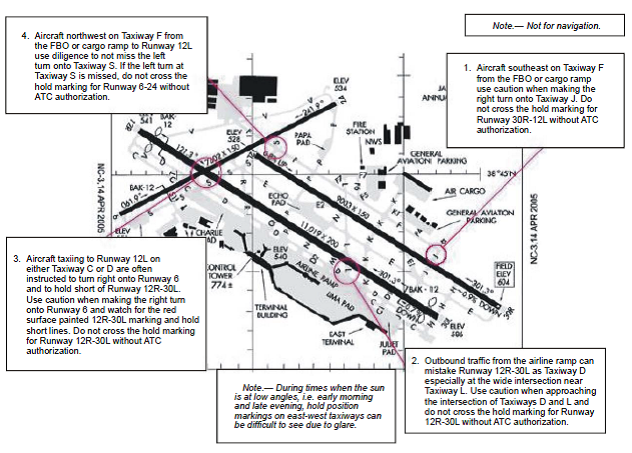
Figure 2
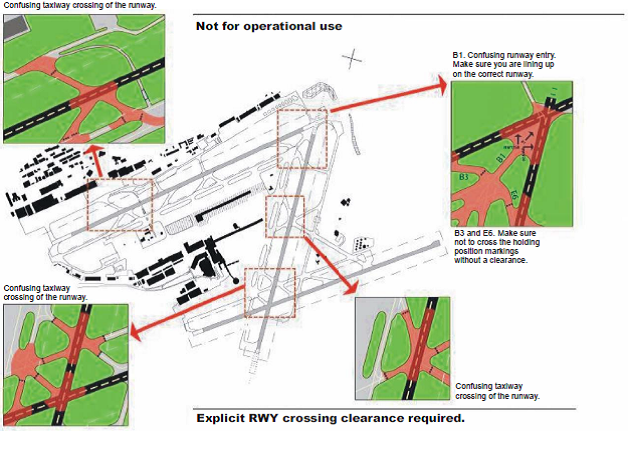 Figure 3
ADR.OPS.B.100 Suspension of runway operations and runway closure
Regulation (EU) 2024/1400
(a)The aerodrome operator shall establish and implement, in cooperation with air traffic services, procedures for the temporary suspension of runway operations or planned runway closure.
(b)The procedures shall contain the following:
(1)roles and responsibilities of the aerodrome operator, the air traffic services and other organisations involved in aerodrome operations, as appropriate to the situation;
(2)access of personnel to the closed runway;
(3)safety measures in accordance with points ADR.OPS.B.070 and ADR.OPS.B.071;
(4)publication of a NOTAM in accordance with point ADR.OPS.A.057, except when the suspension of runway operations is expected to be of short duration;
(5)actions before recommencement of runway operations.
GM1 ADR.OPS.B.100(a) Suspension of runway operations and runway closure
ED Decision 2024/004/R
SUSPENSION OF RUNWAY OPERATIONS
(a)Planned and unplanned events on an aerodrome can necessitate the temporary suspension of runway operations for a short or longer period of time.
(b)In the majority of cases, reasons for suspending runway operations are unplanned. Examples may include:
(1)short-term removal of disabled aircraft or vehicle(s) from the runway;
(2)presence of FOD on the runway;
(3)significant wildlife strikes on the runway;
(4)presence of an unauthorised UAS in the runway system;
(5)significant failure of runway lighting;
(6)ice control and snow removal operations;
(7)aircraft incident, e.g. tail strike, aborted take-off, tyre burst, etc.;
(8)full emergency or local stand-by.