
Filters
GM1 ADR.OPS.A.057(d)(4) Origination of NOTAM
ED Decision 2022/016/R
SNOWTAM FORMAT
The way to complete correctly a SNOWTAM format when initiating a SNOWTAM is indicated below.
1.General
(a)When reporting on more than one runway, repeat Items B to H (aeroplane performance calculation section).
(b)The letters used to indicate items are only used for reference purposes and should not be included in the messages. The letters M (mandatory), C (conditional) and O (optional) mark the usage and information and should be included as explained below.
(c)Metric units should be used, and the unit of measurement shall not be reported.
(d)The maximum validity of SNOWTAM is 8 hours. A new SNOWTAM should be issued whenever a new RCR is received.
(e)A SNOWTAM cancels the previous SNOWTAM.
(f)The abbreviated heading ‘TTAAiiii CCCC MMYYGGgg (BBB)’ is included to facilitate the automatic processing of SNOWTAM messages in computer databanks. The explanation of these symbols is:
TT = data designator for SNOWTAM = SW;
AA = geographical designator for Member States, e.g. LF = FRANCE;
iiii = SNOWTAM serial number in a four-digit group;
CCCC = four-letter location indicator of the aerodrome to which the SNOWTAM refers;
MMYYGGgg = date/time of observation/measurement, whereby:
MM = month, e.g. January = 01, December = 12;
YY = day of the month;
GGgg = time in hours (GG) and minutes (gg) UTC;
(BBB) = optional group for:
Correction, in the case of an error, to a SNOWTAM message previously disseminated with the same serial number = COR.
Brackets in (BBB) are used to indicate that this group is optional.
When reporting on more than one runway and individual dates/times of observation/assessment are indicated by the repeated Item B, the latest date/time of observation/assessment is inserted in the abbreviated heading (MMYYGGgg).
(g)The text ‘SNOWTAM’ in the SNOWTAM Format and the SNOWTAM serial number in a four-digit group is separated by a space, e.g. SNOWTAM 0124.
(h)For readability purposes for the SNOWTAM message, a linefeed would be included after the SNOWTAM serial number, after Item A, and after the aeroplane performance calculation section.
(i)When reporting on more than one runway, repeat the information in the aeroplane performance calculation section from the date and time of assessment for each runway before the information in the situational awareness section.
(j)Mandatory information is:
(1)AERODROME LOCATION INDICATOR;
(2)DATE AND TIME OF ASSESSMENT;
(3)LOWER RUNWAY DESIGNATOR NUMBER;
(4)RUNWAY CONDITION CODE FOR EACH RUNWAY THIRD; and
(5)CONDITION DESCRIPTION FOR EACH RUNWAY THIRD (when RWYCC is reported 15)
2.Aeroplane performance calculation section
Item A — Aerodrome location indicator (four-letter location indicator).
Item B — Date and time of assessment (eight-figure date/time group giving time of observation as month, day, hour and minute in UTC).
Item C — Lower runway designator number (nn[L] or nn[C] or nn[R]).
Only one runway designator should be inserted for each runway and always the lower number.
Item D — RWYCC for each runway third. Only one digit (0, 1, 2, 3, 4, 5 or 6) is inserted for each runway third, separated by an oblique stroke (n/n/n).
Item E — Per cent coverage for each runway third. When provided, insert 25, 50, 75 or 100 for each runway third, separated by an oblique stroke ([n]nn/[n]nn/[n]nn).
This information is provided only when there is a condition description for each runway third (Item G) that has been reported other than ‘DRY’.
When the conditions are not reported, this is signified by the insertion of ‘NR’ for the appropriate runway third(s).
Item F — Depth of loose contaminant for each runway third. When provided, insert in millimetres for each runway third, separated by an oblique stroke (nn/nn/nn or nnn/nnn/nnn).
This information is only provided for the following contamination types:
—standing water, value to be reported 04, then assessed value. Significant changes 3 mm;
—slush, value to be reported 03, then assessed value. Significant changes 3 mm;
—wet snow, value to be reported 03, then assessed value. Significant changes 5 mm; and
—dry snow, value to be reported 03, then assessed value. Significant changes 20 mm.
—When the conditions are not reported, this is signified by the insertion of ‘NR’ for the appropriate runway third(s).
Item G — Condition description for each runway third. Any of the following condition descriptions for each runway third, separated by an oblique stroke, is inserted.
COMPACTED SNOW
DRY SNOW
DRY SNOW ON TOP OF COMPACTED SNOW
DRY SNOW ON TOP OF ICE
FROST
ICE
SLIPPERY WET
SLUSH
SPECIALLY PREPARED WINTER RUNWAY
STANDING WATER
WATER ON TOP OF COMPACTED SNOW
WET
WET ICE
WET SNOW
WET SNOW ON TOP OF COMPACTED SNOW
WET SNOW ON TOP OF ICE
DRY (only reported when there is no contaminant)
When the conditions are not reported, this is signified by the insertion of ‘NR’ for the appropriate runway third(s).
Item H — Width of runway to which the RWYCCs apply. The width in metres if less than the published runway width is inserted.
3.Situational awareness section
Elements in the situational awareness section end with a full stop.
Elements in the situational awareness section for which no information exists, or where the conditional circumstances for publication are not fulfilled, are left out completely.
Item I — Reduced runway length. The applicable runway designator and available length in metres is inserted (e.g. RWY nn [L] or nn [C] or nn [R] REDUCED TO [n]nnn).
This information is conditional when a NOTAM has been published with a new set of declared distances.
Item J — Drifting snow on the runway. When reported, the lower runway designator is inserted with a space ‘DRIFTING SNOW’ (RWY nn or RWY nn[L] or nn[C] or nn[R] DRIFTING SNOW).
Item K — Loose sand on the runway. When loose sand is reported on the runway, the lower runway designator is inserted with a space ‘LOOSE SAND’ (RWY nn or RWY nn[L] or nn[C] or nn[R] LOOSE SAND).
Item L — Chemical treatment on the runway. When application of chemical treatment has been reported, the lower runway designator is inserted with a space ‘CHEMICALLY TREATED’ (RWY nn or RWY nn[L] or nn[C] or nn[R] CHEMICALLY TREATED).
Item M — Snowbanks on the runway. When snowbanks are reported present on the runway, the lower runway designator is inserted with a space ‘SNOWBANK’ and with a space left ‘L’ or right ‘R’ or both sides ‘LR’, followed by the distance in metres from centre line separated by a space ‘FM CL’ (RWY nn or RWY nn[L] or nn[C] or nn[R] SNOWBANK Lnn or Rnn or LRnn FM CL).
Item N — Snowbanks on a taxiway. When snowbanks are present on taxiway(s), the taxiway(s) designator(s) is (are) inserted with a space ‘SNOWBANKS’ (TWY [nn]n or TWYS [nn]n/[nn]n/[nn]n/… or ALL TWYS SNOWBANKS).
Item O — Snowbanks adjacent to the runway. When snowbanks are reported present, penetrating the height profile in the aerodrome snow plan, the lower runway designator and ‘ADJ SNOWBANKS’ are inserted (RWY nn or RWY nn[L] or nn[C] or nn[R] ADJ SNOWBANKS).
Item P — Taxiway conditions. When taxiway conditions are reported slippery or poor, the taxiway designator followed by a space ‘POOR’ is inserted (TWY [n or nn] POOR or TWYS [n or nn]/[n or nn]/… POOR or ALL TWYS POOR).
Item R — Apron conditions. When apron conditions are reported slippery or poor, the apron designator followed by a space ‘POOR’ is inserted (APRON [nnnn] POOR or APRONS [nnnn]/[nnnn]/… POOR or ALL APRONS POOR).
Item S — NR (not reported).
Item T — Plain-language remarks.
GM2 ADR.OPS.A.057(d)(4) Origination of NOTAM
ED Decision 2021/003/R
SNOWTAM FORMAT
Below are four examples of completed SNOWTAMs.
Example SNOWTAM 1
GG EADBZQZX EADNZQZX EADSZQZX
170100 EADDYNYX
SWEA0149 EADD 02170055
(SNOWTAM 0149
EADD
02170055 09L 5/5/5 100/100/100 NR/NR/03 WET/WET/WET SNOW)
Example SNOWTAM 2
GG EADBZQZX EADNZQZX EADSZQZX
170140 EADDYNYX
SWEA0150 EADD 02170135
(SNOWTAM 0150
EADD
02170055 09L 5/5/5 100/100/100 NR/NR/03 WET/WET/WET SNOW
02170135 09R 5/2/2 100/50/75 NR/06/06 WET/SLUSH/SLUSH)
Example SNOWTAM 3
GG EADBZQZX EADNZQZX EADSZQZX
170229 EADDYNYX
SWEA0151 EADD 02170225
(SNOWTAM 0151
EADD
02170055 09L 5/5/5 100/100/100 NR/NR/03 WET/WET/WET SNOW
02170135 09R 5/2/2 100/50/75 NR/06/06 WET/SLUSH/SLUSH
02170225 09C 2/3/3 75/100/100 06/12/12 SLUSH/WET SNOW/WET SNOW
RWY 09L SNOWBANK R20 FM CL. RWY 09R ADJ SNOWBANKS. TWY B POOR. APRON NORTH POOR)
Example SNOWTAM 4
GG EADBZQZX EADNZQZX EADSZQZX
170350 EADDYNYX
SWEA0152 EADD 02170345
(SNOWTAM 0152
EADD
02170345 09L 5/5/5 100/100/100 NR/NR/03 WET/WET/SLUSH
02170134 09R 5/2/2 100/50/75 NR/06/06 WET/SLUSH/SLUSH
02170225 09C 2/3/3 75/100/100 06/12/12 SLUSH/WET SNOW/WET SNOW
DRIFTING SNOW. RWY 09L LOOSE SAND. RWY 09R CHEMICALLY TREATED. RWY 09C CHEMICALLY TREATED.)
ADR.OPS.A.060 Reporting of surface contaminants
Delegated Regulation (EU) 2020/2148
The aerodrome operator shall report to the aeronautical information services and air traffic services units on matters of operational significance affecting aircraft and aerodrome operations on the movement area, particularly in respect of the presence of the following:
(a)water;
(b)snow;
(c)slush;
(d)ice;
(e)frost;
(f)anti-icing or de-icing liquid chemicals or other contaminants;
(g)snowbanks or drifts.
ADR.OPS.A.065 Reporting of the runway surface condition
Delegated Regulation (EU) 2020/2148
(a)The aerodrome operator shall report the runway surface condition over each third of the runway using a runway condition report (RCR). The report shall include a runway condition code (RWYCC) using numbers 0 to 6, the contaminant coverage and depth, and a description using the following terms:
(1)COMPACTED SNOW;
(2)DRY;
(3)DRY SNOW;
(4)DRY SNOW ON TOP OF COMPACTED SNOW;
(5)DRY SNOW ON TOP OF ICE;
(6)FROST;
(7)ICE;
(8)SLIPPERY WET;
(9)SLUSH;
(10)SPECIALLY PREPARED WINTER RUNWAY;
(11)STANDING WATER;
(12)WATER ON TOP OF COMPACTED SNOW;
(13)WET;
(14)WET ICE;
(15)WET SNOW;
(16)WET SNOW ON TOP OF COMPACTED SNOW;
(17)WET SNOW ON TOP OF ICE;
(18)CHEMICALLY TREATED;
(19)LOOSE SAND.
(b)Reporting shall commence when a significant change in runway surface condition occurs due to water, snow, slush, ice or frost.
(c)Reporting of the runway surface condition shall continue to reflect significant changes until the runway is no longer contaminated. When that situation occurs, the aerodrome operator shall issue an RCR that states that the runway is wet or dry as appropriate.
(d)Friction measurements shall not be reported.
(e)When a paved runway or portion thereof is slippery wet, the aerodrome operator shall make such information available to the relevant aerodrome users. That shall be done by originating a NOTAM and shall describe the location of the affected portion.
AMC1 ADR.OPS.A.065(a) Reporting of the runway surface condition
ED Decision 2021/003/R
REPORTING
The aerodrome operator should disseminate an RCR through the aeronautical information services and air traffic services, when the runway is wholly or partly contaminated by standing water, snow, slush, ice or frost, or is wet associated with the clearing or treatment of snow, slush, ice or frost. When the runway is wet, not associated with the presence of standing water, snow, slush, ice or frost, the assessed information should be disseminated using the RCR through the air traffic service.
AMC2 ADR.OPS.A.065(a) Reporting of the runway surface condition
ED Decision 2021/003/R
RUNWAY CONDITION REPORT
(a)The RCR should consist of the:
(1)aeroplane performance calculation section; and
(2)situational awareness section.
(b)The information should be included in an information string in the following order:
(1)aeroplane performance calculation section:
(i)aerodrome location indicator;
(ii)date and time of assessment;
(iii)lower runway designation number;
(iv)RWYCC for each runway third;
(v)per cent coverage contaminant for each runway third;
(vi)depth of loose contaminant for each runway third;
(vii)condition description for each runway third; and
(viii)width of runway to which the RWYCCs apply if less than the published width.
(2)Situational awareness section:
(i)reduced runway length;
(ii)drifting snow on the runway;
(iii)loose sand on the runway;
(iv)chemical treatment on the runway;
(v)snowbanks on the runway;
(vi)snowbanks on the taxiway;
(vii)snowbanks adjacent to the runway;
(viii)taxiway conditions;
(ix)apron conditions; and
(x)plain-language remarks.
GM1 ADR.OPS.A.065(a) Reporting of the runway surface condition
ED Decision 2021/003/R
GENERAL
(a)Assessing and reporting the condition of the movement area and related facilities is necessary in order to provide the flight crew with the information needed for safe operation of the aeroplane. The RCR is used for reporting assessed conditions through the issuance of SNOWTAM, when necessary.
(b)Generally, movement areas are exposed to a multitude of climatic conditions and consequently there is a significant difference in the conditions to be reported. The RCR describes a basic structure applicable for all these climatic variations. Assessing the runway surface condition relies on a great variety of techniques and no single solution can apply to every situation.
(c)The philosophy of the RCR is that the aerodrome operator assesses the runway surface condition whenever water, snow, slush, ice or frost are present on an operational runway. From this assessment, a RWYCC and a description of the runway surface are reported, which can be used by the flight crew for aeroplane performance calculations. This format, based on the type, depth and coverage of contaminants, is the best assessment of the runway surface condition by the aerodrome operator; however, all other pertinent information is taken into consideration and kept up to date, and changes in conditions are reported without delay.
(d)The RWYCC reflects the runway braking capability as a function of the surface conditions. With this information, the flight crew can derive, from the performance information provided by the aeroplane manufacturer, the necessary stopping distance of an aircraft on the approach under the prevailing conditions.
GM2 ADR.OPS.A.065(a) Reporting of the runway surface condition
ED Decision 2021/003/R
RUNWAY CONDITION REPORT
AEROPLANE PERFORMANCE CALCULATION SECTION
(a)The aeroplane performance calculation section is a string of grouped information, separated by a space ‘ ’ ending with a return and a two-line feed ‘<<≡’, in order to distinguish the aeroplane performance calculation section from the following situational awareness section or the following aeroplane performance calculation section of another runway.
(b)The information to be included in this section consists of the following:
(1)Aerodrome location indicator: a four-letter ICAO location indicator in accordance with ICAO Doc 7910 ‘Location Indicators’.
This information is mandatory.
Format: nnnn
(2)Date and time of the assessment: date and time (UTC) when the assessment was performed.
This information is mandatory.
Format: MMDDhhmm
(3)Lower runway designation number: a two- or three-character number identifying the runway for which the assessment is carried out and reported.
This information is mandatory.
Format: nn[L] or nn[C] or nn[R]
(4)Runway condition code for each runway third: a one-digit number identifying the RWYCC assessed for each runway third. The codes are reported in a three-character group separated by a ‘/’ for each third. The direction for listing the runway thirds is the direction as seen from the lower designation number.
This information is mandatory.
When transmitting information on the runway surface condition by air traffic services to flight crews, the sections are, however, referred to as the first, second or third part of the runway. The first part always means the first third of the runway as seen in the direction of landing or take-off as illustrated in Figures 1 and 2.
Format: n/n/n
Example: 5/5/2
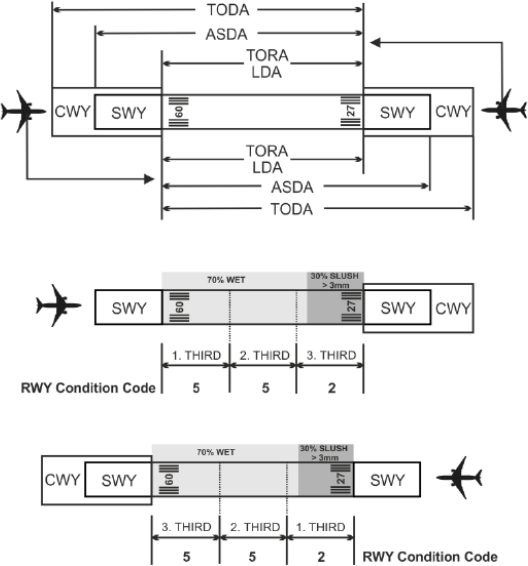 Figure 1: Reporting of RWYCC
from air traffic services to flight crew for runway thirds
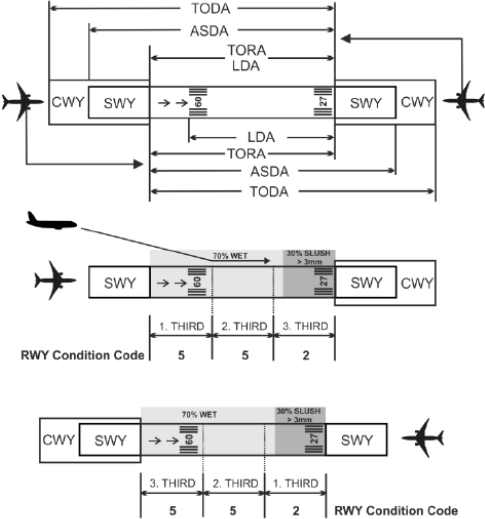
Figure 2: Reporting of RWYCC
for runway thirds from air traffic services to flight crew on a runway with displaced threshold
(5)Per cent coverage contaminant for each runway third: a number identifying the percentage coverage. The percentages are to be reported in an up-to-nine character group separated by a ‘/’ for each runway third. The assessment is based upon an even distribution within the runway thirds using Table 1.
This information is conditional. It is not reported for any runway third that is dry or covered with less than 10 per cent.
Format: [n]nn/[n]nn/[n]nn
Example: 25/50/100
In case of uneven distribution of the contaminants, additional information is given in the plain-language remark part of the situational awareness section of the RCR. Where possible, a standardised text is used.
When no information is to be reported, ‘NR’ is inserted at the relevant position of the message, to indicate to the user that no information exists.
(6)Depth of loose contaminant: dry snow, wet snow, slush or standing water for each runway third: a two- or three-digit number representing the assessed depth (mm) of the contaminant for each runway third. The depth is reported in a six-to nine-character group separated by a ‘/’ for each runway third as defined in Table 2 of AMC1 ADR.OPS.A.065(b);(c). The assessment is based upon an even distribution within the runway thirds following an assessment. If measurements are included as part of the assessment process, the reported values are still reported as assessed depths.
This information is conditional. It is reported only for DRY SNOW, WET SNOW, SLUSH and STANDING WATER.
Format: [n]nn/[n]nn/[n]nn
(7)Condition description for each runway third: to be reported in capital letters using the terms specified in ADR.OPS.A.065 point (a). The condition types are separated by an oblique stroke ‘/’.
This information is mandatory.
Format: nnnn/nnnn/nnnn
(8)Width of runway to which the RWYCCs apply if less than the published width: two-digit number representing the width of cleared runway in metres.
This information is conditional.
Format: nn
If the cleared runway width is not symmetrical along the centre line, additional information is given in the plain-language remark part of the situational awareness section of the RCR.
SITUATIONAL AWARENESS SECTION
(a)All individual messages in the situational awareness section end with a full-stop sign, in order to distinguish the message from subsequent message(s).
(b)The information to be included in this section consists of the following:
(1)Reduced runway length
The information is conditional when a NOTAM has been published with a new set of declared distances affecting the landing distance available (LDA).
Format: Standardised fixed text – RWY nn [L] or nn [C] or nn [R] LDA REDUCED TO [n]nnn
(2)Drifting snow on the runway
This information is conditional.
Format: Standardised fixed text – RWY nn [L] or nn [C] or nn[R] DRIFTING SNOW
(3)Loose sand on the runway
This information is conditional.
Format: RWY nn[L] or nn[C] or nn[R] LOOSE SAND
(4)Chemical treatment on the runway
This information is conditional.
Format: RWY nn[L] or nn[C] or nn[R] CHEMICALLY TREATED
(5)Snowbanks on the runway
This information is conditional.
Left or right distance in metres from centre line.
Format: RWY nn[L] or nn[C] or nn[R] SNOWBANK Lnn or Rnn or LRnn FM CL
(6)Snowbanks on taxiway
This information is conditional.
Format: TWY [nn]n or TWYS [nn]n/[nn]n/[nn]n/… or ALL TWYS SNOWBANKS
(7)Snowbanks adjacent to the runway penetrating level/profile set in the aerodrome snow plan
This information is conditional.
Format: RWY nn[L] or nn[C] or nn[R] ADJ SNOWBANKS
(8)Taxiway conditions
This information is optional.
Format: TWY [nn]n POOR or TWYS[nn]n/[nn]n/… POOR or ALL TWYS POOR
(9)Apron conditions
This information is conditional.
Format: APRON [nnnn] POOR or APRONS[nnnn]/[nnnn]/… POOR or ALL APRONS POOR
(10)Plain-language remarks using only allowable characters in capital letters
Where possible, standardised text is used.
This information is optional except for the conditional information ‘UPGRADED’ or ‘DOWNGRADED’ used whenever the assessed RWYCC differs from what follows directly from the runway condition assessment matrix (RCAM). When present, this information is to be the first piece of information of the plain language remarks in order to ease readability and to recognise its importance as part of the situational awareness prior to aeroplane performance calculations.
Format: Combination of allowable characters where use of full stop ‘.’ marks the end of the message.
Allowable characters:
A B C D E F G H I J K LM N O P Q R S T U V W X Y Z
0 1 2 3 4 5 6 7 8 9
/ [oblique stroke] ‘.’ [period]’ ‘ [space]
If ICE, SNOW or SNOW ON ICE affects only the runway edge, the following text may be used:
RWY nn[L] or nn[C] or nn[R] ICE or SNOW or SNOW ON ICE Lnn or Rnn or LRnn FM EDGE
GM3 ADR.OPS.A.065(a) Reporting of the runway surface condition
ED Decision 2021/003/R
COMPLETE INFORMATION STRING
An example of a complete information string prepared for dissemination is as follows:
COM header and abbreviated header] (Completed by AIS)
GG EADBZQZX EADNZQZX EADSZQZX
070645 EADDYNYX
SWEA0151 EADD 02170055
SNOWTAM 0151
[Aeroplane performance calculation section]
EADD 02170055 09L 5/5/5 100/100/100 NR/NR/NR WET/WET/WET
EADD 02170135 09R 5/2/2 100/50/75 NR/06/06 WET/SLUSH/SLUSH
EADD 02170225 09C 2/3/3 75/100/100 06/12/12 SLUSH/WET SNOW/WET SNOW
[Situational awareness section]
RWY 09L SNOWBANK R20 FM CL. RWY 09R ADJ SNOWBANKS. TWY B POOR. APRON NORTH POOR.
GM4 ADR.OPS.A.065(a) Reporting of the runway surface condition
ED Decision 2021/003/R
REPORTING BY AERODROMES WITH MULTIPLE RUNWAYS
On aerodromes with multiple runways, SNOWTAM includes all the runways, in case that at least one runway is contaminated. This improves pilots’ situational awareness and support their decision on the selection of the landing/take-off runway.
GM1 ADR.OPS.A.065(a)(18);(19) Reporting of the runway surface condition
ED Decision 2021/003/R
REPORTING OF CHEMICALLY TREATED AND LOOSE SAND
The terms ‘CHEMICALLY TREATED’ and ‘LOOSE SAND’ do not appear in the aeroplane performance calculation section but are used in the situational awareness section of the RCR.
AMC1 ADR.OPS.A.065(b);(c) Reporting of the runway surface condition
ED Decision 2021/003/R
SIGNIFICANT CHANGES
A change in the runway surface condition used in the RCR should be considered significant whenever there is any:
(a)change in the RWYCC;
(b)change in the contaminant type;
(c)change in reportable contaminant coverage according to Table 1;
(d)change in contaminant depth according to Table 2; and
(e)other information, for example a SPECIAL AIR-REPORT of runway braking action, which according to assessment techniques used, is known to be significant.
Assessed per cent | Reported per cent |
10-25 | 25 |
26-50 | 50 |
51-75 | 75 |
76-100 | 100 |
Table 1: Percentage of coverage for contaminants
Contaminant | Valid values to be reported | Significant change |
STANDING WATER | 04, then assessed value | 3 mm |
SLUSH | 03, then assessed value | 3 mm |
WET SNOW | 03, then assessed value | 5 mm |
DRY SNOW | 03, then assessed value | 20 mm |
Table 2: Depth assessments for contaminants
Note 1: For STANDING WATER, 04 (4 mm) is the minimum depth value at and above which the depth should be reported. From 3 mm and below, the runway third should be considered WET.
Note 2: For SLUSH, WET SNOW and DRY SNOW, depths up to and including 3 mm should be reported as 03 (3 mm).
Note 3: Above 4 mm for STANDING WATER and above 3 mm for SLUSH, WET SNOW and DRY SNOW, an assessed value should be reported and a significant change relates to the observed change from this assessed value.
GM1 ADR.OPS.A.065(b);(c) Reporting of the runway surface condition
ED Decision 2021/003/R
EXAMPLE OF REPORTING DEPTH OF CONTAMINANT WHENEVER THERE IS A SIGNIFICANT CHANGE
(a)After the first assessment of runway condition, a first RCR is generated. The initial report is:
5/5/5 100/100/100 03/03/03 SLUSH/SLUSH/SLUSH
Note: The full information string is not used in this example.
(b)With continuing precipitation, a new RCR is required to be generated as a subsequent assessment reveals that the depth of contamination has increased from 3 mm to 5 mm along the entire length of the runway and therefore a change in the RWYCC is needed. A second RCR is therefore created as:
2/2/2 100/100/100 05/05/05 SLUSH/SLUSH/SLUSH
(c)With even more precipitation, a further assessment reveals that the depth of contamination has increased from 5 mm to 7 mm along the entire length of the runway. However, a new RCR is not required because the RWYCC has not changed (change in depth is less than the significant change threshold of 3 mm).
(d)A final assessment of the contamination reveals that the depth has increased to 10 mm. A new RWYCC is required because the change in depth from the last RCR (second RWYCC), i.e. from 5 mm to 10 mm is greater than the significant change threshold of 3 mm. A third RCR is thus created as below:
2/2/2 100/100/100 10/10/10 SLUSH/SLUSH/SLUSH
For contaminants other than STANDING WATER, SLUSH, WET SNOW or DRY SNOW, the depth is not reported. The position of this type of information in the information string is then identified by /NR/.
When the depth of the contaminants varies significantly within a runway third, additional information is to be given in the plain-language remark part of the situational awareness section of the RCR.
GM1 ADR.OPS.A.065(d) Reporting of runway surface condition
ED Decision 2021/003/R
USE OF FRICTION MEASUREMENTS
Friction measurements cannot be used by flight crews to determine landing performance requirements, because there is no correlation between the measurements and aeroplane performance data. Nevertheless, continuous friction measuring devices may be used, together with all other available means, to support upgrade or downgrade of the RWYCC, by using friction measurements in a comparative way and not as absolute values.
ADR.OPS.A.070 Information on the aerodrome lighting system
Commission Delegated Regulation (EU) 2022/208
The aerodrome operator shall report to the aeronautical information services the information on the parts of the aerodrome lighting system where light units are light emitting diode (LED) lights.
GM1 ADR.OPS.A.070 Information on the aerodrome lighting system
ED Decision 2022/013/R
GENERAL
EFVS technology relies on the infrared heat signature provided by incandescent lights. The replacement of incandescent lights with LED lights may render the use of EFVS not possible. This information is important to aircraft operators to assess the suitability of the runway in order to conduct EFVS operations.
ADR.OPS.A.075 Charts
Commission Delegated Regulation (EU) 2022/208
The aerodrome operator, either directly or through arrangements with third parties, shall ensure that charts relevant to the aerodrome are published in the AIP by the aeronautical information service provider.
GM1 ADR.OPS.A.075 Charts
ED Decision 2022/013/R
GENERAL
Information on charts is included in Regulation (EU) 2017/373.
ADR.OPS.A.080 Information on radio navigation and landing aids
Commission Delegated Regulation (EU) 2022/208
(a)The aerodrome operator shall ensure, either directly or through arrangements with third parties, that information on the radio navigation and landing aids associated with the instrument approach and the terminal area procedures at the aerodrome, are provided to the aeronautical information services.
(b)The information referred to in point (a) shall include the following:
(1)type of aids;
(2)magnetic variation to the nearest degree, as appropriate;
(3)type of supported operation for ILS/MLS/GLS, basic GNSS and SBAS;
(4)classification for ILS;
(5)facility classification and approach facility designation(s) for GBAS;
(6)for VOR/ILS/MLS also station declination to the nearest degree used for technical line-up of the aid;
(7)identification, if required;
(8)frequency(-ies), channel number(s), service provider and reference path identifier(s) (RPI(s)), as appropriate;
(9)hours of operation, as appropriate;
(10)geographical coordinates in degrees, minutes, seconds and tenths of seconds of the position of the transmitting antenna, as appropriate;
(11)elevation of the DME transmitting antenna to the nearest 30 m (100 ft) and of the distance-measuring equipment precision (DME/P) to the nearest 3 m (10 ft), elevation of GBAS reference point to the nearest metre or foot, and the ellipsoid height of the point to the nearest metre or foot; for SBAS, the ellipsoid height of the landing threshold point (LTP) or the fictitious threshold point (FTP) to the nearest metre or foot;
(12)service volume radius from the GBAS reference point to the nearest kilometre or nautical mile; and
(13)remarks.
ADR.OPS.A.085 Information on visual segment surface (VSS) penetration
Commission Delegated Regulation (EU) 2022/208
The aerodrome operator shall ensure, either directly or through arrangements with third parties, that information on visual segment surface penetration is provided to the aeronautical information services, including procedure and procedure minima affected.
AMC1 ADR.OPS.A.085 Information on visual segment surface (VSS) penetration
ED Decision 2022/013/R
INFORMATION ON OBSTACLES FOR VISUAL SEGMENT SURFACE (VSS) PENETRATION
If the VSS is penetrated, the information to be provided to the AIS provider, to publish it under AD 2.25, should clearly indicate the name of the affected procedure and the procedure minima affected. Apart from this, information about the obstacles that penetrate the VSS should be provided to the responsible AIS provider to publish it under ‘AD 2.10 Aerodrome obstacles’.
GM1 ADR.OPS.A.085 Information on visual segment surface (VSS) penetration
ED Decision 2022/013/R
GENERAL
Criteria related to the VSS are contained in PANS-OPS Volume II, paragraph 5.4.6, Part I – Section 4, Chapter 5.
SUBPART B — AERODROME OPERATIONAL SERVICES, EQUIPMENT AND INSTALLATIONS (ADR.OPS.B)
ADR.OPS.B.001 Provision of services
Regulation (EU) No 139/2014
The services under Subpart B of this Annex shall be provided at the aerodrome by the aerodrome operator directly or indirectly.
GM1 ADR.OPS.B.001 Provision of services
ED Decision 2014/012/R
SERVICES
The services included in Part B of this Annex, need to be provided at an aerodrome. In some cases, these services are not directly provided by the aerodrome operator, but by another organisation or State entity or combination of both. However, the aerodrome operator, being responsible for the operation of the aerodrome should have arrangements and interfaces with these organisations or entities to ensure that these services are provided according to the legal requirements. The method described above meets with the intention of an integrated Safety Management System that helps the aerodrome operator to ensure the safety objective of the service provision is being met. In completing this action, the aerodrome operator should hereby been seen to discharge its responsibility by employing the procedures mentioned above, furthermore, the aerodrome operator should not be understood to be directly responsible or liable for non-compliances by another entity involved in the arrangement.
ADR.OPS.B.003 Handover of activities — provision of operational information
Delegated Regulation (EU) 2020/2148
(a)The aerodrome operator shall establish and implement procedures for the handover of operational activities between personnel involved in the operation and maintenance of the aerodrome to ensure that all new incoming personnel are provided with operational information related to their tasks.
(b)The aerodrome operator shall establish and implement procedures to provide organisations operating or providing services at the aerodrome, with aerodrome-related operational information that may affect the execution of the tasks of the personnel of such organisations.
AMC1 ADR.OPS.B.003(a) Handover of activities — provision of operational information
ED Decision 2021/003/R
HANDOVER OF OPERATIONAL ACTIVITIES — PERSONNEL BRIEFING
(a)The aerodrome operator procedures for the handover of operational activities should as a minimum:
(1)cover the change of a shift within the same function (e.g. between RFFS personnel), as well as the case where a task is handed over to another person within the same shift, and the cases where an activity is handed over between different functions (e.g. from maintenance to operations);
(2)address the case when a planned activity (e.g. light maintenance) is not completed at the time of a planned shift change; or any other non-regular activity is in place; and
(3)allow for the preparation of both outgoing and incoming personnel.
(b)The briefing should be in a manner that allows effective two-way communication between the outgoing and incoming personnel, during which all task-relevant information necessary for the incoming personnel is provided to them, both verbally and in writing. In the case of posts which are not continually manned, or aerodromes with interrupted working hours, the briefing may be in writing, while ensuring that additional information may be provided to the incoming personnel in case of such need.
(c)The briefing of drivers and other operational personnel operating on the manoeuvring area should, as a minimum, include:
(1)the runway(s) in use;
(2)any significant works areas in place, or being established or removed that day;
(3)conditions of stop bars, if applicable, that may be inoperable making a taxiway unusable for runway entry or crossing; and
(4)if low-visibility procedures are in force.
GM1 ADR.OPS.B.003(b) Handover of activities — provision of operational information
ED Decision 2021/003/R
PROVISION OF OPERATIONAL INFORMATION TO OTHER ORGANISATIONS
Given that changes of the operating conditions at an aerodrome may affect all personnel operating on the movement area, there is a need to ensure that the personnel of other organisations which operate or provide services at the aerodrome are also provided with the necessary operational information, which pertains to their operating environment.
Therefore, the aerodrome operator needs to provide this type of information to such organisations, so that they are enabled to relay it to their own personnel. It is important that there is no delay in the provision of such information by the aerodrome operator, and that it is done in a manner prearranged with the other organisations, to ensure it reaches its destination.
Such information may include changes in the operating conditions on the apron (e.g. due to works or occurrences) or on the manoeuvring area, or other facilities of the aerodrome. For the type of information that may be provided regarding the manoeuvring area, see point (c) of AMC1 ADR.OPS.B.003(a).
ADR.OPS.B.005 Aerodrome emergency planning
Regulation (EU) No 139/2014
The aerodrome operator shall have and implement an aerodrome emergency plan that:
(a)is commensurate with the aircraft operations and other activities conducted at the aerodrome;
(b)provides for the coordination of appropriate organisations in response to an emergency occurring at an aerodrome or in its surroundings; and
(c)contains procedures for periodic testing of the adequacy of the plan and for reviewing the results in order to improve its effectiveness.
AMC1 ADR.OPS.B.005(b) Aerodrome emergency planning
ED Decision 2014/012/R
GENERAL
(a)The aerodrome operator should ensure that the aerodrome emergency plan includes the ready availability of, and coordination with, appropriate specialist rescue services to be able to respond to emergencies where an aerodrome is located close to water and/or swampy areas, and where a significant portion of approach or departure operations takes place over these areas.
(b)The aerodrome operator should ensure that an assessment of the approach and departure areas within 1000 m of the runway threshold is carried out to determine the options available for intervention.
AMC2 ADR.OPS.B.005(b) Aerodrome emergency planning
ED Decision 2014/012/R
AERODROME EMERGENCY PLAN DOCUMENT
The aerodrome operator should include, at least, the following in the aerodrome emergency plan document:
(a)Types of emergencies planned for;
(b)Agencies involved in the plan, and details of the aerodrome and local emergency planning arrangements and forums;
(c)Responsibility and role of each agency, the emergency operations centre, and the command post for each type of emergency;
(d)Information on names and telephone numbers of offices or people to be contacted in the case of a particular emergency; and
(e)A grid map of the aerodrome and its immediate surroundings, approximately at a distance of 8 km from the centre of the aerodrome.
AMC1 ADR.OPS.B.005(c) Aerodrome emergency planning
ED Decision 2014/012/R
AERODROME EMERGENCY EXERCISE
The aerodrome operator should ensure that the emergency plan is tested with:
(a)a full-scale aerodrome emergency exercise at intervals not exceeding two years; and
(b)partial emergency exercises in the intervening year to ensure that any deficiencies found during the full-scale aerodrome emergency exercise have been corrected
and reviewed thereafter, or after an actual emergency, so as to correct any deficiency found during such exercises or actual emergency.
GM1 ADR.OPS.B.005(a) Aerodrome emergency planning
ED Decision 2014/012/R
PURPOSE OF THE AERODROME EMERGENCY PLAN
(a)In many cases the aerodrome emergency plan is part of a National or Local Emergency Plan, and the responsibility for its development is assigned to another entity, different from the aerodrome operator. However, this does not prevent the aerodrome operator from preparing its own plan describing the actions that should be taken during an emergency, in cooperation with the authorities which are responsible for the National or Local Emergency Plan.
(b)Irrespective of whose responsibility is the establishment and implementation of an emergency plan covering emergencies at or in the surroundings of an aerodrome, the emergency plan should ensure that there are provisions for:
(1)orderly and efficient transition from normal to emergency operations;
(2)delegation of authority;
(3)assignment of emergency responsibilities;
(4)authorising key personnel for actions contained in the plan;
(5)coordination of efforts to cope with the emergency; and
(6)safe continuation of aircraft operations or return to normal operations as soon as possible.
GM2 ADR.OPS.B.005(a) Aerodrome emergency planning
ED Decision 2014/012/R
AERODROME EMERGENCY PLAN DOCUMENT
(a)The aerodrome emergency plan of the aerodrome operator should observe human factors principles to ensure optimum response in emergency operations.
(b)In order to ensure that the aerodrome emergency plan document fully serves its purpose, it should include the following:
(1)plans for dealing with emergencies occurring at the aerodrome or in its surroundings, including the malfunction of aircraft in flight; structural fires; sabotage, including bomb threats (aircraft or structure); unlawful seizure of aircraft; and incidents on the aerodrome covering ‘during the emergency’ and ‘after the emergency’ considerations;
(2)details of tests for aerodrome facilities and equipment to be used in emergencies such as emergency operations centre, mobile command post, fire fighting vehicles and equipment, communication means, first aid medical supplies, etc., including the frequency of those tests;
(3)details of exercises to test emergency plans, including the frequency of those exercises;
(4)a list of organisations, agencies, and persons of authority, both on and off-aerodrome, for site roles; their telephone and fax numbers, e-mail and SITA addresses, and the radio frequencies of their offices;
(5)the establishment of an aerodrome emergency committee to organise training and other preparations for dealing with emergencies;
(6)the appointment of an on-the-scene commander for the overall emergency operation; and
(7)Details of the off aerodrome areas for which the aerodrome RFFS will provide a response, and the size and nature of the response.
GM3 ADR.OPS.B.005(a) Aerodrome emergency planning
ED Decision 2014/012/R
CONTENTS OF AN AERODROME EMERGENCY PLAN DOCUMENT
The purpose of the aerodrome Emergency Plan Document is to provide all the required information to agencies and staff involved in an emergency. The document should be structured in such a manner, that the required information is easily identifiable. For that purpose, the structure of the aerodrome emergency plan should be as follows:
Section 1 — Emergency telephone numbers
This section should be limited to essential telephone, numbers according to the aerodrome needs, including:
(a)air traffic services unit;
(b)rescue and firefighting services (fire departments);
(c)airfield operations department;
(d)police and security;
(e)medical services:
(1)hospitals;
(2)ambulances; and
(3)doctors — business/residence;
(f)aircraft operators;
(g)ground handling agencies;
(h)government authorities;
(i)civil defence; and
(j)others.
Section 2 — Aircraft accident on the aerodrome
(a)Action by air traffic services unit;
(b)Action by rescue and firefighting services;
(c)Action by police and security services;
(d)Action by the aerodrome operator:
(1)vehicle escort; and
(2)maintenance;
(e)Action by medical services:
(1)hospitals;
(2)ambulances;
(3)doctors; and
(4)medical personnel.
(f)Action by aircraft operator involved;
(g)Action by emergency operations centre and mobile command post;
(h)Action by government authorities;
(i)Communication network (emergency operations centre and mobile command post);
(j)Action by agencies organisations involved in mutual aid emergency agreements;
(k)Action by transportation authorities (land, sea, air);
(l)Action by public information officer(s);
(m)Action by local fire departments when structures involved; and
(n)Action by all other agencies.
Section 3 — Aircraft accident off the aerodrome
(a)Action by air traffic services unit;
(b)Action by rescue and firefighting services;
(c)Action by local fire departments;
(d)Action by police and security services;
(e)Action by aerodrome operator;
(f)Action by medical services;
(i)hospitals;
(ii)ambulances;
(iii)doctors; and
(iv)medical personnel.
(g)Action by agencies involved in mutual aid emergency agreements;
(h)Action by aircraft operator involved;
(i)Action by emergency operations centre and mobile command post;
(j)Action by government authorities;
(k)Action by communication networks (emergency operations centre and mobile command post);
(l)Action by transportation authorities (land, sea, air);
(m)Action by public information officer; and
(n)Action by all other agencies.
Section 4 — Malfunction of aircraft in flight (Full emergency or local standby)
(a)Action by air traffic services unit;
(b)Action by aerodrome rescue and firefighting services;
(c)Action by police and security services;
(d)Action by the aerodrome operator;
(e)Action by medical services:
(1)hospitals;
(2)ambulances;
(3)doctors; and
(4)medical personnel.
(f)Action by aircraft operator involved;
(g)Action by emergency operations centre and mobile command post; and
(h)Action by all other agencies.
Section 5 — Structural fires
(a)Action by air traffic services unit;
(b)Action by rescue and firefighting services (local fire department);
(c)Action by police and security services;
(d)Action by aerodrome authority;
(e)Evacuation of structure;
(f)Action by medical services:
(1)hospitals;
(2)ambulances;
(3)doctors; and
(4)medical personnel.
(g)Action by emergency operations centre and mobile command post;
(h)Action by public information officer; and
(i)Action by all other agencies.
Section 6 — Sabotage including bomb threat (aircraft or structure)
(a)Action by air traffic services unit;
(b)Action by emergency operations centre and mobile command post;
(c)Action by police and security services;
(d)Action by the aerodrome operator;
(e)Action by rescue and firefighting services;
(f)Action by medical services:
(1)hospitals;
(2)ambulances;
(3)doctors; and
(4)medical personnel.
(g)Action by aircraft operator involved;
(h)Action by government authorities;
(i)Isolated aircraft parking position;
(j)Evacuation;
(k)Searches by dogs and trained personnel;
(l)Handling and identification of luggage and cargo on board aircraft;
(m)Handling and disposal of suspected bomb;
(n)Action by public information officer; and
(o)Action by all other agencies.
Section 7 — Unlawful seizure of aircraft
(a)Action by air traffic services unit;
(b)Action by rescue and firefighting services;
(c)Action by police and security services;
(d)Action by the aerodrome operator;
(e)Action by medical services;
(1)hospitals;
(2)ambulances;
(3)doctors; and
(4)medical personnel.
(f)Action by aircraft operator involved;
(g)Action by government authorities;
(h)Action by emergency operations centre and mobile command post;
(i)Isolated aircraft parking position;
(j)Action by public information officer; and
(k)Action by all other agencies.
Section 8 — Incident on the aerodrome
An incident on the aerodrome could require any, or all of the actions detailed in Section 2, ‘Aircraft accident on the aerodrome’. Examples of incidents the aerodrome operator should consider to include: fuel spills at the ramp, passenger loading bridge, and fuel storage area; dangerous goods occurrences at freight handling areas; collapse of structures; vehicle/aircraft collisions; etc.
Section 9 — Persons of authority — site roles
To include, but not limited to, the following, according to local requirements:
(a)On-aerodrome:
(1)Aerodrome chief fire officer;
(2)Aerodrome authority;
(3)Police and security — Officer-in-charge; and
(4)Medical coordinator.
(b)Off-aerodrome:
(1)Local chief fire officer;
(2)Government authority; and
(3)Police and security — officer-in-charge.
The on-the-scene commander will be designated as required from within the pre-arranged mutual aid emergency agreement.
GM4 ADR.OPS.B.005(a) Aerodrome emergency planning
ED Decision 2014/012/R
TYPES OF EMERGENCIES
(a)At least the following types of emergencies may be included in the aerodrome emergency plan:
(1)Aircraft emergencies;
(2)Aircraft ground incidents, where an aircraft on the ground is known to have an emergency situation other than an accident, requiring the attendance of emergency services;
(3)Sabotage, including bomb threats;
(4)Unlawfully seized aircraft;
(5)Dangerous goods occurrences;
(6)Building fires;
(7)Natural disasters; and
(8)Public health emergencies.
(b)The aircraft emergencies for which services may be required are generally classified as:
(1)‘aircraft accident’: an aircraft accident which has occurred on or in the aerodrome surroundings;
(2)‘full emergency’: an aircraft approaching the aerodrome is, or is suspected to be, in such trouble that there is imminent danger of an accident; and
(3)‘local standby’: an aircraft approaching the aerodrome is known. or is suspected to have developed some defect, but the trouble is not such as would normally involve any serious difficulty in effecting a safe landing.
GM1 ADR.OPS.B.005(b) Aerodrome emergency planning
ED Decision 2014/012/R
COORDINATION WITH OTHER AGENCIES AND ORGANISATIONS
(a)The aerodrome emergency plan should describe the procedures for coordinating the response of different aerodrome agencies organisations or services (e.g. ground handlers, airlines, security services) and those agencies in the surrounding community that could be of assistance in responding to an emergency.
(b)If the aerodrome emergency plan is not part of a National or Local Emergency Plan, then it should be coordinated as required.
(c)Emergency mutual aid agreements should be established to define responsibilities and/or liabilities of each external agency responding to an emergency. These agreements should include the following:
(1)clarification of the political and jurisdictional responsibilities of the several agencies (e.g. police, local fire fighting services, local authorities, accident investigation bodies, etc.) that could be involved in order to avoid problems when an emergency occurs;
(2)establishment of the command authority; i.e. a single on-the-scene commander (with designated alternates if necessary);
(3)designation of communication priorities at the accident site;
(4)organisation of emergency transportation facilities under (a) pre-designated coordinator(s);
(5)predetermination of the legal authorities and liabilities of all cooperating emergency personnel; and
(6)pre-arrangements for use of portable and heavy rescue equipment from available sources.
(d)The aerodrome emergency plan should be implemented similarly whether it is an on-aerodrome or an off-aerodrome aircraft accident/incident.
(e)Rendezvous signs and directional arrows should be consistent, and conform to national standards.
(f)The aerodrome operator should assess the level of medical supplies to be held on the aerodrome for emergency purposes.
GM2 ADR.OPS.B.005(b) Aerodrome emergency planning
ED Decision 2014/012/R
INVOLVED AGENCIES IN EMERGENCIES
The following agencies could participate in response to an emergency, depending on the type of emergency and local arrangements:
(a)On the aerodrome:
(1)Air Traffic Control Unit;
(2)Rescue and firefighting services;
(3)Aerodrome administration;
(4)Medical and ambulance services;
(5)Aircraft operators;
(6)Ground handling agencies;
(7)Security services; and
(8)Police.
(b)Off the aerodrome:
(1)Fire departments;
(2)Police;
(3)Health authorities (including medical, ambulance, hospital and public health services);
(4)Military; and
(5)Harbour or coast guard, if applicable.
GM3 ADR.OPS.B.005(b) Aerodrome emergency planning
ED Decision 2014/012/R
EMERGENCY OPERATIONS CENTRE
(a)The practice had shown that emergencies are handled more efficiently centrally through an emergency operations centre and a command post.
(b)The emergency operations centre could be a part of the aerodrome facilities, and responsible for the overall coordination and general direction of the response to an emergency. Depending on the size of the aerodrome and local procedures, more than one emergency centres could be established, but within the aerodrome emergency plan should be identified which of them has the overall responsibility for coordination.
(c)A person should be assigned to assume control of the emergency operations centre and, when appropriate, another person the command post.
(d)The role of the emergency operations centre should be to support the on-the-scene commander in the mobile command post for aircraft accidents/incidents.
(e)The emergency operations centre, depending on relevant security plans and local procedures could be the command, coordination, and communication centre for unlawful seizure of aircraft and bomb threats.
(f)The emergency operations centre should be operationally available 24 hours a day, or during the aerodrome’s hours of operation, and procedures should be established for notifying its staff.
(g)The location of the emergency operation centre is very important for its efficiency. Consideration should be given to establish its location having a clear view of the movement area and isolated aircraft parking position, wherever possible.
(h)Adequate equipment and personnel should be available in order to communicate with the appropriate agencies involved in the emergency, including the mobile post, when this is deployed. The communication and electronic devices should be checked regularly, to identify any malfunctions.
GM4 ADR.OPS.B.005(b) Aerodrome emergency planning
ED Decision 2014/012/R
MOBILE COMMAND POST
(a)The command post is a facility capable of being moved rapidly to the site of an emergency, when required, and undertakes the local coordination of those agencies responding to the emergency.
(b)The mobile command post, when established, should contain the necessary equipment and personnel to communicate with all agencies involved in the emergency, including the emergency operations centre. The communication and electronic devices should be checked regularly, in order to identify any malfunctions.
(c)Maps, charts, and other relevant equipment and information should be available at the mobile command post.
GM5 ADR.OPS.B.005(b) Aerodrome emergency planning
ED Decision 2014/012/R
COMMUNICATION SYSTEMS USED FOR EMERGENCIES
(a)When established, adequate communication systems linking the command post and the emergency operations centre with each other and with the participating agencies should be provided in accordance with the plan and consistent with the particular requirements of the aerodrome.
(b)The communication systems used should include a sufficient number of radio transceivers, telephones, and other communication devices to establish and maintain a primary, and a secondary means of communication;
(c)The role of the communication systems is to provide a primary, and, where necessary, an alternate means for effective direct communications between the following, as applicable:
(1)the alerting authority and the rescue and firefighting (RFF) units serving the aerodrome;
(2)air traffic services unit, the appropriate fire department alarm room/dispatch centre(s) and the firefighting and rescue crews en route to an aircraft emergency and at the accident/incident site;
(3)appropriate mutual aid agencies located on or off the aerodrome, including an alert procedure for all auxiliary personnel expected to respond; and
(4)the RFF vehicles, including a communication capability between crew members on each RFF vehicle.
(d)A communications system should be established in order to provide rapid response of the emergency equipment to accidents and incidents occurring in the terminal areas, and at the apron. Apron accidents include aircraft cabin fires, refuelling spills and fires, aircraft and vehicle collisions, and medical emergencies.
(e)Communication systems used during emergencies should be tested regularly to verify the operability of all radio and telephone networks.
(f)A complete and current list of interagency telephone numbers should be available to all agencies and to personnel responsible for the aerodrome emergency plan, to ensure rapid notification in case of emergencies. These phone numbers should be verified frequently to ensure they are correct. Updated lists should be distributed to all emergency plan participants on a continual basis.
GM1 ADR.OPS.B.005(c) Aerodrome emergency planning
ED Decision 2014/012/R
EMERGENCIES IN DIFFICULT ENVIRONMENT
At those aerodromes located close to water and/or swampy areas, or difficult terrain, the aerodrome emergency plan should include the establishment, testing, and assessment at regular intervals of a predetermined response for the specialist rescue services.
GM2 ADR.OPS.B.005(c) Aerodrome emergency planning
ED Decision 2014/012/R
EMERGENCY EXERCISES
(a)Full-scale exercises
(1)The purpose of a full-scale exercise is to ensure the adequacy of the plan to cope with different types of emergencies.
(2)Full-scale emergency exercises should be supported by all aerodrome and community authorities concerned.
(3)Objectives of the exercise should be defined.
(4)Involved departments and agencies should be thoroughly familiar with the aerodrome emergency plan, and develop individual plans in coordination with the general plan.
(5)The emergency exercises should be held in locations which will provide maximum realism while ensuring minimum disruption of the aerodrome operations. Different scenarios, as described in the aerodrome emergency plan document, should be used. The exercise could be held either during the day or at night on the aerodrome, and at different times of the year when seasonal changes may present additional challenges. Exercises may take place both on or near the aerodrome to test different scenarios.
(6)In order to obtain the maximum benefit from a full-scale emergency exercise, the entire proceedings should be reviewed. An observer critique team should be organised, comprised of members who are familiar with mass casualty accident proceedings. Each member of the critique team should observe the entire exercise, and complete the appropriate emergency drill critique forms. As soon as convenient after the exercise, a critique meeting should be held so members of the team can present their observations and recommendations for improvement of the aerodrome emergency plan procedures and associated aerodrome emergency plan document.
(7)The exercise should be followed by a full debriefing, critique, and analysis. It is important that representatives of all organisations which participate in the exercise actively participate in the critique.
(b)Partial emergency exercises
(1)The purpose of a partial exercise is to ensure the adequacy of the response to individual participating agencies and components of the plan.
(2)Partial emergency exercises should involve, at least, one unit, such as rescue and firefighting services, or medical, or combination of several units, as appropriate.
(3)Partial emergency exercises should ensure that any deficiencies found during the full-scale aerodrome emergency exercise have been corrected.
(c)Tabletop exercises
Tabletop exercises should be held at regular intervals. The aim of these exercises should be to verify that roles and procedures are clear and understood. These exercises offer a good opportunity to test new or revised procedures, before implementation, or preparation for a full-scale emergency exercise.
ADR.OPS.B.010 Rescue and firefighting services
Delegated Regulation (EU) 2020/2148
(a)The aerodrome operator shall ensure that:
(1)aerodrome rescue and firefighting facilities, equipment and services are provided;
(2)adequate equipment, fire extinguishing agents and sufficient personnel are available in a timely manner;
(3)rescue and firefighting personnel are properly trained, equipped and qualified to operate in the aerodrome environment; and
(4)rescue and firefighting personnel potentially required to act in aviation emergencies demonstrate their medical fitness to execute their functions satisfactorily, taking into account the type of activity.
(b)The aerodrome operator shall establish and implement a training programme for persons involved in rescue and firefighting services of the aerodrome;
(c)The training programme shall be conducted in accordance with point ADR.OR.D.017, with the following exceptions:
(1)recurrent training shall include theoretical and continuous practical training;
(2)proficiency checks shall be conducted at intervals not exceeding 12 months since the completion of the initial training.
(d)The training of rescue and firefighting personnel shall be designed to impart fundamental knowledge and practical skills related to the execution of their duties.
(e)Temporary reduction of the level of protection of the aerodrome’s rescue and firefighting services, due to unforeseen circumstances, shall not require prior approval by the competent authority.
AMC1 ADR.OPS.B.010(a) Rescue and firefighting services
ED Decision 2023/003/R
RESCUE AND FIREFIGHTING SERVICES FOR NON-COMMERCIAL OPERATIONS AND SPECIALISED OPERATIONS
(a)The aerodrome operator may define time periods when rescue and firefighting services (RFFS) are not available. During such periods, only non-commercial operations and specialised operations should be allowed.
(b)In that case, the aerodrome operator should provide the aeronautical information services (AIS) provider with information on the periods of time when RFFS are not available, to be published in the aeronautical information publication (AIP).
GM1 ADR.OPS.B.010(a)(1) Rescue and firefighting services
ED Decision 2016/009/R
AVAILABILITY AND SCOPE OF RESCUE AND FIREFIGHTING SERVICES
Public or private organisations, suitably located and equipped, could be designated to provide the rescue and firefighting service. The fire station housing these organisations should normally be located on the aerodrome, although an off-aerodrome location is not precluded, provided that the response time can be met. The principal objective of rescue and firefighting services is to save lives in the event of an aircraft accident or incident occurring at, or in the immediate surroundings of, the aerodrome. The rescue and firefighting service is provided to create and maintain survivable conditions, to provide egress routes for occupants, and to initiate the rescue of those occupants unable to make their escape without direct aid. The rescue may require the use of equipment and personnel other than those assessed primarily for rescue and firefighting purposes. Ambulance and medical services are out of the scope of rescue and firefighting services as described in ADR.OPS.B.010. The role and responsibilities of ambulance and medical services during an emergency situation should be included in the aerodrome emergency plan (AEP), according to GM3 ADR.OPS.B.005(a).
AMC1 ADR.OPS.B.010(a)(2) Rescue and firefighting services
ED Decision 2014/012/R
COMMUNICATION AND ALERTING SYSTEMS
The aerodrome operator should ensure that:
(a)a discrete communication system is provided linking a fire station with the control tower, any other fire station on the aerodrome, and the rescue and firefighting vehicles;
(b)an alerting system for rescue and firefighting personnel, capable of being operated from that station, is provided at the fire station, any other fire station on the aerodrome, and the aerodrome control tower;
(c)means are provided for communication between the rescue and firefighting service and the flight crew of an aircraft in emergency;
(d)communication means are provided to ensure the immediate summoning of designated personnel not on standby duty;
(e)communication means are provided to ensure two-way communication with the rescue and firefighting vehicles in attendance at an aircraft accident or incident.
(f)communications during emergencies should be recorded;
(g)communication means are provided between rescue and firefighting crew members.
AMC2 ADR.OPS.B.010(a)(2) Rescue and firefighting services
ED Decision 2016/009/R
RFFS LEVEL OF PROTECTION
(a)The aerodrome operator should ensure that:
(1)the level of protection normally available at an aerodrome is determined and expressed in terms of the category of the rescue and firefighting services (RFF aerodrome category) as described below and in accordance with the types, amounts, and discharge rates of extinguishing agents normally available at the aerodrome; and
(2)the aerodrome category for rescue and firefighting is determined according to Table 1, based on the longest aeroplanes normally using the aerodrome and their fuselage width. If, after selecting the category appropriate to the longest aeroplane’s overall length, that aeroplane’s fuselage width is greater than the maximum width in Table 1, column 3, for that category, then the category for that aeroplane should actually be one category higher.
Aerodrome category for rescue and fire fighting | ||
Aerodrome Category (1) | Aeroplane overall length (2) | Maximum fuselage width (3) |
1 | 0 m up to but not including 9 m | 2 m |
2 | 9 m up to but not including 12 m | 2 m |
3 | 12 m up to but not including 18 m | 3 m |
4 | 18 m up to but not including 24 m | 4 m |
5 | 24 m up to but not including 28 m | 4 m |
6 | 28 m up to but not including 39 m | 5 m |
7 | 39 m up to but not including 49 m | 5 m |
8 | 49 m up to but not including 61 m | 7 m |
9 | 61 m up to but not including 76 m | 7 m |
10 | 76 m up to but not including 90 m | 8 m |
Table 1
(3)the rescue and firefighting level of protection provided is appropriate to the aerodrome category determined using the principles in (2) above except that where the number of movements (landing or take-off) of the aeroplanes performing passenger transportation in the highest category, normally using the aerodrome, is less than 700 in the busiest consecutive three months, the level of protection provided in accordance with (2) above may be reduced by no more than one category below the determined one.
(b)Notwithstanding (a), the aerodrome operator may, during anticipated periods of reduced activity (e.g. specific periods of the year or day), reduce the rescue and firefighting level of protection available at the aerodrome. In this case:
(1)the level of protection should be no less than that needed for the highest category of aeroplane planned to use the aerodrome during that time, irrespective of the number of movements; and
(2)the periods of aerodrome operation with reduced rescue and firefighting level of protection should be published in the aeronautical information publication (AIP) or through notice to airmen (NOTAM).
(c)The level of protection required for all-cargo, mail, ferry, training, test, positioning and end-of-life aeroplane operations, including those carrying dangerous goods, irrespective of the number of movements, may be reduced in accordance with Table 2 as follows:
Aerodrome category | RFF level of protection required |
1 | 1 |
2 | 2 |
3 | 3 |
4 | 4 |
5 | 5 |
6 | 5 |
7 | 6 |
8 | 6 |
9 | 7 |
10 | 7 |
Table 2
(d)The aerodrome operator, in order to assess whether the rescue and firefighting level of protection to be provided at the aerodrome is appropriate to the aerodrome rescue and firefighting category, should, at least annually, forecast the aeroplane traffic expected to operate at the aerodrome for the next twelve-month period. Upon knowledge of planned changes to traffic volume and structure, additional assessments might be necessary. In doing so, the aerodrome operator may use all information available from aeroplane operators as well as statistics on aeroplane movements during the year preceding the day of review.
(e)Unforeseen circumstances leading to temporary reduction of the aerodrome rescue and firefighting level of protection are considered as unplanned events that result in unavailability of facilities, equipment and resources.
(f)For emergency landings and occasions when in the pilot’s-in-command opinion, a diversion or hold may create a more significant hazard, operation of aeroplanes whose required category is higher than the level of protection provided by the aerodrome should be permitted regardless of the rescue and firefighting level of protection available.
AMC3 ADR.OPS.B.010(a)(2) Rescue and firefighting services
ED Decision 2016/009/R
NUMBER OF RFFS VEHICLES AND RESCUE EQUIPMENT
(a)The aerodrome operator should ensure that:
(1)the minimum number of rescue and firefighting vehicles at the aerodrome to effectively deliver and deploy the agents specified for the aerodrome category will be in accordance with the following table; and
Aerodrome category | Rescue and firefighting vehicles |
1 | 1 |
2 | 1 |
3 | 1 |
4 | 1 |
5 | 1 |
6 | 2 |
7 | 2 |
8 | 3 |
9 | 3 |
10 | 3 |
Table 1
(2)rescue equipment commensurate with the level of aircraft operations is provided on the rescue and firefighting vehicles.
(b)If the aerodrome is located near a water/swampy area, or other difficult environment, or a significant portion of the approach/departure operations takes over these areas, the aerodrome operator should coordinate the availability of suitable rescue equipment and services.
AMC4 ADR.OPS.B.010(a)(2) Rescue and firefighting services
ED Decision 2016/009/R
EXTINGUISHING AGENTS
The aerodrome operator should ensure that:
(a)both principal and complementary extinguishing agents are provided at the aerodrome;
(b)principal extinguishing agent includes:
(1)a foam meeting the minimum performance level A; or
(2)a foam meeting the minimum performance level B; or
(3)a foam meeting the minimum performance level C; or
(4)a combination of these agents;
except for aerodromes in categories 1 to 3, where it should preferably meet a performance level B or C foam;
(c)the complementary extinguishing agent is a dry chemical powder suitable for extinguishing hydrocarbon fires, or any other alternate agent having equivalent firefighting capability;
(d)the amounts of water for foam production, and of the complementary agents provided on the rescue and firefighting vehicles are in accordance with the determined aerodrome category and Table 1,
Minimum usable amounts of extinguishing agents | ||||||||
Foam meeting performance level A | Foam meeting performance level B | Foam meeting performance level C | Complementary agents | |||||
Aerodrome category (1) | Water (L) (2) | Discharge rate foam solution/ minute | Water (L) (4) | Discharge rate foam solution/ minute | Water (L) (6) | Discharge rate foam solution/ minute | Dry chemical powders | Discharge rate (kg/sec) |
1 | 350 | 350 | 230 | 230 | 160 | 160 | 45 | 2.25 |
2 | 1 000 | 800 | 670 | 550 | 460 | 360 | 90 | 2.25 |
3 | 1 800 | 1 300 | 1 200 | 900 | 820 | 630 | 135 | 2.25 |
4 | 3 600 | 2 600 | 2 400 | 1800 | 1 700 | 1 100 | 135 | 2.25 |
5 | 8 100 | 4 500 | 5 400 | 3 000 | 3 900 | 2 200 | 180 | 2.25 |
6 | 11 800 | 6 000 | 7 900 | 4 000 | 5 800 | 2 900 | 225 | 2.25 |
7 | 18 200 | 7 900 | 12 100 | 5 300 | 8 800 | 3 800 | 225 | 2.25 |
8 | 27 300 | 10 800 | 18 200 | 7 200 | 12 800 | 5 100 | 450 | 4.5 |
9 | 36 400 | 13 500 | 24 300 | 9 000 | 17 100 | 6 300 | 450 | 4.5 |
10 | 48 200 | 16 600 | 32 300 | 11 200 | 22 800 | 7 900 | 450 | 4.5 |
Note:The quantities of water shown in columns 2, 4 and 6 are based on the average overall length of aeroplanes in a given category | ||||||||
Table 1
except that for aerodrome categories 1 and 2, up to 100 % of the water may be substituted with complementary agent.
For the purpose of agent substitution, 1 kg of complementary agent is equivalent to 1 L of water for production of a foam meeting performance level A.
Note 1: The amounts of water specified for foam production are predicated on an application rate of 8.2 L/min/m2 for a foam meeting performance level A, 5.5 L/min/m2 for a foam meeting performance level B and 3.75 L/min/m2 for a foam meeting performance level C.
Note 2: When any other complementary agent id used, the substitution ratios need to be checked.
(da)the quantity of foam concentrates separately provided on vehicles for foam production is in proportion to the quantity of water provided and the foam concentrate selected;
(e)the amount of foam concentrate provided on a vehicle should be sufficient to produce, at least, two loads of foam solution;
(f)when a combination of different performance level foams are provided at the aerodrome, the total amount of water to be provided for foam production should be calculated for each foam type and the distribution of these quantities should be documented for each vehicle and applied to the overall rescue and firefighting requirement;
(g)the discharge rate of the foam solution is not less than the rates shown in Table 1;
(h)the complementary agents comply with the appropriate specifications of the International Organisation for Standardisation (ISO);
(i)the discharge rate of complementary agents is not less than the values shown in Table 1;
(j)a reserve supply of foam concentrate equivalent to 200 % of the quantities identified in Table 1 is maintained on the aerodrome for vehicle replenishment purposes. Foam concentrate carried on fire vehicles in excess of the quantity identified in Table 1 can contribute to the reserve;
(k)a reserve supply of complementary agent equivalent to 100% of the quantity identified in Table 1 is maintained on the aerodrome for vehicle replenishment purposes and sufficient propellant gas is included to utilize this reserve complementary agent. Complementary agent(s) carried on fire vehicles in excess of the quantity identified in Table 1 may contribute to the reserve;
(l)for Category 1 and 2 aerodromes that have replaced up to 100% of the water with complementary agent a reserve supply of complementary agent of 200% is maintained;
(m)where a major delay in the replenishment of the supplies is anticipated, the amount of reserve supply is increased as determined by a risk assessment;
(n)a water need analysis is conducted to determine the availability of sufficient quantities of water for fire fighting;
(o)quantities of water and foam concentrate are recalculated and the amount of water and foam concentrate for foam production and the discharge rates for foam solution are increased accordingly, where operations by aeroplanes larger than the average size in a given category are planned;
(oa)Where the level of protection is reduced in accordance with AMC2 ADR.OPS.B.010(a)(2), a recalculation of quantities of extinguishing agents should be computed based on the largest aeroplane in the reduced category;
(ob)For all-cargo, mail, training, test, positioning and end-of-life aeroplane operations, including those carrying dangerous goods, the recalculation of quantities of extinguishing agents should be based on the largest aeroplane in the category specified in Table 2 of AMC2 ADR.OPS.B.010(a)(2);and
(p)arrangements are in place to manage extinguishing agents in terms of selection, storage, maintenance, and testing.
AMC5 ADR.OPS.B.010(a)(2) Rescue and firefighting services
ED Decision 2016/009/R
RESPONSE TIME
The aerodrome operator should ensure that:
(a)rescue and firefighting service achieves a response time not exceeding three minutes with an operational objective of not exceeding two minutes from the time of the initial call to the rescue and firefighting services, to any point of each operational runway, in optimum visibility and surface conditions, and be in a position to apply foam at a rate of, at least, 50 % of the discharge rate specified in AMC4 ADR.OPS.B.010 Table 1;
(b)response times to any other part of the movement area, in optimum visibility and surface conditions, are calculated and included in the Aerodrome Emergency Plan;
(c)any vehicle, other than the first responding vehicle(s), required to achieve continuous agent application of the amount of extinguishing agents specified in Table 1 of AMC4 ADR.OPS.B.010 arrives no more than one minute after the first responding vehicle(s); and
(d)suitable guidance, equipment and/or procedures for rescue and firefighting services are provided, to meet the operational objective, as nearly as possible, in less than optimum conditions of visibility, especially during low visibility operations.
AMC6 ADR.OPS.B.010(a)(2) Rescue and firefighting services
ED Decision 2014/012/R
PERSONNEL
The aerodrome operator should ensure that:
(a)during flight operations and, at least, 15 minutes after the departure of last flight, sufficient trained personnel is detailed and readily available to ride the rescue and firefighting vehicles, and to operate the equipment at maximum capacity;
(b)personnel is deployed in a way that ensures the minimum response times can be achieved, and continuous agent application at the appropriate rate can be fully maintained considering also the use of hand lines, ladders, and other rescue and firefighting equipment normally associated with aircraft rescue and firefighting operations;
(c)all responding rescue and firefighting personnel are provided with protective clothing and respiratory equipment to enable them to perform their duties in an effective manner; and
(d)any other duties carried out by rescue and firefighting personnel do not compromise the response, or their safety.
GM1 ADR.OPS.B.010(a)(2) Rescue and firefighting services
ED Decision 2014/012/R
COMMUNICATION AND ALERTING SYSTEMS
The aerodrome operator should examine the possibility of utilizing means allowing the direct communication between the rescue and fire fighting service and the flight crew of an aircraft in emergency. The decision could be based on the ability of the rescue and fire fighting personnel to communicate effectively with the flight crew either verbally or using hand signals. Two-way radio communication system may be used as well as the hand signals described in Appendix 1 of Commission Implementing Regulation (EU) No 923/2012.