Filters
ADR.OPS.D.080 Training and proficiency check programmes of marshallers and “FOLLOW-ME” drivers
Delegated Regulation (EU) 2020/1234
(a)The aerodrome operator shall establish and ensure the implementation of a training programme for persons providing:
(1)marshalling service;
(2)“FOLLOW-ME” guidance.
(b)The training programme shall be implemented in accordance with point ADR.OR.D.017 of Annex III.
(c)The training shall be designed to impart fundamental knowledge and practical skills related to the execution of their duties.
(d)The aerodrome operator shall ensure the implementation of a proficiency check programme for personnel referred to in point (a) in order to ensure:
(1)their continued competence;
(2)that they are aware of the rules and procedures relevant to their functions and tasks. The aerodrome operator shall ensure that persons referred to in point (a) undergo proficiency checks at intervals not exceeding 12 months since the completion of their initial training.
AMC1 ADR.OPS.D.080(a)(1);(2) Training and proficiency check programme of marshallers and ‘FOLLOW-ME’ drivers
ED Decision 2020/021/R
TRAINING FOR MARSHALLERS
(a)As part of the training programme, the initial training for marshallers should cover, at least, the following aspects:
(1)the role and responsibilities of the marshaller;
(2)the visual signals included in Appendix 1 ‘Signals’ to the Annex to Commission Regulation (EU) No 923/2012 of 26 September 2012;
(3)aircraft characteristics, both physical and operational, which relate to the manoeuvring of aircraft within the confines of the apron;
(4)safety procedures around the aircraft and particularly around the engines;
(5)emergency procedures in the event of an accident or an incident at the apron;
(6)low-visibility procedures;
(7)driving at the apron;
(8)emergency stop procedures for visual or advanced visual docking guidance systems, if applicable; and
(9)aircraft stand configuration and layout.
(b)Marshallers should be briefed or, if required, trained in new procedures or in changes to existing procedures.
AMC1 ADR.OPS.D.080(a)(2);(b)(2)(i) Training and proficiency check programme of marshallers and ‘FOLLOW-ME’ drivers
ED Decision 2024/004/R
TRAINING FOR ‘FOLLOW-ME’ VEHICLE DRIVERS
(a)As part of the training programme, the initial training for ‘FOLLOW ME’ drivers should cover, at least, the following aspects:
(1)the role and responsibilities of the ‘FOLLOW-ME’ driver;
(2)the content of AMC1 ADR.OPS.B.024(b) and AMC2 ADR.OPS.B.024(b);
(3)‘FOLLOW-ME’ specific communication procedures, including radiotelephony procedures;
(4)the visual signals included in Appendix 1 ‘Signals’ to the Annex to Commission Regulation (EU) No 923/2012 of 26 September 2012;
(5)aircraft taxiing speed and appropriate aircraft–vehicle spacing;
(6)specific procedures for guiding aircraft and/or vehicles;
(7)aircraft characteristics, both physical and operational;
(8)‘FOLLOW-ME’ specific procedures for low-visibility operations;
(9)emergency procedures in the event of an accident or an incident; and
(10)the operation of ‘FOLLOW-ME’ vehicles and their equipment.
(b)‘FOLLOW-ME’ vehicle drivers should be briefed or, if required, trained in new procedures or in changes to existing procedures.
ADR.OPS.D.085 Training and proficiency check programme of personnel providing taxi instructions to aircraft through radiotelephony
Delegated Regulation (EU) 2020/1234
(a)The aerodrome operator shall ensure that:
(1)persons providing taxi instructions to aircraft on the apron through radiotelephony, using the assigned aeronautical radio frequencies, are appropriately trained and qualified;
(2)the training programme is implemented in accordance with point ADR.OR.D.017 of Annex III, with the following exceptions:
(i)the initial training shall be followed by a unit training which comprises the following phases:
(A)transitional training phase, designed primarily to impart knowledge and understanding of site-specific operational procedures and task-specific aspects;
(B)on-the-job training phase, which is the final phase of unit training during which previously acquired job-related routines and skills are integrated in practice under the supervision of a qualified training instructor in a live traffic situation;
(ii)recurrent training shall be conducted at intervals not exceeding 12 calendar months and contains a review of the initial training content
(iii)refresher training shall be conducted when a person is absent from duties for a period of more than 12 months and shall include the entire initial training content.
(b)Persons referred to in point (a)(1) shall demonstrate language proficiency, at least at an operational level both in the use of phraseologies and in plain language, in accordance with point (c), in the languages used for air-ground communication at the aerodrome.
(c)The applicant shall demonstrate the ability to:
(1)communicate effectively in voice-only and in face-to-face situations;
(2)communicate on common and work-related topics with accuracy and clarity;
(3)use appropriate communicative strategies to exchange messages and to recognise and resolve misunderstandings in a general or work-related context;
(4)handle successfully the linguistic challenges presented by a complication or unexpected turn of events which occurs within the context of a routine work situation or communicative task with which they are otherwise familiar;
(5)use a dialect or accent which is intelligible to the aeronautical community.
(d)Language proficiency shall be demonstrated by a certificate issued by the organisation that conducted the assessment, attesting the language or languages, the level or levels of proficiency, and the date of the assessment.
(e)Except for persons who have demonstrated language proficiency at an expert level, the language proficiency shall be re-assessed every:
(1)four years from the date of the assessment, if the level demonstrated is operational level;
(2)six years from the date of the assessment, if the level demonstrated is extended level.
(f)The demonstration of language proficiency shall be done through a method of assessment, which shall contain:
(1)the process by which an assessment is done;
(2)the qualifications of the assessors conducting assessments of language proficiency;
(3)the appeal procedure.
(g)The aerodrome operator shall make available language training to maintain the required level of language proficiency of its personnel.
(h)The aerodrome operator shall ensure the implementation of a proficiency check programme for personnel referred to in point (a)(1) in order to ensure:
(1)their continued competence;
(2)that they are aware of the rules and procedures relevant to their functions and tasks. The aerodrome operator shall ensure that persons referred to in point (a) undergo proficiency checks at intervals not exceeding 12 months since the completion of their initial training.
AMC1 ADR.OPS.D.085(a)(2)(i) Training and proficiency check programme of personnel providing taxi instructions to aircraft through radiotelephony
ED Decision 2020/021/R
INITIAL TRAINING
The initial training should include at least the following modules:
MODULE 1. General overview of apron management
(a)Air traffic procedures relevant to aerodrome operations;
(b)Air traffic flow management (ATFM) basic knowledge;
(c)Introduction to apron management services (AMS);
(d)Description of tasks and responsibilities;
(e)Aircraft characteristics, aircraft types, and air operator identification;
(f)Basics of meteorology;
(g)Operational agreements and procedures for the cooperation between apron management services (AMS) providers and other entities;
(h)Traffic priorities at the apron: aircraft, equipment, vehicles;
(i)Basic knowledge of air navigation services (ANS);
(j)Aeronautical information publication (AIP).
MODULE 2. Aeronautical law
(a)Introduction to aeronautical law;
(b)International aviation bodies;
(c)National aviation bodies;
(d)Overview of the relevant national and international legislation.
MODULE 3. Apron management services (AMS) equipment
(a)IT systems;
(b)Communication systems;
(c)Surveillance systems, such as closed-circuit television (CCTV), surface movement radar (SMR), etc.;
(d)Airfield lighting systems relevant to the provision of AMS;
(e)Visual/advanced visual docking guidance systems;
(f)Backup systems.
MODULE 4. Communication procedures and phraseology
(a)Radiotelephony communication phraseology;
(b)Communication procedures during emergencies;
(c)Radio communication with aircraft;
(d)Other communications on the apron.
MODULE 5. Procedures for arriving aircraft
(a)Coordination with ATS and handover of aircraft between ATS and AMS;
(b)Aircraft taxiing;
(c)Holding areas;
(d)Recording of on-block time;
(e)Aerodrome collaborative decision making (A-CDM) procedures.
MODULE 6. Procedures for departing aircraft
(a)Start-up clearances;
(b)Push-back, towing;
(c)Aircraft taxiing;
(d)Coordination with ATS and handover of aircraft between ATS and AMS;
(e)Recording of off-block time;
(f)Aerodrome collaborative decision making (A-CDM) procedures.
MODULE 7. Procedures for emergencies and incidents
(a)Awareness of the aerodrome emergency plan;
(b)Alerting of emergency services;
(c)Aircraft emergencies;
(d)Aircraft incidents at the apron;
(e)Other emergencies and incidents at the apron.
MODULE 8. Safety awareness
(a)Human factors;
(b)Basics of safety management;
(c)Internal and/or aerodrome safety management system (SMS).
MODULE 9. Stand allocation
(a)Factors that affect stand allocation to aircraft;
(b)Stand allocation procedures.
MODULE 10. Ground-servicing of aircraft
(a)Turn-around process overview;
(b)Special ground-servicing procedures.
MODULE 11. Coordination between apron management services (AMS) and air traffic services (ATS) providers
(a)Written agreement between AMS and ATS providers;
(b)Operational procedures for the cooperation between AMS and ATS;
(c)Communication with ATS;
(d)Areas of responsibility of the AMS and the ATS providers.
MODULE 12. All-weather operations
(a)Visibility conditions;
(b)Adverse weather procedures;
(c)Winter operations.
AMC1 ADR.OPS.D.085(a)(2)(ii) Training and proficiency check programme of personnel providing taxi instructions to aircraft through radiotelephony
ED Decision 2020/021/R
UNIT TRAINING
The unit training should include the following subjects:
(a)Local operational agreements;
(b)Aerodrome layout;
(c)Local aerodrome procedures, included in the aerodrome manual, as regards:
(1)low visibility,
(2)adverse weather,
(3)aerodrome emergency plan,
(4)coordination with the ATS unit,
(5)coordination with the aerodrome operator,
(6)handover points,
(7)contingency procedures in case of systems’ failure.
When the training programme includes on-the-job training, it should include the provision of taxi instructions to aircraft through radiotelephony under the supervision of an appropriately qualified and experienced instructor.
AMC1 ADR.OPS.D.085(f) Training and proficiency check programme of personnel providing taxi instructions to aircraft through radiotelephony
ED Decision 2020/021/R
GENERAL
(a)The language proficiency assessment should be designed to reflect the tasks undertaken, but with special focus on the knowledge of the language rather than on the knowledge of the operational procedures.
(b)The assessment should determine the applicant’s ability to:
(1)communicate effectively by using standard radiotelephony phraseology;
(2)deliver and understand messages in plain language in both usual and unusual situations that require departure from standard radiotelephony phraseology;
(3)demonstrate the linguistic ability in dealing with an unexpected turn of events, and in correcting apparent misunderstandings.
AMC2 ADR.OPS.D.085(f) Training and proficiency check programme of personnel providing taxi instructions to aircraft through radiotelephony
ED Decision 2021/003/R
ASSESSMENT
(a)The assessment should comprise the following three elements:
(1)listening: assessment of comprehension;
(2)speaking: assessment of pronunciation, fluency, structure and vocabulary; and
(3)interaction.
(b)The switch between phraseology and plain language should be assessed in relation to listening and speaking proficiency.
(c)When the assessment is not conducted in a face-to-face situation, appropriate technologies should be used for the assessment of the person’s ability to listen and speak, and to enable interactions.
(d)The assessment should also be conducted during training activities or during proficiency checks, with prior notification given to the person concerned.
(e)The assessment should be conducted using the rating scale in AMC1 ADR.OPS.B.029(b).
AMC3 ADR.OPS.D.085(f) Training and proficiency check programme of personnel providing taxi instructions to aircraft through radiotelephony
ED Decision 2020/021/R
LANGUAGE PROFICIENCY ASSESSORS
(a)The persons responsible for the language proficiency assessment should be appropriately trained and qualified.
(b)The language proficiency assessors should undergo regular refresher training in the assessment of language skills.
(c)The language proficiency assessors should not conduct language proficiency assessments of persons to whom they have provided language training, or whenever, for any other reason, their objectivity may be affected.
AMC4 ADR.OPS.D.085(f) Training and proficiency check programme of personnel providing taxi instructions to aircraft through radiotelephony
ED Decision 2020/021/R
CRITERIA FOR THE ACCEPTABILITY OF LANGUAGE ASSESSMENT ORGANISATIONS
(a)If the language assessment organisation provides also language training, there should be a clear and documented separation between the two activities.
(b)The language assessment organisation should employ a sufficient number of qualified interlocutors and language proficiency assessors to administer the tests.
(c)The assessment documentation should include at least the following:
(1)assessment objectives;
(2)assessment layout, timescale, technologies used, assessment samples, voice samples;
(3)assessment criteria and standards (at least for the ‘operational’, ‘extended’ and ‘expert’ level);
(4)documentation that demonstrates the assessment validity, relevance and reliability for the ‘operational’, ‘extended’ and ‘expert’ level;
(5)procedures to ensure that language assessments are standardised within the organisation and across apron management services (AMS) organisations, aerodrome organisations, and the air traffic control (ATC) community;
(6)assessment procedures and responsibilities:
(i)preparation of individual assessments;
(ii)administration: location(s), identity check and invigilation, assessment discipline, confidentiality/security;
(iii)reporting and documentation provided to the aerodrome operator and to the organisation responsible for the provision of AMS or to the applicant, including sample certificates; and
(iv)retention of documents and records.
(d)The assessment documentation and records should be kept for a period of time determined by the Competent Authority and made available to the Competent Authority upon request.
GM1 ADR.OPS.D.085(f) Training and proficiency check programme of personnel providing taxi instructions to aircraft through radiotelephony
ED Decision 2020/021/R
LANGUAGE PROFICIENCY ASSESSMENT
The aim of the assessment is to determine the ability of a person to speak and understand the language(s) used for radiotelephony communications.
(a)The assessment includes:
(1)voice-only or face-to-face situations;
(2)common, concrete, and work-related topics.
(b)The assessment determines the applicant’s ability to speak and listen. A mere assessment of the applicant’s knowledge of grammar as well as their reading and writing skills is not appropriate.
(c)The assessment determines the language skills of the applicant in the following areas:
(1)pronunciation:
(i)the extent to which the pronunciation, stress, rhythm and intonation are influenced by the applicant’s native language or national variations;
(ii)how much they interfere with ease of understanding;
(2)structure:
(i)the ability of the applicant to use both basic and complex grammatical structures;
(ii)the extent to which the errors the applicant makes interfere with the intended meaning;
(3)vocabulary:
(i)the range and accuracy of the vocabulary used;
(ii)the ability of the applicant to paraphrase successfully when they lack the vocabulary;
(4)fluency:
(i)tempo;
(ii)hesitancy;
(iii)rehearsed versus spontaneous speech;
(iv)use of discourse markers and connectors;
(5)comprehension:
(i)of common, concrete, and work-related topics;
(ii)when confronted with a linguistic or situational complication or an unexpected turn of events;
(6)interactions:
(i)quality of response (immediate, appropriate, and informative);
(ii)the ability to initiate and maintain short conversations:
(A)on common, concrete, and work-related topics;
(B)when dealing with an unexpected turn of events;
(iii)the ability to deal with apparent misunderstandings by checking, confirming, or clarifying.
The accent or the variety of accents used in the test material needs to be sufficiently intelligible for an international community of users.
GM2 ADR.OPS.D.085(f) Training and proficiency check programme of personnel providing taxi instructions to aircraft through radiotelephony
ED Decision 2020/021/R
LANGUAGE PROFICIENCY ASSESSORS
(a)The preferred approach for a language proficiency assessment is to form an assessment team that consists of an operational expert and a language expert.
(b)The language proficiency assessors need to be trained in the requirements specific to the language proficiency assessment, as well as to assessment and interlocution techniques.
GM3 ADR.OPS.D.085(f) Training and proficiency check programme of personnel providing taxi instructions to aircraft through radiotelephony
ED Decision 2020/021/R
Further guidance on the assessment of language proficiency may be found in ICAO Doc 9835 ‘Manual on the Implementation of ICAO Language Proficiency Requirements’.
AMC1 ADR.OPS.D.085(g) Training and proficiency check programme of personnel providing taxi instructions to aircraft through radiotelephony
ED Decision 2020/021/R
LANGUAGE TRAINING
(a)Language training should contain communication in a job-related context, and in particular to the handling of abnormal and emergency situations and the conduct of non-routine coordination with colleagues, aircrews and technical staff.
(b)Emphasis should be placed on listening comprehension, speaking interaction and vocabulary building.
GM1 ADR.OPS.D.085(g) Training and proficiency check programme of personnel providing taxi instructions to aircraft through radiotelephony
ED Decision 2020/021/R
LANGUAGE TRAINING
A purely routine use of the language through phraseology, standard procedures and limited social contact only maintains a limited core usage of the language which might be inadequate for managing unexpected and abnormal situations.
Language proficiency erosion (language attrition) occurs rapidly over time: the lower the initial level, the faster the rate of erosion — unless systematic strategies and a high degree of motivation counteract this trend.
It is documented that one’s language and communicative proficiency, even in one’s native language, deteriorates sharply under stress; therefore, regular participation in language training is recommended.
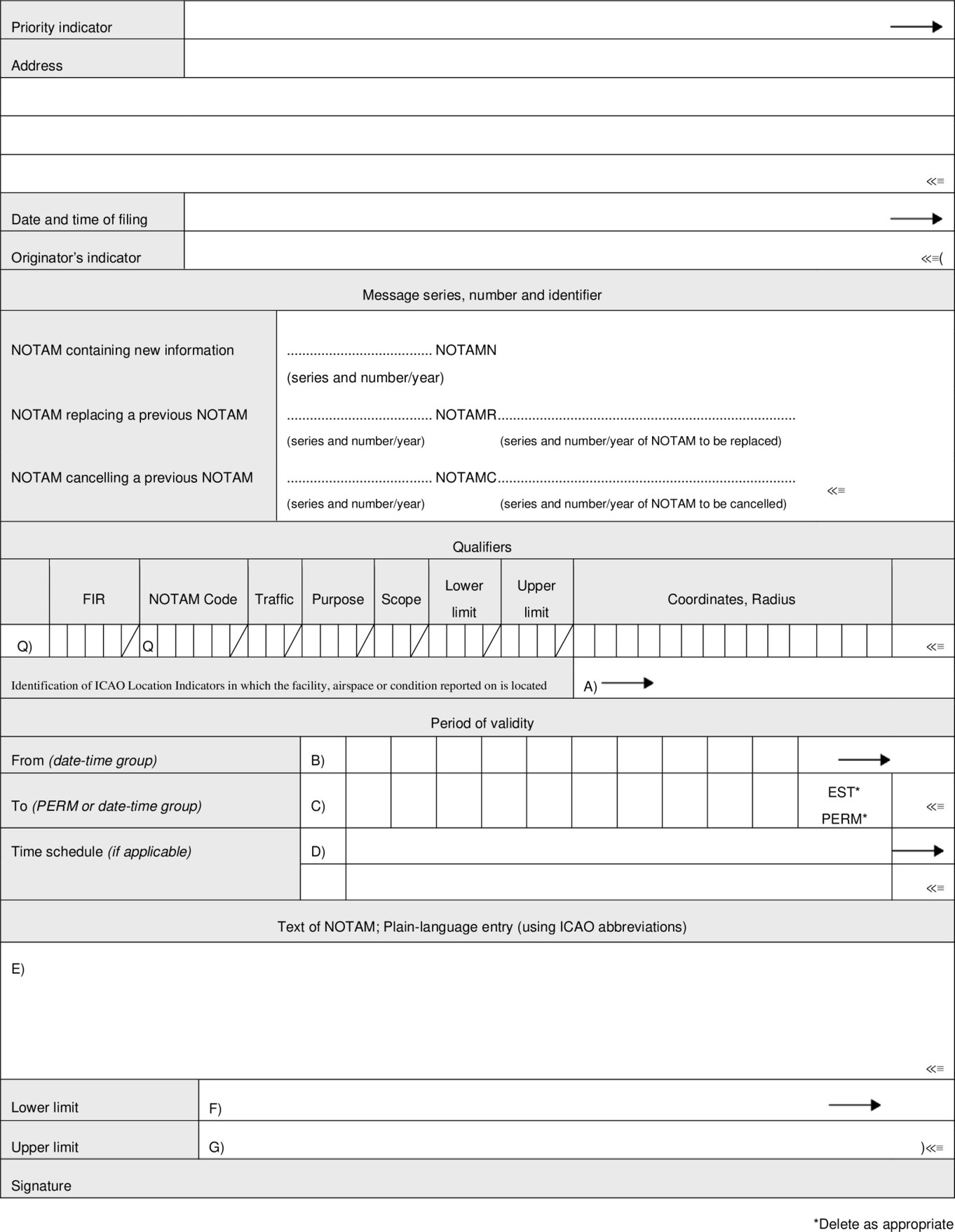
Appendix 1 — NOTAM FORMAT
Delegated Regulation (EU) 2020/2148
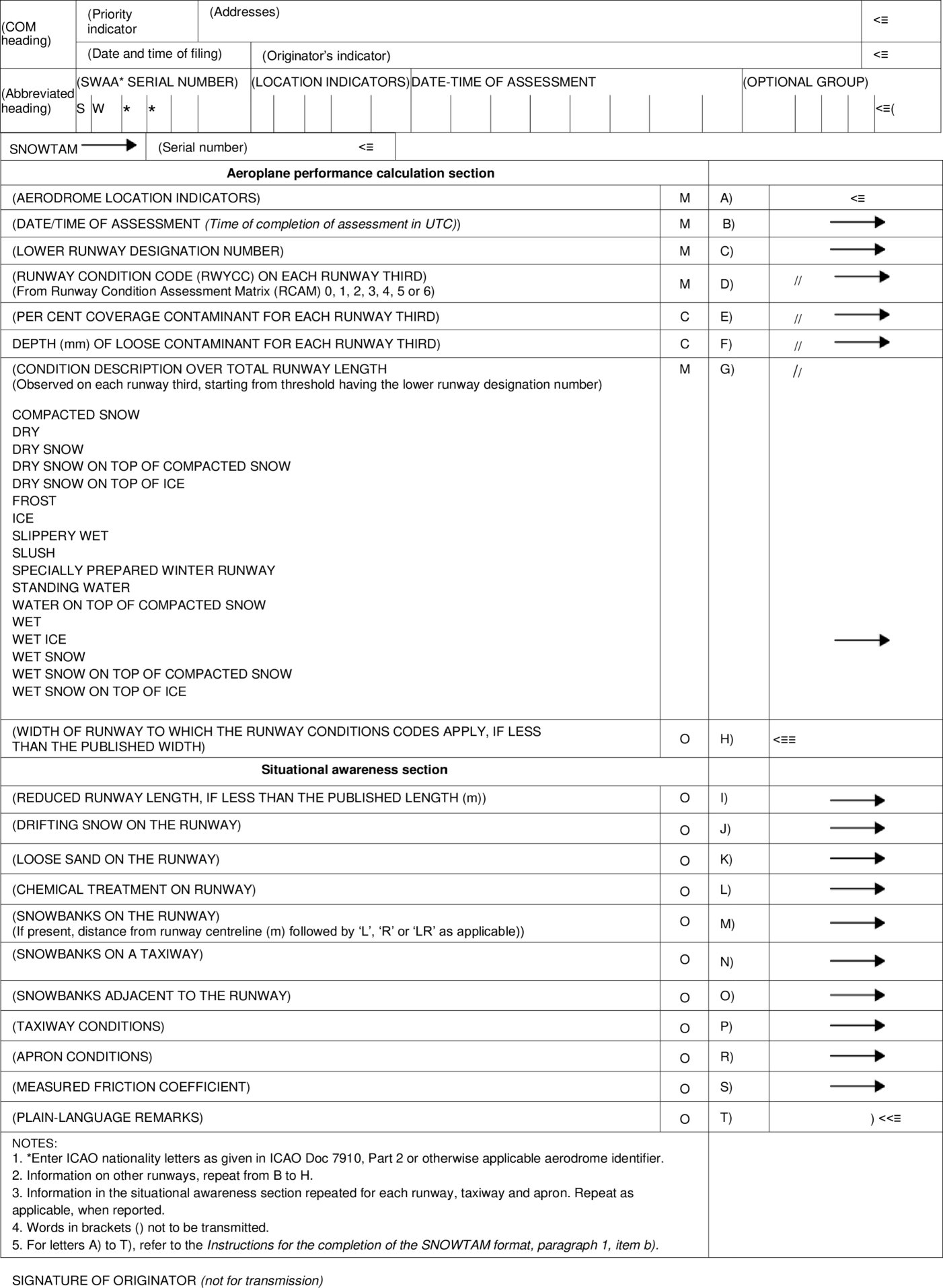
Appendix 2 — SNOWTAM FORMAT
Delegated Regulation (EU) 2020/2148