
Originally published in the CAA Norway Safety Letter (article and online) of November 2025. Authored by Hans Edvard Sunde, Flight OPS Inspector. Republished in the EASA Community General Aviation by invitation from Thomas Hytten, Flight OPS Inspector, CAA Norway.
Radiation fog
As the name implies, this is fog produced by nocturnal radiative cooling.
Specifically, the ground’s longwave heat loss to space. Radiative loss is greatest when the sky is free of low cloud. By contrast, cloud and fog form as a fog blanket at night. Under clear, starry skies the surface cools rapidly, the surface temperature falls to (or below) the dew point, a shallow temperature inversion forms, and surface-based radiation fog develops.

Photo: Civil Aviation Authority Norway
Anticyclones bring VMC but can also lead to fog
When autumn storms dominate, good flying days are scarce for VFR-pilots. So, a forecast of a large, slow-moving anticyclone parked over us for a week sounds ideal.
The catch is that anticyclones often bring clear nights and calm or very light winds. First, near-surface air remains almost stationary and readily picks up moisture from soil, crops, wetlands and open water during the day. Second, any fog that forms overnight tends to persist, because there’s insufficient wind for mixing or advection to disperse it. The air mass becomes saturated, and the fog simply sits.
Wait for the fog to clear
The only effective clearance mechanism is warming of the near-surface layer.
It’s frustrating to wait on the ground in flat calm for the temperature to rise. Fog also has a high albedo and reduces insolation, so warming is slow until breaks appear, sunlight reaches the surface, and the fog lifts and disperses.
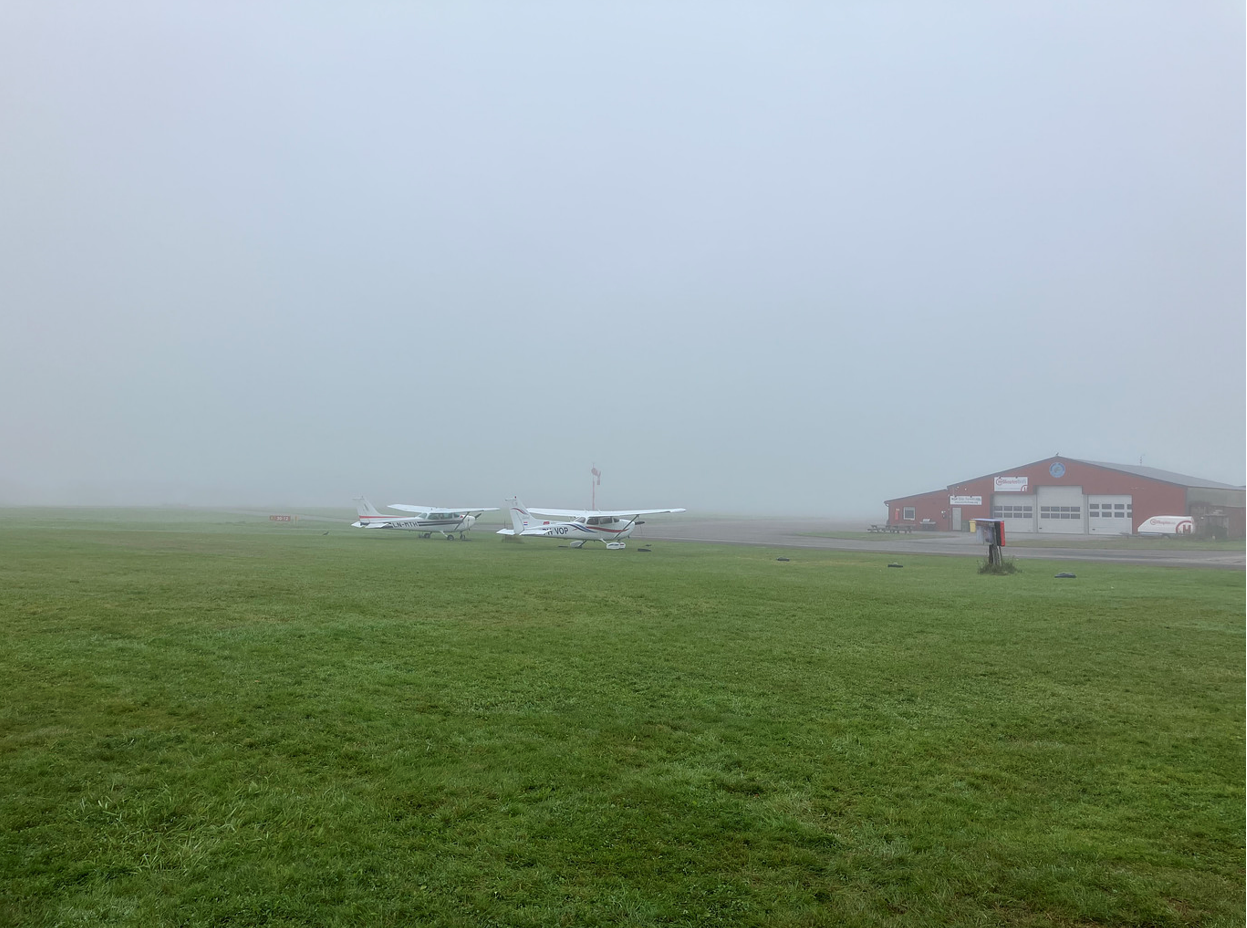
Photo: Civil Aviation Authority Norway
Airfields are often located on broad, flat terrain - frequently near fields, grassland, bogs and water - where moisture supply is abundant. Radiation fog here is typically shallow and surface-hugging, concentrated where ground moisture is highest. Bottom line: you can get widespread radiation fog even under strong, stationary high pressure.
Even if the whole Nordic region is cloud-free, local radiation fog may still occur. In autumn the solar elevation is low, so it can take many hours of weak sunshine before the surface warms enough for the fog to lift.
Fog precludes safe VFR
It’s vexing to sit in the clubhouse staring at a fog-shrouded airfield, but fog precludes safe VFR.
Tight schedules and fixed arrival times are incompatible with radiation fog. If you can’t adjust your plan, cancel!
Please log in or sign up to comment.