
Published in Norwegian safety letter, article and online guide of January 2026..
Written by Hans Edvard Sunde. Republished in the EASA Community by invitation fromn Thomas Hytten, CAA Norway.
Landing on water – winter operations
“The difference between seaplanes and ordinary airplanes – ordinary airplanes sink.”
The quote is, of course, from a seaplane magazine.
Very few of us have landed a landplane on water. Therefore, the experiences of those who have done so are especially valuable. Internationally, there are also few cases. Globally, there may be around 200 cases over ten years, and even that is too little to provide meaningful statistics. The emergency landing itself is survived in approximately 90 % of cases, which is better than almost all alternative emergency landing sites. Nevertheless, we will look at what can go wrong, especially during a typical Norwegian winter.
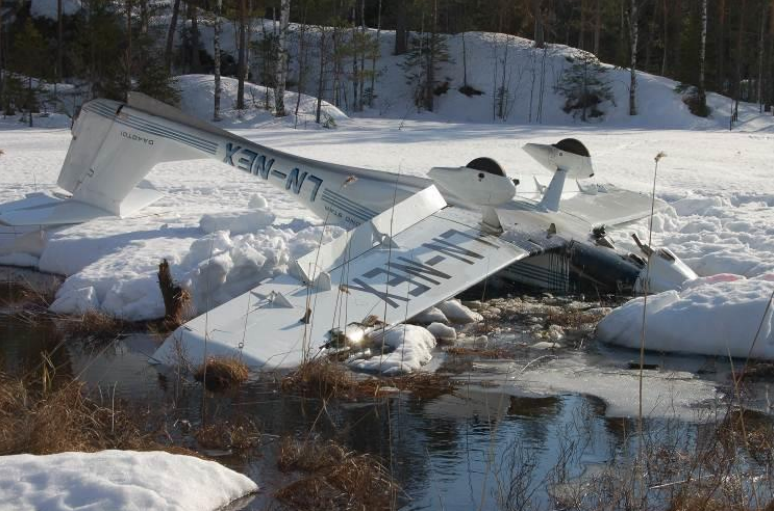
Image couertesy: Norwegian AIBN
Operational choices
Is the aircraft high-wing or low-wing, retractable or fixed landing gear? In general, it is best to land on water with the landing gear retracted. This results in less violent deceleration, but more importantly, the landing gear tends to cause the aircraft to flip over. The last thing you want is to hit your head during a sudden deceleration and then end up upside down and disoriented. That said, the limited statistics available show that it is entirely feasible to land with the landing gear extended – or with fixed landing gear. There is no statistical basis to conclude that aircraft with retractable landing gear flip over less often than aircraft with fixed landing gear. Most often, it is a wingtip that contacts the water and causes the aircraft to flip, not the landing gear. Land parallel to a wave crest.
There are large differences between aircraft types, so if you can find experience data for your specific aircraft, that will be extremely valuable. Generally, an aircraft that has made an emergency landing will float for a few minutes, which is sufficient to evacuate everyone on board. Is the aircraft designed in such a way that one person must exit before the others can get out? What happens if that person becomes trapped or unconscious while the aircraft is sinking? Maybe a landing on dry land is a better option?
If the aircraft sinks, the depth to which it sinks is critical. How far have you ever swum underwater? The answer is that most people manage 5–10 meters. Experienced rescue divers report that most people have little chance beyond 25 meters of depth. You are quite simply unable to swim back to the surface.
Hypothermia
Have you tried the cold plunge at your local water park? These often have water temperatures between 5 and 15 degrees Celsius. Most people can tolerate this for only a couple of minutes. In winter, sea temperatures may be even lower than a cold plunge. Even with normal clothing, you will only last a few minutes in winter water. Rescue is usually further away. To survive, you must be wearing some form of immersion or survival suit. All emergency equipment stored in baggage compartment, tends to remain there. The emergency equipment you will be able to use is what you are wearing. In addition to an immersion suit, you and your passengers should wear life jackets and carry a PLB.
Should I stay or should I go?
If land is close, the water is relatively warm, and the sea calm, experience shows that people survive swimming from floating wreckage to shore. If the distance is long, the water is relatively cold, or the sea rough, those who leave floating wreckage have a reduced chance of survival.
A briefing for a water landing is essential. Statistics show that passengers have inflated life jackets inside the aircraft and then been unable to get out. In some cases, passengers have even inflated life rafts inside the aircraft. That was likely the last thing the pilot-in-command needed while attempting to evacuate the aircraft.
Ice-covered water
Finally, what about landing on ice? In winter, many lakes may be ice-covered and thus resemble a land landing. This introduces an additional hazard. An opening in the ice, slush, or weakened ice can become a trap. We have an example of a successful emergency landing on ice-covered water where the aircraft flipped upside down after landing. The nose of the aircraft reached an opening in the ice near shore, causing the canopy to end up submerged in open water. The water was shallow where the aircraft came to rest, leaving no room to open the canopy in the shallow water. At the same time, the pilot-in-command became trapped, with the head ending up under water. It may therefore be advisable to open the canopy or door before landing. If possible, avoid slush and open leads in the ice.
Please check out the report from Norwegian AIBN here: lot of good learning points!
References
Norwegian CAA safety letter, article and online guide.
Norwegian AIBN Report on air accident at Skjelbreia in Ski, Akershus on 2 April 2009 with Diamond DA40-D, LN-NEX | shk.
Please log in or sign up to comment.