
Published in September 2026 GA Newsletter Norway
Sikkerhetsbrev fra Luftfartstilsynet ✈ September 2026
Article author: Hans Edvard Sunde, Flight OPS Inspector, CAA Norway
Promoted by Thomas Hytten, Flight OPS inspector, CAA Norway
Republished with permission in the EASA Community General Aviation to support aviation safety
Dew point spread and radiation fog
In autumn, we often experience warm days with abundant sunshine and temperatures that can feel almost like summer. At night, however, when there is no incoming solar radiation, heat is radiated from the Earth's surface into space. In this context, radiation refers to the loss of heat from the Earth's surface during the night.
As autumn progresses, the period of daytime heating becomes rapidly shorter, while the period of nighttime cooling becomes longer. As a result, the potential for cooling increases significantly during this season.
If we have a stable weather pattern with relatively moist air and clear skies, the following may occur: During the day, the sun warms the ground under a beautiful blue sky. The same clear skies then allow efficient radiational cooling as soon as the sun sets. The temperature near the surface drops, while the amount of moisture in the air initially remains unchanged. Eventually, the temperature reaches the dew point, the air becomes saturated, and fog may form as a blanket covering the ground.
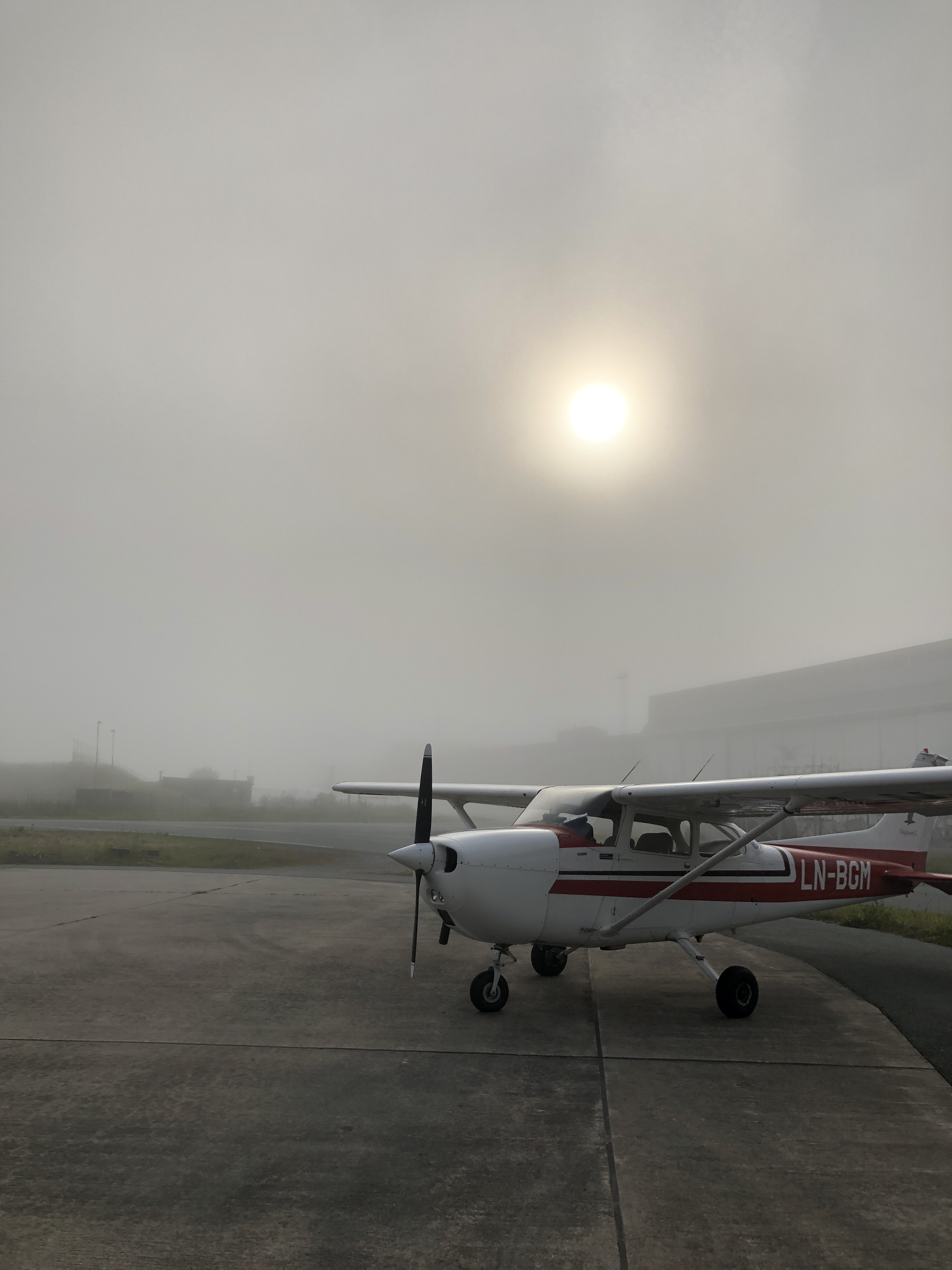
Picture from the August 2026 GA newsletter Norway
What is "Spread"?
As a pilot, you are accustomed to seeing two temperature values reported: the air temperature and the dew point of the air mass. For example, 14/10. The difference between the temperature and the dew point, which in this case is 4°C, is called the temperature-dew point spread. The greater the spread, the lower the risk of fog formation.
During autumn, we experience a major shift in the balance between incoming solar radiation and outgoing terrestrial radiation. In stable air masses, the potential for cooling is therefore greater than at other times of the year. Consequently, the potential for radiation fog is generally higher in autumn than in spring.
A spread of 4°C may provide a reasonable margin on a spring day, but in autumn, 4°C may not be sufficient to prevent fog formation.
This can become an unpleasant surprise if you departed before sunset and continue flying into the evening. By the time you return to land, a dense layer of fog may have formed from the surface up to 100 feet. In such a situation, it matters little that conditions remain clear everywhere else.
Please consider incorporating this into your PAVE risk assessment before flight.
References
Sikkerhetsbrev fra Luftfartstilsynet ✈ September 2026
FAA – The PAVE Checklist (PDF)
Please log in or sign up to comment.