
EASA Research Study Startle Effect Management
Startle and surprise effects can adversely influence pilot performance in numerous ways, from simple distraction to inappropriate actions or hasty decision-making.
Reactions can range from freezing or overreacting at the controls.
Performed from 2015 to 2018, this EASA research focused on startle and surprise reactions and how to manage them on the flight deck:
Startle Effect Management - EASA_REP_RESEA_2015_3 | EASA.
Startle and surprise have played a substantial role in a considerable number of Loss of Control In-flight (LOC-I) events, as well as other types of accidents.
The research aimed to develop a set of practical guidelines to support the creation of training programmes for Commercial Air Transport (CAT) pilots.
It also sought to establish a quantitative framework to measure the impact of startle and surprise and the recovery process during training sessions (e.g., reaction time, restoration of situational awareness), and to assess the effectiveness of the proposed training scheme.
Background and safety context
Startle and surprise effects are recognised contributors to degraded performance and have played a role in a number of serious incidents and accidents, including Loss of Control In-Flight (LOC-I).
While commercial aviation maintains a strong safety record, accident investigations show that pilots may react inappropriately when confronted with unexpected, ambiguous, or time-critical situations. These reactions can narrow attention, and lead to premature or incorrect actions.
In response, EASA funded a research project on Startle Effect Management to better understand the physiological and cognitive mechanisms behind startle and surprise, assess their operational relevance, and evaluate whether specific training techniques could mitigate their negative effects and be used within existing airline training frameworks.
The research study was awarded to the NLR, which teamed up with the KLM Flight Academy. The final study report was published in 2018.
Key concepts and definitions
Commission Regulation 1178/2011 – Aircrew, GM3 FCL.010 Definition
- ‘Startle’ refers to the initial, short-term, involuntary physiological and cognitive reactions to an unexpected event that commence the normal human stress response.
- ‘Surprise’ refers to the emotionally based recognition of a difference in what was expected and was actual.
- ‘Stress (response)’ refers to the response to a threatening event that includes physiological, psychological and cognitive effects. These effects may range from positive to negative and can either enhance or decrease performance.
Startle triggers the amygdala before conscious thought (“amygdala hijack”).
Surprise arises from a mismatch between expectation and reality. It typically lasts longer than startle and requires cognitive reassessment of the situation.
Startle, surprise are normal human reactions (*), not pilot failures.
Safety risk arises when these reactions severely narrow attention, disrupt cognition, coordination, and decision-making.
In aviation, startle and surprise frequently occur together, but surprise alone is more operationally significant.
Many LOC-I events involve a breakdown after the initial surprise.
(*) Note: Startle and surprise aren’t limited to humans. For example, that is illustrated in the video Cats and Cucumbers Compilation - YouTube, featured in the PowerPoint (attached at the end of this article) “Startle and Surprise Effect Management: The European Regulatory Framework and EASA Research Study”, presented in the International Symposium on Pilot Training for Startle and Surprise TNO Soesterberg, NL, 26 Sep 2019.
That video shows cats’ instinctive reactions to cucumbers. How so? Because cucumbers resemble snakes, that cats instinctively perceive as menacing. That split-second recognition triggers a primal fear response, sending them leaping away in dramatic fashion:
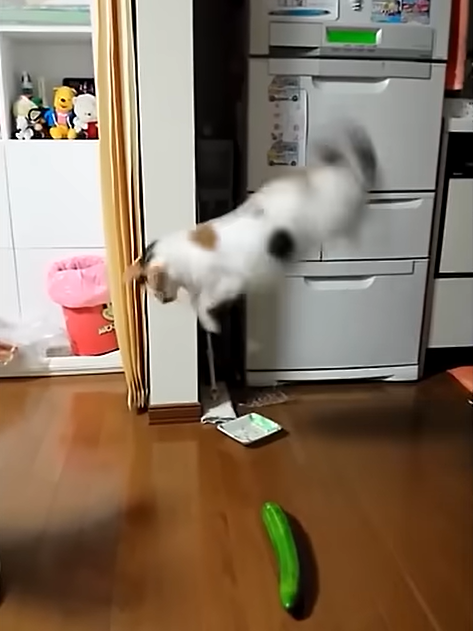
Cats vs. Cucumbers
Managing startle and surprise
Startle and surprise must be effectively managed to maintain control of the situation.
The operational objective is not suppressing startle and surprise but recovering cognitive capacity and situation control.
You cannot prevent surprise – but you can prepare for how you respond to it.

Affiche Effet de surpriise, par René Deymonaz, alias Deymo.
DGAC DSAC Symposium sécurité Gestion des risques & maîtrise du vol,
8 décembre 2016
Translation:
"Risk Management and Control of Flight
Surprise Effect
No stress, we take our time.
Control the situation!".
Literature and accident analysis findings
A comprehensive literature review and analysis of accident and incident data, including NASA ASRS reports, showed that:
- Surprise and unexpected events are common in everyday operations, not just rare emergencies.
- In over 70% of reviewed accidents, surprise exacerbated the outcome, even if it was not the initiating cause.
- Almost any factor – ATC actions, automation behaviour, aircraft state, or other crewmember actions – can trigger surprise.
Therefore, training must be generic and transferable, not event specific. - Traditional scenario-based training alone cannot “inoculate” pilots against surprise because unexpected events are inherently unpredictable.
The research highlights that how pilots manage their initial reaction can be more safety-critical than the technical nature of the event itself.
CRM and teamwork are key recovery mechanisms.
Training and regulatory context
EASA rules require addressing startle and surprise through:
- Crew Resource Management (CRM),
- Upset Prevention and Recovery Training (UPRT),
- Evidence-Based Training (EBT).
The study suggested a promising technique to train pilots to manage the psychophysiological effects of startle and surprise and keep or regain control within realistic time and resource constraints
Development of the “Mental Upset” technique
The NLR - KLM research team developed a simple, operationally applicable technique inspired by sport psychology and military mental training. The technique mirrors the UPRT aircraft recovery mnemonic and is structured as:
Unload – Roll – Power (URP)
- Unload: Control arousal and stop cognitive tunnelling (breathing, muscle relaxation, physical grounding, crew alignment).
- Roll: Restart cognitive processing and information gathering (what do we see, hear, feel; verbalisation; shared assessment).
- Power: Look ahead, project the situation, challenge assumptions, and adjust actions if necessary.
The aim is not to suppress the startle reflex – which is physiologically impossible – but to shorten its operational impact and re-establish effective crew performance.
Experimental evaluation
The technique was evaluated with 40 KLM line pilots at the KLM Flight Academy in Amsterdam using classroom instruction combined with simulator scenarios during recurrent training in a Flight Simulator Training Device (FSTD).
Simulator scenarios are provided in Appendix D of the report, page 131.
Pilot performance was assessed using the KLM SHAPE (Self, Human, Aircraft, Procedures, Environment) behavioural marker system.
Key findings:
- Pilots trained in the technique showed improved information collection and situational assessment after unexpected events.
- Combined classroom + simulator coaching was significantly more effective than classroom instruction alone.
- Training was feasible within existing recurrent training slots.
- Participants rated the training positively and reported increased self-efficacy.
Take away
The study demonstrates that startle and surprise effects can be systematically mitigated through targeted training, even within limited training time. The research does not constitute regulatory guidance, but provides evidence to support:
- Integration of startle and surprise management into CRM, TEM, UPRT, and EBT,
- Greater emphasis on non-technical skills, judgment, and adaptive expertise,
- Instructor awareness of individual differences and negative training experiences.
EASA positions this work as a source of inspiration, encouraging operators to adapt the principles to their own operational and cultural context.
Post research considerations
Startle and surprise should also be considered when analysing occurrences – whether in accident investigation, safety analysis, or risk assessment and management within an SMS – because they can substantially affect performance. In fact, how pilots manage startle and surprise can be as important for safety as the technical nature of the event itself.
References
Startle Effect Management - EASA_REP_RESEA_2015_3 | EASA
NLR-CR-2018-242 EASA Research Startle Effect Managements Final Report
"Startle and Surprise Effect Management: The European Regulatory Framework and EASA Research Study", M. Masson, International Symposium on Pilot Training for Startle and Surprise TNO Soesterberg, NL, Sep 26th, 2019.
Cats and Cucumbers Compilation - YouTube
Symposium sécurité | Ministères Aménagement du territoire Transition écologique
DGAC DSAC Symposium sécurité Gestion des risques & maîtrise du vol, 8 décembre 2016, affiche Effet de Surprise, par René Deymonaz, alias Deymo.

Please log in or sign up to comment.