Same in Canada and northern latitudes.
Join a community to be part of the discussion.
Desmond Ross commented on a post in Rotorcraft

Advice for helicopter pilots in harsh winter conditions
Article by by Anette Kruhaug Haldorsen, Jan. 9, 2022
https://en.ehc.no/advice-for-helicopter-pilots-in-harsh-winter-conditio…
https://www.businessairnews.com/mag_story.html?ident=23445
Norway is a demanding country for helicopter operations. There are many factors involved during the winter season. Icing, white-out, snow landing, weather, flameout, fuel, starting in cold weather, parking outside, skids stuck to the ground, frozen ground and more.
Quote:
To avoid white-out it’s important to:
1. Avoid flying at low altitude over snow covered surfaces without prober references.
2. Do not fly into heavy snow showers.
3. If it’s not possible to see the difference between ground and horizon, turn around or land.
Different technics may be used to reduce the risk of entering self-induced white-out conditions:
1. If possible, stop in high hover and try to blow the snow away. Be aware of different snow types, and that the snow may start to recirculate suddenly when the helicopter is close to the ground.
2. Do not attempt to land if there is no object you can use as a reference during landing.
3. Perform a fast approach with a slightly forward movement and avoid low hovering.
4. Turn the nose of the helicopter, so the reference is visible at all time and fly close to it.
5. Make use of landing lights.
6. At take-off, lift the helicopter slowly to light on skids. If white out conditions occur land immediately, if not a max performance take off shall be performed with a slightly forward movement and always keep a point as a reference. Avoid hovering.
More in this informative article.
I use this opportunity to wish you all a wonderful Christmas time and a Happy New Year! Michel, ESPN-R Coordinator
Same in Canada and northern latitudes.
Michel MASSON created a topic in Air Operations
Michel MASSON posted in General Aviation
In memory of David Cockburn, The Honourable Company of Air Pilots, formerly the Guild of Air Pilots and Air Navigators (GAPAN)
David Cockburn passed away in January 2024.
I had the privilege to work with him in the European General Aviation Safety Team (EGAST) co-chaired by John Vincent and then Dominique Roland, and James Black.
EGAST closed in 2016 and safety promotion was then transferred to the EASA GA Advisory Bodies, with many other roles to perform.
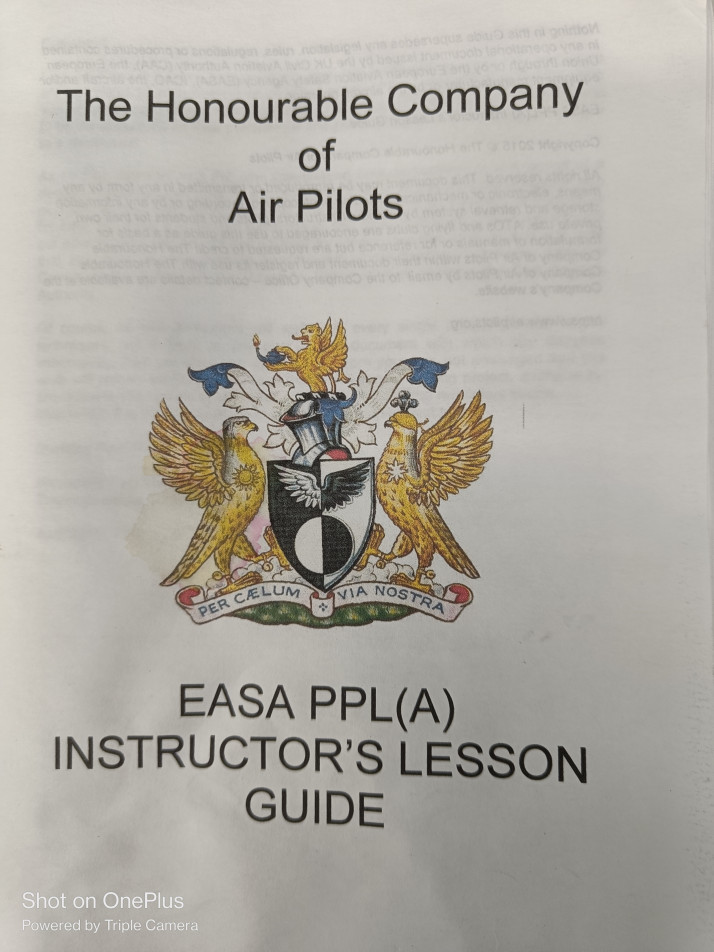
This is a picture of my personal copy of the pre-series dated 2017 of the GAPAN EASA PPL(A) Instructor's lesson Guide, co-authored by David.
David Cockburn was a fine gentleman, a passionate aviator and an inspired writer.
He will be remembered.
John Franklin created a topic in Air Operations
John Franklin created a topic in Air Operations
Andreas Schlager commented on AOPA Finland's topic in General Aviation

Let me bring up this topic again.
Are there any news regarding UAT?
Is there a way to build up pressure with EASA other than the fact that with UAT many accidents could have been avoided in the past?
Federica Cescutti created a topic in General Aviation
R. van Twisk commented on a post in General Aviation
Would would it take for EASA to create a index on the site like this?
https://part-aero.com/en/view/part-nco#NCO.IDE.H.126
That would finding information soooo much easer.
I am looking for that document in the EASA website but google is lost on this site, and the search function of Easa itself does not find any site (I am not looking for PDF's...)
Document I am looking for is Part-NCO
hey John,
the first link works, but I have no idea how to get there from the home page, it's to confusing..
But that said, if I search for "VMC at Night" https://www.easa.europa.eu/en/document-library/easy-access-rules/online…
No results at all.
When I search for "NCO.IDE.H.120" Rules Amendment Status https://www.easa.europa.eu/en/document-library/easy-access-rules/online…
I am not interested in that
Searching for SERA.5005
https://www.easa.europa.eu/en/search?keys=SERA.5005
It does not give any document
But I would expect it to come up with https://www.easa.europa.eu/en/document-library/easy-access-rules/online…
Note: there is no SERA.5005 in the URL, even google had a hard time vinding the document
Searching for Visual FLight Rules:
https://www.easa.europa.eu/en/document-library/easy-access-rules/online…
Totally not relevant.
I expected something like this:
https://www.easa.europa.eu/en/document-library/easy-access-rules/online…
I can only speak for myself, but I find it very hard to find something based on good keywords. the search often find things they are not relevant, or nothing at all.
Again, I do want to thank you for your response, and I think the feedback to the web design team and web team in general is :
1) make the site accessible for every day Joe .
2) make it more snappy, it's not responsive (understandable because it's written in PHP)
3) Don't show me proposals, amendments, revisions, history unless I ask for it.
4) Cover regulation or definitions, unless I ask for it, or shows it as a search result but not relevant.
5) Lastly, the webdevelopers should try the site for themselve instead of pushing new features out. Pretent you are a pilot or other persons and you need to look for something. Or better, do a test with somebody new to the site and ask them to search for documents so the web developers can see what is happening.
I am just a PPL(A) pilot so I don't come here often, but when I want to know something it's for me near impossible to find the right document.
Just my 3 cents :)
have safe landings!
Rudy Muller commented on a post in General Aviation
ADS-L and ADS-B compatibility
EASA is promoting a new conspicuity system - ADS-L. Is it possible to take advantage of this in a ADS-B in/out equipped GA aircraft?
Are those two systems compatible in any way?

Hi Andreas, No ADS-B In on a GA aircraft cannot see ADS-L.
ADS-L is a subset of ADS-B data including position and GNSS altitude transmitted on 860 MHz. You need an extra receiver in your aircraft in order to see ADS-L equiped aircraft.
Therefore we have proposed, for a long time, to stay with the international standard for Electronic Conspicuity just like the UK is doing now. Certified ADS-B transponder or low power ADS-B on 1090 MHZ for manned aviation and ADS-B on 978 MHz (ADS-B UAT frequency) for unmanned BVLOS operations.
Some people already suggested to use the new EASA ADS-L standard only for Remote ID instead of the WIFI/Bluetooth protocol, and follow the UK and the coming ICAO standard “REDUCED CAPABILITY 1090 MHZ ADS-B EQUIPMENT” (i.e. low power ADS-B) for electronic conspicuity on GA aircrafts.
Tom Velkeneers commented on John Franklin's topic in Air Operations
Hi John,
with the increase of GNSS manipulation (jamming, spoofing). Is there any consideration being giving to implementation of "Commission Implementing Regulation (EU) 2018/1048 of 18 July 2018 laying down airspace usage requirements and operating procedures concerning performance-based navigation". Especially past 2030 with the withdrawal of conventional navigation aids/NPAs/SID/STAR. At this moment we already see issues for example at Gdansk where RW11 only has RNP or VOR available with significant GPS interference occasionally requiring a tailwind approach to the ILS runway which increases exposure to runway excursion events. Especially on a contaminated runway. The regulation considers "Establishment of emergency measures in case of the non-availability of the GNSS signal" however this would most likely just lead to a diversion to a CAT 2/3 available location since jamming can blanket a wide area and can be unpredicable.
Kind regards,
Michel MASSON posted in General Aviation
FAAST Human Factors and Safety Culture Training, Jan 2024
Do you know the five main ingredients to a robust safety culture?
Effectively understanding risk requires a greater understanding of human capabilities and limitations. Learn more in FAAST latest #FlySafe topic.
https://medium.com/faa/introduction-to-human-factors-and-safety-culture…

Daniel Revuelta Evrard commented on a post in Air Operations
Hello everybody!
We operate Cessna C550 and C560, and one EASA FSTD is available only. The problem is that this year this EASA FSTD will be retired and no EASA FSTD is going to be available for this fleet.
I would like to know if it is possible to carry out the training in FAA FSTD because no EASA FSTD is available, if EASA can encourage FAA FSTD operators to certify these FSTDs according to EASA, or if training in the aircraft is an option in this situation (for us it is not the best option).
C550/C560 (not XL/XLS) is not a large fleet in Europe but there are dozens of these aircraft operating in Europe, most of them in CAT operation.
Thank you for your cooperation!

Hello!
We are in the same situation.
R. van Twisk posted in General Aviation
Would would it take for EASA to create a index on the site like this?
https://part-aero.com/en/view/part-nco#NCO.IDE.H.126
That would finding information soooo much easer.
I am looking for that document in the EASA website but google is lost on this site, and the search function of Easa itself does not find any site (I am not looking for PDF's...)
Document I am looking for is Part-NCO
Andreas Schlager posted in General Aviation
ADS-L and ADS-B compatibility
EASA is promoting a new conspicuity system - ADS-L. Is it possible to take advantage of this in a ADS-B in/out equipped GA aircraft?
Are those two systems compatible in any way?
Vasileios PAPAGEORGIOU created a topic in Cybersecurity
Jan Bruegmann posted in Air Operations
Hi everybody, one question on FTL/commander discretion: when incresing the max FDP by 3h, ORO.FTL.205 (f) is saying, „augmented crew“ is necessary. Does this imply that inflight rest is planned for this FDP? I ask because we sometimes crew three pilots on a widebody with rest compartment but without extension due to inflight rest. So in such a case is it 2h or 3h the commander may increase max FDP? Many thanks - cheers, Jan
Hubert Massalski commented on Liviu Dnistran's topic in General Aviation

Complementing the above, it would be worthwhile for you to check how Romania CAA understands your ULM authorization.
If it determines that you have a national pilot's license instead of a non-license qualification certificate, you can use the direct provisions of EU Regulation 1178/2011 Article 4 'Existing national pilots' licenses'.
link: https://eur-lex.europa.eu/legal-content/EN/TXT/?uri=CELEX%3A02011R1178-…
Paragraph 2 says:
"Non-JAR-compliant licences including any associated ratings, certificates, authorizations and/or qualifications issued or recognized by a Member State before the applicability of this Regulation shall be converted into Part-FCL licences by the Member State that issued the licence."
Michael Orf commented on a post in General Aviation

Happy 2024 for all members!
...and ALWAYS HAPPY LANDINGS for all aviators ;-)
Liviu Dnistran created a topic in General Aviation
Gonzalo Corral posted in Air Operations
Hello everybody!
We operate Cessna C550 and C560, and one EASA FSTD is available only. The problem is that this year this EASA FSTD will be retired and no EASA FSTD is going to be available for this fleet.
I would like to know if it is possible to carry out the training in FAA FSTD because no EASA FSTD is available, if EASA can encourage FAA FSTD operators to certify these FSTDs according to EASA, or if training in the aircraft is an option in this situation (for us it is not the best option).
C550/C560 (not XL/XLS) is not a large fleet in Europe but there are dozens of these aircraft operating in Europe, most of them in CAT operation.
Thank you for your cooperation!