Looks like Niklas, his CAMO and me are not the only people confused.
There is now a consultation on a memo to clarify some aspects. Look for CM-21.A-K-001 on the Comment Tool, https://hub.easa.europa.eu/crt/docs .
Join a community to be part of the discussion.
Christophe Mutricy commented on Niklas Larsson's topic in General Aviation
Looks like Niklas, his CAMO and me are not the only people confused.
There is now a consultation on a memo to clarify some aspects. Look for CM-21.A-K-001 on the Comment Tool, https://hub.easa.europa.eu/crt/docs .
Michel MASSON posted in General Aviation
NASA ASRS CALLBACK 513, Oct. 2022 - Parachutes, Paragliders, and Power
https://myemail.constantcontact.com/CALLBACK-513--October-2022---Parach…
Parachutes and paragliders, powered or not, have enjoyed a recent surge in popularity. This increased popularity, however, has unveiled an old threat wrapped anew. The airborne conflict has, in these operations, manifested itself in unorthodox ways from unusual vantages, while some surrounding issues have also been revealed. A resulting collision is unthinkable, but the threat must be addressed.

Michel MASSON posted in Air Operations
IATA Safety Conference, Dubai, UAE, Oct. 25-27, 2022
https://www.iata.org/safetyconference/
After a two-year absence the IATA Safety Conference is back with a new name and exclusive focus on our industry’s highest priority: Safety.
The Successor to IATA’s Safety & Flight Operations conference.

Michel MASSON posted in Rotorcraft
FAA Aims to Extinguish Fire as Aviation Risk, Oct. 14, 2022
https://medium.com/faa/faa-aims-to-extinguish-fire-as-aviation-risk-94a…
Research from the FAA’s William J. Hughes Technical Center aims to eliminate all aircraft fire hazards, whether arising from the cabin or post-impact exigencies.
Watch this FAA Resistant Materials video on YouTube:
https://youtu.be/kSbIc5AdJKk.
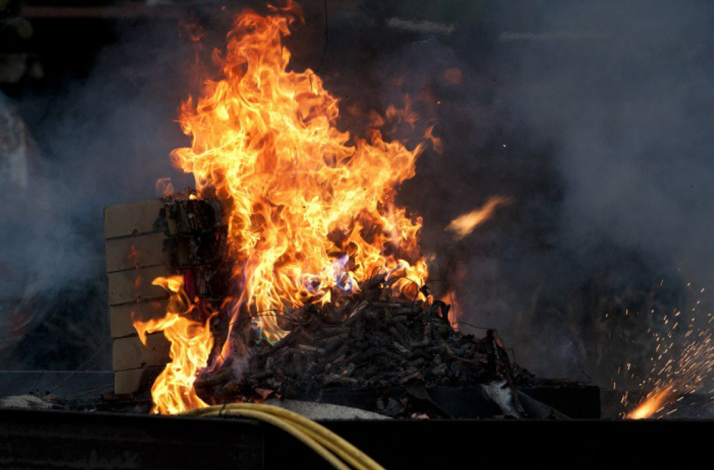
Thermal runaway consumes an entire cargo pallet of lithium batteries in minutes (image: FAA):
Michel MASSON created a topic in General Aviation
Nicolo Eicke commented on a post in Rotorcraft
Hello from Finland
This might be a wrong community, but question anyway about new spa.hems opinion.
VFR weather minima at night. There is still cloud base limitation, but in some cases it might be ceiling.
Really difficult to understand the reasons for cloud base NOT ceiling, especially with NVG's.
How do you understand this new text and it's meaning in practise?
Hi Anssi
Thanks for your reply!
Thats indeed disappointing. On the other hand I'm not surprised they have no clue what they wrote in their regulations...
Andre de Chauvigny de Blot commented on a post in Air Operations
Hello everyone,
We are struggling with the new text of AMC1 ORO.FC.105(b)(2);(c)
which stipulates the requirements of aerodrome classification category A.
In bullet (B) it states a condition of the presence of "at least one runway with no performance-limited procedure for take-off and/or landing, such as no requirement to follow a contingency procedure for obstacle clearance in the event of an engine failure on take-off from any runway expected to be used for departure"
How do we need to interpret this? The second part of the sentence seems to contradict the first part of this sentence. If this means that the presence of an EOSID on any runway precludes category A, most aerodromes will fall in category B. Is this assumption correct? How do you interpreted this regulation?
There is an unofficial reaction from EASA;
After discussing with the operational engineers who followed the rulemaking, we agree to add the following sentence to the AWO implementation manual:
‘The contingency procedures for obstacle clearance requirement implies that as long as one runway has no limitation on the engine out contingency procedure for the intended operations, the airport will be categorised A.’
Good news, however we have to wait for a formal announcement.
Michel MASSON posted in Rotorcraft
Crazy as it sounds, da Vinci Flight Spiral is actually flying!
https://youtu.be/YsG-Mcn29kg
‘Crimson Spin’ brings da Vinci helicopter design to life, Vertical Oct 12, 2022
Article by Ben Forrest
Austin Prete image
https://verticalmag.com/features/crimson-spin-brings-da-vinci-helicopte…
Bet that Leonardo himself would be proud!
https://de.wikipedia.org/wiki/Leonardo_da_Vinci#/media/Datei:Macchina_v…

Boris Zec commented on a post in Air Operations
Dear Part M colleagues,
According to latest Easy (published Oct2022) Part M subpart G still exist!
I expected that it will be changed with Part-CAMO starting 24.03.2022.
It looks like, at this moment, two standards (Part-CAMO and Part M subpart G) parallel exist?
Why Part M subpart G still exist?
When EASA will delete Part M subpart G?
Many thanks in advance for sharing your opinion.
Dear Clement,
now everything is clear. Thanks one more.
Michel MASSON created a topic in Rotorcraft
gianni guiducci commented on John FRANKLIN's event in Air Operations

14-October-2022
Good morning everyone.
I just signed up to be able to share my thoughts with you.
In March 2016 I published a manual "Handling the Circling", made up of over 400 pages where I exhibited all the rules, systems, procedures and limits for all categories of planes.
Since then I have argued that, for example, for category C the 2400 m of visibility, in my opinion, it are insufficient.
The "Draft Provisional Awo Implementation" was therefore interested in it, which tries to increase 3400 m the vis.
I brought all the parameters on graphic computer, from where I noticed that the 3400 m would be considered insufficient.
This arises from the fact that having maintained the continuation after ABM for 5 sec, you remain within 3400 m from the RWY, but the Final is 729 m to the THR and 1020 m to the TDP with a time of only 14.5 sec of flight.
I would also like to emphasize that with a 3° slope, 729 m for the THR, the plane will find itself with the wings leveled at 175 ft = 53 m in height.
It seems to me to be too low a height value and too short time to be able to, if necessary (not aligned for a possible cross wind, Bank inaccurate, etc.), adjast properly and respect the concept of Stabilized Approach.
I would like to remember that:
-FAA AIM-Fig. 5.4.22-Page 5-4-46; FAA AC-120-71 ° Appendix 2-Page 1; ICAO DOC 8168 Vol 1-Chap. 3 3.3b-Page III-4-3-1, indicate a Stabilized Approach Point of 500 ft = 152.4 m
- Flight Safety Foundation Alar Breafing Note - 7.1 Point 8, suggests 300 ft.
I hope that these indications influence to further increase to at least 4000 - 4500 m VIS, in order to contain the plane within the visibility area and be able to carry out an adequate Stabilized Approach.
Thanks for the attention.
Gianni Guiducci
Retired Senior Cpt
John FRANKLIN created an event in Air Operations
John FRANKLIN created an event in Air Operations
Michael Orf created a topic in General Aviation
Boris Zec posted in Air Operations
Dear Part M colleagues,
According to latest Easy (published Oct2022) Part M subpart G still exist!
I expected that it will be changed with Part-CAMO starting 24.03.2022.
It looks like, at this moment, two standards (Part-CAMO and Part M subpart G) parallel exist?
Why Part M subpart G still exist?
When EASA will delete Part M subpart G?
Many thanks in advance for sharing your opinion.
Emanuele Ghiroldi posted in Air Operations
Hi.
I'd like to listed to your opinion about the use of a CPL pilot as commander on CAT multi-pilot operations with a single-pilot aircraft.
I've understood that a single-pilot aircraft can be engaged on multi-pilot operations and that a CPL can be commander on a single-pilot aircraft.
Am I right saying that, if I'm using such a single-pilot aircraft on multi-pilot operations in CAT my commander can be a CPL? Or shall I engage an ATPL instead?
As a reference, here are the definitions:
"Multi-pilot operation" means an operation requiring at least two pilots using multi-crew cooperation in either a multi-pilot or a single-pilot aircraft.
"Single-pilot aircraft":
— for aeroplanes, it means an aircraft certificated for operation by one pilot,
— for helicopters, airships and powered lift aircraft, it means an aircraft which is certificated for operation by one pilot and which is not required to be operated with at least two pilots by Regulation (EU) No 965/2012."
"Multi-pilot aircraft":
— for aeroplanes, it means aeroplanes certificated for operation with a minimum crew of at least two pilots,
— or helicopters, airships and powered-lift aircraft, it means an aircraft which is certificated for operation with a minimum crew of at least two pilots or which is required to be operated with at least two pilots in accordance with Regulation (EU) No 965/2012."
"The privileges of the holder of a CPL are, within the appropriate aircraft category, to:
(1) exercise all the privileges of the holder of an LAPL and a PPL;
(2) act as PIC or co-pilot of any aircraft engaged in operations other than commercial air transport;
(3) act as PIC in commercial air transport of any single-pilot aircraft subject to the restrictions specified in FCL.060 and in this Subpart;
(4) act as co-pilot in commercial air transport subject to the restrictions specified in FCL.060."
Thanks for your comments.
John FRANKLIN posted in Rotorcraft
The agenda for the EASA Rotorcraft and VTOL Symposium is now online. Come and join us to discuss the most important topics for the industry. We look forward to seeing there as part of the exciting European Rotors event from 8-10 November.
Find out more on the EASA Event Page at the link here:
https://www.easa.europa.eu/en/newsroom-and-events/events/easa-rotorcraf…

Sander Starreveld posted in Air Operations
Question regarding the mutual recognition philosophy between EU member states. The CAA of country X is requiring that a foreign (and approved) training provider in a different EU member state still applies for a national authorisation in country X. The topic of training is DG over an online CBT platform. Does anyone recognise this 'national flavour' in their EU CAA? and what could be the basis from the CAA of country X to legally require this?
Michel MASSON posted in Air Operations
Serious risk to manage!
SKYbrary article Flight in Mountainous Terrain, published Oct. 2022
https://skybrary.aero/articles/flight-mountainous-terrain

Boris Zec posted in Air Operations
Dear Part145 colleagues,
I need I cannot understand requirement GM2 145.A.30(e) related to “Knowledge on EWIS when relevant” for “Quality audit staff”.
Concerning mark “X”, it look likes EWIS is mandatory for “Quality audit staff”.
But what is the meaning of “….when relevant”?
In which cases EWIS is not mandatory for “Quality audit staff”?
For “Quality audit staff” working in approved maintenance organization with scope of base and line maintenance for passengers commercial aircraft is EWIS knowledge consider mandatory or not?
Thank you in advance for prompt answer.