
This is Part 1 of a two part series, you can read Part 2 on being Operationally Ready and Fit for Duty here.
As the summer season continues, the pressure can seem never-ending. It builds - on organisations, on the aviation system and, ultimately, on the people who deliver safe operations every day.
Busy schedules, disruption, long duty days, night operations, changing rosters and repeated delays can all take their toll. Fatigue is rarely about one difficult day. It builds gradually, duty after duty, disrupted rest after disrupted rest, until reduced alertness becomes a normal part of the operation.
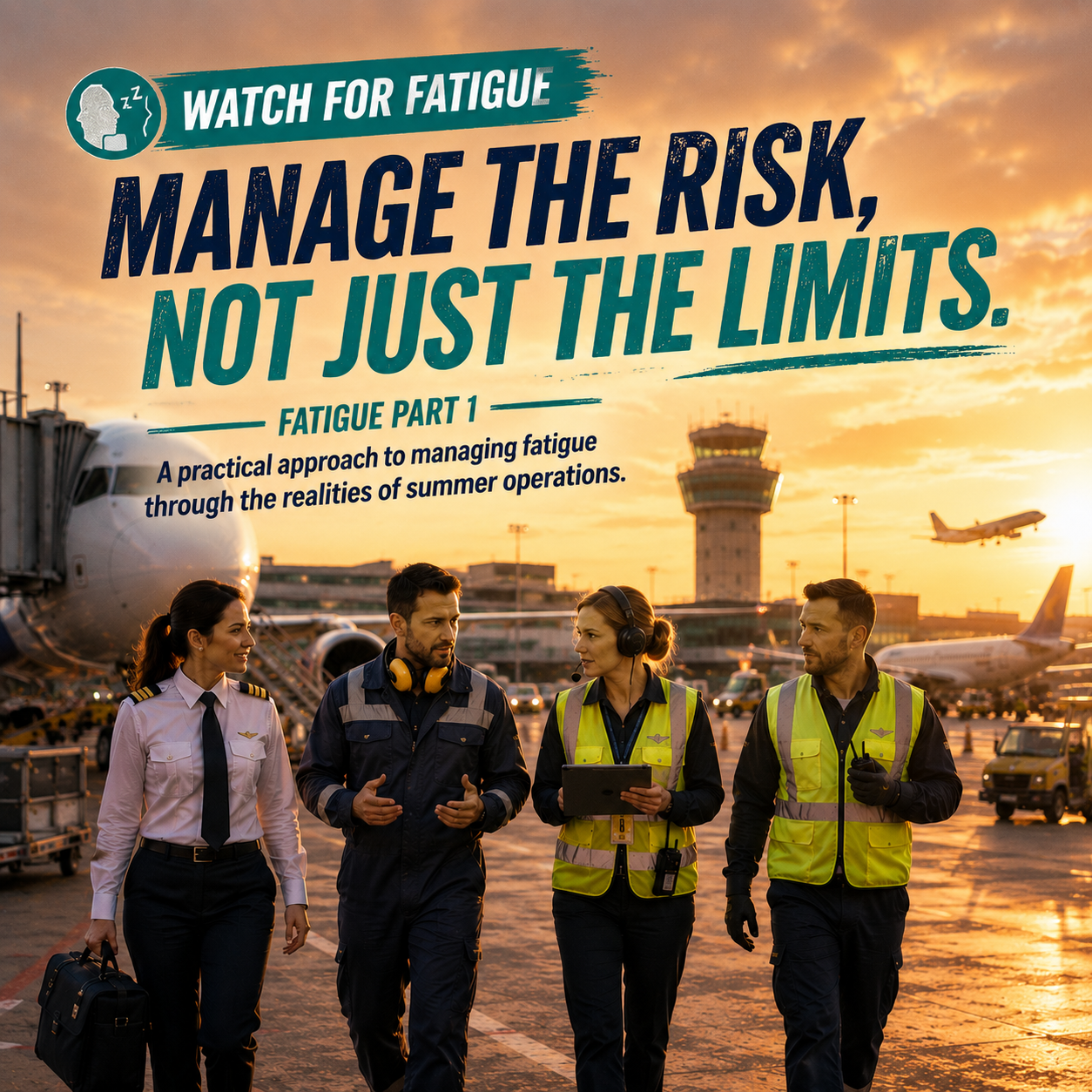
That is why Watch for Fatigue is one of the three key messages in our Go Safe This Summer - Together campaign.
But watching for fatigue means more than asking whether an individual crew member feels tired or just being “compliant” with flight time limitations.
It means watching for fatigue in ourselves, in each other and in the way we plan and manage the operation.
Because fatigue is a safety risk, and as such, it needs to be identified, assessed, managed and mitigated.
FTL Is Just the Baseline
Flight Time Limitations (FTL) provide an essential safety baseline. They establish requirements for crews’ maximum flight duty periods, cumulative flight and duty time, minimum rest, standby and reserve duties, night operations and other areas that can affect fatigue.
But being inside a legal limit does not automatically mean that fatigue risk is being effectively managed. Being compliant does not necessarily mean safe.
Effective Fatigue Risk Management (FRM) goes further. It combines regulatory limits with operational monitoring, active promotion and the use of fatigue reporting as well as scientific knowledge, experience and continuous improvement. All embedded in a positive organisational safety culture. EASA's current FRM guidance deliberately describes this as an important step from FTL compliance towards effective management of fatigue risks tailored to the realities of the operation.
This need for proactive risk management becomes particularly important during demanding periods such as summer operations.
The question should not simply be:
“Are we legal when operating this duty?”
We also need to ask:
“What fatigue risks could prevent our teams from performing at their best, and how are we managing them in our daily operations?”
Plan for the Operation You Actually Expect
Summer disruption is not unusual.
Congested airports, air traffic restrictions, thunderstorms, late inbound aircraft and busy turnarounds are familiar features of the season.
Of course, nobody can predict exactly what will happen on a particular day. But operators can learn from experience and understand where their operation is routinely exposed to disruption.
That matters when schedules and rosters are designed.
The aim is to create an operation that is resilient enough to cope when things do not go perfectly – as they often do during the busy summer period.
If a schedule repeatedly depends on everything going right, the margin can disappear very quickly when summer disruption arrives. If you want to avoid this, the solution is to plan with buffers and use FRM to continuously monitor and adapt to the situation.
Fatigue Usually Builds Up Quietly
One difficult duty may be obvious. Cumulative fatigue however, is often harder to see, especially at this stage of the summer.
A sequence of demanding duties, frequent changes to planned rosters, reduced opportunities for recovery, early starts, late finishes or repeated operational disruption can gradually affect alertness and performance.
This is why effective fatigue management is needed. But for it to function, it needs data.
This includes looking at what was planned versus what actually happened. Looking at fatigue reports, duty patterns, roster stability and repeated extensions via Commander’s Discretion. Looking at where the same problems keep occurring and taking the necessary action to mitigate the risks identified.
This is where FRM add real value. It calls for continuous performance monitoring and trend analysis, using sources including hazard reports, investigations, audits, surveys, reviews and fatigue studies.
The objective is not simply to collect data. It is to spot the warning signs early enough to do something about them before they become a safety issue.
Reporting Fatigue Feeds the System
A strong fatigue reporting culture is therefore essential. A fatigue report should not be seen as somebody complaining that they are fatigued. It is crucial, much-needed safety information. Because only with such information can FRM develop its full potential.
Reports help operators understand where fatigue hazards actually exist, whether operations may be too demanding and whether the controls designed to manage the risks are working.
That requires good-quality reports. What happened? What was the duty pattern? What contributed to the fatigue? Was this an isolated event or part of a sequence?
Crucially, it also requires trust.
Crew members need to be able to report fatigue or step down from a duty when they are sick, fatigued or otherwise not fit without fear of negative consequences. EASA therefore identifies a positive safety culture and effective reporting as key elements of good FRM, while the regulatory framework expects a clear management commitment to effective safety reporting and fostering a positive reporting culture.
If people do not feel comfortable reporting fatigue, an important safety signal disappears and the organisation is blind to where its real safety risks are.
Commander’s Discretion: Exceptional Means Exceptional
One area that deserves particular attention during busy summer operations is Commander’s Discretion.
Commander’s Discretion exists to provide flexibility when unforeseen circumstances arise in actual flight operations. EASA guidance describes these as events that could not reasonably have been predicted and accommodated and which begin at or after reporting time.
It is not simply extra time available when the schedule becomes difficult. Not a standard buffer to compensate for disruptions or overly optimistic planning.
And importantly, discretion is not only about extending a Flight Duty Period. In circumstances that could lead to severe fatigue, the commander can also reduce the actual FDP and/or increase the rest period to eliminate a detrimental effect on flight safety. Particularly during demanding summer operations this is a central safety feature built into EASAs Fatigue regulations.
The commander must consult the crew about their alertness before deciding on the modification, and operators are required to apply a non-punitive process for the use of discretion.
The principles are simple:
Don't plan for it.
Don't pressure people to use it.
Have a non-punitive process in place.
Learn when it is used.
Both EASA’s fatigue regulations and the current FRM guidance are explicit that Commander’s Discretion should remain exceptional and that no crew member should feel pressure to use it.
The ECA Commander’s Discretion guidance reinforces the same central idea: discretion should not become something an operation routinely relies upon to make the schedule work.
Repeated Discretion Is Safety Data
There is another important part of this story. What happens after Commander’s Discretion has been considered or used?
The EASA AMC is clear: operators should regularly assess the series of pairings where discretion has been exercised to identify possible inconsistencies in rostering. It also says discretion should be considered exceptional and should be avoided at home base or company hubs where standby or reserve crew should be available.
That gives us an important FRM principle: One use of Commander’s Discretion may reflect an unexpected operational event. Repeated use may be telling you something about the operation itself.
Are the same routes repeatedly affected? The same pairings? The same hub? The same time of day? The same type of summer disruption?
What is the pattern telling us and what needs to change.
But organisations should look at something else too: how do we respond when a commander makes a decision that has consequences for the operation?
Commander’s Discretion is a safety decision. Sometimes the commander may conclude that an extension can be safely accepted. At other times, after consulting the crew and considering their alertness and the circumstances of the duty, the safe decision may be not to extend, or even to reduce the FDP or increase subsequent rest. The regulatory framework requires a non-punitive process around any such use of discretion.
That principle matters most when the decision is operationally inconvenient.
A cancellation, diversion, stranded passengers or disruption to the following day's schedule can have significant commercial consequences. But those consequences must not translate into direct or indirect pressure on the people making the safety decision.
That means organisations should pay attention not only to the effect that formal disciplinary action may have, but also to the subtler signals their culture sends. Are commanders questioned differently when they decline an extension? Is there an expectation that another commander would have continued? Are people concerned that saying no will affect how they are viewed by management or their future opportunities?
If people believe there is a personal price for making the conservative safety decision, the process may be described as non-punitive on paper while being lived very differently in practice.
The same applies in the other direction. A commander should not feel that accepting an extension is what a “good” or “committed” employee does.
The safe decision needs to remain the safe decision, whether or not it is the decision the operation would have preferred.
That is also valuable FRM information. Organisations should learn not only from how often Commander’s Discretion is used, but from the circumstances surrounding those decisions and what crews tell them about the pressures they experienced.
That is exactly what effective Fatigue Risk Management should do: turn operational experience into learning, and learning into action. It should motivate everybody in the organisation to actively live a positive safety culture.
Shared Responsibility Does Not Mean Shared Equally
Fatigue management is often described as a shared responsibility, and rightly so.
Operators, schedulers, managers, commanders, flight and cabin crew, regulators and others all have a part to play.
But shared responsibility does not mean everyone has the same responsibility.
Operators need to design workable rosters, monitor and mitigate fatigue risks, encourage and respond to reports and create an environment where people can make safety decisions without inappropriate operational pressure.
Crew members also have responsibilities. The rules require them to make optimum use of the opportunities and facilities provided for rest and to plan and use their rest periods properly.
And commanders have specific responsibilities when unforeseen circumstances arise.
Effective FRM brings those responsibilities together.
It is not about transferring responsibility for fatigue from the organisation to the individual—or from the individual to the organisation.
It is about everyone doing their part. Together.
Watch for Fatigue
As the summer season continues and organisations face continued pressures, this is a good moment to look again at their operation.
Not simply at whether it complies with the limits, but at what the data, reports and experience are telling us.
Are we encouraging fatigue reports and are they increasing?
Are actual duties routinely different from those planned?
Are particular pairings, duty types or locations repeatedly creating problems?
Is Commander’s Discretion genuinely exceptional?
And, most importantly, do people feel comfortable to say when fatigue is affecting their ability to operate safely?
The answers provide a much better picture of fatigue risk than compliance figures alone.
Because good fatigue management isn't about seeing how close we can operate to the limit.
It is about creating an operation where people have the capacity to perform safely—even when summer doesn't go according to plan.
“Watch for fatigue. Manage the risk. And do it together.”
Please log in or sign up to comment.