Hi Paolo,
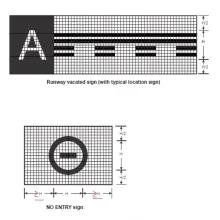
Your interpretation regarding the guidance signs inside airports, specifically concerning the lateral spaces or borders as mentioned in “Figure N-2G. No-entry sign” and “Figure N-3. Sign dimensions,” aligns well with regulatory standards for airport signage, particularly those set by the International Civil Aviation Organization (ICAO) and outlined in their Aerodrome Design Manual (A.D.M) Part 4.
According to the ICAO A.D.M Part 4, paragraph 12.2.6, the width of the lateral spaces or borders around the inscription on the sign is indeed to be considered as “at least” the specified measure, rather than a fixed dimension.
This means that the additional space at either end of the sign (referred to as “H” in the figures you mentioned) should be no less than 0.5 times the height of the inscription. It ensures clarity and visibility of the signage, making it easier for airport operators and users to interpret the signs correctly.
This approach to specifying minimum dimensions rather than fixed sizes allows for flexibility in sign design and manufacturing. It acknowledges the practicalities of producing signs, especially lighted ones, where exact lengths can vary based on the length of the inscription and the need for visibility and legibility.
Such a flexibility is crucial for manufacturers, allowing them to produce signs that meet regulatory requirements without the constraint of adhering to a specific length for every sign, which would indeed be technically unfeasible and unnecessarily restrictive.
Moreover, this interpretation is consistent across various editions of the UK CAP168, which further validates its applicability and acceptance in aviation standards.
In summary, your understanding that the lateral space specifications serve as minimum requirements rather than exact measurements is correct and in line with international regulatory standards for airport signage. This approach provides necessary flexibility for manufacturers while ensuring the signs are effective and compliant with safety and visibility criteria.
Regards,
Benjamin