The requirement for engine instruments (and their interfaces) are defined in the relevant certification specifications e.g., CS 23.2615 Flight, navigation, and powerplant instruments
https://www.easa.europa.eu/en/downloads/106158/en
or CS-VLA 1305 Powerplant instruments
https://www.easa.europa.eu/en/downloads/66874/en
Join your community
Join a community to be part of the discussion.
Michel MASSON created a topic in Rotorcraft
John FRANKLIN posted in Air Operations
Latest version of the EASA Easy Access Rules for Air Ops is now on line.
https://www.easa.europa.eu/en/newsroom-and-events/news/easa-updates-eas…
Vladimir FOLTIN commented on R. van Twisk's topic in General Aviation
R. van Twisk created a topic in General Aviation
Michel MASSON posted in General Aviation
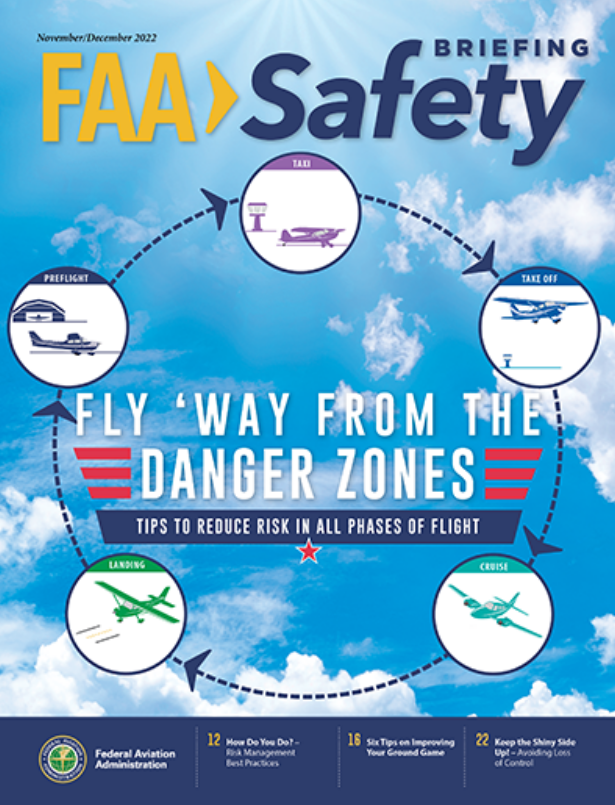
FAA Safety Briefing Magazine, Nov./Dec.2022 issue
https://www.faa.gov/newsroom/faa-safety-briefing-magazine
The Nov./Dec. 2022 issue of FAA Safety Briefing magazine explores tips and best practices that help pilots find ways to avoid the “danger zones” where accidents can occur.
Articles highlight system safety and risk management in the context of persistent accident factors during preflight; taxi; takeoff and departure; maneuvering flight; and approach and landing.
Michel MASSON commented on Michel MASSON's topic in Air Operations
Well thought, thanks, Tapani.
Michel MASSON posted in Rotorcraft
EASA and ESPN-R join HAI and the entire community to mark the passing of helicopter pioneer Frank Robinson, Nov 12, 2022
In expressing condolences to the Robinson family, Helicopter Association International president and CEO James Viola remembered Frank Robinson as an industry giant.
https://rotormedia.com/hai-marks-passing-of-helicopter-pioneer-frank-ro….
Article by Dan Sweet, HAI, Nov. 14
Image credit HAI's ROTORS archives
Patrick L posted in General Aviation
Hello,
after a recent discussion among peers I am trying to get some clarification on "Class Rating Questions".
In principle, there seems to be an illogical application of Class Ratings in the regulatory structure.
As the name beholds, a Class Rating pertains to a "Class" e.g. SEP or SET. In the case of SET, each type has been assigned a separate Class.
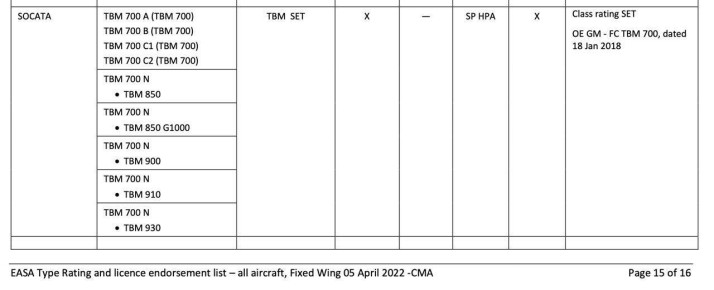
What is the legal basis within 1178/2011 or elsewhere that separates aircraft of the same class into individual ratings and requires differences training between Class Rating airplane variants (where no OSD exists) as defined in the "Type Rating and license endorsement list", see https://tinyurl.com/easaratings legally binding?
In other words I’m trying to establish wether mandatory differences training as per the "Type Rating and license endorsement list, 05 April 2022, CMA" between variants (as indicated by a horizontal line — is correct according to the law,
if the variants in question are
- not type rating aeroplanes
- no OSD exists
- all variants are the same TCDS.
Some excerpts (EASA document content in ""):
„The lists indicate if Operational Evaluation Guidance Material (OE GM) or Operational Suitability Data (OSD) flight crew are available, as described in Article 7a of Commission Regulation (EU) No 748/2012.“
>> Let's take, as an example, the TBM models. For TBM, no OSD exists. Only OE GM aka. „guidance material“ which is not legally binding.
„EASA type certificate data sheets (TCDSs) and the list of EASA supplemental type certificates contain further references to OSD. Complete current OSD information is held by the relevant type certificate (TC) or STC holder.
Furthermore, the lists provide aircraft-specific references relevant to flight crew qualifications and air operations.
FCL.010 ‘Definitions’ defines types of aircraft as follows:
‘type of aircraft’ means a categorisation of aircraft requiring a type rating as determined in the operational suitability data established in accordance with Annex I (Part-21) to Regulation (EU) No 748/2012 (OSD), and which includes all aircraft of the same basic design including all modifications thereto except those which result in a change in handling or flight characteristics.“
>> Not applicable to TBM as it is a Class Rating, not a Type Rating airplane.
„Aircraft class ratings
Aircraft class rating designations are incorporated within the lists.
Aircraft within a class rating are not individually listed, except for all aircraft within the class rating SET and for other aircraft with specific provisions.
Class rating ‘SET’ for single pilot (SP) single-engine (SE) turbo-prop aircraft
The class rating ‘SET’ for SP SE turbo-prop aircraft is established within the lists. All aircraft within the class rating SET are listed individually in the table. Aircraft are added to the class rating SET following EASA classification. Aircraft which had previously been designated as ‘SET’ by the Joint Aviation Authorities (JAA) under the provisions of JAR-FCL 1 are retained in the class rating ‘SET’ without further assessment.“
>> Ok, nice, but why? Legal basis for this "classification"?
„[…..] Finally, the lists indicate whether aircraft have been classified as variants. Flight crew type rating and variant designations are established by EASA through the OSD flight crew evaluation process and are only valid for the evaluated aircraft make and model.“
>> Where is it written in the law how aircraft variants are categorized if there is no OSD?
„Aircraft variants
1. Aircraft within class ratings
Aircraft within class ratings do not have associated OSD in accordance with Part-21. The ‘EASA type rating and licence endorsement lists — flight crew’ provide categories of class ratings — such as SEP, MEP, SET, etc.— and indicate aircraft which are considered as variants.
Aircraft within the same class rating which are separated by a horizontal line in the tables require differences training, whereas those aircraft which are contained in the same cell require familiarisation when transitioning from one aircraft to another
Refer to GM1 FCL.135.A; FCL.135.H DIFFERENCES AND FAMILIARISATION TRAINING:
(a) Differences training requires the acquisition of additional knowledge and training on an appropriate training device or the
aircraft."
>> What is the definition of „appropriate training device“?
"(b) Familiarisation requires the acquisition of additional knowledge.
All aircraft within the same class rating MEP or SET require differences training, unless indicated otherwise in the list."
>> Again, why?
Reason I am asking, particular regarding Class Rating "TBM SET" in this context:
The EASA "Type Ratings and Licence endorsements lists" assigns e.g the TBM 930, among other "trade names", to the entry for the TBM700N. The guidance material OE GM suggests that the only difference with, e.g. the TBM 940, lies in the Garmin avionics. The formal variant is “TBM 700 N”, and from a type certificate point of view, there's no such thing as a 930 or 940. It's just a marketing term. As the TBM 700 N is clearly defined as one variant within the TCDS, absent a defined OSD, should there even be a requirement for differences training. The published OE GM is optional.
Is it conceivable that dividing the various trade name "sub-variants" of the TBM 700 N in the endorsements list is a mistake?
And further, a familiarisation would be applicable? According Annex IV to the Basic Regulation (Essential Requirements for Aircrew), all pilot training requires a structured course with a syllabus. Hence the term "familiarisation training" was changed to "familiarisation", since the latter doesn't require a structured course with a syllabus.
Add on question:
Regarding the revalidation of Class Rating Instructor ratings, e.g. for an instructor holding CRI SEP and CRI TBM SET, is it sufficient to meet the revalidation criteria for either SEP vs. SET, or must it be met separately for each?
Thanks in advance for your input!
Best regards,
Patrick
Michel MASSON created a topic in Air Operations
Paul Francis commented on a post in Air Operations
Interesting findings from #EASA's survey on Standard Passenger Weights. Who would have thought male passengers take more carry-on luggage 😉! Find out more here:
https://www.easa.europa.eu/en/newsroom-and-events/news/easa-review-stan…
Interesting, I had a look at this as my project back when I was doing my BSc.
I seem to recall my average weights (of UK adult population, not passengers) was around 84 kg then.
Baseline conclusion was not so much fuel or MTOW exceedance - more CS 25.562 Emergency landing dynamic conditions..... especially as it had been changed and one of the criteria (HIC) was to accommodate tall people - who would likely weigh more than the 77kg anthropomorphic dummy specified.
Nazariy Harvat Shchesniy created a topic in Air Operations
John FRANKLIN posted in Air Operations
Interesting findings from #EASA's survey on Standard Passenger Weights. Who would have thought male passengers take more carry-on luggage 😉! Find out more here:
https://www.easa.europa.eu/en/newsroom-and-events/news/easa-review-stan…
Raul Moyo commented on Raul Moyo's topic in General Aviation
Dear Vladimir,
Many thanks for your answer. I want to take the opportunity to discuss with you if that make sense or not:
For me it doesn't meke sense because the BASA TIP-L allow to convert in easy way the FAA PPL License if your FAA license is issued BEFORE May 2021, them you only need a currency of ratings (pag 14 TIP-L) but if your FAA licenses is issued AFTER May 2021 them you have to go through Delegated Regulation (EU) 2020/723 which means that you need to pass 2 theory exams and hold 100 hrs TT.
So a person with an old license (Before May 2021) can take advantage of the BASA but a new one (after May 2021) only can take advantage if they convert immediately after obtaining the license and ratings.
Even so, my understanding about the TIP-L, 2.1.3, c) is that the ratings have the validity marked there, but RATINGS not LICENSES. A License should be able to convert via BASA regardless if your FAA PPL was issued before or after May 2021.
May be I'm wrong this is why I will appreciate your comments.
Kind regards.
Michel MASSON commented on Michel MASSON's topic in Rotorcraft
To complete this exchange, here is the link to the Manual and accompanying article:
https://www.easa.europa.eu/community/topics/maintenance-check-flights
Mathieu VANDENAVENNE commented on John FRANKLIN's topic in Air Operations
I wrote this article for Air Rescue Mag, in 2013, about the means of protection for helicopter pilots. The full magazine can be ordered here: https://www.rettungsdienst-shop.de/produkt/airrescue-magazine-safety/
Ana Fonseca posted in General Aviation
Recommended NAA for aircraft registration
Hello to all members,
Based on your own experience, can you tell which are the best NAA to work with?
I'll need to register several light aircrafts and I'm looking for a NAA, with clear procedures available online and easy communication.
Usually I work with LBA but I've heard that their response time to new registrations has increased a lot due to high demand on their services.
Thank you!
John FRANKLIN created a topic in Air Operations
Hannes Voß commented on tom.kaidalov1@gmail.com's topic in General Aviation
I can only agree with the previous commentator.
I myself have been an insulin-dependent type 1 diabetic for 20 years and have been very well controlled for many years.
Above all, the technical possibilities, such as AID systems, which algorithmically deliver insulin via insulin pumps based on continuous glucose monitoring in order to achieve an optimal glucose concentration in the blood, should be included in a reassessment.
A petition is currently being addressed to EASA to raise awareness of the problems associated with flying with type 1 diabetes (https://www.change.org/p/easa-fightforflight-t1d-pilots-with-type-1-dia…).
Michel MASSON posted in Rotorcraft
ESPN-R Safety Promotion Video of the Year and Workshop at EUROPEAN ROTORS,
Nov. 8 and 9, 2022
EASA T4S Rotorcraft Safety Promotion Video of the Year Wearing Helmet with Mathieu Vandenavenne, Safety for Flight, film director and actor, will be released in the EASA Rotorcraft & VTOL Symposium on Day 1, Nov. 8, from15:15 to 15:30.
https://www.europeanrotors.eu/en/e/opening-helicopter-session-day-1.264….
ESPN-R Safety Promotion Network Workshop will then take place on Day 2, Nov. 9, from 15:00 to 17:00. Topic of the Year is IIMC aka UIMC.
https://www.europeanrotors.eu/en/e/vtol-session-day-2.24516.
Thanks for spreading the word.
Looking forward to me meeting you there!
PS: Good news: there is still time to register.
tom.kaidalov1@gmail.com created a topic in General Aviation