Filters
Annex I to AMC1 Article 11
ED Decision 2025/018/R
GLOSSARY OF TERMS
Term | Acronym | Definition |
I.1.Abnormal situation | A situation in which it is no longer possible to continue the flight using normal procedures. | |
I.2.Acceptable risk | The level of risk that individuals or groups are willing to accept given the benefits gained. Each organisation will have its own acceptable risk level, which is derived from its legal and regulatory compliance responsibilities, its threat profile, and its business/organisational drivers and impacts. | |
I.3.Adequate | Whatever is necessary or sufficient for a specific requirement. | |
I.4.Adjacent airspace | The airspace adjacent to the operational volume. See Section S.2.2.6 of AMC1 Article 11. | |
I.5.Adjacent ground area | The ground area adjacent to the ground risk buffer. See also Section S.2.2.5 of this AMC (SORA Main Body). | |
I.6.Aerodrome | A defined area (including any buildings, installations and equipment), on land or on water, on a fixed, fixed offshore or floating structure, including any buildings, installations and equipment thereon, intended to be used either wholly or in part for the arrival, departure and surface movement of aircraft. | |
I.7.Aerodrome environment | The aerodrome environment is normally protected by the Member State through the creation of a geographical zone defined according to Article 15 of Implementing Regulation (EU) 2019/947. The aerodrome environment in the SORA context is generally defined as: (a)class A, B, C, D or E controlled airspace which touches the surface with an aerodrome and/or controlled airspace which does not touch the surface, but in connection to an aerodrome (normally depicted on aeronautical charts and sectionals); or (b)any TMZ in class A, B, C, D or E controlled airspace. | |
I.8.Aeronautical information publication | AIP | A publication issued by or with the authority of a State and containing aeronautical information of a lasting character essential to air navigation. |
I.9.Air risk class | ARC | The ARC is an initial assignment of generic collision risk of airspace before mitigations are applied. The ARC is assigned to airspace encounter categories (AECs) based on a qualitative assessment of collision risk of generic types of airspace. |
I.10. Aircraft | a/c | Any machine that can derive support in the atmosphere from the reactions of the air other than the reaction of the air against the earth’s surface. |
I.11.Airframe | The fuselage, booms, nacelles, cowlings, fairings, air foil surfaces (including rotors but excluding propellers and rotating air foils of engines) and landing gear of an UA, and their accessories and controls. | |
I.12. Airspace encounter category | AEC | The AEC is a qualitative classification of the probability that a UAS would encounter a manned aircraft in typical civil airspace found in the U.S. and Europe. The airspace encounter risk is grouped by operational altitude, airport environment, controlled airspace, uncontrolled TMZ airspace, and in uncontrolled airspace over rural and/or urban populations. The AEC is based on the assessment of the proximity (the more aircraft in the airspace, the higher the rate of proximity, the greater the risk of collision), geometry (an airspace structure which reduces the probability that an aircraft finds itself on collision courses), and dynamics (in general, the faster the speed of the aircraft in the airspace, the greater the number of collision risks over a set time). Airspace where there is a higher density of manned aircraft, few airspace structural controls, and high aircraft closing speeds will experience higher airspace encounter rates than in airspace where there is low density, high airspace structure and slow speeds. |
I.13. Airspace observer | AO | Means a person who assists the remote pilot by performing unaided visual scanning of the airspace in which the unmanned aircraft is operating for any potential hazard in the air. (Article 2(25) of Implementing Regulation (EU) 2019/947) |
I.14. Airworthiness | The condition of an item (aircraft, aircraft system, or part) in which that item operates in a safe manner to accomplish its intended function. | |
I.15. Applicant | An individual or an organisation that desires to operate a UAS in a limited or restricted manner and submits the necessary technical, operational and human information related to the intended use of the UAS to the competent authority. See also Section S.2.5(b) of this AMC (SORA Main Body). | |
I.16. Assemblies of people | Means gatherings where persons are unable to move away due to the density of the people present. (Article 2(3) of Implementing Regulation (EU) 2019/947) | |
I.17. Assurance | The level of verification required by the competent authority prior to granting an approval. All the integrity requirements must still be fulfilled by the UAS operator, but the verification of the implementation can happen before the approval is granted or after in auditing. | |
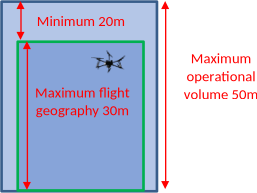
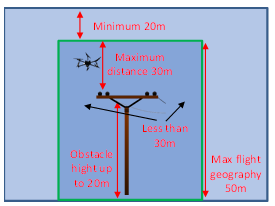
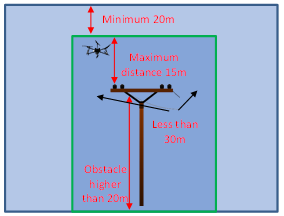
I.18. Atypical air environment | Airspace where the risk of collision between a UAS and manned aircraft is acceptably low. Examples are: (a)restricted airspace or segregated areas; (b)airspace where normally manned aircraft should not be present (e.g. at a height low enough or close to an obstacle, excluding those potential landing sites for manned aircraft, see examples below)81;
(c)airspace not covered in airspace encounter categories (AECs) 1 through 11. | |
I.19. Authority | The organisation responsible within the State concerned with the certification of compliance with applicable requirements. | |
I.20. Authorisation | The permit granted to a UAS operator by a competent authority. | |
I.21. Automatic system | Any system in which the remote crew is supported by mechanised or computerised components executing predefined processes. | |
I.22. Autonomous UA | Means an operation during which an unmanned aircraft operates without the remote pilot being able to intervene. (Article 2(17) of Implementing Regulation (EU) 2019/947) | |
I.23. Barrier | A material object or set of objects that separates, demarcates or serves as a barricade; or something immaterial that impedes or separates. Both physical and non-physical barriers are utilised and applied in hazard control, i.e. anything used to control, prevent or impede unwanted adverse energy flow and/or anything used to control, prevent or impede unwanted event flow. | |
I.24.Beyond visual line of sight operation | BVLOS | Means a type of UAS operation which is not conducted in VLOS. (Article 2(8) of Implementing Regulation (EU) 2019/947) |
I.25.Beyond visual line of sight operation with airspace observers | BVLOS with AOs | A UAS operation whereby the remote pilot maintains uninterrupted situational awareness of the airspace in which the UAS operation is being conducted via visual airspace surveillance through one or more airspace observers, possibly aided by technological means. The remote pilot-in-command (RPIC) has direct control of the UAS at all times. |
I.26.Catastrophic | Failure condition that could result in one or more fatalities. | |
I.27.Certification | The legal recognition based on an appropriate assessment that a product, part, service, organisation or person complies with the applicable requirements through the issuance of a certificate, licence, approval or other documents as required by national laws and procedures, attesting such compliance. | |
I.28.Civil aircraft | Aircraft other than public/State or military aircraft. | |
I.29.Collision avoidance | Averting physical contact between an aircraft and any other object or terrain. | |
I.30.Command and control link | C2 link | Means the data link between the UA and the CMU for the purpose of managing the flight. (Article 2(27) of Implementing Regulation (EU) 2019/947) |
I.31.Commercial off-the-shelf | COTS | Components designed to be implemented into existing systems without extensive customisation and for which design data is not always available to the customer. |
I.32.Competent authority | The authority responsible to assess the safety measures proposed by the UAS operator for a safety operation, following a specific operations risk assessment (SORA) and issuing the operational authorisation. See also Section S.2.5(e) of this AMC (SORA Main Body). | |
I.33.Compliance | Successful performance of all mandatory activities; agreement between the expected or specified result and the actual result. | |
I.34.Component | Any self-contained part, combination of parts, subassemblies or units, which perform a distinct function necessary to the operation of the system. | |
I.35.Configuration | The requirements, design and implementation that define a particular version of a system or system component. | |
I.36.Configuration control/management | The process of evaluating, approving or rejecting, and coordinating changes to configuration items after the formal establishment of their configuration identification. | |
I.37.Conformity | Aircraft or parts checked against design documents for correctness. | |
I.38.Contingency area | Means the projection of the contingency volume on the surface of the earth. (Article 2(31) of Implementing Regulation (EU) 2019/947) | |
I.39.Contingency procedures | Planned course of action designed by the organisation to respond effectively to a future event or abnormal situation that may or may not happen. It includes procedures executed by the remote pilot, or by the UA in case of autonomous flights, to return to normal operations or allow the safe cessation of the flight. | |
I.40.Contingency volume | Means the volume of airspace outside the flight geography where contingency procedures described in point (6)(d) of Appendix 5 to the Annex are applied. (Article 2(30) of Implementing Regulation (EU) 2019/947) See also Section S.2.2.3 of this AMC (SORA Main Body). | |
I.41.Control and monitoring unit | CMU | Means the equipment to control and monitor unmanned aircraft remotely as defined in point (32) of Article 3 of Regulation (EU) 2018/1139. (Article 2(26) of Implementing Regulation (EU) 2019/947) |
I.42.Controlled airspace | Airspace class A, B, C, D and E. Airspace of defined dimensions within which air traffic control service is provided in accordance with the airspace classification. Controlled airspace does not imply that separation services are provided at all times. Classes A, B, C, D and E are described in ICAO Annex 11, and in ICAO Annex 2 Section 6. | |
I.43.Controlled ground area |
| Means the ground area where the UAS is operated and within which the UAS operator can ensure that only involved persons are present. (Article 2(21) of Implementing Regulation (EU) 2019/947) Note: the concept of controlled ground area is applicable also for UAS operations over water surfaces. |
I.44.Cooperative aircraft | Aircraft that have an electronic means of identification (i.e. a transponder) aboard and operating. | |
I.45.Critical (function) | A function whose loss would prevent the continued safe flight and landing of the UA thereby causing a significant increase in the safety risk to third parties and/or the environment involved. | |
I.46.Critical area | The ground area where persons would be expected to be impacted by the UA in the event of a loss of control of the operation or an unplanned landing. | |
I.47.Critical infrastructure | Means systems and assets vital to national defence, national security, economic security, public health or safety including both regional and national infrastructure. | |
I.48.Critical systems | Systems required for the operation to perform one or more critical functions. | |
I.49.Criticality | The degree of impact a malfunction has on the operation of a system. | |
I.50.Danger area | A danger area is airspace of defined dimensions within which activities dangerous to the flight of aircraft may exist at specified times. | |
I.51.Data link | A term referring to all interconnections to, from and within the UAS. It includes control, flight status, communication and payload links. | |
I.52.Demonstration | A method of proof of performance by observation. | |
I.53.Detect and avoid | DAA | The capability to see, sense or detect conflicting traffic or other hazards and take the appropriate action to comply with the acceptable rules of flight. |
I.54.Emergency recovery capability | A UAS safety feature (e.g. return-to-home) that provides for the cessation of the UA operation in a manner that minimises the risk to persons on the ground, other airspace users and critical infrastructure. | |
I.55.Emergency procedures | Planned course of action designed by the UAS operator to respond effectively to an emergency condition. They deal with controlling the aircraft to either return to a state where the operation is ‘in control’ or to minimise hazards until the flight has ended. It includes procedures that are executed by the remote pilot or by the UA itself. See also Section S.2.3.2(d) of this AMC (SORA Main Body). | |
I.56.Emergency response plan | ERP | Plan of actions to be conducted in a certain order or manner, in response to an emergency event. For additional information, please refer to Section S.2.3.2(e) of AMC1 Article 11. |
I.57.Environment | (a)The aggregate of operational and ambient conditions to include the external procedures, conditions and objects that affect the development, operation and maintenance of a system. Operational conditions include traffic density, communication density, workload, etc. Ambient conditions include weather, EMI, vibration, acoustics, etc.; and (b)Everything external to a system which can affect or be affected by the system. | |
I.58.Equipment | A complete assembly operating either independently or within a system/subsystem that performs a specific function. | |
I.59.Failure | The loss of a function or the malfunction of a system or a part of it. It should be understood as an occurrence that affects the operation of a component, part or element such that it can no longer function as intended. Errors may cause failures but are not considered failures. Some structural or mechanical failures may be excluded from the criterion if it can be shown that these structural or mechanical parts were designed according to aviation industry best practices. | |
I.60.Failure mode | The way in which the failure of an item occurs. | |
I.61.Fixed-wing UA | It includes configurations such as aeroplanes, kites, gliders, etc. | |
I.62.Flight geography | Means the volume(s) of airspace defined spatially and temporally in which the UAS operator plans to conduct the operation under normal procedures described in point (6)(c) of Appendix 5 to the Annex. (Article 2(28) of Implementing Regulation (EU) 2019/947) See also Section S.2.2.2 of this AMC (SORA Main Body). | |
I.63.Flight termination system | FTS | Procedure or function which aims to immediately end the flight. |
I.64.Fly-away | A condition due to loss of control of the operation, where the UAS is leaving the operational volume and it is not possible to regain control of the UA with none of the normal, contingency or emergency procedures being effective. | |
I.65.Functional test based | FTB | An approach to demonstrate compliance with some OSOs, as defined in Section 3 of Annex E to this AMC. |
I.66.Geo-awareness | Means a function that, based on the data provided by Member States, detects a potential breach of airspace limitations and alerts the remote pilots so that they can take immediate and effective action to prevent that breach. (Article 2(15) of Implementing Regulation (EU) 2019/947) | |
I.67.Geo-caging | An automatic function that helps the remote pilot to maintain the UAS within the defined overall volume (a ‘cage’). | |
I.68.Geo-fencing | An automatic function for preventing the UA from entering a prescribed volume. | |
I.69.Ground risk buffer | An area over the surface of the earth, which surrounds the operational volume and that is specified in order to minimise the risk to third parties on the surface in the event of the unmanned aircraft leaving the operational volume. (Article 2(33) of Implementing Regulation (EU) 2019/947) See also Section S.2.2.4 of this AMC (SORA Main Body). | |
I.70.Handover | The act of passing command and control from one control and monitoring unit to another. | |
I.71.Hazard | A potentially unsafe condition resulting from failures, external events, errors, or a combination of these. | |
I.72.Height | The vertical distance of a level, a point or an object considered as a point, measured from a specified datum. | |
I.73.Human error | Human action with unintended consequences. | |
I.74.Human factors | HF | Factors affecting human performance and referring to principles that apply to aeronautical design, certification, training, operations and maintenance, and that seek safe interfaces between the human and other system components by proper consideration to human performance. |
I.75.Human factors principles | Principles which apply to aeronautical design, certification, training, operations and maintenance, and that seek safe interface between the human and other system components by proper consideration to human performance. | |
I.76.Initial air risk class | Initial ARC | Initial classification of the airspace where UAS operations are intended to be performed before risk mitigations are applied. |
I.77.Intrinsic ground risk class | iGRC | Initial classification of the ground risk before ground mitigations are applied. |
I.78.Intrinsic ground risk class footprint | iGRC footprint | The projection of the operational volume plus ground risk buffer on the surface of the earth. |
I.79.Incident | An occurrence other than an accident that affects or could affect the safety of operations. | |
I.80.Industry standard | A published document established by consensus and approved by a recognised body that sets out specifications and procedures to ensure that a material, product, method or service meets its purpose and consistently performs to its intended use. Standards are industry-developed standards that define minimum safety and performance requirements of an acceptable product or a means of compliance to specific requirements. | |
I.81.Inspection | An examination of an item against a specific standard. | |
I.82.Integrated airspace | IA | Integrated airspace is considered 500 ft AGL up to VHL airspace (≈FL600) and any airspace where manned aircraft will operate below 500 ft AGL for take-off and landing. It is airspace where UAS are expected to conform and comply with the existing manned aircraft operating rules, procedures and equipment. |
I.83.Integrity | Attribute of a system or an item indicating that it can be relied upon to work as expected. | |
I.84.Involved person | A person directly involved with the operation of the UAS or is fully aware that the UAS operation is being conducted near them. Involved persons are fully aware of the risks involved with the UAS operation and have accepted these risks. The UAS operator informs involved persons of the risks and provides training in the relevant emergency procedures and/or contingency plans. | |
I.85.Loss of control of the operation | A situation —whose outcome heavily relies on providence; or —which cannot be handled by a contingency procedure. | |
I.86.Lost C2 link (loss of data link) | The loss of the command-and-control link contact with the UA such that the remote pilot can no longer intervene in the UA’s flight control. | |
I.87.Maintenance | The inspection, overhaul, repair, preservation and/or replacement of parts. | |
I.88.Malfunction | The occurrence of a condition whereby the UAS operation is outside specified limits. | |
I.89.Maximum take-off mass | MTOM | Means the maximum unmanned aircraft mass, including payload and fuel, as defined by the manufacturer or the builder, at which the unmanned aircraft can be operated. (Article 2(22) of Implementing Regulation (EU) 2019/947) |
I.90.Mid-air collision | MAC | An accident where two aircraft come into contact with each other while both are in flight. |
I.91.Minimum aviation system performance standard | MASPS | A MASPS specifies the characteristics that should be useful to UAS designers, installers, service providers and users of systems intended for operational use within a defined volume. Where the systems are global in nature, the system may have international applications that are taken into consideration. The MASPS describes the system (subsystems/functions) and provides information needed to understand the rationale for system characteristics, operational goals, requirements and typical applications. Definitions and assumptions essential to the proper understanding of the MASPS are provided as well as minimum system test procedures to verify system performance compliance (e.g. end-to-end performance verification). |
I.92.Mitigation | A means to reduce the risk of a hazard. | |
I.93.Minimum operational performance specification | MOPS | A MOPS provides standards for specific equipment that are useful to UAS designers, installers and users of the equipment. The word ‘equipment’ used in a MOPS includes all components and units necessary for the system to properly perform its intended function(s). The MOPS provides the information needed to understand the rationale for the equipment characteristics and the requirements stated. The MOPS describes typical equipment applications and operational goals and establishes the basis for required performance under the standard. Definitions and assumptions essential to the proper understanding are provided as well as installed equipment tests and operational performance characteristics for equipment installations. |
I.94.Multiple simultaneous UAS operations | MSO | UA operations where multiple UA are under a common (centralised) flight management and the individual UA either: —operate relative to each other under the common flight management (e.g. formation flights with a swarm of UAS performing displays for entertainment); or —operate independently of each other under the common flight management. |
I.95.National aviation authority | NAA | Also referred to as ‘civil aviation authority’, is a government statutory authority in each Member State that issues the operational authorisation and conduct the oversight if the UAS operator. |
I.96.Night | ‘Night’ means the hours between the end of evening civil twilight and the beginning of morning civil twilight as defined in Implementing Regulation (EU) No 923/2012. (Article 2(34) of Implementing Regulation (EU) 2019/947) Note: Civil twilight ends in the evening when the centre of the sun’s disc is 6 degrees below the horizon and begins in the morning when the centre of the sun’s disc is 6 degrees below the horizon. | |
I.97.Normal procedure | A set of instructions covering those features of operations which lend themselves to a definite or standardised procedure without loss of effectiveness. | |
I.98.Operation out of control | An operation unintentionally being conducted outside the limits approved in the authorisation. | |
I.99.Operational life | It is defined by the UAS designer as the maximum flight hours and/or cycles a UAS operator should use the UAS while continuously conforming with the maintenance design requirements. | |
I.100.Operations manual | OM | A manual containing procedures, instructions and guidance for use by operational personnel in the execution of their duties. Annex A to this AMC illustrates an example for its content. |
I.101.Operational volume | Is the combination of the flight geography and the contingency volume. (Article 2(32) of Implementing Regulation (EU) 2019/947) See also Section S.2.2.1 of this AMC (SORA Main Body). | |
I.102.Parachute | A device used or intended to be used to retard the fall of a body or object through the air. | |
I.103.Population density | The number of people living per unit of an area (e.g. per square mile or square kilometre). | |
I.104.Procedure | Standard, detailed steps that prescribe how to perform specific tasks. | |
I.105.Process | A set of interrelated resources and activities, which transform inputs into outputs. | |
I.106.Qualification | A process through which a State / competent authority / applicant ensures that a specific implementation satisfies the applicable requirements with an adequate level of confidence. | |
I.107.Quantification | The act of assigning a numerical value to or measuring the probability that a specific event will occur. | |
I.108.Reliability | The probability that an item will perform a required function under specified conditions, without failure, for a specified period of time. | |
I.109.Remote crew member | A member of the crew that performs duties essential to the safety of flight and whose duties and responsibilities have been assigned to them by the UAS operator. It may include the remote pilot-in-command (RPIC), airspace observers (AOs) and UA observers, maintenance staff, launch and recovery system operators etc.. | |
I.110.Remote pilot (in command) | RPIC | A person, nominated by the UAS operator, responsible for the safe conduct of the flight of a UA by operating its flight controls either manually or, when the UA flies automatically, by monitoring its course and remaining able to intervene and change the UA course at any time. |
I.111.Risk | The combination of the frequency (probability) of an occurrence and its associated level of severity. | |
I.112.Risk analysis | The development of qualitative and/or quantitative estimate of risk based on evaluation and mathematical techniques. | |
I.113.Risk assessment | The process by which the results of a risk analysis are used to make decisions. | |
I.114.Risk estimation | The combination of the consequences and likelihood of the hazard. | |
I.115.Risk ratio | The ratio between a conditional probability with a mitigating system, divided by a conditional probability without a mitigating system. An example of conditional probability is the chance that, given an encounter, a potential mid-air collision occurs. A relative risk measure, which compares the probability of an event in a non-mitigated scenario to the probability of the same event in a mitigated scenario. | |
I.116.Robustness | Means the property of mitigations resulting from combining the safety gain provided by the mitigations and the level of assurance and integrity that the safety gain has been achieved. (Article 2(5) of Implementing Regulation (EU) 2019/947) | |
I.117.Rotorcraft-helicopter UA | It includes all vertical-lift UA configurations having up to 2 rotors. | |
I.118.Rural air volume | In the context of air risk, it is the volume not defined as urban environment and is not within the aerodrome traffic zone (ATZ) of an airport. | |
I.119.Safety | The state in which the risk of harm to persons or property on the ground or water surface is reduced to, and maintained at or below, an acceptable level through a continuing process of hazard identification and risk management. | |
I.120.Safety objective | A measurable goal or desirable outcome related to safety. | |
I.121.Safety risk | The composite of predicted severity and likelihood of the potential effect of a hazard. | |
I.122.See and avoid | S&A | The requirement for the pilot of an aircraft to ‘see’ and ‘avoid’ a collision, and to remain well clear of other aircraft in accordance with 14 CFR 91.113, SERA.3201, and ICAO Annex 2 Section 3.2. |
I.123.Segregated airspace | Airspace of specified dimensions allocated for exclusive use to a specific user(s). | |
I.124.Sense and avoid | SAA | See, detect and avoid. |
I.125.Separation | Maintaining a specific minimum distance between two or more aircraft or between aircraft and terrain to avoid collisions, normally by requiring aircraft to fly at set levels or level bands, on set routes or in certain directions, or by controlling an aircraft’s speed. | |
I.126.Severity | The consequence or impact of a hazard’s effect or outcome in terms of degree of loss or harm. | |
I.127.Sheltering | Expected protection of people from the UA in case it crashes into a building or a structure. | |
I.128.Specific operations risk assessment | SORA | A methodology to guide both the UAS operator and the competent authority in determining whether a UAS operation can be conducted in a safe manner. |
I.129.‘Specific’ category | A UAS operation category where a proportionate approach to the assessment of the risk will be taken by requiring the UAS operator to present a specific operations risk assessment (SORA) of the UAS operation before operational authorisation is granted by the competent authority. | |
I.130.Standard operational procedure | SOP | A set of instructions covering those features of operations which lend themselves to a definite or standardised procedure without loss of effectiveness. |
I.131.Standard scenario | STS | A description of a type of UAS operation for which a specific operations risk assessment (SORA) has been conducted and on the basis of which mitigations have been proposed that are deemed acceptable by the competent authority. The use of a standard scenario greatly simplifies and expedites the application process for both the UAS operator and the competent authority. |
I.132.Strategic conflict mitigation | A set of procedures aimed at reducing the UAS encounter probability prior to UAS take-off. Strategic mitigation is about controlling or mitigating risks by reducing local aircraft density or time of exposure of an individual UAS. Strategic mitigations tend to take the form of operational restrictions of time or space. Strategic mitigations do not fulfil the 14 CFR 91.113, SERA.3201, or ICAO Annex 2 Section 3.2 ‘see and avoid’ requirement. (Examples of strategic mitigation: an operational restriction to fly between the hours of 10PM and 3AM; operational restriction to stay below 500 ft AGL; operational restriction to stay within 1 mile of a geographic location; etc.) Strategic mitigation traces to the strategic layer of ICAO’s conflict management concept. | |
I.133.System | A combination of interrelated items arranged to perform a specific function or specific functions. | |
I.134.System safety | System safety is a specialty within system engineering that supports programme risk management. It is the application of engineering and management principles, criteria and techniques to optimise safety. The goal of system safety is to optimise safety through the identification of safety-related risks, eliminating or controlling them through design and/or procedures, based on acceptable system safety precedence. | |
I.135.Tactical conflict mitigation | The act of mitigating collision risk over a very short time horizon (minutes to seconds). Tactical mitigations take the form of SDAF loops (see, decide, action and feedback loop). Tactical mitigation systems operate using a sensor to ‘see’ the threat, ‘deciding’ how to mitigate the risk, ‘acting’ on the decision, and then having a feedback system in order to monitor the risk and implement new corrections if needed. Tactical mitigation may fulfil the 14 CFR 91.113, SERA.3201 and ICAO Annex 2 Section 3.2 ‘See and Avoid’ requirement (examples of tactical mitigation: TCAS, ATC, ACAS, MIDCAS, DAA, ABSAA, GBSAA, see and avoid, etc.). Tactical mitigation traces to the separation requirements and collision avoidance layers of the ICAO’s conflict management concept. | |
I.136.Testing | The process of operating a system under specified conditions, observing or recording the results, and making an evaluation of some aspects of the system. | |
I.137.Third party | A party that derives no economic benefit and has no control over the risk associated with the UAS operation. | |
I.138.Threat | An occurrence that in the absence of appropriate threat barriers can potentially result in a hazard. | |
I.139.Total system error | All errors impacting the position of the UA. It includes the accuracy of the navigation solution, the flight technical error of the UAS, as well as the path definition error (e.g. map error) and latencies. Errors are usually determined by the interaction of several contributes, such as positioning sensors providing position, navigation and flight control systems, system and human latencies, and environment. | |
I.140.Transponder mandatory zone | TMZ | Airspace of defined dimensions in which the carriage and operation of pressure-altitude reporting transponders is mandatory. |
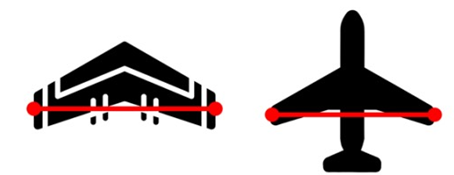
I.141.UA characteristic dimension | UA CD | The width of the UA in the direction transversal to the direction of flight (refer to Annex F Edition 2.5, critical area). For example: —for fixed-wing UA, regardless of the number of planes, including hybrid configurations, the UA characteristic dimension is the wingspan;
—for rotorcraft UA (e.g. helicopters or gyroplanes), the UA characteristic dimension is the diameter of the main rotor;
—for VTOL-capable aircraft (VCA), such as multicopters, the UA characteristic dimension is defined by the maximum distance (i.e. the diagonal distance) between the blade tips.
|
I.142.UAS flight manual | Sometimes also referred to as ‘manufacturer’s instructions’, it is a manual developed by the designer of the UAS, containing limitations within which the aircraft is to be considered airworthy, and instructions and information necessary to the flight crew members for the safe operation of the aircraft. | |
I.143.UAS traffic management (UTM) | UTM | A specific aspect of air traffic management which manages UAS operations safely, economically and efficiently through the provision of facilities and a seamless set of services in collaboration with all parties and involving airborne and ground-based functions. In Europe, it is referred to as ‘U-space’. |
I.144.UAS component design and production organisation | The organisation designing and producing a component to be installed on a UAS (e.g. a parachute). It is also responsible for carrying out the test, check compatibility and interface with the UAS models listed in the component instructions manual. | |
I.145.UAS component installer | The organisation responsible for installing a component (e.g. a parachute) on a UAS model listed in the component instructions manual, using the procedure defined in the same manual. Depending on the level of integration of the component, the component installer may be the UAS operator or in some cases the UAS production organisation or the organisation designated by them. | |
I.146.UAS operation | It may consist in one or multiple flights, even in different locations and with different purposes, conducted with a UAS with the same features, characterised by the same final air risk, final ground risk, SAIL score, ground and air risk mitigations and containment level. | |
I.147.UAS operator | Means any legal or natural person operating or intending to operate one or more UAS. (Article 2(2) of Implementing Regulation (EU) 2019/947) See also Section S.2.5(c) of this AMC. | |
I.148.Uncontrolled airspace | For the purpose of this assessment, uncontrolled airspace is that defined as class G airspace. | |
I.149.Uninvolved persons | Means persons who are not participating in the UAS operation or who are not aware of the instructions and safety precautions given by the UAS operator. (Article 2(18) of Implementing Regulation (EU) 2019/947) | |
I.150.Unmanned aircraft | UA | Means any aircraft operating or designed to operate autonomously or to be piloted remotely without a pilot on board. (Article 3(30) of Regulation (EU) 2018/1139) |
I.151.Unmanned aircraft system | UAS | Means an unmanned aircraft, as defined in Article 3(30) of Regulation (EU) 2018/1139, and its control and monitoring unit. (Article 2(1) of Implementing Regulation (EU) 2019/947) |
I.152.Urban air volume | In the context of air risk, it is the volume above a town or a city, starting from the ground, where there is a higher probability that air operations (with or without pilots on board) may take place for several purposes (e.g. aerial work, delivery, transport, emergency, etc.). | |
I.153.U-space | The UAS traffic management (UTM) concept defined in Europe through Implementing Regulation (EU) 2021/664. | |
I.154.Verified | A term used to describe controls / safety requirements that are objectively determined to have been met. | |
I.155.Very high-level airspace | VHL airspace | Airspace from FL600 and above. The altitude of FL600 is not a hard value, but an initial value used in this assessment as a starting point for discussion. It may be adjusted by the regulatory authorities as needed. UAS operating in VHL airspace may have to comply with operating rules, procedures and equipment not yet identified. VHL airspace is airspace where manned aircraft operations are very infrequent. |
I.156.Very low-level airspace | VLL airspace | Airspace from ground level to 500 ft AGL. The altitude of |
I.157.Visual line of sight operation | VLOS operation | Means a type of UAS operation in which the remote pilot is able to maintain continuous unaided visual contact with the unmanned aircraft, allowing the remote pilot to control the flight path of the UA in relation to other aircraft, people and obstacles for the purpose of avoiding collisions. (Article 2(7) of Implementing Regulation (EU) 2019/947) |
I.158.VTOL-capable UA | It includes vertical-lift UA configurations with 3 or more rotors and fixed-wing aircraft capable of vertically taking off and landing. It includes multirotor UA. |