
Filters
Cover Regulation to Implementing Regulation (EU) 2019/947
COMMISSION IMPLEMENTING REGULATION (EU) 2019/947
of 24 May 2019
on the rules and procedures for the operation of unmanned aircraft systems
Regulation (EU) 2019/947
THE EUROPEAN COMMISSION,
Having regard to the Treaty on the Functioning of the European Union,
Having regard to Regulation (EU) 2018/1139 of the European Parliament and of the Council of 4 July 2018 on common rules in the field of civil aviation and establishing a European Union Aviation Safety Agency, and amending Regulations (EC) No 2111/2005, (EC) No 1008/2008, (EU) No 996/2010, (EU) No 376/2014 and Directives 2014/30/EU and 2014/53/EU of the European Parliament and of the Council, and repealing Regulations (EC) No 216/2008 and (EC) No 552/2004 of the European Parliament and of the Council and Council Regulation (EEC) No 3922/915, and in particular Article 57 thereof,
Whereas:
(1)Unmanned aircraft, irrespective of their mass, can operate within the same Single European Sky airspace, alongside manned aircraft, whether airplanes or helicopters.
(2)As for manned aviation, a uniform implementation of and compliance with rules and procedures should apply to operators, including remote pilots, of unmanned aircraft and unmanned aircraft system (‘UAS’), as well as for the operations of such unmanned aircraft and unmanned aircraft system.
(3)Considering the specific characteristics of UAS operations, they should be as safe as those in manned aviation.
(4)Technologies for unmanned aircraft allow a wide range of possible operations. Requirements related to the airworthiness, the organisations, the persons involved in the operation of UAS and unmanned aircraft operations should be set out in order to ensure safety for people on the ground and other airspace users during the operations of unmanned aircraft.
(5)The rules and procedures applicable to UAS operations should be proportionate to the nature and risk of the operation or activity and adapted to the operational characteristics of the unmanned aircraft concerned and the characteristics of the area of operations, such as the population density, surface characteristics, and the presence of buildings.
(6)The risk level criteria as well as other criteria should be used to establish three categories of operations: the ‘open’, ‘specific’ and ‘certified’ categories.
(7)Proportionate risks mitigation requirements should be applicable to UAS operations according to the level of risk involved, the operational characteristics of the unmanned aircraft concerned and the characteristics of the area of operation.
(8)Operations in the ‘open’ category, which should cover operations that present the lowest risks, should not require UAS that are subject to standard aeronautical compliance procedures, but should be conducted using the UAS classes that are defined in Commission Delegated Regulation (EU) 2019/9456.
(9)Operations in the ‘specific’ category should cover other types of operations presenting a higher risk and for which a thorough risk assessment should be conducted to indicate which requirements are necessary to keep the operation safe.
(10)A system of declaration by an operator should facilitate the enforcement of this Regulation in case of low risk operations conducted in the ‘specific’ category for which a standard scenario has been defined with detailed mitigation measures.
(11)Operations in the ‘certified’ category should, as a principle, be subject to rules on certification of the operator, and the licensing of remote pilots, in addition to the certification of the aircraft pursuant to Delegated Regulation (EU) 2019/945.
(12)Whilst mandatory for the ‘certified category’, for the ‘specific’ category a certificate delivered by the competent authorities for the operation of an unmanned aircraft, as well as for the personnel, including remote pilots and organisations involved in those activities, or for the aircraft pursuant to Delegated Regulation (EU) 2019/945 could also be required.
(13)Rules and procedures should be established for the marking and identification of unmanned aircraft and for the registration of operators of unmanned aircraft or certified unmanned aircraft.
(14)Operators of unmanned aircraft should be registered where they operate an unmanned aircraft which, in case of impact, can transfer, to a human, a kinetic energy above 80 Joules or the operation of which presents risks to privacy, protection of personal data, security or the environment.
(15)Studies have demonstrated that unmanned aircraft with a take-off mass of 250 g or more would present risks to security and therefore UAS operators of such unmanned aircraft should be required to register themselves when operating such aircraft in the ‘open’ category.
(16)Considering the risks to privacy and protection of personal data, operators of unmanned aircraft should be registered if they operate an unmanned aircraft which is equipped with a sensor able to capture personal data. However, this should not be the case when the unmanned aircraft is considered to be a toy within the meaning of Directive 2009/48/EC of the European Parliament and of the Council on the safety of toys7.
(17)The information about registration of certified unmanned aircraft and of operators of unmanned aircraft that are subject to a registration requirement should be stored in digital, harmonised, interoperable national registration systems, allowing competent authorities to access and exchange that information. The mechanisms to ensure the interoperability of the national registers in this Regulation should be without prejudice to the rules applicable to the future repository referred to in Article 74 of Regulation (EU) 2018/1139.
(18)In accordance with paragraph 8 of Article 56 of Regulation (EU) 2018/1139, this Regulation is without prejudice to the possibility for Member States to lay down national rules to make subject to certain conditions the operations of unmanned aircraft for reasons falling outside the scope of Regulation (EU) 2018/1139, including public security or protection of privacy and personal data in accordance with the Union law.
(19)National registration systems should comply with the applicable Union and national law on privacy and processing of personal data and the information stored in those registrations systems should be easily accessible8.
(20)UAS operators and remote pilots should ensure that they are adequately informed about applicable Union and national rules relating to the intended operations, in particular with regard to safety, privacy, data protection, liability, insurance, security and environmental protection.
(21)Some areas, such as hospitals, gatherings of people, installations and facilities like penal institutions or industrial plants, top-level and higher-level government authorities, nature conservation areas or certain items of transport infrastructure, can be particularly sensitive to some or all types of UAS operations. This should be without prejudice to the possibility for Member States to lay down national rules to make subject to certain conditions the operations of unmanned aircraft for reasons falling outside the scope of this Regulation, including environmental protection, public security or protection of privacy and personal data in accordance with the Union law.
(22)Unmanned aircraft noise and emissions should be minimised as far as possible taking into account the operating conditions and various specific characteristics of individual Member States, such as the population density, where noise and emissions are of concern. In order to facilitate the societal acceptance of UAS operations, Delegated Regulation (EU) 2019/945 includes maximum level of noise for unmanned aircraft operated close to people in the ‘open’ category. In the ‘specific’ category there is a requirement for the operator to develop guidelines for its remote pilots so that all operations are flown in a manner that minimises nuisances to people and animals.
(23)Current national certificates should be adapted to certificates complying with the requirements of this Regulation.
(24)In order to ensure the proper implementation of this Regulation, appropriate transitional measures should be established. In particular, Member States and stakeholders should have sufficient time to adapt their procedures to the new regulatory framework before this Regulation applies.
(25)The new regulatory framework for UAS operations should be without prejudice to the applicable environmental and nature protection obligations otherwise stemming from national or Union law.
(26)While the ‘U-space’ system including the infrastructure, services and procedures to guarantee safe UAS operations and supporting their integration into the aviation system is in development, this Regulation should already include requirements for the implementation of three foundations of the U-space system, namely registration, geo-awareness and remote identification, which will need to be further completed.
(27)Since model aircraft are considered as UAS and given the good safety level demonstrated by model aircraft operations in clubs and associations, there should be a seamless transition from the different national systems to the new Union regulatory framework, so that model aircraft clubs and associations can continue to operate as they do today, as well as taking into account existing best practices in the Member States.
(28)In addition, considering the good level of safety achieved by aircraft of class C4 as provided in Annex to this Regulation, low risk operations of such aircraft should be allowed to be conducted in the ‘open’ category. Such aircraft, often used by model aircraft operators, are comparatively simpler than other classes of unmanned aircraft and should therefore not be subject to disproportionate technical requirements.
(29)The measures provided for in this Regulation are in accordance with the opinion of the committee established in accordance with Article 127 of Regulation (EU) 2018/1139,
HAS ADOPTED THIS REGULATION:
Article 1 - Subject matter
Regulation (EU) 2019/947
This Regulation lays down detailed provisions for the operation of unmanned aircraft systems as well as for personnel, including remote pilots and organisations involved in those operations.
GM1 Article 1 Subject matter
ED Decision 2019/021/R
AREAS OF APPLICABILITY OF THE UAS REGULATION
For the purposes of the UAS Regulation, the term ‘operation of unmanned aircraft systems’ does not include indoor UAS operations. Indoor operations are operations that occur in or into a house or a building (dictionary definition) or, more generally, in or into a closed space such as a fuel tank, a silo, a cave or a mine where the likelihood of a UA escaping into the outside airspace is very low.
Article 2 - Definitions
Regulation (EU) 2024/1110
For the purposes of this Regulation, the following definitions shall apply:
(1)‘unmanned aircraft system’ (‘UAS’) means an unmanned aircraft, as defined in Article 3(30) of Regulation (EU) 2018/1139, and its control and monitoring unit;
(2)‘unmanned aircraft system operator’ (‘UAS operator’) means any legal or natural person operating or intending to operate one or more UAS;
(3)‘assemblies of people’ means gatherings where persons are unable to move away due to the density of the people present;
(4)‘UAS geographical zone’ means a portion of airspace established by the competent authority that facilitates, restricts or excludes UAS operations in order to address risks pertaining to safety, privacy, protection of personal data, security or the environment, arising from UAS operations;
(5)‘robustness’ means the property of mitigation measures resulting from combining the safety gain provided by the mitigation measures and the level of assurance and integrity that the safety gain has been achieved;
(6)‘standard scenario’ means a type of UAS operation in the ‘specific’ category, as defined in Appendix 1 of the Annex, for which a precise list of mitigating measures has been identified in such a way that the competent authority can be satisfied with declarations in which operators declare that they will apply the mitigating measures when executing this type of operation;
(7)‘visual line of sight operation’ (‘VLOS’) means a type of UAS operation in which, the remote pilot is able to maintain continuous unaided visual contact with the unmanned aircraft, allowing the remote pilot to control the flight path of the unmanned aircraft in relation to other aircraft, people and obstacles for the purpose of avoiding collisions;
(8)‘beyond visual line of sight operation’ (‘BVLOS’) means a type of UAS operation which is not conducted in VLOS;
(9)‘light UAS operator certificate’ (‘LUC’) means a certificate issued to a UAS operator by a competent authority as set out in part C of the Annex;
(10)‘model aircraft club or association’ means an organisation legally established in a Member State for the purpose of conducting leisure flights, air displays, sporting activities or competition activities using UAS;
(11)‘dangerous goods’ means articles or substances, which are capable of posing a hazard to health, safety, property or the environment in the case of an incident or accident, that the unmanned aircraft is carrying as its payload, including in particular:
(a)explosives (mass explosion hazard, blast projection hazard, minor blast hazard, major fire hazard, blasting agents, extremely insensitive explosives);
(b)gases (flammable gas, non-flammable gas, poisonous gas, oxygen, inhalation hazard);
(c)flammable liquids (flammable liquids; combustible, fuel oil, gasoline);
(d)flammable solids (flammable solids, spontaneously combustible solids, dangerous when wet);
(e)oxidising agents and organic peroxides;
(f)toxic and infectious substances (poison, biohazard);
(g)radioactive substances;
(h)corrosive substances;
(12)‘payload’ means instrument, mechanism, equipment, part, apparatus, appurtenance, or accessory, including communications equipment, that is installed in or attached to the aircraft and is not used or intended to be used in operating or controlling an aircraft in flight, and is not part of an airframe, engine, or propeller;
(13)‘direct remote identification’ means a system that ensures the local broadcast of information about a unmanned aircraft in operation, including the marking of the unmanned aircraft, so that this information can be obtained without physical access to the unmanned aircraft;
(14)‘follow-me mode’ means a mode of operation of a UAS where the unmanned aircraft constantly follows the remote pilot within a predetermined radius;
(15)‘geo-awareness’ means a function that, based on the data provided by Member States, detects a potential breach of airspace limitations and alerts the remote pilots so that they can take immediate and effective action to prevent that breach;
(16)‘privately built UAS’ means a UAS assembled or manufactured for the builder’s own use, not including UAS assembled from sets of parts placed on the market as a single ready-to-assemble kit;
(17)‘autonomous operation’ means an operation during which an unmanned aircraft operates without the remote pilot being able to intervene;
(18)‘uninvolved persons’ means persons who are not participating in the UAS operation or who are not aware of the instructions and safety precautions given by the UAS operator;
(19)‘making available on the market’ means any supply of a product for distribution, consumption or use on the Union market in the course of a commercial activity, whether in exchange of payment or free of charge;
(20)‘placing on the market’ means the first making available of a product on the Union market;
(21)‘controlled ground area’ means the ground area where the UAS is operated and within which the UAS operator can ensure that only involved persons are present;
(22)‘maximum take-off mass’ (‘MTOM’) means the maximum Unmanned Aircraft mass, including payload and fuel, as defined by the manufacturer or the builder, at which the Unmanned Aircraft can be operated;
(23)‘unmanned sailplane’ means an unmanned aircraft that is supported in flight by the dynamic reaction of the air against its fixed lifting surfaces, the free flight of which does not depend on an engine. It may be equipped with an engine to be used in case of emergency.
(24)‘unmanned aircraft observer’ means a person, positioned alongside the remote pilot, who, by unaided visual observation of the unmanned aircraft, assists the remote pilot in keeping the unmanned aircraft in VLOS and safely conducting the flight;
(25)‘airspace observer’ means a person who assists the remote pilot by performing unaided visual scanning of the airspace in which the unmanned aircraft is operating for any potential hazard in the air;
(26)‘control and monitoring unit (CMU)’ means the equipment to control and monitor unmanned aircraft remotely as defined in point (32) of Article 3 of Regulation (EU) 2018/1139;
(27)‘C2 link’ means the data link between the UA and the CMU for the purpose of managing the flight;
(28)‘flight geography’ means the volume(s) of airspace defined spatially and temporally in which the UAS operator plans to conduct the operation under normal procedures described in point (6)(c) of Appendix 5 to the Annex;
(29)‘flight geography area’ means the projection of the flight geography on the surface of the earth;
(30)‘contingency volume’ means the volume of airspace outside the flight geography where contingency procedures described in point (6)(d) of Appendix 5 to the Annex are applied;
(31)‘contingency area’ means the projection of the contingency volume on the surface of the earth;
(32)‘operational volume’ is the combination of the flight geography and the contingency volume;
(33)‘ground risk buffer’ is an area over the surface of the earth, which surrounds the operational volume and that is specified in order to minimise the risk to third parties on the surface in the event of the unmanned aircraft leaving the operational volume.
(34)‘night’ means the hours between the end of evening civil twilight and the beginning of morning civil twilight as defined in Implementing Regulation (EU) No 923/2012 9.
(35)‘UAS component’ means any engine, propeller or part of the UA, or any element of the control and monitoring unit (CMU).
GM1 Article 2(3) Definitions
ED Decision 2019/021/R
DEFINITION OF ‘ASSEMBLIES OF PEOPLE’
Assemblies of people have been defined by an objective criterion related to the possibility for an individual to move around in order to limit the consequences of an out-of-control UA. It was indeed difficult to propose a number of people above which this group of people would turn into an assembly of people: numbers were indeed proposed, but they showed quite a large variation. Qualitative examples of assemblies of people are:
(a)sport, cultural, religious or political events;
(b)beaches or parks on a sunny day;
(c)commercial streets during the opening hours of the shops; and
(d)ski resorts/tracks/lanes.
AMC1 Article 2(11) Definitions
ED Decision 2022/002/R
DEFINITION OF ‘DANGEROUS GOODS’
‘Dangerous goods’ should be considered any articles or substances which are capable of posing a hazard to health, safety, property or the environment, and which are listed as dangerous goods in the ICAO Technical Instructions for the Safe Transport of Dangerous Goods by Air (ICAO Doc 9284), known as the ‘Technical Instructions’, or which are classified as such according to the Technical Instructions.
GM1 Article 2(11) Definitions
ED Decision 2022/002/R
DEFINITION OF ‘DANGEROUS GOODS’
The definition of ‘dangerous goods’ in Article 2(11) of the UAS Regulation stems from the definition and classification of ‘dangerous goods’ in the ICAO Technical Instructions. ICAO Advisory Circular (AC) 102-37, Revision 0, issued on 23 June 2020, contains further information.
Under the definition of ‘dangerous goods’ in Article 2(11), blood is considered capable of posing a hazard to health when it contains or may contain infectious substances.
‘Infectious substances’ means substances that are classified under Division 6.2 of the Technical Instructions. The definition and classification of such substances are also available in the abovementioned ICAO AC 102-37.
Blood for transfusion and medical samples that are not subject to the provisions of the Technical Instructions may be transported in the ‘open’, ‘specific’, or ‘certified’ categories.
Blood that contains or potentially contains infectious substances should be transported in the ‘specific’ or ‘certified’ categories. If such transport results in a high risk for third parties in case of an accident, the UAS operation falls under the ‘certified’ category (as per Article 6(1)(b)(iii) of the UAS Regulation). If the blood contains or potentially contains infectious substances and is enclosed in such a container such that the blood will not be spilled in case of an accident, the UAS operation may fall under the ‘specific’ category if there are no other causes of high risk for third parties.
Articles and substances which would otherwise be classified as dangerous goods (e.g. fuel, batteries and other goods used during the flight to supply energy to the drone’s system) but which are required to be on board the aircraft for the propulsion of the UAS or for the operation of its specialised equipment during transport, or which are required in accordance with the pertinent operating requirements should not be considered as transported dangerous goods and their safety should verified during the design verification of the UAS.
GM1 Article 2(16) Definitions
ED Decision 2022/002/R
DEFINITION OF ‘PRIVATELY BUILT UAS’
A UAS is considered privately built when it is manufactured or assembled by the operator for their own use and not placed on the market (i.e. there is no offer or agreement (written or verbal) for the transfer of its ownership or any other property right). In the context of this definition, the terms ‘assembled’ or ‘manufactured’ by the operator concerns one of the following actions:
(a)the complete manufacturing of the UAS, or at least the most of it;
(b)the assembly of the UAS from parts or sub-assemblies sold separately;
(c)the modification of a class C4 UAS (aeromodel).
A change of one or a few components of a UAS bearing a class identification label (apart from a C4 UAS) does not qualify it as a privately built UAS, unless the change is described in the manufacturer’s instructions. For more information, please refer to AMC1 UAS.OPEN.020(5)(c) and (d), UAS.OPEN.030(3) and UAS.OPEN.040(4)(c), (d) and (e).
A UAS assembled from the elements provided in a ‘ready-to-assemble kit’ is also not considered ‘privately built’.
GM1 Article 2(17) Definitions
ED Decision 2019/021/R
DEFINITION OF ‘AUTONOMOUS OPERATION’
Flight phases during which the remote pilot has no ability to intervene in the course of the aircraft, either following the implementation of emergency procedures, or due to a loss of the command-and-control connection, are not considered autonomous operations.
An autonomous operation should not be confused with an automatic operation, which refers to an operation following pre-programmed instructions that the UAS executes while the remote pilot is able to intervene at any time.
GM1 Article 2(18) Definitions
ED Decision 2022/002/R
DEFINITION OF ‘UNINVOLVED PERSONS’
Due to the huge variety of possible circumstances, this GM only provides general guidelines.
An uninvolved person is a person that does not take part in the UAS operation, either directly or indirectly, and that could be potentially affected by the UAS operation. Persons protected by a shelter (e.g. a roof) are not considered to be affected by the UAS operation nor exposed to direct risks if the MTOM of the UA is below 25 kg or if the UA complies with the conditions defined in criterion #2 of mitigation M1 of the SORA (refer to point B.2 of Annex B to the SORA).
People that sit at a beach or in a park, or walk on a street or on a road, are also generally considered uninvolved persons.
A person may be considered to be ‘involved’ in the UAS operation when the following conditions are met.
Before the flight, the person:
(a)has given explicit consent (it may be verbal) to the UAS operator or to the remote pilot to be part of the UAS operation (even indirectly as a spectator or just accepting to be overflown by the UAS); and
(b)has received from the UAS operator or from the remote pilot clear instructions and safety precautions to follow in case the UAS exhibits any unplanned behaviour.
UAS operators are responsible for ensuring that all persons involved are able to follow in a timely manner the emergency procedures.
In principle, in order to be considered a ‘person involved’, one:
(a)is able to decide whether or not to participate in the UAS operation;
(b)broadly understands the risks involved;
(c)has reasonable safeguards during the UAS operations, introduced by the site manager and the aircraft operator; and
(d)is not restricted from taking part in the event or activity if they decide not to participate in the UAS operation.
The person involved is expected to follow the directions and safety precautions provided by the UAS operator or the remote pilot, and the UAS operator or the remote pilot should check by asking simple questions to make sure that the directions and safety precautions have been properly understood.
It should be reminded that UAS operations over assemblies of people (e.g. sport activities or other mass public events) are never allowed in the ‘open’ category. These operations may be classified as falling into the ‘specific’ or ‘certified’ category, depending on the risk involved. Spectators or any other people gathered for sport activities or other mass public events for which the UAS operation is not the primary focus are generally considered ‘uninvolved persons’.
An example: when filming with a UAS at a large music festival or public event, it is not sufficient to inform the audience or anyone present via a public address system, or via a statement on the ticket, or in advance by email or text message. Those types of communication channels do not satisfy the points above. In order to be considered a person involved, each person should be asked for their permission and be made aware of the possible risk(s).
GM1 Article 2(21) Definitions
ED Decision 2022/002/R
DEFINITION OF ‘CONTROLLED GROUND AREA’
‘Controlled ground area’ is an area on the ground (on the surface of the Earth) where the UAS operator is able to ensure that only the persons involved are present. Such area comprises the ‘flight geography area’, the ‘contingency area’ and the ‘ground risk buffer’. The UAS operator may protect the controlled ground area by means of fencing or using other methods, as appropriate, considering the population density.
GM1 Article 2(22) Definitions
ED Decision 2019/021/R
DEFINITION OF ‘MAXIMUM TAKE-OFF MASS (MTOM)’
This MTOM is the maximum mass defined by the manufacturer or the builder, in the case of privately built UAS, which ensures the controllability and mechanical resistance of the UA when flying within the operational limits.
The MTOM should include all the elements on board the UA:
(a)all the structural elements of the UA;
(b)the motors;
(c)the propellers, if installed;
(d)all the electronic equipment and antennas;
(e)the batteries and the maximum capacity of fuel, oil and all fluids; and
(f)the heaviest payload allowed by the manufacturer, including sensors and their ancillary equipment.
GM1 Article 2(25) Definitions
ED Decision 2022/002/R
RESPONSIBILITIES OF THE AIRSPACE OBSERVER (AO)
The employment of AOs is not limited to operations covered by STSs — they can be employed also in other operations under the ‘specific’ category. The AO’s main responsibilities, as defined in point UAS.STS-02.050, are to:
(1)maintain a thorough visual scan of the airspace surrounding the unmanned aircraft (UA) in order to identify any risk of collision with any manned aircraft;
(2)maintain awareness of the position of the UA through visual contact or through assistance provided by electronic means;
(3)alert the remote pilot when a hazard is detected and assist in avoiding or minimising the potential negative effects.
GM1 Articsle 2(28), (29), (30), (31), (32) and (33) Definitions
ED Decision 2022/002/R
DEFINITIONS OF ‘FLIGHT GEOGRAPHY’, ‘FLIGHT GEOGRAPHY AREA’, ‘CONTINGENCY VOLUME’, ‘CONTINGENCY AREA’, ‘OPERATIONAL VOLUME’ AND ‘GROUND RISK BUFFER’
The ‘flight geography’ is the spatially and temporally defined volume of airspace in which the UAS operator plans to conduct the operation under normal procedures; the projection of such volume on the surface of the Earth constitutes the ‘flight geography area’. Additionally, the UA positioning errors must be accounted for in the definition of this area.
To cope with abnormal situations (e.g. navigation errors, UA drifting due to wind/gusts, etc.), the UAS operator should define the ‘contingency volume’ as an airspace volume where contingency procedures are applied in order to bring the UA back to a normal situation within the ‘flight geography’ (for example, if the UA exits the boundaries of the flight geography, the remote pilot should take actions to pilot the UAS back into the flight geography. If the contingency situation persists, the remote pilot should activate the FTS (if available) before the UAS exits the contingency volume). The projection of the contingency volume on the surface of the Earth is the ‘contingency area’.
The ‘operational volume’ includes the ‘flight geography’ and the ‘contingency volume’. To define the operational volume, the UAS operator should consider the position-keeping capabilities of the UAS in a 4D space (latitude, longitude, height, and time).
The accuracy of the navigation solution, the flight technical error of the UAS, as well as the path definition error (e.g. map error) and latencies should be considered and addressed in defining the operational volume. For navigation errors: the UAS operator should take into account that such errors are determined by the interaction of several contributes, like positioning sensors providing position, navigation and flight control systems, system and human latencies, and environment.
The UAS operator should, therefore, establish sufficient margins to cater for such errors.
The ‘ground risk buffer’ is the area on the surface of the Earth surrounding the operational volume, which is defined by the UAS operator to minimise the risk to third parties on the surface in case the UA leaves the operational volume (i.e. the area the UA is expected to impact if its FTS is triggered when the UA leaves the operational volume). Point 2.3.1(c)(3) of AMC1 to Article 11 (SORA) provides additional information.
The relation between ‘flight geography’, ‘flight geography area’, ‘contingency area’, ‘operational volume’ and ‘ground risk buffer’ are depicted in Figure 1 below:
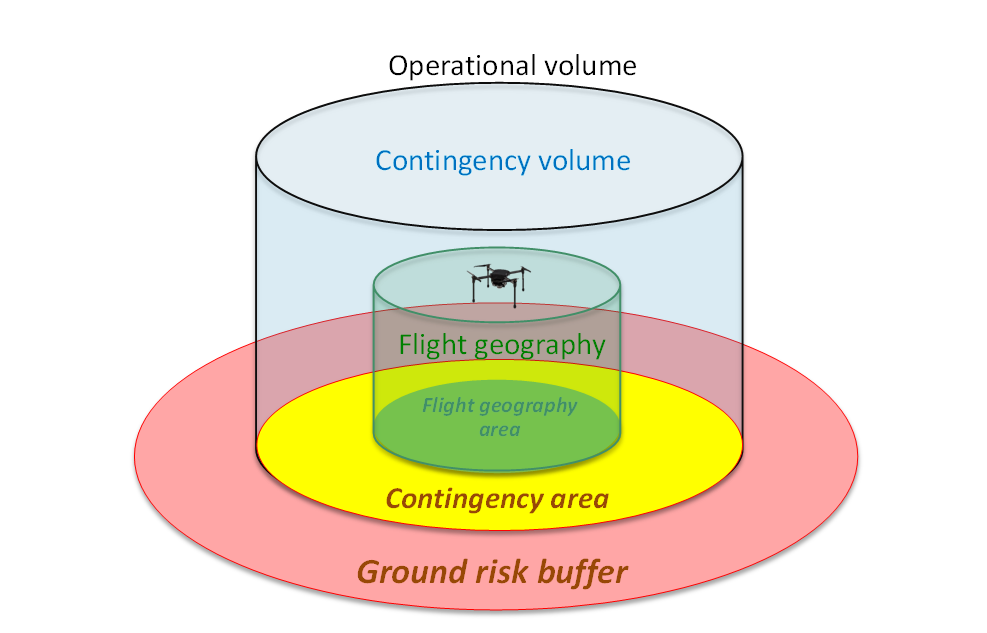
Figure 1 — Relation between ‘flight geography’, ‘flight geography area’, ‘contingency area’, ‘operational volume’ and ‘ground risk buffer’
Article 3 - Categories of UAS operations
Regulation (EU) 2019/947
UAS operations shall be performed in the ‘open’, ‘specific’ or ‘certified’ category defined respectively in Articles 4, 5 and 6, subject to the following conditions:
(a)UAS operations in the ‘open’ category shall not be subject to any prior operational authorisation, nor to an operational declaration by the UAS operator before the operation takes place;
(b)UAS operations in the ‘specific’ category shall require an operational authorisation issued by the competent authority pursuant to Article 12 or an authorisation received in accordance with Article 16, or, under circumstances defined in Article 5(5), a declaration to be made by a UAS operator;
(c)UAS operations in the ‘certified’ category shall require the certification of the UAS pursuant to Delegated Regulation (EU) 2019/945 and the certification of the operator and, where applicable, the licensing of the remote pilot.
GM1 Article 3 Categories of UAS operations
ED Decision 2019/021/R
BOUNDARIES BETWEEN THE CATEGORIES OF UAS OPERATIONS
(a)Boundary between ‘open’ and ‘specific’
A UAS operation does not belong to the ‘open’ category when at least one of the general criteria listed in Article 4 of the UAS Regulation is not met (e.g. when operating beyond visual line of sight (BVLOS)) or when the detailed criteria for a subcategory are not met (e.g. operating a 10 kg UA close to people when subcategory A2 is limited to 4 kg UA).
(b)Boundary between ‘specific’ and ‘certified’
Article 6 of the UAS Regulation and Article 40 of Regulation (EU) 2019/945 define the boundary between the ‘specific’ and the ‘certified’ category. The first article defines the boundary from an operational perspective, while the second one defines the technical characteristics of the UA, and they should be read together.
A UAS operation belongs to the ‘certified’ category when, based on the risk assessment, the competent authority considers that the risk cannot be mitigated adequately without the:
—certification of the airworthiness of the UAS;
—certification of the UAS operator; and
—licensing of the remote pilot, unless the UAS is fully autonomous.
UAS operations are always considered to be in the ‘certified’ category when they:
—are conducted over assemblies of people with a UA that has characteristic dimensions of 3 m or more; or
—involve the transport of people; or
—involve the carriage of dangerous goods that may result in a high risk for third parties in the event of an accident.
Article 4 - ‘Open’ category of UAS operations
Regulation (EU) 2019/947
1.Operations shall be classified as UAS operations in the ‘open’ category only where the following requirements are met:
(a)the UAS belongs to one of the classes set out in Delegated Regulation (EU) 2019/945 or is privately built or meets the conditions defined in Article 20;
(b)the unmanned aircraft has a maximum take-off mass of less than 25 kg;
(c)the remote pilot ensures that the unmanned aircraft is kept at a safe distance from people and that it is not flown over assemblies of people;
(d)the remote pilot keeps the unmanned aircraft in VLOS at all times except when flying in follow-me mode or when using an unmanned aircraft observer as specified in Part A of the Annex;
(e)during flight, the unmanned aircraft is maintained within 120 metres from the closest point of the surface of the earth, except when overflying an obstacle, as specified in Part A of the Annex
(f)during flight, the unmanned aircraft does not carry dangerous goods and does not drop any material;
2.UAS operations in the ‘open’ category shall be divided in three sub-categories in accordance with the requirements set out in Part A of the Annex.
Article 5 - ‘Specific’ category of UAS operations
Commission Implementing Regulation (EU) 2021/1166
1.Where one of the requirements laid down in Article 4 or in Part A of the Annex is not met, a UAS operator shall be required to obtain an operational authorisation pursuant to Article 12 from the competent authority in the Member State where it is registered.
2.When applying to a competent authority for an operational authorisation pursuant Article 12, the operator shall perform a risk assessment in accordance with Article 11 and submit it together with the application, including adequate mitigating measures.
3.In accordance with point UAS.SPEC.040 laid down in Part B of the Annex, the competent authority shall issue an operational authorisation, if it considers that the operational risks are adequately mitigated in accordance with Article 12.
4.The competent authority shall specify whether the operational authorisation concerns:
(a)the approval of a single operation or a number of operations specified in time or location(s) or both. The operational authorisation shall include the associated precise list of mitigating measures;
(b)the approval of an LUC, in accordance with part C of the Annex.
5.Where the UAS operator submits a declaration to the competent authority of the Member State of registration in accordance with point UAS.SPEC.020 laid down in Part B of the Annex for an operation complying with a standard scenario set out in Appendix 1 to that Annex, the UAS operator shall not be required to obtain an operational authorisation in accordance with paragraphs 1 to 4 of this Article and the procedure laid down in paragraph 5 of Article 12 shall apply. The UAS operator shall use the declaration referred to in Appendix 2 to that Annex.
6.An operational authorisation or a declaration shall not be required for:
(a)UAS operators holding an LUC with appropriate privileges in accordance with point UAS.LUC.060 of the Annex;
(b)operations conducted in the framework of model aircraft clubs and associations that have received an authorisation in accordance with Article 16.
AMC1 Article 5 ‘Specific’ category of UAS operations
ED Decision 2022/002/R
TRANSPORT OF DANGEROUS GOODS IN THE ‘SPECIFIC’ CATEGORY
(a)Dangerous goods may be transported in the ‘specific’ category of UAS operations only if the UAS operator is able to demonstrate that these goods will not cause harm or damage to third parties or to the environment in case of accident. When compatible with the operation, a crashprotected container, which will prevent the leakage/dispersion of dangerous goods in case of accident, would be acceptable. In this case, the UAS operator should demonstrate that the container is capable of maintaining/protecting the dangerous goods without causing damage or harm to third parties or the environment in case of accident. In demonstrating the conformity of the container, the operational characteristics of the flight (flight speed, altitude, weather conditions, etc.) shall be taken into account, as well as the defining aspects of the geographical area of operation.
(b)The assessment of the operational risk of transporting dangerous goods should take into account the following:
(1)the risk that such goods pose to persons that are directly involved in their handling, to the environment, and to third parties and their properties;
(2)the hazard posed by the quantity and class of the dangerous goods;
(3)the characteristics of the container for the dangerous goods;
(4)the level of competence of those handling the dangerous goods; and
(5)the geographical area in which the flight will be operated.
(c)The UAS operator that wishes to carry out operations in the ‘specific’ category to transport dangerous goods should establish a dangerous goods training programmes for the personnel involved, as required by the Technical Instructions. Such training programmes should be commensurate with the responsibilities of the personnel involved in those operations. The training programmes should be subject to review and approval by the competent authority, and should cover at least the following aspects:
(1)dangerous goods terminology;
(2)classification of dangerous goods;
(3)labelling of dangerous goods;
(4)identification of dangerous goods that use ‘SDSs’ and the Globally Harmonised System of Classification and Labelling of Chemicals (GHS) consumer labelling;
(5)use of the dangerous goods list provided in the Technical Instructions;
(6)storage and handling of dangerous goods, including but not limited to the segregation of incompatible dangerous goods, dangerous goods loading, and dangerous goods securing;
(7)instructions and safety precautions to be provided to employees and third parties; and
(8)emergency/reporting procedures included in the ERP in case of an accident/incident with dangerous goods.
Article 6 - ‘Certified’ category of UAS operations
Regulation (EU) 2019/947
1.Operations shall be classified as UAS operations in the ‘certified’ category only where the following requirements are met:
(a)the UAS is certified pursuant to points (a), (b) and (c) of paragraph 1 of Article 40 of Delegated Regulation (EU) 2019/945; and
(b)the operation is conducted in any of the following conditions:
i.over assemblies of people;
ii.involves the transport of people;
iii.involves the carriage of dangerous goods, that may result in high risk for third parties in case of accident.
2.In addition, UAS operations shall be classified as UAS operations in the ‘certified’ category where the competent authority, based on the risk assessment provided for in Article 11, considers that the risk of the operation cannot be adequately mitigated without the certification of the UAS and of the UAS operator and, where applicable, without the licensing of the remote pilot.
GM1 Article 6 ‘Certified’ category of UAS operations
ED Decision 2019/021/R
UAS OPERATIONS IN THE ‘CERTIFIED’ CATEGORY
Article 6 of the UAS Regulation should be read together with Article 40 of Regulation (EU) 2019/945 — Article 6 addresses UAS operations and Article 40 addresses the UAS. This construction was necessary to respect the EU legal order reflected in Regulation (EU) 2018/1139, which foresees that the requirements for UAS operations and registration are in the implementing act, and that the technical requirements for UAS are in the delegated act. The reading of the two articles results in the following:
(a)the transport of people is always in the ‘certified’ category. Indeed, the UAS must be certified in accordance with Article 40 and the transport of people is one of the UAS operations identified in Article 6 as being in the ‘certified’ category;
(b)flying over assemblies of people with a UAS that has a characteristic dimension of less than 3 m may be in the ‘specific’ category unless the risk assessment concludes that it is in the ‘certified’ category; and
(c)the transport of dangerous goods is in the ‘certified’ category if the payload is not in a crashprotected container, such that there is a high risk for third parties in the case of an accident.
Article 7 - Rules and procedures for the operation of UAS
Regulation (EU) 2024/1110
1.UAS operations in the ‘open’ category shall comply with the operational limitations set out in Part A of the Annex.
2.UAS operations in the ‘specific’ category shall comply with the operational limitations set out in the operational authorisation as referred to in Article 12 or the authorisation as referred to in Article 16, or in a standard scenario defined in Appendix 1 to the Annex as declared by the UAS operator.
This paragraph shall not apply where the UAS operator holds an LUC with appropriate privileges.
UAS operations in the ‘specific’ category shall be subject to the applicable operational requirements laid down in Commission Implementing Regulation (EU) No 923/201210.
2a.The operator of a UAS that meets the conditions specified in point 1(d) of Article 40 of Delegated Regulation (EU) 2019/945 shall obtain the following certificates:
(i)a certificate of airworthiness or a restricted certificate of airworthiness issued in accordance with Subpart H of Annex I (Part 21) to Commission Regulation (EU) No 748/201211;
(ii)a noise certificate issued in accordance with Subpart I of Annex I (Part 21) to Commission Regulation (EU) No 748/2012 when the UA is subject to the environmental protection requirements laid down in point 21.B.85 of Regulation (EU) No 748/2012.
3.UAS operations in the ‘certified’ category shall be subject to the applicable operational requirements laid down in Implementing Regulation (EU) No 923/2012 and Commission Regulations (EU) No 965/201212 and (EU) No 1332/201113.
Article 8 - Rules and procedures for the competency of remote pilots
Regulation (EU) 2019/947
1.Remote pilots operating UAS in the ‘open’ category shall comply with the competency requirements set in Part A of the Annex.
2.Remote pilots operating UAS in the ‘specific’ category shall comply with the competency requirements set out in the operational authorisation by the competent authority or in the standard scenario defined in Appendix 1 to the Annex or as defined by the LUC and shall have at least the following competencies:
(a)ability to apply operational procedures (normal, contingency and emergency procedures, flight planning, pre-flight and post-flight inspections);
(b)ability to manage aeronautical communication;
(c)manage the unmanned aircraft flight path and automation;
(d)leadership, teamwork and self-management;
(e)problem solving and decision-making;
(f)situational awareness;
(g)workload management;
(h)coordination or handover, as applicable.
3.Remote pilots operating in the framework of model aircraft clubs or associations shall comply with the minimum competency requirements defined in the authorisation granted in accordance with Article 16.
Article 9 - Minimum age for remote pilots
Regulation (EU) 2019/947
1.The minimum age for remote pilots operating a UAS in the ‘open’ and ‘specific’ category shall be 16 years.
2.No minimum age for remote pilots shall be required:
(a)when they operate in subcategory A1 as specified in Part A of the Annex to this Regulation, with a UAS Class C0 defined in Part 1 of the Annex to Delegated Regulation (EU) 2019/945 that is a toy within the meaning of Directive 2009/48/EC;
(b)for privately-built UAS with a maximum take-off mass of less than 250g;
(c)when they operate under the direct supervision of a remote pilot complying with paragraph 1 and Article 8.
3.Member States may lower the minimum age following a risk-based approach taking into account specific risks associated with the operations in their territory:
(a)for remote pilots operating in the ‘open’ category by up to 4 years;
(b)for remote pilots operating in the ‘specific’ category by up to 2 years.
4.Where a Member State lowers the minimum age for remote pilots, those remote pilots shall only be allowed to operate a UAS on the territory of that Member State.
5.Member States may define a different minimum age for remote pilots operating in the framework of model aircraft clubs or associations in the authorisation issued in accordance with Article 16.
GM1 Article 9 Minimum age for remote pilots
ED Decision 2019/021/R
SUPERVISOR
A person may act as a remote pilot even if he or she has not reached the minimum age defined in Article 9(1) of the UAS Regulation, provided that the person is supervised. The supervising remote pilot must, in any case, comply with the age requirement specified in that Article. The possibility to lower the minimum age applies only to remote pilots (and not to supervisors). Since the supervisor and the young remote pilot must both demonstrate competency to act as a remote pilot, no minimum age is defined to conduct the training and pass the test to demonstrate the minimum competency to act as a remote pilot in the ‘open’ category.
Article 10 - Rules and procedures for the airworthiness of UAS
Regulation (EU) 2019/947
Unless privately-built, or used for operations referred to in Article 16, or meeting the conditions defined in Article 20, UAS used in operations set out in this Regulation shall comply with the technical requirements and rules and procedures for the airworthiness defined in the delegated acts adopted pursuant to Article 58 of Regulation (EU) 2018/1139.
Article 11 - Rules for conducting an operational risk assessment
Regulation (EU) 2019/947
1.An operational risk assessment shall:
(a)describe the characteristics of the UAS operation;
(b)propose adequate operational safety objectives;
(c)identify the risks of the operation on the ground and in the air considering all of the below:
i.the extent to which third parties or property on the ground could be endangered by the activity;
ii.the complexity, performance and operational characteristics of the unmanned aircraft involved;
iii.the purpose of the flight, the type of UAS, the probability of collision with other aircraft and class of airspace used;
iv.the type, scale, and complexity of the UAS operation or activity, including, where relevant, the size and type of the traffic handled by the responsible organisation or person;
v.the extent to which the persons affected by the risks involved in the UAS operation are able to assess and exercise control over those risks.
(d)identify a range of possible risk mitigating measures;
(e)determine the necessary level of robustness of the selected mitigating measures in such a way that the operation can be conducted safely.
2.The description of the UAS operation shall include at least the following:
(a)the nature of the activities performed;
(b)the operational environment and geographical area for the intended operation, in particular overflown population, orography, types of airspace, airspace volume where the operation will take place and which airspace volume is kept as necessary risk buffers, including the operational requirements for geographical zones;
(c)the complexity of the operation, in particular which planning and execution, personnel competencies, experience and composition, required technical means are planned to conduct the operation;
(d)the technical features of the UAS, including its performance in view of the conditions of the planned operation and, where applicable, its registration number;
(e)the competence of the personnel for conducting the operation including their composition, role, responsibilities, training and recent experience.
3.The assessment shall propose a target level of safety, which shall be equivalent to the safety level in manned aviation, in view of the specific characteristics of UAS operation.
4.The identification of the risks shall include the determination of all of the below:
(a)the unmitigated ground risk of the operation taking into account the type of operation and the conditions under which the operation takes place, including at least the following criteria:
i.VLOS or BVLOS;
ii.population density of the overflown areas;
iii.flying over an assembly of people;
iv.the dimension characteristics of the unmanned aircraft;
(b)the unmitigated air risk of the operation taking into account all of the below:
i.the exact airspace volume where the operation will take place, extended by a volume of airspace necessary for contingency procedures;
ii.the class of the airspace;
iii.the impact on other air traffic and air traffic management (ATM) and in particular:
—the altitude of the operation;
—controlled versus uncontrolled airspace;
—aerodrome versus non-aerodrome environment;
—airspace over urban versus rural environment;
—separation from other traffic.
5.The identification of the possible mitigation measures necessary to meet the proposed target level of safety shall consider the following possibilities:
(a)containment measures for people on the ground;
(b)strategic operational limitations to the UAS operation, in particular:
i.restricting the geographical volumes where the operation takes place;
ii.restricting the duration or schedule of the time slot in which the operation takes place;
(c)strategic mitigation by common flight rules or common airspace structure and services;
(d)capability to cope with possible adverse operating conditions;
(e)organisation factors such as operational and maintenance procedures elaborated by the UAS operator and maintenance procedures compliant with the manufacturer’s user manual;
(f)the level of competency and expertise of the personnel involved in the safety of the flight;
(g)the risk of human error in the application of the operational procedures;
(h)the design features and performance of the UAS in particular:
i.the availability of means to mitigate risks of collision;
ii.the availability of systems limiting the energy at impact or the frangibility of the unmanned aircraft;
iii.the design of the UAS to recognised standards and the fail-safe design.
6.The robustness of the proposed mitigating measures shall be assessed in order to determine whether they are commensurate with the safety objectives and risks of the intended operation, particularly to make sure that every stage of the operation is safe.
GM1 AMC1 Article 11 Rules for conducting an operational risk assessment
ED Decision 2025/018/R
GENERAL
The operational risk assessment required by Article 11 of the UAS Regulation may be conducted using the methodology described in AMC1 Article 11. This methodology is basically the specific operations risk assessment (SORA) developed by JARUS. Other methodologies might be used by the UAS operator as alternative means of compliance.
Unmanned free balloons are unmanned aircraft and shall thus comply with Regulation (EU) 2019/947. For this type of aircraft, compliance with Appendix 2 to Regulation (EU) No 923/2012 is considered an acceptable means of compliance with Article 11.
Aspects other than safety, such as security, privacy, environmental protection, the use of the radio frequency (RF) spectrum, etc., should be assessed in accordance with the applicable requirements established by the Member State in which the operation is intended to take place, or by other EU regulations.
For some UAS operations that are classified as being in the ‘specific’ category, alternatives to carrying out a full risk assessment are offered to UAS operators:
(a)for UAS operations with lower intrinsic risks, a declaration may be submitted when the operations comply with the standard scenarios (STSs) listed in Appendix 1 to the UAS Regulation. Table 1 provides a summary of the STSs; and
(b)for other UAS operations, a request for authorisation may be submitted based on the mitigations and provisions described in the predefined risk assessment (PDRA) when the UAS operation meets the operational characterisation described in AMC2 et seq. Article 11 to the UAS Regulation. Table 2 below provides a summary of the PDRAs that have been published so far.
While the STSs are described in a detailed way, the provisions and mitigations in the PDRAs are described in a rather generic way to provide flexibility to UAS operators and the competent authorities to establish more prescriptive limitations and provisions that are adapted to the particularities of the intended operations. Two types of PDRAs are provided:
—those derived from an STS, which allow the UAS operator to conduct similar operations, but using, for example, UAS without the class label that is mandated by the STS (e.g. privately built UAS); and
—more generic PDRAs.
The codification of a PDRA includes the letter ‘G’ or ‘S’ (e.g. PDRA-G01 or PDRA-S01):
—‘G’ is used for generic PDRAs.
—‘S’ is used for PDRAs that are derived from an STS whose level of prescriptiveness is the same as of the corresponding STS. Therefore, those PDRAs, although they address UAS operations that are subject to operational authorisations (to allow the use of UAS without a class label), are expected to provide an even more simplified authorisation process compared to other (non-STS-related) PDRAs. Ideally, for UAS operations that are performed based on those PDRAs, the competent authorities may implement expedited operational-authorisation processes. Those processes may be based on the review of the documentation that is submitted by the UAS operator to support the declaration of compliance with the PDRA provisions.
In accordance with Article 11 of the UAS Regulation, the applicant must collect and provide the relevant technical, operational and system information needed to assess the risk associated with the intended operation of the UAS, and the SORA (AMC1 Article 11 of the UAS Regulation) provides a detailed framework for such data collection and presentation. The concept of operations (ConOps) description is the foundation for all other activities, and should be as accurate and detailed as possible. The ConOps should not only describe the operation, but also provide insight into the UAS operator’s operational safety culture. It should also include how and when to interact with the air navigation service provider (ANSP) when applicable.
PDRAs only address safety risks; consequently, additional limitations and provisions might need to be included after the consideration of other risks (e.g. security, privacy, etc.).
STS# | Edition/date | UAS characteristics | BVLOS/VLOS | Overflown area | Maximum range from remote pilot | Maximum height | Airspace | Notes |
STS-01 | June 2020 | Bearing a C5 class marking (maximum characteristic dimension of up to 3 m and MTOM of up to 25 kg) | VLOS | Controlled ground area that might be located in a populated area | VLOS | 120 m | Controlled or uncontrolled, with low risk of encounter with manned aircraft | |
STS-02 | June 2020 | Bearing a C6 class marking (maximum characteristic dimension of up to 3 m and MTOM of up to 25 kg) | BVLOS | Controlled ground area that is entirely located in a sparsely populated area | 2 km with an AO 1 km, if no AO | 120 m | Controlled or uncontrolled, with low risk of encounter with manned aircraft |
Table 1 — List of STSs published as ‘Appendix 1 for standard scenarios supporting a declaration’ to the Annex to the UAS Regulation
When UAS operators intend to conduct an operation covered by a PDRA, they should fill in the last two columns of the table related to the selected PDRA, named ‘integrity’ and ‘proof’. In the column ‘integrity’ they should explain how the level of integrity is met, and in the column ‘proof’ how the level of integrity is demonstrated. To support UAS operators, the two columns are already prefilled; however, the UAS operator may adapt the text to their needs.
If the UAS operation does not fit completely within the limits of the PDRA, the UAS operator is required to conduct a full risk assessment and submit it to the competent authority. Changes to the PDRA should not be done, unless the competent authority accepts that minor changes should be made.
PDRA# | Edition/date | UAS characteristics | BVLOS/VLOS | Overflown area | Maximum range from remote pilot | Maximum height | Airspace | AMC# to Article 11 | Notes |
PDRA-S01 | 1.1 / January 2022 | Maximum characteristic dimension of up to 3 m and take-off mass of up to 25 kg | VLOS | Controlled ground area that might be located in a populated area | VLOS | 150 m | Controlled or uncontrolled, with low risk of encounter with manned aircraft | AMC4 | |
PDRA-S02 | 1.1 / January 2022 | Maximum characteristic dimension of up to 3 m and take-off mass of up to 25 kg | BVLOS | Controlled ground area that is entirely located in a sparsely populated area | 2 km with an AO or with AOs 1 km, if no AO | 150 m | Controlled or uncontrolled, with low risk of encounter with manned aircraft | AMC5 | |
PDRA-G01 | 1.2 / January 2022 | Maximum characteristic dimension of up to 3 m and typical kinetic energy of up to 34 kJ | BVLOS | Sparsely populated area | If no AO, up to 1 km | 150 m (operational volume) | Uncontrolled, with low risk of encounter with manned aircraft | AMC2 | |
PDRA-G02 | 1.1 / January 2022 | Maximum characteristic dimension of up to 3 m and typical kinetic energy of up to 34 kJ | BVLOS | Sparsely populated area | n/a (direct C2 link) | As established for the reserved or segregated airspace | Reserved or segregated for the UAS operation | AMC3 | |
PDRA-G03 | 1.0 / January 2022 | Maximum characteristic dimension of up to 3 m and typical kinetic energy of up to 34 kJ | BVLOS | Sparsely populated areas | n/a (direct C2 link) | 50 m from ground unless in reserved or segregated airspace | Controlled or uncontrolled airspace if height is below 50 m, otherwise reserved or segregated airspace | AMC6 |
Table 2 — List of PDRAs published as AMC to Article 11 of the UAS Regulation