
Filters
AMC6 Article 11 Rules for conducting an operational risk assessment
ED Decision 2023/012/R
PREDEFINED RISK ASSESSMENT PDRA-G03 Version 1.1
EDITION September 2023
(a)Scope
This PDRA is the result of applying the methodology described in AMC1 Article 11 of the UAS Regulation to UAS operations performed in the ‘specific’ category:
(1)with UA with maximum characteristic dimensions (e.g. wingspan, rotor diameter/area or maximum distance between rotors in case of a multirotor) of up to 3 m and typical kinetic energies of up to 34 kJ;
(2)BVLOS of the remote pilot;
(3)over sparsely populated areas;
(4)within the range of the direct C2 link in an operational volume under 30 m above the overflown area (or any other altitude reference defined by the Member State of operations);
(5)following preprogrammed or preplanned flexible routes within the operational volume;
(6)in one of the following conditions:
(i)reserved or segregated airspace for UAS operations;
(ii)operating at a maximum height not exceeding 30 m from the ground;
(iii)when operating at no more than 30 m horizontally from an obstacle, operating at a maximum height not exceeding 15 m from the obstacle; if the height of the obstacle does not exceed 20 m, then the hight of the operation may be up to 30 m from the obstacle (meaning no more than a total of 50 m from the ground);
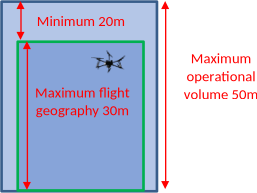
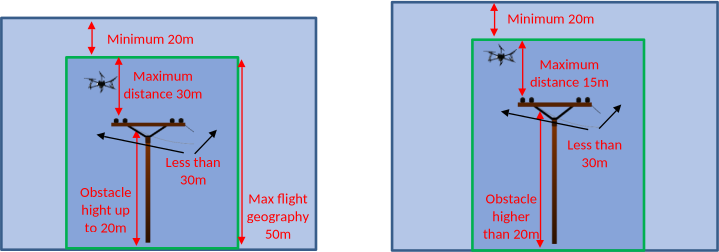
Figure 1 — Flight geography and operational volume when the operation is not conducted in reserved or segregated area
(7)operated routinely for regular inspections of facilities and infrastructure, e.g. industrial plants and similar, and operating in the atypical airspace within the shielding of such artificial obstacles as well as the natural obstacles, if any. The area of operation should be clearly identified within the application and the competent authority should issue a ‘precise’ operation authorisation according to GM1 UAS.SPEC.040(1).
Note 1: This PDRA has been tailored for routine automated surveillance operation and inspection of facilities and infrastructures. It may be used as a basis for other purposes and, thus, may require an additional risk assessment.
Note 2: Many UAS operations under this PDRA may be conducted with a high level of automation, which should be considered by the competent authorities in terms of the required level of practical-skills training and assessment, as it should be proportionate to the lower level of intervention required by the remote pilot.
(b)PDRA characterisation and conditions
The characterisation and conditions for this PDRA are summarised in Table PDRA-G03.1 below:
PDRA characterisation and conditions | ||||||||
Topic | Method of proof | Condition | Integrity145 | Proof146 | ||||
1.Operational characterisation (scope and limitations) | ||||||||
Level of human intervention | Self-declaration | 1.1No autonomous operations: the remote pilot should have the ability to maintain control of the UA, except in case of a loss of the commandandcontrol (C2) link. | Please include a reference to the relevant chapter/section of the OM. | ‘I declare compliance.’ | ||||
1.2The remote pilot should always be able to terminate the flight. | Please include a reference to the relevant chapter/section of the OM. | ‘I declare compliance.’ | ||||||
1.3Either the flight path should be preprogrammed or flexible routes should be preplanned to ensure the UA avoids obstacles in the operational volume. | Please include a reference to the relevant chapter/section of the OM. | ‘I declare compliance.’ | ||||||
1.4The remote pilot should not hand the control of the UA over to another command unit. | Please include a reference to the relevant chapter/section of the OM. | ‘I declare compliance.’ | ||||||
1.5The remote pilot should not operate the UA from a moving vehicle. | Please include a reference to the relevant chapter/section of the OM. | ‘I declare compliance.’ | ||||||
1.6The remote pilot should not hand the control of the UA over to another command unit. | Please include a reference to the relevant chapter/section of the OM. | ‘I declare compliance.’ | ||||||
UA range limit | Self-declaration | 1.7Launch/recovery: at VLOS distance from the remote pilot, if not operating from a safe prepared area. Note: ‘Safe prepared area’ means a controlled ground area that is suitable for the safe launch/recovery of the UA. | Please include a reference to the relevant chapter/section of the OM. | ‘I declare compliance.’ | ||||
1.8In flight: The range limit should be within the C2 link direct coverage which ensures the safe conduct of the flight. | Please include a reference to the relevant chapter/section of the OM. | ‘I declare compliance.’ | ||||||
Overflown areas | Declaration supported by | 1.9UAS operations should be conducted: | ||||||
1.9.1over sparsely populated areas, and | Please include a reference to the relevant chapter/section of the OM where the procedures for determining the population density are provided. | ‘I declare compliance.’ Please describe how the population density data is identified. | ||||||
1.9.2over or up to 15 m horizontal distance from a facility or infrastructure at the request of the person or entity that is responsible for that facility or infrastructure. | Please include a reference to the relevant chapter/section of the OM. | ‘I declare compliance.’ | ||||||
UA limitations | Self-declaration | 1.10Maximum characteristic dimensions (e.g. wingspan, rotor diameter/area or maximum distance between rotors in the case of a multirotor): up to 3 m | Please include a reference to the relevant chapter/section of the OM. | ‘I declare compliance.’ | ||||
1.11Typical kinetic energy: up to 34 kJ | Please include a reference to the relevant chapter/section of the OM. | ‘I declare compliance.’ | ||||||
Flight height limit | Self-declaration | 1.12The maximum height of the operational volume should not be greater than the size of the reserved or segregated airspace, if applicable, or the height defined according to para 3.9. Note: See point 3.10 defining the air risk buffer to be considered | Please include a reference to the relevant chapter/section of the OM. | ‘I declare compliance.’ | ||||
Airspace | Self-declaration | 1.13The UA should be operated: (refer also to point 3.9) | ||||||
1.13.1in ‘atypical airspace’ that is included in uncontrolled airspace; | Please include a reference to the relevant chapter/section of the OM. | ‘I declare compliance.’ | ||||||
1.13.2in controlled airspace which the competent authority has defined it meets ‘atypical airspace’ requirements and with the relevant coordination as defined by competent authority; or | Please include a reference to the relevant chapter/section of the OM. | ‘I declare compliance.’ | ||||||
Visibility | Self-declaration | 1.14If take-off and landing are conducted in VLOS of the remote pilot, the visibility should be sufficient to ensure that no people are in danger during the take-off /landing phase. The remote pilot should abort the take-off or landing in case people on the ground are in danger. | Please include a reference to the relevant chapter/section of the OM. | ‘I declare compliance.’ | ||||
Others | Self-declaration | 1.15The UA should not be used to drop material or to carry dangerous goods, except for dropping items in connection with agricultural, horticultural or forestry activities where the carriage of such items does not contravene any applicable regulations. | Please include a reference to the relevant chapter/section of the OM. | ‘I declare compliance.’ | ||||
2.Operational risk classification (according to the classification defined in AMC1 to Article 11 of the UAS Regulation) | ||||||||
Final GRC | 3 | Final ARC | ARC-a | SAIL | II | |||
3.Operational mitigations | ||||||||
Operational volume | Self-declaration | 3.1To determine the operational volume, the UAS operator should consider the position-keeping capabilities of the UAS in 4D space (latitude, longitude, height, and time). | Please include a reference to the relevant chapter/section of the OM. | ‘I declare compliance.’ | ||||
3.2In particular, the accuracy of the navigation solution, the flight technical error of the UAS and the path definition error (e.g. map error) and latencies should be considered and addressed when determining the operational volume. | Please include a reference to the relevant chapter/section of the OM. | ‘I declare compliance.’ | ||||||
3.3The remote pilot should apply the emergency procedures as soon as there is an indication that the UA may exceed the limits of the operational volume. | Please include a reference to the relevant chapter/section of the OM. | ‘I declare compliance.’ | ||||||
Ground risk | Self-declaration | 3.4The UAS operator should establish a ground risk buffer to protect third parties on the ground outside the operational volume. | Please include a reference to the relevant chapter/section of the OM. | ‘I declare compliance.' | ||||
3.4.1The default criterion should be the use of the ‘1:1 rule’ (e.g. if the UA is planned to operate at a height of 25 m, the ground risk buffer should at least be 25 m). | Please include a reference to the relevant chapter/section of the OM. | ‘I declare compliance.' | ||||||
3.4.2A smaller ground risk buffer value may be applied by the applicant for a rotary wing UA using a ballistic methodology approach acceptable to the competent authority. The 1:1 rule may in certain cases not be sufficient to meet the target level of safety. In such a case, the competent authority may ask for a refinement of the definition of the ground risk buffer, based on criteria defined in SORA Step #9 depending on the adjacent air and ground risks. | Please include a reference to the relevant chapter/section of the OM. | ‘I declare compliance.' | ||||||
3.5The operational volume and the ground risk buffer should be all contained in a sparsely populated area. | Please include a reference to the relevant chapter/section of the OM. | ‘I declare compliance.' | ||||||
3.6The UAS operator should evaluate the area of operations, typically by means of on-site inspection or appraisal, and should be able to justify the significantly lower density of people at risk than in sparsely populated areas within the entire operational volume including the ground risk buffer. | Please include a reference to the relevant chapter/section of the OM. | ‘I declare compliance.' | ||||||
3.7The UAS operator should ensure that the person or entity responsible for the facility or infrastructure has taken the necessary measures to protect the uninvolved persons present within the limits of the facility or infrastructure during the UAS operation. | Please include a reference to the relevant chapter/section of the OM. | ‘I declare compliance.' | ||||||
3.8The UAS operator should include points 3.4 to 3.7 in the Operations Manual (OM) (see point 4.1.1) and declare compliance with those conditions. | Please include a reference to the relevant chapter/section of the OM. | ‘I declare compliance.' | ||||||
Air risk | Self-declaration | 3.9The UAS operation should be conducted: 3.9.1in ‘atypical airspace’ which, for the purpose of this PDRA, is one of the following: 3.9.1.1in reserved or segregated airspace; the claim for ARC-a is met if a reserved or segregated airspace is established and approved for the purpose of conducting UAS operations under this PDRA, with the operational volume and air risk buffer, if applicable, being entirely contained in that reserved or segregated airspace; 3.9.1.2at a height of the flight geography of less than 30 m; 3.9.1.3when operating in the proximity of natural or artificial obstacles (e.g. trees, buildings, towers, cranes, fences, power lines, etc.) whose height is below 20 m, keeping the UA within the following distances: (i)30 m horizontal distance; (ii)30 m vertical distance from the top of the overflown obstacle; 3.9.1.4when operating in the proximity of natural or artificial obstacles (e.g. trees, buildings, towers, cranes, fences, power lines, etc.) whose height is above 20 m, keeping the UA within the following distances: (i)30 m horizontal distance; (ii)15 m vertical distance from the top of the overflown obstacle; 3.9.2away from all of the following: (i)any known permanent or temporary take-off and landings areas for all types of manned aircraft; this also includes parking lots, parks and other areas where helicopters occasionally operate from, as well as sites where police and helicopter emergency medical services (HEMS), and search and rescue (SAR) helicopters occasionally operate from in cases of accidents or other emergencies; (ii)known military aircraft lowflying routes; (iii)any other known low-level manned aircraft operations in the intended area of operation (e.g. balloon operations authorised en route below 500 ft); (iv)harbour/coastal areas where SAR operations may transit or operate; (v)any known areas where other unmanned aircraft operate (including areas for model aircraft clubs or associations). | Please include a reference to the relevant chapter/section of the OM. | ‘I declare compliance.’ | ||||
3.10The UAS operator should establish an air risk buffer to protect third parties in the air, outside the operational volume, if: 3.10.1airspace classified as ARC-d is adjacent to the operational volume; or 3.10.2the competent authority or the entity responsible for the airspace management considers it necessary to require that the protection of third parties in the air be ensured. | Please include a reference to the relevant chapter/section of the OM. | ‘I declare compliance.’ | ||||||
3.11The air risk buffer as per point 3.10 should be contained where the probability of encounter with manned aircraft and other airspace users is low, as defined by the competent authority. | Please include a reference to the relevant chapter/section of the OM. | ‘I declare compliance.’ | ||||||
3.12Before the flight, the UAS operator should assess the proximity of the planned UAS operation to manned aircraft activity. | Please include a reference to the relevant chapter/section of the OM. | ‘I declare compliance.’ | ||||||
Observers | n/a | |||||||
4.UAS operator and UAS operations conditions | ||||||||
UAS operator and UAS operations | Declaration supported by | 4.1The UAS operator should: | ||||||
4.1.1develop an operations manual (OM) (for the template, refer to AMC1 UAS.SPEC.030(3)(e) and to the complementary information in GM1 UAS.SPEC.030(3)(e)); | Please describe how this condition is met. | ‘I declare compliance and that supporting evidence is included in the OM.’ | ||||||
4.1.2develop a procedure to ensure that the security requirements applicable to the area of operations are complied with during the intended operation; | Please include a reference to the relevant chapter/section of the OM. | ‘I declare compliance and that supporting evidence is included in the OM.’ | ||||||
4.1.3develop measures to protect the UAS against unlawful interference and unauthorised access; | Please include a reference to the relevant chapter/section of the OM. | ‘I declare compliance and that supporting evidence is included in the OM.’ | ||||||
4.1.4develop procedures to ensure that all operations comply with Regulation (EU) 2016/679 on the protection of natural persons with regard to the processing of personal data and on the free movement of such data. In particular, the UAS operator should carry out a data protection impact assessment, when this is required by the data protection national authority of the Member State with regard to the application of Article 35 of that Regulation; | Please include a reference to the relevant chapter/section of the OM. | ‘I declare compliance and that supporting evidence is included in the OM.’ | ||||||
4.1.5develop guidelines for its remote pilots to plan UAS operations in a manner that minimises nuisance, including noise and other emissions-related nuisance, to people and animals; | Please include a reference to the relevant chapter/section of the OM. | ‘I declare compliance and that supporting evidence is included in the OM.’ | ||||||
4.1.6develop an emergency response plan (ERP) in accordance with the conditions for a ‘medium’ level of robustness (please refer to AMC3 UAS.SPEC.030(3)(e); | Please describe how this condition is met. | ‘I declare compliance and that supporting evidence is included in the OM.’ | ||||||
4.1.7validate the operational procedures in accordance with the provisions for a ‘medium’ level of robustness included in AMC2 UAS.SPEC.030(3)(e); | Please describe how this condition is met. | ‘I declare compliance and that the description for meeting this condition is available to the competent authority for review.’ | ||||||
4.1.8ensure the adequacy of the contingency and emergency procedures and prove it through any of the following: (a)dedicated flight tests; (b)simulations, provided that the representativeness of the simulation means is proven for the intended purpose with positive results; (c)any other means acceptable to the competent authority; | Please describe how this condition is met | ‘I declare compliance and that the description for meeting this condition is available to the competent authority for review.’ | ||||||
4.1.9have a policy that defines how the remote pilot and any other personnel in charge of duties essential to the UAS operation can declare themselves fit to operate before conducting any operation; | Please describe how this condition is met | ‘I declare compliance and that the description for meeting this condition is available to the competent authority for review.’ | ||||||
4.1.10if the operation takes place in reserved or segregated airspace, as part of the procedures that are contained in the OM (point 4.1.1 above), include the description of the following: | ||||||||
(a)the method and means of communication with the authority or entity that is responsible for the management of the airspace during the entire period of the reserved or segregated airspace being active, as mandated by the authorisation; Note: The communication method should be published in the notice to airmen (NOTAM), which activates the reserved airspace to also allow coordination with manned aircraft. | Please describe how this condition is met. | ‘I declare compliance and that evidence is available to the competent authority for review.’ | ||||||
(b)the personnel in charge of duties essential to the UAS operation, who are responsible for establishing that communication; | Please describe how this condition is met. | ‘I declare compliance and that evidence is available to the competent authority for review.’’ | ||||||
4.1.11designate for each flight a remote pilot with adequate competency and other personnel in charge of duties essential to the UAS operation if needed; | Please include a reference to the relevant chapter/section of the OM. | ‘I declare compliance and that supporting evidence is included in the OM.’ | ||||||
4.1.12ensure that the UAS operation effectively uses and supports the efficient use of the radio spectrum in order to avoid harmful interference; | Please include a reference to the relevant chapter/section of the OM. | ‘I declare compliance and that supporting evidence is included in the OM.’ | ||||||
4.1.13keep for a minimum of 3 years and maintain up to date a record of the information on UAS operations, including any unusual technical or operational occurrences and other data as required by the declaration or by the operational authorisation; | Please include a reference to the relevant chapter/section of the OM. | ‘I declare compliance and that recordkeeping data is available to the competent authority.’ | ||||||
UAS maintenance | Self-declaration | 4.2The UAS operator should: | ||||||
4.2.1ensure that the UAS maintenance instructions that are defined by the UAS operator are included in the OM and cover at least the UAS manufacturer’s instructions and requirements, when applicable; and | Please include a reference to the relevant chapter/section of the OM. | ‘I declare compliance.’ | ||||||
4.2.2ensure that maintenance staff follow the UAS maintenance instructions when performing maintenance; | Please include a reference to the relevant chapter/section of the OM. | ‘I declare compliance.’ | ||||||
4.2.3keep for a minimum of 3 years and maintain up to date a record of the maintenance activities conducted on the UAS; | Please include a reference to the relevant chapter/section of the OM. | ‘I declare compliance.’ | ||||||
4.2.4establish and keep up to date a list of the maintenance staff employed by the operator to carry out maintenance activities; | Please include a reference to the relevant chapter/section of the OM. | ‘I declare compliance.’ | ||||||
4.2.5comply with point UAS.SPEC.100, if the UAS uses certified equipment. | Please include a reference to the relevant chapter/section of the OM or indicate ‘n/a’. | ‘I declare compliance.’ or ‘n/a’ | ||||||
External services | Self-declaration | 4.3The UAS operator should ensure that the level of performance for any externally provided service necessary for the safety of the flight is adequate for the intended operation. The UAS operator should declare that this level of performance is adequately achieved. | Please describe how this condition is met. | ‘I declare compliance.’ | ||||
4.4The UAS operator should define and allocate the roles and responsibilities between the UAS operator and the external service provider(s), if applicable. | Please describe how this condition is met. | ‘I declare compliance.’ | ||||||
5.Conditions for the personnel in charge of duties essential to the UAS operation | ||||||||
General | Self-declaration | 5.1The UAS operator should ensure that all personnel in charge of duties essential to the UAS operation are provided with competency-based theoretical and practical training specific to their duties, which consists of theoretical elements defined in AMC1 UAS.SPEC.050(1)(d) and practical elements defined in AMC2 UAS.SPEC.050(1)(d). | Please describe how this condition is met. | ‘I declare compliance. Evidence of training is available for inspection at the request of the competent authority or its authorised representative. The training programme is documented in the OM.’ | ||||
5.2The UAS operator should keep and maintain up to date a record of all the relevant qualifications and training courses completed by the remote pilot and the other personnel in charge of duties essential to the UAS operation and by the maintenance staff for at least 3 years after those persons have ceased to be employed by the organisation or have changed position within the organisation. | Please describe how this condition is met. | ‘I declare compliance. Record-keeping data is available for inspection at the request of the competent authority.’ | ||||||
Remote pilot | Self-declaration | 5.3The remote pilot has the authority to cancel or delay any or all flight operations under the following conditions: | ||||||
5.3.1the safety of persons is jeopardised; | Please include a reference to the relevant chapter/section of the OM. | ‘I declare compliance.’ | ||||||
5.3.2property on the ground is jeopardised; | Please include a reference to the relevant chapter/section of the OM. | ‘I declare compliance.’ | ||||||
5.3.3other airspace users are in jeopardy; | Please include a reference to the relevant chapter/section of the OM. | ‘I declare compliance.’ | ||||||
5.3.4there is a violation of the terms of the operational authorisation. | Please include a reference to the relevant chapter/section of the OM. | ‘I declare compliance.’ | ||||||
5.4The remote pilot should: | ||||||||
5.4.1not perform any duties under the influence of psychoactive substances or alcohol, or when they are unfit to perform their tasks due to injury, fatigue, medication, sickness or other causes; | Please include a reference to the relevant chapter/section of the OM. | ‘I declare compliance.’ | ||||||
5.4.2be familiar with the manufacturer’s instructions provided by the manufacturer of the UAS; | Please include a reference to the relevant chapter/section of the OM. | ‘I declare compliance.’ | ||||||
5.4.3obtain updated information relevant to the intended operation about any geographical zones defined in accordance with Article 15 of the UAS Regulation; and | Please include a reference to the relevant chapter/section of the OM. | ‘I declare compliance.’ | ||||||
5.4.4ensure that the UAS is in a safe condition to complete the intended flight safely and, if applicable, check whether the direct remote identification is active and up to date. | Please include a reference to the relevant chapter/section of the OM. | ‘I declare compliance.’ | ||||||
Multi-crew cooperation (MCC) | Self-declaration | 5.5Where multi-crew cooperation (MCC) is required, the UAS operator should: | ||||||
5.5.1designate the remote pilot-in-command to be responsible for each flight; | Please include a reference to the relevant chapter/section of the OM, otherwise indicate ‘n/a’. | ‘I declare compliance.’ or ‘n/a’ | ||||||
5.5.2include procedures to ensure the coordination between the remote crew members with robust and effective communication channels; those procedures should cover as a minimum the following: | Please include a reference to the relevant chapter/section of the OM, otherwise indicate ‘n/a’. | ‘I declare compliance.’ or ‘n/a’ | ||||||
5.5.2.1the assignment of tasks to the remote crew members; and | Please include a reference to the relevant chapter/section of the OM, otherwise indicate ‘n/a’. | ‘I declare compliance.’ or ‘n/a’ | ||||||
5.5.2.2the establishment of step-by-step communication; and | Please include a reference to the relevant chapter/section of the OM, otherwise indicate ‘n/a’. | ‘I declare compliance.’ or ‘n/a’ | ||||||
5.6ensure that the training of the remote crew covers MCC. | Please include a reference to the relevant chapter/section of the OM, otherwise indicate ‘n/a’. | ‘I declare compliance.’ or ‘n/a’ | ||||||
Maintenance staff | Self-declaration | 5.7Any staff member authorised by the UAS operator to perform maintenance activities should have been duly trained regarding the documented maintenance procedures. | Please describe how this condition is met. | ‘I declare compliance. Evidence of training is available at the request of the competent authority or its authorised representative.’ | ||||
Personnel in charge of duties essential to the UAS operation are fit to operate | Self-declaration | 5.8The personnel in charge of duties essential to the UAS operation should declare that they are fit to operate before conducting any operation based on the policy defined by the UAS operator. | Please include a reference to the relevant chapter/section of the OM. | ‘I declare compliance.’ | ||||
6.Technical conditions | ||||||||
General | Self-declaration | 6.1The UAS should be equipped with means to monitor the critical parameters for a safe flight, and in particular the following: | ||||||
6.1.1UA position, height or altitude, ground speed or airspeed, attitude, and trajectory; | Please include a reference to the relevant chapter/section of the OM. | ‘I declare compliance.’ | ||||||
6.1.2UAS energy status (fuel, battery charge, etc.); and | Please include a reference to the relevant chapter/section of the OM. | ‘I declare compliance.’ | ||||||
6.1.3the status of critical functions and systems; as a minimum, for services based on RF signals (e.g. C2 link, GNSS, etc.), means should be provided to monitor the adequate performance and trigger an alert when the performance level becomes too low. | Please include a reference to the relevant chapter/section of the OM. | ‘I declare compliance.’ | ||||||
6.2The UAS performance and in particular its capability to keep the position in 4D space (latitude, longitude, height, and time) should be such that allows the remote pilot to conduct safely operations close to natural or artificial obstacles. Note: The UA should be able to fly safely at a distance closer than 30 m to artificial or natural obstacles. | Please include a reference to the relevant chapter/section of the OM. | ‘I declare compliance.’ | ||||||
6.3The UAS should provide means to programme the UA flight path prior to take-off, or if utilising flexible routes, be equipped with means to avoid obstacles while staying within the intended operational volume. | Please include a reference to the relevant chapter/section of the OM. | ‘I declare compliance.’ | ||||||
6.3.1.If flexible routes are utilised, the UAS should provide means to prevent the UA from breaching the horizontal and vertical limits of a programmable operational volume. | Please include a reference to the relevant chapter/section of the OM, otherwise indicate ‘n/a’. | ‘I declare compliance.’ | ||||||
6.4The UAS should be protected against potential electromagnetic interferences from the infrastructure/facilities in the overflown area. | Please include a reference to the relevant chapter/section of the OM. | ‘I declare compliance.’ | ||||||
Human–machine interface (HMI) | Self-declaration | 6.5The UAS information and control interfaces should be clearly and succinctly presented and should not confuse, cause unreasonable fatigue, or contribute to causing any disturbance to the personnel in charge of duties essential to the UAS operation such that this could adversely affect the safety of the operation. | Please include a reference to the relevant chapter/section of the OM. | ‘I declare compliance.’ | ||||
6.6The UAS operator should conduct a UAS evaluation that considers and addresses human factors to determine whether the HMI is appropriate for the operation. | Please include a reference to the relevant chapter/section of the OM. | ‘I declare compliance.’ | ||||||
C2 links and communication | Self-declaration | 6.7The UAS should comply with the appropriate requirements for radio equipment and the use of the RF spectrum. | Please include a reference to the relevant chapter/section of the OM. | ‘I declare compliance.’ | ||||
6.8Protection mechanisms against interference should be used, especially if unlicensed bands (e.g. ISM) are used for the C2 link (mechanisms such as FHSS, DSSS or OFDM technologies, or frequency deconfliction by procedure). | Please include a reference to the relevant chapter/section of the OM. | ‘I declare compliance.’ | ||||||
6.9The UAS should be equipped with a C2 link that is protected against unauthorised access to the C2 functions. | Please include a reference to the relevant chapter/section of the OM. | ‘I declare compliance.’ | ||||||
6.10In case of a loss of the C2 link, the UAS should have a reliable and predictable method for the UA to recover the C2 link or terminate the flight in a way that reduces the effect on third parties in the air or on the ground. | Please include a reference to the relevant chapter/section of the OM. | ‘I declare compliance.’ | ||||||
6.11In the event of an emergency, the remote pilot should have effective means to communicate with the relevant bodies. | Please include a reference to the relevant chapter/section of the OM. | ‘I declare compliance.’ | ||||||
Tactical mitigation | n/a | |||||||
Containment | Declaration supported by | 6.12To ensure a safe recovery from a technical issue that involves the UAS or an external system that supports the operation, the UAS should comply with the following basic containment provisions: | ||||||
6.12.1no probable failure of the UAS or any external system that supports the operation should lead to operation outside the operational volume; and | Please describe how this condition is met. | ‘n/a since enhanced containment applies.’ or ‘I declare compliance. A design and installation appraisal is available, and covers at least the following: —the design and installation features (independence, separation, and redundancy); and —the particular risks (e.g. hail, ice, snow, electromagnetic interference, etc.) relevant to the type of operation.’ | ||||||
6.12.2it is reasonably expected that a fatality will not occur from any probable failure of the UAS, or any external system that supports the operation. Note: The term ‘probable’ should be understood in its qualitative interpretation, i.e. ‘anticipated to occur one or more times during the entire system/operational life of an item’. | Please describe how this condition is met. | |||||||
6.13The following enhanced containment conditions should apply if the adjacent area includes an assembly of people or if the adjacent airspace is classified as ARC-c or ARC-d (in accordance with SORA): | ||||||||
6.13.1The UAS should be designed to standards that are considered adequate by the competent authority and/or in accordance with a means of compliance that is acceptable to that authority such that: | Please include a reference to the relevant chapter/section of the OM or indicate ‘n/a’. | ‘N/A since the basic containment applies’ or ‘I declare compliance with MoC Light-UAS.2511. Analysis and/or test data with supporting evidence are/is available.’ or ‘The UAS has a DVR demonstrating compliance with Light-UAS.2511. | ||||||
6.13.1.1the probability of the UA leaving the operational volume should be less than 10–4 /FH; and | Please include a reference to the relevant chapter/section of the OM or indicate ‘n/a’. | |||||||
6.13.1.2no single failure of the UAS or of any external system supporting the operation should lead to operation outside the ground risk buffer. Note: The term ‘failure’ should be understood as an occurrence which affects the operation of a component, part, or element such that it can no longer function as intended. Errors may cause failures but are not considered to be failures. Some structural or mechanical failures may be excluded from the criterion if it can be shown that these mechanical parts were designed according to aviation industry best practices. | Please include a reference to the relevant chapter/section of the OM or indicate ‘n/a’. | |||||||
6.13.2SW and AEH whose development error(s) could directly lead to operations outside the ground risk buffer should be developed according to an industry standard or methodology that is recognised as adequate by EASA. Note 1: The proposed additional safety conditions cover both the integrity and the assurance levels. Note 2: The proposed additional safety conditions do not imply a systematic need to develop the SW and AEH according to an industry standard or methodology recognised as adequate by the competent authority. For instance, if the UA design includes an independent engine shutdown function that systematically prevents the UA from exiting the ground risk buffer due to single failures or an SW/AEH error of the flight controls from occurring, the intent of the conditions of point 6.13.1 above could be considered met. Note 3: For this PDRA, having adjacent airspace classified as ARC-c like a hospital heliport in uncontrolled airspace is also deemed subject to the above additional conditions (in addition to ARC-d, as per SORA Step #9 (c)). | Please include a reference to the relevant chapter/section of the OM or indicate ‘n/a’. | |||||||
Remote identification147 | Self-declaration | 6.14The UAS bears a unique serial number compliant with standard ANSI/CTA2063A2019, Small Unmanned Aerial Systems Serial Numbers, 2019, according to Article 40(4) of Regulation (EU) 2019/945. | Please describe how this condition is met. | ‘I declare compliance.’ | ||||
6.15The UAS is equipped with a remote identification system according to Article 40(5) of Regulation (EU) 2019/945. | Please describe how this condition is met. | ‘I declare compliance.’ | ||||||
Lights148 | Self-declaration | 6.16If the UAS is operated at night, it is equipped with at least one green flashing light according to point UAS.SPEC.050(1)(l)(i) of the UAS Regulation. | Please describe how this condition is met or indicate ‘n/a’. | ‘I declare compliance.’ or ‘n/a’ | ||||
Table PDRA-G03.1 — Main limitations and provisions for PDRA-G03