
Filters
Annex to Implementing Regulation (EU) 2019/947 — UAS OPERATIONS IN THE ‘OPEN’ AND ‘SPECIFIC’ CATEGORIES
PART A — UAS OPERATIONS IN THE ‘OPEN’ CATEGORY
UAS.OPEN.010 General provisions
Regulation (EU) 2020/639
(1)The category of UAS ‘open’ operations is divided into three subcategories A1, A2 and A3, on the basis of operational limitations, requirements for the remote pilot and technical requirements for UAS.
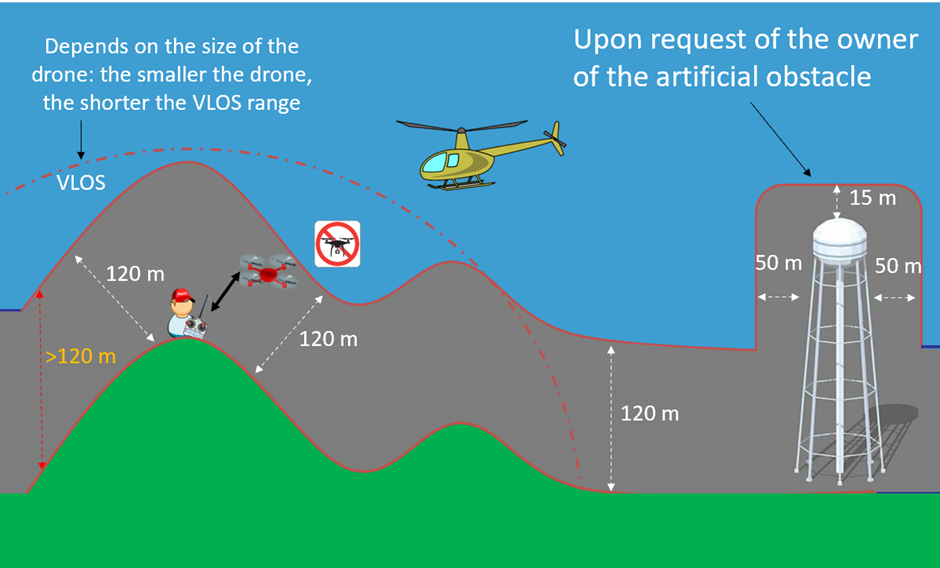
(2)Where the UAS operation involves the flight of the unmanned aircraft starting from a natural elevation in the terrain or over terrain with natural elevations, the unmanned aircraft shall be maintained within 120 metres from the closest point of the surface of the earth. The measurement of distances shall be adapted accordingly to the geographical characteristics of the terrain, such as plains, hills, mountains.
(3)When flying an unmanned aircraft within a horizontal distance of 50 metres from an artificial obstacle taller than 105 metres, the maximum height of the UAS operation may be increased up to 15 metres above the height of the obstacle at the request of the entity responsible for the obstacle.
(4)By way of derogation from point (2), unmanned sailplanes with a MTOM, including payload, of less than 10 kg, may be flown at a distance in excess of 120 metres from the closest point of the surface of the earth, provided that the unmanned sailplane is not flown at a height greater than 120 metres above the remote pilot at any time.
GM1 UAS.OPEN.010 General provisions
ED Decision 2022/002/R
MAXIMUM HEIGHT
The remote pilot must ensure that he or she keeps the unmanned aircraft (UA) at a distance less than 120 m (400 ft) from the terrain, and the picture below shows how the maximum height that the UA may reach changes according to the topography of the terrain. In addition, when the Member State (MS) has defined a geographical zone with a lower maximum height, the remote pilot must ensure that the UA always complies with the requirements of the geographical zone.
The entity responsible for the artificial obstacle referred to in point UAS.OPEN.010(3) needs to explicitly grant the unmanned aircraft system (UAS) operator permission to conduct an operation close to a tall man-made obstacle, e.g. a building, or antenna. No UAS operator should conduct an operation close to such an obstacle without permission from the entity responsible for the obstacle.
GM1 UAS.OPEN.010(4) General provisions
ED Decision 2019/021/R
OPERATIONS WITH UNMANNED SAILPLANES
This derogation was included to allow model gliders to continue to operate along slopes. Strictly applying the 120-metre distance from the closest point of the surface of the earth would have had disproportionate consequences. These operations have been conducted successfully for decades and have generated a micro-economy in certain countries. Two measures have been put in place to reduce the risk:
(a)A maximum takeoff mass (MTOM), including the payload, limited to 10 kg to reduce the consequences of an impact. 10 kg should cover the vast majority of gliders in operation.
(b)The maximum height above the remote pilot is limited to 120 m, which reduces the air risk.
UAS.OPEN.020 UAS operations in subcategory A1
Regulation (EU) 2020/639
UAS operations in subcategory A1 shall comply with all of the following conditions:
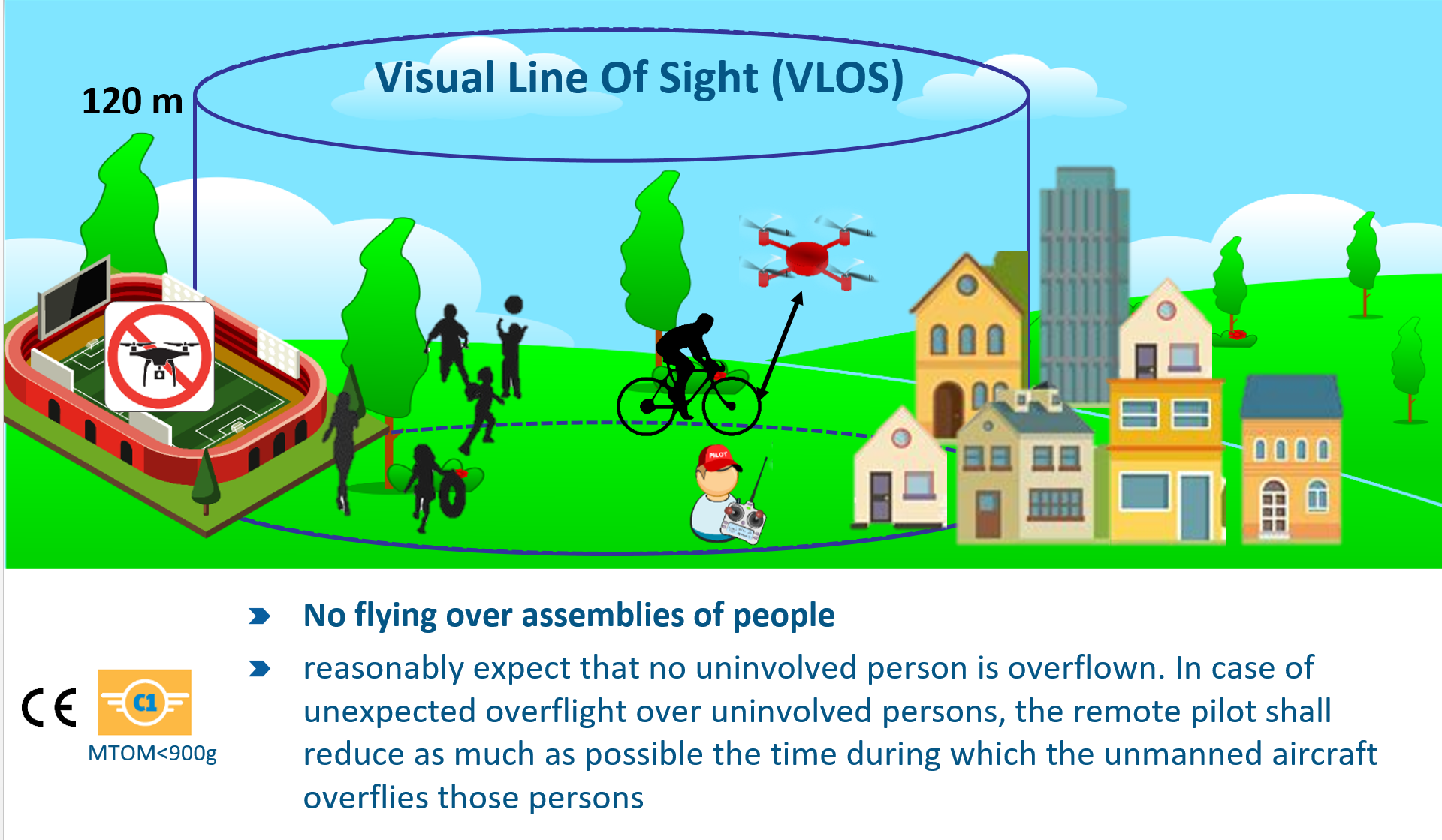
(1)for unmanned aircraft referred to in point (5)(d), be conducted in such a way that a remote pilot of the unmanned aircraft does not overfly assemblies of people and reasonably expects that no uninvolved person will be overflown. In the event of unexpected overflight of uninvolved persons, the remote pilot shall reduce as much as possible the time during which the unmanned aircraft overflies those persons;
(2)in the case of an unmanned aircraft referred to in points (5)(a), (5)(b) and (5)(c), be conducted in such a way that the remote pilot of the unmanned aircraft may overfly uninvolved persons, but shall never overfly assemblies of people;
(3)by way of derogation from point (d) of paragraph 1 of Article 4, be conducted, when the followme mode is active, up to a distance of 50 metres from the remote pilot;
(4)be performed by a remote pilot who:
(a)is familiar with manufacturer’s instructions provided by the manufacturer of the UAS;
(b)in the case of an unmanned aircraft class C1, as defined in Part 2 of the Annex to Delegated Regulation (EU) 2019/945, has completed an online training course followed by completing successfully an online theoretical knowledge examination provided by the competent authority or by an entity designated by the competent authority of a Member State achieving at least 75% of the overall marks. The examination shall comprise 40 multiple-choice questions distributed appropriately across the following subjects:
(i)air safety;
(ii)airspace restrictions;
(iii)aviation regulation;
(iv)human performance limitations;
(v)operational procedures;
(vi)UAS general knowledge;
(vii)privacy and data protection;
(viii)insurance;
(ix)security.
(5)be performed with an unmanned aircraft that:
(a)has an MTOM, including payload, of less than 250 g and a maximum operating speed of less than 19 m/s, in the case of a privately built UAS; or
(b)meets the requirements defined in point (a) of Article 20;
(c)is marked as class C0 and complies with the requirements of that class, as defined in Part 1 of the Annex to Delegated Regulation (EU) 2019/945; or
(d)is marked as class C1 and complies with the requirements of that class, as defined in Part 2 of the Annex to Delegated Regulation (EU) 2019/945 and is operated with active and updated direct remote identification system and geo-awareness function.
AMC1 UAS.OPEN.020(1) and (2) UAS operations in subcategory A1
ED Decision 2019/021/R
OPERATIONAL LIMITATIONS IN SUBCATEGORY A1
As a principle, the rules prohibit overflying assemblies of people. Overflying isolated people is possible, but there is a distinction between class C1 and class C0 UAS or privately built UAS with MTOMs of less than 250 g.
(a)For UAS in class C1, before starting the UAS operation, the remote pilot should assess the area and should reasonably expect that no uninvolved person will be overflown. This evaluation should be made taking into account the configuration of the site of operation (e.g. the existence of roads, streets, pedestrian or bicycle paths), and the possibility to secure the site and the time of the day. In case of an unexpected overflight, the remote pilot should reduce as much as possible the duration of the overflight, for example, by flying the UAS in such a way that the distance between the UA and the uninvolved people increases, or by positioning the UAS over a place where there are no uninvolved people.
(b)It is accepted that UAS in class C0 or privately built UAS with MTOMs less than 250 g may fly over uninvolved people; however, this should be avoided whenever possible, and where it is unavoidable, extreme caution should be used.
AMC1 UAS.OPEN.020(4)(b) and UAS.OPEN.040(3) UAS operations in subcategories A1 and A3
ED Decision 2022/002/R
THEORETICAL KNOWLEDGE SUBJECTS FOR BASIC ONLINE THEORETICAL KNOWLEGDE TRAINING COURSES AND THEORETICAL KNOWLEGDE EXAMINATIONS FOR SUBCATEGORIES A1 AND A3
The acquisition of theoretical knowledge by the remote pilot should cover at least the following theoretical knowledge subjects:
(a)Air safety:
(1)non-reckless behaviour, safety precautions for UAS operations and basic requirements regarding dangerous goods;
(2)starting or stopping the operations taking into account environmental factors, UAS conditions and limitations, remote pilot limitations and human factors;
(3)operation in visual line of sight (VLOS) and in very low level (VLL), which entails:
(i)keeping a safe distance from people, animals, property, vehicles, and other airspace users;
(ii)the identification of assemblies of people;
(iii)a code of conduct in case the UA encounters other traffic;
(iv)respecting the height limitation; and
(v)when using a UA observer, the responsibilities and communication between the UA observer and the remote pilot; and
(4)familiarisation with the operating environment, in particular:
(i)how to perform the evaluations of the presence of uninvolved person in the overflown area as required in UAS.OPEN.020(1) and UAS.OPEN.040(1); and
(ii)informing the people involved;
(b)Airspace restrictions:
(1)obtain and observe updated information about any flight restrictions or conditions published by the MS according to Article 15 of the UAS Regulation164;
(2)describe the types of geographical zones and the procedures for receiving a flight authorisation; and
(3)upload the geographical zones onto the geo-awareness system;
(c)Aviation regulations:
(1)Introduction to EASA and the aviation system;
(2)Regulation (EU) 2019/945 and Regulation (EU) 2019/947:
(i)their applicability to EU MSs;
(ii)subcategories in the ‘open’ category and the associated classes of UAS;
(iii)registration of UAS operators;
(iv)the responsibilities of the UAS operator;
(v)the responsibilities of the remote pilot; and
(vi)incident – accident reporting;
(d)Human performance limitations:
(1)the influence of psychoactive substances or alcohol or when the remote pilot is unfit to perform their tasks due to injury, fatigue, medication, sickness or other causes;
(2)human perception:
(i)factors influencing VLOS;
(ii)the distance of obstacles and the distance between the UA and obstacles;
(iii)evaluation of the speed of the UA;
(iv)evaluation of the height of the UA;
(v)situational awareness; and
(vi)night operations.
(e)Operational procedures:
(1)pre-flight:
(i)assessment of the area of operation and the surrounding area, including the terrain and potential obstacles and obstructions for keeping VLOS of the UA, potential overflight above uninvolved persons, and the potential overflight above critical infrastructure;
(ii)identification of a safe area where the remote pilot can perform a practice flight;
(iii)environmental and weather conditions (e.g. factors that can affect the performance of the UAS such as electromagnetic interference, wind, temperature, etc.); methods of obtaining weather forecasts; and
(iv)checking the condition of the UAS;
(2)in-flight:
(i)normal procedures;
(ii)determine the UA’s attitude, altitude, and direction of flight;
(iii)observe the airspace for other air traffic or hazards;
(iv)determine that the UA does not pose a danger for the life or property of other people; and
(v)contingency and emergency procedures for abnormal situations:
(a)managing the UAS flight path in abnormal situations;
(b)managing the situation when the UAS positioning equipment is impaired;
(c)managing the situation of incursion of a person into the area of operation, and taking appropriate measures to maintain safety;
(d)managing the exit from the area of operation as defined during the flight preparation;
(e)managing the situation when a manned aircraft flies near the area of operation;
(f)managing the incursion of another UAS into the area of operation;
(g)dealing with a situation of a loss of attitude or position control caused by external phenomena; and
(h)following the C2 loss-of-link procedure;
(3)post-flight:
(i)maintenance; and
(ii)logging of flight details;
(f)UAS general knowledge:
(1)basic principles of flight;
(2)the effect of environmental conditions on the performance of the UAS;
(3)principles of command and control:
(i)overview;
(ii)data link frequencies and spectrums; and
(iii)automatic flight modes, override and manual intervention;
(4)familiarisation with the instructions provided by the user’s manual of a UAS, and in particular with regard to:
(i)overview of the main elements of the UAS;
(ii)limitations (e.g. mass, speed, environmental, duration of battery, etc.);
(iii)controlling the UAS in all phases of flights (e.g. the take-off, hovering in mid-air, when applicable, flying basic patterns and landing);
(iv)features that affect the safety of flight;
(v)setting the parameters of the lost link procedures;
(vi)setting the maximum height;
(vii)procedures to load geographical zone data into the geoawareness system;
(viii)procedures to load the UAS operator registration number into the direct remote identification system;
(ix)safety considerations:
(A)instructions to secure the payload;
(B)precautions to avoid injuries from rotors and sharp edges; and
(C)the safe handling of batteries;
(x)Maintenance instructions:
(g)Privacy and data protection:
(1)understanding the risk posed to privacy and data protection; and
(2)the guiding principles for data protection under the GDPR165;
(h)Insurance:
(1)liability in case of an accident or incident;
(2)general knowledge of the EU regulations; and
(3)awareness of the possible different national requirements for insurance in the MSs.
(i)Security:
(1)an understanding of the security risk;
(2)an overview of the EU regulations;
(3)awareness of the possible different national requirements for security in the MSs.
AMC2 UAS.OPEN.020(4)(b) and UAS.OPEN.040(3) UAS operations in subcategories A1 and A3
ED Decision 2022/002/R
PROOF OF COMPLETION OF THE ONLINE THEORETICAL KNOWLEGDE TRAINING COURSE AND SUCCESSFUL COMPLETION OF THE ONLINE THEORETICAL KNOWLEGDE EXAMINATION
Upon receipt of the proof that a remote pilot has successfully completed the online theoretical knowledge training course and the online theoretical knowledge examination, the competent authority should provide a proof of completion to the remote pilot in the format that is depicted in the figure below. An entity that is designated by the competent authority may issue the certificate on behalf of the competent authority. The proof may be provided in electronic form.
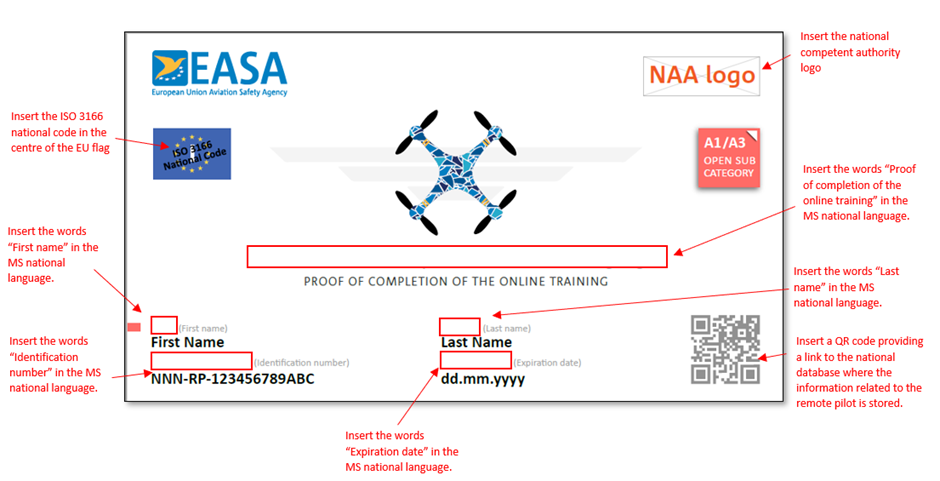
The remote pilot identification number that is provided by the competent authority or the entity that is designated by the competent authority that issues the proof of completion should have the following format:
NNN-RP-xxxxxxxxxxxx
Where:
—‘NNN’ is the ISO 3166 Alpha-3 code of the MS that issues the proof of completion;
—‘RP’ is a fixed field meaning ‘remote pilot’; and
—‘xxxxxxxxxxxx’ are 12 alphanumeric characters (lower-case only) defined by the competent authority or the entity that is designated by the competent authority that issues the proof of completion.
Example: (FIN-RP-123456789abc)
The QR code provided a link to the national database where the information related to the remote pilot is stored. Through the ‘remote pilot identification number’, all information related to the training of the remote pilot can be retrieved by authorised bodies (e.g. competent authorities, law enforcement authorities, etc.) and authorised personnel.
AMC1 UAS.OPEN.020(5)(c) and (d), UAS.OPEN.030(3) and UAS.OPEN.040(4)(c),(d) and (e) UAS operations in subcategories A1, A2 and A3
ED Decision 2022/002/R
MODIFICATION OF A UAS WITH A CLASS IDENTIFICATION LABEL
When placing UASs with a class identification label on the market, manufacturers should ensure the compliance of those UASs with the applicable regulatory requirements. It is the responsibility of UAS operators to ensure that those UASs remain compliant throughout their lifetime. UAS operators should, therefore, not make any modifications to a UAS in class C0, C1, C2, C3 or C4 that breach compliance with the product requirements, unless the modification is foreseen by the manufacturer and documented in the manufacturer’s instructions.
The replacement of a part by a similar one for maintenance purposes is not considered a modification, provided the operator uses an original part or a part that complies with the characteristics defined by the manufacturer in the list of replaceable parts provided in the manufacturer’s instructions.
The affixation of payload is not considered a modification provided that affixing a payload is not forbidden by the manufacturer and the payload complies with the characteristics provided in the manufacturer’s instructions. Affixing a payload when it is forbidden by the manufacturer or affixing a payload that does not comply with the characteristics provided in the manufacturer’s instructions is strictly forbidden.
If the payload does not comply with the characteristics of the allowed payloads or if maintenance is not performed according to the manufacturer’s instructions, it is then considered a modification that invalidates the class conformity. The class identification label must be removed from the UAS identification label and the modified UAS may only be operated in the ‘specific’ category in accordance with Subpart B of Annex to the UAS Regulation.
Changes to UASs with a class identification label C4 are allowed, and such UASs can be considered ‘privately built’ UASs and continue to be operated in subcategory A3 of the ‘open’ category.
GM1 UAS.OPEN.020(5)(c) and (d), UAS.OPEN.030(3) and UAS.OPEN.040(4)(c), (d) and (e) UAS operations in subcategories A1, A2 and A3
ED Decision 2019/021/R
MODIFICATION OF A UAS WITH A CE CLASS MARK
Modifications to UAS that breach compliance with the requirements for the CE marking are those that affect the weight or performance so that they are outside the specifications or the instructions provided by the manufacturer in the user manual. A replacement of a part with another that has the same physical and functional characteristics is not considered to be a breach of the requirements for the CE marking (e.g. a replacement of a propeller with another of the same design). The UA user manual should define instructions for performing maintenance and applying changes that do not breach compliance with the CE marking requirements.
UAS.OPEN.030 UAS operations in subcategory A2
Regulation (EU) 2020/639
UAS operations in subcategory A2 shall comply with all of the following conditions:
(1)be conducted in such a way that the unmanned aircraft does not overfly uninvolved persons and the UAS operations take place at a safe horizontal distance of at least 30 metres from them; the remote pilot may reduce the horizontal safety distance down to a minimum of 5 metres from an uninvolved person when operating an unmanned aircraft with an active low speed mode function and after evaluation of the situation regarding:
(a)weather conditions,
(b)performance of the unmanned aircraft,
(c)segregation of the overflown area.
(2)be performed by a remote pilot who is familiar with manufacturer’s instructions provided by the manufacturer of the UAS and holds a certificate of remote pilot competency issued by the competent authority or by an entity designated by the competent authority of a Member State. This certificate shall be obtained after complying with all of the following conditions and in the order indicated:
(a)completing an online training course and passed the online theoretical knowledge examination as referred to in point (4)(b) of point UAS.OPEN.020;
(b)completing a self-practical training in the operating conditions of the subcategory A3 set out in points (1) and (2) of point UAS.OPEN.040;
(c)declaring the completion of the self-practical training defined in point (b) and passing an additional theoretical knowledge examination provided by the competent authority or at an entity designated by the competent authority of a Member State achieving at least 75% of the overall marks. The examination shall comprise at least 30 multiple-choice questions aimed at assessing the remote pilot’s knowledge of the technical and operational mitigations for ground risk, distributed appropriately across the following subjects:
(i)meteorology;
(ii)UAS flight performance;
(iii)technical and operational mitigations for ground risk.
(3)be performed with an unmanned aircraft which is marked as class C2 and complies with the requirements of that class, as defined in Part 3 of the Annex to Delegated Regulation (EU) 2019/945, and is operated with active and updated direct remote identification system and geo-awareness function.
AMC1 UAS.OPEN.030(1) UAS operations in subcategory A2
ED Decision 2019/021/R
SAFE DISTANCE FROM UNINVOLVED PERSONS
(a)The minimum horizontal distance of the UA from uninvolved persons should be defined as the distance between the points where the UA would hit the ground in the event of a vertical fall and the position of the uninvolved persons.
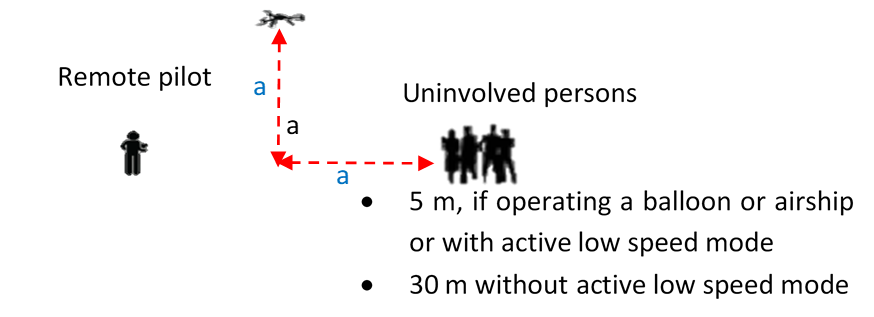
(b)As a reference, when the UA is operating in close proximity to people, the remote pilot should keep the UA at a lateral distance from any uninvolved person that is not shorter than the height (‘1:1 rule’, i.e. if the UA is flying at a height of 30 m, the distance from any uninvolved person should be at least 30 m).
(c)In any case, the distance from uninvolved persons should always be greater than:
(1)5 m, when the low-speed mode function on the UA is activated and set to 3 m per second;
(2)5 m, when operating a UAS balloon or airship; or
(3)30 m in all other cases.
GM1 UAS.OPEN.030(1) UAS operations in subcategory A2
ED Decision 2019/021/R
SAFE DISTANCE FROM UNINVOLVED PERSONS
The safe distance of the UA from uninvolved persons is variable and is heavily dependent on the performance and characteristics of the UAS involved, the weather conditions and the segregation of the overflown area. The remote pilot is ultimately responsible for the determination of this distance.
AMC1 UAS.OPEN.030(2) UAS operations in subcategory A2
ED Decision 2022/002/R
REMOTE PILOT CERTIFICATE OF COMPETENCY
After the verification that the applicant has passed the online theoretical knowledge examination, has completed and declared the practical-skills self-training, and has passed the additional theoretical knowledge examination provided by the competent authority or by an entity recognised by the competent authority, the competent authority should provide a certificate of competency to the remote pilot in the format depicted in the figure below. An entity that is designated by the competent authority may issue the certificate on behalf of the competent authority. The certificate may be provided in electronic form.
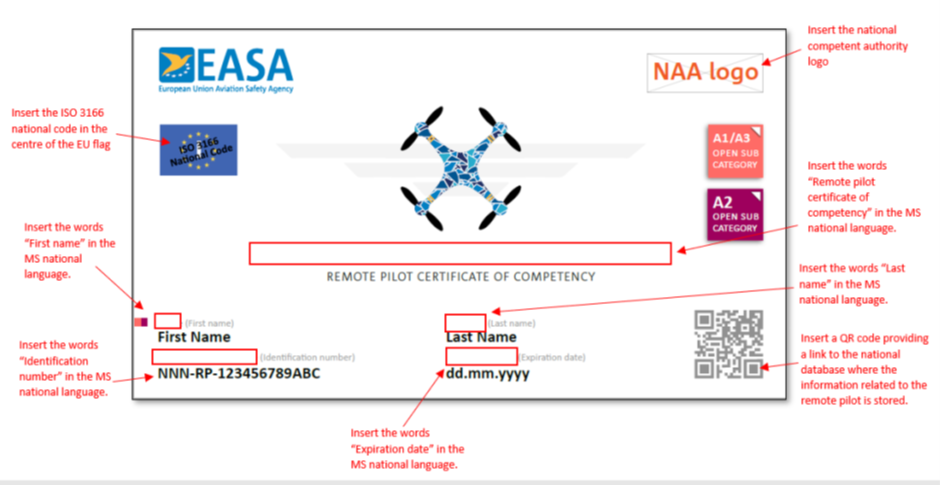
The remote pilot identification number that is provided by the competent authority or the entity that is designated by the competent authority that issues the certificate of remote pilot competency should have the following format:
NNN-RP-xxxxxxxxxxxx
Where:
—‘NNN’ is the ISO 3166 Alpha-3 code of the MS that issues the proof of completion;
—‘RP’ is a fixed field meaning ‘remote pilot’; and
—‘xxxxxxxxxxxx’ are 12 alphanumeric characters (lower-case only) defined by the competent authority or the entity that is designated by the competent authority that issues the proof of completion.
Example: (FIN-RP-123456789abc)
The QR code provides a link to the national database where the information related to the remote pilot is stored. Through the ‘remote pilot identification number’, all information related to the training of the remote pilot can be retrieved by authorised bodies (e.g. competent authorities, law enforcement authorities, etc.) and authorised personnel.
AMC1 UAS.OPEN.030(2)(b) UAS operations in subcategory A2
ED Decision 2022/002/R
PRACTICAL-SKILLS SELF-TRAINING
(a)The aim of the practical-skills self-training is to ensure that the remote pilot demonstrate at all times the ability to:
(1)operate a class C2 UAS within its limitations;
(2)complete all manoeuvres with smoothness and accuracy;
(3)exercise good judgment and airmanship;
(4)apply their theoretical knowledge; and
(5)maintain control of the UA at all times in such a manner that the successful outcome of a procedure or manoeuvre is never seriously in doubt.
(b)The remote pilot should complete the practical-skills self-training with a UAS that features the same flight characteristics (e.g. fixed wing, rotorcraft), control scheme (manual or automated, human–machine interface) and a similar weight as the UAS intended for use in the UAS operation. This implies the use of a UA with an MTOM of less than 4 kg and bearing the Class 2 identification label.
(c)If a UAS with both manual and automated control schemes is used, the practicalskills selftraining should be done with both control schemes. If a UAS has multiple automated features, the remote pilot should demonstrate proficiency with each automated feature.
(d)The practical-skills self-training should contain at least flying exercises regarding take-off or launch and landing or recovery, precision flight manoeuvres remaining in a given airspace volume, hovering in all orientations or loitering around positions when applicable. In addition, the remote pilot should follow the contingency procedures for abnormal situations (e.g. a return-to-home function, if available), as stipulated in the user’s manual provided by the manufacturer. However, the remote pilot should only follow those contingency procedures that do not require the deactivation of the UAS functions that may reduce its safety level.
AMC2 UAS.OPEN.030(2)(b) UAS operations in subcategory A2
ED Decision 2022/002/R
PRACTICAL COMPETENCIES FOR THE PRACTICAL-SKILLS SELF-TRAINING
When doing the practical-skills self-training, the remote pilot should perform as many flights as they deem necessary to gain a reasonable level of knowledge and the skills to operate the UAS.
The following list of practical competencies should be considered:
(a)Preparation of the UAS operation:
(1)make sure that the:
(i)chosen payload is compatible with the UAS used for the UAS operation;
(ii)zone of UAS operation is suitable for the intended operation; and
(iii)UAS meets the technical requirements of the geographical zone;
(2)define the area of operation in which the intended operation takes place in accordance with UAS.OPEN.040;
(3)define the area of operation considering the characteristics of the UAS;
(4)identify the limitations published by the MS for the geographical zone (e.g. nofly zones, restricted zones and zones with specific conditions near the operation zone), and if needed, seek authorisation by the entity responsible for such zones;
(5)identify the goals of the UAS operation;
(6)identify any obstacles and the potential presence of uninvolved persons in the area of operation that could hinder the intended UAS operation; and
(7)check the current meteorological conditions and the forecast for the time planned for the operation.
(b)Preparation for the flight:
(1)assess the general condition of the UAS and ensure that the configuration of the UAS complies with the instructions provided by the manufacturer in the user’s manual;
(2)ensure that all removable components of the UA are properly secured;
(3)make sure that the software installed on the UAS and on the remote pilot station (RPS) is the latest published by the UAS manufacturer;
(4)calibrate the instruments on board the UA, if needed;
(5)identify possible conditions that may jeopardise the intended UAS operation;
(6)check the status of the battery and make sure it is compatible with the intended UAS operation;
(7)activate the geo-awareness system and ensure that the geographical information is up to date;
(8)set the height limitation system, if needed;
(9)set the low-speed mode, if available; and
(10)check the correct functioning of the C2 link.
(c)Flight under normal conditions:
(1)following the procedures provided by the manufacturer in the user’s manual, familiarise themselves with how to:
(i)take off (or launch);
(ii)make a stable flight:
(A)hover in case of multirotor UA;
(B)perform coordinated large turns;
(C)perform coordinated tight turns;
(D)perform straight flight at constant altitude;
(E)change direction, height and speed;
(F)follow a path;
(G)return of the UA towards the remote pilot after the UA has been placed at a distance that no longer allows its orientation to be distinguished, in case of multirotor UA;
(H)perform horizontal flight at different speeds (critical high speed or critical low speed), in case of fixed-wing UA;
(iii)keep the UA outside no-fly zones or restricted zones, unless holding an authorisation;
(iv)use some external references to assess the distance and height of the UA;
(v)perform a return-to-home (RTH) procedure — automatic or manual;
(vi)land (or recover);
(vii)perform a landing procedure and a missed approach in case of fixed-wing UA; and
(vii)perform real-time monitoring of the status and endurance limitations of the UAS; and
(2)maintain sufficient separation from obstacles.
(d)Flight under abnormal conditions:
(i)manage the UAS flight path in abnormal situations;
(ii)manage the situation when the UAS positioning equipment is impaired (if the UAS used allows the deactivation of that equipment);
(iii)simulate the incursion of a person into the area of operation, and take appropriate measures to maintain safety;
(iv)manage the exit from the operation zone as defined during the flight preparation;
(v)simulate the incursion of a manned aircraft nearby the area of operation;
(vi)simulate the incursion of another UAS in the area of operation;
(vii)select the safeguard mechanism relevant to the situation;
(viii)resume manual control of the UAS when the use of automatic systems renders the situation dangerous; and
(ix)apply the recovery method following a deliberate (simulated) loss of the C2 link.
(e)Briefing, debriefing and feedback:
(i)shut down the UAS and secure it;
(ii)carry out a post-flight inspection and record any relevant data on the general condition of the UAS (its systems, components, and power sources);
(iii)conduct a review of the UAS operation; and
(iv)identify situations where an occurrence report is necessary, and complete the occurrence report.
AMC1 UAS.OPEN.030(2)(c) UAS operations in subcategory A2
ED Decision 2019/021/R
ADDITIONAL THEORETICAL KNOWLEDGE OF SUBJECTS FOR THE EXAMINATION FOR SUBCATEGORY A2
(a)By passing the additional theoretical knowledge examination, the remote pilot should demonstrate that they:
(1)understand the safety risks linked with a UAS operation in close proximity to uninvolved people or with a heavier UA;
(2)are able to assess the ground risk related to the environment where the operation takes place, as well as to flying in close proximity to uninvolved people;
(3)have a basic knowledge of how to plan a flight and define contingency procedures; and
(4)understand how weather conditions may affect the performance of the UA.
(b)The theoretical knowledge examination should cover aspects from the following subjects:
(1)meteorology:
(i)the effect of weather on the UA:
(A)wind (e.g. urban effects, turbulence);
(B)temperature;
(C)visibility; and
(D)the density of the air;
(ii)obtaining weather forecasts;
(2)UAS flight performance:
(i)the typical operational envelope of a rotorcraft, for fixed wing and hybrid configurations;
(ii)mass and balance, and centre of gravity (CG):
(A)consider the overall balance when attaching gimbals, payloads;
(B)understand that payloads can have different characteristics, thus making a difference to the stability of a flight; and
(C)understand that each different type of UA has a different CG;
(iii)secure the payload;
(iv)batteries:
(A)understand the power source to help prevent potential unsafe conditions;
(B)familiarise with the existing different kinds of battery types;
(C)understand the terminology used for batteries (e.g. memory effect, capacity, crate); and
(D)understand how a battery functions (e.g. charging, usage, danger, storage); and
(3)technical and operational mitigations for ground risk:
(i)low-speed mode functions;
(ii)evaluating the distance from people; and
(iii)the 1:1 rule.
AMC2 UAS.OPEN.030(2)(c) UAS operations in subcategory A2 and Attachment A to Chapter I of Appendix 1 ‘Remote pilot theoretical knowledge and practical-skills examination for STS-01’
ED Decision 2022/002/R
THEORETICAL KNOWLEDGE EXAMINATION FOR THE CERTIFICATE OF REMOTE PILOT COMPETENCY AND OF THE REMOTE PILOT THEORETICAL KNOWLEDGE FOR STSs
The theoretical knowledge examination to obtain a ‘certificate of remote pilot competency’ in subcategory A2 of the ‘open’ category (according to point UAS.OPEN.030(2)(c)) and the ‘certificate of remote pilot theoretical knowledge’ for STSs (as per Attachment A to Chapter I of Appendix 1 of the UAS Regulation) should be conducted:
(1)as a face-to-face examination at the facilities of the competent authority, or of the entity that is designated by the competent authority (if that entity issues the certificate), or of the entity recognised by the competent authority (if the certificate is issued by the competent authority); or
(2)through an online-proctored examination provided by the competent authority, or the entity that is designated by the competent authority (if that entity issues the certificate), or the entity recognised by the competent authority (if the certificate is issued by the competent authority). The examination provider should provide the participants in the exam with a clear procedure on how to conduct such an examination as well as with a system that:
(a)allows the adequate verification of the identity of the person that takes the examination;
(b)provides a method to verify that the person that takes the examination does not use during the examination support other than that specified in the examination procedure (e.g. computer traffic data lock and monitoring to prevent screen sharing, mirroring and remote desktop, video and room sound analysis).
GM1 UAS.OPEN.030(2)(c) UAS operations in subcategory A2
ED Decision 2022/002/R
REMOTE PILOT COMPETENCIES REQUIRED TO OBTAIN A CERTIFICATE OF REMOTE PILOT COMPETENCY
A remote pilot may obtain the additional theoretical knowledge that is needed to pass the additional theoretical examination for a certificate of remote pilot competency via competency-based training that covers aspects related to non-technical skills in an integrated manner, taking into account the particular risks associated with UAS operations. Competency-based training should be developed using the analysis, design, development, implementation, and evaluation (ADDIE) principles.
The competency may be acquired by one of the following two ways:
(a)Self-study, such as:
(1)reading the manual or leaflet provided by the UA manufacturer;
(2)reading related information or watching instructional films; and
(3)obtaining information from others who have already experience in flying a UA.
(b)Study in a training facility.
A remote pilot may also undertake this study as classroom training, e-learning or similar training at a training facility. Since this training is not mandated by the UAS Regulation, the national aviation authorities (NAAs) are not required to approve the training syllabi.
UAS.OPEN.040 UAS operations in subcategory A3
Regulation (EU) 2020/639
UAS operations in subcategory A3 shall comply with all of the following conditions:
(1)be conducted in an area where the remote pilot reasonably expects that no uninvolved person will be endangered within the range where the unmanned aircraft is flown during the entire time of the UAS operation;
(2)be conducted at a safe horizontal distance of at least 150 metres from residential, commercial, industrial or recreational areas;
(3)be performed by a remote pilot who is familiar with manufacturer’s instructions provided by the manufacturer of the UAS and who has completed an online training course and passed an online theoretical knowledge examination as defined in point (4)(b) of point UAS.OPEN.020;
(4)be performed with an unmanned aircraft that:
(a)has an MTOM, including payload, of less than 25 kg, in the case of a privately built UAS, or
(b)meets the requirements defined in point (b) of Article 20;
(c)is marked as class C2 and complies with the requirements of that class, as defined in Part 3 of the Annex to Delegated Regulation (EU) 2019/945 and is operated with active and updated direct remote identification system and geo-awareness function or;
(d)is marked as class C3 and complies with the requirements of that class, as defined in Part 4 of the Annex to Delegated Regulation (EU) 2019/945 and is operated with active and updated direct remote identification system and geo-awareness function; or
(e)is marked as class C4 and complies with the requirements of that class, as defined in Part 5 of the Annex to Delegated Regulation (EU) 2019/945.
AMC1 UAS.OPEN.040(1) Operations in subcategory A3
ED Decision 2019/021/R
AREAS WHERE UAS OPERATIONS IN A3 MAY BE CONDUCTED
(a)If an uninvolved person enters the range of the UAS operation, the remote pilot should, where necessary, adjust the operation to ensure the safety of the uninvolved person and discontinue the operation if the safety of the UAS operation is not ensured.
(b)A minimum horizontal distance from the person that is passing the area could be estimated as follows:
(1)no less than 30 m;
(2)no less than the height (‘1:1 rule’, i.e. if the UA is flying at a height of 30 m, the distance of the UA from the uninvolved person should be at least 30 m), and
(3)no less than the distance that the UA would cover in 2 seconds at the maximum speed (this assumes a reaction time of 2 seconds).
This minimum horizontal distance is intended to protect people on the ground, but can be extended to property and animals.
GM1 UAS.OPEN.030(1) and UAS.OPEN.040(1) UAS operations in subcategories A1 and A3
ED Decision 2019/021/R
DIFFERENCE BETWEEN SUB-CATEGORIES A2 AND A3
Subcategory A2 addresses operations during which flying close to people is intended for a significant portion of the flight. The minimum distance ranges from 30 m to 5 m from uninvolved people. 5 m is only allowed when there is an active low-speed mode function on the UA, and the remote pilot has conducted an evaluation of the situation regarding the weather, the performance of the UA and the segregation of the overflown area.
Sub-category A3 addresses operations that are conducted in an area (hereafter referred to as ‘the area’) where the remote pilot reasonably expects that no uninvolved people will be endangered within the range of the unmanned aircraft where it is flown during the mission. In addition, the operation must be conducted at a safe horizontal distance of at least 150 m from residential, commercial, industrial or recreational areas.
GM1 UAS.OPEN.040(4) UAS operations in subcategory A3
ED Decision 2022/002/R
USE OF UASs WITH A CLASS C0 OR C1 CLASS IDENTIFICATION LABEL IN SUBCATEGORY A3
Since subcategory A3 UAS operations are conducted at a 150-m distance from residential, commercial, and industrial areas, where no uninvolved persons are endangered, subcategory A3 encompass subcategory A1 (operations that are not conducted over assemblies of people and over uninvolved people). Therefore, UAS operations in subcategory A3 may also be conducted with an UA with:
(a)a class C0 class identification label that complies with the requirements of Part 1 of the Annex to Regulation (EU) 2019/945; or
(b)a class C1 class identification label that complies with the requirements of Part 1 of the Annex to Regulation (EU) 2019/945, as well as with an active and updated direct remote identification system and a geo-awareness function.
UAS.OPEN.050 Responsibilities of the UAS operator
Regulation (EU) 2020/639
The UAS operator shall comply with all of the following:
(1)develop operational procedures adapted to the type of operation and the risk involved;
(2)ensure that all operations effectively use and support the efficient use of radio spectrum in order to avoid harmful interference;
(3)designate a remote pilot for each flight;
(4)ensure that remote pilots and all other personnel performing a task in support of the operations are familiar with manufacturer’s instructions provided by the manufacturer of the UAS, and:
(a)have appropriate competency in the subcategory of the intended UAS operations in accordance with points UAS.OPEN.020, UAS.OPEN.030 or UAS.OPEN.040 to perform their tasks or, for personnel other than the remote pilot, have completed an onthejobtraining course developed by the operator;
(b)are fully familiar with the UAS operator’s procedures;
(c)are provided with the information relevant to the intended UAS operation concerning any geographical zones published by the Member State of operation in accordance with Article 15;
(5)update the information into the geo-awareness system when applicable according to the intended location of operation;
(6)in the case of an operation with an unmanned aircraft of one of the classes defined in Parts 1 to 5 of the Annex of Delegated Regulation (EU) 2019/945, ensure that the UAS is:
(a)accompanied by the corresponding EU declaration of conformity, including the reference to the appropriate class; and
(b)the related class identification label is affixed to the unmanned aircraft.
(7)Ensure in the case of an UAS operation in subcategory A2 or A3, that all involved persons present in the area of the operation have been informed of the risks and have explicitly agreed to participate.
AMC1 UAS.OPEN.050(1) Responsibilities of the UAS operator
ED Decision 2022/002/R
OPERATIONAL PROCEDURES
The UAS operator should develop procedures adapted to the type of operations they intend to perform and to the risks involved. Therefore, written procedures should not be necessary if the UAS operator is also the remote pilot, and the remote pilot may use the procedures defined in the manufacturer’s instructions.
If a UAS operator employs more than one remote pilot, the UAS operator should:
(a)develop procedures for UAS operations in order to coordinate the activities between its employees; and
(b)establish and maintain a list of their personnel and their assigned duties.
GM1 UAS.OPEN.050(3) Responsibilities of the UAS operator
ED Decision 2022/002/R
OPERATIONAL PROCEDURES
The UAS operator must identify a remote pilot for each flight. For UAS operations in the ‘open’ category, it is forbidden to hand the control of the UA over to another command unit during the flight.
AMC1 UAS.OPEN.050(4)(c) Responsibilities of the UAS operator
ED Decision 2019/021/R
OBTAIN UPDATED INFORMATION ABOUT THE GEOGRAPHICAL ZONE
The UAS operator should download the latest version of the geographical data and make available to the remote pilot such that they can upload it onto the geo-awareness system, if such a system is available on the UA used for the operation.
UAS.OPEN.060 Responsibilities of the remote pilot
Commission Implementing Regulation (EU) 2021/1166
(1)Before starting an UAS operation, the remote pilot shall:
(a)have the appropriate competency in the subcategory of the intended UAS operations in accordance with points UAS.OPEN.020, UAS.OPEN.030 or UAS.OPEN.040 to perform its task and carry a proof of competency while operating the UAS, except when operating an unmanned aircraft referred to in points (5)(a), (5)(b) or (5)(c) of point UAS.OPEN.020;
(b)obtain updated information relevant to the intended UAS operation about any geographical zone published by the Member State of operation in accordance with Article 15;
(c)observe the operating environment, check the presence of obstacles and, unless operating in subcategory A1 with an unmanned aircraft referred to in points (5)(a), (5)(b) or (5)(c) of point UAS.OPEN.020, check the presence of any uninvolved person;
(d)ensure that the UAS is in a condition to safely complete the intended flight, and if applicable, check if the direct remote identification is active and up-to-date;
(e)if the UAS is fitted with an additional payload, verify that its mass does not exceed neither the MTOM defined by the manufacturer or the MTOM limit of its class.
(2)During the flight, the remote pilot shall:
(a)not perform duties under the influence of psychoactive substances or alcohol or when it is unfit to perform its tasks due to injury, fatigue, medication, sickness or other causes;
(b)keep the unmanned aircraft in VLOS and maintain a thorough visual scan of the airspace surrounding the unmanned aircraft in order to avoid any risk of collision with any manned aircraft. The remote pilot shall discontinue the flight if the operation poses a risk to other aircraft, people, animals, environment or property;
(c)comply with the operational limitations in geographical zones defined in accordance with Article 15;
(d)have the ability to maintain control of the unmanned aircraft, except in the case of a lost link or when operating a free-flight unmanned aircraft;
(e)operate the UAS in accordance with manufacturer’s instructions provided by the manufacturer, including any applicable limitations;
(f)comply with the operator’s procedures when available;
(g)when operating at night, ensure that a green flashing light on the unmanned aircraft is activated.
(3)During the flight, remote pilots and UAS operators shall not fly close to or inside areas where an emergency response effort is ongoing unless they have permission to do so from the responsible emergency response services.
(4)For the purposes of point (2)(b), remote pilots may be assisted by an unmanned aircraft observer. In such case, clear and effective communication shall be established between the remote pilot and the unmanned aircraft observer.
GM1 UAS.OPEN.060(1)(b) Responsibilities of the remote pilot
ED Decision 2019/021/R
OBTAINING UPDATED INFORMATION ABOUT ANY FLIGHT RESTRICTIONS OR CONDITIONS PUBLISHED BY THE MEMBER STATE
Information on airspace structure and limitations, including limited zones for UA or no-UA zones, will be provided by the MSs in accordance with Article 15 of the UAS Regulation.
AMC1 UAS.OPEN.060(1)(c) Responsibilities of the remote pilot
ED Decision 2019/021/R
OPERATING ENVIRONMENT
(a)The remote pilot should observe the operating environment and check any conditions that might affect the UAS operation, such as the locations of people, property, vehicles, public roads, obstacles, aerodromes, critical infrastructure, and any other elements that may pose a risk to the safety of the UAS operation.
(b)Familiarisation with the environment and obstacles should be conducted, when possible, by walking around the area where the operation is intended to be performed.
(c)It should be verified that the weather conditions at the time when the operation starts and those that are expected for the entire period of the operation are compatible with those defined in the manufacturer’s manual.
(d)The remote pilot should be familiar with the operating environment and the light conditions, and make a reasonable effort to identify potential sources of electromagnetic energy, which may cause undesirable effects, such as electromagnetic interference (EMI) or physical damage to the operational equipment of the UAS.
AMC1 UAS.OPEN.060(1)(d) Responsibilities of the remote pilot
ED Decision 2019/021/R
UAS IN A SAFE CONDITION TO COMPLETE THE INTENDED FLIGHT
The remote pilot should:
(a)update the UAS with data for the geo-awareness function if it is available on the UA;
(b)ensure that the UAS is fit to fly and complies with the instructions and limitations provided by the manufacturer, or the best practice in the case of a privately built UAS;
(c)ensure that any payload carried is properly secured and installed and that it respects the limits for the mass and CG of the UA;
(d)ensure that the charge of the battery of the UA is enough for the intended operation based on:
(1)the planned operation; and
(2)the need for extra energy in case of unpredictable events; and
(e)for UAS equipped with a loss-of-data-link recovery function, ensure that the recovery function allows a safe recovery of the UAS for the envisaged operation; for programmable loss-of-data-link recovery functions, the remote pilot may have to set up the parameters of this function to adapt it to the envisaged operation.
GM1 UAS.OPEN.060(2)(a) and UAS.SPEC.060(1)(a) Responsibilities of the remote pilot
ED Decision 2019/021/R
OTHER CAUSES
‘Other causes’ means any physical or mental disorder or any functional limitation of a sensory organ that would prevent the remote pilot from performing the operation safely.
AMC1 UAS.OPEN.060(2)(b) Responsibilities of the remote pilot
ED Decision 2019/021/R
VLOS RANGE
(a)The maximum distance of the UA from the remote pilot should depend on the size of the UA and on the environmental characteristics of the area (such as the visibility, presence of tall obstacles, etc.).
(b)The remote pilot should keep the UA at a distance such that they are always able to clearly see it and evaluate the distance of the UA from other obstacles. If the operation takes place in an area where there are no obstacles and the remote pilot has unobstructed visibility up to the horizon, the UA can be flown up to a distance such that the UA remain clearly visible. If there are obstacles, the distance should be reduced such that the remote pilot is able to evaluate the relative distance of the UA from that obstacle. Moreover, the UA should be kept low enough so that it is essentially ‘shielded’ by the obstacle, since manned aircraft normally fly higher than obstacles.
GM1 UAS.OPEN.060(2)(b) Responsibilities of the remote pilot
ED Decision 2019/021/R
DISCONTINUATION OF THE FLIGHT IF THE OPERATION POSES A RISK TO OTHER AIRCRAFT
The rules put an obligation on the remote pilot to maintain a thorough visual scan of the airspace to avoid any risk of a collision with manned aircraft. This means that the remote pilot is primarily responsible for avoiding collisions. The reason is that the manned aircraft pilot(s) may not be able to see the UA due to its small size. Therefore, the remote pilot should make an evaluation of the risk of collision and take appropriate action.
As soon as the remote pilot sees another aircraft or a parachute or any other airspace user, they must immediately keep the UA at a safe distance from it and land if the UA is on a trajectory towards the other object.
For example, if the remote pilot sees a manned aircraft flying at very high altitude (i.e. an en route flight at a height of 1 km or more), since the pilot will always keep the UA below 120 m, they can continue the operation.
If the remote pilot observes an aircraft passing through the sky at a low altitude, at which it may interact with the UA, they need to immediately reduce the height of the UA (e.g. to less than 10 m above the ground) and keep the UA in an area that is far (not less than 500 m) from the other aircraft. If they cannot ensure such a distance, the UA needs to be immediately landed.
AMC1 UAS.OPEN.060(2)(d) Responsibilities of the remote pilot
ED Decision 2019/021/R
ABILITY TO MAINTAIN CONTROL OF THE UA
(a)The remote pilot should:
(1)be focused on the operation of the UA, as appropriate;
(2)not operate a UA while operating a moving vehicle; and
(3)operate only one UA at a time.
(b)If the remote pilot operates a UA from a moving ground vehicle or boat, the speed of the vehicle should be slow enough for the remote pilot to maintain a VLOS of the UA, maintain control of the UA at all times and maintain situational awareness and orientation.
GM1 UAS.OPEN.060(2)(d) Responsibilities of the remote pilot
ED Decision 2019/021/R
ABILITY TO MAINTAIN CONTROL OF THE UA
Autonomous operations are not allowed in the ‘open’ category, and the remote pilot must be able to take control of the UA at any time, except in the event of a lost-link condition or a free-flight UA.
GM2 UAS.OPEN.060(2)(d) Responsibilities of the remote pilot
ED Decision 2019/021/R
FREE-FLIGHT UA
‘Free flight’ means performing flights with no external control, taking advantage of the ascending currents, dynamic winds and the performance of the model. Outdoor free flights are carried out with gliders or with models equipped with means of propulsion (e.g. rubber-bands, thermal engines) that raise them in altitude, before they freely glide and follow the air masses.
GM1 UAS.OPEN.060(3) and UAS.SPEC.060(3)(e) Responsibilities of the remote pilot
ED Decision 2019/021/R
EMERGENCY RESPONSE DEFINITION
‘Emergency response’ is an action taken in response to an unexpected and dangerous event in an attempt to mitigate its impact on people, property or the environment.
GM2 UAS.OPEN.060(3) and UAS.SPEC.060(3)(e) Responsibilities of the remote pilot
ED Decision 2019/021/R
EMERGENCY RESPONSE EFFORT
When there is an emergency response effort taking place in the operational area of a UAS, the UAS operation should be immediately discontinued unless it was explicitly authorised by the responsible emergency response services. Otherwise, a safe distance must be maintained between the UA and the emergency response site so that the UA does not interfere with, or endanger, the activities of the emergency response services. The UAS operator should take particular care to not hinder possible aerial support and to protect the privacy rights of persons involved in the emergency event.
GM1 UAS.OPEN.060(4) Responsibilities of the remote pilot
ED Decision 2019/021/R
ROLE OF THE UA OBSERVER AND FIRST PERSON VIEW
The remote pilot may be assisted by a UA observer helping them to keep the UA away from obstacles. The UA observer must be situated alongside the remote pilot in order to provide warnings to the remote pilot by supporting them in maintaining the required separation between the UA and any obstacle, including other air traffic.
UA observers may also be used when the remote pilot conducts UAS operations in first-person view (FPV), which is a method used to control the UA with the aid of a visual system connected to the camera of the UA. In any case, including during FPV operations, the remote pilot is still responsible for the safety of the flight.
As the UA observer is situated alongside the remote pilot and they must not use aided vision (e.g. binoculars), their purpose is not to extend the range of the UA beyond the VLOS distance from the remote pilot. Exceptions are emergency situations, for instance, if the pilot must perform an emergency landing far from the pilot’s position, and binoculars can assist the pilot in safely performing such a landing.
UAS.OPEN.070 Duration and validity of the remote pilot online theoretical competency and certificates of remote pilot competency
Regulation (EU) 2020/639
(1)The remote pilot online theoretical competency, required by points (4)(b) of point UAS.OPEN.020 and point (3) of point UAS.OPEN.040, and the certificate of remote pilot competency, required by point (2) of point UAS.OPEN.030, shall be valid for five years.
(2)The revalidation of the remote pilot online theoretical competency and of the certificate of remote pilot competency is, within its validity period, subject to:
(a)demonstration of competencies respectively in accordance with point (4)(b) of point UAS.OPEN.020 or point (2) of point UAS.OPEN.030; or
(b)the completion of a refresher training addressing respectively the theoretical knowledge subjects as defined in point (4)(b) of point UAS.OPEN.020 or point (2) of point UAS.OPEN.030 provided by the competent authority or by an entity designated by the competent authority.
(3)In order to revalidate the remote pilot online theoretical competency or the certificate of remote pilot competency upon its expiration, the remote pilot shall comply with point (2)(a).
PART B — UAS OPERATIONS IN THE ‘SPECIFIC’ CATEGORY
UAS.SPEC.010 General provisions
Regulation (EU) 2020/639
The UAS operator shall provide the competent authority with an operational risk assessment for the intended operation in accordance with Article 11, or submit a declaration when point UAS.SPEC.020 is applicable, unless the operator holds a light UAS operator certificate (LUC) with the appropriate privileges, in accordance with Part C of this Annex. The UAS operator shall regularly evaluate the adequacy of the mitigation measures taken and update them where necessary.
UAS.SPEC.020 Operational declaration
Regulation (EU) 2020/639
(1)In accordance with Article 5, the UAS operator may submit an operational declaration of compliance with a standard scenario as defined in Appendix 1 to this Annex to the competent authority of the Member State of registration as an alternative to points UAS.SPEC.030 and UAS.SPEC.040 in relation to operations:
(a)of unmanned aircraft with:
(i)maximum characteristic dimension up to 3 metres in VLOS over controlled ground area except over assemblies of people,
(ii)maximum characteristic dimension up to 1 metre in VLOS except over assemblies of people;
(iii)maximum characteristic dimension up to 1 metre in BVLOS over sparsely populated areas;
(iv)maximum characteristic dimension up to 3 metres in BVLOS over controlled ground area.
(b)performed below 120 metres from the closest point of the surface of the earth, and:
(i)in uncontrolled airspace (class F or G) unless different limitations are provided by Member States through UAS geographical zones in areas where the probability of encountering manned aircraft is not low; or
(ii)in controlled airspace, in accordance with published procedures for the area of operation, so that a low probability of encountering manned aircraft is ensured.
(2)A declaration of UAS operators shall contain:
(a)administrative information about the UAS operator;
(b)a statement that the operation satisfies the operational requirement set out in point (1) and a standard scenario as defined in Appendix 1 to the Annex;
(c)the commitment of the UAS operator to comply with the relevant mitigation measures required for the safety of the operation, including the associated instructions for the operation, for the design of the unmanned aircraft and the competency of involved personnel.
(d)confirmation by the UAS operator that an appropriate insurance cover will be in place for every flight made under the declaration, if required by Union or national law.
(3)Upon receipt of the declaration, the competent authority shall verify that the declaration contains all the elements listed in point (2) and shall provide the UAS operator with a confirmation of receipt and completeness without undue delay.
(4)After receiving the confirmation of receipt and completeness, the UAS operator is entitled to start the operation.
(5)UAS operators shall notify, without any delay, the competent authority of any change to the information contained in the operational declaration that they submitted.
(6)UAS operators holding an LUC with appropriate privileges, in accordance with Part C of this Annex, are not required to submit the declaration.
UAS.SPEC.030 Application for an operational authorisation
Regulation (EU) 2020/639
(1)Before starting an UAS operation in the ‘specific’ category the UAS operator shall obtain an operational authorisation from the national competent authority of the Member State of registration, except:
(a)when point UAS.SPEC.020 is applicable; or
(b)the UAS operator holds an LUC with the appropriate privileges, in accordance with Part C of this Annex.
(2)The UAS operator shall submit an application for an updated operational authorisation if there are any significant changes to the operation or to the mitigation measures listed in the operational authorisation.
(3)The application for an operational authorisation shall be based on the risk assessment referred to in Article 11 and shall include in addition the following information:
(a)the registration number of the UAS operator;
(b)the name of the accountable manager or the name of the UAS operator in the case of a natural person;
(c)the operational risk assessment;
(d)the list of mitigation measures proposed by the UAS operator, with sufficient information for the competent authority to assess the adequacy of the mitigation means to address the risks;
(e)an operations manual when required by the risk and complexity of the operation;
(f)a confirmation that an appropriate insurance cover will be in place at the start of the UAS operations, if required by Union or national law.
AMC1 UAS.SPEC.030(2) Application for an operational authorisation — EASA Form 208
ED Decision 2025/018/R
APPLICATION FORM FOR AN OPERATIONAL AUTHORISATION
The UAS operator should submit an application for an operational authorisation according to the following form. The application and all the documentation referred to or attached to the application should be stored for at least 2 years after the expiry of the related operational authorisation or submission of application in case of refusal. The UAS operator should ensure the protection of the stored data from unauthorised access, damage, alteration, and theft. The declaration may be complemented by the description of the procedures to ensure that all operations are in compliance with Regulation (EU) 2016/679 on the protection of natural persons with regard to the processing of personal data and on the free movement of such data, as required by point UAS.SPEC.050 (1)(a)(iv) of the UAS Regulation.
| Application for an operational authorisation for the ‘specific’ category | ||||||||||||||||
Data protection: Personal data included in this application is processed by the competent authority pursuant to Regulation (EU) 2016/679 of the European Parliament and of the Council of 27 April 2016 on the protection of natural persons with regard to the processing of personal data and on the free movement of such data, and repealing Directive 95/46/EC (General Data Protection Regulation). Personal data will be processed for the purpose of the performance, management and follow-up of the application by the competent authority in accordance with Article 12 of Regulation (EU) 2019/947 of 24 May 2019 on the rules and procedures for the operation of unmanned aircraft. If the applicant requires further information concerning the processing of their personal data or exercising their rights (e.g. to access or rectify any inaccurate or incomplete data), they should refer to the point of contact of their competent authority. The applicant has the right to file a complaint regarding the processing of their personal data at any time to the national data protection supervisory authority. | |||||||||||||||||
New application | Amendment to operational authorisation NNN-OAT-xxxxx/yyy | ||||||||||||||||
1. UAS operator data | |||||||||||||||||
1.1 UAS operator registration number | |||||||||||||||||
1.2 UAS operator name | |||||||||||||||||
1.3 Name of the accountable manager | |||||||||||||||||
1.3 Operational point of contact Name Telephone | |||||||||||||||||
2. Details of the UAS operation | |||||||||||||||||
2.1 Expected date of start of the operation | DD/MM/YYYY | 2.2 Expected end date | DD/MM/YYYY | ||||||||||||||
2.3 Risk assessment reference and revision | SORA edition date __ PDRA # __-__ edition date other _________ | ||||||||||||||||
2.4. Type of operation | VLOS BVLOS | ||||||||||||||||
2.5 Transport of dangerous goods | Yes No | ||||||||||||||||
2.6 Dropping material | Yes No | ||||||||||||||||
2.7 What is the minimum RP:UA ratio allowed between the remote pilot (RP) and the UA that may be operated simultaneously? | RP:UA ___:____ | ||||||||||||||||
2.8 Operations manual reference | |||||||||||||||||
2.9 Compliance matrix file reference | |||||||||||||||||
3. UAS data | |||||||||||||||||
3.1 Design organsation name | 3.2 Model name | ||||||||||||||||
3.3 Type of UAS | Fixed wing Rotorcraft-helicopter Rotorcraft-gyroplane VTOL-capable aircraft (VCA) (including multirotors) Lighter than air / other | 3.4 Maximum UA characteristic dimensions | _____ m | ||||||||||||||
3.5 Take-off mass | _____ kg | 3.6 Maximum speed | _____ m/s (_____ kt) | ||||||||||||||
3.7 Type of C2 link | |||||||||||||||||
3.8 Size of the adjacent ground area | ____ km | ||||||||||||||||
3.9 Is the UAS tethered during the operation? | Yes No | ||||||||||||||||
3.10 Type of propulsion system | Electric Combustion Hybrid, specify type: ______________________ Other, please specify: _____________________ | ||||||||||||||||
3.11 Serial number or, if applicable, UA registration mark | |||||||||||||||||
3.12 Type certificate (TC) or design verification report, if applicable | |||||||||||||||||
3.13 Number of the certificate of airworthiness (CofA), if applicable | |||||||||||||||||
3.14 Number of the noise certificate, if applicable | |||||||||||||||||
3.15 E-conspicuity system | Direct remote ID Network remote ID SRD-860 In SRD-860 Out ADS-B In ADS-B Out Other________ | ||||||||||||||||
3.16 Green flashing light | Yes No | ||||||||||||||||
I, the UAS operator, declare that: —the UAS operation complies with any applicable Union and national regulations related to privacy, data protection, liability, insurance, security, and environmental protection; —I have developed procedures to ensure that the intended UAS operation complies with the security requirements applicable to the area(s) of operation; —I have developed measures to protect against unlawful interference and unauthorised access; —I have developed procedures to ensure that all flights comply with Regulation (EU) 2016/679 on the protection of natural persons with regard to the processing of personal data and on the free movement of such data; —I have developed procedures for the remote pilot(s) to plan UAS operations in a manner that minimises nuisance, including noise- and other emissions-related nuisance, to people and animals; —I have records of: —all relevant qualifications and training courses completed by the remote pilot(s) and other personnel in charge of duties essential to the UAS operation and by maintenance staff, for at least 3 years after those persons have ceased employment with the organisation or have changed their position within the organisation; —the maintenance activities carried out on the UAS for a minimum of 3 years; —the information on UAS operations, including any unusual technical or operational occurrences and other data as required by the declaration or by the operational authorisation for a minimum of 3 years; —an up-to-date list of designated remote pilots-in-command for each flight, and if applicable, for each phase of flight; —an up-to-date list of maintenance staff employed to carry out maintenance activities; —the insurance coverage, if applicable, will be in place at the expected date of start of the UAS operation | |||||||||||||||||
Section 4 – Specific operations risk assessment (SORA) | |||||||||||||||||
Step #1 — Documentation of the proposed operation | |||||||||||||||||
Step #1.1 Description of proposed locations | —If location-specific: Give reference to the file: ___________________________________ —If location-independent: (generic authorisation) Give reference to the file as example of a location: ___________________________________ | ||||||||||||||||
Step #1.2 Short description of the proposed operation | |||||||||||||||||
Step #1.3 Dimensions of the operational volume and the adjacent volume (Rounded up to first decimal place) | Maximum height of the flight geography Maximum height of the contingency volume Width of the contingency volume Width of the ground risk buffer Width of the adjacent volume | HFGmax HCVmax SCVmax SGRBmax
| ________ m ________ m ________ m ________ m ________ m | ||||||||||||||
Step #2 — UAS intrinsic ground risk class (iGRC) | |||||||||||||||||
Step #2.1 Type of operational areas or maximum population density on the ground (including flight geography, contingency volume and ground risk buffer) | controlled ground area people/km2 sparsely populated area up to 5 up to 50 up to 500 populated area up to 5 000 up to 50 000 more than 50 000 assemblies of people no limit | ||||||||||||||||
Step #2.2 Specify the intrinsic ground risk class (iGRC) | |||||||||||||||||
Step #2.3 Remarks/Reasoning for Step #2 (optional) | |||||||||||||||||
Step #3 — Final ground risk class (GRC) determination (optional) | |||||||||||||||||
Step #3.1 Specify the ground risk mitigations applied and the level of robustness (if applicable) | M1(A) Strategic mitigation — sheltering | ||||||||||||||||
☐None | ☐Low | ☐Medium | |||||||||||||||
M1(B) Strategic mitigation — operational restrictions | |||||||||||||||||
☐None | ☐Medium | ☐High | |||||||||||||||
M1(C) Tactical mitigation — ground observation | |||||||||||||||||
☐None | ☐Low | ||||||||||||||||
M2 Effects of UA impact dynamics are reduced | |||||||||||||||||
☐None | ☐Medium | ☐High | |||||||||||||||
Step #3.2 Specify the final ground risk class (GRC) | |||||||||||||||||
Step #3.2 Remarks/Reasoning for Step #3 (optional) | |||||||||||||||||
Step #4 — Initial air risk class (ARC) | |||||||||||||||||
Step #4.1 Classification of the airspace where the operation is intended to be conducted (multiple answers possible) | ☐A | ☐B | ☐C | ☐D | ☐E | ☐F | ☐G | ||||||||||
☐Restricted area | ☐Danger area | ||||||||||||||||
☐TMZ ☐RMZ ☐ATZ ☐CTR ☐CTA ☐FIZ | |||||||||||||||||
Step 4.2 Specify the initial air risk class (ARC) of the operational volume | ☐ARC-a ☐ARC-b ☐ARC-c ☐ARC-d | ||||||||||||||||
Step #4.3 Remarks/Reasoning for choosing the ARC in Step #4 | |||||||||||||||||
Step #5 — Strategic air risk mitigations and final air risk class (ARC) | |||||||||||||||||
Step #5.1 Specify the strategic mitigations of the air risk class, if applied | ☐No | ☐ VLOS ☐BVLOS with AOs ☐ Operational restrictions ☐ Common rules and structures | |||||||||||||||
Step #5.2 Residual air risk class (after strategic mitigation) | ☐ARC-a ☐ARC-b ☐ARC-c ☐ARC-d | ||||||||||||||||
Step #5.3 Remarks/Reasoning for Step #5 (not needed if no mitigation applied) | |||||||||||||||||
Step #6 — Tactical mitigation performance requirements (TMPRs) and robustness level | |||||||||||||||||
Step #6 Tactical mitigation performance requirements (TMPRs) | ☐ No requirement (VLOS / BVLOS with AOs) ☐BVLOS ☐No requirement (ARC-a) ☐Low (ARC-b) ☐Medium (ARC-c) ☐High (ARC-d) | ||||||||||||||||
Step #6.1 Remarks/Reasoning for Step #6 (optional) | |||||||||||||||||
Step #7 — SAIL determination | |||||||||||||||||
Step #7.1 Specific assurance and integrity level (SAIL) | ☐SAIL I ☐SAIL II ☐SAIL III ☐SAIL IV ☐SAIL V ☐SAIL VI | ||||||||||||||||
Step #8 — Determination of containment requirements | |||||||||||||||||
Step #8.1 Containment | ☐Low ☐Medium ☐High ☐Tethered | ||||||||||||||||
Step #8.2 Assembly of people within 1 km of the operational volume? | ☐No ☐Yes | ||||||||||||||||
Step #8.2 Remarks/Reasoning for Step #8 (optional) | |||||||||||||||||
Step #9 — Identification of operational safety objectives (OSOs) | |||||||||||||||||
Step #9.1 Operational safety objectives | |||||||||||||||||
5. Remarks | |||||||||||||||||
Date DD/MM/YYYY | Signature and stamp | ||||||||||||||||

EASA Form 208
Instructions for filling in the application form
If the application relates to an amendment to an existing operational authorisation, indicate the number of the operational authorisation and fill out in red the fields that are amended compared to the last operational authorisation.
Section 1
1.1UAS operator registration number in accordance with Article 14 of the UAS Regulation.
1.2UAS operator’s name as declared during the registration process.
1.3Contact details of the person responsible for the operation, in charge to answer possible operational questions raised by the competent authority.
Section 2
2.2Date on which the UAS operator expects to end the operation. The UAS operator may ask for an unlimited duration; in this case, indicate ‘Unlimited’.
2.3Select one of the three options. If the SORA is used, indicate the edition date as defined in AMC1 Article 11. In case a PDRA is used, indicate the number and its edition date as defined in the applicable AMC to Article 11. In case a risk assessment methodology is used other than the SORA, provide its reference. In this last case, the UAS operator should demonstrate that the methodology complies with Article 11 of the UAS Regulation. In case a PDRA is used, then section 4 of this form is not required to be completed.
2.7If the UAS flight manual provided by the UAS designer indicates that it is designed with a level of automation that reduces the remote pilot’s workload allowing one remote pilot (RP) to control multiple UA simultaneously, then specify the number of UA that one remote pilot is permitted to control (e.g. in case one RP is able to control simultaneously five UA, indicate RP:UA 1:5). This number should not exceed the limit defined in the UAS flight manual. Additionally, the UAS operator may decide to have a pool of remote pilots controlling multiple UA simultaneously. In this case, clear procedures should be developed to define who is the pilot-in-command, responsible during each phase of the flight (e.g. in case three RPs are permitted to control simultaneously ten UA, indicate RP:UA 3:10).
2.8Indicate the OM’s identification and revision number.
2.9Indicate the compliance matrix file identification and revision number (e.g. the compliance matrix defined in Chapter A.4 of Annex A to AMC1 Article 11 (SORA). This document should be attached to the application.
Section 3
This section may be replicated for all authorised UAS models to be used under this operational authorisation.
3.2Model of the UAS as defined by the design organisation in the UAS flight manual.
3.3Fixed-wing UA includes configurations such as aeroplanes, kites, gliders, etc.).
Rotorcraft-helicopter UA includes all vertical-lift configurations having up to 2 rotors.
Rotorcraft-gyroplane UA is a special configuration with unpowered rotor.
VTOL-capable aircraft (VCA) UA includes vertical-lift configurations with 3 or more rotors and fixed-wing UA capable of vertically taking off and landing.
Lighter-than-air configurations include configurations such as airships, hot-air balloons, etc.
3.4Indicate the maximum dimensions of the UA in metres (refer to definition I.141 ‘UA characteristic dimension’ in Annex I of AMC1 Article 11 (SORA)).
3.5Indicate the maximum value of the UA take-off mass (TOM), expressed in kg, at which the UA may be operated. All flights should be conducted without exceeding the specified TOM. The TOM may be different from (however, not exceeding) the MTOM defined by the UAS design organisation in the UAS flight manual.
3.6Maximum operational airspeed, expressed in m/s and kt in parentheses, that the remote pilot will not exceed during the operation. This should always be lower than the maximum defined in the UAS flight manual.
3.7Indicate the type of C2 link to be used during the operation (e.g. radio link, LTE/5G, satellite, etc.).
3.8indicate the size in km to be considered for the adjacent ground area starting from the limits of the ground risk buffer, using the instructions defined in Section S.4.8.4 of AMC1 Article 11 (SORA).
3.11This field is mandatory if the UA is registered according to Article 14(7) of Implementing Regulation (EU) 2019/947. If the UA is not registered, the NAA may indicate the unique serial number (SN) of the UA defined by the design organisation according to standard ANSI/CTA2063A2019, Small Unmanned Aerial Systems Serial Numbers, 2019. In case of privately built UAS or UAS not equipped with a unique SN, insert the unique SN of the remote identification system. For UAS operations classified in SAIL V or higher, the serial numbers of all UAS should be provided and any change to them would require the competent authority’s prior approval. For UAS operations classified up to SAIL IV, a change to the serial number does not require a prior approval from the competent authority.
3.12Include the EASA TC number, or the UAS design verification report (DVR) number issued by EASA, if applicable.
3.13If a UAS with an EASA TC is required by the competent authority, the UAS should have a certificate of airworthiness (CofA).
3.14If a UAS with an EASA TC is required by the competent authority, the UAS should have a noise certificate.
3.15Multiple options are possible. Direct remote ID developed according to EN 4709-002.
In order to compile Section 4, please refer to AMC1 Article 11 (SORA).
Section 4
Step #1.1:
The identification of the location(s) should contain the full operational volume and ground risk buffer (the red line in Figure 1; refer to Annex A to AMC1 Article 11 for guidance and examples on the calculation of the operational volume and ground risk buffer). Depending on the initial ground and air risk classification determined using the SORA process and on the application of mitigations, the location(s) may be ‘generic’ or ‘precise’ (refer to GM2 UAS.SPEC.030(2)).
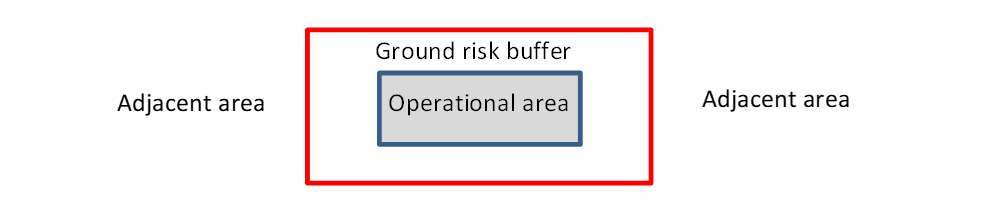
Figure 1 — Operational area and ground risk buffer
—Please, refer to GM2 UAS.SPEC.030(2) for guidance on the conditions to apply for ‘generic’ versus ‘precise’ locations.
—If location-specific: please, provide a list with the geo-coordinates for each location including the operational volume (flight geography and contingency volume), the ground risk buffer and the air risk buffer (if available) as a separate file using either ‘.txt’, ‘.kmz’ or ‘.kml’.
—If location-independent: please, provide a reference to the documented process for the determination of volumes and buffers and the assessment of the local conditions and their compliance limitations. An example of a geographical file (e.g. ‘.kmz’ or ‘.kml’) may be provided to show a typical operational volume, ground risk buffer and the air risk buffer (if available).
Step #1.2: Insert, for example, transport, inspection, filming, testing, etc.
Step #1.3: Please, provide a list with this information if location-specific with multiple locations.
Step #4.1: For information on the airspace classification, refer to Article 2 and to points SERA.6001 and SERA.6005 of Regulation (EU) No 923/2012.
Step #9.1: List the OSOs and the level of robustness you intend to comply with. The level of robustness should as a minimum reflect the one defined in Table 14 of Section S.4.9.3 of AMC1 Article 11 considering the SAIL listed in point ‘Step #7.1’ of this form.
SECTION 5Free-text field for the addition of any relevant remark.
Note: The signature and stamp may be provided in electronic form.
AMC2 UAS.SPEC.030(2) Application for an operational authorisation
ED Decision 2019/021/R
SIGNIFICANT CHANGES TO THE OPERATIONAL AUTHORISATION
(a)Any non-editorial change that affects the operational authorisation, or affects any associated documentation that is submitted to demonstrate compliance with the requirements established for the authorisation, should be considered to be a significant change.
(b)With regard to the information and documentation associated with the authorisation, changes should be considered to be significant when they involve, for example:
(1)changes in the operations that affect the assumptions of the risk assessment;
(2)changes that relate to the management system of the UAS operator (including changes of key personnel), its ownership or its principal place of business;
(3)non-editorial changes that affect the operational risk assessment report;
(4)non-editorial changes that affect the policies and procedures of the UAS operator; and
(5)non-editorial changes that affect the OM (when required).