
Filters
AMC7 Article 11 Rules for conducting an operational risk assessment
ED Decision 2023/012/R
OPERATIONS OF UNMANNED FREE BALLOONS
An operation using an unmanned free balloon that complies with the provisions defined in Appendix 2 to Regulation (EU) No 923/2012 is considered meeting the safety objectives of the operational risk assessment laid down in Article 11 and thus implies compliance with this Article.
Article 12 - Authorising operations in the ‘specific’ category
Regulation (EU) 2024/1110
1.The competent authority shall evaluate the risk assessment and the robustness of the mitigating measures that the UAS operator proposes to keep the UAS operation safe in all phases of flight.
2.The competent authority shall grant an operational authorisation when:
(a)the evaluation performed pursuant to paragraph 1 concludes that:
(i)the operational safety objectives take account of the risks of the operation;
(ii)the combination of mitigation measures concerning the operational conditions to perform the operations, the competence of the personnel involved and the technical features of the unmanned aircraft, are adequate and sufficiently robust to keep the operation safe in view of the identified ground and air risks;
(b)for UAS that are or will be certified pursuant to Article 40, point 1(d) of Delegated Regulation (EU) 2019/945, the UAS have:
(i)a valid certificate of airworthiness or a restricted certificate of airworthiness and, if the UA is subject to the environmental protection requirements laid down in point 21.B.85 of Regulation (EU) No 748/2012, a valid noise certificate; or
(ii)if the UA does not meet, or has not been shown to meet, the applicable airworthiness requirements, flight conditions approved according to Subpart P of Annex I (Part 21) to Regulation (EU) No 748/2012
(c)the UAS operator has provided to the competent authority a statement confirming that the intended operation complies with any applicable Union and national rules relating to it, in particular with regard to privacy, data protection, liability, insurance, security and environmental protection.
3.When the operation is not deemed sufficiently safe, the competent authority shall inform the applicant accordingly, giving reasons for its refusal to issue the operational authorisation.
4.The operational authorisation granted by the competent authority shall detail:
(a)the scope of the authorisation;
(b)the ‘specific’ conditions that shall apply:
ito the UAS operation and the operational limitations;
iito the required competency of the UAS operator and, where applicable, of the remote pilots;
iiito the technical features of the UAS, including the certification of the UAS, if applicable;
(c)the following information:
ithe registration number of the UAS operator and the technical features of the UAS;
iia reference to the operational risk assessment developed by the UAS operator;
iiithe operational limitations and conditions of the operation;
ivthe mitigation measures that the UAS operator has to apply;
vthe location(s) where the operation is authorised to take place and any other locations in a Member States in accordance with Article 13;
viall documents and records relevant for the type of operation and the type of events that should be reported in addition to those defined in Regulation (EU) No 376/2014 of the European Parliament and of the Council149.
viithe certificate of airworthiness or restricted certificate of airworthiness and noise certificate, where such certificates have been issued;
viiithe flight conditions approved in accordance with Regulation (EU) No 748/2012 where the UAS meets the conditions set out in Article 40, point 1(d) of Delegated Regulation (EU) 2019/945 and the UA does not meet, or has not been shown to meet, the applicable airworthiness requirements.
5.Upon receipt of the declaration referred to in paragraph 5 of Article 5, the competent authority shall:
(a)verify that it contains all elements set out in paragraph 2 of point UAS.SPEC.020 of the Annex;
(b)if this is the case, provide the UAS operator with a confirmation of receipt and completeness without undue delay so that the operator may start the operation.
AMC1 Article 12(2)(a) Authorising operations in the ‘specific’ category
ED Decision 2025/018/R
GRANTING AN OPERATIONAL AUTHORISATION FOR UAS OPERATIONS CLASSIFIED IN A SAIL WHERE THE LEVEL OF ROBUSTENSS OF OSOS AND MITIGATIONS IS LOW
When the risk assessment defined in Article 11 classifies the level of robustness of the operational safety objectives and the mitigations as ‘low’, the competent authority may issue an operational authorisation based on the applicant’s declaration of compliance with the related OSOs and mitigations.
The same applies in case the level of robustness is classified as ‘medium’ and the applicant has provided a declaration based on a means of compliance published by EASA.
For a VLOS UAS operation classified up to SAIL II according to AMC1 Article 11 (SORA), the competent authority may only validate the compliance matrix (i.e. Chapter A.4 of Annex A to AMC1 Article 11) provided by the UAS operator. The competent authority may authorise the operation without receiving evidence (e.g. the operations manual).
The applicant is responsible to comply with all the requirements and produce or obtain any required evidence (e.g. operations manual) and keep it updated during the time of validity of the operational authorisation.
AMC1 Article 12(5) Authorising operations in the ‘specific’ category
ED Decision 2019/021/R
DECLARATION, VERIFICATION AND ACKNOWLEDGEMENT OF RECEIPT
(a)The competent authority should establish an online system for the submission of operational declarations, which provides the submitter with an automatic acknowledgement of receipt when the submission has been successful.
(b)For a submission to be considered successful, the online system should check that all the required information has been provided. Otherwise, the system should indicate to the submitter which parts of the information still need to be added to complete the submission of the declaration (e.g. fields to be filled in, compliance with requirements or statements to be accepted or acknowledged, etc.).
(c)In order to facilitate cross-border operations, the acknowledgement of receipt should be written at least in English, in addition to the language of the Member State. A formula such as the following may be used:
‘The {name of the competent authority} acknowledges the receipt of the declaration submitted by {name of the UAS operator and UAS operator registration number}, on {date of submission of the declaration} related to the STS {identification of the STS}. The declaration has been found to be complete.’
Article 13 - Cross-border operations or operations outside the state of registration
Regulation (EU) 2020/639
1.When an UAS operator intends to conduct an operation in the ‘specific’ category for which an operational authorisation has already been granted in accordance with Article 12, and which is intended to take place partially or entirely in the airspace of a Member State other than the Member State of registration, the UAS operator shall provide the competent authority of the Member State of intended operation with an application including the following information:
(a)a copy of the operational authorisation granted to the UAS operator in accordance with Article 12; and
(b)the location(s) of the intended operation including the updated mitigation measures, if needed, to address those risks identified under Article 11(2)(b) which are specific to the local airspace, terrain and population characteristics and the climatic conditions.
2.Upon receipt of the application set out in paragraph 1, the competent authority of the Member State of intended operation shall assess it without undue delay and provide the competent authority of the Member State of registration and the UAS operator with a confirmation that the updated mitigation measures referred to in point (b) of paragraph 1 are satisfactory for the operation at the intended location. Upon receipt of that confirmation, the UAS operator may start the intended operation and the Member State of registration shall record the updated mitigation measures that the UAS operator has to apply in the operational authorisation issued in accordance with Article 12.
3.When an UAS operator intends to conduct an operation in the ‘specific’ category for which a declaration has been made in accordance with paragraph 5 of Article 5, and which is intended to take place partially or entirely in the airspace of a Member State other than the Member State of registration, the UAS operator shall provide the competent authority of the Member State of the intended operation with a copy of the declaration submitted to the Member State of registration, as well as a copy of the confirmation of receipt and completeness.
4.Where a UAS operator holding an LUC with privileges in accordance with point UAS.LUC.060 of the Annex intends to conduct an operation in the ‘specific category’ taking place partially or entirely in the airspace of a Member State other than the Member State of registration, the UAS operator shall provide the competent authority of the Member State of intended operation with the following information:
(a)a copy of the term of approval received in accordance with point UAS.LUC.050 of the Annex; and
(b)the location or locations of the intended operation in accordance with paragraph 1(b) of this Article.
AMC1 Article 13 Cross-border operations or operations outside the State of registration
ED Decision 2022/002/R
CROSS-BORDER OPERATIONS
(a)A UAS operator that intends to conduct an operation, for which an operational authorisation is required, partially or fully in a Member State other than the State of registration, it should firstly obtain any required authorisation for that operation from the State of registration, unless the UAS operator has a LUC with the appropriate privileges. This process applies also when the UAS operator intends to conduct an operation only in a MS other than the State of registration.
(b)The UAS operator should:
(1)identify the applicable local conditions in the area of operation;
(2)adapt the operational procedures, as necessary:
(i)to comply with the applicable local conditions150; and
(ii)as required by the application to the new location(s) of the mitigation measures, identified in the operational authorisation;
(3)submit to the competent authority of the MS of operation (refer to https://www.easa.europa.eu/domains/civil-drones/naa for the links to the NAA websites) an application for a cross-border operation using the form provided in AMC1 Article 13(1), attaching the following:
(i)a copy of the operational authorisation issued by the competent authority of the MS of registration, or a copy of the LUC terms of reference if the operation is conducted under the privileges of the LUC;
(ii)those chapter(s)/section(s) of the operations manual (OM) providing the operational procedures and the relevant information, amended as necessary, to comply with the local conditions and apply the mitigation measures to the new intended location(s), unless the UAS operator holds a LUC with the appropriate privileges; and
(iii)evidence of compliance of the amended procedures (refer to point ii) according to the level of robustness of the mitigation measures, if any, unless the UAS operator has a LUC with the appropriate privileges.
(c)The competent authority of the MS of operation should, without undue delay, evaluate the information provided by the UAS operator and verify the application of local condition(s) and of the updated mitigation measures applicable to the intended location(s) of the operation.
(d)Once the competent authority of the MS of operation is satisfied, it should provide the competent authority of the MS of registration and the UAS operator with the confirmation of acceptability (refer to the template provided in AMC1 Article 13(2)) that the updated mitigation measures and procedures are satisfactory for the intended location(s).
(e)After receiving the confirmation of acceptability, the UAS operator may start its operation.
(f)The competent authority of the MS of registration should issue a revision of the operational authorisation listing the additional new location(s), and provide a copy of the revised operational authorisation to the MS of authorisation and to the UAS operator.
(g)A UAS operator that holds a LUC with the appropriate privileges listed in its terms of reference may operate without following the above procedures. However, the UAS operator:
(1)must provide to the MS of operation the application using the form provided in AMC1 Article 13(1), attaching the following:
(i)a copy of the terms of approval received in accordance with point UAS.LUC.050 of the Annex to the UAS Regulation; and
(ii)the location(s) of the intended operation in accordance with paragraph 1(b) of Article 13(1) of the UAS Regulation.
(2)If the LUC terms of reference include the privileges to assess the local conditions and to apply the mitigation measures in other locations, than the UAS operator may start the operation as soon as it has received confirmation of receipt and completeness of the application.
(3)If the LUC terms of reference do not include the privileges to assess the local conditions and/or apply the mitigation measures in other locations, than the UAS operator may start the operation only after it has received the confirmation of acceptability (refer to the template provided in AMC1 Article 13(2)) that the updated mitigation measures and procedures are satisfactory for the intended location(s).
GM1 Article 13 Cross-border operations or operations outside the state of registration
ED Decision 2019/021/R
GENERAL
The picture below illustrates an example of an authorisation, already provided by the competent authority, to conduct an operation in the Member State of registration, which is used to conduct the same operation in another Member State:
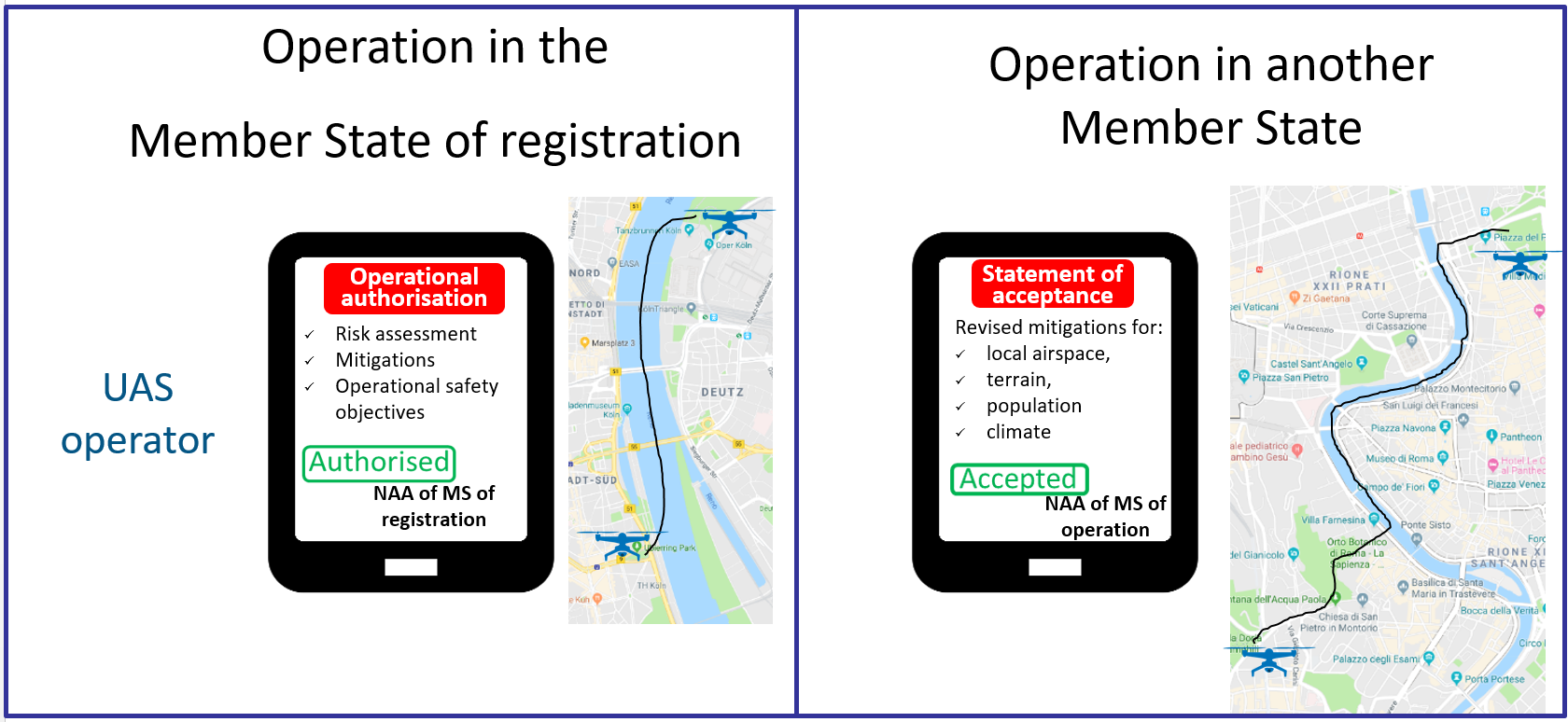
In the example, the UAS operator receives the authorisation from the competent authority of the Member State of registration where the mitigation measures are listed, and they may be adapted to the characteristics of the area of operation (e.g. the ground risk may be mitigated by flying over a river).
When the UAS operator intends to conduct the same operation in another Member State, a copy of the authorisation issued by the competent authority of the Member State of registration needs to be sent to the NAA of the Member State of the UAS operations. A number of elements of the mitigation measures may remain valid, such as the way the operator is organised, the competences of the pilot, or the characteristics of the UAS, for example. Other elements instead need to be adapted to the geography of the area of operation (e.g. the operations cannot be conducted mostly over the river, or it is necessary to identify a flight path meeting the equivalent conditions in terms of the ground risk, the local airspace, terrain and climate). On these points and also on the airspace, terrain and climate, the UAS operators are expected to review and possibly update the mitigation means, but only in relation to those elements.
The competent authority of the Member State of operation is not expected to review the full risk assessment, but to limit its activity to checking and providing the UAS operator and the competent authority of the Member State of registration with confirmation that the updated mitigation measures are satisfactory. Upon receipt of the confirmation, the UAS operator may start operating immediately, and the competent authority of registration will update the authorisation.
The picture below illustrates an example of the case when an operation complying with one of the STSs listed in Appendix 1 to the UAS Regulation is conducted in a Member State other than the state of registration:
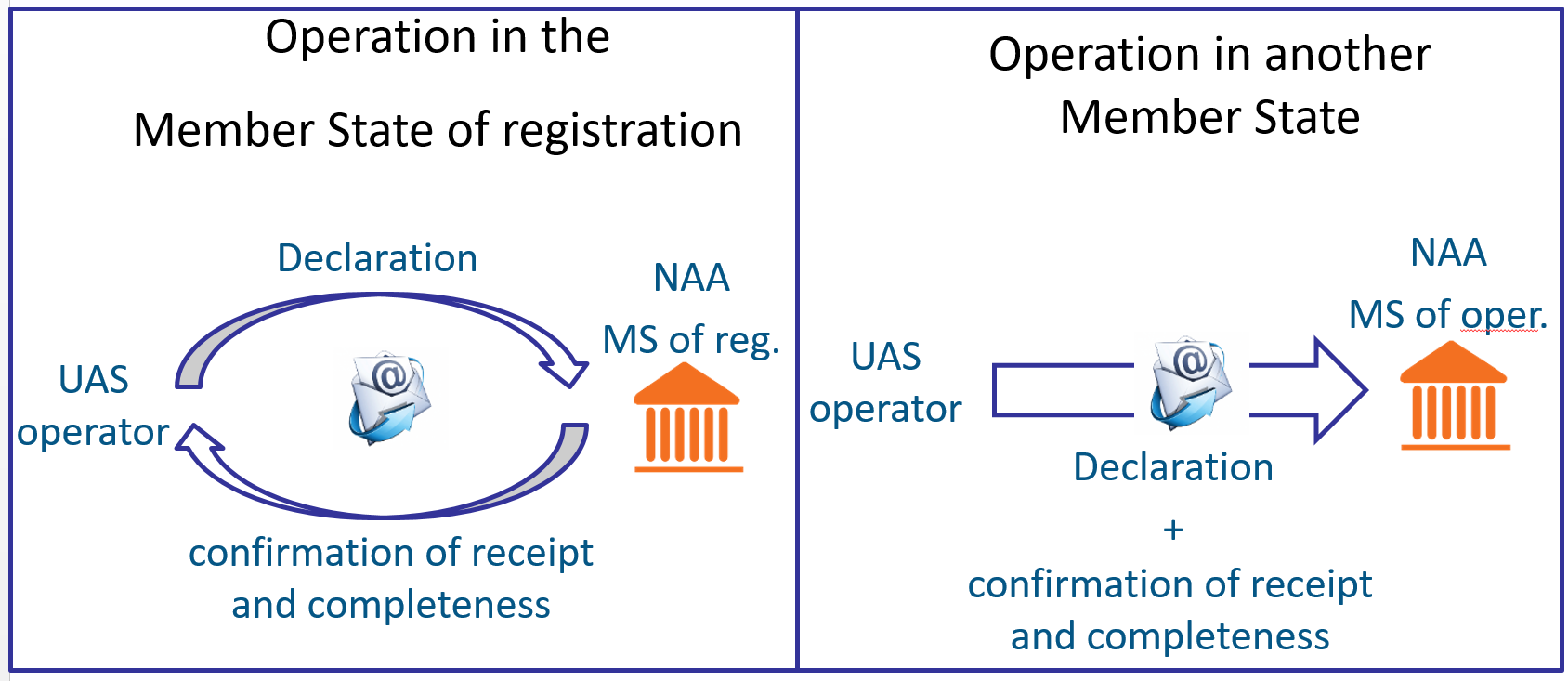
The UAS operator firstly submits the declaration to the competent authority of the Member State of registration, which, if the declaration complies with the UAS Regulation, issues a confirmation of receipt and completeness. The UAS operator will then provide the competent authority of the Member State of operations with a copy of the declaration and the confirmation of completeness received by the competent authority of the Member State of registration. There is no need for further verification.
AMC1 Article 13(1) Cross-border operations or operations outside the State of registration
ED Decision 2022/002/R
APPLICATION FORM FOR A CROSS-BORDER UAS OPERATION
| Application for a cross-border UAS operation in the ‘specific’ category | |||
Data protection: Personal data included in this application is processed by the competent authority pursuant to Regulation (EU) 2016/679 of the European Parliament and of the Council of 27 April 2016 on the protection of natural persons with regard to the processing of personal data and on the free movement of such data, and repealing Directive 95/46/EC (General Data Protection Regulation). Personal data will be processed for the purposes of the performance, management and follow-up of the application by the competent authority in accordance with Articles 12 and 13 of Regulation (EU) 2019/947 of 24 May 2019 on the rules and procedures for the operation of unmanned aircraft. If the applicant requires further information concerning the processing of their personal data or exercising their rights (e.g. to access or rectify any inaccurate or incomplete data), they should refer to the point of contact of their competent authority. The applicant has the right to file a complaint regarding the processing of their personal data at any time to the national data protection supervisory authority. | ||||
New application | Amendment to confirmation of acceptability NNN-CBO-xxxxx/yyy | |||
1. UAS operator and approval data | ||||
1.1 UAS operator registration number | ||||
1.2 UAS operator name | ||||
1.3 Operational point of contact Name Telephone | ||||
1.4 Type of approval | 1.4.1 Operational authorisation / LUC number issued by the MS of registration | 1.4.2 Expiry date | ||
☐ Operational authorisation ☐ LUC | DD/MM/YYYY | |||
2. Locations | ||||
2.1 Expected date of start of the operation | DD/MM/YYYY | 2.2 Expected end date | DD/MM/YYYY | |
2.3 Intended location(s) for the operation | ||||
2.4 Operational volume height limit | _____ m (______ ft) | |||
2.5 Airspace of the intended operation | A B C D E F G U-space Other, specify | |||
2.6. Applicable local conditions | ||||
3. Update of the application of the mitigation means and local conditions | ||||
3.1 Updated ‘Location of UAS operation’ chapter of the operations manual (OM), if applicable | ||||
3.2 Compliance evidence for updated mitigation measures and local conditions, if applicable | ||||
4. Remarks | ||||
5. Declaration of compliance | ||||
I, the undersigned, hereby request the confirmation of acceptability of the cross-border UAS operation in xxx (name of the Member State) and declare that the UAS operation will comply with: —any national rules related to privacy, data protection, liability, insurance, security, and environmental protection; —the applicable requirements of Regulation (EU) 2019/947; and —the limitations and conditions defined in the operational authorisation provided by the competent authority of the Member State of registration and in the confirmation of acceptability of the cross-border UAS operation provided by the competent authority of the Member State of operation. Moreover, I declare that the related insurance coverage, if applicable, will be in place at the start date of the UAS operation. | ||||
Date DD/MM/YYYY | Signature and stamp | |||

Instructions for filling in the application form
If the application relates to an amendment to a confirmation of acceptability for a cross-border UAS operation, please indicate the number of the confirmation of acceptability and fill out in red the fields that are amended compared to the last confirmation of acceptability.
1.1UAS operator registration number in accordance with Article 14 of the UAS Regulation.
1.2UAS operator’s name as declared during the registration process.
1.3Contact details of the person responsible for the operation, in charge to answer possible operational questions raised by the competent authority.
1.4Select one of the two options.
1.4.1Number of the operational authorisation or of the LUC terms of approval issued by the competent authority of the MS of registration. The referenced document should be attached to the application.
1.4.2Expiry date of the document listed in 1.4.2. If the validity is unlimited, indicate ‘Unlimited’.
2.1Date on which the UAS operator expects to start the operation.
2.2Date on which the UAS operator expects to end the operation. The UAS operator may ask for an unlimited duration; in this case, indicate ‘Unlimited’.
2.3Location(s) in the MS of operation where the UAS operator intends to conduct the UAS operation. The identification of the location(s) should contain the full operational volume and ground risk buffer (the red line in Figure 1). The location(s) should be expressed in the same way as in the operational authorisation (e.g. ‘generic’ or ‘precise’ (refer to GM2 UAS.SPEC.030(2)).
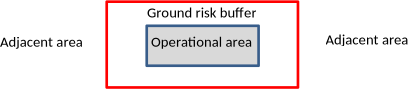
Figure 1 — Operational area and ground risk buffer
2.4Insert the upper limit, expressed in metres and feet in parentheses, of the contingency volume (adding the air risk buffer, if applicable) using the AGL reference when the upper limit is below 150 m (492 ft) or use the MSL reference when the upper limit is above 150 m (492 ft).
2.5Select one or more of the nine options. Select ‘other’ in case none of the previous is applicable (i.e. military areas).
2.6List the local conditions applicable to the location(s) defined in point 2.3 (e.g. special frequency to be avoided, national insurance regulation, etc.). If needed, a separate document may be attached.
3.1If operational procedures need to be updated to take into account the new locations or the local conditions, indicate either the identification and revision number of the OM or the document providing an extract of the OM including the chapter describing the operational procedures and the relevant information, amended by the UAS operator. This document should be attached to the application. Otherwise indicate ‘n/a’.
3.2If procedures are updated to address the characteristics of the new location or to meet the local conditions, indicate the compliance evidence file identification and revision number. This document should be attached to the application. Otherwise indicate ‘n/a’.
4Free-text field for the addition of any relevant remark.
Note:In case of LUC, point 3 should not be filled in if according to the LUC terms of approval the organisation has the privilege to extend the operational authorisation to different locations.
AMC1 Article 13(2) Cross-border operations or operations outside the State of registration
ED Decision 2022/002/R
FORM FOR THE CONFIRMATION OF ACCEPTABILITY OF A CROSS-BORDER UAS OPERATION IN THE ‘SPECIFIC’ CATEGORY
| Confirmation of acceptability of a cross-border UAS operation |
| ||
1. UAS operator and approval data | ||||
1.1 UAS operator registration number | ||||
1.2 UAS operator name | ||||
1.3 Operational point of contact Name Telephone | ||||
1.4 Type of approval | 1.4.1 Operational authorisation / LUC number issued by the MS of registration | 1.4.2 Expiry date | ||
☐ Operational authorisation ☐ LUC | DD/MM/YYYY | |||
2. Locations | ||||
2.1 Location(s) for the operation | ||||
2.2 Operational volume height limit | _____ m (______ ft) | |||
3. Remarks | ||||
4. Confirmation of acceptability | ||||
4.1 Confirmation number | ||||
4.2 Expiry date | DD/MM/YYYY | |||
3 Updated ‘Location of UAS operation’ chapter of the operations manual, if applicable | ||||
4.4 Compliance evidence for updated mitigations and local conditions | ||||
| ||||
Date DD/MM/YYYY | Signature and stamp | |||


Instructions for filling in the form for the ‘Confirmation of acceptability of a cross-border UAS operation in the “specific” category’.
1.1UAS operator registration number in accordance with Article 14 of the UAS Regulation.
1.2Name of the UAS operator as declared during the registration process.
1.3Contact details of the person responsible for the operation, in charge to answer possible operational questions raised by the competent authority.
1.4Select one of the two options.
1.4.1Number of the operational authorisation or of the LUC terms of approval issued by the competent authority of the MS of registration.
1.4.2Expiry date of the document listed in 1.4.2. If the validity is unlimited, indicate ‘Unlimited’.
2.1Location(s) in the MS of operation where the UAS operator is authorised to operate. The identification of the location(s) should contain the full operational volume and ground risk buffer (the red line in Figure 2). The location(s) should be expressed in the same way as in the operational authorisation (e.g. ‘generic’ or ‘precise’ (refer to GM2 UAS.SPEC.030(2)).
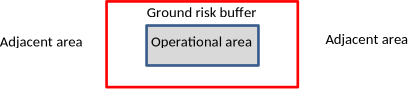
Figure 2 — Operational area and ground risk buffer
2.2Insert the upper limit, expressed in metres and feet in parentheses, of the approved contingency volume (adding the air risk buffer, if applicable) using the AGL reference when the upper limit is below 150 m (492 ft), or use the MSL reference when the upper limit is above 150 m (492 ft).
3.Free-text field for the addition of any relevant remark.
4.1Reference number of the confirmation of acceptability, as issued by the competent authority.
The number should have the following format:
NNN-CBO-xxxxx/yyy
Where:
—‘NNN’ is the ISO 3166 Alpha-3 code of the MS that issues the confirmation of acceptability of the operational authorisation number;
—‘CBO’ is a fixed field meaning ‘cross-border operation’;
—‘xxxxx’ are up to 12 alphanumeric characters defining the confirmation of acceptability of the operational authorisation number; and
—‘yyy’ are 3 alphanumeric characters defining the revision number of the confirmation of acceptability of the operational authorisation number. Each amendment of the confirmation of acceptability of the operational authorisation number will determine a new revision number.
4.2The duration of the confirmation of acceptability of the operational authorisation may be unlimited; in this case, indicate ‘Unlimited’. The confirmation of acceptability will be valid for as long as the UAS operator complies with the relevant provisions of the UAS Regulation and with the conditions defined in the operational authorisation and in the confirmation of acceptability.
4.3If the UAS operator has submitted to the competent authority of the MS of operation the full revised operations manual (OM), indicate its identification and revision number. Otherwise, in case only the chapter/section of the OM with the updated locations and procedures is submitted, provide its identification and revision number. In case no local conditions are identified or there is no need to update the procedures in the OM, indicate ‘n/a’.
4.4If provided, indicate the compliance evidence file identification and revision number.
Note 1: In case of LUC, points 4.3 and 4.4 may not be filled in if according to the LUC terms of approval the organisation has the privilege to extend the operational authorisation to different locations.
Note 2: The signature and stamp may be provided in electronic form. The QR code should provide the link to the national database where the confirmation of acceptability for cross-border operations is stored.
Article 14 - Registration of UAS operators and certified UAS
Regulation (EU) 2020/639
1.Member States shall establish and maintain accurate registration systems for UAS whose design is subject to certification and for UAS operators whose operation may present a risk to safety, security, privacy, and protection of personal data or environment.
2.The registration systems for UAS operators shall provide the fields for introducing and exchanging the following information:
(a)the full name and the date of birth for natural persons and the name and their identification number for legal persons;
(b)the address of UAS operators;
(c)their email address and telephone number;
(d)an insurance policy number for UAS if required by Union or national law;
(e)the confirmation by legal persons of the following statement: ‘All personnel directly involved in the operations are competent to perform their tasks, and the UAS will be operated only by remote pilots with the appropriate level of competency’;
(f)operational authorisations and LUCs held and declarations followed by a confirmation in accordance with Article 12(5)(b).
3.The registration systems for unmanned aircraft whose design is subject to certification shall provide the fields for introducing and exchanging the following information:
(a)manufacturer’s name;
(b)manufacturer’s designation of the unmanned aircraft;
(c)unmanned aircraft’s serial number;
(d)full name, address, email address and telephone number of the natural or legal person under whose name the unmanned aircraft is registered.
4.Member States shall ensure that registration systems are digital and interoperable and allow for mutual access and exchange of information through the repository referred to in Article 74 of Regulation (EU) 2018/1139.
5.UAS operators shall register themselves:
(a)when operating within the ‘open’ category any of the following unmanned aircraft:
i.with a MTOM of 250 g or more, or, which in the case of an impact can transfer to a human kinetic energy above 80 Joules;
ii.that is equipped with a sensor able to capture personal data, unless it complies with Directive 2009/48/EC.
(b)when operating within the ‘specific’ category an unmanned aircraft of any mass.
6.UAS operators shall register themselves in the Member State where they have their residence for natural persons or where they have their principal place of business for legal persons and ensure that their registration information is accurate. A UAS operator cannot be registered in more than one Member State at a time.
Member States shall issue a unique digital registration number for UAS operators and for the UAS that require registration, allowing their individual identification.
The registration number for UAS operators shall be established on the basis of standards that support the interoperability of the registration systems;
7.The owner of an unmanned aircraft whose design is subject to certification shall register the unmanned aircraft.
The nationality and registration mark of an unmanned aircraft shall be established in line with ICAO Annex 7. An unmanned aircraft cannot be registered in more than one State at a time.
8.The UAS operators shall display their registration number on every unmanned aircraft meeting the conditions described in paragraph 5.
9.In addition to the data defined in point (2) Member States may collect additional identity information from the UAS operators.
AMC1 Article 14 Registration of UAS operators and ‘certified’ UAS
ED Decision 2019/021/R
NATIONAL CONTACT POINT FOR ACCESSING AND EXERCISING THE RIGHTS
The competent authority should identify and publish the contact point for accessing and exercising the rights in accordance with Regulation (EU) 2016/679151 on the protection of natural persons with regard to the processing of personal data and on the free movement of such data.
GM1 Article 14(1) Registration of UAS operators and ‘certified’ UAS
ED Decision 2020/022/R
ACCURACY OF THE REGISTRATION SYSTEMS
UAS operators, when registering themselves or their certified UAS, are required to provide accurate information and update the registration data when it changes.
Member States are required to keep that information and registration data accurate in their registration systems.
An example of data that may change over time is:
—a UAS operator address, email address, and telephone number; and
—the validity of the insurance policy for the UAS.
To verify the validity of the insurance policy, Member States may require, at the time of registration, the UAS operator to provide the expiry date of the insurance policy and to consider the registration invalid after that date.
UAS operators, especially those conducting UAS operations for leisure, may decide to fly their UAS only for a short period; therefore, it is possible that even if the database of a registration system contains many registered UAS operators, only some of them are active. Member States may define a duration period for the validity of registration of all UAS operators and may revoke the registration number if the UAS operator does not renew that number before it expires. Member States may also decide to suspend or revoke the registration number if the UAS operator’s conduct justifies such a measure.
AMC1 Article 14(6) Registration of UAS operators and ‘certified’ UAS
ED Decision 2020/022/R
UAS OPERATOR REGISTRATION NUMBER
(a)The unique UAS operator digital registration number that is issued by the Member States should consist of sixteen (16) alphanumerics in total, arranged as follows:
(1)the first three (3) alphanumerics (upper-case only) corresponding to the ISO 3166 Alpha3 code of the Member State of registration;
(2)followed by twelve (12) randomly generated characters that consist of alphanumerics (lower-case only); and
(3)one (1) character corresponding to the checksum that is generated in line with point (c).
(b)The Member States should randomly generate three (3) additional alphanumerics (lower-case only) called ‘secret digits’.
(c)The Member States should generate a checksum by applying the Luhn-mod-36 algorithm to the fifteen (15) alphanumerics that result from the concatenation, in the following order, of:
(1)the twelve (12) alphanumerics of the UAS operator registration number defined in point (a)(2); and
(2)the three (3) randomly generated ‘secret digits’ that are defined in point (b).
(d)For the Luhn-mod-36 algorithm, the mapping of the alphanumerics to the code-points should start with digits that are followed by lower-case letters, as shown below:
Alphanumeric | 0 | 1 | 2 | 3 | 4 | 5 | 6 | 7 | 8 | 9 | a | b | c | d | e | f | … | z |
Code-point | 0 | 1 | 2 | 3 | 4 | 5 | 6 | 7 | 8 | 9 | 10 | 11 | 12 | 13 | 14 | 15 | … | 35 |
(e)At the time of registration, the Member State should provide the UAS operator with the full registration string that consists, in the following order, of:
(1)the UAS operator registration number as defined in point (a); and
(2)the three (3) randomly generated ‘secret digits’, separated by a hyphen ‘-’ (ASCII code [DEC] 45).
GM1 to AMC1 Article 14(6) Registration of UAS operators and ‘certified’ UAS
ED Decision 2020/022/R
UAS OPERATOR REGISTRATION NUMBER
An example of a UAS operator registration number as defined in point (a) of AMC1 Article 14(6) Registration of UAS operators and ‘certified’ UAS is ‘FIN87astrdge12k8’, where:
—‘FIN’ is the ISO 3166 Alpha-3 code of Finland;
—‘87astrdge12k’ is an example of the twelve (12) alphanumerics, as defined in point (a)(2) of AMC1 Article 14(6); and
—‘8’ is the checksum, i.e. the result of the application of the Luhn-mod-36 algorithm to the fifteen (15) alphanumerics that result from the concatenation of the twelve (12) alphanumerics of the UAS operator registration number and the three (3) randomly generated alphanumerics (‘secret digits’, as defined in point (b) of AMC1 Article 14(6)): ‘87astrdge12kxyz’.
An example of the full registration string, as defined in point (e) of AMC1 Article 14(6), to be provided by a Member State, is ‘FIN87astrdge12k8-xyz’, where:
—‘FIN87astrdge12k8’ is the UAS operator registration number; and
—‘xyz’ is an example of the three (3) randomly generated ‘secret digits’.
The UAS operator must upload the UAS registration number and the three (3) ‘secret digits’ into the remote identification system of the UAS, if available, or into the electronic-identification system, if required by the geographical zone.
The UAS operator should not share with anybody the three (3) ‘secret digits’ that are used to enhance the protection of the UAS operator registration number from being illegally uploaded into a UA.
AMC1 Article 14(8) Registration of UAS operators and ‘certified’ UAS
ED Decision 2020/022/R
DISPLAY OF REGISTRATION INFORMATION
(a)If the UAS operator owns the UAS or uses a UAS that is owned by a third party, it should:
(1)register itself;
(2)display on the UA the UAS operator registration number, which is received at the end of the registration process, in a way that the number is readable at least when the UA is on the ground, without using other devices than eyeglasses or corrective lenses; and
(3)upload the full string, which consists of the UAS operator registration number and the three (3) randomly generated alphanumerics, into the electronic identification system, if available.
(b)A QR code (quick response code) may be used.
(c)If the size of the UA does not allow the mark to be displayed in a visible way on the fuselage, or the UA represents a real aircraft where affixing the marking on the UA would spoil the realism of the representation, a marking inside the battery compartment is acceptable if the compartment is accessible.
Article 15 - Operational conditions for UAS geographical zones
Regulation (EU) 2020/639
1.When defining UAS geographical zones for safety, security, privacy or environmental reasons, Member States may:
(a)prohibit certain or all UAS operations, request particular conditions for certain or all UAS operations or require a prior flight authorisation for certain or all UAS operations;
(b)subject UAS operations to specified environmental standards;
(c)allow access to certain UAS classes only;
(d)allow access only to UAS equipped with certain technical features, in particular remote identification systems or geo awareness systems.
2.On the basis of a risk assessment carried out by the competent authority, Member States may designate certain geographical zones in which UAS operations are exempt from one or more of the ‘open’ category requirements.
3.When pursuant to paragraphs 1 or 2 Member States define UAS geographical zones, for geo awareness purposes they shall ensure that the information on the UAS geographical zones, including their period of validity, is made publicly available in a common unique digital format.
GM1 Article 15 Operational conditions for UAS geographical zones
ED Decision 2022/002/R
MEANS TO INFORM MANNED AVIATION OF UAS GEOGRAPHICAL ZONES
Depending on the duration of the validity of a UAS geographical zone, Member States may use AIPs and NOTAMs, as deemed appropriate, to inform manned aviation of:
—UAS geographical zones in which UASs are exempted from one or more of the ‘open’ category requirements in accordance with Article 15(2) of the UAS Regulation;
—other UAS geographical zones which are of relevance for manned aviation (e.g. U-space).
For temporary zones, NOTAMs may be used whereas for zones with longer duration, a publication in the AIP is more appropriate.
AMC1 Article 15(1) Operational conditions for UAS geographical zones
ED Decision 2022/002/R
CROSS-BORDER UAS GEOGRAPHICAL ZONE(S)
When more than one Member State decide to designate a cross-border UAS geographical zone(s), those Member States should establish coordination procedures in accordance with Article 19(1) of the UAS Regulation. Those coordination procedures should indicate which country codes should be used for the identification of the zone(s).
AMC2 Article 15(1) Operational conditions for UAS geographical zones
ED Decision 2022/002/R
DATA INTEGRITY
When data related to the UAS geographical zones described in GM3 to Article 15(1) Example 2 is processed, as a minimum, data integrity is ensured as prescribed in Part-ATM/ANS.OR.A.085(b)(2) ‘Aeronautical data quality management’ and in Part-AIS.TR.200(c) ‘General’ of Commission Implementing Regulation (EU) 2017/373 of 1 March 2017152.
GM2 Article 15(1) Operational conditions for UAS geographical zones
ED Decision 2022/002/R
GENERAL ASPECTS
In line with the Chicago Convention153, UAS geographical zones with restrictions and prohibitions should not be designated over the high seas / international airspace.
UAS geographical zones are defined in accordance with policies and procedures established by the Member States. Various entities (e.g. public institutions, law enforcement authorities, ANSPs, local authorities, nature park authorities, the military, etc.) may initiate the identification of UAS geographical zones. The initiating entity may provide the approving entity with the data on the UAS geographical zone(s) together with supporting material in accordance with the Member States’ arrangements for validation and confirmation or approval, as necessary.
Formal arrangements between the initiating entity and the entity that processes the data for the identification of the UAS geographical zone(s) may be considered. Such formal arrangements may include specific requirements on data quality.
If a flight authorisation is required to enter a UAS geographical zone, the Member States should also establish the related procedure and designate the entity responsible for providing such authorisation.
GM3 Article 15(1) Operational conditions for UAS geographical zones
ED Decision 2022/002/R
DATA QUALITY
When establishing UAS geographical zones, the Member States may require specific data quality requirements based on the purpose and location of a given zone.
Example 1
If a UAS geographical zone is of relevance to manned aviation (e.g. U-space or zones established according to Article 15(2)) of the UAS Regulation, it should, as far as practicable, comply with the data quality requirements applicable to prohibited/restricted/danger areas included in Appendix 1 ‘Aeronautical data catalogue’ to Annex III (Part-ATM/ANS.OR) to Commission Implementing Regulation (EU) 2017/373154.
Example 2
If a UAS geographical zone is relevant to UAS operations only, for example, over terrain that contains one of the infrastructures or areas/zones listed below, the MS may adapt the data quality requirements (e.g. accuracy) defined in Appendix 1 ‘Aeronautical data catalogue’ to Annex III (PartATM/ANS.OR) to Commission Implementing Regulation (EU) 2017/373 to the peculiarities of UAS operations:
—highways, express ways, and roads,
—railroads,
—hospitals,
—artworks,
—rural and urban areas,
—local restrictions to reduce noise, climate, and nature impact,
—nature parks,
—reserved areas,
—populated areas,
—bridges,
—critical sites,
—secure areas,
—electrical power lines,
—zones forbidden for aerial photography,
—harbour areas,
—industrial areas,
—emergency drone zones (e.g. areas for stacking or emergency landings in the event of traffic conflicts or equipment failure).
GM1 Article 15(2) Operational conditions for UAS geographical zones
ED Decision 2022/002/R
EXEMPTION(S) FROM ONE OR MORE OF THE REQUIREMENTS FOR UAS OPERATIONS IN THE ‘OPEN’ CATEGORY
Member States may designate UAS geographical zones in which UAS operations are exempted from one or more of the requirements for the ‘open’ category. UAS operators, when complying with the remaining requirements for the ‘open’ category, may operate without the need to apply for an operational authorisation.
GM2 Article 15(2) Operational conditions for UAS geographical zones
ED Decision 2022/002/R
EXEMPTION(S) FROM ONE OR MORE OF THE REQUIREMENTS FOR UAS OPERATIONS IN THE ‘OPEN’ CATEGORY
Examples of operations that the Member States may authorise in UAS geographical zones without an application for an operational authorisation are:
—operations in the ‘open’ category, conducted with UASs that exceed 25 kg (a different mass threshold may be defined by the Member States);
—operations in the ‘open’ category, conducted at a height that exceeds 120 m (a different height threshold may be defined by the Member States).
Exemptions may also apply to all categories, for example, geographical zones where UASs are exempted from some technical features, such as electronic identification or geo-awareness.
AMC1 Article 15(3) Operational conditions for UAS geographical zones
ED Decision 2022/002/R
COMMON UNIQUE DIGITAL FORMAT
The ‘common unique digital format’ should be as described in Chapter 8 ‘UAS restriction zone data model’ and Appendix 2 ‘INFORMATION DEFINITION AND DATA STRUCTURES’ of EUROCAE ED269 ‘MINIMUM OPERATIONAL PERFORMANCE STANDARD FOR GEOFENCING’, Edition June 2020.
AMC2 Article 15(3) Operational conditions for UAS geographical zones
ED Decision 2022/002/R
PUBLICATION OF INFORMATION ON UAS GEOGRAPHICAL ZONES IN THE AERONAUTICAL INFORMATION PRODUCTS AND SERVICES
(a)The Member States should publish in Section ENR 5.3.1 ‘Other activities of a dangerous nature’ of the aeronautical information publication (AIP) the information on where and how the data on UAS geographical zones is publicly available in the common unique digital format.
(b)The Member States should publish information on UAS geographical zones that are relevant to manned aircraft operations in Section ENR 5.1 ‘Prohibited, restricted and danger areas’ of the AIP.
(c)In addition to making UAS geographical zones publicly available in the common unique digital format, the Member States, when publishing data in the AIP, should ensure consistency.
AMC3 Article 15(3) Operational conditions for UAS geographical zones
ED Decision 2022/002/R
CROSS-BORDER UAS GEOGRAPHICAL ZONE(S)
All affected neighbouring Member States should make data available for the entire cross-border UAS geographical zone including the part(s) that is (are) located in their own territory and the part(s) that is (are) located in the territory(ies) of the neighbouring State(s) (the responsibility for data quality of the respective parts remains with the respective Member State). The conditions for the coordination process should ensure consistency across all resulting data sets.
AMC4 Article 15(3) Operational conditions for UAS geographical zones
ED Decision 2022/002/R
PUBLICATION OF MAPS OF UAS GEOGRAPHICAL ZONES
When Member States decide to publish maps of UAS geographical zones on their website or via smartphone applications, in addition to the data made available in the common unique digital format, consistency with Chapter 8 of ED-269, Edition June 2020, should be ensured.
The Member States should ensure consistency with the relevant aeronautical information publication (AIP) data in cases where a UAS geographical zone is at the same time established and published for the purpose of manned aviation. This, for instance, is the case for U-space airspace.
GM1 Article 15(3) Operational conditions for UAS geographical zones
ED Decision 2022/002/R
EXAMPLES OF MAPS OF UAS GEOGRAPHICAL ZONES WITH COLOUR-CODE INDEX
Note: The following examples, including colour codes and explanations, are courtesy of the ‘Latvijas gaisa satiksme’, the Latvian ANSP, for the purpose of illustration only and should not be used for UAS operations.
The examples represent a possible approach of a Member State to present UAS geographical zones in a way which is proven to be compliant with the ED-269 standard. A maximum level of standardisation/harmonisation would be beneficial for the EU-wide implementation of Article 15 of the UAS Regulation.
This example provides a simplified and clearly understandable way to visualise UAS geographical zones to non-ATM professionals. The set of colours is limited to the three colours of the traffic light scheme illustrating the purpose of a UAS geographical zone.
Detailed information related to a respective UAS geographical zone, such as details of restrictions, maximum height, maximum noise level, application procedure for flight authorisation, etc., may be provided when the UAS operator selects the respective zone on the website or on the smartphone application.
COLOUR CODE | MEANING |
| UAS geographical zones where UAS operations are prohibited. However, restrictions may be waived for particular users. UAS operations in some UAS geographical zones may be subject to the fulfilment of special requirements, e.g. compliance with published procedures, request for flight authorisation, etc. The competent authority should publish the conditions for obtaining the waiver and the point of contact of the entity from which the flight authorisation needs to be requested. |
| UAS geographical zones where UAS operations are limited and subject to the fulfilment of a set of conditions that are imposed for such zones. Such limitations and conditions may concern administrative procedures, operational limitations, or technical requirements for the UAS or mandatory functions. For example, UAS operations are permitted in such UAS geographical zones if the UAS MTOM does not exceed 1.5 kg and the flight altitude is below 50 m above the ground. |
| UAS geographical zones that facilitate UAS operations in the ‘open’ category (UAS operations are exempt from one or more of the ‘open’ category requirements). |
| U-space airspace where UAS operations are supported by a set of Uspace services. UAS operations are compliant with the capability and performance requirements that are determined for the particular U-space airspace. The Member States should list the U-space service provider(s) (USSP(s)) that is (are) identified for that geographical zone. |
| Riga flight information region (FIR) boundary. |





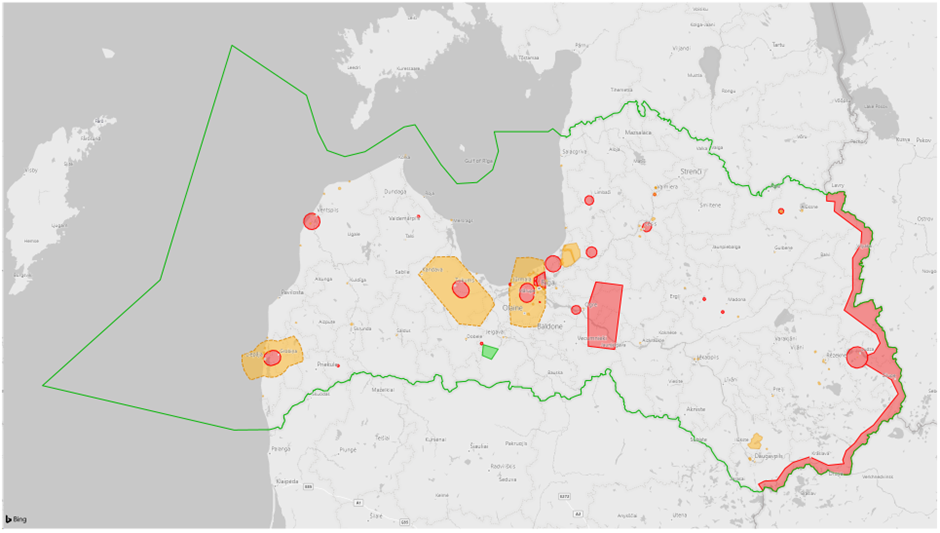
Figure 1 — Example of UAS geographical zones
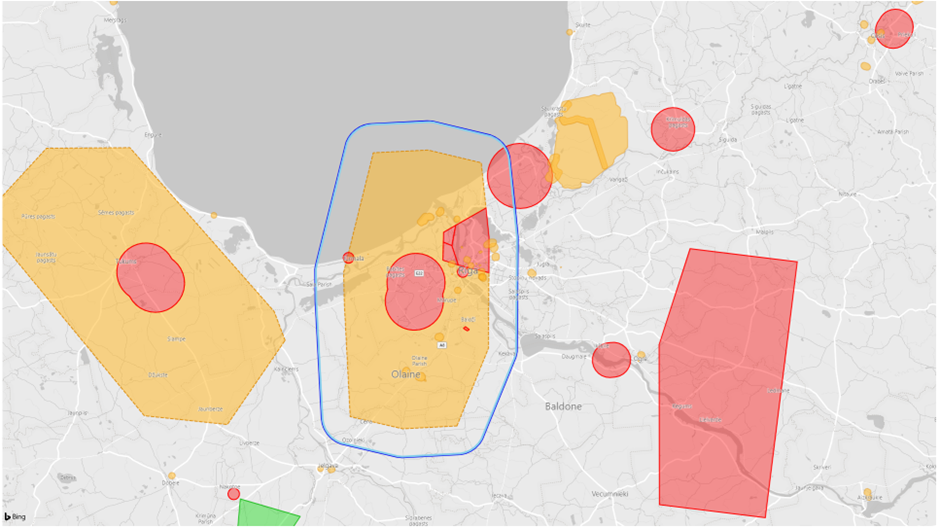
Figure 2 — Example of UAS geographical including representation of planned U-space
Article 16 - UAS operations in the framework of model aircraft clubs and associations
Regulation (EU) 2019/947
1.Upon request by a model aircraft club or association, the competent authority may issue an authorisation for UAS operations in the framework of model aircraft clubs and associations.
2.The authorisation referred to in paragraph 1 shall be issued in accordance with any of the following:
(a)relevant national rules;
(b)established procedures, organisational structure and management system of the model aircraft club or association, ensuring that:
i.remote pilots operating in the framework of model aircraft clubs or associations are informed of the conditions and limitations defined in the authorisation issued by the competent authority;
ii.remote pilots operating in the framework of model aircraft clubs or associations are assisted in achieving the minimum competency required to operate the UAS safely and in accordance with the conditions and limitations defined in the authorisation;
iii.the model aircraft club or association takes appropriate action when informed that a remote pilot operating in the framework of model aircraft clubs or associations does not comply with the conditions and limitations defined in the authorisation, and, if necessary, inform the competent authority;
iv.the model aircraft club or association provides, upon request from the competent authority, documentation required for oversight and monitoring purposes.
3.The authorisation referred to in paragraph 1 shall specify the conditions under which operations in the framework of the model aircraft clubs or associations may be conducted and shall be limited to the territory of the Member State in which it is issued.
4.Member States may enable model aircraft clubs and associations to register their members into the registration systems established in accordance with Article 14 on their behalf. If this is not the case, the members of model aircraft clubs and associations shall register themselves in accordance with Article 14.
GM1 Article 16 UAS operations in the framework of model aircraft clubs and associations
ED Decision 2019/021/R
GENERAL
Unless differently provided by national regulation, a model aircraft club and association may obtain from the national competent authority an authorisation that is valid for all their members to operate UA according to conditions and limitations tailored for the club or association.
The model aircraft club and association will submit to the competent authority the procedures that all members are required to follow. When the competent authority is satisfied with the procedures, organisational structure and management system of the model aircraft club and association, it may provide an authorisation that defines different limitations and conditions from those in the UAS Regulation. The authorisation will be limited to the operations conducted within the authorised club or association and within the territory of the Member State of the authorised competent authority. The authorisation cannot exempt members of the club or association from registering themselves according to Article 14 of the UAS Regulation; however, it may allow a model club or association to register their members on their behalf.
The authorisation may also include operations by persons who temporarily join in with the activities of the club or association (e.g. for leisure during holidays or for a contest), as long as the procedures provided by the club or association define conditions acceptable to the competent authority.
GM2 Article 16 UAS operations in the framework of model aircraft clubs and associations
ED Decision 2019/021/R
OPTIONS TO OPERATE A MODEL AIRCRAFT
Model flyers have the following options to conduct their operations:
(a)They may operate as members of a model club or association that has received from the competent authority an authorisation, as defined in Article 16 of the UAS Regulation. In this case, they should comply with the procedures of the model club or association in accordance with the authorisation. The authorisation should define all the deviations from the aforementioned Regulation granted to the model club or association’s members. Members must register themselves in accordance with Article 14 of the UAS Regulation, except when the model aircraft clubs and associations have obtained from the Member State the right to register their members in the registration system.
(b)In accordance with Article 15(2) of the UAS Regulation, Member States may define zones where UAS are exempted from certain technical requirements, and/or where the operational limitations are extended, including mass or height limitations. They may also define different height limitations for those zones.
(c)The UAS may be operated in Subcategory A3, in which the following categories of UAS are allowed to fly according to the limitations and conditions defined in UAS.OPEN.040:
(1)UAS with a class C0, C1, C2, C3, C4 CE mark;
(2)UAS that meet the requirements defined in Article 20(b) of the UAS Regulation; and
(3)privately built UAS with MTOMs of less than 25 kg.
GM1 Article 16(2)(b)(iii) UAS operations in the framework of model aircraft clubs and associations
ED Decision 2019/021/R
ACTION IN CASES OF OPERATIONS/FLIGHTS THAT EXCEED THE CONDITIONS AND LIMITATIONS DEFINED IN THE OPERATIONAL AUTHORISATION
When a model club or association is informed that a member has exceeded the conditions and limitations defined in the operational authorisation, appropriate measures will be taken, proportionate to the risk posed. Considering the level of risk, the model club or association decides whether the competent authority should be informed. In any case, occurrences that cause an injury to persons or where the safety of other aircraft was compromised, as defined in Article 125 of Regulation (EU) 2018/1139159, must be reported by the model club or association to the competent authority.
Article 17 - Designation of the competent authority
Regulation (EU) 2019/947
1.Each Member State shall designate one or more entities as the competent authority for the tasks referred to in Article 18.
2.Where a Member State designates more than one entity as a competent authority it shall:
(a)clearly define the areas of competence of each competent authority in terms of responsibilities;
(b)establish appropriate coordination mechanism between those entities to ensure the effective oversight of all organisations and persons subject to this Regulation.
GM1 Article 17 Designation of the competent authority
ED Decision 2019/021/R
GENERAL
Member States may also designate an entity as a competent authority only for specific tasks. It should be highlighted that in such a case, this entity must comply with Article 62(3) of Regulation (EU) 2018/1139 and is the one that will be audited by EASA under Article 85 (monitoring of Member State) of the same Regulation.
Article 18 - Tasks of the competent authority
Regulation (EU) 2019/947
The competent authority shall be responsible for:
(a)enforcing this Regulation;
(b)issuing, suspending or revoking certificates of UAS operators and licenses of remote pilots operating within the ‘certified’ category of UAS operations;
(c)issuing remote pilots with a proof of completion of an online theoretical knowledge examination according to points UAS.OPEN.020 and UAS.OPEN.040 of the Annex and issuing, amending, suspending, limiting or revoking certificates of competency of remote pilots according to point UAS.OPEN.030 of the Annex;
(d)issuing, amending, suspending, limiting or revoking operational authorisations and LUCs and verifying completeness of declarations, which are required to carry out UAS operations in the ‘specific’ category of UAS operations;
(e)keeping documents, records and reports concerning UAS operational authorisations, declarations, certificates of competency of the remote pilots and LUCs;
(f)making available in a common unique digital format information on UAS geographical zones identified by the Member States and established within the national airspace of its State;
(g)issuing a confirmation of receipt and completeness in accordance with Article 12(5)(b) or a confirmation in accordance with paragraph 2 of Article 13;
(h)developing a risk-based oversight system for:
i.UAS operators that have submitted a declaration or hold an operational authorisation or an LUC;
ii.model clubs and associations that hold an authorisation referred to in Article 16;
(i)for operations other than those in the ‘open’ category, establishing audit planning based on the risk profile, compliance level and the safety performance of UAS operators who have submitted a declaration, or hold a certificate issued by the competent authority;
(j)for operations other than those in the ‘open’ category, carrying out inspections with regard to UAS operators who have submitted a declaration or hold a certificate issued by the competent authority inspecting UAS and ensuring that UAS operators and remote pilots comply with this Regulation;
(k)implementing a system to detect and examine incidents of non-compliance by UAS operators operating in the ‘open’ or ‘specific’ categories and reported in accordance with paragraph 2 of Article 19;
(l)providing UAS operators with information and guidance that promotes the safety of UAS operations;
(m)establishing and maintaining registration systems for UAS whose design is subject to certification and for UAS operators whose operation may present a risk to safety, security, privacy, and protection of personal data or the environment.
GM1 Article 18(a) Tasks of the competent authority
ED Decision 2019/021/R
ENFORCEMENT
Member States are responsible for enforcing the UAS Regulation, and it is their decision to nominate the competent authority. In making this decision, Member States should consider that most of the UAS operations will occur in areas far from aerodromes, and therefore, the selected competent authority should employ personnel able to verify that the UAS operations conducted in such areas are safe. In addition, the issues that are likely to occur more often will be related to noise, privacy and security. Taking all this into account, law enforcement authorities may be well-placed to fulfil that role. Law enforcement authorities may take different forms, depending on the Member State’s national legal framework.
AMC1 Article 18(e) Tasks of the competent authority
ED Decision 2022/002/R
DOCUMENTS, RECORDS AND REPORTS TO BE RETAINED
(a)The competent authority should retain at least the following documentation:
(1)operational authorisations, in accordance with Article 12(2) of the UAS Regulation:
(i)the initial application for an authorisation as defined in UAS.SPEC.030(3) of Part-B and the associated documents;
(ii)the application(s) for updated operational authorisations;
(iii)the final version of the risk assessment performed by the UAS operator, and the supporting material;
(iv)the UAS operator’s statement confirming that the intended UAS operation complies with any applicable European Union and national rules relating to it, in particular with regard to privacy, data protection, liability, insurance, security and environmental protection, in accordance with Article 12(2)(c) of the UAS Regulation;
(v)the procedures to ensure that all operations comply with Regulation (EU) 2016/679 on the protection of natural persons with regard to the processing of personal data and on the free movement of such data;
(vi)confirmation by the competent authority of the Member State of operation that the updated mitigation measures are satisfactory for the operation at the intended location in accordance with Article 13(2) of the UAS Regulation;
(vii)when applicable, a procedure for coordination with the relevant service provider for the airspace if the entire operation, or part of it, is to be conducted in controlled airspace; and
(viii)up-to-date operational authorisation(s) with a table outlining successive changes;
(2)declarations in accordance with Article 12(5) of the UAS Regulation:
(i)up-to-date declarations with a table outlining successive changes;
(ii)up-to-date confirmations of receipt and completeness, provided in accordance with Article 12(5)(b) of the UAS Regulation, with a table outlining successive changes;
(3)remote pilots’ competency:
(i)proof of competency for remote pilots that have passed the online theoretical knowledge examination in accordance with UAS.SPEC.020(4)(b) of Part-B;
(ii)certificates of remote pilot competency for remote pilots that have passed the examination in accordance with UAS.SPEC.030(2)(c) of Part-B, with the declaration of completion of the practical self-training provided by the remote pilot; and
(iii)proof of competency or other certificates for remote pilots, as required by the STSs as defined in Appendix 1 to the UAS Regulation or the operational authorisations;
(4)Light UAS Operator Certificates:
(i)initial applications in accordance with UAS.LUC.010(2) of Part-C and associated documents;
(ii)applications for amendments to an existing LUC, and the associated documents; and
(iii)up-to-date terms of approval in accordance with UAS.LUC.050 of Part-C, with a table outlining the successive changes.
(5)Documentation related to audits and inspections regarding the oversight of the competent authority by EASA, as well as the oversight of UAS operators and other entities by the competent authority. This documentation should include at least the following:
(i)training, qualifications, and authorisation of team leaders and team members of the competent authority;
(ii)audit/inspection programmes;
(iii)reports, including at least the following information:
—objectives of the audit/inspection;
—date of the audit/inspection;
—type of the audit (on-site, off-site);
—personnel involved;
—summary of the main elements discussed;
—reference to the related evidence.
Note: In case of off-site audits/inspections, it should also be indicated the extent to which remote information and communication technology (ICT) has been used in conducting the audit and the effectiveness of the ICT in achieving the audit/inspection objectives. Other aspects to be considered in case of off-site activities are digital data protection and security of access.
(iv)findings and related evidence;
(v)agreed corrections and corrective actions; and
(vi)closure of findings of non-conformities and related evidence.
(b)The records should be kept for at least 3 years after their validity date expires.
GM1 Article 18(h) Tasks of the competent authority
ED Decision 2019/021/R
GUIDELINES FOR RISK-BASED OVERSIGHT (RBO)
NOTE: The guidelines below are based on the document ‘Practices for risk-based oversight’, which may be found at the address below, and where further information may also be found:
https://www.easa.europa.eu/document-library/general-publications/practices-risk-based-oversight
That document:
—highlights the relationship between RBO and the (safety) management system, the management of change, the overall performance of the organisation and the oversight cycle;
—describes the interconnection, availability and exchange of data, which will significantly change the relationship between the authority and their regulated entities, as well as their ongoing management of safety;
—does not constitute regulatory material nor means of compliance nor guidance material. It reflects the RBO state of play to date, in an effort to gain a common understanding and to look ahead; and
—can be used as guidelines for competent authorities who have to implement RBO.
(a)General Definitions:
(1)Oversight: the function by means of which a competent authority ensures that the applicable requirements are met by regulated entities.
(2)Risk profile: the element of risks that are inherent to the nature and operations of the regulated entity, this includes the:
—specific nature of the organisation;
—complexity of its activities; and
—risks stemming from the activities carried out.
(3)Safety performance: the demonstration of how effectively a regulated entity can mitigate its risks, substantiated through the proven ability to:
—comply with the applicable requirements;
—implement and maintain effective safety management;
—identify and manage safety risks; and
—achieve and maintain safe operations.
The results of past certification or oversight also need to be taken into account.
(4)RBO: a way of performing oversight, in which:
—planning is driven by the combination of the risk profile and safety performance; and
—execution focuses on the management of risk, besides ensuring compliance.
(b)The RBO scheme is summed-up by the drawing below:
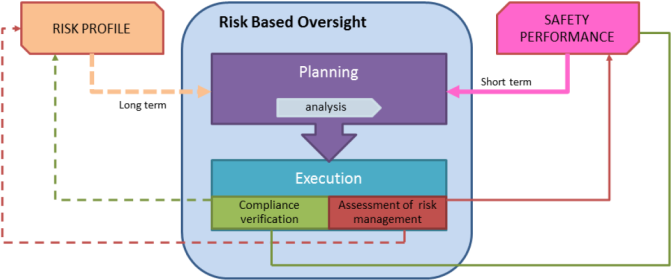
(1)the risk profile and oversight are described in paragraph 3 of the ‘Practices for risk-based oversight’;
(2)the management of safety information and information sharing with other authorities are described in paragraph 4 of ‘Practices for risk-based oversight’;
(3)the training and qualification of inspectors are described in paragraph 4.3 of ‘Practices for risk-based oversight’;
(4)conducting risk-based audits is described in paragraph 5 of ‘Practices for risk-based oversight’.
Article 19 - Safety information
Regulation (EU) 2024/1110
1.The competent authorities of the Member States and market surveillance and control authorities referred to in Article 36 of Delegated Regulation (EU) 2019/945 shall cooperate on safety matters and establish procedures for the efficient exchange of safety information.
2.Each UAS operator shall report to the competent authority on any safety-related occurrence and exchange information regarding its UAS in compliance with Regulation (EU) No 376/2014.
3.The European Union Aviation Safety Agency (‘the Agency’) and the competent authorities shall collect, analyse and publish safety information concerning UAS operations in their territory in accordance with Article 119 of Regulation (EU) 2018/1139 and its implementing acts.
4.Upon receiving any of the information referred to in paragraphs 1, 2 or 3, the Agency and the competent authority shall take the necessary measures to address any safety issues on the best available evidence and analysis, taking into account interdependencies between the different domains of aviation safety, and between aviation safety, cyber security and other technical domains of aviation regulation.
5.Where the competent authority or the Agency takes measures in accordance with paragraph 4, it shall immediately notify all relevant interested parties and organisations that need to comply with those measures in accordance with Regulation (EU) 2018/1139 and its implementing acts.
6.Notwithstanding Regulation (EU) No 376/2014, the UAS operator of an unmanned aircraft which design is certified shall report to the design approval holder of the UAS or of the UAS component any safety-related event or condition of the UAS or the UAS component identified by the organisation. In particular, the UAS operator shall report any accident or serious incident involving the UAS or the UAS component, which endangers or, if not duly corrected or addressed, could endanger the safety of the UAS or of any natural or legal person.
GM1 Article 19 Safety information
ED Decision 2019/021/R
EXCHANGE OF SAFETY INFORMATION
Cooperation between competent authorities should be organised pursuant to Article 61 of Regulation (EU) 2018/1139. Cooperation between market surveillance authorities and the exchange of safetyrelated and non-compliance information should be organised pursuant to Regulation (EC) No 765/2008160. Article 19 of the UAS Regulation is intended to help organise the information flow and cooperation between the competent authorities on the one hand, and between the market surveillance authorities on the other.
Cooperation should be organised primarily at the Member State level. All the competent authorities concerned should make the best use of the information systems defined in Articles 22 ‘Exchange of information — Community Rapid Information System’ and 23 ‘General information support system’ of Regulation (EC) No 765/2008, as well as of the occurrence-reporting system of Regulation (EU) No 376/2014.
GM1 Article 19(1) Safety information
ED Decision 2022/002/R
CROSS-BORDER GEOGRAPHICAL ZONE(S)
The coordination among the Member States includes the designation of cross-border geographical zones as per AMC1 Article 15(1).
GM1 Article 19(2) Safety information
ED Decision 2019/021/R
OCCURRENCE REPORT
According to Regulation (EU) No 376/2014, occurrences shall be reported when they refer to a condition which endangers, or which, if not corrected or addressed, would endanger an aircraft, its occupants, any other person, equipment or installation affecting aircraft operations. Obligations to report apply in accordance with Regulation (EU) No 376/2014, namely its Article 3(2), which limits the reporting of events for operations with UA for which a certificate or declaration is not required, to occurrences and other safety-related information involving such UA if the event resulted in a fatal or serious injury to a person, or it involved aircraft other than UA.
Article 20 - Particular provisions concerning the use of certain UAS in the ‘open’ category
Regulation (EU) 2022/425
UAS types within the meaning of Decision No 768/2008/EC of the European Parliament and of the Council161, which do not comply with Delegated Regulation (EU) 2019/945 and which are not privatelybuilt are allowed to continue to be operated under the following conditions, when they have been placed on the market before 1 January 2024:
(a)in subcategory A1 as defined in Part A of the Annex, provided that the unmanned aircraft has a maximum take-off mass of less than 250 g, including its payload;
(b)in subcategory A3 as defined in Part A of the Annex, provided that the unmanned aircraft has a maximum take-off mass of less than 25 kg, including its fuel and payload.
Article 21 - Adaptation of authorisations, declarations and certificates
Regulation (EU) 2020/746
1.Authorisations granted to UAS operators, certificates of remote pilot competency and declarations made by UAS operators or equivalent documentation, issued on the basis of national law, shall remain valid until 1 January 2022.
2.By 1 January 2022 Member States shall convert their existing certificates of remote pilot competency and their UAS operator authorisations or declarations, or equivalent documentation, including those issued until that date, in accordance with this Regulation.
3.Without prejudice to Article 14, UAS operations conducted in the framework of model aircraft clubs and associations shall be allowed to continue in accordance with relevant national rules and without an authorisation in accordance with Article 16 until 1 January 2023.
Article 22 - Transitional provisions
Regulation (EU) 2022/425
Without prejudice to Article 20, the use of UAS in the ‘open’ category which do not comply with the requirements of Parts 1 to 5 of the Annex to Commission Delegated Regulation (EU) 2019/945162 shall be allowed for a transitional period ending on 31 December 2023, subject to the following conditions:
(a)unmanned aircraft with a take-off mass of less than 500 g are operated within the operational requirements set out in points UAS.OPEN.020(1) of Part A of the Annex by a remote pilot having competency level defined by the Member State concerned;
(b)unmanned aircraft with a take-off mass of less than 2 kg is operated by keeping a minimum horizontal distance of 50 meters from people and the remote pilots have a competency level at least equivalent to the one set out in point UAS.OPEN.030(2) of Part A of the Annex;
(c)unmanned aircraft with a take-off mass of less than 25 kg is operated within the operational requirements set out in point UAS.OPEN.040(1) and (2) and the remote pilots have a competency level at least equivalent to the one set out in point UAS.OPEN.020(4)(b) of Part A of the Annex.
GM1 Article 22(b) Transitional provisions
ED Decision 2022/002/R
UAS OPERATIONS CLOSE TO PERSONS
When operating a UAS with a maximum take-off mass (MTOM) of up to 2 kg, the remote pilot may fly the UAS keeping a minimum horizontal distance of 50 m from uninvolved persons (please refer to GM1 Article 2(18) for additional information).
Article 23 - Entry into force and application163
Regulation (EU) 2022/425
1.This Regulation shall enter into force on the twentieth day following that of its publication in the Official Journal of the European Union.
It shall apply from 31 December 2020.
2.Article 5(5) shall apply from 1 January 2024;
3.Points UAS.OPEN.060(2)(g) UAS.SPEC.050(1)(l)(i) of the Annex shall apply from 1 July 2022 and point UAS.SPEC.050(1)(l)(ii) of the Annex shall apply from 1 January 2024.
4.Without prejudice to Article 21(1), until 31 December 2023 Member States may accept declarations made by UAS operators in accordance with Article 5(5), based on national standard scenarios or equivalent, if those national scenarios meet the requirements of point UAS.SPEC.020 of the Annex.
Such declarations shall cease to be valid from 1 January 2026.
5.Paragraph 3 of Article 15 shall apply from 1 January 2022.
This Regulation shall be binding in its entirety and directly applicable in all Member States.
Done at Brussels, 12 March 2019.
For the Commission
The President
Jean-Claude JUNCKER