
The Season Isn't Over Yet – Stay Focused, Stay Safe
As the summer flying season continues, many of the biggest operational challenges are no longer ahead of us—they're already here.
Airspace remains busy, aircraft utilisation is high, weather continues to disrupt carefully planned schedules and many aviation professionals have already been working at an intense pace for several months. It is also the point in the season where fatigue begins to accumulate, operational pressure can become the norm and the temptation to take shortcuts becomes greatest.
Earlier this summer, EASA launched its "Go Safe This Summer – Together" campaign and published the latest edition of Conversation Aviation, bringing together practical articles on the key safety challenges facing aviation throughout the summer season.
This article revisits the campaign's central message because it remains just as relevant today as it was at the start of the season.
Summer does not usually introduce entirely new risks. Instead, it amplifies the ones we already know. As the weeks pass, people become more tired, disruptions become harder to recover from and familiar tasks can begin to feel routine. That is exactly when we need to consciously return to the fundamentals.
Safe summer operations continue to depend on three simple principles:
- Watch for fatigue
- Follow the basics
- Speak up early
These are simple messages, but they become even more important as the season progresses.
Summer Changes the Operating Environment
Summer flying often represents aviation at its most dynamic. Passenger demand peaks. Seasonal routes expand. Aircraft utilisation increases. Airports operate close to capacity. Many organisations bring in seasonal staff or adjust rosters to cope with increased operational demand.
At the same time, weather conditions can become less predictable. Thunderstorms, turbulence, convective weather, heatwaves and strong winds can all quickly disrupt carefully planned operations. Crews may face rerouting, airborne holding or rapidly changing operational conditions. Ground operations may slow due to heat stress or adverse weather activity. Recovery plans become more complex as delays spread across network.
Importantly, summer pressure rarely comes from one single major issue.
More often, that pressure comes from the accumulation of many smaller operational pressures happening simultaneously.
A delayed aircraft. A shortened turnaround. A tired crew. An incomplete handover. An overloaded radio frequency. A last-minute stand change. A passenger issue onboard. A storm approaching nearby.
Individually, none of these may appear critical. Together, they can erode normal safety margins surprisingly quickly.
This is why summer operations require deliberate attention to the basics of safety performance. Not only technical competence, but also communication, teamwork, awareness and disciplined operational behaviour.
Watch for Fatigue
During the summer period, fatigue remains one of the most significant operational risks. Importantly, fatigue is not limited to flight crew: during busy summer operations, cabin crew, air traffic controllers, dispatch teams, ground handlers, fuelling staff, airport operations personnel and managers can all experience the effects of sustained operational pressure, disrupted routines and increased workloads.
High temperatures can also increase physical and mental fatigue. Sleep quality may reduce during heatwaves. Rosters may become more demanding as organisations attempt to recover disrupted schedules. Without our people fully recognising the impact on their performance, extended daylight hours and changing routines can gradually affect alertness.
Fatigue rarely appears dramatically; instead, it often develops quietly, over time through small changes in behaviour and performance. Things like reduced attention to detail, slower reactions, missed communications, incomplete checks, reduced situational awareness, poor prioritisation, or increased frustration and reduced resilience under pressure.
In aviation, these small degradations matter. They lead to things like a distracted readback, a missed briefing item, an incomplete handover, misunderstood instruction or an inappropriate operational decision.
These are rarely caused by one single factor alone. Fatigue often manifests as a combination of with workload, distraction and operational pressure to create conditions where errors become more likely.
During periods of disruption, there can also be organisational pressure to stretch operational limits to recover schedules. The aircraft “Commander’s discretion” exists for exceptional and unexpected situations, not as a routine solution to predictable operational pressures or commercial recovery plans.
Safe operations depend on organisations creating realistic schedules and an appropriate operational resilience, rather than relying on crews repeatedly extending beyond planned limits during busy periods.
Aircraft commanders should feel supported in making safe fatigue-related decisions without concern that their safety judgement will be viewed negatively.
This is why organisations must manage fatigue risk actively during summer operations rather than treating it as an unavoidable consequence of a busy season.
There are a number of factors that really matter. Things like operational planning, realistic rostering, providing regular breaks, ensuring everyone is hydrated and, finally, being open to staff reporting things to help continually improve.
Just as importantly, colleagues looking after one another matters. People often recognise fatigue in others before they recognise it in themselves.
A strong operational culture allows people to speak honestly about workload, tiredness and operational concerns without fear of judgement or stigma. That is not weakness, it is an essential part of maintaining safe operations.
Fatigue does not only affect individual performance. It affects the resilience of the entire system.
Follow the Basics
Summer pressure can create a dangerous temptation to “press on”, or “just keep things moving”. That is precisely when the basics matter most.
Across aviation, many serious incidents do not begin with unusual failures or extreme situations. They begin when normal safety habits gradually drift under operational pressure. Checklists become rushed. Communications become abbreviated. Standard procedures become assumed rather than confirmed.
During busy turnarounds, this can affect everything from clear coordination between teams to cabin safety procedures, such as door arming and cross-checks. On the ramp, simple hazards such as the safe use of passenger stairs can become overlooked when operations are under time pressure.
In flight operations, pressure to recover delays can also influence decision-making in the air. Rushed or unstable approaches, late changes and reduced margins can quickly increase workload during critical phases of flight.
The basics matter because they protect people precisely when operational pressure increases. Things like stable approaches, positive handovers, clear phraseology, checklist discipline, proper turnaround coordination, cross-checking, fuel verification.
These are not administrative exercises, they are operational safety barriers designed to stop unforced human error from becoming incidents or accidents.
Summer operations often test organisational discipline because the pace of operations increases while tolerance for delay decreases.
That is exactly why the basics must remain non-negotiable. Professionalism is often most visible not during emergencies, but during routine operations under pressure.
Speak Up Early
One of aviation’s greatest safety strengths is people’s willingness to speak up when something does not look right.
That can only work, however, when people trust the system around them.
In busy operational environments, people may hesitate to report concerns because they fear blame, negative consequences or being viewed as a problem within the organisation. Others may stay silent because they do not want to delay operations or create additional pressure for colleagues.
This can be particularly dangerous during summer operations when small operational concerns can escalate quickly under high workload and tight schedules.
Speaking up early remains one of the most effective ways to prevent minor issues from becoming serious safety events.
That includes reporting fatigue concerns, unstable operational situations, weather-related risks, equipment issues, passenger behaviour problems or situations where operational pressure is beginning to erode safety margins.
Strong safety cultures are built on trust. People must feel confident that raising genuine safety concerns will be supported, treated fairly and used for learning rather than blame.
Nobody sees the full operational picture alone. Safe operations depend on information flowing openly across crews, dispatch, cabin operations, airports, air traffic management and management teams.
Silence can become a risk multiplier. Trust and early communication strengthen the resilience of the entire system.
The Summer Safety Map
This summer, organisations across aviation are encouraged to focus on six connected safety principles:
🧠 Mindset. Stay deliberate under pressure. Slow down mentally when operations speed up physically.
👥 People. Protect each other from fatigue, overload, distraction and operational stress.
⚙️ Equipment. Use the right equipment properly every time, especially during high tempo operations.
📋 Compliance. Procedures, reporting requirements and operational rules exist because predictable risks exist.
⚠️ Risks. Recognise how small operational pressures can combine into larger threats.
📚 Learning. Share lessons openly and early across teams, organisations and the wider aviation community.
These principles are not independent, they reinforce one another.
Having the right tools and equipment for a task cannot compensate for fatigue. Good procedures alone cannot overcome poor communication. Reporting systems alone cannot improve safety unless people actively use them. Safe summer operations depend on the entire system working together.
The Summer Isn't Over Yet
Every day this summer, millions of passengers continue to travel safely because aviation professionals across Europe make thousands of good decisions, often under significant operational pressure.
As the season progresses, maintaining that performance becomes more challenging. Fatigue accumulates, disruption recovery becomes more demanding and the temptation to accept "good enough" can quietly creep into everyday operations.
Now is exactly the time to pause, reset and refocus.
Return to the basics.
Take the extra moment for the checklist.
Support a colleague who looks tired.
Ask the question if something doesn't feel right.
Speak up before a small issue becomes a larger one.
The Go Safe This Summer – Together campaign was never intended to be just a launch at the beginning of the season. It is a reminder that safety is built every day, throughout the summer, by people looking after one another and making good decisions, one flight, one turnaround and one operation at a time.
Because the longer the summer continues, the more important those simple actions become.
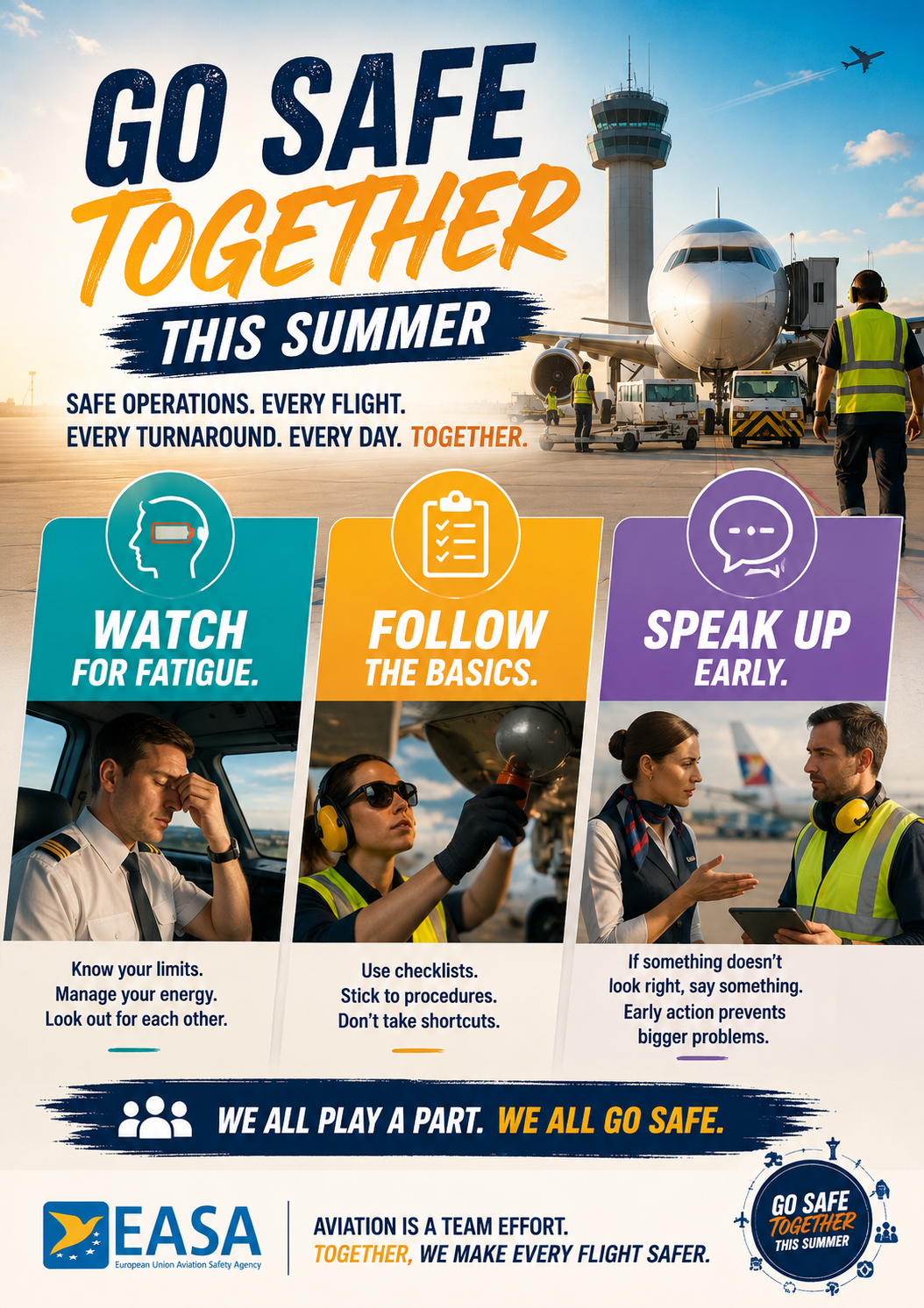
Go Safe This Summer — Together.
Please log in or sign up to comment.