
You don't have to go near an aircraft to influence the safety of a flight.
From selling tickets and managing passenger requests to planning schedules and allocating resources, everyday business decisions can have significant consequences for operational safety.
But how well do the people making those decisions understand their contribution to safety? And how effectively do we involve them in our safety management activities?
In this article from the Conversation Aviation Magazine, Gemma, who works in Operations Control at our fictional airline Safewings, explores why creating safe operations requires us to look beyond traditional operational departments and connect people, decisions and information across the entire organisation.
Understanding the Risk Challenge from Other Parts of the Business
The phone always rings in Operations Control.
- A passenger with a complex medical condition needs to travel.
- A last-minute seat change has been approved.
- Special assistance hasn't arrived.
- The flight is already boarding.
- The cabin crew have questions.
- The dispatcher needs a decision.
- The airport has changed the gate.
- The turnaround is running late.
Suddenly, everyone is looking at Operations Control for an answer. But by the time the phone rings, many of the decisions that influence the safety of the flight have already been made.
Safety Is Everyone's Business
When we think about operational safety, we often think about pilots, cabin crew, controllers, engineers and ground handlers. But many of the decisions that influence safety happen much earlier and often in departments that don't traditionally see themselves as part of the operational safety system.
Sales teams decide what products and services are offered. Customer service teams manage passenger requests. Commercial teams make decisions about schedules and turnaround times. Human resources teams influence staffing. Airport teams manage gate allocations. Special assistance providers coordinate support for passengers who need additional help.
Individually, none of these decisions may appear safety-critical. Collectively, however, they can fundamentally change the operational picture and when all those decisions finally converge, they often converge in one place: Operations Control.
The challenge is helping everyone understand that their decisions can influence the safety of a flight, even if they never go near an aircraft.
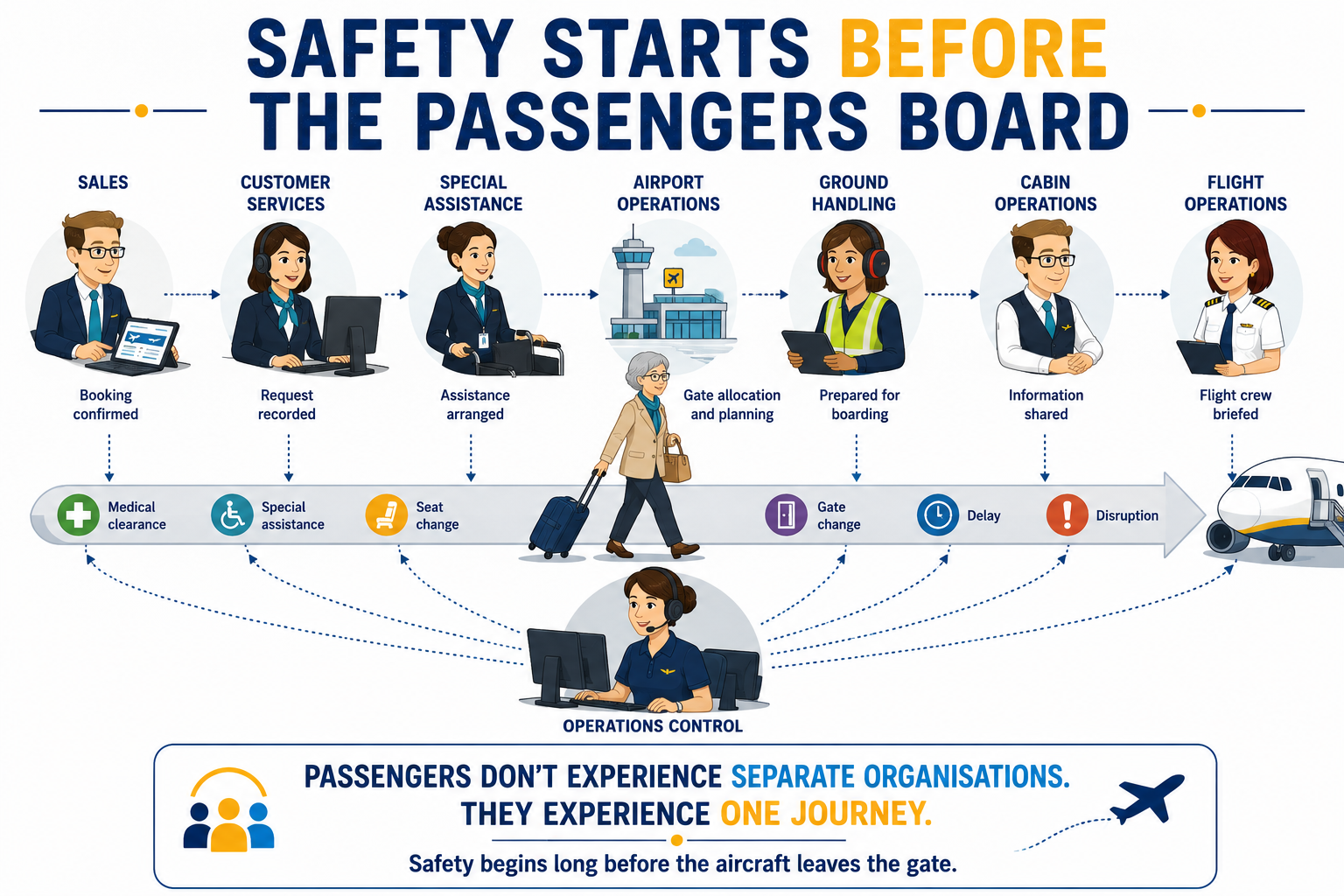
The Invisible Safety Chain
Consider a passenger with a complex medical condition. The ticket is sold, a request for assistance is submitted and information is transferred between different systems. Ground staff prepare for boarding, cabin crew receive information and the flight crew are briefed. Operations Control coordinates any changes.
Now add a few more variables.
Perhaps there isn't just one passenger requiring additional assistance, but a group of ten. Perhaps the right information isn't transferred and a special assistance request doesn't reach the gate. Perhaps a last-minute aircraft change alters the seating configuration. Perhaps nobody confirms that an important message has been received.
None of these situations is particularly unusual. They are the kinds of challenges that people manage every day across the aviation system.
The challenge is that modern aviation operations are highly interconnected. A single passenger journey can involve airlines, airports, ground handlers, customer service teams, special assistance providers, dispatchers, cabin crew, flight crews and Operations Control.
Each team may be doing exactly what it is supposed to do, based on the information available to it. But does anyone have the complete picture?
Risk doesn't necessarily arise because one person makes a mistake. It can arise when a series of perfectly reasonable decisions become disconnected from one another.
Building Resilience Before We Need It
Periods of operational disruption often make these situations more challenging.
Winter weather, the busy summer season or other unexpected events can lead to aircraft substitutions, delays, last-minute gate changes and stretched resources. The entire operational system becomes less predictable.
Under pressure, even relatively small communication failures can become much more significant.
The answer isn't simply to ask people to work harder. Resilient organisations don't expect frontline teams to solve every problem themselves. Instead, they build systems that support people when operational complexity increases.
Resilient organisations do the following things:
- Create clear processes for sharing information and confirming that important messages have been received.
- Make sure that different departments understand how their decisions affect others.
- Design procedures that remain practical when operations become disrupted.
- Create enough flexibility within the system to absorb change without transferring all the pressure to the people at the sharp end.
These are things we need to put in place when the operation is running well, rather than trying to develop solutions when everyone is already under pressure.
Resilience Isn't Built in Operations Control Alone
There is something I've learned over the years: by the time Operations Control becomes involved, many of the important decisions have already been made.
Operations Control plays an important role in managing disruption, but it also reveals how much resilience already exists across the organisation.
Has the right information been shared? Have the operational consequences been considered? Do different departments understand how their decisions affect the wider operation? Do the right people have the information they need to make good decisions?
These are organisational questions, not just operational ones. Answering them before disruption occurs is one of the most important things an organisation can do.
For those working in safety management, this also means looking beyond the traditional operational departments. When was the last time we had a conversation about safety with our colleagues in sales, customer service, commercial planning or human resources?
Do we understand the challenges they face? And do they understand the operational consequences of some of the decisions they make?
Those conversations can help us identify risks and opportunities for improvement that might otherwise remain invisible.
Six Questions Every Organisation Should Be Asking
Whether you're preparing for winter, the busy summer season or simply looking to improve the resilience of your everyday operation, take some time to consider these six questions:
- Who influences safety? Which departments make decisions that influence operational safety?
- Do people understand their role? Do those departments understand their contribution to the wider safety system?
- How does information flow? How is safety-related information transferred between departments, organisations and systems?
- Where are the gaps? Where could important information be lost, misunderstood or not acted upon?
- Where does the pressure go? Which decisions create additional workload or operational complexity for other teams?
- Can people make informed decisions? Does Operations Control, and everyone else involved in delivering the operation, receive the right information at the right time?
Don't just answer these questions within the Safety Department. Bring the different teams together and explore the answers with them.
You might be surprised by what you learn about your own organisation.
Working Together When It Matters Most
The safest organisations don't simply react to problems. They recognise that safety begins long before an aircraft pushes back from the gate.
From a passenger's perspective, there is no distinction between an airline, an airport, an assistance provider, a ground handler or an operations centre.
There is simply one journey, their journey. The challenge for us all is ensuring that our organisations work in the same way.
Not as separate departments handing work from one team to another, but as a connected system designed to support people, share information and adapt when things change.
Passengers experience one journey. That journey is only as safe as the conversations, decisions and relationships that connect us all.
Take the Conversation Beyond the Safety Department
Think about a department in your organisation that influences operational safety but isn't regularly involved in safety discussions.
Arrange a conversation with them. Explore how their decisions affect the operation, what challenges they face and how you could work better together.
Remember, it's not about giving everyone another safety task. It's about helping people understand how the work they already do contributes to safe operations.
How does your organisation involve people outside the traditional operational departments in safety management?
Share your experiences and join the conversation in the comments below.
This article was adapted from Conversation Aviation 3-2026, EASA's Winter Safety edition.
Go Safe Together - When It Matters Most.
Please log in or sign up to comment.