
The Hidden Risk of Success: When Safety Looks Easy
Good safety performance is something to celebrate. But could it also make us less aware of the people, systems and everyday actions that keep us safe?
In this article from Conversation Aviation, Milena, CEO of our fictional airline Safewings, explores why strong safety performance should never become a reason to reduce our attention to safety and why understanding what makes operations safe is just as important as understanding what goes wrong.
These articles are designed for anyone in aviation to reuse them in their own safety promotion.
By Milena, CEO, Safewings
At Safewings, we've had another good year. Our operation is growing, our people are delivering, customers are choosing to fly with us and, most importantly, we continue to operate safely.
It's a situation many aviation organisations will recognise. Good operational performance and good safety performance are things we should rightly celebrate.
I don't see business performance and safety performance as competing priorities. A safe airline is the foundation of a successful airline; but success brings its own risk.
When serious accidents are rare and our safety performance is strong, it becomes very easy to believe that everything is working exactly as it should.
That's when we need to be at our most vigilant.
The Success Paradox
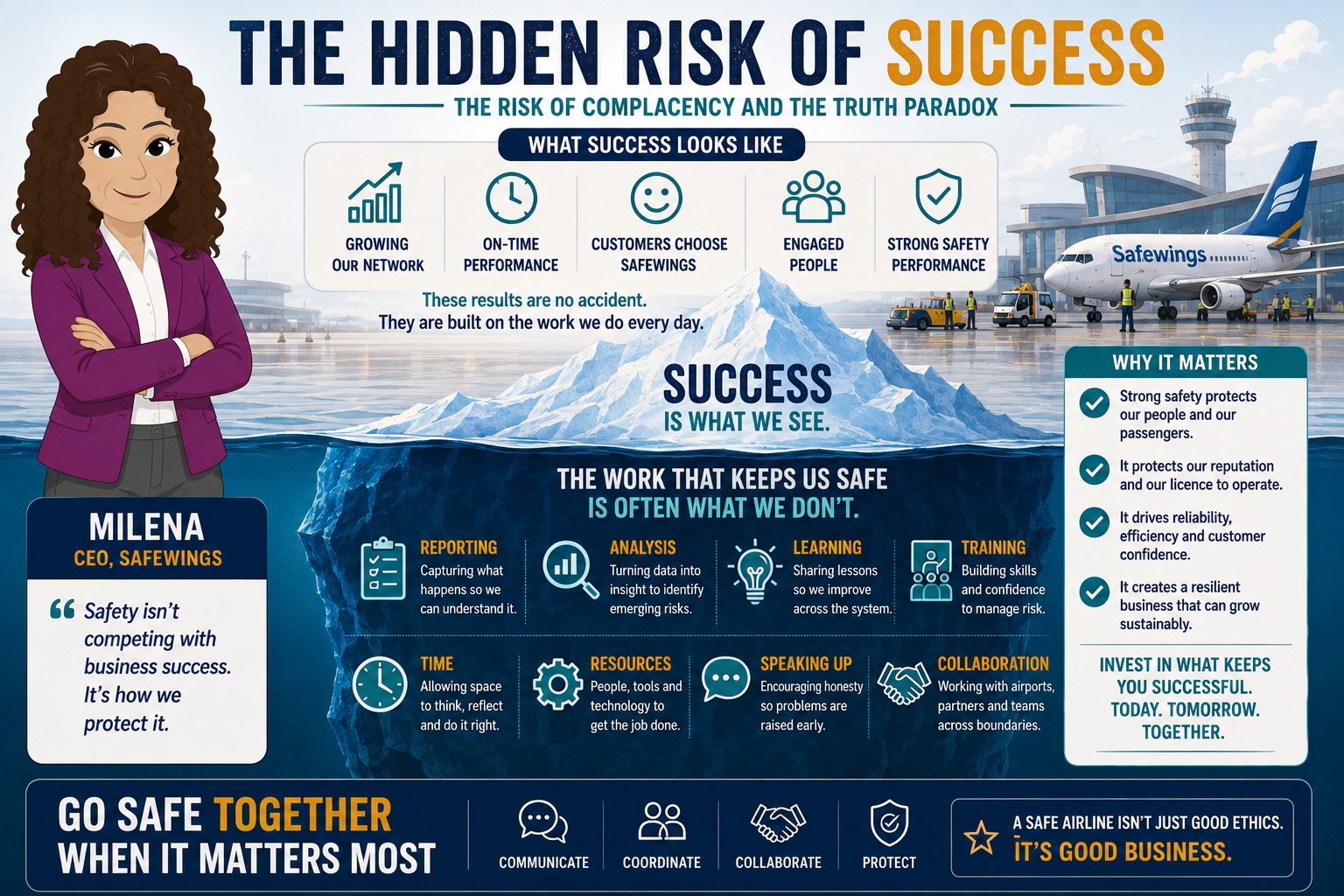
There is a strange paradox in aviation safety: when safety works, very little happens. There is no accident. No damaged aircraft. No serious injury. No disruption splashed across the news. That's exactly the outcome we want.
Conversely, it also means that much of the work that created that outcome could become less visible.
The occurrence that was reported and investigated. The trend somebody spotted in the data. The difficult conversation with a supplier. The procedure that was changed. The extra training. The safety action that prevented something happening months or years later.
Success can, therefore, create the conditions for complacency:
"We're safe. Why do we need to keep spending so much time on safety?"
For me, the question should be exactly the opposite:
"We're safe. What are we doing that is helping to keep us that way?"
Safety Is Productive Work
This matters when we talk about resources.
Safety teams across aviation are being asked to do more. New regulations arrive; new technologies create opportunities and risks; operations grow; data increases; and organisations change.
It would be tempting to respond by simply adding another task, but there are still only so many hours in the working day.
If we want our safety people to analyse reports properly, understand why events happen, identify emerging risks, engage with operational teams and work with other organisations, we need to give them the time to do it.
Critically, that isn't time taken away from running the business or operation. It must be a fundamental part of it. The same applies beyond the Safety Department.
A pilot taking time to write a useful occurrence report, an engineer stopping to investigate something unusual, a manager joining a safety review or a ground handler raising a concern are all contributing to the resilience of the operation.
Safety isn't an additional activity we perform when the "real work" is finished.
Safety is part of the real work, for everyone, every day. Don't measure safety only by what didn't happen but by the risks that we have effectively managed. This is where leadership matters.
If our only measure of safety is the absence of accidents, we can easily reach the wrong conclusion.
No Accidents Does Not Mean No Risk
No accidents certainly doesn't mean there is nothing left to learn and that all our risks are effectively managed. A healthy organisation should still be finding things to learn from.
People should still be reporting mistakes, hazards and weak signals. Investigations should still challenge assumptions. Safety reviews should still uncover uncomfortable questions.
In fact, I become more concerned when everything looks perfect.
A strong safety culture doesn't necessarily produce a clean dashboard. Sometimes it produces more information about where the organisation is vulnerable; that's useful information.
The Truth Is Valuable Even When It's Inconvenient
As CEO, I need people to tell me what is really happening in our operation. Not what we hope is happening. Not what the procedure says should be happening. And not simply what makes the performance dashboard look good.
That means creating an organisation where people can raise concerns, report mistakes and challenge decisions without believing that delivering uncomfortable information makes them the problem.
It also means being willing to hear that something needs more resources, more time or a different approach.
That doesn't mean every safety request automatically receives unlimited resources. Every organisation has to make choices. Those choices should, however, be informed by a genuine understanding of the risk, not by the assumption that yesterday's success guarantees tomorrow's safety.
Invest in What Keeps You Successful
Perhaps the biggest danger of a good safety record isn't complacency itself. It's forgetting why the record is good.
Our procedures, reporting systems, training, safety specialists, operational expertise and willingness to learn all contribute, but ultimately, it comes back to people. People noticing. People reporting. People asking difficult questions. People being given enough time to understand the answers. And leaders listening when they do.
That is not safety competing with business success. That is safety protecting it.
What Does This Mean for Your Organisation?
Good safety performance is worth celebrating, but it should also make us curious about what's working and why.
Here are three questions to take into your next safety meeting:
- What are we doing today that is actively helping to keep our operation safe?
- Are we giving people enough time and support to report, investigate, learn and improve?
- If our safety performance looks good, how confident are we that we're seeing the whole picture?
We'd love to hear your thoughts and experiences. How does your organisation recognise and support the everyday work that creates safety?
Join the conversation in the comments below. This article was originally published in Conversation Aviation 3-2026, EASA's Winter Safety edition.
Please log in or sign up to comment.