Could you provide the link with the reference to have this document please???
Join a community to be part of the discussion.
Renaud Brehat commented on a post in Rotorcraft

Good morning,
The french rotorcraft flight safety network just finished a double-sided leaflet for people welcoming helicopters. The first part is in this post and the second one in the next post. The objective is to help people (as firefighters) welcoming helicopters to ensure a safe arrival and departure. The leaflet is in French but I hope it could still help.
PS : the quality is not perfect (normally it is a PDF file)
Could you provide the link with the reference to have this document please???
Sergio Romero commented on a post in Rotorcraft
Second part

Fulfilling requirements is not only a MUST, but a guarantee to operate safe!!!
John FRANKLIN created a topic in Rotorcraft
Antony Delclos posted in Rotorcraft
Second part
Antony Delclos posted in Rotorcraft
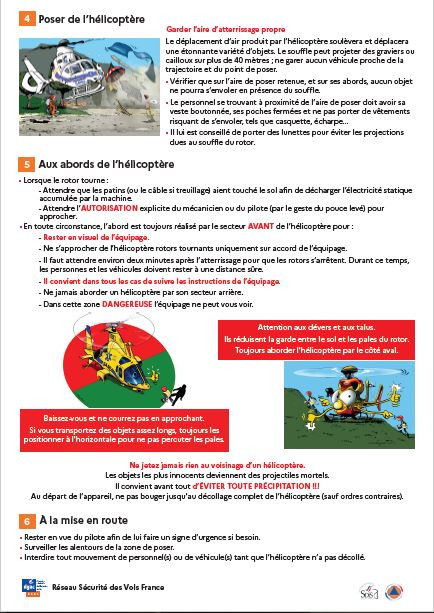
Good morning,
The french rotorcraft flight safety network just finished a double-sided leaflet for people welcoming helicopters. The first part is in this post and the second one in the next post. The objective is to help people (as firefighters) welcoming helicopters to ensure a safe arrival and departure. The leaflet is in French but I hope it could still help.
PS : the quality is not perfect (normally it is a PDF file)

John FRANKLIN created a topic in Air Operations
Thomas Dietrich commented on Renato Cortelletti's topic in General Aviation

Renato, your post is now out for a week and no comments. That should make you think!
Jose Coutinho posted in Air Operations
Hi,
I am from Brazil and I am glad to be here.
SIVASANKAR G A created an event in General Aviation
Michel MASSON commented on Michel MASSON's topic in Rotorcraft

Thanks. Olivier.
These articles are not limited to EASA Europe and can be accessed worldwide.
Thanks for raising attention on the egafor project.
Several VFR flight-planning and navigation and weather info apps are available today, like Skydemon (without publicity) for instance.
One issue with weather info is imperfect radar coverage. Consequently, the reality can be worth than the weather picture shown on the screen.
Another issue is that weather forecast can be wrong, hence the necessity to get weather updates during the flight and to carry enough fuel. See for instance: https://www.easa.europa.eu/community/topics/lessons-learned-episode-6-w…
AOPA Weather, among other reference websites, provides a weath of good advices to GA pilots and instructors.
Mike B commented on a post in General Aviation

Good day everyone. I have a question about national registration services. In the UK, the CAA database is openly accessible to any enquirer (through its G-INFO search facility). I am trying to find the whereabouts of an aircraft I used to own - now on the Polish Register but cannot find a way to access the information. Is there an EASA protocol about access to national databases of aircraft details and ownership?

G-info - nice tool. But I never heard about similar concern PL reg. Try to contact: https://www.ulc.gov.pl/en/contact/9-for-clients
Bob Oliver posted in General Aviation
Good day everyone. I have a question about national registration services. In the UK, the CAA database is openly accessible to any enquirer (through its G-INFO search facility). I am trying to find the whereabouts of an aircraft I used to own - now on the Polish Register but cannot find a way to access the information. Is there an EASA protocol about access to national databases of aircraft details and ownership?
Steve Hutt posted in General Aviation
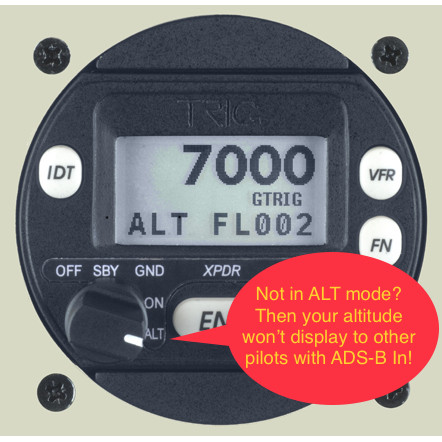
https://airspace4all.org/not-in-alt-mode-not-transmitting-ads-b-altitud…
If you have a Mode S ES transponder with connected GPS correctly configured to broadcast ADS-B Out you may not be aware that if you deselect ALT mode then the transponder will NOT include your altitude in the ADS-B data stream.
That means any other pilots equipped with ADS-B In Electronic Conspicuity devices will NOT get traffic alerts if your flight path conflicts with theirs.
John FRANKLIN commented on John FRANKLIN's topic in Air Operations

Thanks for the positive comment, feel free to share it with anyone you think would find it useful.
Kyriakos Kourousis posted in Air Operations
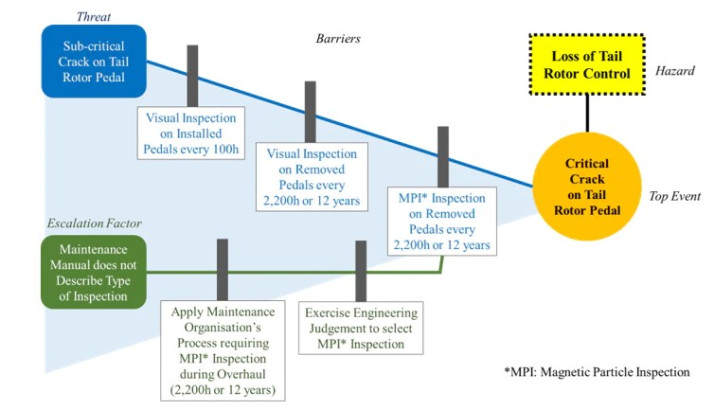
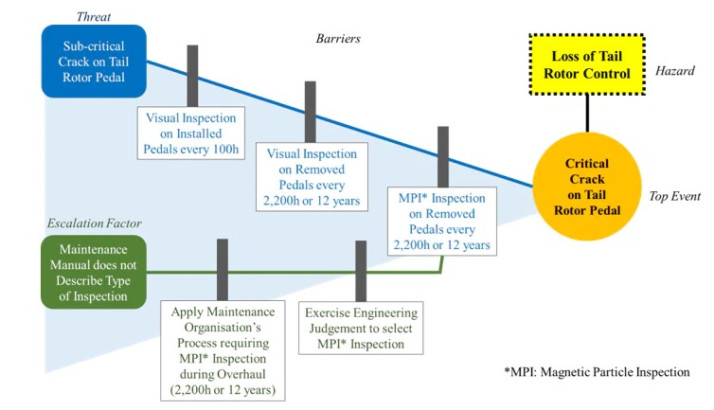
The Bowtie Methodology as a Meta-Analysis Tool for Aviation Accident Investigation Reports
https://www.aviationpros.com/aircraft/article/21158951/the-bowtie-metho…
Kyriakos Kourousis posted in General Aviation
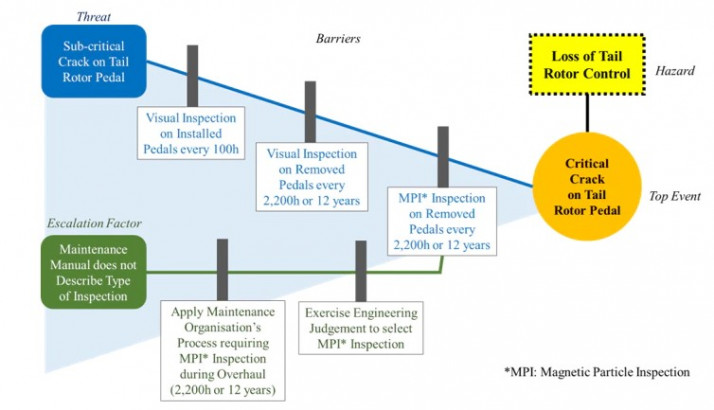
The Bowtie Methodology as a Meta-Analysis Tool for Aviation Accident Investigation Reports
https://www.aviationpros.com/aircraft/article/21158951/the-bowtie-metho…
Kyriakos Kourousis posted in Rotorcraft
The Bowtie Methodology as a Meta-Analysis Tool for Aviation Accident Investigation Reports
https://www.aviationpros.com/aircraft/article/21158951/the-bowtie-metho…
John FRANKLIN created a topic in Air Operations
Peter Holt commented on Peter Holt's topic in General Aviation
Jyrki, yes, spot on. The phrase "cleared to [destination airport]" is indeed widely used.
The discussion then gets more involved. Funnily enough the UK stopped using this phrase some years ago, and documented the change. I can't tell you where to find it though. They said they stopped using it because of this very issue: if a route has any OCAS segments, then the phrase is obviously an empty one.
Last week I departed from Aosta LIMW to Shoreham EGKA. LIMW was VFR-only so I got the IFR clearance from Geneva, as I was climbing out of the Alps around FL130. And it said the classic words "cleared to Shoreham" which made me smile because once London Control drop out out of CAS you are in Class G, your flight plan is binned (in the practical sense of IFPS distribution along the filed route; the destination only has still got it) and you are definitely not cleared to go anywhere then :)
There is definitely a problem with FP distribution in the UK, if a route contains Class G segments. AIUI, IFPS *always* transmits a validated filed FP to the country concerned (I was told this by an IFPS employee). Even a trivial (and practically meaningless) one like EGKA-EGMD 2000ft, which validates, gets transmitted by IFPS to, I believe, LTCC.
The problem starts somewhere later.
LTCC then looks at whether it is wholly in CAS and if so (Class G at the two ends is acceptable) it distributes it along the route, and you get the normal IFR coordination.
If it is not wholly in CAS (like the EGKA-EGHE one at the top) then it works with the first unit (Solent, a.k.a. EGHI) and when the route passes into Class G after Solent, the distribution ends. I know this for a fact because I have asked the various succeeding units if they have it.
LTCC seems to be using some algorithm, or a human procedure, for limiting the distribution in this way. It may have been done to ensure that the traffic actually flying that route is forced to negotiate a fresh clearance. Another aspect, which may or may not be relevant, is that the UK blocked the Autorouter (an electronic route generator / FP filing tool) from messaging pilots with the Eurocontrol-allocated txp code; the only explanation I can think of for this is again to force pilot-ATC interaction for CAS entry. Well, there is another explanation which is that setting a Eurocontrol txp code prevents the CAIT (infringement detection) software working :)
This main topic has come up many times on pilot forums but one can never find a UK ATCO commenting usefully. They have all signed the Official Secrets Act but really somebody in the "system" ought to know what is going on and more relevantly whether there is any will to fix it.
Elsewhere in Europe, and to a large degree in Scotland, if you go into Class G you can pick up the clearance later and the ability to do so is assured.