
Promoted in the EASA Community Rotorcraft to raise awareness and further disseminate the safety message.
How To Stay Safe Around Yorkshire Air Ambulance Helicopters, May 2026
The Yorkshire Air Ambulance has launched a campaign aimed at raising public awareness of helicopter safety.
As part of this initiative, the charity released a video featuring aviation team members who highlight the serious risks associated with being too close to a helicopter during take-off and landing:
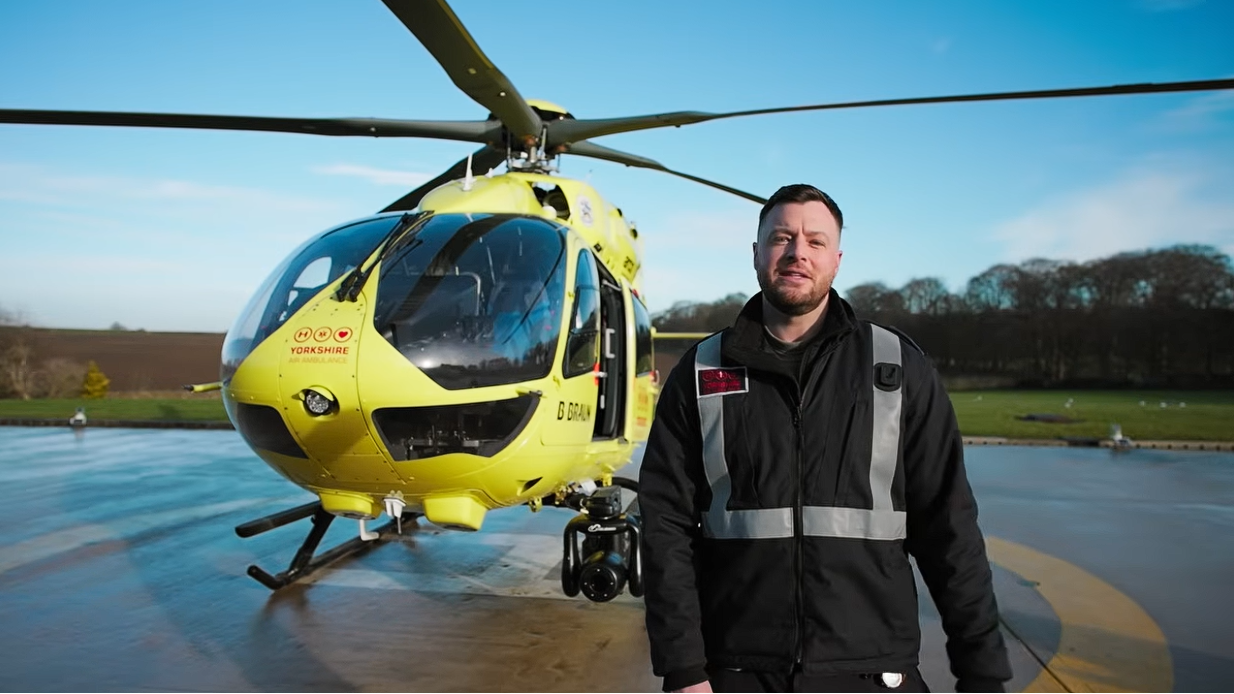
How To Stay Safe Around Yorkshire Air Ambulance Helicopters.
Trigger: a serious near miss event
The campaign was launched in May 2026 following a dangerous incident in Rotherham, South Yorkshire, England.
A child threw a stone at the helicopter, narrowly missing rotor blades, then ran underneath the aircraft during take-off.
The situation posed extreme danger to the public, crew, and aircraft and was reported to police.
This triggered a proactive safety response: a public education campaign and video.
Campaign objective
The video “How To Stay Safe Around Yorkshire Air Ambulance Helicopters” aims to:
- Educate the public about safe behaviour near helicopters
- Address common but underestimated risks
- Reduce preventable hazards during critical emergency operations
Key hazards highlighted
1. Rotor blades
- High-speed blades are invisible and lethal at close range
- Even small objects (stones, debris) can cause catastrophic damage
2. Rotor downwash (the biggest hidden risk)
- Powerful airflow can knock people ove and lift debris and turn it into projectiles
- Injuries have occurred to pedestrians even within approximatively 30 m of landing sites due to downwash
3. Reduced pilot visibility
- Pilots have limited visibility below and around the aircraft
- People entering the landing zone may not be seen at all
4. External hazards (growing concern)
- Drones
- Laser pointers
- Objects thrown toward the aircraft
All can disrupt flight in safety-critical phases: take-off or landing.
Core safety messages to the public
The campaign emphasises simple but critical behaviours:
- Keep your distance (well clear of landing zone)
- Never approach unless instructed by crew
- Supervise children closely
- Keep dogs on leads
- Do not fly drones nearby
- Do not throw objects or use lasers
- Be aware debris can become airborne
- Respect patient privacy during incidents
References
Yorkshire Air Ambulance Launches Safety Campaign After "near Miss"
Consider also this EASA and ESPN-R material:
Welcoming Helicopters - Advice to Ground Personnel | EASA Community
Avoiding Collisions with Rotor Blades | EASA Community
Off-Site Landings - Part 1 - Planning and Preparation | EASA Community
Off-Site Landings - Part 2 - Recce | EASA Community
Off-Site Landings - Part 3 - Manoeuvring in the Landing Site | EASA Community
Off-Site Landings - Part 4 - Departure, Take-off and Climb Procedures | EASA Community
ESPN-R Mission Request Vade Mecum (Go with Me) | EASA Community
Please log in or sign up to comment.